

When we decided to celebrate our fifth wedding anniversary, I expected the usual: a bottle of wine, perhaps a sentimental card, and a quiet conversation about the years we had shared. Mark had suggested a high-end French bistro, a place we had been talking about for months. I spent the afternoon preparing, feeling a rare sense of optimism that our recent, strained dynamic might be softening. We had been arguing about money, specifically his newfound obsession with ‘fiscal transparency,’ but I thought tonight would be an oasis.
As I sat across from him, sipping my sparkling water, the air felt heavy. Mark wasn’t looking at me with affection. Instead, he was fidgeting with a leather portfolio. The waiter hovered nearby, waiting to take our drink order, but Mark waved him away with a sharp flick of his wrist. ‘We need to settle some things before we eat,’ he said, his voice devoid of any festive warmth. I felt a cold knot tighten in my stomach, a familiar sensation whenever the topic of our finances came up.
I didn’t realize until that moment that my life was about to be partitioned into line items. He reached into the portfolio, pulled out a stack of papers bound with a heavy binder clip, and slid them across the white tablecloth with the precision of a litigator. It wasn’t a menu. It wasn’t a gift. It was a ledger, printed in a tiny, dense font, titled ‘Expense Reconciliation: 2019-2024.’ My heart hammered against my ribs, a warning signal I ignored at my own peril.
The moral dilemma here wasn’t just about money; it was about the fundamental erosion of partnership. In marriage, we operate under the assumption of a shared life, a collective effort to build something greater than the sum of our parts. To see that reduced to a transactional tally—down to the exact cost of a half-gallon of milk from three years ago—felt like a spiritual autopsy. I was looking at the man I loved, and all I could see was an auditor.
In the following sections, I will break down how we reached this point, the horrifying contents of that ledger, and the exact moment I realized I had to walk out into the cold night air, leaving him with his receipt and his empty seat. This isn’t just a story about a broken dinner; it is a story about the death of intimacy in the face of calculated greed.
The Ledger of Our Shared History
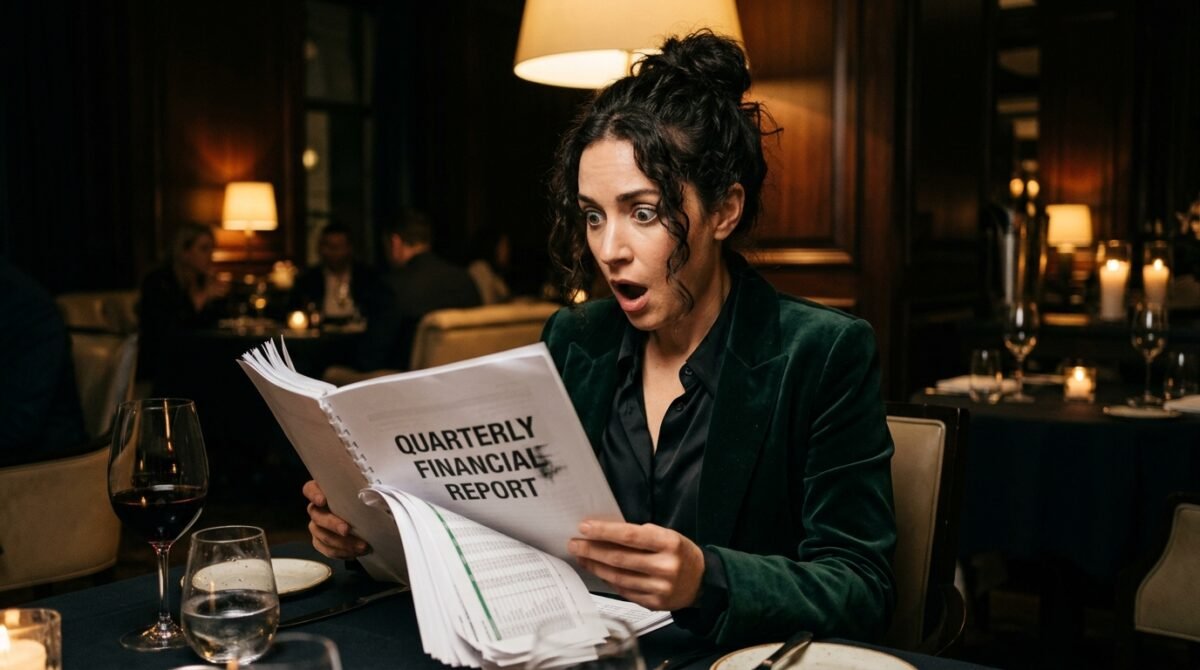
The ledger began with a date: June 12th, 2019, our first month living together. It detailed every grocery run, every restaurant tip, and every utility bill split by exact percentage. As I scanned the columns, I realized he had been tracking everything since day one. There were notes in the margins about ‘excessive produce usage’ and ‘unauthorized snack purchases’ that I apparently owed him for. It was a digital map of his resentment, laid out for me to witness on our anniversary.
I looked up at him, my hands trembling. He was watching me, waiting for a reaction, perhaps expecting me to be impressed by his meticulous bookkeeping. ‘What is this, Mark?’ I whispered. He didn’t blink. He simply adjusted his glasses and started explaining the methodology behind his calculations. It was as if he were presenting a quarterly earnings report to a board of directors, not speaking to his wife on a night meant to celebrate our union.
“I thought we agreed that we needed to be more responsible. I took the time to calculate every shared expense. You owe me exactly $14,293.42, factoring in interest on the initial apartment deposit.”
— Mark, during the dinner
The audacity of it was staggering. He had calculated interest on our own living expenses. It wasn’t just that he wanted the money back; he wanted to treat me as a debtor, a subordinate to his financial sovereignty. I looked at the totals. The sheer pettiness of tracking a $4.50 bag of spinach from 2021 made my head spin. I felt like a stranger in my own life, being audited for the crime of participating in our marriage.
I looked at the waiter, who had returned and was now standing awkwardly a few feet away, sensing the tension. I felt the heat rising in my cheeks, a mixture of shame and boiling rage. The restaurant, filled with the hum of happy couples and clinking glasses, suddenly felt like a prison. I hadn’t come here to be bankrupt; I had come here to be loved.
The Myth of the Shared Household
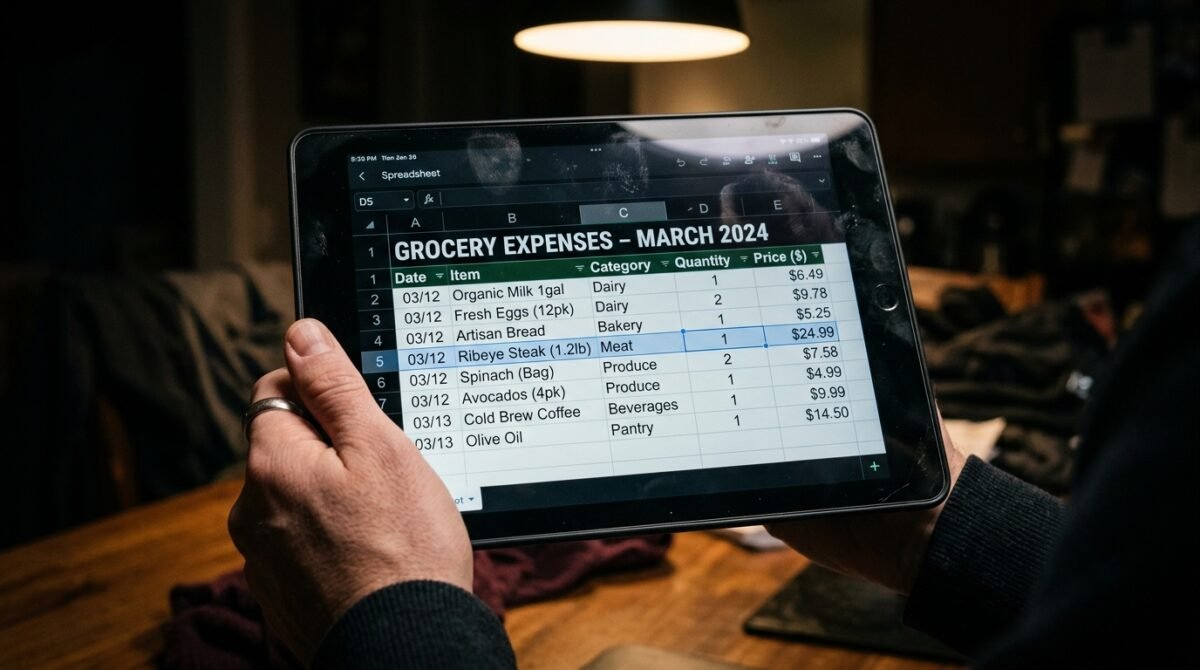
Our financial arrangement had always been simple: we split the rent 50/50, and we took turns buying groceries. There was never an official contract. It was a standard, trusting approach for two working professionals. Or so I thought. Apparently, Mark had been keeping a shadow book, a secret record where he adjusted the math to his advantage. He had decided that my habit of buying organic produce was a ‘luxury’ he shouldn’t have to subsidize, despite him eating every single meal I prepared.
He explained that for the past two years, he had been keeping this ‘reconciliation’ file as a way to ensure ‘equity.’ He genuinely believed that he was the victim of a financial imbalance, despite me handling the cleaning, the home repairs, and the majority of our social planning. To him, those things had no value because they couldn’t be quantified in a spreadsheet. He had reduced our life to a series of debits and credits.
“You spent $300 more on groceries than I did in 2022. I adjusted that for inflation and added the interest since it was technically my savings that covered the initial grocery account. It’s only fair, right?”
— Mark, justifying the invoice
I realized then that he had never viewed us as a team. He had viewed us as two competing entities, and he had been playing the long game to ensure he didn’t lose a single cent. The realization was colder than the water in my glass. I had been planning a future, buying furniture, and envisioning a family, while he was calculating the cost of my existence in his home.
The disconnect was total. Every time I had suggested we combine our accounts to make things easier, he had refused, claiming he wanted to ‘maintain his independence.’ Now, I understood what that independence really meant. It meant he wanted to be able to invoice me for the coffee I drank in the morning. It was a control tactic, pure and simple, designed to make me feel small and indebted.
The Breaking Point at the Bistro

When the waiter asked if we were ready to order, I finally found my voice. ‘No,’ I said, standing up. The sound was louder than I intended, and several tables turned to look. Mark looked annoyed, gesturing for me to sit back down. He still didn’t understand the gravity of what he had done. He thought this was a negotiation, a debate we could win or lose based on who had the better data. He didn’t realize the relationship was currently bleeding out on the tablecloth.
I picked up the binder clip, folded the papers, and placed them back on his side of the table. ‘I hope you enjoyed the audit, Mark, because it’s the last one you’re ever going to conduct on me.’ He looked genuinely confused, as if I had just rejected a sensible business proposal. ‘Don’t be dramatic,’ he muttered, checking his watch. ‘We have a reservation, let’s just eat and discuss the payment plan later.’
“You really think we’re going to discuss a payment plan? I’m done. I’m done with the tracking, the counting, and the spreadsheets. You want your money? Take the apartment. I’m leaving.”
— My response to Mark
I left him there with his invoice and his half-ordered bottle of wine. I walked out into the cool night air, my heart racing not with fear, but with a sudden, overwhelming sense of liberation. I took a cab to my sister’s house, and for the first time in five years, I didn’t worry about whether I had exceeded my ‘budgeted’ travel expenses for the month. I was finally off the clock.
As the cab pulled away, I looked back at the restaurant window. He was still sitting there, alone, staring at the papers. He looked small. He looked pathetic. And for the first time, I felt nothing but relief that I had walked away before the appetizers arrived.
The Digital Paper Trail of Resentment
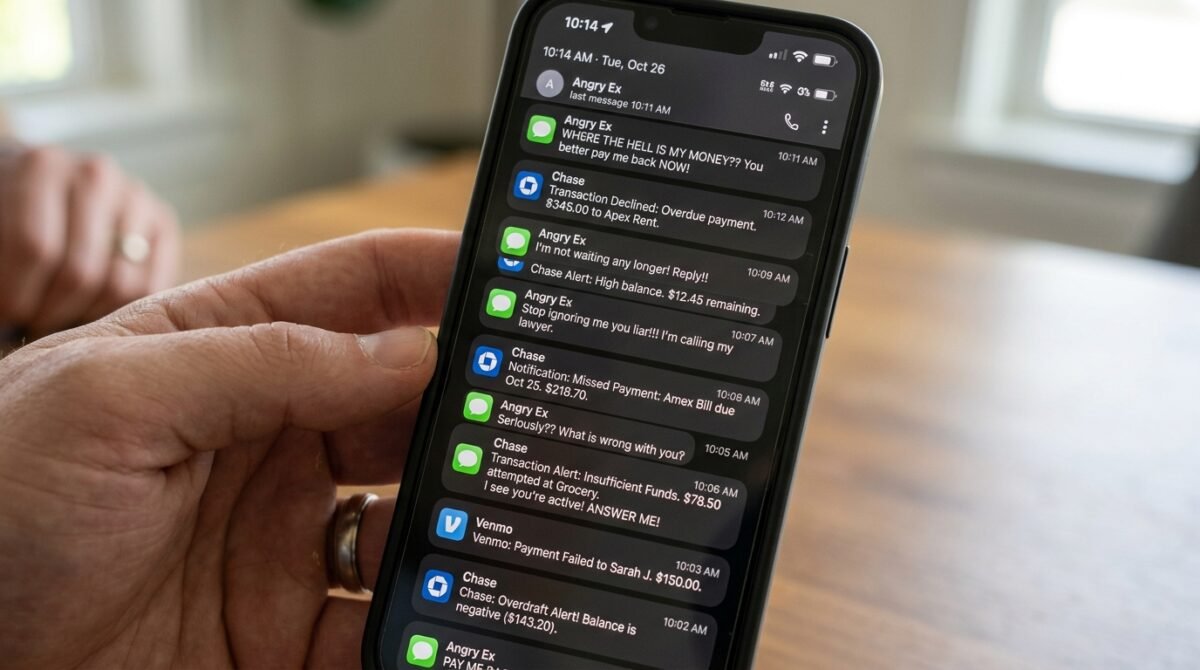
The next morning, my phone was a graveyard of notifications. Mark had sent me no less than forty-two text messages. Most of them were screenshots of bank transfers and receipts, accompanied by demands for ‘immediate reimbursement.’ It was a frantic, desperate attempt to reclaim the control he had lost the moment I walked out. He wasn’t mourning the marriage; he was mourning the debt.
“You cannot just walk out on a contract. The ledger is legally binding as an admission of debt. If you don’t send the first payment of $2,000 by Friday, I am taking this to small claims court. I have every receipt for every loaf of bread since 2019.”
— Mark, via text message
I didn’t respond. I had already spoken to a lawyer who laughed at the notion of an ‘admitted debt’ based on a self-made spreadsheet of grocery expenses. The irony was almost too much: he had spent years documenting my supposed financial failures, only to provide the evidence of his own emotional abuse. It was all there—the timestamped, quantified, and itemized proof that he had been systematically devaluing our marriage to a transaction.
My sister helped me draft a single, final response. I didn’t address the money. I addressed the reality. I told him that if he wanted to pursue this in court, he was more than welcome to, but he would also have to account for the labor I had provided, the domestic support, and the emotional toll his ‘audits’ had taken on my mental health. I never heard back about the small claims court again.
Reddit Weighs In: The Verdict

I posted my story on r/relationship_advice just to see if I was insane. The response was immediate and overwhelming. Thousands of people reached out, sharing their own stories of financial control and thanking me for leaving. It was a massive validation, a digital community of strangers confirming what I had known in my gut but had been too close to the situation to fully accept.
“This isn’t about groceries. This is financial abuse, plain and simple. He wasn’t looking for a fair split; he was looking for a way to own you. The fact that he brought a spreadsheet to an anniversary dinner shows exactly where his priorities lie. You didn’t walk out of a dinner; you walked out of a prison.”
— u/FinancialFreedomSeeker (Top Comment, 32.1k upvotes)
The comments were a mixture of outrage and support. Many users pointed out the ‘sunk cost fallacy’—how I had stayed so long because I thought I could ‘fix’ the money issues. Others warned me about his potential for retaliation, advising me to document every interaction from here on out. It was a masterclass in collective wisdom, and it gave me the strength to proceed with the divorce.
There were a few contrarians, of course, claiming that ‘fair is fair’ and that I should have paid my share. But those voices were quickly drowned out by the sheer volume of people who understood that a relationship isn’t a business partnership. A marriage requires trust, and once trust is replaced by an invoice, the marriage is already dead.
The Silence of the Empty Apartment

Going back to the apartment to collect my things was the hardest part. Mark wasn’t there, which was a blessing. I walked through the rooms we had decorated together, seeing the history of our five years in every object. The dining table, where I had cooked so many meals, was still there. It looked different now—clean, sterile, and devoid of the chaos of shared life.
I found the rest of his ‘ledgers’ in the home office. They were everywhere. Binders full of receipts, color-coded files for every year, and even folders dedicated to ‘potential savings’ if we switched to cheaper toilet paper. It was a obsessive, pathological need to control every variable. Seeing it all laid out like that, I felt a deep, profound sadness for the years I had spent trying to make sense of his madness.
I packed my clothes, my books, and the few items that were uniquely mine. I left behind the furniture we had bought together, not because I didn’t want it, but because I didn’t want anything that had been ‘accounted for’ in his books. I wanted a clean break. I wanted to start over in a place where the only thing measured was the space I had to grow.
As I closed the door for the last time, I didn’t look back. I realized that the heavy feeling in my chest, the one I had carried for years, had finally dissipated. I was no longer a debtor. I was just a person, free to define my own worth, independent of any spreadsheet or invoice.
Why the Sunday Dinner Table Went Completely Silent
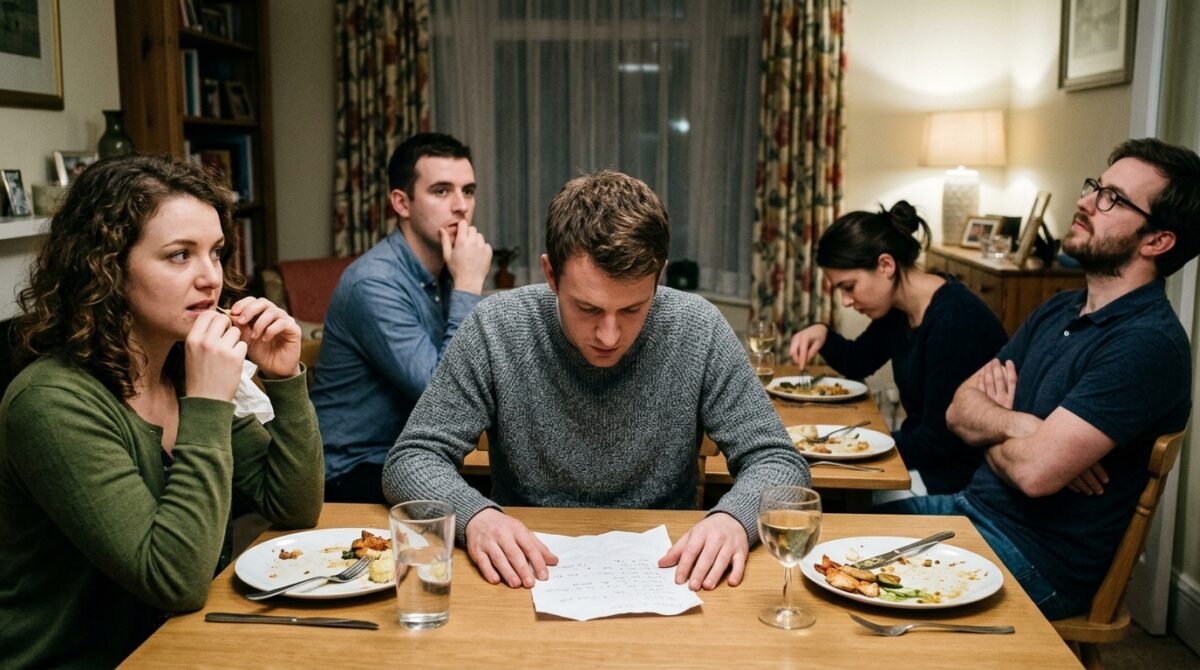
The fallout with our mutual friends was surprisingly swift. Mark had tried to spin the narrative, claiming I was ‘irresponsible’ and ‘fled the state’ to avoid paying my debts. He had invited some of our friends to dinner, intending to present his ‘case’ against me. When they refused to engage with his spreadsheets, he threw a tantrum that left everyone in stunned silence.
One of our friends, Sarah, later told me exactly what happened. She said Mark had started the dinner by complaining about the ‘financial burden’ of our marriage, but when he pulled out the ledger, the room went cold. They didn’t see a responsible husband; they saw a man who had treated his partner like a bank teller. The silence that followed wasn’t just awkward; it was a wall that he couldn’t break down.
“He sat there, waving a printout of the 2021 utility bills, and nobody said a word. We just looked at him like he was a stranger. He eventually went silent when he realized that none of us were on his side.”
— Sarah, recounting the dinner
It was validating to know that my perception of reality was shared by those who knew us. Mark had lived in a world of numbers for so long that he had forgotten how to interact with actual human beings. He had alienated everyone who cared about us, and in the end, he was left with nothing but his calculations.
I realized then that his need for control was a defense mechanism—a way to avoid the vulnerability required for a real relationship. By turning everything into a debt, he ensured that he never had to rely on anyone, and more importantly, that he never had to be truly known.
The Legal Reality Check

When the formal divorce papers arrived, they were accompanied by another document: a ‘settlement offer’ where he requested that I pay back half of the ‘shared household expenses’ for the last year. My lawyer laughed again. It was a desperate attempt to exert influence one last time. We filed our own response, detailing the emotional abuse and the record-keeping as evidence of his controlling nature.
The court wasn’t interested in his grocery receipts. They were interested in the division of assets, and since I had walked away from everything, the split was straightforward. I didn’t ask for a dime of his money. I didn’t want his savings, his retirement, or his precious spreadsheets. I just wanted my freedom. And that was something he couldn’t invoice.
The legal process was a relief. It was cold, formal, and objective—the exact opposite of the chaotic, manipulative environment Mark had created. For the first time, I felt like the rules were clear. I wasn’t being graded on my snack purchases; I was being processed as a person ending a contract. It was the closure I needed to move forward.
I spent those months focusing on myself, rediscovering hobbies I had neglected, and rebuilding my social life. I started going to therapy to process the trauma of the marriage and to understand why I had stayed as long as I did. It was a process of deprogramming, learning to trust my own judgment again and to see that a relationship is meant to be a partnership, not a transaction.
Reflecting on the Lost Years

Looking back, I see the red flags I missed. The early comments about how ‘important’ it was to keep finances separate, the way he would count the glasses of wine I had at dinner, the subtle pressure to always be the one to pay for ‘shared’ items. I had dismissed these as quirks, as signs of his ‘organized’ nature. I didn’t see them as the building blocks of a prison.
I learned that love shouldn’t feel like a debt. It shouldn’t feel like you’re constantly performing, being audited, or proving your worth through financial contributions. If someone is counting the cost of your existence in their life, they aren’t your partner; they are your landlord, and you are just a tenant in their world.
I’ve come to realize that my worth isn’t tied to how much I contribute to a spreadsheet. My worth is innate, independent of anyone else’s validation or accounting. It took a painful anniversary dinner to realize that, but I’m grateful for the clarity. I’m grateful that I walked out when I did, before I lost any more of myself to his tally.
I’m in a much better place now. I’ve learned to set boundaries, to trust my intuition, and to recognize the signs of control before they escalate. And I’ve learned that sometimes, the best way to win is to simply walk away from the table.
The Aftermath: Moving Forward

It’s been a year since that night. I live in a quiet apartment, and I buy exactly the groceries I want, when I want them, without checking a spreadsheet. I don’t think about Mark anymore. The anger has faded into a distant memory, replaced by a sense of peace that I never thought I could achieve. I’ve started dating again, and the contrast is stark. I’m with someone who doesn’t track my coffee usage or my restaurant choices. It’s a joy to be in a relationship where I’m seen as a partner, not a financial variable.
I keep the invoice in a drawer, not because I want to look at it, but as a reminder. A reminder of what I survived and a reminder of why I’ll never settle for less than true partnership again. It’s a piece of paper, nothing more, and it has no power over me. I’m the author of my own life now, and I’m making sure the next chapter is a lot more balanced than the last.
I hope that if anyone reading this is in a similar situation—feeling controlled, audited, or diminished by a partner—that they know they aren’t alone. You deserve to be in a relationship where you are valued for who you are, not for what you contribute to a balance sheet. You deserve freedom, and sometimes, the only way to get it is to walk out.
So, to everyone who has ever felt like their life was being quantified or judged: you are worth more than any spreadsheet. Your life is yours to live, and you don’t owe anyone an explanation for the joy you find in it. Keep your head up, stay true to yourself, and never be afraid to leave the table.
Conclusion
The story of that anniversary dinner has become a cautionary tale among my friends and family. It serves as a reminder that financial abuse is real, insidious, and often hidden behind the guise of ‘organization’ or ‘responsibility.’ My journey from that bistro to my current life has been one of rediscovery, proving that you can reclaim your autonomy even after being reduced to a number.
I look back on that night not with regret, but with a strange sense of gratitude. It was the catalyst I needed to break free from a life that was stifling me. It taught me the value of boundaries and the importance of choosing partners who see me as an equal. The invoice didn’t define me; it liberated me by showing me exactly who Mark was.
Reflecting on this, I often wonder how many others are stuck in similar ‘accounting’ relationships. I hope this serves as a wake-up call. Love is not a transaction. If you find yourself having to justify your expenses to a partner, you aren’t in a partnership; you’re in a negotiation, and you’re already losing. Leave the table, walk out into the air, and reclaim your life.
What about you? Have you ever had a partner try to quantify your relationship in a way that made you feel small? Share your stories below—I’d love to hear how you stood up for yourself and moved on from a toxic situation.
What's your verdict on this dilemma?
Vote below to contribute to the official community consensus.

Have a Dilemma Keeping You Up at Night?
Share your real-life feud, wedding chaos, or relationship crossroads anonymously with our editorial team.
What do you think ?
0 Comments🛡️ Comments are moderated to protect community integrity. Your comment will appear once approved by the editorial team.