

When we purchased our 1920s craftsman home, the real estate agent specifically highlighted the ‘original mint-condition’ master bathroom, complete with a clawfoot tub and hand-painted tile work. It was the selling point that broke the tie in our house hunting process. My husband, Marcus, spent months talking about ‘preserving the integrity’ of our home. I believed him. I really did.
The shift began on a Tuesday morning. I came home early from the office to find the vanity ripped from the wall, the plumbing severed, and a contractor—whom I had never met—hauling away the vintage porcelain sink. There was no permit on the door, no warning, and certainly no discussion about the master bedroom now smelling like a humidified cigar warehouse.
Marcus didn’t see the destruction of a historic architectural feature. He saw his ‘vision’ coming to life: an indoor cigar lounge. When I confronted him, he dismissed my outrage as ‘an overreaction to aesthetic preferences.’ He insisted that a house is just a box, but a man needs a place to decompress. That was the moment the scale of our partnership tipped from mutual respect into a power struggle that would redefine our marriage.
I realized that I couldn’t stop his project through words, and I certainly couldn’t stop it through begging. He was already thousands of dollars into his vision, despite us having a joint savings account earmarked for our roof repair. I had to make a choice: be a bystander to my own home’s destruction, or leverage the only thing he truly cared about—the funding for the project.
This is not just a story about a bathroom; it is a story about the breaking point of a marriage, the audacity of unilateral decision-making, and the cold, hard reality of financial boundaries. By midnight that day, I had changed the access codes to our joint account, and the silence in our home had become deafening.
The Sound of a Sledgehammer at 8:00 AM
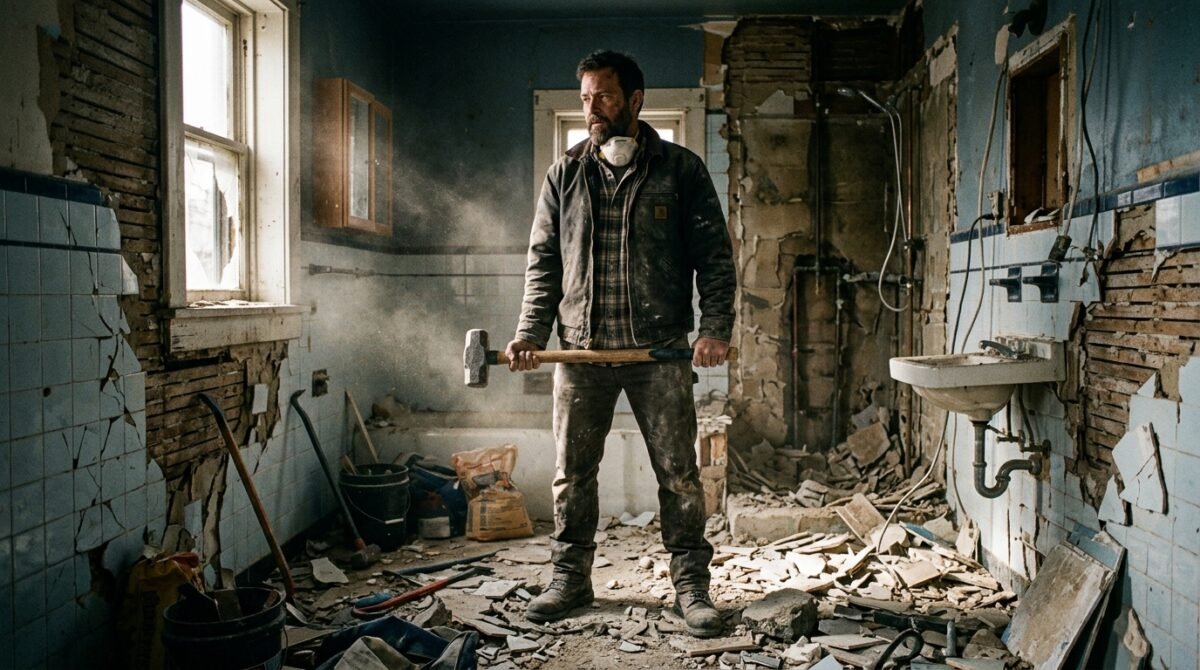
The sound hit me before the visual did. A rhythmic, industrial thudding echoing through the floorboards. I was in the kitchen pouring coffee, thinking the neighbors were finally doing that fence project they’d mentioned last spring. Then, I heard a crash—the distinct, high-pitched shatter of porcelain hitting concrete. That was the sound of our vintage pedestal sink meeting its demise.
I bolted up the stairs, my heart hammering against my ribs. When I pushed open the door to the master bath, the dust was so thick it hung in the air like a fog. Marcus was standing there, safety goggles pushed up onto his forehead, holding a sledgehammer like a trophy. Behind him, the wall that housed the original 1920s tiling was a gaping, jagged hole.
He didn’t even look guilty. He looked exhilarated. He saw me standing in the doorway, face pale, and he grinned, gesturing to the ruins of our home. ‘Wait until you see the plans, babe,’ he said, his voice echoing in the hollowed-out room. ‘I’m installing a high-grade ventilation system. We’re going to have a private sanctuary right here. No more stepping outside into the cold to enjoy a smoke.’
“You destroyed the bathroom. You destroyed the one room in this house that was actually perfect. Did you even think for one second to ask me before you started swinging a hammer at our investment?”
— Me, in the heat of the first confrontation
He scoffed, wiping sweat from his brow. ‘It’s an investment in my mental health. You spend your weekends in the library; I spend my nights stressed. This is my space. I’m doing the demo myself to save money, so I don’t see why you’re so upset. It’s just tile and pipes, honey. We can always put up drywall later if you’re really that attached to the look.’
The arrogance of the statement hit me harder than the dust. He had already spent three thousand dollars on custom cedar panels and a bespoke humidor unit. That money was supposed to be for our roof, which was currently leaking every time it rained. He hadn’t just destroyed a bathroom; he had sabotaged our future stability for a hobby.
The Humidifier That Leaked Into The Marriage

Over the next forty-eight hours, the bathroom morphed into a construction site that looked more like a dungeon than a lounge. Marcus brought in an industrial-sized humidifier that hummed with a low, vibrating drone that I could feel in my teeth. He spent his nights in there, surrounded by blueprints, ignoring the fact that our bedroom now smelled like stale tobacco and damp wood.
I tried to sleep, but the scent was pervasive. It clung to the linens, the curtains, and my own hair. Every time I brought up the issue of the roof, he would dismiss me with a wave of his hand. He had convinced himself that this project was a necessity, a ‘man cave’ that would add value to the property—despite every contractor I called telling me that an indoor smoking lounge without professional, permit-backed ventilation was a massive fire and resale liability.
I spent my days at work in a state of quiet fury. My colleagues noticed the change. I was usually the one who kept it together, the one who mediated office disputes. Now, I was staring at my spreadsheets, my pulse quickening every time my phone buzzed with an update from the bank. He was still spending. A notification hit my email: $800 for ‘premium leather seating’ from a boutique furniture catalog. That was it.
“I am not funding your mid-life crisis anymore. The joint account is locked. If you want to finish this ‘lounge,’ you’re going to have to find a way to pay for it yourself, because I’m done being the silent sponsor of my own home’s decay.”
— My text to Marcus at 2:00 PM
When he didn’t respond for three hours, I knew he was furious. But when he finally did, the sheer entitlement of his reply made me realize I hadn’t made a mistake. I had made a survival move. He didn’t ask how we would fix the roof now. He asked how I dared to treat him like a child who needed an allowance.
The Group Chat Betrayal

I didn’t realize until that evening that the ‘discussion’ about our finances had migrated to his family group chat. I was added to the chat by his sister, who clearly thought she was doing me a favor by ‘calling me out’ in front of the extended family. My phone started vibrating uncontrollably, a waterfall of messages accusing me of being controlling, toxic, and unsupportive.
They were framing the situation as if I were preventing Marcus from having a ‘hobby’ because I was ‘bitter.’ They had no idea about the destroyed bathroom or the leaking roof. To them, I was just the wife who wouldn’t let her husband have his cigars. The irony was so thick I could have cut it with a knife.
“I can’t believe you cut off his funds for a simple remodel. It’s his house too, you know. Maybe if you focused on being a supportive partner instead of a bank manager, you’d be happier.”
— Marcus’s sister in the family group chat
I read the messages, my thumbs hovering over the keyboard. I could have explained the roof. I could have sent pictures of the ruined tiles. But I realized that they didn’t want the truth. They wanted a villain, and Marcus had painted me perfectly. I didn’t defend myself. I simply muted the chat and watched from the sidelines as they spiraled into a frenzy of misinformation.
Marcus walked into the bedroom, his eyes red from the smoke. He threw his phone onto the bed. ‘My family is calling me, asking if we’re getting a divorce. Are you happy now? You’ve humiliated me in front of everyone because you’re mad about a little bit of renovation dust.’
I looked at him, truly looked at him, and realized he wasn’t interested in the marriage. He was interested in maintaining his image as the man of the house, even as the house was literally falling down around us. ‘I’m not the one who destroyed our home, Marcus. You did that all by yourself. And the money is staying locked until you provide a plan for the repairs.’
The Contractor’s Cold Reality Check
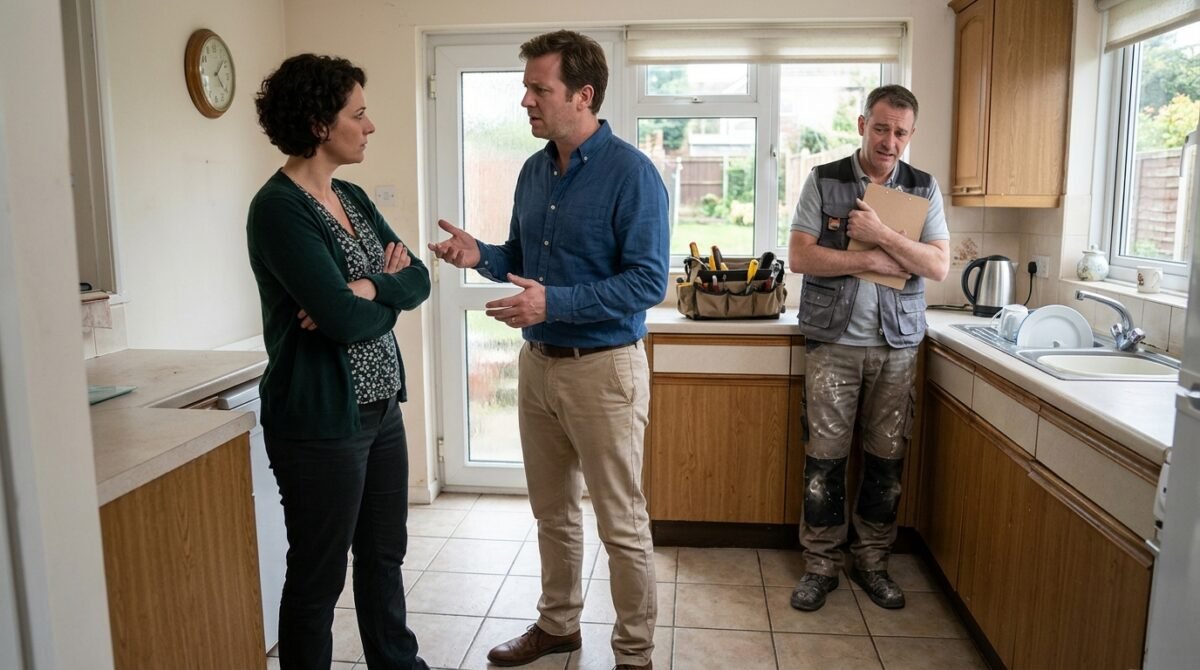
On Wednesday, the contractor, a man named Gary who clearly sensed the shifting tides of the house, showed up at the front door. He wasn’t there to work; he was there for his payment. He had been working on a handshake agreement with Marcus, expecting a mid-project check that clearly wasn’t coming. I met him at the door, holding my ground.
Marcus was hovering in the hallway, looking frantic. He tried to interrupt, to tell Gary that the check would be there ‘by tomorrow,’ but I held up a hand. I had the ledger in my other hand, a detailed breakdown of every cent spent on the lounge versus every cent we had allocated for the roof. I handed it to Gary.
“I am the co-owner of this property,” I told him, my voice steady for the first time in days. “And I have not authorized any further work on this room until the water damage in the foundation and the roof is addressed. If you continue to work on this, you will be doing so without payment from our joint account.”
“Look, lady, I don’t want to be in the middle of a domestic. But the boss-man here told me the funds were cleared. If they aren’t, I’m pulling my crew. I’ve got other jobs waiting.”
— Gary the Contractor
Marcus was purple with rage. He pulled me into the kitchen, his voice a low, threatening hiss. “You are ruining my reputation. You are making me look like a deadbeat. Do you have any idea how embarrassing this is for me?” He grabbed my arm, not hard, but enough to make me recoil. I realized then that the line had been crossed. It wasn’t just about the bathroom anymore; it was about control.
I walked away from him, leaving him in the kitchen with his contractor and his half-finished lounge. I went to the guest room, locked the door, and for the first time, I felt a sense of relief. The house was a mess, yes, but for the first time in months, I wasn’t the one cleaning up after him.
The Reddit Trial: A Community Verdict

I posted the situation on a popular sub-forum that evening, laying out the timeline: the original bath, the unilateral destruction, the ignored roof repairs, and the group chat gaslighting. I didn’t expect the response I got. Within an hour, the thread had thousands of comments, and they weren’t divided at all.
The community was ruthless. They picked apart Marcus’s actions with a level of detail that made me feel vindicated. They pointed out the financial abuse, the safety hazards of indoor smoking, and the blatant disrespect for shared property. It wasn’t just ‘NTA’ (Not The Asshole); it was a chorus of people urging me to leave.
“This isn’t a ‘cigar lounge.’ This is the slow-motion destruction of a major financial asset. He’s not just building a room; he’s burning your equity to satisfy his ego. Keep the accounts locked. Get a lawyer. This is financial abuse disguised as ‘hobbies.’ 14k upvotes.”
— u/HomeRenovationLawyer (Top Comment)
Another user noted the health implications. ‘My husband did this once,’ one commenter wrote. ‘The smell never leaves. The nicotine stains on the ceiling are permanent. You’re living in a health hazard. Leave now before the structural damage ruins the rest of the house value.’ The validation was overwhelming. I wasn’t being crazy; I was being responsible.
I read the comments until 3:00 AM, the blue light of the screen illuminating the guest room. I realized that my husband’s ‘vision’ had been a trap. He wanted me to be the one who enabled him, to be the one who silently accepted the decay of our shared life. But I wasn’t that person anymore. I was ready to dismantle his vision, one financial boundary at a time.
The Midnight Confrontation
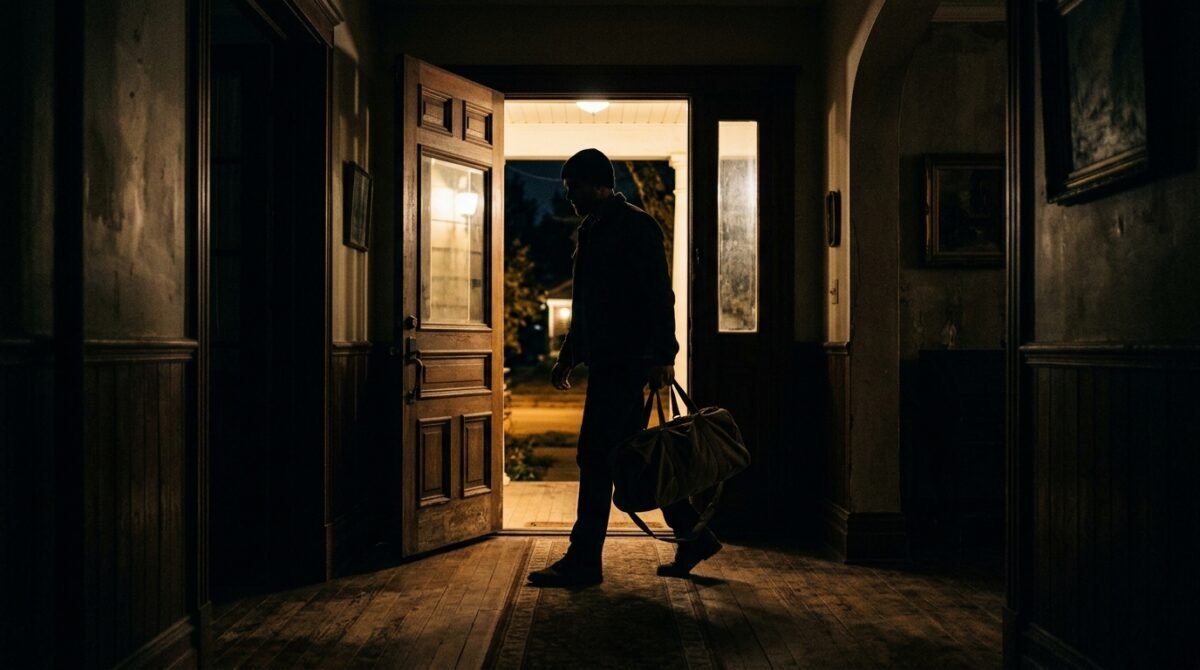
Marcus didn’t come to bed. He stayed in the unfinished lounge, presumably stewing in the smell of sawdust and his own anger. Around 4:00 AM, I heard him moving. He was packing. He had realized that the funds weren’t coming back, and he was deciding that if he couldn’t have his way, he would just leave. I walked into the hallway, just as he was stuffing clothes into a duffel bag.
He looked at me, his eyes hollowed by exhaustion. ‘You wanted this, right? You wanted me gone so you could have your perfect little historic house back. Well, you got it. I can’t live like this, being treated like a tenant in my own home.’
“You aren’t a tenant, Marcus. You’re a co-owner who decided that your personal desires were more important than our shelter. You didn’t just build a room; you built a wall between us.”
— My response to him as he packed
He didn’t have an answer for that. He just zipped the bag and walked past me. There was no grand apology, no dramatic tearful exit. Just the sound of his boots on the hardwood floors and the closing of the front door. The house was silent again, but it was a different kind of silence. It was the silence of a space that was finally mine to breathe in.
I went into the master bath. It was still a ruin. The holes in the wall, the exposed pipes, the debris on the floor. I stood there, looking at the spot where the clawfoot tub had been. I didn’t feel sad. I felt a strange, detached peace. I had protected our future, even if it meant losing the person I thought I was spending it with.
The Aftermath: Damage Assessment

The week following his departure was a blur of contractor visits and damage reports. The news was worse than I thought. The demo he’d performed hadn’t just removed tiles; he had compromised the integrity of the plumbing vent. We had been leaking moisture into the subfloor for weeks, creating mold that would cost thousands to remediate.
I sat with the head of the contracting firm, listening to him detail the repairs. It was going to cost double what the cigar lounge had cost. I looked at the numbers on the page and felt a grim sense of satisfaction. I had stopped the bleeding before it became a total loss. I was going to pay for it, yes, but I was going to pay for a restoration, not a fantasy.
My friends started coming over, not to judge, but to help. We cleaned the dust, we treated the mold, and we started the process of sourcing vintage tiles that matched the original 1920s aesthetic. It was exhausting work, but for the first time since the renovation started, I felt like I was actually living in my own home.
“You’re doing this perfectly. It’s like the last month never happened. We’re going to get this place back to its glory, and you’re going to do it without him.”
— My sister, helping me scrape tile adhesive
Marcus hadn’t reached out. No texts, no calls, no apologies from his family. They had realized, perhaps, that the money was truly gone and that I wasn’t going to be the one to replace it. The silence from that side of the family was the greatest gift they could have given me.
Finding New Purpose in Old Walls

Restoring a 1920s home is an act of love. It’s about understanding the people who came before you and respecting the craftsmanship they left behind. As we replaced the vanity and sealed the walls, I found myself thinking about the kind of life I wanted to live. It wasn’t one defined by ‘man caves’ or unilateral decisions.
I started leaving my phone in the other room when I worked on the house. I spent hours reading in the newly restored, functional, and beautiful bathroom. It was a sanctuary, not because of a cigar lounge, but because of the peace I had reclaimed. The smell of tobacco was gone, replaced by the scent of fresh wood and ceramic cleaner.
I realized that I hadn’t lost a husband; I had shed a weight. The pressure of maintaining a facade of ‘happily married’ while living in a construction site had been eroding my soul. Now, there was just the house, the work, and the future. And for the first time, that future looked bright.
“I thought I was losing my home. Turns out, I was just losing the person who didn’t deserve to live in it with me.”
— My journal entry, one month later
The lessons I learned weren’t just about renovation or money. They were about the non-negotiables of a relationship. If you can’t trust your partner to protect your shared assets, you aren’t in a partnership—you’re in a hostage situation. And I was finally free.
The Legal Reality of Shared Assets

When the divorce papers arrived, they weren’t the dramatic, contested documents I had feared. They were simple. He wanted out, and I wanted the house. I had documentation of every cent he had spent on the ‘lounge’ versus the money I had contributed to the household repairs. It wasn’t a fight; it was an accounting exercise.
My lawyer was impressed by the meticulous records I had kept. The fact that I had cut off the joint account at the first sign of financial irresponsibility worked in my favor. It showed that I was protecting our joint assets, not hoarding them. He couldn’t claim I was the one who had drained the accounts.
The hearing was brief. I kept the house; he kept his furniture and his cigars. The judge didn’t even blink at the details of the ‘cigar lounge.’ It was just another case of a marriage falling apart over a lack of communication and a surplus of ego. I left the courthouse and felt the air in my lungs for the first time in years.
“You handled this with a level of restraint that most people don’t have. You saved your equity and you saved your sanity. That’s a win in any court.”
— My lawyer after the final hearing
I went back to the house, to my bathroom, to my life. The work was done. The roof was fixed, the mold was gone, and the house was quiet. It was the best investment I had ever made.
Looking Back: What I Learned

It’s been six months since I sat on the floor of my bathroom, watching him walk out. The Reddit thread I posted has become a touchstone for others in similar situations. I get messages every day from people who are living in their own ‘cigar lounges,’ dealing with partners who treat their home like a personal playground. My advice to them is always the same: keep your boundaries.
You are not a bad person for wanting to protect your home. You are not a bad person for refusing to fund an obsession that destroys your assets. And you are definitely not a bad person for choosing your peace over a partner who doesn’t respect your boundaries.
The house is currently worth more than it was before the disaster. The restoration brought it back to its original 1920s splendor, and I’ve even added a few touches of my own. It’s a beautiful place to live, and every time I step into the bathroom, I’m reminded not of the destruction, but of the strength it took to stop it.
“It isn’t just about the money. It’s about the person you want to be. Do you want to be the one who waits for permission to protect your own life, or the one who takes control?”
— My closing thoughts to the Reddit community
I’m finally happy. Not the kind of happy that comes from a perfect marriage, but the kind that comes from knowing exactly who you are and what you will tolerate. And that is a price worth paying.
Conclusion
This story of home renovation, financial boundary-setting, and marital collapse serves as a stark reminder of what happens when communication breaks down and entitlement takes over. Marcus saw a bathroom as a toy; I saw it as a home. When we could no longer agree on the fundamental value of our shared space, the structure—both physical and metaphorical—simply couldn’t hold.
The lessons here are clear: transparency in finances is the bedrock of a healthy partnership. When one person begins making unilateral decisions that affect the long-term equity and safety of the home, the relationship is already in crisis. My decision to halt the funding wasn’t an act of aggression; it was a desperate attempt to save our future, even if it meant realizing there was no future left to save.
Now, I look at my restored bathroom and I don’t see the ghost of a cigar lounge. I see a space that I fought for, a space that I built with my own choices and my own strength. If you find yourself in a similar position, remember: you are the architect of your own life. Don’t let anyone else tear it down.
What about you? Have you ever had to draw a hard line on your finances to protect your sanity? Have you ever dealt with a partner who prioritized their ‘vision’ over your shared home? Share your stories below—let’s keep the conversation going.
What's your verdict on this dilemma?
Vote below to contribute to the official community consensus.

Have a Dilemma Keeping You Up at Night?
Share your real-life feud, wedding chaos, or relationship crossroads anonymously with our editorial team.
What do you think ?
0 Comments🛡️ Comments are moderated to protect community integrity. Your comment will appear once approved by the editorial team.