
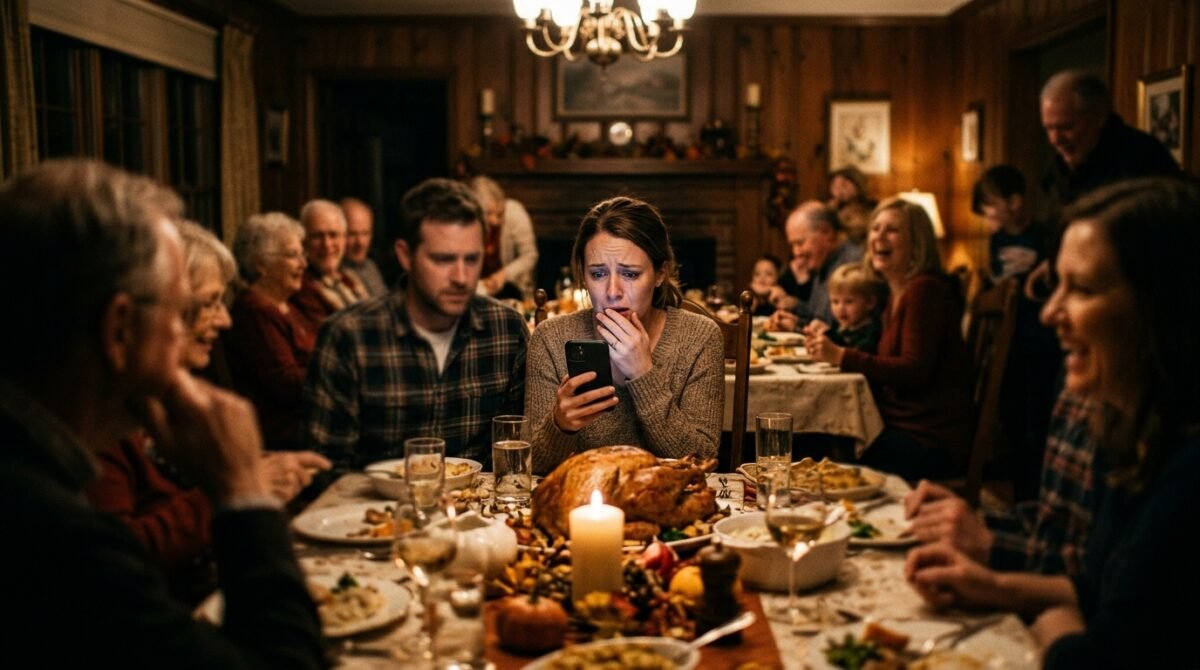
The aroma of rosemary and roasted turkey usually signifies comfort, a sanctuary of family and gratitude. For me, Thanksgiving was meant to be the cornerstone of our year, a time to ignore the minor frictions of married life and focus on the warmth of our shared home. My husband, Mark, had spent weeks planning the menu, ensuring his mother’s stuffing recipe was perfected. Everything seemed pristine, a carefully curated facade of marital bliss that I had spent years meticulously maintaining.
But the cracks weren’t just showing; they were cavernous, hiding beneath a thin veneer of domestic normalcy. I had noticed the late-night bathroom trips, the phone turned facedown on the coffee table, and the sudden, defensive shifts in his posture whenever I walked into the room. I told myself it was work stress, perhaps a project gone sideways or a colleague causing trouble. I was, in retrospect, willfully blind.
The morning of the holiday, the air felt electric, charged with a static tension that I attributed to the looming arrival of his boisterous extended family. I didn’t know that the explosion wasn’t coming from the kitchen or the living room, but from a small, glowing screen sitting innocently next to a centerpiece of autumn gourds. It would be the digital ghost of a past romance that finally set my world ablaze.
This isn’t just a story about a singular betrayal. It is a chronicle of how financial autonomy, trust, and the sanctity of a shared life can be shattered in a single notification. When I caught the transaction—a clean, cold $3,000 transfer on Venmo—I realized that the man sitting across from me, carving the turkey with an unnerving, practiced grace, was a stranger. My departure wasn’t a tantrum; it was a survival instinct kicking into high gear.
The Ping That Shattered The Centerpiece

We were mid-conversation about whether his sister would bring her notoriously chaotic golden retriever when the chime sounded. It wasn’t a generic notification; it was the distinct, sharp ring of a banking app alert. Mark’s face, which had been relaxed only seconds prior, tightened into a mask of frantic rigidity. He reached for his phone with a speed that defied the leisurely pace of our holiday morning.
I watched, my own curiosity piqued, as he tapped the screen. He thought he had cleared the notification, but the screen stayed illuminated just long enough for me to see the recipient’s name—a name I hadn’t heard spoken in our home for the better part of a decade. It was Sarah, the high school sweetheart who had supposedly been ‘dealt with’ in the early days of our courtship.
“Everything okay, Mark? You look like you’ve seen a ghost. Was that a work notification on a holiday?”
— Me, trying to sound casual while my heart hammered against my ribs.
He didn’t look up, his thumbs flying across the glass. “It’s just… it’s nothing. A vendor for the business. They’re always so pushy, even on holidays. You know how these guys are, always needing their payment processed immediately.” His lie was clumsy, hanging in the air like a heavy, unlit candle.
I stood up, ostensibly to check the oven, but my real destination was the living room table where he had left his phone. As he walked toward the kitchen to ‘check the bird,’ I saw it. The phone was unlocked. A quick swipe into his recent history revealed not just a text conversation, but a Venmo transfer notification. The amount was staggering, and the caption on the transaction read simply: ‘For the car trouble. Don’t tell him.’
The air in the house suddenly felt thin. I wasn’t just looking at an infidelity; I was looking at the systematic dismantling of our joint savings account. The $3,000 wasn’t just a number; it was the vacation fund we had been building for our anniversary. It was the security cushion we had debated for months before setting aside. And it had been shipped off to a ghost from his past in a matter of seconds.
Confrontation Over The Turkey Platter
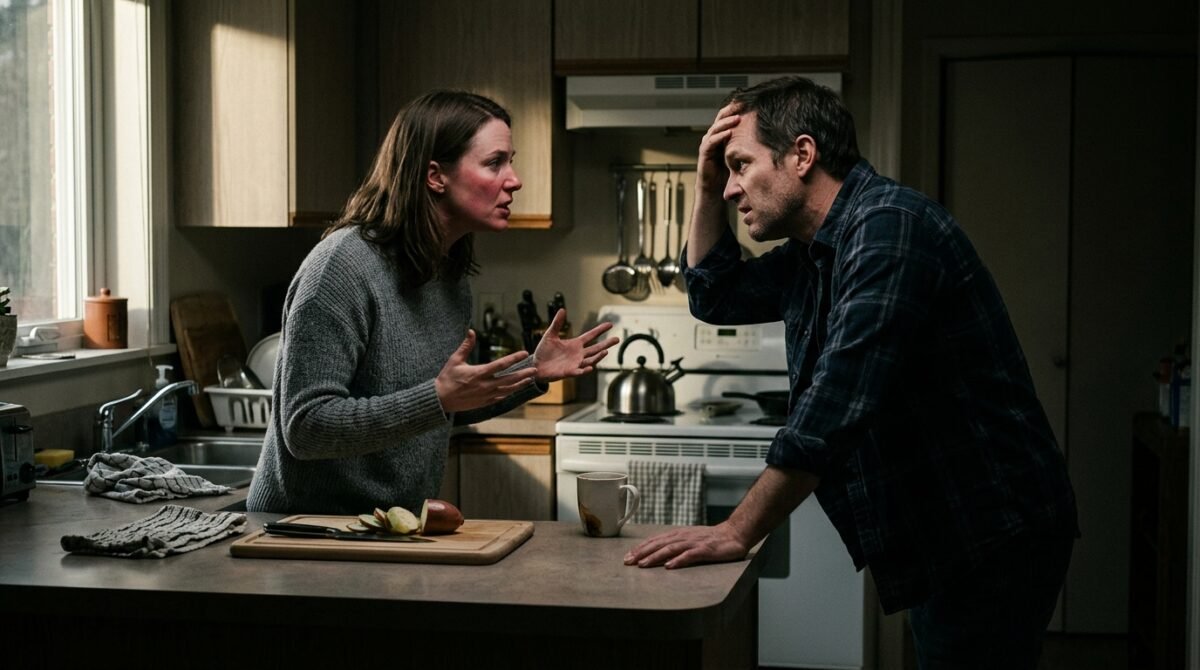
I didn’t wait for him to return. I marched into the kitchen, the phone held out like a piece of radioactive waste. He was leaning against the counter, a glass of wine in his hand, his expression shifting from annoyance to terror as he saw what I was holding. He knew. The game was up, and the festive decor only made the impending conflict feel more surreal, more grotesque.
“Explain this to me, Mark. Why is $3,000 of our savings currently sitting in the account of your high school ex-girlfriend? And don’t tell me it’s for a business vendor. I saw the name. I saw the note about her car.”
— My voice, surprisingly steady, cutting through the silence of the kitchen.
He set the wine glass down, a nervous clatter against the granite countertop. He tried to reach for the phone, but I pulled it back, my grip firm. He attempted to pivot, to gaslight, to reframe the narrative into something manageable, something he could control. But the cold, hard reality of the numbers was an anchor that wouldn’t let him drift away from the truth.
“It was an emergency, okay?” he stammered, his face flushing a deep, mottled red. “Her transmission blew out. She has kids, she needs the car for school runs. She reached out in desperation. I couldn’t just stand by and watch her be stranded. It was just a loan, and I intended to pay it back before you ever noticed the account was low. It was a one-time thing, a human kindness.”
His audacity was almost impressive. To frame a secret transfer to an ex as a charitable act of ‘human kindness’ while we sat on the precipice of our own financial goals was a level of manipulation that made my skin crawl. I wasn’t angry because he helped someone; I was angry because he had established a secret channel of support, a shadow life where his priorities lay with his past, not his present.
“A loan? You didn’t consult me. You didn’t ask. You drained our joint account for someone you haven’t seen in years. Do you have any idea how betrayed I feel right now? This isn’t about the money, Mark. This is about who you think you’re married to. You think I’m the person who keeps the books, not the person who shares your life.”
The Justification Of A Ghost

He tried to move closer, to use the physical proximity that usually served to intimidate or soothe me. He started explaining the ‘history’—how they had stayed in touch through social media, how they had ‘grown up’ and were ‘just friends’ now. He spun a web of platitudes about how she had fallen on hard times, as if that somehow justified the secrecy. Every word he uttered felt like another layer of insulation being stripped away from our marriage.
“She’s a single mother, for God’s sake! Do you really want to be the kind of person who begrudges a struggling woman a helping hand? I didn’t tell you because I knew you’d react exactly like this—with suspicion and pettiness.”
— Mark, attempting to turn the moral high ground into a weapon against me.
The irony was suffocating. He was accusing me of pettiness while he was the one actively concealing financial infidelity. I looked at him—really looked at him—and realized that he had spent years cultivating this alternate persona, a man who could easily juggle the responsibilities of a husband and the secret desires of a past flame. The ‘struggling single mom’ narrative was just the cherry on top of a very bitter sundae.
I asked him about the other times. The times he had gone to the ATM ‘for business expenses’ or the random charges I had ignored. He went quiet. The silence was the loudest confession I had ever heard. It wasn’t just the $3,000; it was a recurring theme. The car repairs, the ‘lost’ phones, the emergency vet bills for pets I didn’t know she had. My husband had been subsidizing his ex-girlfriend’s lifestyle for months.
I felt a strange sense of clarity, a cold, surgical detachment that allowed me to see the end of our marriage with crystal precision. There was no salvaging this. The foundation wasn’t just cracked; it had been hollowed out from the inside. He wasn’t looking for forgiveness; he was looking for a way to keep the secret buried while maintaining the comfort of the status quo. I was merely an obstacle to be managed.
Leaving Before The Guests Arrived

The sound of a car pulling into the driveway signaled the arrival of his parents. They were early. They always were. The prospect of sitting through a Thanksgiving dinner with his mother—who always had a comment about my weight or my career—while sitting on this powder keg was physically repulsive to me. I reached for my purse, which I had left on the kitchen island.
“Where are you going? My parents are here! You can’t leave now, you’ll look like a lunatic. We have guests! Don’t you dare walk out on this family.”
— Mark, his voice rising in panic as he realized I was actually leaving.
I didn’t argue. I didn’t scream. I just looked at him, my expression blank, drained of the passion I had once felt. The house, which had felt like home an hour ago, now felt like a stage set for a play I no longer wanted to perform. I walked past him, toward the front door, the sound of his mother’s laugh echoing from the porch.
I opened the door just as his mother was reaching for the handle. She looked at me, confused, then at Mark standing in the kitchen, a wine glass still in his hand, looking disheveled and frantic. I didn’t explain. I didn’t offer a polite excuse about an emergency. I just grabbed my keys and walked to my car, the gravel crunching beneath my feet like the sound of a closing chapter.
As I backed out of the driveway, I watched in the rearview mirror as his mother tried to stop me, her hands waving in the air. Mark was standing in the doorway, the very image of a man whose world had just collapsed. I didn’t feel the surge of victory I expected; I felt only a profound, hollow exhaustion. The life we had built was gone, and I was the one who had finally turned the lights off.
The Digital Fallout And The Receipts

The first few days were a blur of lawyers, hotels, and the quiet, crushing realization of what had been lost. I found out the true extent of the betrayal when I finally managed to secure access to the financial records. It wasn’t just $3,000. It was a slow, steady drip, a fiscal hemorrhage that had been going on for over a year. There were small transfers, restaurant bills, and even subscription service fees paid out of our ‘joint’ account to her personal accounts.
“I just wanted to make sure she was okay. She doesn’t have anyone else. You have me. You have our savings. What’s a few thousand dollars compared to the security we have?”
— A text message from Mark sent three days after I left.
The audacity of his perspective was almost charming in its delusion. He truly believed that his ‘generosity’ was a victimless crime because I hadn’t ‘noticed’ the impact on my daily life. He didn’t understand—and perhaps never would—that the betrayal wasn’t the currency; it was the secrecy. The fact that he could look me in the eye every morning and kiss me goodbye while simultaneously plotting how to hide a payment to an ex-lover was the true violation.
I started documenting everything. I saved every screenshot, every transaction record, every text message where he tried to gaslight me into believing I was the crazy one for being upset. The lawyers were impressed by the paper trail. It was cold, hard evidence of financial infidelity, a clear-cut case of marital misconduct that would make the divorce proceedings significantly less ‘he said, she said’ and much more ‘look at these statements.’
I felt a strange sense of validation in the documentation. For years, I had questioned my own reality, wondered if I was being too sensitive, too controlling, or too suspicious. The numbers didn’t lie. They told a story of a man who was living a double life, financing a past he wasn’t ready to let go of, at the expense of a future he was supposedly building with me. The anger was still there, but it was now cold and focused, a tool I could use to rebuild my life.
The Reddit Community Weighs In

I posted my story anonymously on a popular relationship subreddit, expecting a barrage of ‘you’re overreacting’ comments or ‘it’s just money’ dismissals. I was wrong. The response was a flood of validation, shared trauma, and legal advice that I hadn’t even thought to ask for. People saw through his ‘charitable’ narrative immediately, identifying the patterns of control and manipulation that I had been too close to see.
“This isn’t about charity, OP. This is about maintaining an emotional and financial tether to his past. He’s funding his ‘what-if’ life with your labor. Do not let him gaslight you into thinking this is about her transmission. It’s about his refusal to be a partner to you.”
— u/RelationshipGuru_88 (Top Comment, 45.2k upvotes)
Other comments followed, sharing similar stories of ‘secret loans’ and ’emergency help’ that turned out to be long-term affairs of the heart and wallet. The community didn’t just support me; they gave me the vocabulary to describe what had happened to me. They called it ‘financial infidelity’ and ’emotional maintenance.’ It was a relief to know that I wasn’t just ‘crazy,’ that my instincts were right all along.
There were some who suggested I was being too harsh, that maybe he just needed a second chance if he swore to stop. But the majority of the responses were a resounding ‘get out.’ They understood that the transgression wasn’t just the money; it was the erosion of the shared reality that constitutes a marriage. Once the trust is gone, the structure is just a house of cards waiting for the next breeze.
Reading the comments gave me a sense of perspective. I was one of thousands who had been through this, and yet, in the loneliness of my hotel room, I had felt like the only person on earth. The collective wisdom of the internet served as a mirror, showing me that while my pain was unique, the betrayal was a common, ugly feature of human relationships. And knowing that made it easier to move on.
The Legal Reality Check

When we finally sat down with our lawyers, the mask of the ‘charitable friend’ crumbled completely. Mark tried to argue that the money was a loan, that he had a right to spend it, and that I was being vindictive. But the judge and the attorneys weren’t interested in his excuses. They looked at the bank statements, the frequency of the transfers, and the lack of any repayment schedule. It was clear: this was a systematic depletion of joint assets for personal gain.
“Mr. Miller, this isn’t a loan. This is a pattern of dissipation of marital assets. You have systematically funneled thousands of dollars to a third party without your spouse’s knowledge or consent. This has significant implications for the settlement.”
— My lawyer, during the mediation meeting, speaking directly to Mark.
The look on his face was one of pure, unadulterated shock. He had truly believed that he could talk his way out of the math. He thought that because he was the one who worked the ‘big job’ and brought in the ‘main income,’ he had the right to decide how the money was spent. He didn’t understand the concept of a partnership, of a shared life where every cent is a collective decision.
The mediation was brutal. Every transaction was audited, every ’emergency’ questioned. It turns out, most of those ‘transmissions’ were actually just lifestyle support—rent, groceries, clothes. He had been playing the role of the secret provider for his ex, while I had been playing the role of the unsuspecting partner. The revelation was humiliating, but it was also the final nail in the coffin of my attachment to him.
I realized then that I wasn’t fighting for the money. I was fighting for the truth. I was forcing him to look at the reality of his actions, to stop hiding behind his own lies. And for the first time, he was forced to account for everything. The, ‘I didn’t think you’d care’ defense didn’t hold up in a court of law, and it certainly didn’t hold up in the face of his own mounting debt and the impending reality of a halved life.
The Aftermath: Rebuilding From Zero

The divorce was finalized three months later. I kept the house, but I had to buy him out, a process that was both painful and liberating. I was starting over in my mid-thirties, but I was starting over with a clean slate, a clear conscience, and a much sharper understanding of what I was looking for in a partner. I spent the first few weeks just enjoying the silence of the house, no more hiding, no more checking phones, no more wondering where the money was going.
“I hope you find whatever it is you were looking for with her. Because clearly, it wasn’t here. Thank you for showing me exactly what I deserved.”
— My parting words to him as I handed him the final settlement papers.
I started a new hobby—pottery. It was something I had always wanted to do but ‘never had the time for’ during the marriage. There was something profoundly healing about working with clay, about taking a lump of earth and shaping it into something beautiful, something entirely my own. It was a metaphor for my life: broken, reformed, and now, much stronger.
I still talk to some of the people I met on the forums. We share stories, vent about the dating scene, and support each other through the lingering trauma of betrayal. It’s a strange community, built on the ashes of failed dreams, but it’s real, and it’s supportive in a way my marriage never was. I’ve learned that I don’t need a partner to complete me, that my own capacity for growth is enough.
As for Mark, I heard through the grapevine that he and his ex are no longer ‘friends.’ The money dried up, and with it, the artificial intimacy he had worked so hard to maintain. He’s back to square one, but without the safety net I provided. It’s not my business anymore, and for the first time in years, I don’t feel the need to look over my shoulder or check his phone. The freedom is intoxicating.
Reflecting On The Signs I Missed

Looking back, the signs were always there. The defensiveness, the sudden urge to be ‘charitable,’ the way he would change the subject whenever I brought up our savings goals. I had ignored them because I wanted to believe in the story we were telling ourselves. I wanted to believe that we were the ‘perfect couple,’ and to acknowledge the truth would have been to admit that the story was a lie.
“We don’t see things as they are; we see them as we are. I saw a husband, a partner, a teammate. I should have been looking at the evidence, not the narrative.”
— A reflection written in my journal during the recovery process.
I realized that my desire for harmony had been my greatest vulnerability. I had been so afraid of rocking the boat that I had let him drill a hole in the bottom of it. I had conflated peace with silence, and harmony with submission. It was a costly lesson, but one that has fundamentally changed how I view relationships. I now value honesty over comfort, and truth over harmony.
If I could go back and tell myself one thing, it wouldn’t be ‘check his phone sooner.’ It would be ‘trust your own perception.’ When something feels off, it usually is. When your partner starts acting like a stranger, believe them. Don’t waste time trying to rationalize their behavior or convince yourself that you’re the one in the wrong. Your intuition is your most valuable asset.
I have no regrets about leaving on Thanksgiving. It was the best gift I could have given myself—the gift of truth. I didn’t get to eat the turkey, and the holiday was ruined, but I started a new, better tradition. I spend my holidays now with friends who respect me, in a home that feels like a sanctuary, and with a heart that is no longer hiding secrets.
The Final Verdict: Lessons Learned

The story of my marriage, and its spectacular, messy conclusion, has taught me more about myself than a decade of ‘couple therapy’ ever could. I learned that I have a backbone made of steel, that I can survive the loss of my financial security, and that I am capable of starting over even when the odds seem stacked against me. I am no longer defined by who I am with, but by what I am doing and how I am living.
“The most dangerous thing you can do is stay in a situation where you are forced to ignore your own reality. Once you accept the truth, you become invincible.”
— A quote I found and pinned to my fridge, a reminder of my own power.
I often think about the woman who was standing in that kitchen, holding the phone, feeling her world collapse. I want to tell her that it gets better, that the pain is temporary, and that the freedom on the other side is worth every ounce of the agony. I want to tell her that the Thanksgiving dinner she walked out on was the start of the best part of her life.
To anyone reading this who is currently living in a house of secrets, who feels that constant, nagging suspicion that something is wrong: listen to it. Don’t wait for the ‘ping’ that ruins your life. Demand transparency now. If your partner can’t or won’t give it to you, then they aren’t your partner. They are just someone you are sharing a space with, and you deserve more than that.
I am happy now. Genuinely, deeply happy. It’s not the happiness of a curated, perfect life, but the happiness of a life built on solid ground. I have my own accounts, my own goals, and my own future. And I have the peace of mind that comes with knowing that I am the only one who holds the keys to my own life.
Conclusion
My departure on that fateful Thanksgiving was more than just an exit; it was a reclamation of self. The betrayal was deep, but the recovery has been deeper. I found that I wasn’t just losing a husband; I was gaining an identity that had been suppressed by years of compromise and quiet desperation. The financial lessons were harsh, but they were the catalysts for a life that is truly mine.
We often talk about trust in relationships, but we rarely talk about the responsibility of transparency. When we merge our lives, we aren’t just merging finances; we are merging realities. When one person hides a part of that reality, they aren’t just ‘sparing’ the other; they are isolating them. I chose not to be isolated any longer.
I hope my story serves as a reminder that your intuition is never wrong, even when you want it to be. If you find yourself in a similar position, know that walking out is not a failure—it is a beginning. You are worthy of a partner who treats your life, your money, and your trust with the same respect they would their own.
What about you? Have you ever had a moment where a simple notification completely changed your perspective on a relationship? How did you handle the aftermath? Let us know in the comments below.
What's your verdict on this dilemma?
Vote below to contribute to the official community consensus.

Have a Dilemma Keeping You Up at Night?
Share your real-life feud, wedding chaos, or relationship crossroads anonymously with our editorial team.
What do you think ?
0 Comments🛡️ Comments are moderated to protect community integrity. Your comment will appear once approved by the editorial team.