
I had been looking forward to this evening for six months. It was a milestone celebration—a promotion to Senior Project Manager that I had worked blood, sweat, and tears to achieve. I chose ‘L’Etoile,’ an exclusive, adults-only tasting menu experience known for its seven-course seasonal flights and strict 21-and-over policy. It wasn’t cheap, but it was the kind of sophisticated, quiet atmosphere I craved after a year of relentless deadlines.
My best friend, Sarah, had been my sounding board throughout the job search. When I invited her to join me, I made it explicitly clear: ‘This is a 21+ venue, Sarah. No kids. I need a night of adult conversation.’ She agreed immediately, saying she was thrilled to take a break from her three toddlers, aged two, three, and five. She promised to have her mother watch them for the evening, and we finalized the reservation with a non-refundable deposit.
But as I stood outside the restaurant at 7:00 PM, a black SUV pulled up to the curb. My heart sank as I watched Sarah emerge from the vehicle, followed by the chaotic, high-pitched shrieking of three toddlers who had clearly not been left with their grandmother. My stomach dropped, not just because the silence I had paid for was shattered, but because I knew exactly what was about to happen.
The restaurant’s hostess was already standing at the door with a look of pure dread. Sarah didn’t even look at me; she was busy wrestling a diaper bag and a stroller out of the trunk, her face set in a mask of practiced nonchalance. This wasn’t a mistake; it was a power move, a deliberate test of boundaries that I had already drawn in neon lights.
The moral dilemma was laid bare: do I create a public scene and ruin my own celebratory night, or do I let this happen and sacrifice my hard-earned money and sanity? I chose a third path—one that would lead to the most explosive confrontation of our ten-year friendship.
The Curb-Side Ambush

The moment Sarah stepped onto the sidewalk, I knew I was in trouble. The children were dressed in play clothes, not the nice attire I’d suggested, and they were already running circles around the valet stand, screaming at the top of their lungs. Sarah looked at me and offered a tight, apologetic smile that didn’t reach her eyes.
I felt my pulse quicken. I walked toward her, my voice dropping to a low, intense whisper. ‘Sarah, what is going on? We talked about this. This is an adults-only tasting menu. They won’t even seat you.’
“Oh, don’t be so dramatic! My mom had a last-minute emergency and I couldn’t find a sitter. Besides, they’re fine! They’re hungry, and I thought maybe they could just share some of our appetizers while we have our wine. They won’t be a bother, I promise.”
— Sarah, attempting to normalize the impossible
I looked at the hostess, who looked ready to call security. I had to intervene. I explained that I was the one who made the reservation and begged them to make an exception. They only agreed because I was a long-time member, but with the caveat that if the children made a single sound, we would be escorted out.
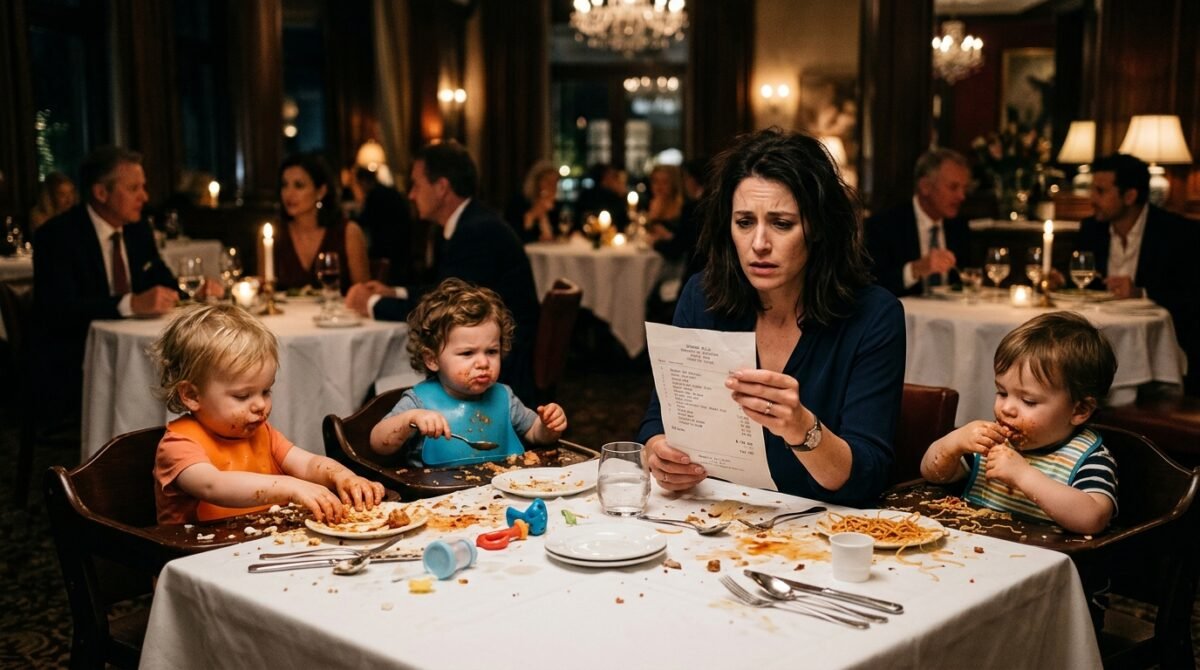
The walk to our table felt like marching toward a guillotine. The other diners turned their heads, their expressions shifting from curiosity to open annoyance as the three-year-old dragged a plastic dinosaur across the pristine hardwood floor, making a hideous screeching noise.
Sarah didn’t seem to notice—or, more likely, she didn’t care. She sat down, took a massive gulp of the complimentary sparkling water, and began trying to force a bread roll into the hands of her crying toddler. The table was set for two adults, not an entire daycare center, and the silverware clattered as the kids began to grab at everything in reach.
The Seven-Course Disaster

The dinner was meant to be a delicate, curated experience of fusion flavors. Instead, it became a battle for survival. The first course—a delicate amuse-bouche of scallop and ginger—was barely placed on the table before the five-year-old knocked the glass over, soaking the tablecloth in expensive white wine.
Sarah laughed it off, waving her hand as if a glass of $200 wine was just water. ‘Kids will be kids, right?’ she said to the waiter, who was clearly struggling to maintain his professional composure. I was mortified. I couldn’t even taste the food; I was too busy staring at the faces of the other diners, who were now openly complaining to the manager.
By the third course, the toddlers were bored and hungry. They didn’t want the gourmet menu; they wanted nuggets and fries. Sarah began to rummage through her bag, pulling out loud, crinkly snack packets that sounded like a gunshot in the quiet room. She looked at me, completely oblivious to the tension.
“I don’t know why you’re so tense! You’re getting your promotion, you’re making good money now. Just relax and enjoy the night. It’s not like the waiter cares if they eat a few bites of your fish.”
— Sarah, during the third course
I couldn’t believe her audacity. She had hijacked my evening, humiliated me in front of the restaurant staff, and was now gaslighting me about my reaction to the chaos. I felt a cold, hard anger setting in—a feeling that this friendship had finally reached its expiration date.
Every time a waiter came by, they shot me a look of pity, which only fueled my humiliation. The manager eventually made his rounds, leaning over our table to remind us that ‘disturbances’ were not permitted. Sarah looked at him with an icy glare that suggested she thought the policy was beneath her.
The Unspoken Agreement Ignored

When the bill finally arrived, I felt a heavy sense of dread. It was tucked into a leather-bound folder, a small, unassuming thing that held the financial consequences of the worst night of my life. I reached for it, but Sarah pulled it toward her side of the table with a flick of her wrist.
‘I’ll look at it,’ she said, as if she were planning on paying. She opened the folder, scanned the total, and her eyes widened. It was a high-end restaurant, and with the added expense of the kids ordering a la carte items off-menu at the chef’s insistence to keep them quiet, it was significantly more than I had budgeted.
She placed it back on the table between us. ‘So, it’s about $850. We can just split this down the middle, right? It’s only fair since you invited me to celebrate your big promotion.’
I felt my jaw drop. I had paid for the deposit, the valet, and the stress of the entire evening. Now she wanted me to subsidize her decision to bring three uninvited, unruly children to a place they had no business being. I looked at the bill, then at her, and finally, I spoke.
“Sarah, you brought three children to an adults-only restaurant. They ate items that weren’t even on the menu, and they turned this dinner into a nightmare. I am not paying for their food, and I am certainly not splitting a bill that is inflated because you couldn’t find a babysitter.”
— OP, finally drawing a line
The silence that followed was deafening. Sarah looked at me as if I had just slapped her. She turned bright red, her voice rising to a pitch that caught the attention of every table in the room.
The Group Chat Explosion
I paid my portion of the bill—for my meal and my share of the appetizers we actually agreed upon—and walked out. I didn’t wait for her to figure out the rest. I just left. I wanted out of that building as fast as my heels could carry me.
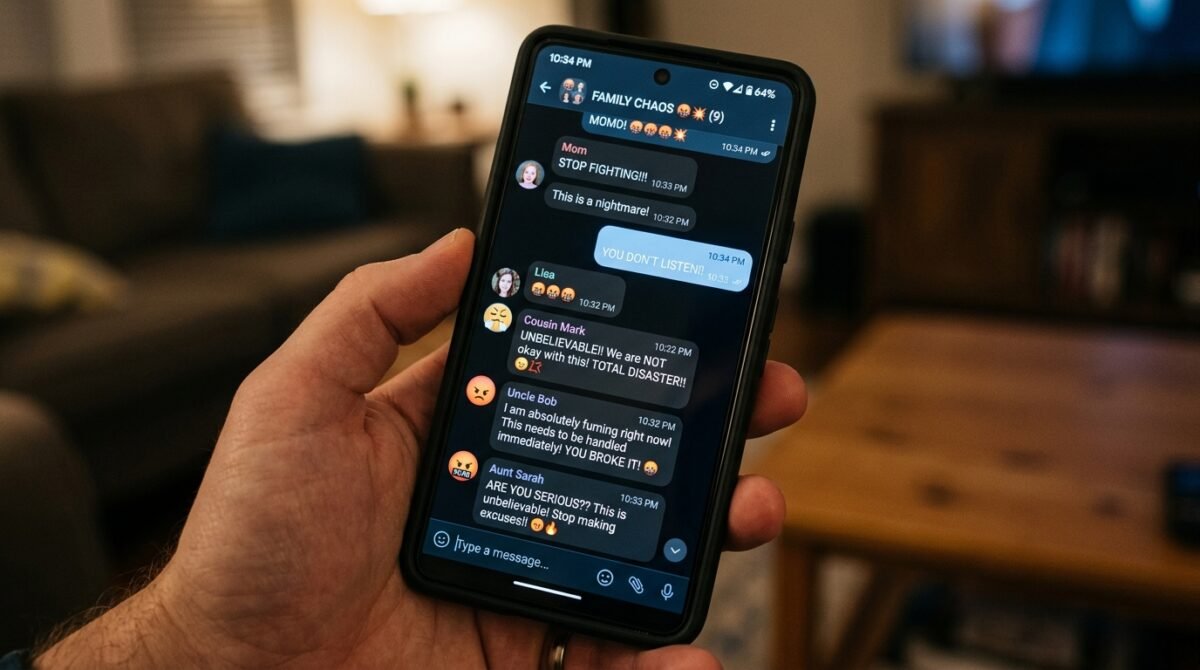
By the time I reached my car, my phone was buzzing incessantly. Sarah had already taken to our shared friend group chat, painting a narrative where I was the ‘selfish, elitist, child-hating’ villain who abandoned a mother in need at a restaurant. The messages were coming in fast and furious.
“Can you believe she just left me there with the bill? She invited me to celebrate HER promotion and then had a total meltdown because my kids were being kids. She has absolutely zero empathy for working moms. Stay away from her.”
— Sarah in the group chat
My phone lit up with responses from friends who only had Sarah’s side of the story. ‘Are you serious?’ ‘That’s so cold, OP.’ ‘You couldn’t just suck it up and pay for your friend?’ I felt a wave of nausea. She had managed to manipulate the situation before I even got home.
I started typing a long response, detailing the $850 bill, the 21+ policy, and the fact that she had lied about having a sitter. But then I stopped. Why was I explaining myself to these people? If they were the kind of friends who would believe her instantly without asking for my side, maybe they weren’t the friends I needed in my life anyway.
Instead, I sent one final message: ‘I have the receipt, the restaurant’s policy on my phone, and the text messages where she agreed it was a 21+ dinner. If anyone wants the truth, ask me privately. Otherwise, I’m done with this conversation.’ And then, I muted the group chat.
The Reality Check

The next morning, the fallout was absolute. My phone was flooded with missed calls, mostly from Sarah, but also from mutual friends who were now starting to realize there might be more to the story. I ignored them all, opting instead to post a summary of the events on a local community subreddit to see if I was actually the one in the wrong.
I laid out the facts: the reservation, the 21+ policy, the unexpected arrival of the children, and the demand to split the bill. The response was immediate and overwhelming. Within hours, the post had thousands of upvotes and hundreds of comments, and the consensus was not what Sarah would have liked.
“NTA. Your friend didn’t just ‘bring kids.’ She violated a strict policy, ruined your expensive night, and then expected you to pay for the privilege of being inconvenienced. This isn’t about being a mom; it’s about being a selfish, entitled person who doesn’t respect boundaries.”
— u/ReasonableObserver, 18.2k upvotes
It was validating, but it also stung. I realized that my circle of friends had been enabling this behavior for years. Sarah was always the one who ‘couldn’t help it’ or ‘was just doing her best,’ and everyone else had been conditioned to pick up her slack—emotionally, logistically, and now, financially.
I spent the afternoon reading through the comments. Some people shared similar stories of ‘entitled parents’ who assumed their children were the center of the universe. Others provided legal advice about how to handle the inevitable fallout if she tried to pursue the payment. It was a strange comfort to know I wasn’t alone in this experience.
I felt a sense of clarity I hadn’t had in years. The promotion, the dinner, the friendship—it was all part of a larger picture I had been ignoring. I had been shrinking myself to fit into a mold that accommodated someone else’s chaos, and for the first time, I felt like I was allowed to take up my own space.
The Confrontation We Never Had

Two days later, Sarah showed up at my apartment. She didn’t call, and she didn’t text. She just started pounding on my door, clutching a bag of groceries she clearly expected me to pay for. I looked through the peephole and saw her, looking disheveled and frantic, with the same ‘I’m a victim’ expression she wore at the restaurant.
I opened the door, but I didn’t let her in. I stood in the doorway, blocking the entrance. ‘I’m not paying for the rest of that bill, Sarah. And I’m not interested in hearing your side of the story anymore. You lied, you ruined my night, and you tried to ruin my reputation in our friend group.’
“You are being so incredibly petty! It was one night! You have a new salary now! Why are you acting like this is the end of the world? I’m your best friend! You’re supposed to support me, especially when things are hard with the kids!”
— Sarah, trying one last time to guilt-trip me
I felt a strange sense of calm. The anger was gone, replaced by a cold, hard resolve. I wasn’t being petty; I was being an adult who expected the same from others. I realized then that she didn’t see me as a person; she saw me as a resource—a bank account, a babysitter, a shoulder to cry on.
I told her, ‘You aren’t my friend, Sarah. You’re someone who uses people. And I’m done being used.’ I closed the door, locked it, and walked away. I didn’t look back to see how she reacted. I just went into my kitchen and made a cup of coffee, finally enjoying the silence of my own home.
The Aftermath and Social Exile

The fallout within our friend group was predictable. Those who chose to side with Sarah stopped talking to me, which was actually a relief. It was like a social detox; I didn’t realize how much dead weight I had been carrying until it was gone. The people who reached out to apologize, or to ask for the truth, became my new inner circle.
I started attending networking events for my new position, meeting people who valued professionalism and respected boundaries. It was refreshing to be around adults who understood the value of time and personal responsibility. I felt a surge of pride in my career and my ability to stand up for myself.
I also started seeing a therapist to unpack why I had allowed this dynamic to persist for so long. She helped me see that my need to be the ‘accommodating friend’ was a trauma response from my own upbringing. I was so used to putting others’ needs before my own that I had lost the ability to even recognize when I was being exploited.
It wasn’t easy. There were lonely nights, and there were moments when I doubted my decision. But then I would think about that $850 bill, the crying toddlers, and the way Sarah looked at me when I told her ‘no,’ and I knew I had done the right thing. I had reclaimed my life.
The Lesson on Boundaries

If there’s one thing I learned, it’s that boundaries are not just for others; they are for yourself. They are the walls you build to protect your peace, your money, and your sanity. And the people who get angry when you set them are usually the people who were benefiting the most from you not having them in the first place.
I stopped apologizing for my success. I stopped feeling guilty for wanting a quiet dinner. And I stopped being the person who always says ‘yes’ to someone who wouldn’t dream of doing the same for me. It was a hard lesson, but it was one I needed to learn if I wanted to grow.
I also realized that ‘friendship’ is not a blank check. It’s a two-way street of mutual respect and consideration. If one person is always doing the giving and the other is always doing the taking, it’s not a friendship; it’s a parasitical relationship that needs to be cut off.
I’m in a better place now. I have a new group of friends who respect my time and my life. I have a job that I love, and I have a clear sense of who I am. And I still enjoy going to 21+ restaurants, though now, I go with people who are actually capable of behaving like adults.
Reflecting on the Community Response

Looking back at the thousands of comments on my Reddit post, I see that this isn’t just about me. It’s a universal struggle. So many people are trapped in these ‘friendships’ where they are expected to sacrifice everything for the sake of ‘being nice.’ The sheer volume of people who shared their own stories of being pushed to the brink by entitled friends was staggering.
It made me realize that we need to stop romanticizing toxic relationships under the guise of ‘loyalty.’ Loyalty is not allowing someone to disrespect you. Loyalty is standing by someone who respects you as much as you respect them. And if someone can’t do that, they don’t deserve your loyalty.
The community support was the final piece of the puzzle. It confirmed that I wasn’t crazy for being upset, and I wasn’t a bad person for standing my ground. I hope that by sharing my story, someone else might find the strength to set their own boundaries and realize that they, too, are worth more than the chaos others try to bring into their lives.
I still get messages from people asking for updates or thanking me for the inspiration. It’s a strange feeling, being a ‘viral’ story, but if it helps just one person to say ‘no’ to an unreasonable demand, then the entire, disastrous night at L’Etoile was worth it.
The Final Verdict

So, where am I now? Sarah eventually tried to reach out again, but I blocked her across every platform. I heard through the grapevine that she’s still struggling with her children and her finances, but that’s not my concern anymore. My concern is my own life, my own growth, and my own happiness.
I’ve learned that I don’t owe anyone an explanation for why I value my own time and resources. I’ve learned that ‘no’ is a complete sentence. And I’ve learned that sometimes, the hardest decisions are the ones that lead to the most beautiful beginnings.
I’m finally at peace. And that is worth more than any fancy tasting menu, or any friendship that demands I lose myself to keep it. I’m moving forward, and I’m doing it on my own terms. And that, more than anything, is the true celebration of my promotion.
I hope that if you are in a similar situation, you realize that you have the power to change it. Don’t let someone else’s dysfunction define your reality. Stand up for yourself, hold your boundaries, and know that you are worthy of respect. You deserve a life that feels as good on the inside as it looks on the outside.
Conclusion
This experience taught me that boundaries are the ultimate form of self-respect. It wasn’t just about the money or the dinner; it was about reclaiming my dignity in a relationship that had become deeply lopsided. For all those out there feeling pressured by ‘friends’ who act like entitled toddlers, remember this: your peace is not for sale.
The community reaction was a powerful reminder that we are not alone in these struggles. It was heartening to see so many people validate the importance of holding the line. If you’ve ever had a ‘friend’ turn your special night into a disaster, tell me about it in the comments below. Have you ever had to cut ties with someone because they refused to respect your boundaries? Let’s discuss in the poll below.
Poll: If you were in my shoes, would you have paid for your friend’s kids just to keep the peace, or would you have walked out as well?
What's your verdict on this dilemma?
Vote below to contribute to the official community consensus.

Have a Dilemma Keeping You Up at Night?
Share your real-life feud, wedding chaos, or relationship crossroads anonymously with our editorial team.
What do you think ?
0 Comments🛡️ Comments are moderated to protect community integrity. Your comment will appear once approved by the editorial team.