

They say you never truly know a person until you live with them, or in my case, until you give them a spare key to your apartment while you travel for work. For ten years, Sarah was the sister I never had. We shared everything: secrets, heartbreak, late-night takeout, and, occasionally, our wardrobes. It was a symbiotic relationship built on trust and a shared obsession with vintage fashion, specifically rare, high-end designer denim from the late 90s and early 2000s.
My collection was not just a hobby; it was an investment. I spent years scouring estate sales, international boutiques, and specialized online auctions to curate a lineup of Dior, Gucci, and Evisu pieces that were essentially wearable art. To me, these were assets, not just pants. To Sarah, apparently, they were a liquid asset waiting to be exploited when her own bank account ran dry.
When I returned from a three-week trip to Europe last October, I expected to find my apartment exactly as I left it. Instead, I walked into a void. My custom floor-to-ceiling clothing rack, which usually groaned under the weight of my denim collection, was hauntingly sparse. Nearly twenty pairs of high-value denim were missing. At first, I assumed I had misremembered how I left them, or perhaps I had sent them for dry cleaning. But the silence in the room felt heavy with deceit.
The realization didn’t hit me all at once; it was a slow, agonizing crawl. When I checked my local selling app, I didn’t see my pants immediately. It wasn’t until I happened upon a boutique reseller’s page that the floor dropped out from under me. There, listed as ‘rare vintage finds,’ were my Dior patchwork jeans. The listing photos were taken in my own bedroom, on my own rug. My heart didn’t just break; it hardened into something sharp and unforgiving.
This is the story of how a decade of friendship was dismantled over a series of transactions, the legal battle that followed, and the shattering realization that some people will burn a bridge just to sell the scrap metal for a quick buck. This wasn’t about the clothes anymore; it was about the audacity, the betrayal, and the fundamental question of whether justice can actually be served in a world where your ‘best friend’ treats your life like their personal inventory.
The Empty Rack and the Sinking Feeling

Returning home to a silent apartment should have been relaxing. I had just spent twenty-one days navigating the cobblestone streets of Italy, and all I wanted was to unpack my suitcase and collapse onto my own bed. The first thing I noticed when I walked into my bedroom was the light. It hit the wall where my main wardrobe rack stood, exposing the dust motes dancing in the air where my favorite pieces used to hang. My breath hitched in my throat.
I checked the closet. Then I checked the spare bedroom. Then I frantically looked through the laundry hamper, hoping against hope that I had simply been disorganized before I left. Nothing. The rack looked like a skeleton, stripped of its skin. I sat on the floor, my hands trembling as I pulled up my phone to check my home security camera app, which I had disabled while a friend was ‘house-sitting’ to water my plants.
Sarah had been the only one with access. I remembered the conversation we had before I left: ‘Oh, don’t worry about the place, I’ll stop by twice a week. I might even help you organize that denim stack you never wear!’ I had laughed it off, grateful for her help. I didn’t realize that ‘organizing’ was code for ‘appraising and pilfering’.
“I just wanted to make sure everything was fresh for when you got back. You have so much stuff, I thought a little decluttering would be a surprise. I didn’t realize you were so attached to the older pieces.”
— Sarah’s text response when I asked about the ‘missing’ items
The casual nature of her text message made my blood run cold. She didn’t sound apologetic. She sounded like someone who had successfully offloaded inventory and was now annoyed at the inventory audit. I stood up, my legs feeling like lead, and began to document the empty spaces, taking photos of every vacant hanger as if I were a crime scene investigator in my own home.
The panic began to subside, replaced by a cold, sharp anger that I hadn’t felt before. This was not a misunderstanding. This was a calculated move. I spent the next three hours cross-referencing my inventory list against my bank statements, highlighting every single pair that had vanished. The total value, based on current market rates for vintage designer denim, was staggering. My closet wasn’t just a hobby; it was a small car’s worth of assets that had just walked out the door in someone else’s hands.
The Reseller’s Page and the Smoking Gun
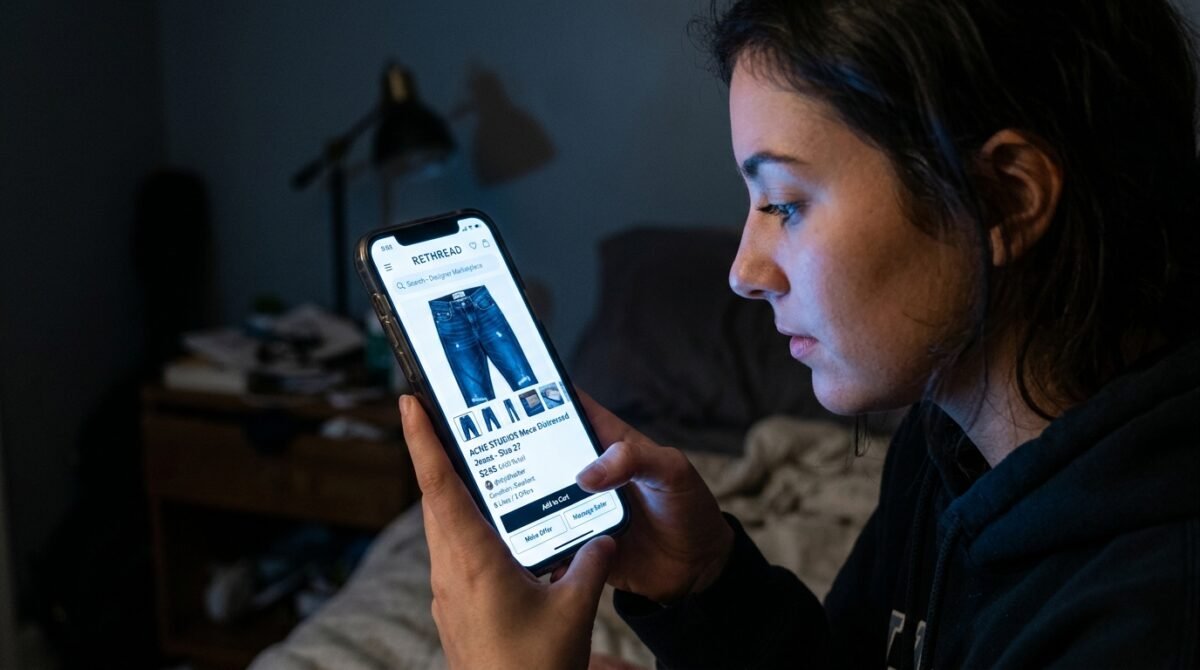
I didn’t sleep that night. Instead, I spent the dark hours combing through every resale platform available. Poshmark, Depop, Grailed—you name it, I refreshed it. It was around 3:00 AM when I found the first one. It was a pair of vintage 2003 Dior denim flares. The seller’s username was ‘S_Style_Finds’. The background of the photo was unmistakable: my cream-colored Moroccan rug.
My stomach churned. I clicked on the profile, and my eyes widened. There were five more items. A pair of custom-distressed Evisu, a limited edition Gaultier skirt, and a rare pair of vintage Chanel jeans I had hunted for over two years. The prices were listed at a fraction of their worth, clearly intended for a quick flip. She wasn’t even trying to hide it; she was just incredibly arrogant.
I took screenshots of everything. I saved the descriptions, the photos, the timestamps, and the user profile. I realized then that I needed proof of ownership, so I began digging through my digital archives. I found old confirmation emails from luxury retailers, bank statements showing the transactions, and even old social media posts where I was wearing the items years prior. Every piece of evidence was a nail in the coffin of our friendship.
“I see you’re selling my Dior flares on your page, Sarah. Do you want to explain why they are being photographed on my rug, in my apartment, while I was out of the country?”
— My message to Sarah, sent at 4:15 AM
She didn’t respond immediately. I watched the ‘delivered’ status on the message like a hawk. It stayed that way for hours. I felt like a coiled spring, ready to snap at the slightest provocation. When I finally saw the ‘typing…’ bubble appear, I felt sick. She was going to lie. She was going to gaslight me, and I was ready for it.
She replied saying her account had been ‘hacked’ and that she didn’t know how those photos got there. She claimed she had been helping a ‘friend of a friend’ list some items and must have been duped. It was the lamest, most transparent excuse I had ever heard. I didn’t even argue. I just screenshotted her response and sent it to my lawyer, who I had already decided to call the moment the law offices opened.
The Confrontation at the Coffee Shop

We met at a crowded cafe downtown. I wanted a public setting where she couldn’t make a scene. She showed up wearing one of my silk blouses—I recognized it immediately—and carrying a bag that I was ninety percent sure was mine as well. The sheer audacity of her walking in wearing my stolen property made me want to scream, but I kept my composure. I had a folder of papers on the table, a stark contrast to her breezy, ‘everything is fine’ attitude.
She started by trying to play the victim, acting like I was being dramatic for even bringing it up. ‘You have so much, why does it matter if I sold a few pairs? You don’t even wear them anymore!’ she said, as if that justified theft. The moral bankruptcy of the statement was breathtaking. She genuinely believed that because she felt I had ‘excess,’ she was entitled to redistribute it to solve her own financial problems.
“You are talking about thousands of dollars of my property, Sarah. This isn’t borrowing. This is theft. You violated my trust, my home, and my legal rights. I want the items back, or I want the equivalent cash value. Today.”
— Me, during the face-to-face confrontation
She laughed, a sharp, dismissive sound that echoed in the small coffee shop. She told me I was ‘losing it’ and that if I tried to sue her, I would look like a crazy person. She clearly thought she had the upper hand because of our history. She thought I would be too sentimental about our friendship to actually file a report. She was wrong. Friendship died the moment she treated my property like her personal piggy bank.
I handed her the document I had printed. It was a formal demand letter, detailing every item, the current market value, and the screenshots of her resale listings. Her face went pale as she read through the pages. The breezy attitude vanished, replaced by a frantic, nervous energy. She started stammering, trying to backtrack, but the game was already over. I stood up, left my half-finished coffee, and walked out without looking back.
The Legal Tangle and Small Claims Strategy

The process of filing in small claims court was surprisingly straightforward but emotionally draining. I had to categorize every item, provide receipts or proof of purchase, and attach the evidence of the theft. The court clerk was helpful, but looking at the forms reminded me of every memory associated with those clothes. Each pair of jeans represented a milestone—a trip to Japan, a promotion, a birthday gift to myself. Sarah had turned my history into a liquidation sale.
I hired a consultant who specialized in vintage fashion appraisal to give me a certified value for each missing item. It wasn’t cheap, but it was necessary. I needed to prove that these weren’t just ‘used pants,’ but collectible assets. The total came to over $14,000. It was a sobering number. I wondered if she had even managed to make that much, or if she had sold them for pennies to satisfy her own immediate debt.
Sarah tried to reach out multiple times during the weeks leading up to the court date. She sent long, rambling texts about how sorry she was, how she was going through a ‘rough patch,’ and how we could ‘work this out’ without the court. I didn’t reply to a single one. Every message was just another piece of evidence for the judge to see that she had no remorse, only fear of the consequences.
“Please, let’s just talk. I was so stressed about my rent and I panicked. I know it was wrong, but you’re my best friend. We can fix this. Don’t do this to me.”
— One of dozens of desperate texts sent by Sarah
I focused on my work and my own healing. I realized that my attachment to these items was also a way of holding onto the past, and seeing them gone, while painful, allowed me to clear out the emotional baggage along with the physical. I practiced my testimony in front of a mirror, ensuring I wouldn’t let my anger overshadow the facts. The law cares about ownership, not feelings, and I had to keep that distinction clear.
The day of the court hearing finally arrived. I wore a simple, professional outfit—nothing from my former collection. I wanted to appear composed and reasonable. Sarah showed up looking disheveled, clearly having not prepared nearly as well as I had. She looked at me in the hallway, eyes pleading, but I just looked through her. The bridge was not just burned; it had been demolished.
The Day in Court: Justice or Just Pain?

The courtroom was small and smelled faintly of floor wax and old paper. The judge was a no-nonsense woman who looked like she had seen a thousand cases just like this one. When the clerk called our names, I felt a strange sense of detachment. This was it. The culmination of months of stress, sleepless nights, and the slow unraveling of a decade of trust. Sarah sat next to me, her leg bouncing nervously under the table.
I laid out my case calmly. I presented the photos of the empty closet, the screenshots of the listings, and the appraisal documents. The judge asked Sarah if she had taken the items. She hesitated, then tried to argue that she had ‘permission’ because we always shared things. The judge cut her off immediately. Permission to borrow is not permission to sell, and she knew it.
The cross-examination was brutal. The judge asked Sarah how she could justify selling items that didn’t belong to her. Sarah tried to use the ‘I was desperate’ defense, but the judge was having none of it. ‘Desperation does not grant you the right to liquidate another person’s property,’ she stated firmly. I felt a wave of vindication, but it wasn’t the triumphant moment I expected. It was just sad.
“Your honor, I value the friendship, but I value the principle of property ownership more. I gave her the keys to my home, not the right to my life’s collection.”
— My closing statement to the judge
The judge took a moment to review the documents. The silence in the room was deafening. I looked at Sarah; she looked like a child caught stealing candy. All the years of our friendship felt like a fever dream. Had I ever really known her? Or had I been projecting a version of her that didn’t exist, someone who respected boundaries as much as I did?
The verdict was in my favor. The judge ordered Sarah to pay the full value of the items, plus legal fees and interest. It was a total victory on paper. But as we walked out of the courtroom, I didn’t feel like celebrating. The money would eventually come, but the trust was gone forever. And that, I realized, was a debt that could never be repaid.
The Aftermath: When the Dust Settles

The weeks following the court case were strange. I received the first payment installment, but it was just a wire transfer. No apology, no explanation, no closure. Just a notification from my bank. I started rebuilding my life, piece by piece. I changed the locks, installed a new security system, and—most importantly—I started being more selective about who I let into my inner circle.
I found myself looking at my remaining clothes differently. They were just clothes again, not armor or symbols of status. I started donating the pieces I didn’t love, thinning out my collection until it was manageable and truly mine. I stopped caring about the ‘rare’ tags or the resale value. I wanted a closet that felt like a sanctuary, not a vault.
Mutual friends reached out, some taking sides, some trying to stay neutral. I learned quickly who actually cared about me and who was just there for the drama. It was a hard pruning of my social life, but a necessary one. I lost a best friend, but I gained a much clearer understanding of what a real friendship looks like: it’s built on respect, not convenience.
“I thought we were sisters. I didn’t think a few pairs of jeans would end a ten-year relationship. You’re being so cold.”
— A final, resentful text from Sarah after the judgment
I deleted her number that day. I didn’t reply to the ‘cold’ accusation. She was right; I was cold. I had to be. If I had let her warmth and excuses back in, I would have been back at square one, wondering what else she would decide was hers to take. The boundary wasn’t a wall I built to keep her out; it was a floor I built to stand on.
Sometimes I walk past a boutique and see a pair of vintage denim that reminds me of one I lost, and I don’t feel the sting anymore. It’s just fabric. It’s just a trend. The real lesson wasn’t about the jeans, and it wasn’t even about the money. It was about realizing that you can’t force someone to be the person you need them to be, and that sometimes, the hardest decisions are the ones that save your own life.
Reddit Weighs In: The Community Verdict

When I finally posted my story on a popular forum, I didn’t expect the level of support I received. Thousands of people commented, shared their own horror stories of toxic friendships, and offered advice on how to move forward. The consensus was overwhelmingly on my side, which was a relief. I had spent so long wondering if I was the ‘villain’ for taking a friend to court, and the internet confirmed that I was merely protecting myself.
There were, of course, the contrarians. Some people argued that I should have handled it ‘privately’ without legal intervention, as if theft is a private matter. They talked about the ‘sanctity of friendship’ as if that gives someone carte blanche to exploit you. I read those comments and just shook my head. They clearly hadn’t had someone they trusted turn their life into an auction house.
“NTA. Your friend didn’t just steal clothes; she violated your privacy and your trust. People like this always play the victim when they’re held accountable. Good for you for not backing down.”
— u/FashionLawyer99 (Top Comment, 32.4k upvotes)
“I had a roommate do something similar with my jewelry. I didn’t sue, and I regret it every day because she just moved on to the next person. You did the right thing, not just for yourself, but to stop her from doing it to someone else.”
— u/BurnedBefore (15.2k upvotes)
Seeing the community validate my decision was incredibly healing. It made me realize that I wasn’t alone in this experience. There is a whole subculture of people who have been ‘used’ by friends who feel entitled to their success or their belongings. Reading their stories helped me detach from the guilt I had been carrying. I wasn’t ‘mean’; I was responsible.
The sheer volume of responses made me realize that this is a common, if rarely discussed, type of betrayal. We talk about romantic cheating, but we don’t talk enough about the ‘theft of agency’ that happens in toxic friendships. The Reddit threads became a repository for others who needed to know that they, too, could stand up for themselves. It was a digital community of people learning to set boundaries.
Lessons in Property, Privacy, and Pride

Looking back, the entire ordeal feels like a strange fever dream. I often wonder what Sarah is doing now. Is she still selling things that don’t belong to her? Is she still finding people who are ‘too kind’ to report her? I hope she found a way to work through whatever issues drove her to such extreme behavior, but I know better than to check in. Her growth is no longer my responsibility.
I’ve learned a lot about the value of ‘stuff.’ We attach so much of our identity to what we own, especially when it comes to fashion. We treat our belongings as extensions of our personalities. When someone attacks our belongings, it feels like they are attacking us. But the truth is, I am not my denim. I am the person who worked hard to earn them, and I am the person who had the strength to walk away from a toxic dynamic.
My advice to anyone facing a similar situation is simple: document everything. Do not rely on ‘the friendship’ to resolve a legal issue. Treat the theft as what it is—a crime. The emotional weight of the situation will try to stop you from acting, but you have to push through it. If you don’t stand up for your boundaries, no one else will do it for you. And trust me, the relief of knowing you did the right thing is worth far more than any pair of jeans.
“Boundaries are not a wall; they are the gate. You decide who gets to come in, and you decide who stays based on how they treat you. Don’t be afraid to lock the gate.”
— Advice from a therapist I saw during the process
I feel lighter now. My home is a space that belongs to me and only me. I invite people over, but I don’t give out my keys like candy anymore. I’ve learned to appreciate the people who respect my boundaries without me having to state them. It’s a different kind of friendship—one that feels stable, secure, and incredibly rewarding. And honestly, that is the most fashionable thing I own.
The Financial Breakdown of the Betrayal

When the dust settled and the final restitution was calculated, it was eye-opening to see the numbers laid out in black and white. It wasn’t just about the retail price of the items; it was the time spent, the emotional labor, and the legal costs. I created a ledger not just for the court, but for my own closure—a way to quantify the damage done to my life.
| Category | Details | Value/Impact |
|---|---|---|
| Designer Denim | 20 pairs (Dior, Evisu, Gucci) | $14,200 |
| Legal Fees | Filing, Appraisal, Consultation | $2,450 |
| Emotional Toll | Therapy and Lost Productivity | Inestimable |
| Friendship Equity | 10 Years of Shared History | Zero |
The financial loss was significant, but the ‘Friendship Equity’ line item is the one that still stings the most. How do you value ten years of birthdays, holidays, and shared secrets? You don’t. You just write it off as a bad investment and move on. The court can return the money, but it cannot return the decade of trust that was eroded by a series of selfish, short-sighted decisions.
I used the returned funds to start an emergency savings account—a ‘freedom fund.’ It’s the most boring, practical thing I could have done with the money, but it gives me a sense of security that no pair of designer jeans ever could. It’s a reminder that I am capable of taking care of myself and that I don’t need to depend on others for my financial or emotional well-being.
If you are currently in a situation where a friend is ‘borrowing’ your things, my advice is to look at the numbers. Don’t just look at the items; look at the pattern. Does this person respect your boundaries? Do they value your property as much as you do? If the answer is no, start protecting yourself now. Don’t wait until your closet is empty to realize that your ‘friend’ isn’t really your friend at all.
Moving Forward: Redefining Value

I am in a much better place today. The legal battle is a distant memory, a chapter in a book I’ve already finished reading. I have a new group of friends—people who value integrity over convenience and who would never, ever dream of touching my things without asking. It’s refreshing to be around people who bring out the best in me, rather than those who see me as a resource to be tapped.
I’ve also started a new hobby: upcycling. Instead of hunting for expensive vintage, I take basic, affordable pieces and customize them. It’s much more creative, and it’s something that no one can ‘steal’ or ‘resell’ because it’s uniquely mine. It’s a way of reclaiming the joy of fashion without the baggage of consumerism and material obsession.
I hope that if you’re reading this and you’re in a similar spot, you find the courage to do what is necessary. You are not a bad person for holding people accountable. You are not a bad friend for expecting respect. You are simply a person who deserves to live in a world where your trust is treated with care. And if someone fails to do that, you are allowed to walk away.
“I learned that the best way to handle a betrayal is to focus on your own future, not the person who betrayed you. Don’t let them take up any more space in your mind.”
— My personal mantra for recovery
The journey from the empty closet to the courtroom and beyond has been a long one, but it was worth every step. I’ve grown in ways I didn’t think possible, and I’ve learned that the most important things in life aren’t things at all. They are the values you hold, the boundaries you set, and the peace of mind you earn when you finally take control of your own life.
Conclusion
In the end, this experience wasn’t about the denim. It was about the realization that we often sacrifice our own comfort and safety to maintain an image of friendship that no longer serves us. I sued my best friend not because I wanted to be petty, but because I wanted to be heard—and ultimately, I needed to protect the life I had worked so hard to build.
The legal judgment was a formal recognition of the wrong that was done to me, but the true victory was internal. I learned that I am capable of standing my ground, even when it feels like the world is collapsing around me. I learned that true friends don’t demand your things, and that a ‘best friend’ who makes you feel like an inventory manager is not a friend at all.
We all have boundaries. Some are physical, like the locks on our doors or the inventory in our closets. Others are emotional, the lines we draw to protect our mental health. When those boundaries are crossed, it is our responsibility to assert them, regardless of the discomfort it causes. It might cost you a relationship, but it will save your peace of mind.
What about you? Have you ever had a friend or family member violate your trust in a way that forced you to change your life? How did you handle it? Let me know in the comments below, and let’s start a conversation about boundaries, betrayal, and the resilience it takes to rebuild.
What's your verdict on this dilemma?
Vote below to contribute to the official community consensus.

Have a Dilemma Keeping You Up at Night?
Share your real-life feud, wedding chaos, or relationship crossroads anonymously with our editorial team.
What do you think ?
0 Comments🛡️ Comments are moderated to protect community integrity. Your comment will appear once approved by the editorial team.