
It began, as so many family tragedies do, with a text message that sounded deceptively casual. My sister, Sarah, has always operated under the assumption that the world—and specifically, our late grandmother’s estate—is a bottomless well from which she can draw whenever her latest get-rich-quick scheme hits a snag. I, on the other hand, have spent years acting as the executor and guardian of our family history, trying to preserve the few physical remnants of a woman who shaped our childhoods with grace and discipline.
The tension had been simmering for months. Sarah’s ’boutique dog grooming mobile salon’ had folded, and she was currently pivoting to ‘organic holistic lifestyle coaching,’ a venture that required, in her words, ‘a small injection of capital to jumpstart the marketing phase.’ She asked for five thousand dollars, money that was tied up in repair costs for the family home we were preparing to list. I told her no. It wasn’t a malicious no; it was a mathematical one. I simply didn’t have it, and even if I did, the money was earmarked for the probate process.
I never imagined that the denial of a loan would trigger an act of literal, violent destruction. The table was the centerpiece of my grandmother’s dining room for over a century—a heavy, rich mahogany piece that had survived wars, moves, and generations of chaotic holiday dinners. It was sturdy, beautiful, and irreplaceable. It was also, as I would soon discover, the target of Sarah’s misguided, vengeful rage.
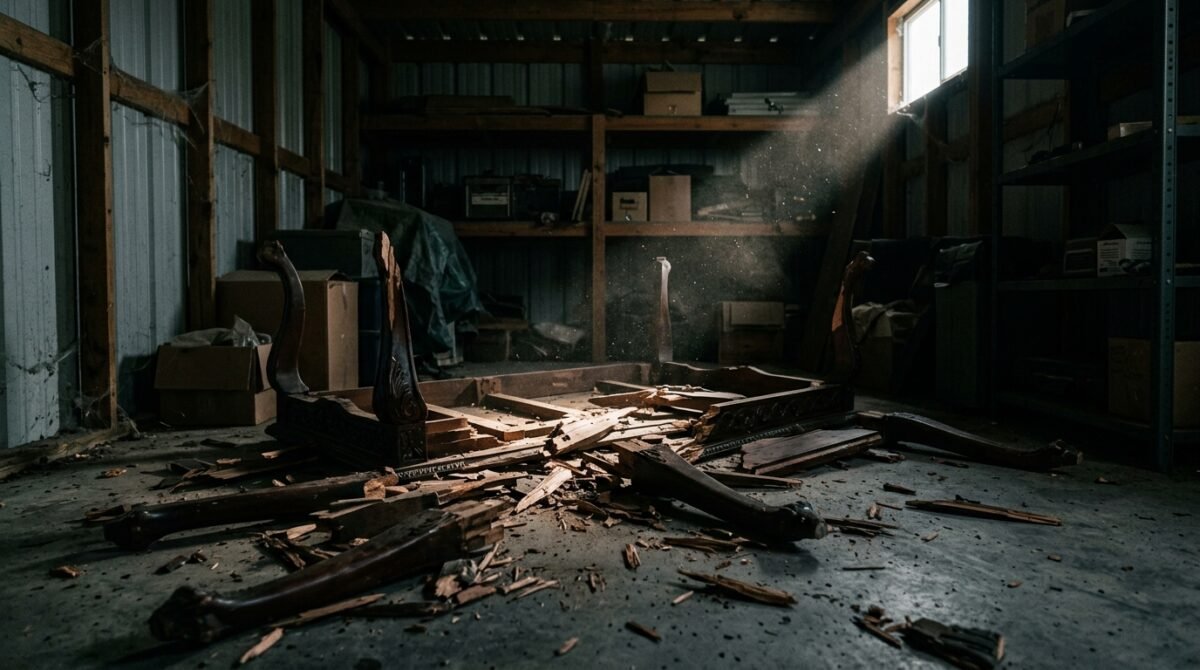
When I arrived at the storage unit three days later, the air felt thick with a strange, biting scent. It wasn’t the smell of damp wood or old cardboard; it was the sharp, resinous tang of freshly exposed mahogany heartwood. I unlocked the metal rolling door, expecting to see the neatly wrapped furniture I had left behind. Instead, I saw a jagged, splintered graveyard. The table had been hacked into pieces, the legs severed, the surface carved into unrecognizable chunks. It wasn’t just ruined; it was systematically dismantled.
This story isn’t just about furniture. It’s about the devastating realization that some people view the world not as a space for shared heritage, but as a collection of resources to be exploited. When I confronted Sarah, her response was so calm, so terrifyingly entitled, that I realized I wasn’t just dealing with a frustrated sibling—I was dealing with someone who had completely detached from the reality of our shared history.
The Five-Thousand-Dollar Marketing Fantasy

The request came in on a Tuesday, right as I was finalizing the appraisal for the estate. Sarah didn’t ask; she demanded, framing the loan as an investment in our collective future. She spoke about her ‘brand’ and her ‘vision’ as if they were established realities rather than fleeting, expensive hobbies.
I sat at my kitchen table, staring at the screen of my phone, feeling that familiar knot of anxiety tighten in my chest. Sarah had already burned through her portion of the inheritance three years ago, fueled by a series of ‘sure-fire’ investments. This time, she needed the cash to launch a social media presence, hire a consultant, and buy an expensive inventory of herbal supplements that she planned to resell.
“I’m not asking for a handout, I’m asking for a bridge loan. If you don’t give me this, you’re basically sabotaging my career before it starts. Don’t you want to see me succeed? Or do you just want to hoard everything for yourself?”
— Sarah (Text message sent at 11:42 PM)
I responded with the patience of a saint, or at least someone who had been doing this for a long time. I explained the state of the estate, the pending legal fees, and the fact that the money simply wasn’t liquid. I suggested she look into a standard small business loan, a suggestion that felt like an insult to her ears.
Her reply was curt, cold, and final. She didn’t argue the finances; she just shifted the goalpost. She stopped responding to my detailed explanations about legal obligations and started posting cryptic, status-seeking updates on her social media. I felt the shift, a sudden coldness in our dynamic that warned of something worse than a simple argument.
I spent the rest of the week distracted, unable to focus on the home staging. I kept thinking about her tone—that underlying bitterness that suggested she wasn’t just angry, but deeply resentful of the fact that I held the keys to the kingdom. I should have changed the access code to the storage unit, but I never thought she’d go there. That was my first, and perhaps most significant, mistake.
The Discovery of the Splintered Mahogany
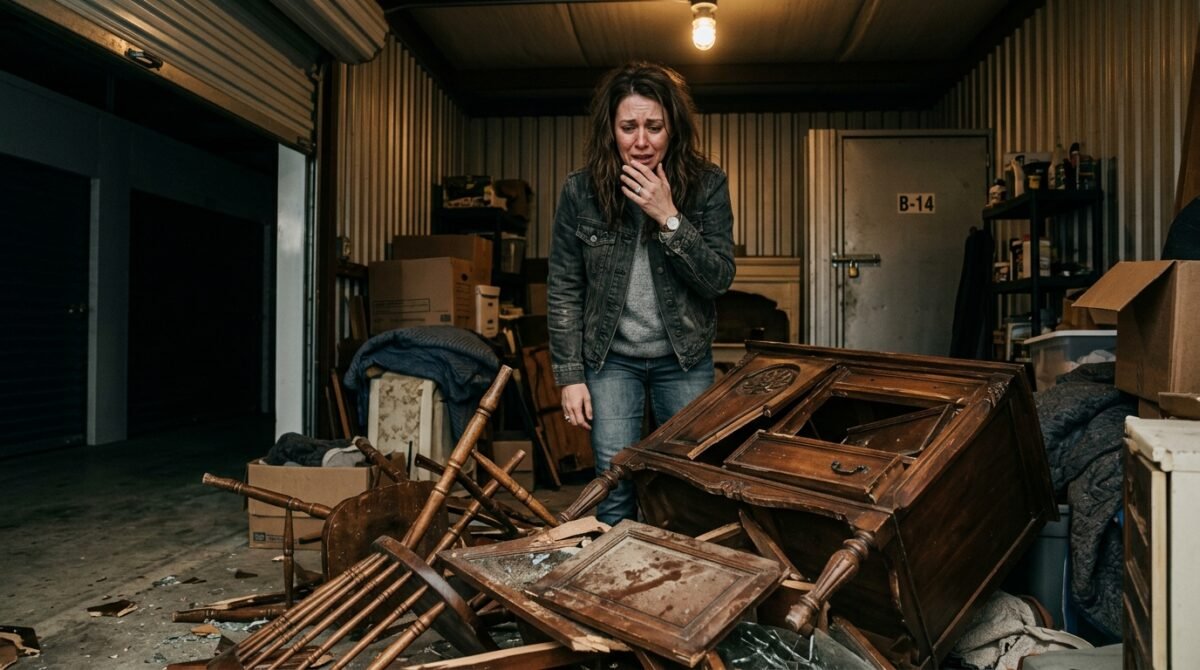
When I finally pulled the heavy steel door of the storage unit open, my heart didn’t just sink; it felt like it stopped entirely. The smell hit me first—the raw, deep scent of mahogany, so familiar and comforting, now ruined by the harshness of a violent intrusion. On the ground, scattered like trash, lay the remnants of what had been our grandmother’s pride and joy.
The table was gone. In its place were hacked-up segments, the wood grain exposed and raw. I walked into the space, my boots crunching on the wood chips. I picked up a piece of the table leg. It was heavy, solid, and completely destroyed. My hands began to shake, and I felt a wave of nausea wash over me. This wasn’t just a piece of furniture; it was a connection to a woman who had taught us how to be kind, how to be patient, and how to respect the things that mattered.
I stood there for a long time, staring at the debris, trying to understand the logic behind the destruction. Did she think that by breaking it, she was somehow taking back what was ‘hers’? Was it an act of sheer, impulsive destruction, or was it a calculated strike at my heart? It was the most senseless thing I had ever witnessed.
I pulled out my phone and took photos. Not for social media, but for evidence. I felt like a stranger in my own life, documenting the wreckage of my family tree. Every piece of the table represented a memory—the time we carved our names into the underside, the Thanksgiving dinners where the table held the weight of a dozen people and enough food to feed a village.
I didn’t call her immediately. I couldn’t. If I had spoken to her right then, I would have said things that could never be unsaid. Instead, I drove home, the silence in the car ringing in my ears, and sat in my driveway for an hour, just breathing, trying to process the absolute, cold-blooded malice of it all.
The Confrontation of True Colors

I didn’t have to call her. When I finally walked through my front door, she was sitting on my porch, drinking a latte, as if nothing had happened. She looked up at me with a smirk that didn’t quite reach her eyes. She knew. She had been waiting for me to see it, waiting to see the look on my face.
I didn’t yell. I didn’t scream. I walked up to her, pulled out my phone, and showed her the pictures of the destroyed table. She didn’t flinch. She took a sip of her drink and shrugged, a casual movement that was more violent than any shout.
“You said you didn’t have the money to help me. That table was worth a lot, wasn’t it? I figured if I couldn’t have the cash, I’d take the value another way. Besides, it was just taking up space in that unit. I needed firewood for the fire pit this weekend, and I didn’t want to buy any. It’s practical, don’t you think?”
— Sarah (During the confrontation on the front porch)
I stared at her, genuinely unable to comprehend the level of detachment. She was talking about a hundred-year-old heirloom as if it were a bag of charcoal from the hardware store. The arrogance was staggering. She didn’t just destroy the table; she destroyed the very idea that our grandmother’s history had any value beyond its immediate utility to her.
“It was for firewood?” I whispered, my voice thick with disbelief. “You chopped up a piece of our history for a weekend fire?” She stood up, her expression turning from smug to defensive, the mask finally starting to slip. She started talking about how ‘unfair’ it was that I controlled everything, how ‘stifling’ it was to have to ask for permission to access assets that were technically half hers.
“You’re just like them,” she said, her voice rising now. “You want to keep everything behind glass, preserved and dead. I’m living, I’m trying to move forward, and all you want to do is cling to the past.” I realized then that there was no reasoning with her. She had rewritten the narrative to make herself the victim, and in her mind, the destruction of the table was a righteous act of liberation.
The Family Group Chat Explosion

The fallout wasn’t contained to just the two of us. Sarah, in an attempt to get ahead of the story, took to the family group chat. She framed the entire incident as a ‘misunderstanding’ and accused me of being ‘overly sentimental’ about a ‘rotting piece of wood’ that she had ‘repurposed’ for the family gathering.
The chat exploded. My aunt, who had always doted on Sarah, was the first to chime in, horrified by the news. My cousins, who remembered the table from their own childhoods, were equally incensed. Sarah, however, doubled down, spinning a narrative where I was the one who had ‘neglected’ the table, letting it sit in a damp unit until it was ‘virtually worthless.’
“Honestly, the wood was already warped from the humidity in that unit. I did us all a favor by clearing it out. OP is just using this to play the martyr again. It’s just wood, people. Can we focus on the real issue, which is my business plan?”
— Sarah (Family Group Chat)
The responses were swift and brutal. My uncle, the family patriarch, didn’t mince words. He called it an act of ‘vandalism’ and ‘disrespect’ that was beyond the pale. The chat became a battlefield, with people taking sides based on old grudges and hidden biases. It was a chaotic, toxic mess that proved one thing: the family was fracturing, and the table was the fault line.
I watched the messages scroll by, feeling a strange sense of detachment. I didn’t defend myself. I didn’t need to. The sheer absurdity of her argument—that destruction is a form of ‘clearing out’—was so transparent that it spoke for itself. I realized then that my relationship with my sister was effectively over, not because of the table, but because of what the table revealed about her character.
By the end of the night, the group chat was muted. I couldn’t look at it anymore. The constant buzzing of notifications, the bickering, the defenses, and the accusations—it was all just noise. I walked away from the phone and went to bed, feeling a heavy, permanent silence settling over the house. It was a silence I knew I would be living with for a very long time.
The Legal Reality of Inheritance
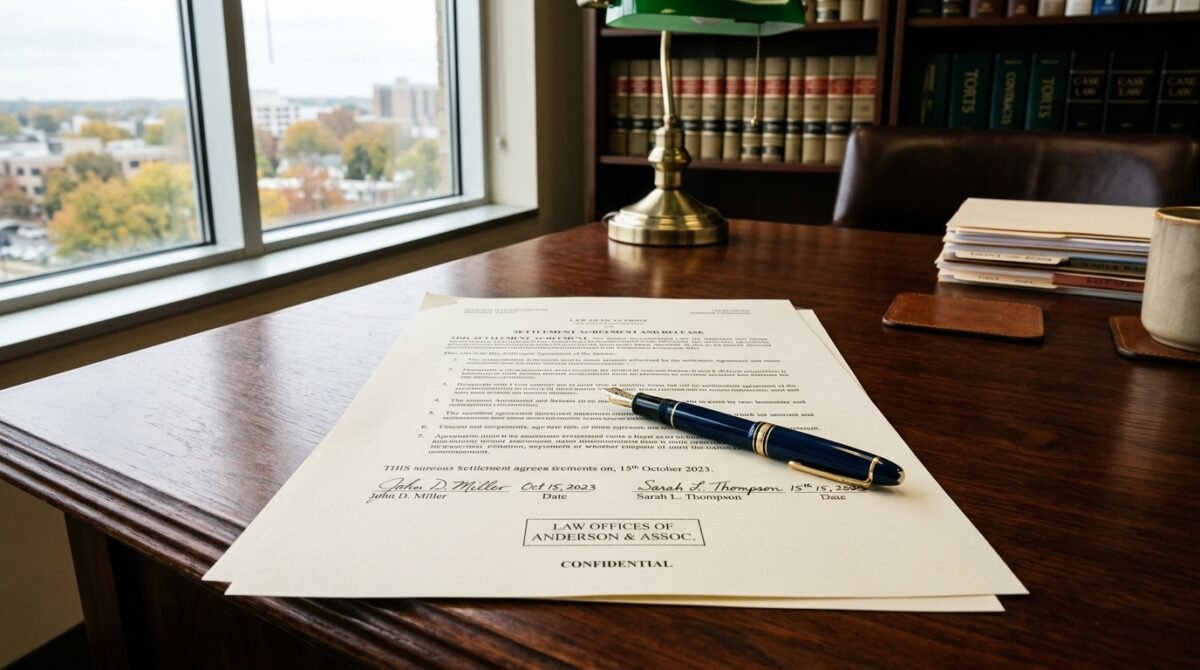
The next day, I called the estate attorney. I had to know where I stood legally. If she thought the table was hers to do with as she pleased, she was sorely mistaken. The attorney was grim. He explained that since the estate was in probate, Sarah had zero legal authority to touch any of the assets, let alone destroy them. It was, in the eyes of the law, a clear-cut case of destruction of property.
He asked if I wanted to file a report. I hesitated. Filing a police report against your own sister is a line you can’t cross back from. But as I sat there, thinking about the look on her face when she told me it was ‘just firewood,’ I realized that she had already crossed that line. She hadn’t seen me as a sister; she had seen me as an obstacle.
We discussed the financial implications. The table, being a rare mahogany piece from a specific era, had an appraisal value that far exceeded what she had asked for in the loan. It wasn’t just a piece of furniture; it was a significant asset. By destroying it, she hadn’t just ‘repurposed’ wood—she had committed a crime against the estate.
“This changes everything,” the attorney said, his voice measured. “If you file, this becomes a matter for the court. She will have to answer for the damages, and it could impact her share of the inheritance. Are you prepared for that?” I nodded. I was prepared for anything, as long as it meant she could no longer hold the family’s history hostage to her whims.
The decision felt like an amputation. It was painful, necessary, and final. I wasn’t just protecting a table; I was protecting the legacy of a woman who didn’t deserve to have her life’s belongings treated with such utter, blatant disregard. I signed the paperwork, my hand steady for the first time in days.
The Reddit Community Weighs In

I posted my story on a popular forum, not looking for validation, but for a reality check. Was I crazy for filing? Was I the one being ‘stifling’? The response was overwhelming. Thousands of people weighed in, their comments ranging from shock to practical advice, to shared experiences of toxic family members.
“This isn’t just about a table. This is about a person who believes they are entitled to anything they want, and if they can’t have it, they will burn it to the ground. OP, you are NTA. Please, for the love of god, cut this person out of your life before they destroy something even more irreplaceable—like your sanity or your future.”
— u/FamilyDramaExpert (Top Comment, 32.1k upvotes)
The sentiment was nearly unanimous. People identified the pattern immediately: the financial entitlement, the manipulation, the gaslighting, and the ultimate act of destruction. They shared their own stories of ‘black sheep’ siblings who used the guilt of the family unit to excuse their worst impulses. It was comforting, in a way, to know that I wasn’t alone in this specific, painful corner of the world.
Others were more pragmatic, warning me about the legal complexities. They advised me to keep every record, every text, every email. They reminded me that Sarah would likely try to play the ‘troubled sibling’ card, and that I needed to be ready to counter that narrative with the cold, hard facts of the damage she had caused.
Reading the comments, I felt a weight lift. The internet, for all its faults, provided a mirror for my own situation. Seeing it laid out so clearly helped me detach from the emotional cloud I had been living under. I wasn’t the bad guy. I was the person who had been pushed, shoved, and finally broken, and I was doing what I had to do to survive.
I spent the night reading through the threads, noting the advice, and feeling a sense of resolution. The drama wasn’t over, but I knew what I had to do. The boundaries were clear now, drawn in the wreckage of the mahogany table, and I had no intention of letting her step over them ever again.
The Silence of the Empty Unit
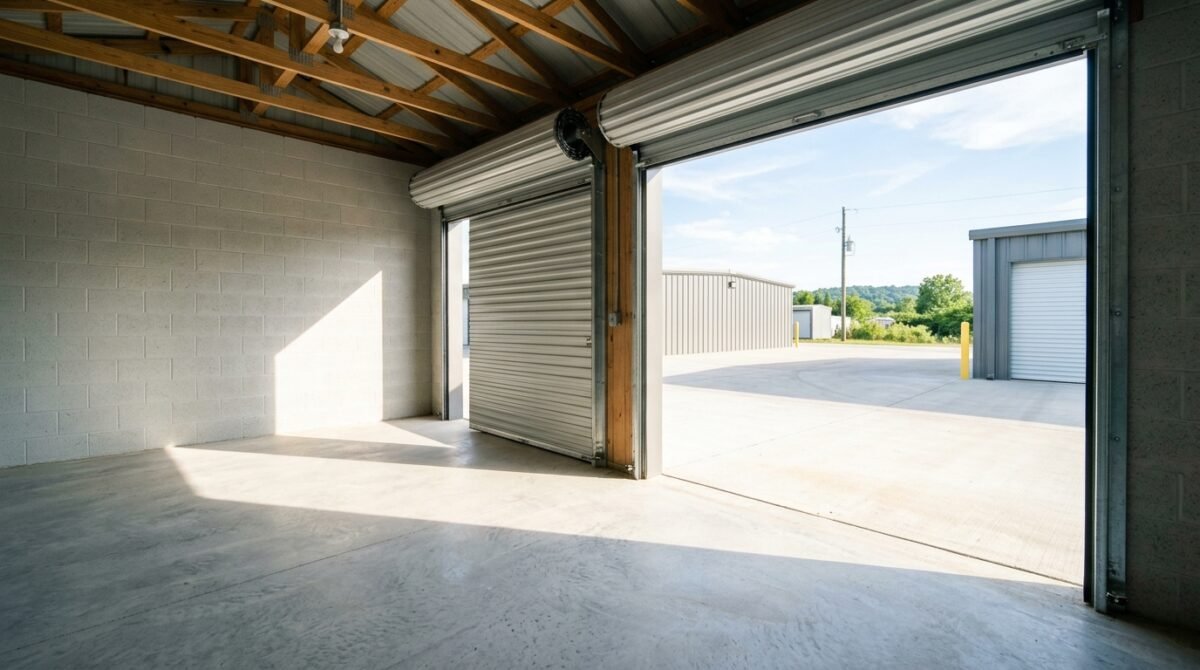
Returning to the storage unit a week later, I brought a professional cleaner to handle the debris. I couldn’t bring myself to touch it anymore. Watching the crew carefully collect the wood splinters and the shattered legs of the table was a surreal experience. Each piece they picked up was a memory, now reduced to a cataloged item for the insurance claim.
The owner of the storage facility approached me, offering his condolences. He had seen the security footage. He told me that Sarah had come in at 3 AM, looking frantic, with an axe she had clearly purchased just for the occasion. It wasn’t a crime of passion; it was a planned, deliberate attack. Knowing that she had spent hours hacking away at the wood in the middle of the night made my skin crawl.
I looked at the now-empty space where the table used to sit. It felt bigger, emptier, and colder. It wasn’t just the table that was missing; it was the illusion that my sister was someone I could rely on. I realized that for years, I had been making excuses for her, covering for her, and trying to ‘save’ her from her own bad decisions. But you can’t save someone who doesn’t want to be saved.
I sat on the floor of the empty unit, letting the silence wrap around me. There was a sense of peace in the finality of it. The bridge hadn’t just been burned; it had been dismantled, piece by piece, and left to rot. I knew that when I walked out of that unit, I wouldn’t be looking back. The table was gone, but so was the burden of trying to keep Sarah in my life.
I left the keys with the facility manager, signed the exit papers, and walked into the bright, harsh afternoon sun. I felt lighter. The anger was still there, a hot coal in the pit of my stomach, but it was directed now, focused, and purposeful. I was done.
The Last Attempt at Manipulation

She tried one last time to reach me, a few days after the legal papers were served. A long, rambling email that started with an apology but quickly devolved into a list of my ‘failings’ as a sibling. She talked about the ‘trauma’ of our childhood, the ‘burden’ of the estate, and how I had forced her into this position by being ‘unreasonable’ about the money.
“I just wanted to feel like I was a part of something. You have the house, the money, the status. I have nothing. I didn’t mean to break the table, I just wanted to see if you would finally pay attention to me. Why are you doing this to me?”
— Sarah (Email sent at 2:00 AM)
I didn’t respond. I didn’t delete the email either; I saved it, printed it, and added it to the file. It was the perfect document for the court, a confession written in the language of a victim. She still didn’t get it. She still thought that her feelings were a valid excuse for the destruction of property. She still couldn’t understand that actions have consequences.
I realized then that she would never change. People like Sarah, who operate from a place of pure, unadulterated entitlement, don’t have the capacity for reflection. They don’t see people; they see obstacles. They don’t see heirlooms; they see currency. And they don’t see consequences; they see persecution.
I blocked her number, her email, and her social media profiles. It was the hardest thing I had ever done, but it was necessary. I needed to build a life that wasn’t defined by her drama, a life where I could breathe without waiting for the next shoe to drop. The silence from her was exactly what I needed to start healing.
The estate would be settled in time, and the court would decide the outcome. I would follow the process, let the lawyers do their work, and move forward. The mahogany table was gone, but the lesson it taught me—a hard, brutal lesson—was one that would protect me for the rest of my life.
Reflecting on the Weight of Legacy

It’s strange how objects can become the anchors for our history. That table wasn’t just wood; it was the place where my grandmother sat when she told me stories about her life, where we learned to do our homework, where the family gathered to laugh and argue. By destroying it, Sarah had tried to erase that history, to strip away the foundation of our shared past.
But she failed. She didn’t destroy the memories. The memories are mine, and they are stronger than any piece of furniture. I realize now that I was clinging to the table because I was afraid of losing the connection to my grandmother. I thought if I kept the table safe, I was keeping her alive. But the table was just a vessel. The real legacy is the strength, the kindness, and the integrity she passed on to me—things that Sarah clearly never inherited.
I’ve started to look at the other pieces of the estate with a different eye. I’m selling them, donating them, or keeping them, but I’m doing it with a sense of clarity. I’m not holding onto things out of fear. I’m holding onto them because they bring me joy, or because they are truly useful. The fear that defined my relationship with the estate is gone.
I’ve learned that boundaries aren’t just about what you keep out; they’re about what you let in. I was letting in chaos, entitlement, and destruction under the guise of family duty. I’m not doing that anymore. I’ve reclaimed my space, my time, and my peace of mind. It’s a quiet, simple life, but it’s mine.
The table is gone, but the house is quiet. And in that quiet, I finally hear the voice of the person I was always supposed to be. I am not the keeper of Sarah’s chaos. I am the guardian of my own future.
Moving Forward Into the New Normal

Life without the constant threat of family drama is, to put it mildly, refreshing. I’ve started a new project—working with a local historical society to preserve family archives, not just for my own family, but for others. I’ve found that there is a deep sense of purpose in helping people protect what matters to them, ensuring that their histories aren’t lost to the passage of time or the recklessness of others.
Sarah is currently dealing with the legal repercussions of her actions. She’s quiet, for now. I don’t know where she is, and for the first time in my life, I don’t care. The worry that used to keep me up at night has dissipated, replaced by a steady, calm resolve. I know that if she ever tries to break into my life again, I am prepared to handle it.
I still think about the table sometimes. I imagine it, not as the shattered pieces I saw in the storage unit, but as it was—sturdy, warm, and welcoming. I honor that version of it. I don’t harbor the bitterness of its end; I honor the beauty of its existence. That, I think, is the true way to deal with the past.
To anyone reading this who is currently trapped in a cycle of toxic family entitlement: you have the power to stop it. You don’t owe anyone your peace, your history, or your sanity. You are allowed to say no. You are allowed to set boundaries. And you are allowed to walk away from people who would burn your world just to see if you’d notice.
The lesson of the mahogany table is a hard one, but it is a necessary one. We are defined by what we protect, yes, but we are also defined by what we are willing to let go. And sometimes, letting go is the most powerful thing we can do.
Conclusion
The saga of the destroyed mahogany table serves as a stark reminder that some family boundaries are not suggestions, but necessities. When someone demands your resources with a sense of entitlement, it is rarely just about the money; it is about the control and the disrespect that follows. The destruction of an heirloom is a symbolic attempt to exert power over one’s heritage, but it ultimately reveals the shallowness of the perpetrator’s own values.
For me, the journey was one of moving from a place of suffocating duty to one of liberated agency. I lost a piece of furniture, but I gained a life free from the weight of someone else’s dysfunction. The table is gone, but the values it represented remain intact within me, far safer than they ever could have been in a storage unit.
What about you? Have you ever had to draw a line in the sand with family members who believe they are entitled to your assets or your labor? At what point does ‘family duty’ become a form of abuse? Share your thoughts and your own experiences in the comments below. Let’s discuss how we protect our legacies and our peace in a world that often demands we sacrifice both.
What's your verdict on this dilemma?
Vote below to contribute to the official community consensus.

Have a Dilemma Keeping You Up at Night?
Share your real-life feud, wedding chaos, or relationship crossroads anonymously with our editorial team.
What do you think ?
0 Comments🛡️ Comments are moderated to protect community integrity. Your comment will appear once approved by the editorial team.