
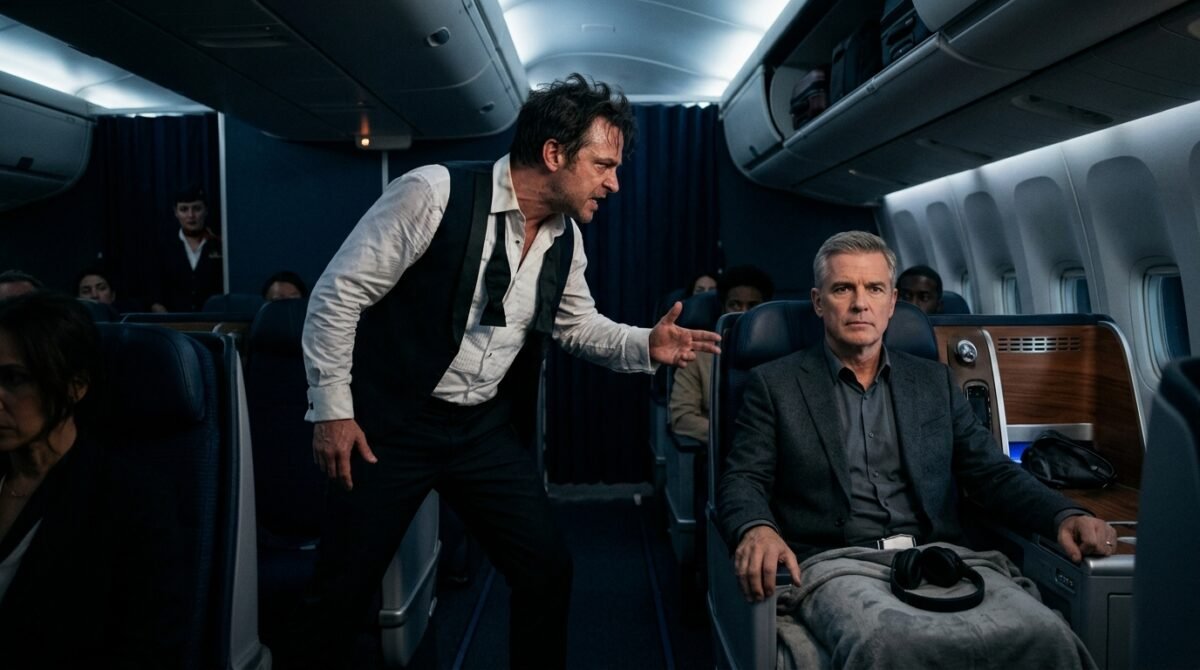
Air travel is already a high-stress environment, often defined by tight spaces, recycled air, and the sheer unpredictability of our fellow passengers. We have all faced the moral dilemma of the armrest or the reclined seat, but rarely does the situation escalate into a full-scale public spectacle. For most, a bulkhead seat—that golden ticket offering extra legroom and a barrier from the cramped rows behind—is a hard-won victory of early booking and seat selection fees.
When I boarded my flight from London to New York, I considered that seat my sanctuary. It was a long-haul journey, one where I intended to work, sleep, and arrive relatively human. I paid for the privilege, I checked in early, and I secured my space. I never imagined that my choice would lead to a confrontation involving a groom, his best man, and an entire cabin of judging passengers.
The trouble began before we even reached cruising altitude. It started with a tap on the shoulder—a polite request that rapidly devolved into a display of staggering entitlement. It was not just about a seat; it was about the assumption that my comfort was somehow less important than a newlywed’s desire to nap next to his friend. What followed was an hours-long battle of nerves that tested my resolve and forced me to stand my ground against a stranger who felt the world owed him a favor.
This story is a deep dive into the architecture of modern entitlement and the thin line between asking for a favor and demanding subservience. As the situation unfolded, I found myself at the center of a social storm, wondering if my decision to stay put made me a villain or simply a traveler who knows the value of boundaries. This is the account of the flight that taught me that sometimes, the most powerful word in your vocabulary is simply, ‘No.’
The Initial Tap on the Shoulder
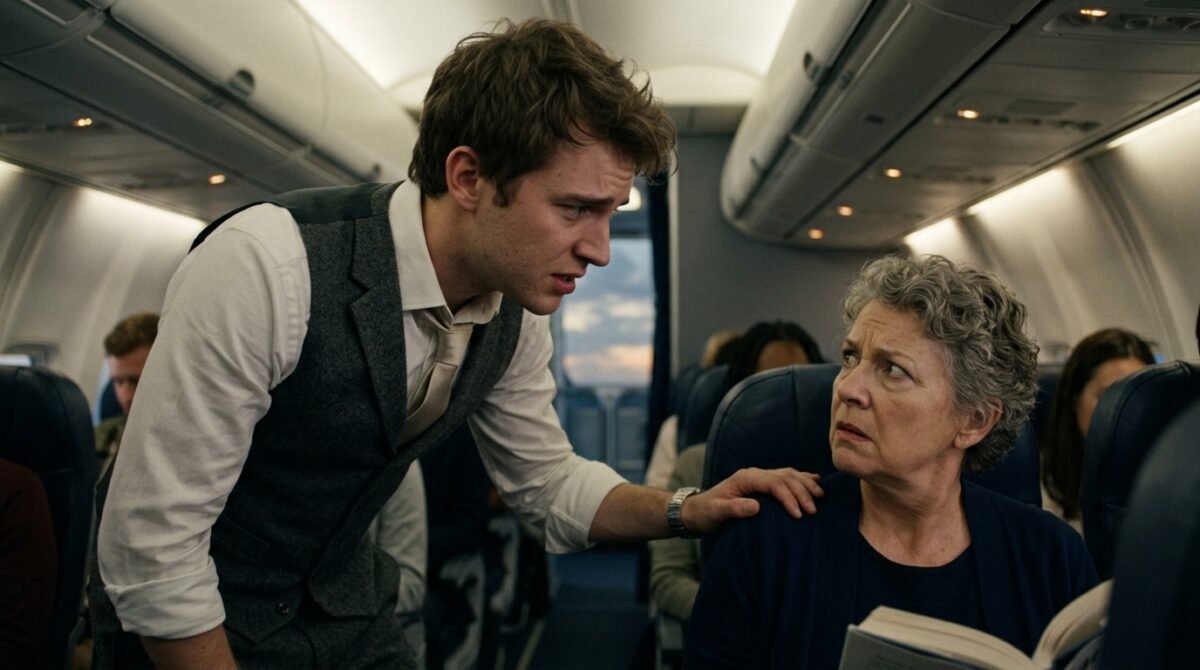
I had just settled into my seat, tucking my carry-on underneath the slight obstruction near the bulkhead wall. The cabin was buzzing with the usual pre-flight chaos—people jamming oversized bags into overhead bins, the hum of engines, and the sterile smell of disinfectant. I adjusted my noise-canceling headphones, ready to retreat into a podcast for the next eight hours. Then, I felt it: a sharp, insistent tap on my left shoulder.
I pulled my headphones down to find a man in his late twenties, still wearing a boutonniere pinned to a vest, looking down at me with an expression of mild annoyance. Beside him stood a taller man, presumably the best man, who looked significantly more embarrassed. The groom didn’t introduce himself or offer a greeting. He simply pointed at the empty seat next to me and then back to the seat behind us.
“Hey, look, we’re heading to a destination wedding and my buddy and I really need to catch up on some sleep. You’re in the bulkhead, and I’m in the row behind. Would you mind swapping with me so we can sit together? It’s just for the flight, it’s not that big of a deal.”
— The Groom
I blinked, taken aback by the casual assumption that I would willingly trade a bulkhead seat with significant legroom for a standard seat in a middle row. I had specifically paid an extra $150 for this seat months in advance, knowing I had a long day of meetings ahead of me. To me, it was a business necessity; to him, it was just a minor inconvenience.
I politely explained that I had paid specifically for this seat for the legroom and that I wouldn’t be moving. The groom’s face shifted instantly from ‘casual request’ to ‘incredulous shock.’ He seemed genuinely unable to process the concept of a stranger prioritizing their own comfort over his social convenience. He stood there for a beat longer than necessary, as if expecting me to change my mind if he just stared long enough.
The best man nudged him, clearly wanting to avoid a scene before the plane even took off. The groom finally sighed, threw his hands up in a theatrical display of disappointment, and muttered something to his friend about people being ‘incredibly selfish’ these days. They turned and squeezed into their assigned seats, leaving me to wonder if this was going to be the longest flight of my life.
The Escalating Passive-Aggression
The takeoff went smoothly, but the tension in the immediate vicinity was palpable. Every time the groom shifted in his seat behind me, I felt the chair shake. He was clearly trying to make his frustration known, kicking the back of my seat with enough force to be annoying but not enough to be considered a direct assault. It was the petty, calculated behavior of someone who felt slighted.
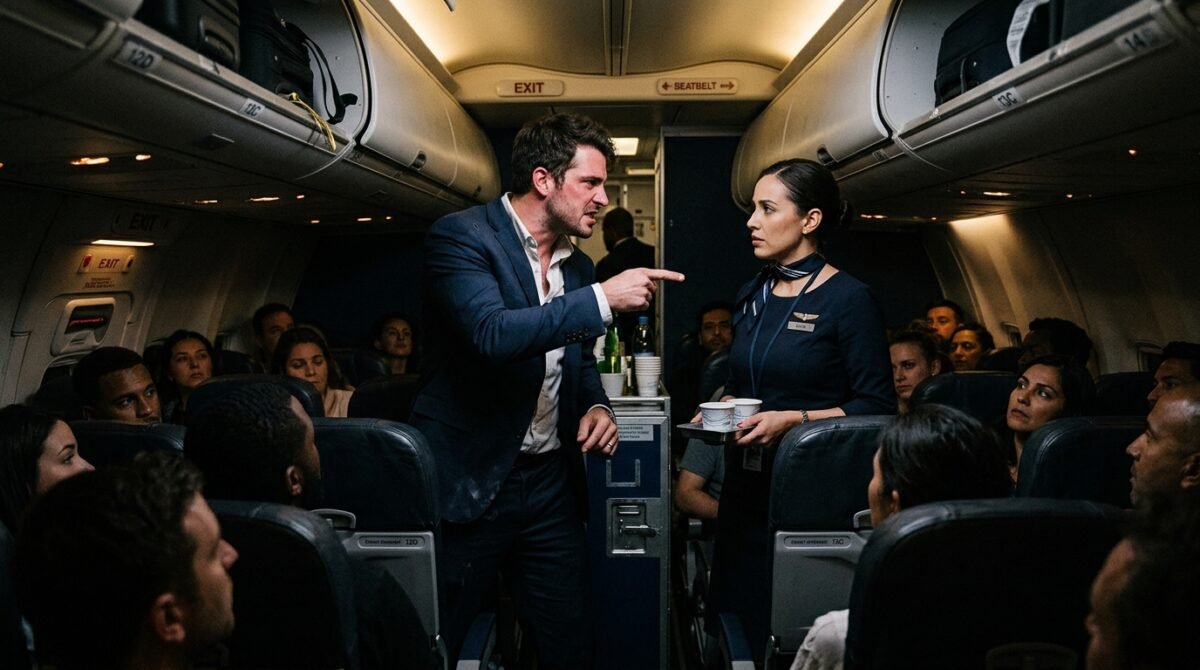
About an hour into the flight, a flight attendant walked down the aisle. The groom immediately flagged her down. I could hear his voice clearly over the ambient hum of the cabin, and it was loud enough for the surrounding rows to hear. He was laying it on thick, painting me as the heartless traveler who wouldn’t move for ‘someone on their way to their wedding.’
“Excuse me, is there any way we can move? The person in front of me is being extremely difficult. I’m the groom, I have a wedding to get to, and I just wanted to sit with my friend to coordinate final details. Can’t you move them?”
— The Groom to the Flight Attendant
The flight attendant, looking weary, gave the standard, practiced response. She explained that the seat assignments were fixed and that unless there was a safety issue or a mechanical problem with the seat, they couldn’t force a passenger to move. She glanced at me with an apologetic look, clearly recognizing the situation for what it was: a passenger trying to bully someone else out of a superior seat.
The groom was not satisfied. He spent the next twenty minutes whispering loudly to his friend about ‘entitled people’ and ‘lack of basic human decency.’ I kept my headphones on, but I could still feel the heat of his anger radiating toward me. It was an exercise in extreme patience, knowing that he was essentially throwing a tantrum because he didn’t get his way.
I realized then that this wasn’t about the wedding or the napping. It was about control. He had likely spent his entire life getting people to accommodate his whims, and the bulkhead seat was the first brick wall he had hit in a long time. The more he talked, the more ridiculous he sounded, and I began to feel a strange sense of resolve. I wasn’t moving. Not for the wedding, not for the best man, and certainly not for his ego.
The Digital Campaign Begins
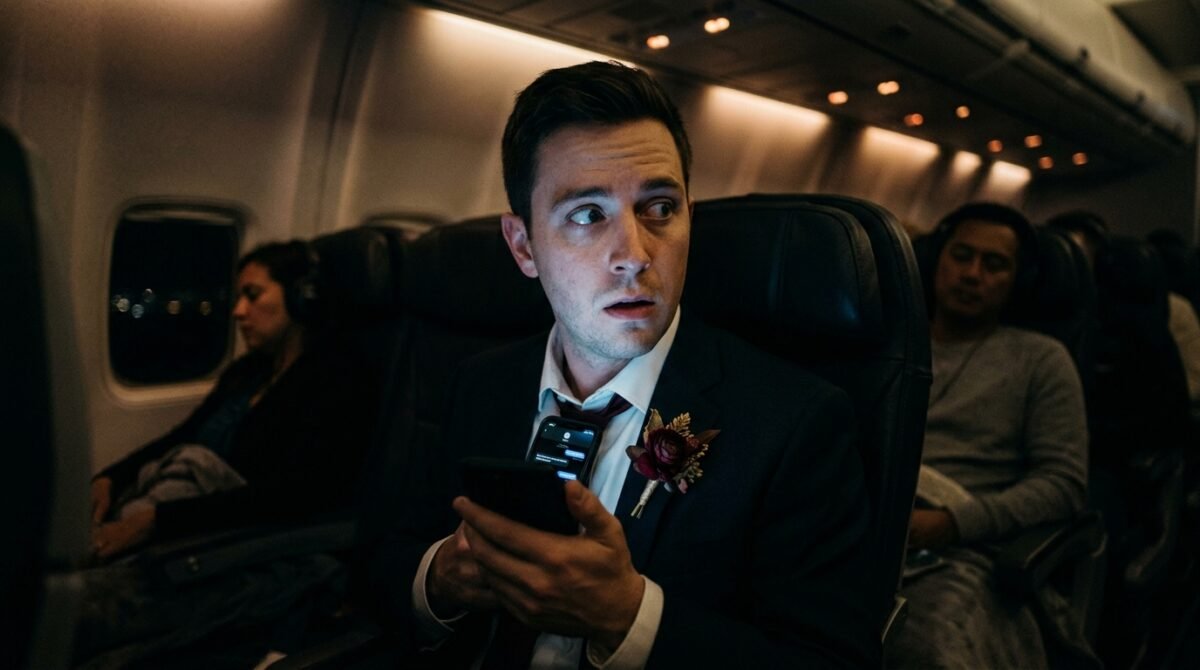
Things took a turn for the surreal when I noticed the glowing screens of the phones behind me. I wasn’t intentionally spying, but the light was bright, and the groom was not being subtle. He was typing furiously into a group chat, likely the wedding party thread. I caught a glimpse of his screen when I tilted my head to adjust my neck pillow. He was typing a message that looked remarkably like a call to action.
“Stuck behind the most selfish person on earth on this flight. Won’t give up their bulkhead seat so I can sit with [Best Man’s Name]. If anyone knows how to deal with people like this, let me know. Honestly, the nerve of some people. I might just start kicking the seat until they move.”
— The Groom’s Group Chat
The best man was laughing, typing something back. It felt incredibly childish. Here we were, thousands of feet in the air, and this man was crowdsourcing petty revenge for a seat he hadn’t booked. It was a bizarre realization of how modern social media and connectivity have emboldened people to think they are the main character in every scenario, and that everyone else is just an NPC (non-player character) in their life.
I felt a flicker of anxiety. Was he going to do something truly disruptive? I considered alerting the flight attendant, but decided against it. I didn’t want to escalate things unnecessarily, and as long as they were just talking, I could handle the inconvenience. However, the audacity of the situation started to grate on my nerves. I decided to pull out my own phone and start documenting the interaction, just in case things went sideways.
The irony was not lost on me. He was complaining about me being selfish, while he was the one demanding I relinquish something I had paid for to satisfy his personal convenience. It was the classic entitlement paradox: the person making the unreasonable demand always frames their desire as a moral necessity. I put my phone away and focused on my book, trying to ignore the digital gossip happening inches behind my head.
The group chat pinged repeatedly. I heard the best man suggest they ‘accidentally’ spill a drink on me. That made my blood boil. It moved from petty annoyance to something malicious. I stood up, turned around, and looked the groom directly in the eye, my expression unreadable but firm. He stopped typing immediately, his eyes widening in alarm. For a second, the entire row went silent.
The Confrontation in the Aisle
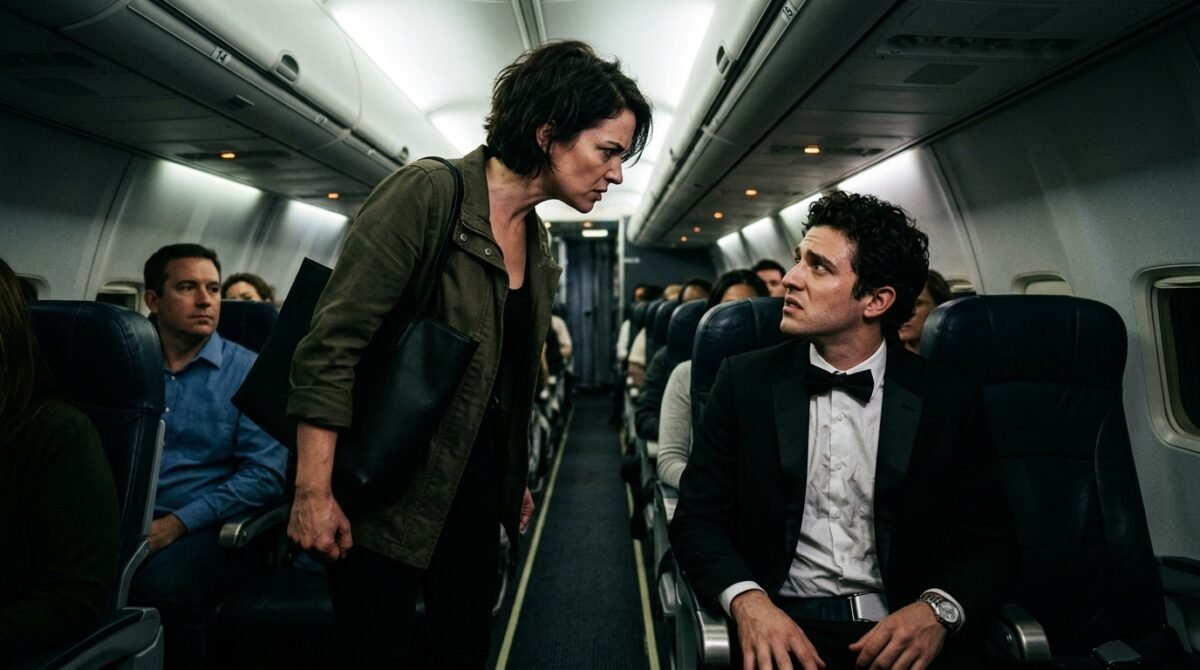
I didn’t say a word at first. I just stared at him. The silence was thick, heavy with the weight of his own calculated malice. He looked away, shifting in his seat, suddenly very interested in the airline magazine. I didn’t need to speak to send a message; the look on my face communicated clearly that I knew exactly what they were planning, and that I was not a person to be trifled with.
Finally, I broke the silence. I leaned in, keeping my voice low and even, devoid of any aggression but sharp with steel. I wasn’t going to let them think they could intimidate me with childish threats of spilled drinks or seat kicking. I needed to establish boundaries that would hold for the remainder of the flight.
“I don’t know who you’re texting or what you’re planning, but I suggest you keep your drinks to yourselves and your feet off my seat. I paid for this space, and I’m going to use it. If I hear one more word about me being selfish, or if there is any ‘accidental’ interference with my personal space, I will be speaking to the captain. Do we have an understanding?”
— OP
The groom turned bright red. He looked at the best man, who was suddenly staring at the floor, wanting absolutely no part of this. The groom sputtered, trying to maintain some semblance of his ego. He tried to laugh it off, saying it was just a joke, but his voice lacked conviction. He knew he had been caught, and he knew he had miscalculated his target.
The rest of the flight was a masterclass in silence. The kicking stopped entirely. The whispering ceased. Even the flight attendants seemed to notice the change in temperature; the cabin service became a quiet, efficient affair. I finally had the peace I had paid for, though the adrenaline of the confrontation left me wide awake for the next several hours.
It was a strange victory. I felt a mix of relief and lingering anger. Why was it so hard for people to accept that ‘no’ is a complete sentence? Why did I have to become the ‘villain’ just because I held onto what was rightfully mine? The rest of the flight, I sat there, reflecting on the entitlement that seems to permeate so much of our social interactions these days.
The Internet Weighs In
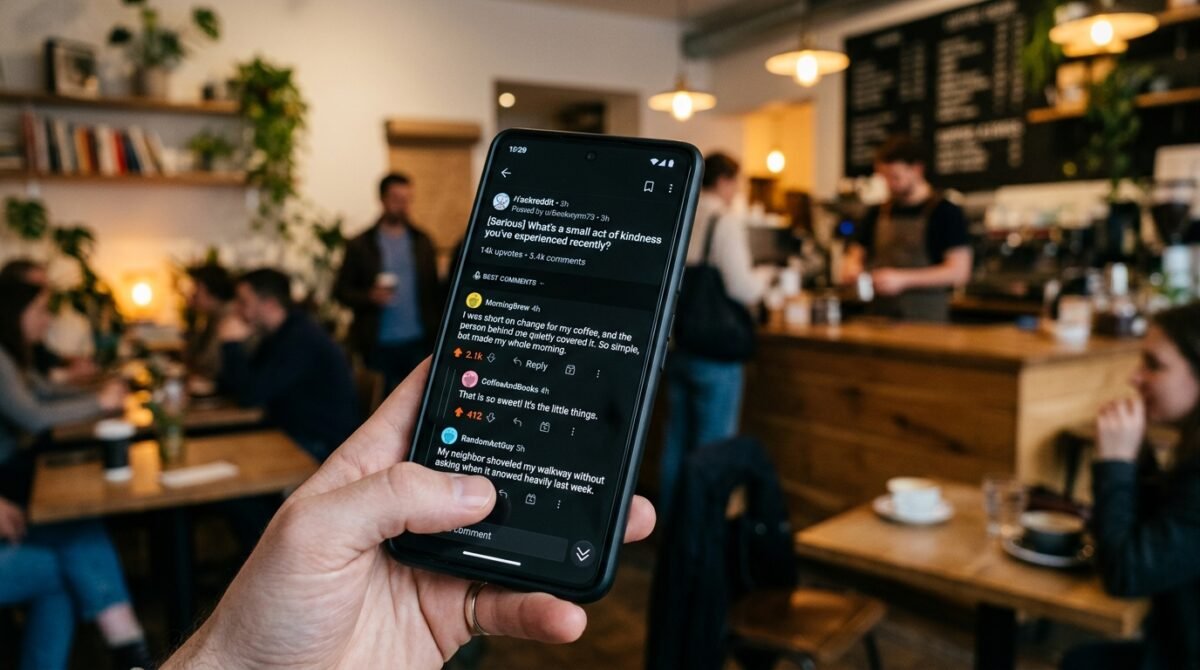
I couldn’t help myself. Once I landed and navigated through customs, I posted a summary of the events to a popular subreddit dedicated to relationship and travel dilemmas. I didn’t include names or specific flight numbers, but I laid out the logic of the situation. Within an hour, the post had exploded. The reactions were a fascinating, if sometimes terrifying, window into how people view boundaries and etiquette.
“NTA. You paid for that seat, end of story. The groom’s entitlement is staggering. The fact that he tried to bully you and then plan petty revenge just proves he isn’t even a nice person. Being the groom doesn’t give you a pass to treat people like trash.”
— u/TravelExpert22, 12.4k upvotes
The comments were overwhelmingly in my favor, which was validating, but there were also the contrarians. There was a vocal minority who argued that I should have just ‘been kind’ and swapped, especially since it was a wedding. They argued that the ‘small inconvenience’ to me would have been a ‘huge favor’ to the groom, and that my refusal was ‘unnecessarily rigid.’
“ESH. Yes, the groom was a jerk, but is it really worth the stress? If you had just swapped, you would have saved yourself hours of misery. Sometimes it’s better to be kind than to be ‘right.’ You chose to make your own flight worse by picking a fight.”
— u/Peacemaker99, 4.2k upvotes
I found the ‘ESH’ (Everyone Sucks Here) argument particularly infuriating. It implies that the only way to avoid drama is to surrender to bullies. If I had swapped, I would have been uncomfortable for the entire flight, and I would have sent the signal that if you push hard enough, you can get whatever you want from a stranger. That is not a lesson I wanted to teach.
The discussion devolved into a broader debate about the death of social norms in air travel. People shared their own horror stories of demanding passengers, screaming toddlers, and entitled travelers who think the entire plane exists to serve them. It became clear that this wasn’t just about me and the groom; it was a symptom of a much larger societal issue regarding space, entitlement, and the erosion of personal boundaries.
I kept checking the thread, watching as the numbers climbed. Thousands of people were debating my decision. It felt like I had inadvertently touched a nerve that had been raw for a long time. People were hungry for a story where someone actually said ‘no’ and didn’t apologize for it. It was a strange, communal catharsis.
The Anatomy of Entitlement
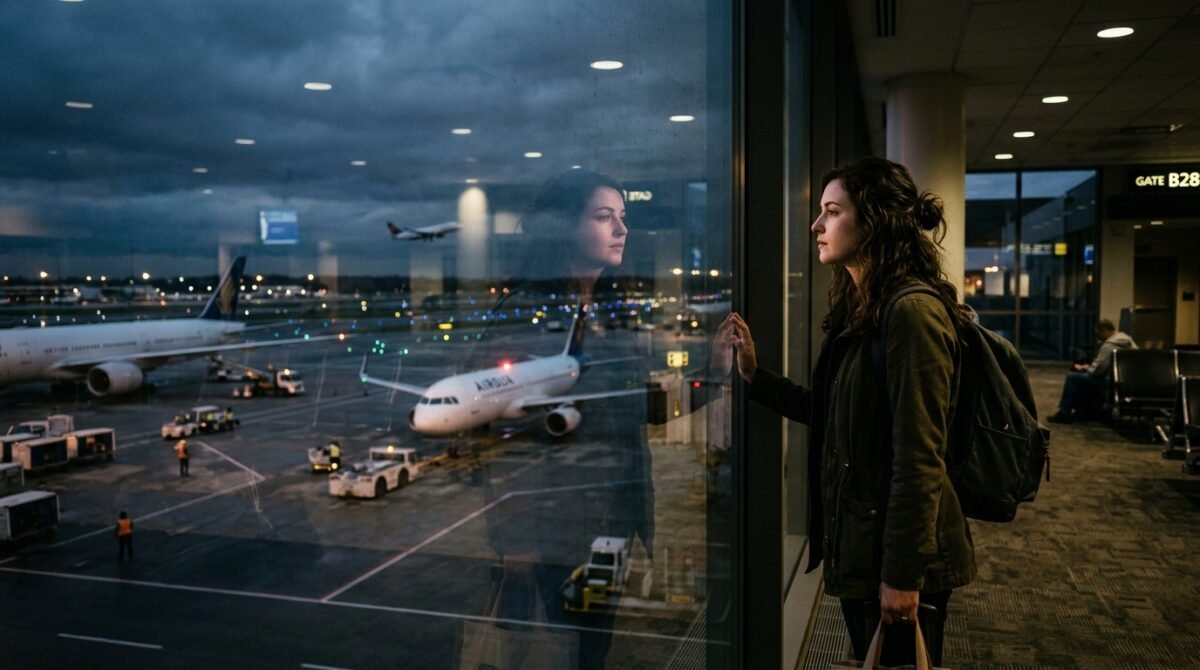
As I sat in the airport lounge waiting for my connecting flight, I couldn’t stop thinking about the groom. Who is this person in their normal life? Do they behave this way with their employees? Their friends? Their spouse? It struck me that entitlement is rarely a one-off event. It is a muscle that is exercised daily. If he felt comfortable demanding a bulkhead seat from a stranger on a plane, he likely demands everything else in his life without hesitation.
I realized that the groom wasn’t just a rude guy on a plane; he was a manifestation of a mindset that views the world as a transaction. Everything is a negotiation, and everyone is a potential asset or obstacle. To him, my comfort wasn’t a human need; it was a resource to be acquired. The fact that I had paid for it was irrelevant; his ‘need’ to sit with his friend was, in his mind, a higher-order requirement.
This transactional worldview is incredibly destructive. It turns relationships into power struggles and makes empathy an optional extra rather than a core component of interaction. When he didn’t get his way, his immediate reaction was to escalate the power struggle—to use social pressure and intimidation. He couldn’t handle the ‘no’ because it challenged his entire worldview.
I wondered about the bride. Did she know who she was marrying? Did she know that her partner was the type of person who would try to bully a stranger into giving up a seat? Or was she just as entitled, perhaps the one who convinced him that he ‘deserved’ to be comfortable regardless of the cost to others? It’s a sad reality that some people only find partners who mirror their own worst impulses.
I felt a strange sense of pity for him. He will spend his life constantly battling the world for small, petty advantages, never realizing that the biggest barrier to his happiness is his own lack of grace. He will always be the victim of ‘selfish’ people, never acknowledging that the selfishness is entirely his own. I was glad to be getting off the plane and leaving him behind in his own small, cramped world.
The Aftermath and Personal Boundaries
A few days after returning home, I found myself still thinking about the flight. I realized that my decision to hold my ground wasn’t just about the seat. It was about reclaiming a sense of agency that I often feel I lose in the modern world. We are constantly pressured to accommodate, to be ‘nice,’ to ‘pick our battles,’ and to ‘let things slide.’ But when do we stop?
The incident reminded me that boundaries are not just about keeping others out; they are about keeping our own peace intact. By saying no, I was protecting my physical comfort, but I was also protecting my mental well-being. If I had yielded, I would have spent the rest of the flight feeling resentful and foolish, which is a much higher price to pay than a few awkward moments of confrontation.
I’ve started to look at other areas of my life where I’ve been too ‘accommodating.’ I’ve realized that I often say ‘yes’ to favors I don’t want to do, or put up with behavior I find unacceptable, all in the name of keeping the peace. The encounter with the groom was a wake-up call. Life is too short to be a pushover, and there is a distinct, quiet strength in being able to stand your ground with calm, unwavering conviction.
I don’t regret the confrontation. I don’t regret the ‘cold shoulder’ I gave him for the rest of the trip. And most importantly, I don’t regret the refusal. The world is full of people who want to take up your space, both literally and figuratively. You don’t owe them your compliance. You don’t owe them your comfort. And you certainly don’t owe them your peace.
I’ve moved on, and I suspect the groom has too, likely to his next target. But I have a new rule for myself: if someone makes a request that feels like a demand, I will look them in the eye and say ‘no’ without offering an excuse. It’s a small change, but it feels like a significant one. The bulkhead seat was just the beginning.
Reflecting on the ‘Wedding Exception’
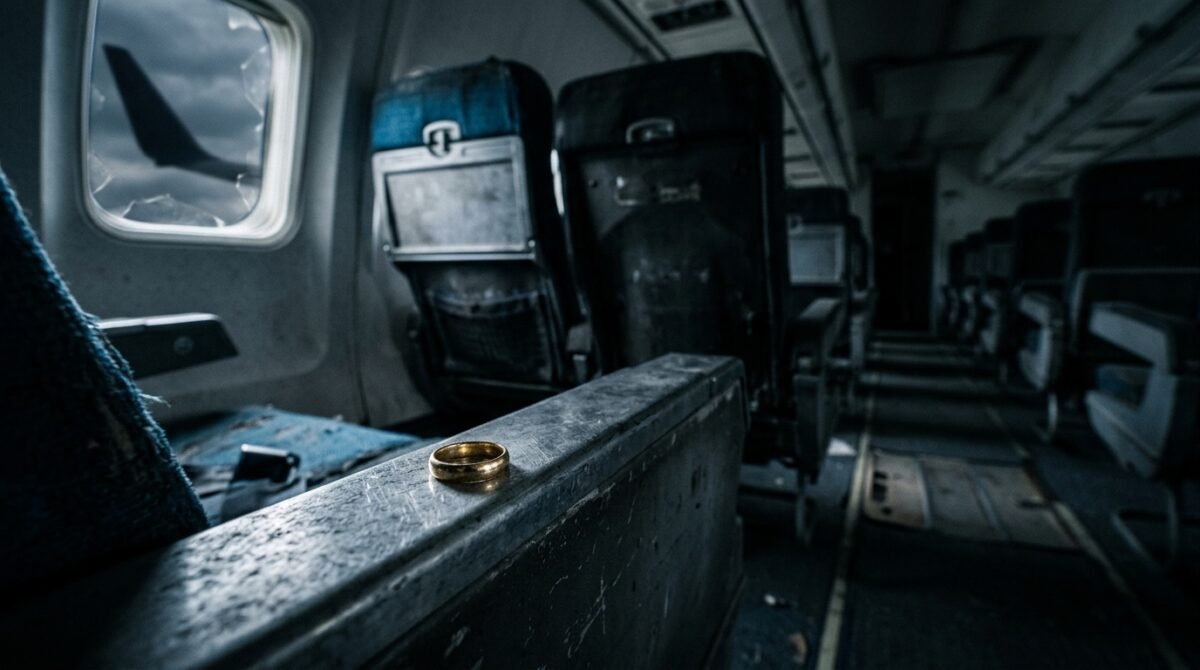
One of the most persistent arguments I encountered online was the ‘wedding exception.’ People seem to believe that being part of a wedding—whether as the bride, groom, or even a guest—grants a special dispensation to ignore social rules. It’s as if the wedding is a sacred event that justifies any behavior, no matter how rude or manipulative. This is a dangerous narrative.
Why should a wedding entitle someone to harass a stranger? If anything, you would think that a couple about to embark on a life of partnership would be more focused on acting with integrity and kindness. Instead, the wedding-industrial complex often encourages a sense of entitlement, where every whim of the couple must be catered to, regardless of who it hurts or how it inconveniences the public.
I’ve heard stories of brides demanding people move seats on flights, or demanding guests pay for exorbitant gifts, or even demanding friends change their appearance for the big day. It’s all rooted in the same fallacy: that the occasion is more important than the people involved in it. A wedding is a celebration, not a justification for bad behavior.
If the groom had come to me, introduced himself, and politely asked if I would consider a trade for something of equal or greater value, the conversation might have been different. I might have even said yes. But he didn’t do that. He demanded, he assumed, and he threatened. He didn’t see me as a person; he saw me as a means to his comfort. And that is why no amount of ‘it’s for my wedding’ could ever justify his actions.
We need to stop rewarding this kind of behavior. Every time we give in to someone who acts like a bully, we are signaling that the behavior works. We are teaching them that if they complain loud enough, someone will eventually cave. By holding the line, I wasn’t just protecting my seat; I was, in a very small way, refusing to participate in the cycle of rewarding bad behavior. That is a principle I will continue to uphold.
The Social Media Echo Chamber

Watching the story go viral was an eye-opening experience. It highlighted the way information is consumed and distorted in the digital age. People took the story and ran with it, creating their own narratives, speculating about the groom’s identity, and even creating memes about ‘bulkhead bandits.’ It was both hilarious and slightly alarming to see how quickly a personal experience becomes public property.
I received messages from people I didn’t know, sharing their own ‘seat-stealing’ stories. It seems this is a universal experience. Everyone has a story about someone trying to claim their space. It made me realize that I wasn’t alone in this, and that there is a massive community of people who are just as tired of the entitlement as I am. We are all looking for validation that our boundaries are normal and necessary.
The echo chamber effect was also present. Some groups of people were convinced that I was a ‘toxic’ person for not being ‘generous,’ while others were convinced that I was a hero. The truth, of course, lies somewhere in between. I was just a traveler who wanted to use the seat I paid for. The polarization of the internet means that everything is either a grand moral crusade or a complete failure of character.
I learned to stop reading the comments eventually. It’s too easy to get sucked into the vitriol and the endless debate. Once the story had run its course, I found it better to just let it go. The lesson had been learned, the boundary had been set, and I didn’t need the internet’s approval to know I had done the right thing for me.
The takeaway for anyone reading this? Your boundaries are your own. You don’t need to explain them, you don’t need to justify them, and you certainly don’t need to let strangers on the internet or in your own life debate them. Stand your ground, be kind when you can, but never compromise your values for the sake of someone else’s ego.
Moving Toward a More Respectful Travel Culture
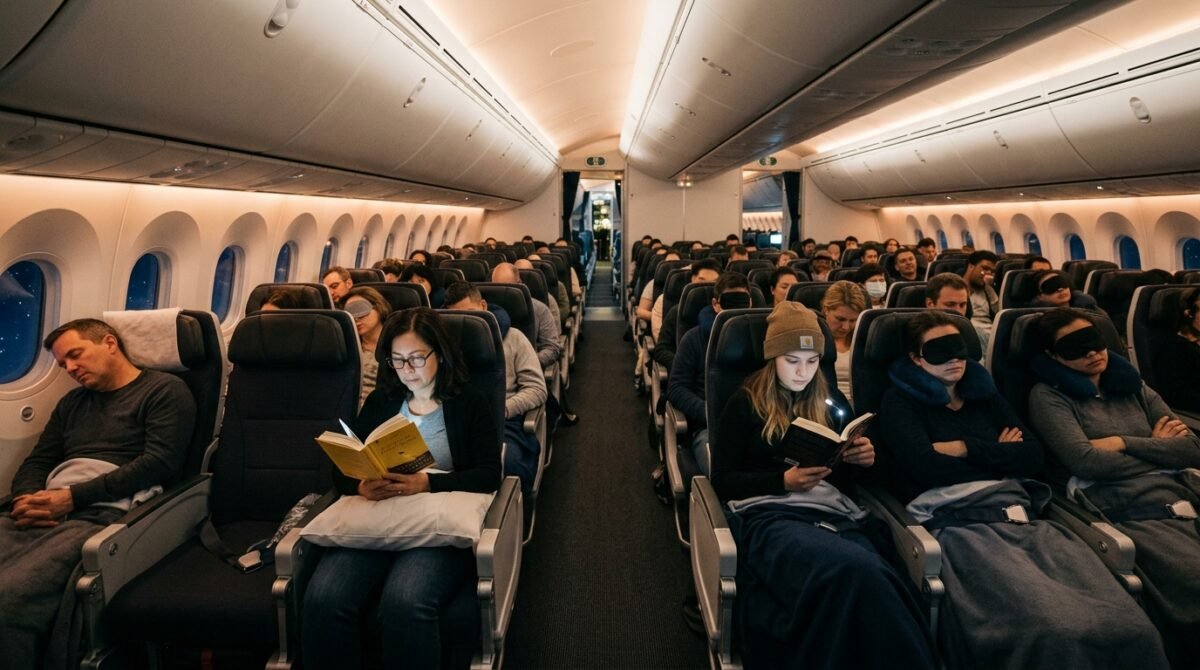
As I think about my future travel, I am filled with a mix of anticipation and caution. I will still book the bulkhead seat when I can, and I will still stand my ground if asked to move. But I also hope that we can collectively move toward a culture of travel that is based on mutual respect rather than constant negotiation.
What would it look like if we all just sat in the seats we booked? What if we treated our fellow passengers as neighbors for the duration of the flight, instead of obstacles to our convenience? It’s a simple shift in mindset, but it would have a profound impact on the stress levels of everyone on board. We are all trapped in a metal tube in the sky; we might as well make it as pleasant as possible for one another.
I think about the flight attendants who have to deal with this every single day. They are the ones who have to mediate these conflicts, and they rarely get the support they need. We should be making their jobs easier, not adding to their burden. By holding our ground respectfully, we can actually help maintain the order of the cabin.
I will continue to travel, and I will continue to value my comfort. But I also hope to be a better passenger myself. I’ll make sure to be patient, to be kind, and to remember that the person in front of me is a human being with their own needs and reasons for being there. It’s a two-way street, after all.
If you find yourself in a similar situation, remember: you are not a ‘jerk’ for wanting what you paid for. You are a person who values their own dignity and needs. Keep that in mind the next time someone taps you on the shoulder. You have the right to say no, and you have the right to be comfortable. Don’t let anyone convince you otherwise.
Conclusion
The saga of the bulkhead seat was more than just a travel anecdote; it was a profound lesson in the necessity of setting firm, uncompromising boundaries. In a world that often rewards those who push, demand, and manipulate, choosing to stand your ground is a radical act of self-respect. Whether you are in the air or on the ground, your space—and your peace of mind—are yours to defend.
As we navigate our complex social landscapes, we must constantly balance the desire for kindness with the need for self-preservation. It is not about being a ‘villain’ or a ‘hero’; it is about being an adult who understands the value of their own choices. I hope this story encourages you to look at the ‘small’ demands placed upon you and question whether they truly deserve your compliance.
What do you think? Have you ever been in a position where you were pressured to give up something you had paid for? Would you have stayed in the seat, or would you have yielded for the sake of the ‘peace’? Join the conversation below and share your own experiences with everyday entitlement. Does the wedding ‘pass’ truly exist, or is it time we retired the idea that special occasions grant a license to be rude?
What's your verdict on this dilemma?
Vote below to contribute to the official community consensus.

Have a Dilemma Keeping You Up at Night?
Share your real-life feud, wedding chaos, or relationship crossroads anonymously with our editorial team.
What do you think ?
0 Comments🛡️ Comments are moderated to protect community integrity. Your comment will appear once approved by the editorial team.