
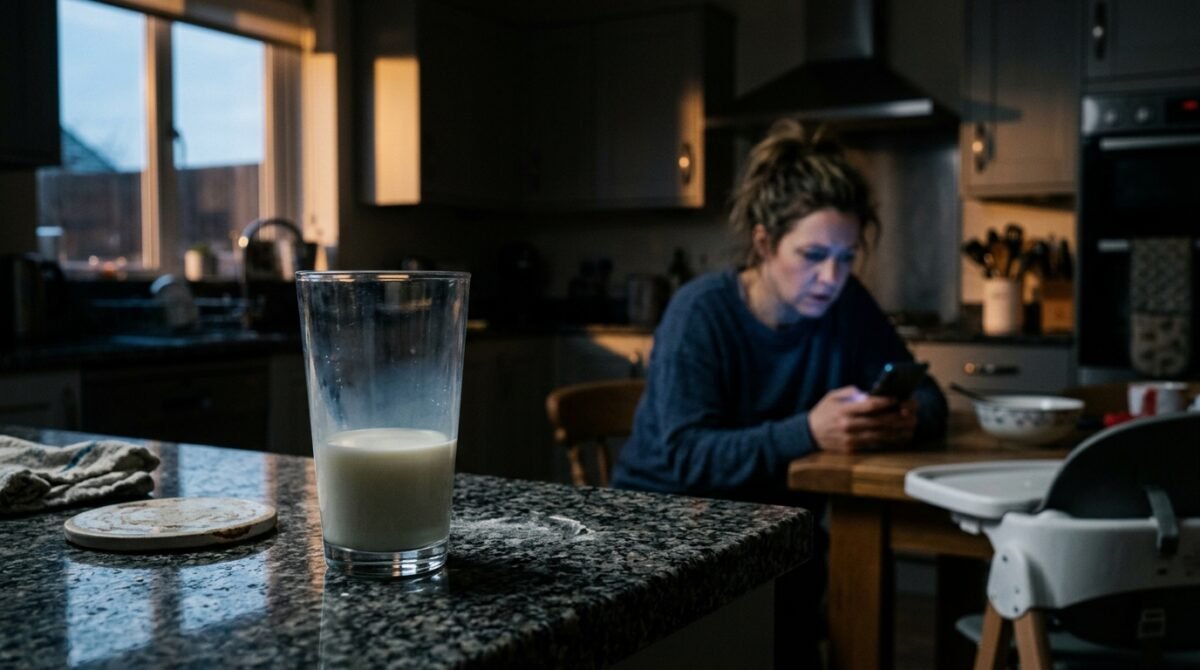
When we decided to start a family, my husband Mark and I had a very clear vision for how we would raise our son, Leo. We were diligent, perhaps even obsessive, about nutrition, developmental milestones, and the medical advice provided by our pediatrician. When I eventually returned to work, we made the difficult decision to let Mark’s mother, Linda, step in as our primary babysitter. It was a choice born of necessity and, at the time, a deep-seated belief that family would always have our child’s best interest at heart. We trusted her. That was our first mistake.
Linda had always been… unconventional. She was a devotee of fringe wellness trends and held a deep-seated, irrational distrust for ‘Big Pharma’ and modern nutritional standards. We had navigated her quirky comments about vaccinations and supplements with a polite smile, assuming that as long as we were the ones setting the rules, she would abide by them. We were wrong. The betrayal didn’t happen in a single, loud explosion, but rather in a series of subtle, calculated deviations from the plan that left our seven-month-old infant vulnerable.
The realization hit me on a quiet Tuesday evening. I had noticed Leo was fussy, his digestion seemed off, and he had developed a strange rash that baffled us. When I went to check the pantry for a spare bottle of the specialized formula he required due to his sensitive stomach, I found a mason jar shoved behind a box of cereal. It was marked only with a handwritten label: ‘Raw-Best.’ A quick search on my phone turned my blood to ice. My mother-in-law was not just feeding my son—she was conducting a dangerous biological experiment on his fragile system.
The moral dilemma that followed was not merely about milk; it was about the fundamental violation of parental authority. When I confronted her, the response wasn’t remorse. It was a lecture on the ‘purity of nature.’ At that moment, the grandmother who had held my son wasn’t a family member; she was a threat to his safety. This is the story of how that realization led me to the most difficult decision of my life: cutting off access entirely, and the chaotic, heartbreaking firestorm that ensued within my marriage and the extended family.
The Mason Jar Under the Sink
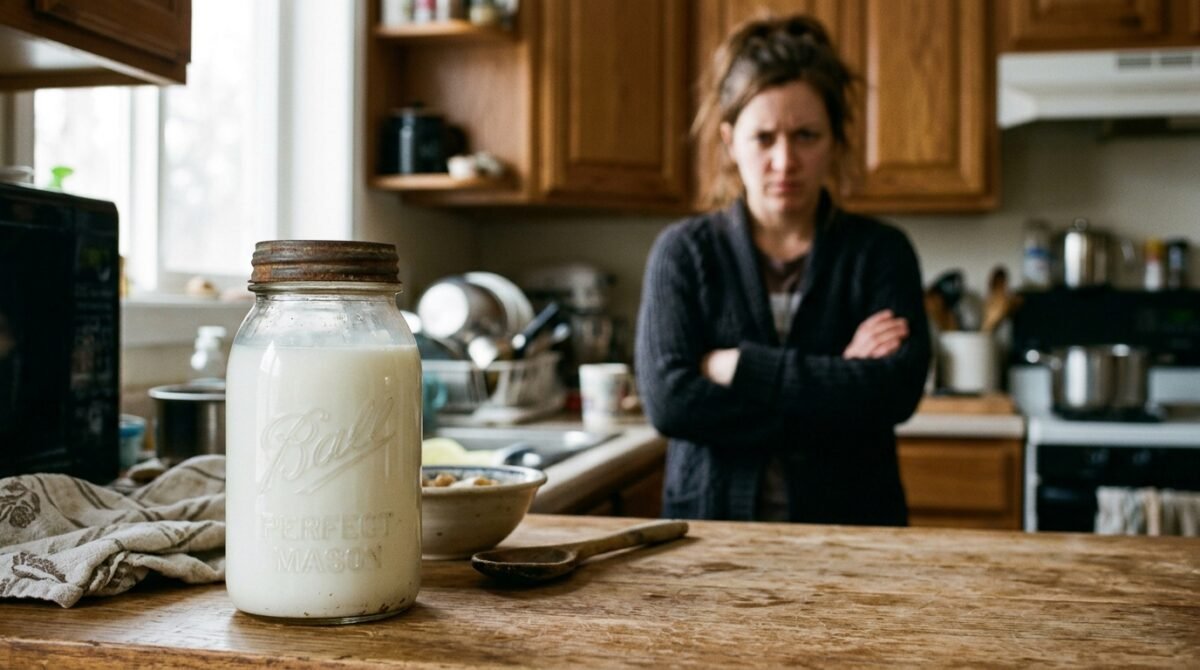
It was 6:00 PM when I finally walked through the door, exhausted from a long day of meetings. Linda was sitting on the couch, bouncing Leo on her knee, smiling with a serenity that now feels deeply chilling. I went to the kitchen to prep Leo’s evening bottle, expecting to find the formula container in the usual spot. Instead, I found it empty. I frowned, opening the lower cabinet to look for the backup supply I keep in case of emergencies.
That is when I saw it. Tucked behind the cleaning supplies, in a dark, humid corner of the under-sink cabinet, was a glass mason jar filled with a thick, opaque white liquid. It didn’t look like formula. It didn’t look like store-bought milk. I pulled it out, and the smell hit me immediately—a sharp, musky, earthy scent that was unmistakably raw goat milk. My heart hammered against my ribs. I knew Linda frequented a local farm, but I had explicitly forbidden her from bringing any animal products near Leo.
“Linda, what is this?” I asked, my voice shaking as I walked into the living room, holding the jar up like evidence in a criminal trial. “Why is there raw milk in my house?”
She didn’t even look up from the baby. She simply sighed, a condescending, practiced sound that usually preceded one of her ‘wisdom’ sessions. ‘It’s nutrient-dense, darling,’ she said. ‘Leo needs real food, not that processed chemical sludge you’ve been feeding him. His skin has been looking a bit sallow, and I thought he deserved the best nature has to offer. It’s from a very reputable farm, mind you.’
I felt a cold wave of nausea wash over me. The sheer audacity of her, sitting there, holding my son, while simultaneously poisoning his developing immune system with unpasteurized bacteria. I was shaking so hard I had to set the jar on the coffee table. The risk of E. coli, Listeria, and Salmonella rushed through my mind—all the things our pediatrician had warned us about during our very first visit.
I reached down and took Leo from her arms. He felt heavy, and for a second, I looked at him and wondered how long this had been going on. I looked back at Linda, whose smile was fading into a thin, tight line of annoyance. ‘You have been feeding this to a seven-month-old infant?’ I whispered, horror overriding my ability to speak at a normal volume. ‘You have been risking his life behind my back?’
The Husband Caught in the Middle
When Mark finally got home an hour later, the house was silent, but the tension was thick enough to suffocate us. I had placed the jar in the center of the kitchen island. I didn’t say a word when he walked in. I just pointed at it. He looked confused, his brow furrowing as he picked it up and inspected the label. He looked at me, then back at his mother, who had retreated to the guest room to ‘give us space.’
“It’s just milk, honey,” Mark said, his voice hesitant. “Mom is a bit old-school, you know that. She grew up on a farm. She probably thinks she’s doing him a favor. Let’s not blow this out of proportion.”
I was floored. The fact that he was already trying to minimize the situation was a breaking point. ‘Mark, this is raw, unpasteurized goat milk. It is medically dangerous for an infant. This isn’t about being old-school; this is about basic medical safety and my right as a mother to decide what goes into my child’s body. If you can’t see the difference, then you’re as dangerous as she is.’
We argued for three hours. He kept insisting that I was being ‘hysterical’ and ‘controlling.’ He pointed out that he himself had been raised on ‘everything’ and turned out fine. I sat on the floor of the nursery, listening to Leo sleep, wondering how I could have married a man who prioritized his mother’s ego over his son’s physical health. The division was clear: he was in his mother’s corner, and I was entirely alone.
I realized then that this wasn’t just about the milk. It was about the lack of respect for my boundaries that had been building for months. Every time she had ‘fixed’ his clothes, ignored his nap schedule, or snuck him sweets, I had let it slide to keep the peace. That silence had been a mistake. It had signaled to them that my authority was negotiable.
I pulled out my phone and started drafting a message to my sister. I needed an ally. I needed someone to tell me I wasn’t going crazy. The feeling of isolation was absolute. My husband was currently in the hallway, texting his mother, likely apologizing for my ‘outburst.’ I felt like a stranger in my own home.
The Midnight Group Chat Exposure
While Mark was in the shower, his phone, which he had left on the kitchen counter, lit up with a notification. It was a group chat titled ‘Family Support.’ My curiosity got the better of me. I unlocked the phone—we had always shared passwords—and scrolled through the messages. My stomach dropped. The conversation was not just about the milk; it was about me.
“She’s being absolutely impossible,” Linda wrote. “I’m just trying to save that baby from her anxiety-ridden coddling. If we don’t push back now, she’ll never let us have any input on his upbringing. Stick to your guns, Mark.”
I kept scrolling. There were messages from my sister-in-law, cheering Linda on. They were mocking my ‘helicopter parenting’ and discussing ways to ‘subtly ignore’ my rules because they knew better. The level of coordinated gaslighting was breathtaking. They weren’t just disagreeing; they were actively plotting to undermine me as a parent.
I realized that Mark hadn’t been defending me in the other room; he had been reporting back to his mother about my ‘instability.’ The betrayal was absolute. It wasn’t just a disagreement about nutrition; it was a fundamental power struggle where I was the outsider and they were the united front. I took screenshots of every single message, my hands trembling as I saved the evidence to a secure folder.
I realized that the decision I was about to make would likely end my marriage. Or, at the very least, it would fundamentally change it forever. I didn’t care. The safety of my son was the only thing that mattered. If Mark wanted to be part of that group chat, he could be, but he wouldn’t be part of our son’s life in the same way again.
I put the phone back exactly where I found it. I went into the bedroom, turned off the lights, and lay in the dark, waiting for him. I didn’t feel angry anymore; I felt a cold, sharp, and necessary clarity. The era of playing nice was over. Tomorrow, the cleanup would begin.
The Morning Ultimatum
The next morning, the air in the house was heavy. I waited until Mark was pouring his coffee before I spoke. I had Leo in his high chair, and for the first time in months, I didn’t let Linda near him. I had already put her suitcase by the front door before she even came out of the guest room. She looked at the suitcase, then at me, with a look of pure, unadulterated shock.
“You need to leave,” I said, my voice steady. “I’ve read the group chat, Linda. I know exactly what you’ve been doing, and I know that Mark has been enabling it. You are no longer welcome in this house, and you are no longer welcome to watch my son.”
Linda’s face turned a shade of purple I didn’t know was humanly possible. She turned to Mark, expecting him to intervene, to pull his wife back into line. But Mark looked at me, then at the suitcase, then at his mother. He looked terrified. He knew that if he fought me on this, he would lose me, and he wasn’t prepared for that. He stayed silent.
Linda started to scream, calling me every name in the book. She accused me of being a cold-hearted tyrant, of tearing a family apart. She claimed that she was just doing what was ‘natural’ and that I was the one who was sick. I didn’t argue back. I didn’t defend myself. I just opened the front door and stood there, waiting.
It was one of the most painful moments of my life, but also one of the most liberating. Seeing her walk out that door, hearing the latch click into place, I felt a weight lift off my shoulders that I hadn’t realized I was carrying. The power dynamic had shifted. I was the one in control now. My son was safe.
Mark eventually followed her out to the driveway to try and smooth things over, but I didn’t follow. I stayed inside with Leo, playing with his blocks, trying to maintain a sense of normalcy in the wake of the hurricane. The house felt bigger, quieter, and finally, it felt like mine again.
The Fallout and The Silence
The following week was a blur of hostile texts, voicemails, and attempted interventions from the extended family. My phone was blowing up with messages from my mother-in-law’s sisters, calling me ‘cruel’ and ‘unreasonable.’ They demanded to know why I had ‘kicked a grandmother out of her grandson’s life.’ I ignored every single one of them.
“You’re making a huge mistake,” Mark said one night, sitting at the kitchen table. “Mom is really hurting. Can’t we just let her come over for a supervised visit? Just to keep the peace?”
I looked at him, feeling a deep, hollow sadness. ‘Mark, she didn’t just break a rule; she endangered our son and then lied to our faces. A “supervised visit” implies that I trust her to follow rules when I’m watching. I don’t. And as long as you continue to view her behavior as a minor inconvenience, I don’t fully trust you to prioritize Leo’s safety either.’
The silence in our marriage was deafening. We were living like roommates who were constantly walking on eggshells. He was grieving the loss of his mother’s presence, and I was grieving the loss of the trust I had in my husband. We were in a liminal space, neither together nor apart, waiting for the other shoe to drop.
I decided to take the initiative and schedule an appointment with a marriage counselor. I knew we couldn’t resolve this on our own. I told Mark that if he wanted to save our marriage, he had to be willing to do the hard work of setting boundaries with his family. To my surprise, he agreed. He was clearly shaken by the prospect of losing his family, but he was also terrified of losing me.
The road ahead was going to be long and difficult, but for the first time, we were moving in the same direction. It wasn’t perfect, and it certainly wasn’t easy, but it was a start. We were finally addressing the systemic issues that had allowed this to happen in the first place.
The Reddit Verdict: A Divided Internet
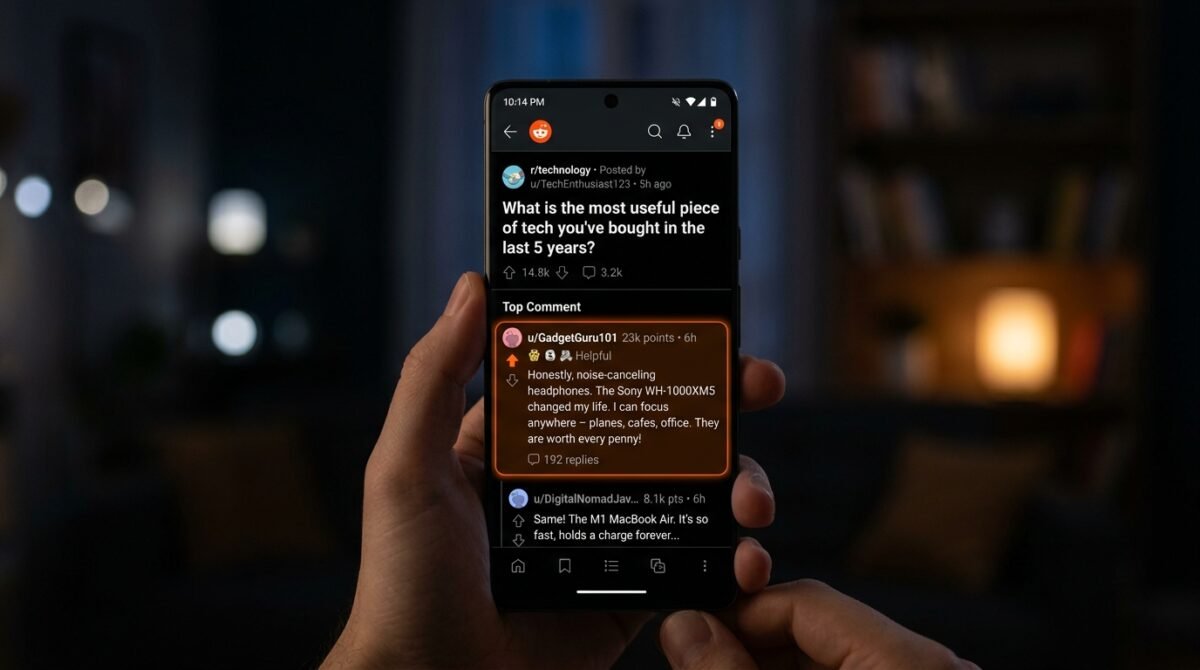
I finally decided to post about the situation on a popular sub-reddit dedicated to family conflicts. I didn’t tell Mark, but I needed an objective perspective. I laid out the facts, the milk, the lies, the group chat, and the ban. The response was immediate and overwhelming. Within hours, the post had thousands of upvotes and comments.
“NTA. You are the parent. You set the rules. If she can’t respect them, she loses access. That’s how it works. And honestly, feeding raw milk to an infant is a hill to die on. You saved your son’s life.”— u/SafetyFirstMom (Top Comment, 32.4k upvotes)
There were, of course, the dissenters. Some people argued that I was overreacting, that families should ‘stick together’ no matter what. Others pointed out that I had ‘forced’ the situation by being too rigid. But the overwhelming consensus was on my side. People shared their own horror stories of boundary-crossing in-laws, validating my feelings of betrayal and anger.
It was incredibly cathartic to read those comments. Seeing so many people recognize the gravity of the situation helped me stop doubting myself. I wasn’t being ‘difficult’ or ‘controlling’; I was being a responsible mother. The validation from strangers gave me the strength to stand my ground when the family pressure intensified.
I showed some of the comments to Mark. He was quiet as he read them, scrolling through page after page of people calling his mother’s actions ‘dangerous’ and ‘toxic.’ It seemed to finally sink in that this wasn’t just my opinion; it was a societal standard of safety that he had been ignoring.
He didn’t say anything for a long time, but that night, he finally deleted the ‘Family Support’ group chat from his phone. It was a small gesture, but it was a beginning. It showed me that he was starting to see the reality of the situation, and that he was willing to make changes, no matter how hard they were.
The Unexpected Legal Letter
Just when I thought we were moving toward some kind of resolution, the mailbox delivered a certified letter. It was from a lawyer representing Linda. My hands were shaking as I opened it. It was a formal request for ‘grandparent visitation rights,’ citing ‘the best interests of the child’ and claiming I was ‘alienating’ Leo from his family.
“I cannot believe she is actually doing this,” Mark said, his voice trembling with a mixture of rage and disbelief. “Does she really think a court is going to give her rights after she put our son in danger?”
I didn’t answer. I was already on the phone with a family law attorney. The irony of her claiming to be concerned about Leo’s ‘best interests’ after feeding him unsafe milk wasn’t lost on me. It was a calculated, aggressive move, designed to intimidate me into submission.
This shifted the situation from a family drama into a legal nightmare. We had to document everything. Every text, every email, every incident where she had ignored our boundaries. The ‘group chat’ screenshots became our most valuable asset. It wasn’t just about the milk anymore; it was about demonstrating a pattern of behavior that proved she was a liability.
The stress was immense. We were spending money we didn’t have on legal fees, and the emotional toll was exhausting. But it also galvanized us. Mark stopped being the ‘middle man’ and became my fiercest advocate. He was the one who insisted on hiring the best lawyer, the one who spent hours organizing our evidence.
We weren’t just fighting for our privacy anymore; we were fighting for our right to raise our son without interference. The legal threat, while terrifying, actually served to unify us in a way that nothing else could have. We were in the trenches together, and for the first time, I knew I could count on him.
The Confrontation at the Park
A month later, I was at the park with Leo, keeping a wary eye on my surroundings. I knew Linda had been trying to track us down, but I didn’t expect to see her there. She approached us, her face etched with a mix of defiance and desperation. She didn’t try to take him; she just stood there, staring, a ghost in the bright daylight.
“You’re making a mistake, and you will regret it,” she hissed, her voice barely audible. “Mark knows what you’re doing. He knows how you’ve twisted his mind. When he finally sees the light, you’ll be the one left alone.”
I didn’t blink. I pulled Leo closer, shielding him with my body. ‘Linda, this is the last time you approach us. If you ever try to corner me again, I will get a restraining order. You have no rights to this child, and you have no place in our lives until you accept that.’ She scoffed, but she backed away. She knew I meant it.
I stayed at the park for another twenty minutes, my heart pounding, before I felt safe enough to leave. The encounter shook me to my core. I realized that she wasn’t just going to go away; she was going to escalate until she got what she wanted. I had to be prepared for the next move.
When I got home, I told Mark about the encounter. He didn’t say a word; he just hugged me, and then he made a call to our lawyer. We started the process of filing for a protective order the next morning. It was a difficult, painful step, but it was necessary for our peace of mind.
We were finally taking the steps we needed to protect ourselves. It wasn’t about being mean or spiteful; it was about survival. I realized that sometimes, in order to protect the people you love, you have to be willing to be the ‘villain’ in someone else’s story. I could live with that.
The Resolution of the Lawsuit

The court hearing was a cold, sterile affair. The judge, a stern woman with a sharp gaze, listened to both sides. When our lawyer presented the evidence of the raw milk, the group chat, and the pattern of boundary violations, the mood in the room shifted. It became clear that this wasn’t about a grandmother being unfairly excluded; it was about a grandmother who refused to acknowledge the basic safety of her grandchild.
“The court finds that the petitioners have failed to demonstrate that the respondent has acted in a way that is contrary to the best interests of the child,” the judge concluded. “The petition for visitation is denied, and the court advises all parties to respect the boundaries established by the parents.”
The relief was so profound I almost fainted. Linda, for the first time, looked small, defeated. She left the courtroom without a word, and we never heard from her lawyer again. It was over. We had won, and more importantly, we had established a legal precedent that protected us from future interference.
The drive home was quiet. We didn’t celebrate; we just sat in the car, exhaling. We had spent so much energy fighting, so much time in a state of high alert, that we didn’t know how to exist without it. We were both exhausted, but we were also free.
We went home and spent the rest of the day with Leo, just being a family. We didn’t talk about the case, the milk, or the grandmother. We just enjoyed the silence of a house that was truly our own, a space where no one could tell us how to raise our son.
It was a turning point. We were no longer reacting to her; we were living our own lives, on our own terms. We had reclaimed our power, and in the process, we had built a stronger, more resilient partnership. It was the hardest thing we had ever gone through, but it was also the most important.
Reflecting on the Boundaries We Set
Looking back now, months later, I realize that the raw milk was just the catalyst for a much-needed reckoning. It forced us to confront the toxic dynamics that had been simmering under the surface of our family life for years. It forced Mark to grow up, to leave the ‘child’ version of himself behind and become a husband and a father who could stand on his own.
“I see it now,” Mark told me one night as we were putting Leo to bed. “I see how much she was controlling me, and how much I was letting her control us. I’m sorry it took this for me to wake up. But I’m glad we’re here now.”
I am glad too. Our marriage is stronger than it has ever been. We communicate more, we set boundaries more effectively, and we prioritize our little family above all else. We have learned that ‘family’ isn’t just about blood; it’s about respect, safety, and mutual support. And when those things are violated, it’s not just a ‘difference of opinion’; it’s a breach of trust that needs to be addressed.
We still get the occasional ‘checking in’ text from an aunt or cousin, but we handle them with firm, polite detachment. We don’t owe anyone access to our son. We don’t owe anyone an explanation for the choices we make for our family. And we certainly don’t owe anyone the right to risk our child’s health.
I often wonder what would have happened if I hadn’t found that jar. Would I have ever confronted her? Would I have ever seen the group chat? It’s a chilling thought. I am grateful for that moment of discovery, as painful as it was. It saved us, and more importantly, it saved Leo.
The experience has taught me that the most important thing a parent can do is to trust their gut. If something feels off, it usually is. Don’t be afraid to speak up, to set boundaries, and to hold people accountable. Your child’s life is worth more than anyone’s feelings, and that is a lesson I will never forget.
Conclusion
My journey through this nightmare has taught me that the hardest boundaries are often the ones we have to set with the people we love most. However, the safety of my child was non-negotiable, and the fallout, while incredibly painful, has paved the way for a healthier, more independent future for my own family. We are now living in a space where our rules are respected, our authority is absolute, and our son is growing up in a safe, nurturing environment.
I share this not to encourage conflict, but to empower other parents to trust their instincts when their boundaries are being pushed. You are not a ‘tyrant’ for keeping your child safe from medical negligence, and you are not ‘difficult’ for expecting respect from your in-laws. Sometimes, the most loving thing you can do for your family is to shut the door on those who refuse to respect your role as a parent.
What about you? Have you ever had to cut off a family member to protect your peace or your child’s well-being? Was it worth the short-term chaos for the long-term benefit of your mental health and family safety? Let’s talk about it in the comments below.
What's your verdict on this dilemma?
Vote below to contribute to the official community consensus.

Have a Dilemma Keeping You Up at Night?
Share your real-life feud, wedding chaos, or relationship crossroads anonymously with our editorial team.
What do you think ?
0 Comments🛡️ Comments are moderated to protect community integrity. Your comment will appear once approved by the editorial team.