

Marriage is often described as a partnership—a union of two lives, two bank accounts, and two shared burdens. But for Sarah, a 32-year-old mother of a newborn, the sanctity of that union was shattered by a single, crisp sheet of paper left on the kitchen island. While she was recovering from an emergency C-section, struggling to bond with her daughter and manage the excruciating physical pain of major abdominal surgery, her husband, Mark, had been busy tracking expenses. Not for the baby, not for the household utilities, but for his ‘labor’ in keeping the family fed.
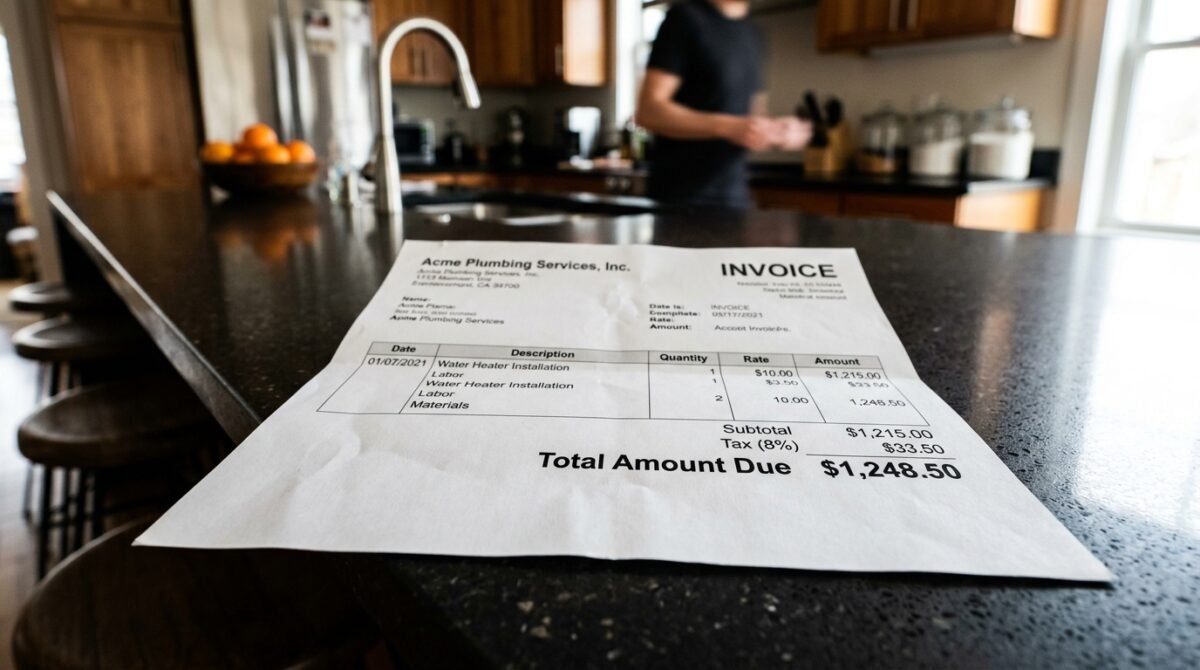
The invoice was simple, clinical, and devastatingly cold. It listed dates, times, and a specific dollar amount for every grocery delivery he had made during her two-week recovery window. It was the moment the veil of domestic stability lifted, revealing a transactional mindset that Sarah had never fully acknowledged until it was weaponized against her. She was not just a wife anymore; she was a debtor in her own home.
This wasn’t merely about a few hundred dollars or a dispute over chores. It was a fundamental clash of philosophies: is a marriage a team effort where support is unconditional, or is it a business arrangement where every favor must be quantified and reimbursed? Sarah’s decision to split their marital finances—and effectively dismantle their shared life structure—was not made in haste, but in the heat of a realization that she could no longer trust her partner to value her health over his ledger.
The following story is a deep dive into the collapse of their arrangement, the shocking text messages that followed, and the way the online community reacted to a boundary drawn in blood—or rather, in bank statements. This is the story of how one woman reclaimed her autonomy after being treated like a contractor in her own marriage.
The Three-Column Spreadsheet of Resentment
The realization didn’t happen all at once. It began with the arrival of a shared digital spreadsheet, a project Mark insisted on starting shortly after the pregnancy test turned positive. He spoke of ‘financial transparency’ and ‘preparedness,’ terms that sounded responsible at the time. Yet, as the weeks ticked by, the rows grew increasingly granular. By the time Sarah was in the hospital, the spreadsheet had expanded into a labyrinth of costs, including co-pays, hospital parking fees, and the cost of the protein bars he bought for himself during her delivery.
When she returned home, still navigating the physical trauma of surgery, she expected to see a partner stepping up to handle the load of a newborn. Instead, she saw a man who seemed to be keeping a tally. He would sigh while putting away the groceries, occasionally muttering about how much time it took out of his workday to run to the store. Sarah assumed it was just stress—until she saw the invoice.
It sat on the counter like an indictment. The document was formatted with the precision of a corporate statement: itemized dates, the cost of gas, the ‘delivery fee’ he had manufactured, and the final total of $450. It was not meant to be a joke. When Sarah confronted him, his defense was as clinical as the invoice itself.
“I just wanted us to be on the same page about the extra household costs during this transition period. It’s not about the money, Sarah; it’s about acknowledging the effort required to maintain this house while you’re out of commission.”
The phrase ‘out of commission’ echoed in her ears. He didn’t see a recovering mother; he saw a temporary deficit in their domestic productivity. She realized then that he wasn’t keeping track of the money to save it—he was keeping track of it to ensure that he was never ‘losing’ in their relationship. The shift from intimacy to auditing had been complete.
The tension in the air was palpable, thick enough to choke on. Sarah stood in the kitchen, still moving slowly due to the incision, feeling the weight of the paper in her hand. The absurdity of it was laughable, yet the betrayal felt like a cold blade. She wasn’t an equal; she was a business partner who had suddenly become a bad investment.
The Confrontation in the Nursery

The argument didn’t stay in the kitchen. It spilled over into the nursery, a space that was supposed to be a sanctuary. Sarah approached Mark, who was sitting at his computer, likely updating his next set of calculations. She threw the invoice on the desk, her voice trembling but firm. She had spent the last two days trying to ignore it, hoping he would walk in, apologize, and rip it up, but his silence had been deafening.
Mark didn’t look up immediately. He finished typing a sentence before turning, his face wearing an expression of calculated annoyance. He argued that the money was for the ‘inconvenience’ of his changed schedule, claiming that he had to skip gym sessions and work late because of her recovery. He framed his lack of support as a sacrifice he was entitled to be compensated for.
“You think this is a marriage? A marriage is support, Mark. I am healing from a surgery that brought our child into this world, and you are charging me for the cost of milk and eggs? Are you going to bill me for the diaper changes too?”
He countered that everything was about fairness. He argued that if she were single, she would have to pay for these services, so why should he be penalized for being the sole provider during her recovery? The logic was so distorted that Sarah felt as though she were living in an alternate reality. She realized that he viewed their marriage as a zero-sum game where his comfort was the only currency that mattered.
Sarah took a deep breath, the pain in her abdomen a sharp reminder of what she had actually sacrificed. She realized that trying to change his mindset was a waste of time. He didn’t lack empathy; he lacked the basic understanding of what a partnership meant. The conversation ended with him walking out of the room, leaving her alone in the quiet, the silence of the house feeling heavier than ever before.
She spent the night awake, cradling her daughter, and making a decision. She wouldn’t argue with him anymore. She wouldn’t try to justify her existence or her recovery to a man who had already reduced them to a balance sheet. The realization that she was entirely on her own in this marriage was liberating, in a terrifying way. She started planning her next move, not with anger, but with the cold efficiency he seemed to admire so much.
The Financial Partitioning

The next morning, the tone in the house was icy. Mark acted as if nothing had happened, expecting her to fulfill the usual household expectations despite her physical limitations. He asked her if she had ‘processed the request’ yet, referring to the invoice. Sarah simply nodded, a tight smile on her face. She had already been to the bank.
She had opened a separate account, one that he had no access to, and had transferred her share of their savings. She had also contacted their joint credit card company to freeze further charges. When she sat him down that evening, she didn’t raise her voice. She handed him a document of her own—a detailed breakdown of the household expenses they had shared, and a bill for her labor during his own ‘unproductive’ periods over the last year.
“I’ve calculated the value of my contributions to this household over the last twelve months, Mark. Since you believe our time and labor should be invoiced, I’ve taken the liberty of itemizing the cleaning, the cooking, the emotional labor, and the childcare. Your balance for the last year is significantly higher than mine.”
The look on his face was priceless—a mixture of confusion, indignation, and genuine shock. He hadn’t expected her to play by his rules, or perhaps he hadn’t expected her to be so thorough. He sputtered, calling her petty and vindictive, but Sarah remained calm. She explained that if they were going to be a business, they needed to be a fair one, and she was officially ending their ‘shared service’ contract.
Mark tried to argue that her contributions were ‘implied’ duties, while his grocery runs were ‘extraordinary’ efforts. Sarah laughed, a sharp, humorless sound. She pointed out that if his grocery runs were extraordinary, then her daily maintenance of their life was nothing short of a miracle. The power dynamic in the room shifted instantly. He wasn’t the auditor anymore; he was the one being audited.
He threatened to call his parents, to ‘expose’ her behavior. Sarah shrugged. She had already told her side of the story to her own family, and she had the documentation to back it up. She had become an expert in the language he chose to speak: the language of receipts, dates, and cold, hard facts. She wasn’t playing the victim; she was playing the game better than he was.
The Digital Trail of Betrayal

As the week progressed, the tension evolved into a digital standoff. Mark began texting her throughout the day, demanding passwords to the new accounts and questioning the validity of her ‘invoice.’ The texts were a window into his deteriorating composure. He claimed she was ruining their future, that she was being ‘unreasonable’ and ‘childish.’ He even went so far as to send her screenshots of bank transactions, trying to prove that he had contributed more to the grocery fund than she had.
“I just checked the account. Where is the transfer for the groceries? You’re acting like a child. This is our marriage, not a courtroom. Stop this nonsense and give me the account credentials.”
— Text Message from Mark
Sarah didn’t engage. She sent short, polite, and firm replies, refusing to be drawn into the chaos. She had already contacted a lawyer to discuss the legal implications of their finances and to ensure her rights as a mother were protected. She knew Mark’s next step would be an attempt to control the narrative, perhaps by playing the victim to their friends and family.
Sure enough, the group chat started buzzing. Mark had posted a vague, self-pitying message about how ‘difficult’ it was to manage a home when your partner refuses to be a team player. He didn’t mention the invoice. He didn’t mention the C-section. He just painted a picture of a man burdened by an ungrateful wife. The responses from his friends were immediate, but Sarah was ready.
She decided to take the high road by simply posting the truth. She didn’t need to be dramatic; she just needed to be factual. She posted a screenshot of the $450 invoice, side by side with his demand for payment, and a simple caption: ‘When your husband bills you for grocery delivery while you’re recovering from major surgery, it’s time to rethink the partnership.’ The silence that followed in the group chat was deafening.
The reaction was instantaneous. Her friends, his friends, even his own mother reached out. The narrative he had tried to spin was falling apart, not because of her opinion, but because of his own documented actions. It was the ultimate exposure: he had tried to quantify his love and ended up quantifying his own cruelty for the world to see.
The Fallout: Family Dinner at the Breaking Point

The inevitable family dinner took place three days later. Mark’s mother, a woman who prided herself on ‘family values,’ had insisted they all get together to ‘sort this out.’ Sarah arrived with her daughter, still feeling the physical toll of her recovery but determined to hold her ground. Mark sat at the head of the table, looking like a man who had lost his grip on his own narrative.
The conversation started with thinly veiled jabs. Mark’s mother tried to frame the whole thing as a misunderstanding, a ‘silly argument’ that had gotten out of hand. She kept glancing at Sarah, expecting her to apologize and move on. Sarah remained silent, letting the discomfort in the room build. She didn’t have to say anything; the invoice was already common knowledge in their circle.
“We are not here to debate the merits of a grocery list, Martha. We are here to talk about why my husband thought it was appropriate to treat a post-surgical recovery as a business transaction. If you want to talk about family values, let’s start there.”
The table went silent. Mark turned bright red, his fork clattering against his plate. He tried to interrupt, but his mother held up a hand. She had seen the screenshot Sarah posted, and she knew exactly how it looked to everyone else. She had realized that her son’s ‘financial transparency’ was nothing more than a mask for a deep-seated lack of empathy.
The rest of the dinner was agonizingly slow. Every time someone spoke, it felt like they were walking on eggshells. Mark tried to defend himself, his voice raising in volume as he grew more desperate. He kept repeating the same tired lines about his ‘sacrifices’ and the ‘high cost of living,’ but no one was listening. He had alienated everyone, and he didn’t even seem to understand why.
Sarah realized that this was the end of the line for their shared public life. She wouldn’t be coming back to these dinners, and she wouldn’t be pretending that things were okay. She packed up her things, took her daughter, and left before the dessert was even served. She felt a strange sense of peace as she walked to the car. The burden of maintaining his image was gone, and for the first time in months, she felt like she could actually breathe.
The Internet Weighs In

The story hit Reddit later that night. Sarah had shared the details on a popular relationship subreddit, expecting a few comments and maybe some advice. Instead, she got a tsunami of support and a masterclass in collective outrage. The post, titled ‘AITA for splitting my finances after my husband invoiced me for groceries during my C-section recovery?’, shot to the top of the feed within hours.
“This is not just about the money. This is financial abuse, plain and simple. He is trying to control you by making you feel like a burden. Get a lawyer, freeze those accounts, and get out. You don’t owe him a cent.”
— u/JusticeForSarah (Top Comment, 32.1k upvotes)
The community response was overwhelming. Thousands of people shared their own stories of financial control, neglect, and the painful process of reclaiming their lives. It was a validation that Sarah hadn’t received from her own household. She spent hours reading the comments, realizing that her experience was part of a larger, systemic problem that women often face in marriages where one partner insists on ‘financial equality’ while ignoring the reality of unpaid labor.
Some users provided detailed advice on how to protect her assets, suggesting she document every interaction and ensure she was legally prepared for a separation. Others shared stories of how they had left similar relationships and found happiness on the other side. The solidarity was palpable, a digital community wrapping their arms around a stranger in pain.
There were a few contrarians, of course—people who argued that marriage should be a strictly split arrangement and that Sarah was being ‘difficult.’ But they were quickly drowned out by the sheer volume of people who understood the fundamental moral failure of Mark’s actions. The Reddit thread became a place of healing, not just for Sarah, but for anyone who had ever felt like they were being audited in their own home.
The thread also served as a wake-up call for Mark. He somehow found the post, and the comments—his own friends and family members chiming in with their disgust—were the final blow to his ego. He sent Sarah a text, his bravado replaced by a pathetic, shaky attempt at bargaining. He asked her to delete the post, claiming it was ‘destroying his reputation.’ Sarah didn’t even reply.
The Legal Reality Check

While the online support was heartening, the reality of the situation was cold and hard. Sarah met with a family law attorney the following week. She brought every piece of documentation she had: the invoice, the text messages, the bank statements, and the records of their joint expenses. The attorney didn’t see a ‘silly argument’; they saw a clear pattern of controlling behavior.
They discussed the division of assets and the implications of the ‘financial arrangement’ Mark had insisted on. The attorney explained that in many jurisdictions, courts look unfavorably upon attempts to characterize the basic costs of a marriage—especially during a medical event—as debts. Mark’s ‘invoice’ was essentially a roadmap of his own failure to provide basic support during a time of need.
“Do not engage with him anymore. Let me handle the communication. He is trying to create a narrative of a business partnership, but the law sees a marriage. His attempt to invoice you is going to look very bad for him in front of a judge.”
Sarah felt a sense of relief wash over her. She wasn’t just a woman with a story anymore; she was a client with legal standing. The attorney walked her through the process of filing for a formal separation, ensuring that her daughter’s needs were met and that her own financial future was protected. The ‘business’ that Mark had built was being dismantled, one legal filing at a time.
Mark, meanwhile, was struggling to understand why his life was collapsing. He had spent his time focusing on the numbers, thinking that he could control the outcome if he just accounted for every variable. He hadn’t accounted for the human element: the fact that a marriage cannot survive on spreadsheets. He was now facing the prospect of a messy, public divorce, all because he couldn’t let go of a $450 invoice.
The legal process was grueling, but it was also a form of closure. Every form signed and every document submitted felt like she was shedding a layer of the life she had been forced into. She was reclaiming her story, one legal victory at a time. She wasn’t an auditor; she was a woman who was done being managed.
The Final Settlement

The final settlement was reached six months later. It wasn’t the dramatic, cinematic courtroom showdown she had imagined, but it was definitive. Mark agreed to the terms, largely because his lawyer warned him that his ‘invoicing’ behavior would be a disaster for him if it went to trial. The marriage was over, and the financial separation was complete.
Sarah walked away with her share of the assets and, most importantly, her autonomy. She moved into a small, bright apartment that was entirely her own. She no longer had to answer to anyone about how she spent her money, and she certainly didn’t have to worry about being billed for her own existence. The quiet in her new home was not heavy with resentment; it was light with possibility.
“I thought I was fighting for my dignity in that house, but I was actually fighting for my life. I didn’t lose a marriage; I lost a weight that I didn’t realize was dragging me down until I finally let it go.”
She had started a new chapter, focusing on her daughter and her own recovery. She still had moments of doubt, of course—the occasional pang of sadness for what she had once hoped their life would be. But then she would look at the invoice, which she had kept in a file box, not to dwell, but to remind herself of the day she woke up.
Mark, she heard, had tried to start similar ‘transparency’ arrangements with his next partner, but the word had gotten around. His reputation as the ‘grocery bill guy’ had followed him, and he was finding it difficult to maintain relationships. He was still living in his spreadsheet, still tallying up the costs of his interactions, never realizing that he was the only one paying the price for his cold, calculated approach to love.
Sarah’s life was now measured not in dollars, but in experiences. She saw the beauty in the small, unquantifiable moments—the way her daughter’s eyes lit up, the quiet joy of a morning without an audit, the freedom of a life lived on her own terms. She had learned the hardest lesson of all: that sometimes, the most expensive thing you can pay for is a relationship that costs you your soul.
The Lessons of the Ledger

Reflecting on the journey, Sarah realized that the invoice was merely a symptom of a larger rot. The rot wasn’t just the money; it was the lack of partnership, the total absence of empathy, and the refusal to see her as anything other than a means to an end. The invoice was just the moment she finally decided to call it what it was: a breach of contract that had existed long before the bill was even printed.
She looked back at the Reddit thread, the thousands of comments, and the stories of others who had been in her position. She realized she wasn’t an outlier. She was part of a movement of people who were done with the performative, transactional nature of relationships that masqueraded as partnerships. She was part of a generation that was reclaiming the definition of ‘equality’—not as a balance sheet, but as a shared commitment to each other’s well-being.
“Don’t let anyone turn your life into a balance sheet. You are a human being, not a cost center. When someone shows you they value their ledger more than your health, believe them the first time.”
Sarah began a blog, sharing her story in greater detail and offering advice to others who felt like they were being audited in their own homes. She became a voice for those who were struggling to find the words to explain why their relationships felt so cold. She was no longer just the woman who had been invoiced; she was the woman who had walked away and built a life worth living.
She often thought about the $450. It was the best money she had ever spent. It was the price of her freedom, the cost of her awakening. It was a bargain, really, when she looked at the life she had gained in exchange. She was no longer waiting for a response to an email, no longer checking her bank account for hidden fees, and no longer wondering if she was ‘enough’ to justify her own existence.
The story of the grocery bill had become a viral phenomenon, a cautionary tale that had traveled around the world. But to Sarah, it was just her life. And for the first time, that life was entirely hers. She was at peace, she was healthy, and she was, for the first time in a long time, truly, genuinely happy.
Community Perspectives: The Reddit Verdict

The community dialogue on this story did not end when the post was archived. It sparked a series of follow-up discussions on financial abuse and the ‘hidden’ labor performed by women in domestic settings. The consensus was clear: the actions of her ex-husband were not just inconsiderate, they were a textbook example of coercive financial control.
“People need to understand that the ‘invoicing’ isn’t about the money. It’s a power move. By putting a price tag on basic care, he was asserting ownership over your time and your physical recovery. Leaving was the only way to retain your autonomy.”
— u/FinancialPsychology (Top Comment, 18.2k upvotes)
Many readers pointed out that his defense—that he was ‘just’ trying to be fair—is a common tactic used to gaslight partners into accepting unfair conditions. The fact that he was willing to bill his recovering wife for groceries, while she was still healing from a major surgery, was viewed by thousands as an unforgivable moral failure. It served as a stark reminder of the importance of financial independence in any relationship.
Others shared their own experiences of ‘spreadsheet relationships,’ where partners would constantly compare who paid for what, often leading to a culture of resentment and score-keeping. The stories were remarkably similar: the initial promise of transparency turning into a tool for emotional manipulation. The community consensus was a resounding ‘NTA’ (Not the Asshole), with most users urging Sarah to remain completely no-contact.
Legal professionals who chimed in noted that while there is no specific ‘anti-invoicing’ law, the pattern of behavior she documented was highly useful in court. They emphasized the importance of saving text messages, emails, and any other evidence of controlling or manipulative behavior. The Reddit community had essentially turned into a support network, providing both emotional validation and practical, life-saving advice.
The story had a lasting impact on those who read it, serving as a catalyst for many to re-examine their own financial arrangements. It prompted many to have the ‘tough conversations’ they had been avoiding, ensuring that their own partnerships were built on mutual respect rather than mutual audits. The $450 invoice had become a symbol of what not to do, a lesson that would be remembered by thousands for years to come.
Conclusion
The saga of the $450 invoice serves as a profound, if painful, reminder that a marriage is defined by the quality of its support, not the precision of its accounting. Sarah’s story is a testament to the resilience of the human spirit when faced with the cold, transactional nature of a partner who values ledgers over lives. By setting a boundary and choosing to walk away, she not only reclaimed her financial future but also her sense of self-worth.
In the end, Mark’s attempt to quantify his ‘labor’ only succeeded in exposing the true cost of his character. For the readers who have followed this journey, it is an invitation to reflect: what are the silent ‘invoices’ in your own life? Are you in a partnership of equals, or are you being measured by a standard that was never meant to be a foundation for love?
We invite you to share your thoughts in the comments below. Have you ever been in a relationship where finances were used as a tool for control? How did you navigate the pressure to keep score, and what was the turning point that allowed you to reclaim your independence? Your stories matter, and your experiences may be the lifeline someone else needs right now.
What's your verdict on this dilemma?
Vote below to contribute to the official community consensus.

Have a Dilemma Keeping You Up at Night?
Share your real-life feud, wedding chaos, or relationship crossroads anonymously with our editorial team.
What do you think ?
0 Comments🛡️ Comments are moderated to protect community integrity. Your comment will appear once approved by the editorial team.