
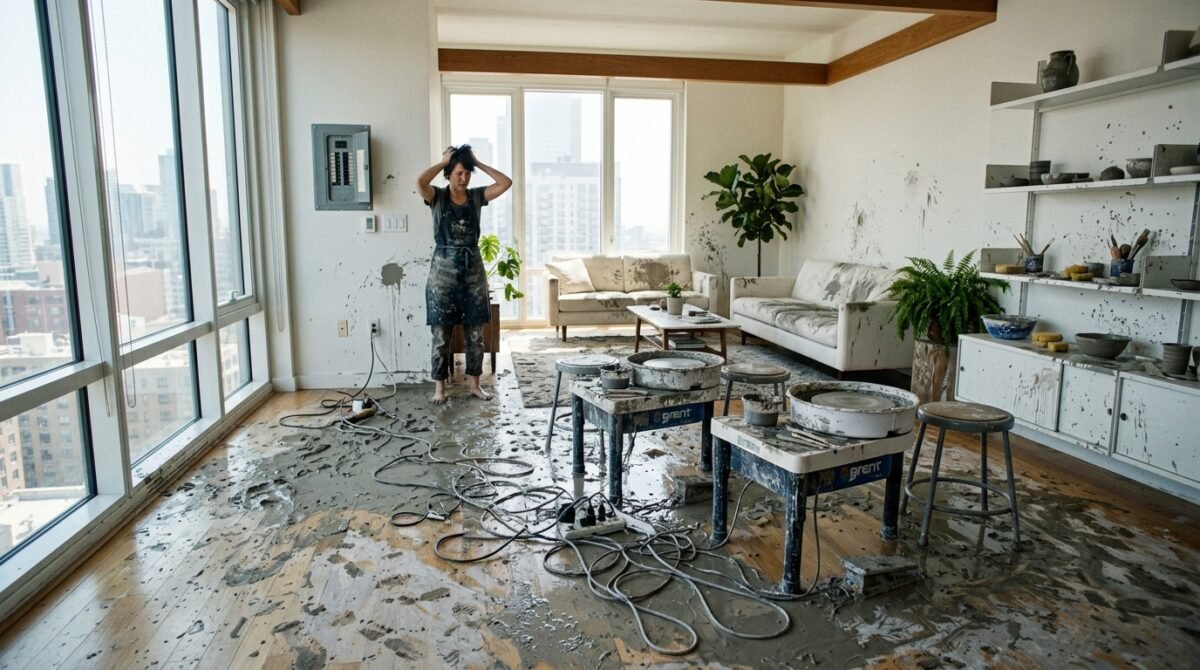
Living with a roommate is often described as a delicate dance of shared expectations and quiet compromises. For the first six months, Jessica and I were the gold standard of roommate harmony. We split the bills, we respected the quiet hours, and we navigated the shared common space with an unspoken agreement that our 900-square-foot apartment was a sanctuary for relaxation, not a workspace for industrial-level hobbies.
That all changed the Tuesday I walked through the door to find my living room transformed into what looked like an amateur ceramics factory. It wasn’t just a small hobby desk; it was a full-scale operation. Three electric pottery wheels were humming against the grain of our expensive oak hardwood floors, with buckets of slip, slurry, and bags of raw clay occupying every square inch of our limited walking space.
The air was thick with the scent of wet earth and the low, mechanical whine of motors straining against resistance. My roommate, Chloe, didn’t even look up as I entered. She was wearing an apron caked in drying mud, coaching two students who were clearly paying for an unadvertised, unpermitted class in our shared home. The sight was surreal—a nightmare of property damage and boundary violations unfolding in real-time.
I stood in the doorway for a long minute, paralyzed by the sheer audacity of the situation. My mind raced through the implications: the damage to the finish on the floors, the inevitable dust that would settle into our air vents, and the complete lack of respect for my right to peace and quiet in my own home. When I realized that she had not only moved my furniture to accommodate this circus but had also tapped into our shared kitchen outlets to power these high-draw machines, I knew a polite conversation was no longer an option.
The moral dilemma weighed on me heavily, but the physical reality of the apartment took precedence. I had to make a choice: confront her in front of her paying customers, which would be explosive, or neutralize the threat to the house immediately. I chose the latter, walking calmly to the utility closet and flipping the master circuit breaker. The sudden silence that filled the room was deafening, and that was when the real war began.
The Unannounced Transformation of the Living Room
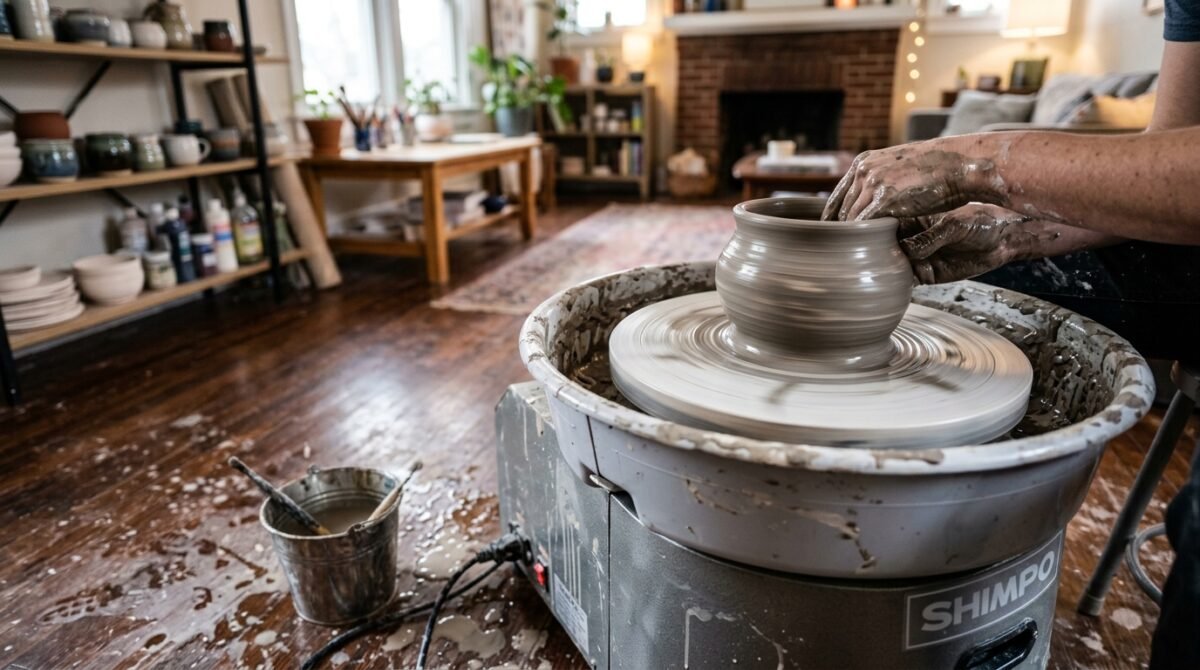
When I arrived home at 5:30 PM, I expected to find the usual calm of a Tuesday evening. Instead, the front door was propped open, and the hum of machinery was vibrating through the floorboards. Chloe had moved our sofa and coffee table into the bedroom, creating a makeshift studio space that looked like something out of a home-improvement show gone wrong.
There were three electric pottery wheels bolted down to what I could only assume were improvised wooden platforms designed to protect the floors—though they clearly weren’t doing a good job. Splatters of wet clay had already begun to dry on the hardwood, creating a crusty, gray film that I knew would be a nightmare to buff out.
I watched from the kitchen entryway as she leaned over a student, guiding their hands through a mound of spinning, wet earth. The floor around them was a disaster zone of slurry. It was clear this wasn’t a one-time thing; this was a business enterprise. She had transformed our shared living space into a commercial hub without asking for a dime in extra rent or even the common courtesy of a heads-up.
“Chloe, what in the world is happening here? Since when is our living room an open-access art studio for strangers?”
— Me
She wiped her hands on a rag, looking entirely too comfortable. “Oh, hey! I’m just hosting a trial class for my new side hustle. You’re home early! Don’t worry, they’ll be out by seven, and I’ve got drop cloths down. It’s totally fine, and it’s going to help me pay off my student loans.”
The arrogance in her tone was startling. She spoke as if my apartment, a place I paid half the rent for, was merely an extension of her creative ambition. My blood began to boil, not just because of the mess, but because of the complete disregard for my comfort and the structural integrity of our floor. I realized then that she didn’t view this as a violation; she viewed it as her entitlement.
The Breaking Point at the Circuit Breaker
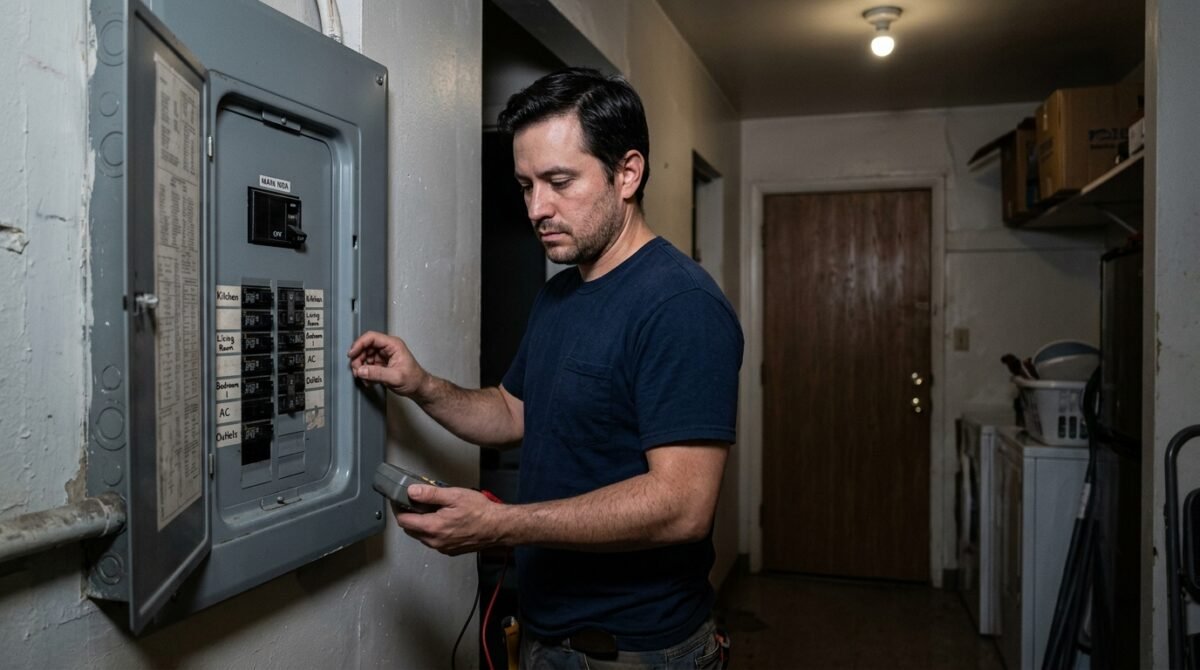
The realization that she had already taken deposits for these classes made my stomach turn. She wasn’t just ‘trying it out’; she was locked into a schedule. I looked at the three wheels, each pulling a significant amount of current, and then at our kitchen outlets, where she had daisy-chained power strips to reach the living area. It was not only disrespectful—it was a fire hazard.
I didn’t argue. I didn’t yell. I realized that if I engaged her in a debate, she would just talk over me or try to gaslight me about how ‘good this is for us.’ I simply walked past the group, ignored the confused looks from the students, and marched directly to the electrical panel in the utility hallway.
I gripped the main handle, felt the weight of it, and pulled it down with a firm, decisive click. The lights in the entire apartment flickered and died. The pottery wheels screeched to a halt, the sudden silence followed by a chorus of confused murmurs from the students in the living room. It was the most satisfying sound I had ever heard.
“Are you kidding me right now? The power just went out! I’m in the middle of a demonstration!”
— Chloe
I walked back out, my arms crossed, watching her fumble for her phone to use as a flashlight. She was irate, her face flushed with anger. “I’m not paying for a studio space, Chloe. And I’m certainly not letting you run an industrial operation on floors that we don’t even own. The power stays off until every single piece of equipment is out of this house.”
The silence in the apartment shifted from the hum of machinery to a thick, suffocating tension. The students were clearly uncomfortable, looking between us and wondering if they should leave their clay projects behind. I held my ground, staring her down while she stood there with a dead wheel and a ruined lesson.
The Fallout in the Group Chat

Within an hour of the students leaving, my phone was blowing up. Chloe had gone straight to her inner circle, creating a group chat with our mutual friends to frame me as the ‘controlling, anti-art, toxic roommate’ who had ruined her livelihood. She conveniently left out the part about the hardwood floors and the unlicensed business.
“Can you believe she killed the power during my class? She’s literally trying to sabotage me because she’s jealous I have a side business. I’m literally shaking.”
— Chloe, in the group chat
I didn’t respond in the chat. I waited until I had printed out our lease agreement, specifically the clause regarding ‘commercial activity’ and ‘alterations to the property.’ I screen-capped the specific line about the floors and sent it back to the group, alongside a photo of the muddy, scarred floor near the baseboards.
“Chloe, please check section 4.2 of our lease. You are operating a business in a residential unit and causing permanent damage to the floor. I’m not sabotaging you; I’m protecting our security deposit and our legal standing. The power stays off until the equipment is gone.”
— Me, in the group chat
The group chat went silent for several minutes. It was the digital equivalent of a room freezing over. One of our friends, Sarah, replied shortly after, asking if it was true that the wheels had caused scratches. I didn’t need to lie; the photos spoke for themselves. The narrative Chloe tried to spin was falling apart in real-time.
I sat in the dark for a while, feeling the adrenaline slowly leave my system. It was lonely, and it was stressful, but it was also the first time in months I felt like I was actually living in my own home again. I knew the blowback would be intense, but I was ready for the fallout. The line had been crossed, and I was the one who drew it back.
The Landlord’s Unannounced Inspection

The next morning, I received an email from our landlord, Mr. Henderson. Chloe had clearly tried to get ahead of the story, but he was a man who cared about his property above all else. He was coming over at noon for an ‘urgent inspection.’ I didn’t have to say a word; he saw the state of the living room the moment he stepped through the door.
The clay had hardened into a crusty, stubborn mess overnight. Mr. Henderson didn’t even look at me; he walked straight to the pottery wheels, touched the hardwood, and then looked at the baseboards. The damage was visible even to the untrained eye. Chloe was standing in the corner, trying to explain it away as a ‘small, temporary workshop,’ but her voice was trembling.
“Miss, this is a residential lease. You are not permitted to run a commercial pottery studio. Not to mention the damage to these floors will cost thousands to refinish. This is an immediate violation of your contract.”
— Mr. Henderson, Landlord
He pulled out a legal notice of violation right then and there. I stood back, observing the scene with a sense of grim vindication. It wasn’t about being ‘right’—it was about accountability. Chloe looked at me with pure venom, blaming me for ‘calling him,’ which was a lie; he had heard through the grapevine of the building’s superintendent who noticed the extra foot traffic.
The reality of the financial stakes hit her hard. Mr. Henderson mentioned that if the floors couldn’t be cleaned without refinishing, the entire security deposit would be forfeit, and we might be looking at additional charges. I felt a pang of guilt for my own share of the deposit, but I knew I hadn’t caused this. The burden of the outcome was entirely on her shoulders.
The Aftermath of the Eviction Threat
After Mr. Henderson left, the apartment felt like a tomb. Chloe was packing her things, not to move out, but to move the wheels out to a storage unit. She was still fuming, refusing to speak to me directly, communicating only through short, aggressive sticky notes left on the refrigerator.
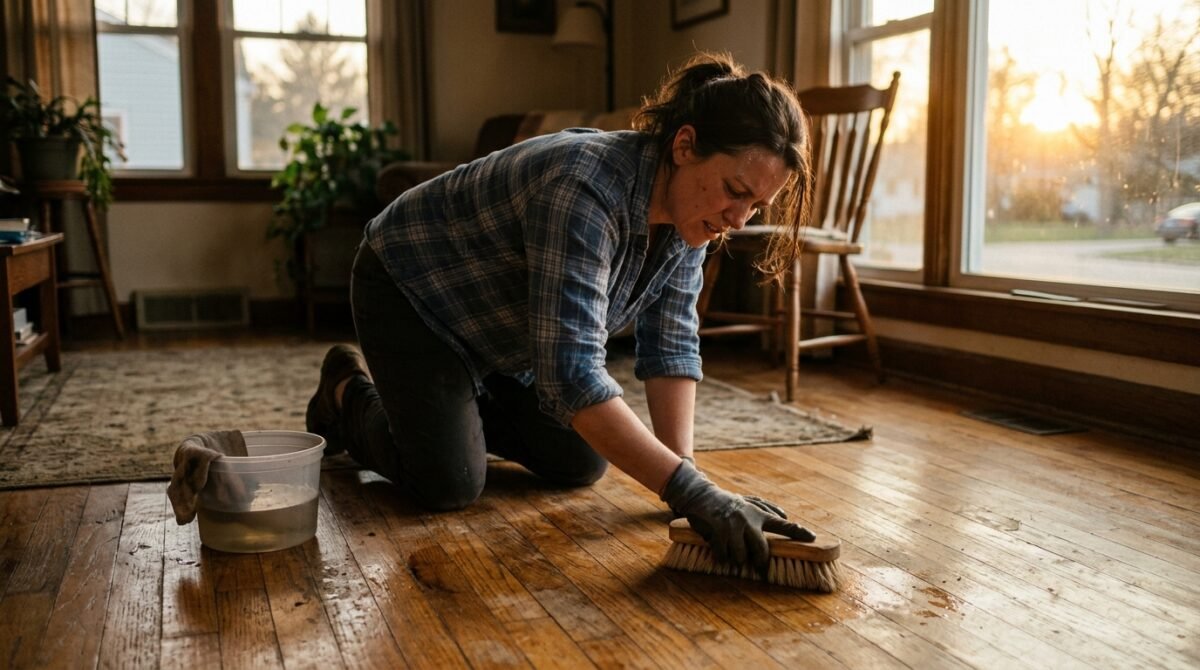
I spent the afternoon cleaning the living room. It was grueling work—scrubbing the clay out of the gaps in the hardwood floorboards with a toothbrush and a damp cloth. Every time I found a deep gouge where a wheel had been bolted down, my anger flared up again. It wasn’t just the mess; it was the sheer selfishness of it all.
By the time I finished, the sun was setting, casting long, orange shadows across the clean floor. It looked better, but the finish was definitely dulled in those spots. I knew we were going to have to pay for a professional refinishing. I calculated the costs in my head: a few hundred for the labor, maybe a thousand for the materials. It was a steep price for someone else’s hobby.
“I hope you’re happy. You’ve basically destroyed my chance at a business and ruined my friendship with half the people in this building. I don’t know how you live with yourself.”
— A sticky note left on the mirror
I left the note there for a long time. It was a classic projection. She was the one who had destroyed the peace, who had risked our housing, and who had ignored the boundaries of our shared living space. I didn’t feel guilty. I felt like a person who had finally stood up for their environment.
The Reddit Verdict: NTA or ESH?

I decided to post my situation on Reddit to see if I had handled the situation correctly. The response was overwhelming. Within hours, the thread had thousands of comments, with people weighing in on everything from the legal ramifications of the lease to the social dynamics of roommates.
“NTA. Your roommate literally tried to set up a commercial business in your living space without permission and ruined the floors. Turning off the power was a petty but effective move to stop the damage before it got worse.”
— u/RoommateTruths (Top Comment, 24.3k upvotes)
There were, of course, the contrarians who claimed I was ‘escalating’ things too quickly, but the vast majority of the community supported my choice. Many users shared their own horror stories of roommates with ‘hobbies’ that turned into full-blown domestic disasters. It was reassuring to see that I wasn’t alone in dealing with this kind of entitlement.
“ESH. You should have talked to her before cutting the power. Petty revenge rarely solves the problem, even if she was in the wrong. You could have just told the landlord from the jump.”
— u/NeutralObserver (1.2k upvotes)
The debate in the comments was fascinating. It highlighted the difference between those who believe in direct, conflict-avoidant communication and those who believe that when someone crosses a clear boundary, immediate, drastic action is the only way to get through to them. I spent hours reading through the advice, trying to process the event from an outside perspective.
The Search for a New Arrangement

Living with Chloe became impossible after the incident. We existed in a state of ‘cold war,’ avoiding each other in the kitchen and never speaking. The trust had been completely eroded. I knew I couldn’t stay here, not just because of the tension, but because the living room—the space I loved—now felt tainted by the memory of the pottery wheels.
I started looking for a subletter, but I knew I had to be upfront about the history of the apartment. I didn’t want to trap someone else in a lease with someone as boundary-blind as Chloe. I started looking for my own place, a small studio where I wouldn’t have to share my floor or my peace with anyone else.
Chloe, meanwhile, was trying to convince me to stay. She had realized that if I left, she wouldn’t be able to afford the rent on her own. She even offered to ‘make up for it’ by paying for a deep cleaning of the floors. It was too little, too late. The damage wasn’t just to the wood; it was to the foundation of our living arrangement.
“I’ve looked into studios downtown. I’m moving out in two months. I suggest you find someone who is okay with your ‘business’ or look into a commercial space.”
— Me, during a brief, icy conversation
She tried to argue, but I walked away. There was no point in continuing the dialogue. I had made my decision, and for the first time in a long time, I felt like I was in control of my own future. The apartment was just a box; my peace of mind was the real asset I was protecting.
The Final Walkthrough
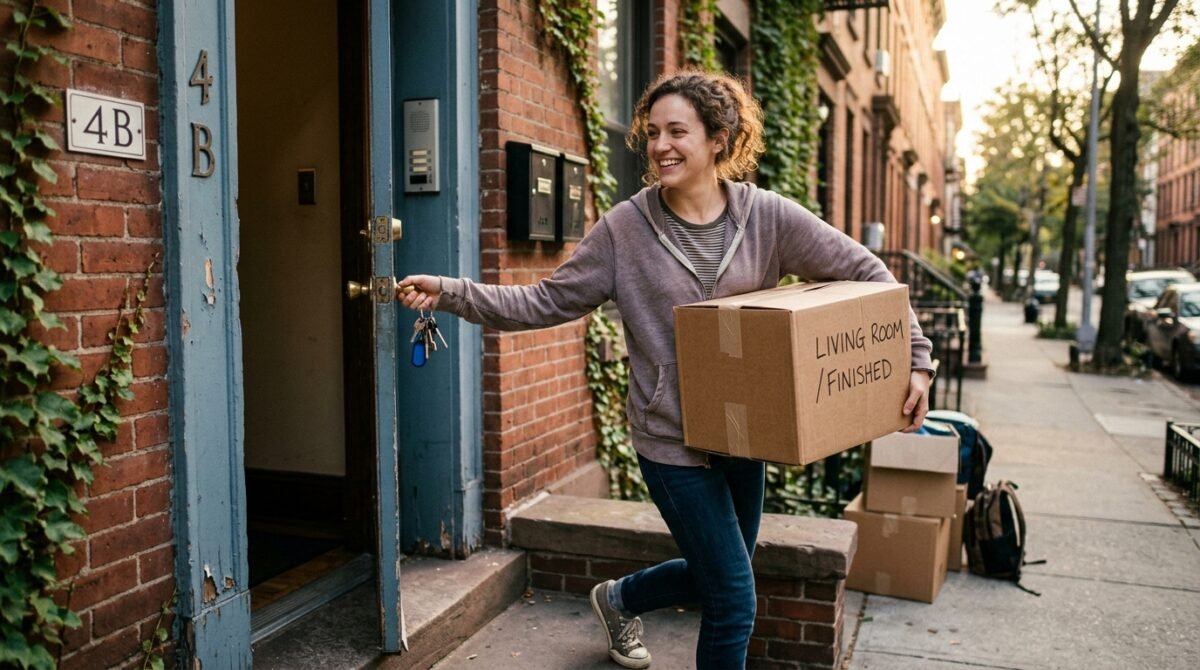
When the day finally came to hand over my keys, the apartment was empty. The pottery wheels were long gone, the floors had been sanded and refinished, and the living room looked almost like it did when I first moved in. But the feeling was different. I was ready to leave behind the stress and the constant vigilance of living with someone who didn’t respect me.
Mr. Henderson came by for the final inspection. He looked at the floors, nodded, and told me that the repair costs had been deducted from the security deposit, as expected. I didn’t fight it. It was the cost of freedom. Chloe was in her room, not coming out to say goodbye, which was fine by me.
As I walked out the door for the last time, I felt a wave of relief that I hadn’t expected. The ordeal had been exhausting, but it had also taught me a valuable lesson about the importance of boundaries. I realized that my kindness had been mistaken for weakness, and that I had to be firmer from the very beginning.
“I hope you find a roommate who appreciates your ‘creativity.’ Good luck, Chloe.”
— My final message to her
I walked to my car, the late afternoon sun warming my face. I was heading to my new place, a quiet, one-bedroom apartment where I could work, sleep, and live without worrying about what would be waiting for me in the living room. It was a fresh start, and I was looking forward to it.
The Philosophical Reflection on Boundaries

Reflecting on the experience, I realize that the conflict wasn’t really about the pottery wheels at all. It was about respect. It was about the fundamental human need for a space that is truly one’s own—a sanctuary where we don’t have to negotiate our existence with others. Chloe’s desire to express her creativity was valid, but her method of doing so was an act of aggression.
We often talk about compromise in relationships, but compromise shouldn’t mean the total sacrifice of one person’s comfort for the gain of another. When we agree to share a space, we are agreeing to a set of rules, both written and unwritten. Violating those rules is a breach of trust that is hard to recover from. I learned that I have a right to demand better, and that standing up for those boundaries is not ‘petty’—it’s self-preservation.
Some might argue that I could have handled it differently, that I could have had a ‘grown-up’ conversation. But I think about the moment I cut the power, and I realize that it was the only thing that actually communicated the gravity of the situation. Sometimes, words aren’t enough. Sometimes, you have to create a physical disruption to make someone stop and listen.
“Boundaries aren’t walls to keep people out; they’re the fences that keep our peace of mind in. Don’t be afraid to pull the plug when someone is trampling on your life.”
— A thought I kept in my journal
I’m grateful for the experience, as painful as it was. It taught me who I am when pushed, and it taught me what I deserve in a living situation. I’m moving forward now, with a much clearer understanding of my own worth and a refusal to let anyone else dictate the terms of my living space again.
The Community’s Ongoing Debate

Even months later, I still get messages from people who read the post online. It seems the story struck a nerve in a way I didn’t expect. People are still arguing about the circuit breaker incident, with some hailing it as a masterclass in setting firm boundaries and others still clinging to the idea that communication should have been prioritized.
I’ve stopped engaging in the comments. I’ve said my piece, and I’ve moved on with my life. But it’s interesting to see how the story has taken on a life of its own. It’s become a case study for some in roommate conflict resolution, and a cautionary tale for others about the dangers of unchecked entitlement.
I’ve reached out to a few friends who had similar experiences, and we’ve formed a small support group. We share tips on how to vet roommates, what to look for in a lease, and how to deal with the inevitable friction of living with others. It’s been a healing process, turning a negative experience into something that helps others avoid the same fate.
“I just wanted to say that your post helped me realize I don’t have to put up with my roommate’s constant loud music at 3 AM. I finally moved out, and I feel so much lighter.”
— A private message from a reader
Hearing things like that makes me realize that even the most frustrating situations can have a positive outcome. I’m glad I could be the one to show someone else that it’s okay to put yourself first. It’s a lesson I’ll carry with me for the rest of my life.
Conclusion
The saga of the pottery wheels taught me more than just a lesson in property maintenance; it taught me the power of self-advocacy. When someone violates your home, they are violating your peace. While I don’t regret my actions, I do recognize that my decision to pull the master breaker was the culmination of months of suppressed frustration that perhaps should have been addressed sooner. I learned that silence is often interpreted as consent, and by not speaking up earlier, I had inadvertently allowed the problem to fester until it exploded.
Today, I am living in a beautiful studio apartment where the only ‘wheels’ are the ones on my desk chair. I have established clear, written agreements with any visitors, and I prioritize my own comfort above the convenience of others. I have learned to speak my mind when I feel my boundaries being encroached upon, and I have found that most people respect me more for it. The emotional aftermath was a long, winding road, but the destination—a place of genuine peace and autonomy—was worth the journey.
What about you? Have you ever had to resort to ‘nuclear’ options to regain control of your living space? Or do you believe there is always a path for diplomatic resolution, no matter the provocation? Let us know in the comments below—I’m curious to see how many of you have faced your own ‘pottery wheel’ nightmare.
What's your verdict on this dilemma?
Vote below to contribute to the official community consensus.

Have a Dilemma Keeping You Up at Night?
Share your real-life feud, wedding chaos, or relationship crossroads anonymously with our editorial team.
What do you think ?
0 Comments🛡️ Comments are moderated to protect community integrity. Your comment will appear once approved by the editorial team.