

I have spent the last seven years building my career as an architectural illustrator. My tools aren’t just objects; they are an extension of my professional capability. The centerpiece of my home office—a hand-crafted, vintage-inspired drafting table with a tilt-adjustable top and custom-fit storage—was a gift to myself after my first major contract. It wasn’t cheap, it wasn’t replaceable, and it certainly wasn’t community property for the extended family.
My husband, Mark, has always had a ‘what is mine is yours’ philosophy, which is lovely for our marriage but absolutely catastrophic when applied to my professional assets. He views my office as a spare room that happens to contain desks, rather than a workspace that demands privacy and respect. This fundamental disconnect in our values regarding personal property and professional boundaries has been a low-level hum of tension for years, but I never expected it to explode into a legal confrontation.
The events leading up to the disaster began when his sister, Sarah, decided to expand her home daycare into a ‘creative learning center.’ She was operating under an LLC, treating her small business as a legitimate enterprise, yet she seemed to view my husband as her personal procurement department. She was constantly asking for ‘donations’ of supplies, equipment, and labor, usually under the guise of family support.
The morning I walked into my office to find a gaping, empty space where my drafting table should have been, I didn’t immediately assume the worst. I thought perhaps I had moved it, or maybe Mark had cleaned the room. But when I checked the security camera mounted in the hallway, I saw them: Mark and Sarah, sweating and heaving my heavy table down the stairs at 6:00 AM, laughing as they loaded it into the back of her minivan. The moral dilemma wasn’t just about the table; it was about the erasure of my autonomy within my own home.
I chose not to scream. I chose not to call him while he was at work. Instead, I sat down, calculated the exact market value of the piece, added a markup for professional loss of productivity, and drafted a formal invoice to Sarah’s LLC. If she wanted to act like a business owner, I was going to treat her like one. This is how the most expensive furniture in my house turned into the ultimate test of our marriage.
The Empty Room and the Hallway Footage
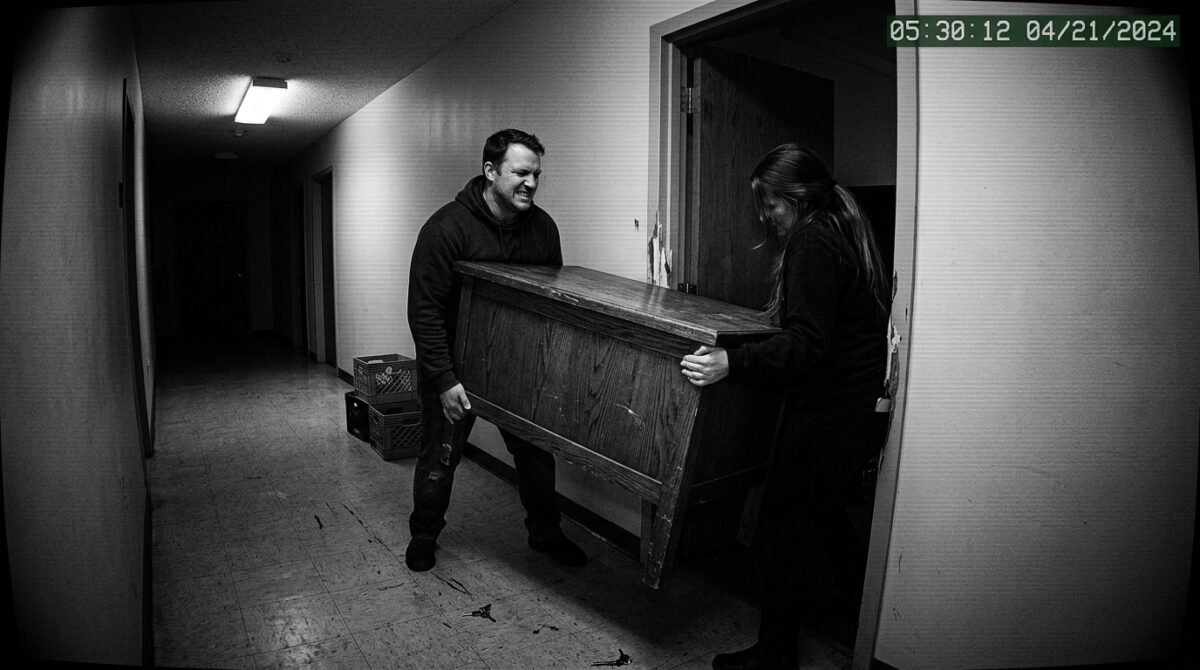
The silence in my office was deafening. I stood in the doorway, staring at the indentation in the rug where the drafting table had anchored the room for years. My heart didn’t race; it went cold. I am someone who thrives on order and predictability, and this was an invasion of my inner sanctum. I walked over to the desk where I keep the tablet connected to our home security system, my fingers trembling slightly as I pulled up the log for the early morning hours.
The footage was clear as day. At 6:15 AM, Mark emerged from the bedroom, looking disheveled, followed by his sister. They were whispering, and Sarah was pointing at the office door. Mark opened it, and I watched as they dismantled my workspace. They didn’t even cover the table to protect the wood. They dragged it across the hardwood floor, leaving a faint, jagged scratch that I could see from the doorway even now.
“Be careful, Mark! You’re going to dent the corner! It has to look professional for the parents when they drop off the toddlers, or they won’t think I’m serious about the art curriculum.”
— Sarah, caught on security footage
I watched as Mark wiped sweat from his forehead and chuckled, patting the table like it was a piece of junk he’d found at a garage sale. He didn’t care about the function of the table. He didn’t even seem to realize that I used it for work. To him, it was just a large desk. I felt a surge of adrenaline that was entirely focused on retribution.
I didn’t call him. I didn’t send a text. I pulled up my accounting software and began to compile the numbers. I knew that if I confronted him, he would gaslight me, telling me I was ‘overreacting’ or that ‘family comes first.’ I needed the paperwork to be in order before the shouting started. I needed to establish that this wasn’t a family squabble; this was a business transaction.
By the time I finished the invoice, I had included not just the replacement cost of the table, but the cost of the professional cleaning required for the scratches they left on my floor, and a ‘consulting fee’ for the sudden disruption to my workflow. I printed it out, put it in a professional envelope, and waited for the inevitable arrival of the evening.
The Confrontation Over Sunday Dinner
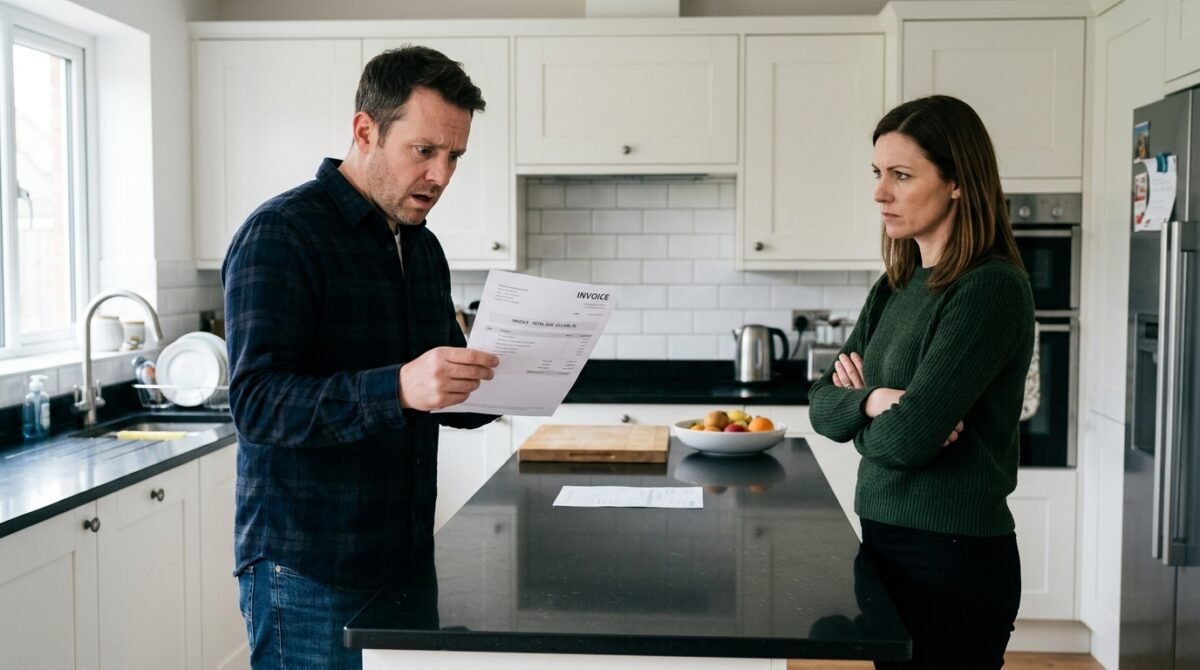
Mark came home that evening with an air of smug satisfaction, completely oblivious to the storm he had invited into our living room. He walked through the front door, kissed my cheek, and went straight to the kitchen to start pouring a glass of wine. He didn’t mention the table. He didn’t mention that he had spent his morning moving my furniture. He acted as though it was just another Tuesday.
I sat at the kitchen island, the invoice sitting face-down on the counter. I watched him move around the kitchen, feeling a strange detachment. How could I be married to someone who viewed my professional tools as disposable items for his sister’s convenience? The entitlement was staggering.
“Rough day, honey? You’re awfully quiet. Did you finish that project you were working on, or are you waiting until tomorrow?”
— Mark, while pouring wine
I let him talk. I let him dig the hole deeper. When he finally turned to face me, I stood up and slid the envelope across the granite. He looked at it, confused, as if he expected me to hand him a grocery list. He opened the envelope, and I watched his face shift from confusion to annoyance, and finally, to genuine alarm.
“What is this? An invoice? To Sarah? Are you out of your mind? It’s a desk, not a nuclear weapon. She’s using it to teach the kids how to draw, and you’re acting like I sold your kidney.”
— Mark, holding the invoice
I didn’t flinch. I told him that the desk was a professional asset that cost four thousand dollars, and that Sarah was now the owner of that asset via his theft. I told him that since he and Sarah had treated the removal as a business decision for her LLC, I was simply invoicing the business. He tried to laugh it off, but the look in my eyes told him I wasn’t joking. I told him if the money wasn’t in my account by Friday, I would be filing a police report for the theft of property.
The Group Chat Explosion

I knew Mark would go straight to the family group chat. He was the golden child, the one who always smoothed things over with his mother and sister. Within twenty minutes of our argument, my phone began to vibrate incessantly. The family group chat, which usually consisted of holiday plans and birthday wishes, had become a war zone.
“I cannot believe you are charging your own family for a desk! Sarah is trying to build a business to support her kids, and you’re acting like a loan shark. You’ve always been so cold.”
— Mother-in-law, in the family group chat
The messages were flying in. Sarah was claiming that she had already ‘set up’ the table in the classroom and that it would be ‘traumatizing’ for the children to move it now. It was the classic manipulation tactic: weaponizing the children to bypass any accountability for the parents. I didn’t reply to any of them. I took screenshots of every single message, including the ones where Sarah admitted to taking the item without permission.
I realized then that this wasn’t just about the table. It was about the fact that they all expected me to be the ‘supportive wife’ who existed to provide assets for the rest of the family. I was the silent partner in their schemes. Every time I had donated to their causes in the past, they had taken it as a sign of weakness, or worse, an obligation.
Mark eventually came into the room where I was working on my laptop. He looked exhausted, but his tone was still patronizing. He wanted me to just ‘drop it’ and move on. He told me that Sarah would never pay the invoice and that I was just embarrassing myself by acting like a lawyer. I told him that I wasn’t acting; I was being an adult who expected to be treated with basic respect.
I stood my ground, telling him that if he wanted to live in a house where property was shared, he should have married someone who didn’t work for a living. I told him the invoice stands, and that my relationship with his family was now officially a business transaction. He left the room, slamming the door, but the damage to our trust was already done.
Legal Realities and the LLC Factor
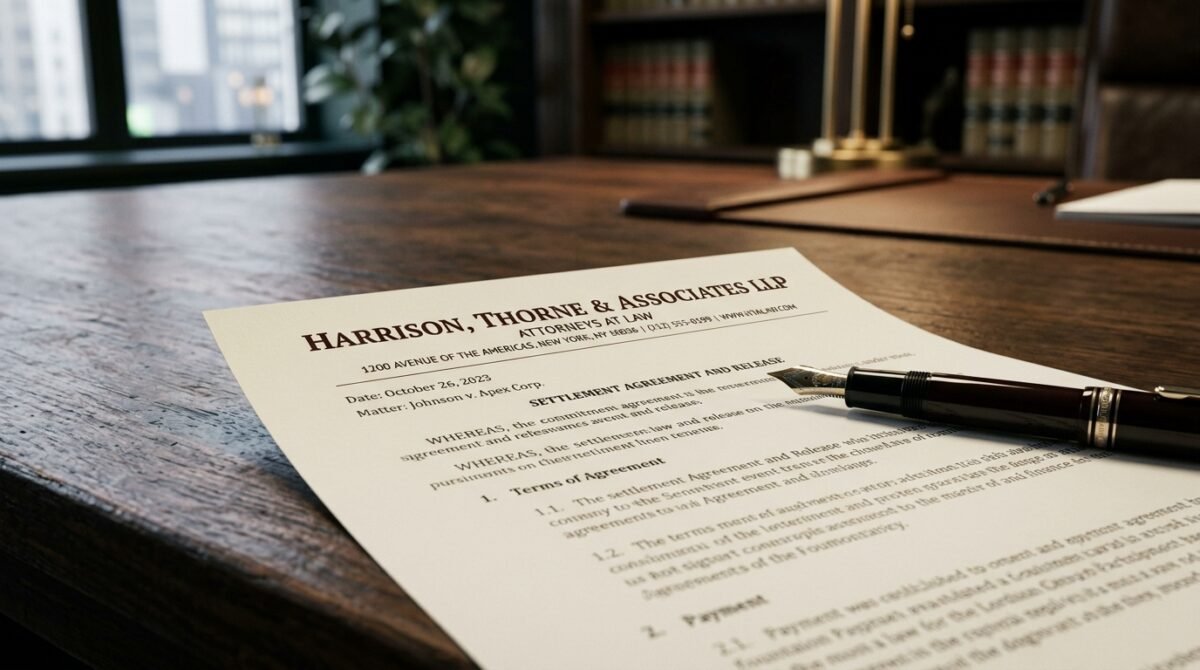
I didn’t just pull the numbers out of thin air. I had the original receipts, the appraisal for the vintage wood, and the labor costs for the installation of the specialized surface. Because Sarah’s business was a registered LLC, she was legally liable for the actions taken by her ‘company.’ Taking an asset from a third party without authorization was a massive liability for her, especially if I could prove she knew it was mine.
I visited a small business attorney the next day during my lunch break. I didn’t need to sue her yet, but I needed to know my options. The lawyer told me that if she was using the equipment for a commercial enterprise, she was legally required to have an inventory of her assets. Using my table as a ‘donation’ without documentation was a tax fraud waiting to happen.
When I returned home, I printed out a formal demand letter on my company’s letterhead. It was cold, professional, and cited the exact statutes regarding theft and business property. I also sent a courtesy copy to Mark, just so he knew I wasn’t playing around. He was white as a sheet when he read it. He finally realized that this wasn’t a fight he could win by shouting.
“If you send this, you’re ending your relationship with my family. They will never forgive you for this. Is a piece of furniture really worth cutting us off?”
— Mark, pleading in the living room
I looked at him and realized that he still didn’t get it. He thought the price of the table was the cost of the relationship. He didn’t see that the relationship was already dead because they didn’t value me. If they were willing to steal from me to help Sarah’s business, they were already the ones who had cut me off.
The next day, I received a frantic email from Sarah. She wasn’t calling me names anymore; she was trying to negotiate. She offered to pay ‘half’ the value if I dropped the legal threats. I didn’t reply. I just sent her a link to a payment portal and a deadline. The business side of me had taken over, and I found it strangely liberating.
The Return of the Property
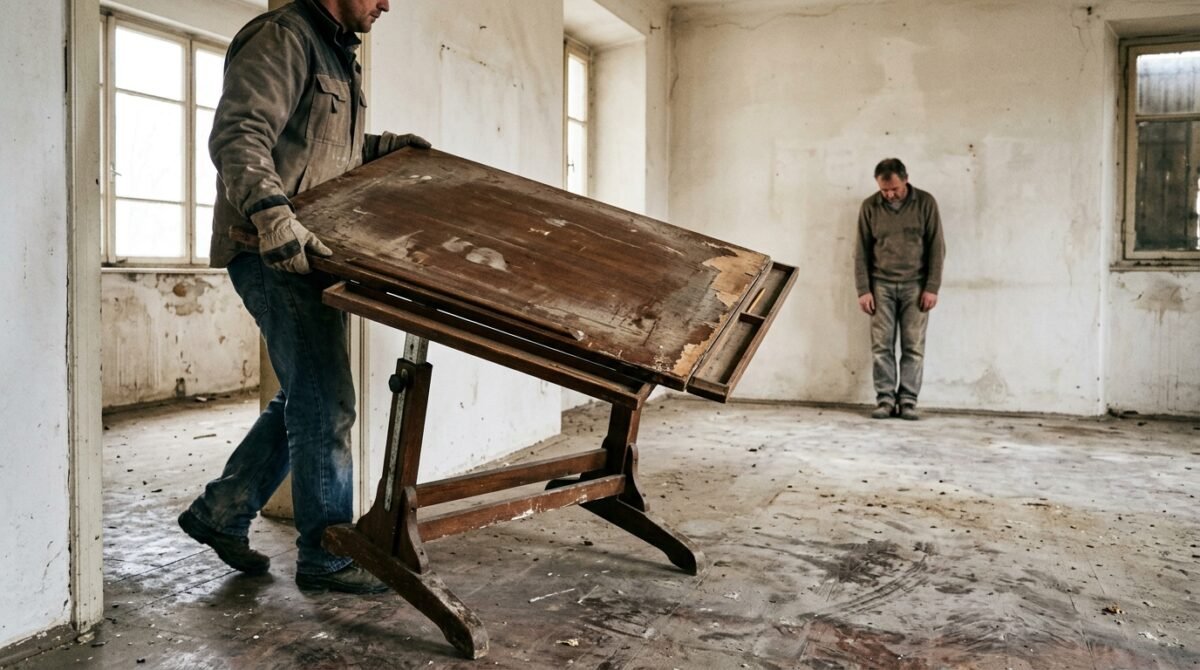
Two days later, a moving truck pulled up to our house. Mark was outside, looking mortified as two movers carried the table back into the house. It was covered in dust and had a new, deep scratch on the side. My heart broke, not just for the table, but for the disrespect it represented. Sarah didn’t even show up to apologize; she sent a text message about how ‘unsupportive’ I was.
I watched them bring it in through the window, my arms crossed. They set it down in the center of the office, which was still just an empty room. Mark came in, looking for an opening to fix things. He wanted a hug, he wanted me to say it was all okay now that the ‘toy’ was back. But I couldn’t look at it the same way. It was a symbol of everything that was wrong with our marriage.
“See? It’s back. Can we please stop acting like this? The invoice is gone, the table is back, let’s just go back to normal. I’ll make it up to you, I promise.”
— Mark, standing by the returned table
I told him that the damage was already done. The scratches weren’t just on the table; they were a permanent mark on my trust. I told him that I wanted him to pay for the professional restoration of the table, and that I would be installing a keyed lock on my office door that only I had the key to. He looked offended, but I didn’t care.
The restoration cost was significant, and I made sure he paid it out of his ‘fun money’ account, not our joint account. I wanted him to feel the financial sting of his decision. He complained about the cost, but he paid it. It was the first time he had ever been held accountable for his impulsive ‘generosity’ at my expense.
That night, I sat at the restored table for the first time. It felt different. It felt like a line had been drawn. I wasn’t just his wife; I was a person with boundaries, and for the first time in years, I felt like those boundaries were actually real.
The Reddit Verdict: NTA or ESH?

I decided to share my story anonymously on a popular subreddit for relationship advice. I needed to know if I was the villain, or if I had finally found my backbone. The response was overwhelming. Within hours, the post had thousands of upvotes and a comment section that felt like a courtroom.
“NTA. Your husband and sister-in-law committed theft. It doesn’t matter if they are family; you don’t take someone’s professional equipment without asking. You were right to bill the LLC. That’s how you handle business, and it’s how you handle entitled family.”
— u/ArchitectLife (Top Comment, 15.2k upvotes)
There were, of course, the dissenters. Some people argued that I was being ‘petty’ and that ‘family is family.’ I read those comments with a sense of clinical detachment. I realized that the people who called me petty were likely the ones who had been in Sarah’s position, or the ones who had been walked over their entire lives and were terrified of the idea of setting boundaries.
“ESH. You are both being toxic. He shouldn’t have taken the table, but billing the LLC is a cold, passive-aggressive move that guarantees you’ll never have a good relationship with your in-laws. There were better ways to handle this.”
— u/FamilyFirstOnly (Downvoted, -2.4k upvotes)
The community support was validating, but the debate opened my eyes to how deeply ingrained the idea of ‘family immunity’ is. People were shocked that I had treated them like strangers. But that was the point. They had acted like strangers who felt entitled to my things. Why should I treat them like family when they treated me like a resource?
I spent the next few days reading through the thread, finding comfort in the stories of others who had similar experiences. It made me realize that I wasn’t alone. Thousands of people had dealt with the ‘golden child’ dynamic and the ‘support the business’ manipulation. It was a universal story of boundary-setting, and for the first time, I felt empowered instead of guilty.
The Shifting Power Dynamic

The fallout within the family was immediate and severe. My mother-in-law refused to speak to me, and Sarah stopped responding to my texts entirely. Mark was caught in the middle, and for the first time, he realized that his silence wasn’t keeping the peace—it was enabling the war. He stopped trying to force me to reconcile with them, sensing that the topic was now nuclear.
I noticed a change in how he approached our life together. He started asking before he moved things. He started asking about my work projects, showing genuine interest instead of just assuming I was ‘playing’ at my desk. It was a slow, tentative process, but the boundary I had established by force was now being respected by habit.
I started attending family gatherings again, but only on my terms. I didn’t go to the ones where Sarah was hosting her ‘creative learning sessions.’ I didn’t offer any more financial help to the family. I kept my money, my time, and my professional life completely walled off from the rest of them. It was a lonely existence at first, but it was a quiet one, and peace was something I hadn’t had in years.
Mark eventually started to see the benefits of the boundary too. He realized that our marriage was actually stronger when he wasn’t trying to please his sister. He started to see Sarah not as the ‘victim’ of my coldness, but as the person who had tried to steal from us. It was a painful realization for him, but a necessary one.
“I’m sorry, babe. I really didn’t see it until you laid out the numbers. I thought I was helping, but I was just being a tool. I’m proud of you for standing up for yourself, even if I was the one you were standing up against.”
— Mark, during a quiet dinner
It was the closest he had ever come to a real apology. I accepted it, but I didn’t forget. I kept the invoice in a folder in my office, a reminder of what happens when you let people take what isn’t theirs. The drafting table remained in the center of the room, a testament to the fact that some things are mine, and mine alone.
Reflecting on the ‘Generosity’ Trap

Looking back, I realize that the trap wasn’t just the table. The trap was the assumption that I was a ‘supportive’ person who would always say yes. I had spent years being the ‘easy’ daughter-in-law, the one who always contributed to the potluck, the one who never complained about the late-night visits, the one who always loaned out the equipment. I had trained them to view me as a resource.
When I finally broke that training, the reaction was predictable. People who have been fed by your generosity for years rarely appreciate the moment you stop providing, even if you have every right to stop. They don’t see your rights; they see their loss. It’s a painful lesson, but it’s one that every person needs to learn at some point in their life.
I’ve learned that ‘no’ is a complete sentence. I’ve learned that setting boundaries doesn’t make you a bad person; it makes you a person with self-respect. If the only way to keep the peace is to give away pieces of your professional life, then the peace was never worth it in the first place.
I started investing my time in my own business, working harder and more efficiently than ever before. The office is now my sanctuary. I have a keyed lock, a camera, and a sense of security that I never knew I was missing. I am still married to Mark, but we have a different kind of relationship now—one built on mutual respect rather than assumed availability.
“Generosity without boundaries is just self-destruction. You have to save some of yourself for yourself, or you’ll have nothing left to give.”
— A thought I wrote in my journal that week
The table is still there, solid and firm. Every time I sit down to work, I remember the morning it was taken and the day it came back. It’s a reminder that I am the guardian of my own life, and that no one—not even family—has the right to take that away from me.
The Aftermath: Where We Stand Today

Sarah’s business eventually hit a rough patch, not because of the table, but because of her own lack of planning. She tried to reach out again, this time asking for a loan. I didn’t even read the email. I just deleted it. Mark didn’t even ask me if I had seen it. He knew the answer, and he knew why the answer was what it was. We had finally reached a point of understanding.
The family gatherings are still awkward, but they are fewer and far between. We go when we want to go, and we leave when we want to leave. We don’t owe them anything, and we don’t expect anything from them. It’s a clean, cold, and efficient way to handle family relations, and it works perfectly for us.
Mark and I have started planning for a future that is entirely ours. We’re moving to a new house soon—one with an office that has a proper door, a lock, and a space for my work that isn’t up for discussion. It’s a new beginning, one that we’ve earned through the fire of the last few months.
I still draw, I still design, and I still use that same drafting table. It’s a bit scarred, but it’s still strong. It’s a reflection of us, I think. We’ve been through the damage, we’ve been through the fallout, but we’re still here, and we’re still standing. I’ve realized that the most important thing I ever ‘donated’ wasn’t the table; it was the version of myself that didn’t know how to say no.
“Sometimes you have to lose a piece of your peace to find your power. I’m not the same person I was before they took that table, and honestly, I like this version of me much better.”
— My final journal entry on the topic
If there’s a lesson in all of this, it’s that you have to be the architect of your own boundaries. No one else is going to build them for you. And if people get mad because you’ve built a fence, it just means they were planning on trespassing.
Community Reflection: The Power of Boundaries

The discussion on Reddit didn’t stop with just my post. It spawned a mini-movement of people sharing their own stories of ‘family entitlement.’ It’s amazing how many people have had their work, their time, or their money stolen by family members under the guise of ‘love.’ We aren’t just talking about a table anymore; we are talking about the right to exist as an individual.
The thread became a repository for advice on how to handle similar situations. People were sharing legal tips, scripts for saying no, and even stories of how they finally went no-contact with toxic relatives. It was a support group disguised as a drama forum, and it was exactly what I needed to see.
I realize now that the most important part of my story isn’t the drama—it’s the realization that you have the right to be protected. You don’t have to be the ‘nice’ one. You don’t have to be the ‘accommodating’ one. You just have to be the person who respects themselves enough to stand up when things go wrong.
I’ve moved on, but I haven’t forgotten. And every time I walk past my office door and see the lock, I feel a sense of relief. It’s not just a lock on a door; it’s a lock on my life, keeping the chaos out and the peace in. It’s the best investment I’ve ever made.
“I learned that if I don’t protect my own joy and my own work, no one else will. The most valuable thing I own isn’t the table; it’s the peace of mind I have now.”
— My final response to the community
I hope that my story helps someone else. I hope it helps someone realize that they don’t owe their family their sanity, their career, or their property. You are allowed to be selfish with your own life. In fact, sometimes, it’s the only way to be happy.
Conclusion
The saga of the drafting table is, at its core, a story about the fragility of respect and the necessity of boundaries. What started as an impulsive, entitled act by my husband and his sister ended up being the catalyst for a fundamental shift in my self-perception and my marriage. I learned that you cannot build a life on the foundation of someone else’s convenience, especially when they view your success as their personal pool of resources.
By treating the situation as a business matter, I didn’t just reclaim a piece of furniture; I reclaimed my autonomy. The legal invoice was a statement—a way to show them that I was no longer an invisible asset to be moved at their whims. Today, my drafting table sits in its rightful place, a symbol of a boundary that has been tested and solidified. My marriage, while changed, is grounded in a new reality where my professional identity is respected, and my personal property is my own.
I want to hear from you. Have you ever had to draw a hard line with family members who felt entitled to your work, your time, or your belongings? How did you enforce those boundaries, and what was the cost? Was it worth the peace you found on the other side? Let’s discuss in the comments below—I’m looking forward to hearing your own stories of vindication and boundary-setting.
What's your verdict on this dilemma?
Vote below to contribute to the official community consensus.

Have a Dilemma Keeping You Up at Night?
Share your real-life feud, wedding chaos, or relationship crossroads anonymously with our editorial team.
What do you think ?
0 Comments🛡️ Comments are moderated to protect community integrity. Your comment will appear once approved by the editorial team.