

They say money is the root of all evil, but in my experience, it is more like the ultimate mirror. It reflects exactly who a person is when they think their future is secured. For three years, I believed I was with a partner who valued me for my ambition, my drive, and the quiet security I had worked so hard to build. I had spent my early twenties living in cramped studios, skipping vacations, and saving every penny of a modest inheritance to finally purchase my dream condo—a place that was entirely, legally mine.
We had been living together for a year when the shift happened. It wasn’t a sudden explosion; it was a slow, calculated creep of entitlement. It started with small comments about ‘our home’ and ‘our investment,’ which I initially dismissed as romantic sentimentality. I loved him, or at least, I loved the version of him I had constructed in my head. I wanted us to be a team, but I never imagined that ‘team’ was just a code word for ‘your assets are now mine.’
The moral dilemma didn’t present itself as a villainous monologue. It appeared during a casual Tuesday evening, over takeout Thai food and a bottle of wine that I had paid for. The casual nature of the request made it all the more jarring. He didn’t ask; he presented a business proposal for our life together, one that stripped away the autonomy I had fought a decade to earn. The illusion of our partnership shattered right there in the glow of the television screen.
I realized then that his affection was tied to a ledger. Every time he bought dinner or paid a portion of the utility bills, he wasn’t being a partner; he was keeping score. And in his tally, he felt he had earned a stake in my stability. This isn’t just a story about a breakup; it is a story about the audacity of expectations and the strength it takes to say ‘no’ when everything in your heart is screaming that you are being used.
The Tuesday Night Business Proposal

It was a standard Tuesday, the kind of evening marked by the hum of the refrigerator and the flickering blue light of a Netflix documentary. Mark was sitting on the couch, laptop open, scrolling through financial apps. I was tidying up the kitchen, feeling a sense of peace that I usually associated with my home. The condo had been mine for two years, and I still loved the way the sunlight hit the hardwood floors in the morning. It was my sanctuary.
Mark cleared his throat, a sound that usually preceded a request for a movie recommendation or a grocery list. Instead, he turned his laptop around to face me. He had a spreadsheet open, rows and columns of figures that looked suspiciously like a balance sheet. He started talking about ‘financial synergy’ and ‘optimizing our long-term equity.’ I stood there, dish towel in hand, feeling a strange prickle of unease at the back of my neck.
“Look, I’ve been doing the math on our living situation. I’m paying rent to you, essentially, and that’s dead money. If we want to build a real future, we should restructure the title of this place to reflect our combined contributions. If I put in half of the mortgage equivalent plus repairs, I should be on the deed for 50 percent equity.”
I stared at him, unable to process the audacity of the request. I had paid the down payment in full using an inheritance from my grandmother—money specifically earmarked for my independence. He had moved in after the place was already paid off, contributing only to the shared utility bills and groceries. The idea that he considered his occasional grocery runs as a down payment on my real estate was incomprehensible to me.
“Mark,” I said, my voice shaking slightly, “this isn’t a rental property. This is my home. I worked through my twenties for this. Why would I ever sign over half of my largest asset to you? We aren’t married, and even if we were, this is a pre-existing asset.” He didn’t blink. He just adjusted his glasses, looking at me like I was a business partner who didn’t understand the market.
The air in the room felt heavy, suffocating. I realized then that he hadn’t come to this conclusion overnight. He had been planning this pitch, calculating the ‘return on investment’ of our relationship. It wasn’t about us building a life; it was about him securing a safety net at my expense. The romantic notion of our life together evaporated, replaced by a cold, clinical realization that I was looking at a stranger.
Tracing the Roots of the Entitlement

Looking back, the warning signs were scattered like breadcrumbs throughout our relationship. There were the ‘jokes’ about how he couldn’t wait to renovate the kitchen ‘our way,’ or the subtle, patronizing comments about how I was ‘lucky’ to have had financial help, as if that somehow invalidated the years I spent working triple shifts while my friends were traveling abroad. He viewed my stability not as a result of my hard work, but as a stroke of unearned luck that he was entitled to share in.
We had lived together for twelve months, and for most of that time, he had been paying me a nominal ‘rent’ that was significantly below market rate. He treated this contribution like a massive sacrifice, constantly mentioning how much money he was ‘losing’ by not investing in his own place. He didn’t seem to grasp that he was living in a luxury condo in a prime location for the price of a studio in the suburbs. He felt the discrepancy in price was an injustice that I owed him.
“You have to understand, I feel like a guest in my own home. I pay you, but I have no say in the decor or the structural changes. If I’m going to be truly invested, I need to have skin in the game. You’re holding all the cards, and that’s not a partnership. That’s a landlord-tenant arrangement, and I’m tired of feeling like your tenant.”
I tried to explain the difference. I tried to tell him that a landlord-tenant arrangement is a professional contract, whereas our relationship was built on love and mutual support. But he wasn’t listening. He was focused on the bottom line. He wanted the stability of a homeowner without the burden of having to actually buy a home. He wanted me to subsidize his lifestyle by devaluing my own financial history.
The resentment had been festering for months. Every time I bought a new piece of furniture, he would critique it, not because he hated the style, but because he didn’t want to feel responsible for it unless he owned it. He was pathologically focused on ownership. He didn’t want a partner; he wanted a co-investor who would foot the bill for his lack of financial discipline. I started to wonder if he had ever actually loved me, or if he was just waiting for the right moment to make his move.
The Explosive Sunday Brunch
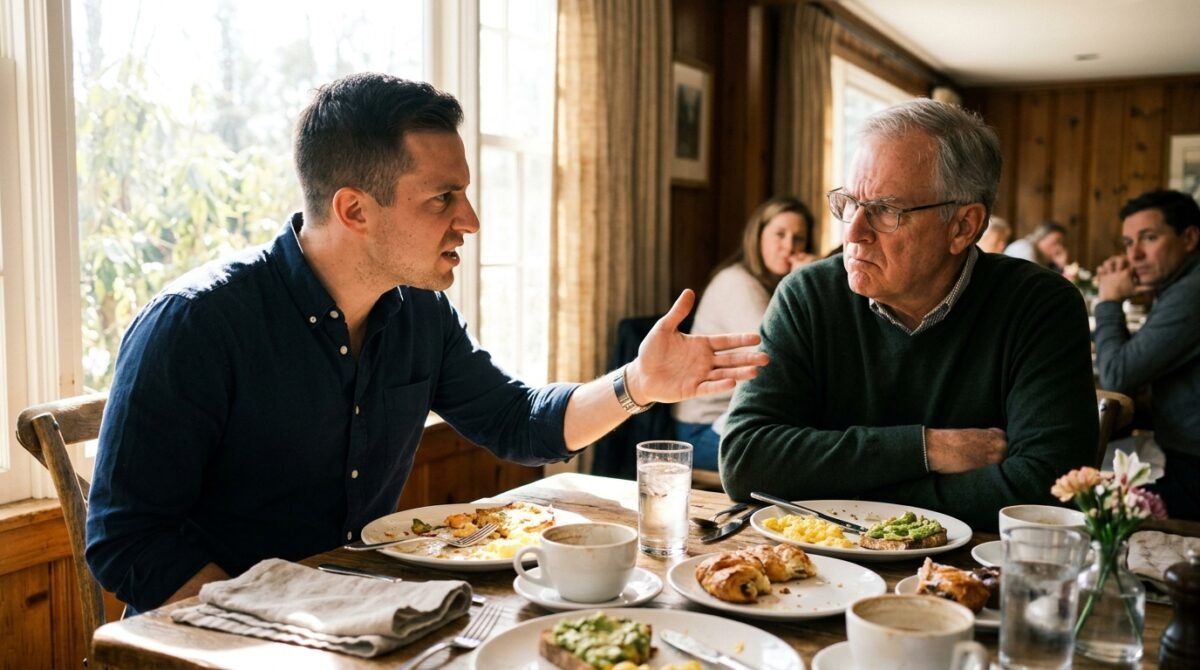
The conversation reached a boiling point during a Sunday brunch at my parents’ house. Mark had been unusually quiet all morning, radiating a passive-aggressive energy that usually meant he was about to say something regrettable. My parents, who had always been polite to him, were asking about our future plans. Mark saw this as his golden opportunity to ‘soft launch’ his demand in front of an audience.
He started by talking about how much he enjoyed living in ‘our’ condo and how he was looking forward to making it a permanent fixture of our lives. Then, he transitioned into his pitch about equity. He framed it as a mature, adult step toward marriage and commitment. My mother, bless her heart, looked confused, but my father, who knew exactly how much I had sacrificed to buy that place, turned a shade of red I had never seen before.
“It’s only fair,” Mark said, waving a piece of bacon for emphasis. “If we’re going to be together forever, why should she hold all the cards? I’m contributing to the household, and I deserve to have my name on the deed. It’s about building a foundation for our family, right? I don’t see why you guys wouldn’t support that.”
The room went deathly silent. You could hear the clink of silverware against china from three houses away. My father put his napkin down very slowly. He didn’t scream, which made it ten times worse. He looked at Mark with a pitying expression that cut deeper than any insult. He asked Mark exactly what he had contributed to the purchase price, the taxes, and the maintenance of the condo. Mark tried to argue that his ‘in-kind’ contributions and rent were sufficient.
I wanted to disappear. I felt humiliated, exposed, and incredibly angry. I had defended him so many times, rationalized his behavior as ‘ambitious’ or ‘financially conscious.’ Now, seeing him try to maneuver my parents into supporting his heist, I realized how far gone he was. He wasn’t just delusional; he was predatory. I stood up, excused myself, and walked out of the house, leaving him to face the fallout alone. That was the first time I realized I was done.
Leaked Texts and The Hidden Agenda

When I returned home, I found my laptop still logged into our shared browser—a mistake I would soon be grateful for. Mark had left a tab open for a messaging app he used with his friends. Curiosity got the better of me, and what I found turned my stomach. There was a group chat titled ‘The Real Estate Plan,’ and the messages were dated back to three months ago. They were discussing how to manipulate me into signing over the equity.
“If I can just make her feel like she’s being a bad partner, she’ll eventually cave. She’s sensitive about being ‘fair.’ Once I get the 50 percent equity, I’m set. Even if the relationship goes south, I’ve got a half-million-dollar asset. It’s the ultimate hedge. Just gotta keep playing the ‘we’re a team’ card.”
— Mark, in the ‘The Real Estate Plan’ group chat
Reading those words, the betrayal felt like a physical blow. It wasn’t just that he wanted my money; it was the calculated, sociopathic nature of his plan. He had been performing a role, pretending to care about our future while looking at me as nothing more than a mark in a long-con scheme. The ‘rent’ he complained about paying was part of his investment strategy to ‘prove’ he had skin in the game.
I took screenshots of everything. My hands were shaking so hard I could barely tap the screen. Every sweet note, every ‘I love you,’ every shared dream now looked like a lie, a tool used to soften me up for the kill. I didn’t cry. I was too stunned for that. I felt a cold, hard resolve settle into my chest. He wanted a negotiation? He was going to get one, but it wouldn’t be on the terms he expected.
I waited for him to come home. I didn’t pack his bags yet—I wanted him to think everything was normal. I wanted to see him try to keep playing the game. I sat on the couch, laptop in my lap, and watched the clock. Each tick felt like a countdown. When he finally walked through the door, humming a tune, he had no idea that his entire scheme had just collapsed into a pile of digital evidence.
The Final Confrontation
When Mark walked into the living room, he looked smug, clearly convinced that he had made a good impression on my parents earlier. He sat down next to me and tried to put his arm around me. I recoiled as if he had touched me with a hot iron. I turned the laptop around and opened the chat window, leaving it there for him to see. His face went through a kaleidoscope of emotions: confusion, realization, and finally, a desperate, pathetic attempt to spin the narrative.
“You were snooping? That’s a violation of my privacy! Those are just out-of-context jokes with the guys. You’re overreacting, as usual. We’re in a relationship, but clearly, you’re just looking for an excuse to kick me out because you’re scared of real commitment.”
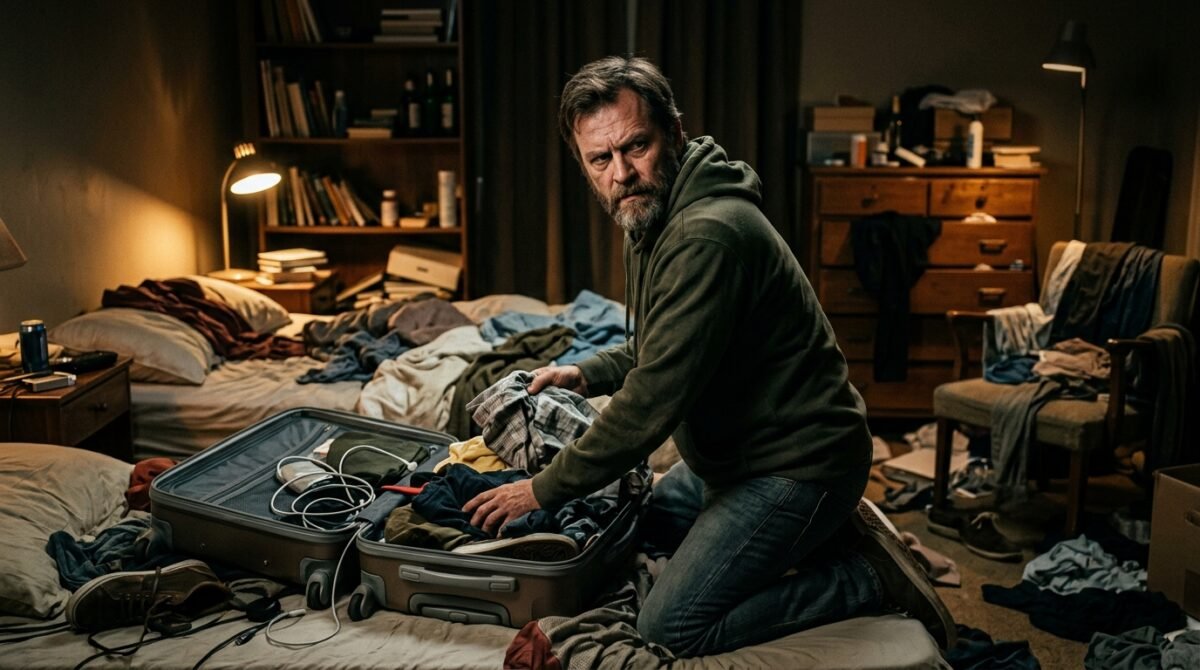
I didn’t argue. I didn’t explain. I just pointed to the door. I told him that his ‘investment’ was over and that he had exactly two hours to pack his things and leave. He tried to argue, tried to threaten legal action, tried to play the victim one last time. It was the most pathetic performance I had ever witnessed. I told him that I had already sent the screenshots to his brother, who was a lawyer, just so he knew that I had proof of his intent to defraud.
He turned pale at the mention of his brother. He realized that the game was truly up. He started packing, his movements frantic and uncoordinated. He tried to take a few things that weren’t his—a lamp I had bought, a set of towels—but I stopped him each time. I felt like a guardian of my own life, reclaiming every square inch of space he had tried to colonize. It was empowering, in a dark, hollow way.
As he walked out the door, he didn’t apologize. He looked at me with pure, unadulterated hatred, the look of a man who had lost his meal ticket. He didn’t even slam the door. He just walked out, and the silence that followed was the most beautiful sound I had ever heard. I locked the deadbolt, turned on the alarm, and finally, for the first time in three years, I felt like I was truly home.
The Aftermath and Community Reaction

The days following the breakup were a blur of paperwork, changing locks, and processing the absolute trauma of the betrayal. I went to the internet, not for validation, but for some semblance of sanity. I posted the story on a popular forum, keeping the names anonymous, and the response was overwhelming. It wasn’t just people agreeing with me; it was a deluge of similar stories from people who had been swindled by ‘partners’ in the exact same way.
“The ‘equity’ demand is a classic red flag for financial predators. They start with ‘fairness’ and end with ‘ownership.’ OP, you dodged a bullet that would have cost you hundreds of thousands of dollars and years of litigation. Block him on everything and don’t look back.”
— u/LegalEagleEye (Top Comment, 45.2k upvotes)
Reading the comments helped me realize that I wasn’t crazy. I wasn’t being ‘difficult’ or ‘uncooperative.’ I was protecting my future. Many people suggested I should look into a restraining order given his blatant attempt to defraud me, especially after seeing the group chat messages where he discussed his ‘plan.’ I realized that he wasn’t just a bad boyfriend; he was a potential legal nightmare that I had narrowly escaped.
My friends rallied around me, bringing over food, helping me change the security codes, and reminding me of the person I was before Mark. I realized I had shrunk myself to fit into his life, to make him feel comfortable, to make him feel like an equal. I had been paying the ‘tax’ of his ego, and the cost had been almost everything I had worked for. Never again.
The most surprising reaction came from his brother, who reached out to apologize on his family’s behalf. He told me that Mark had a history of this, that he always viewed relationships as a way to climb the ladder of success. It wasn’t about me. It was about his own deep-seated insecurity and his desperate need to be ‘on top’ without doing the work. That realization brought me a strange kind of peace. It wasn’t a failure of my love; it was a failure of his character.
Financial Lessons in the Wake of Betrayal

After the dust settled, I sat down with a financial planner to lock down my assets. We created a iron-clad prenup-style agreement that I would use for any future partner, but more importantly, we set up a structure that protected my real estate from any future ‘business proposals.’ I learned that love and business are two things that should never be mixed, especially when one party has significantly more to lose than the other.
I also learned the importance of transparency early on. I had tried to be ‘nice’ by not talking about my finances, by not making a big deal out of the fact that I owned the place outright. I thought I was being humble; in reality, I was leaving a vacuum that he was all too happy to fill with his own assumptions. I learned that financial boundaries aren’t an insult; they are a necessary component of a healthy, adult relationship.
“If they want to be your partner, they should be happy for your success, not looking for ways to extract it. A partner adds value to your life, they don’t treat your life as a resource to be mined. If someone starts talking about equity in your home after a year, run for the hills.”
I started taking courses on investment and real estate law, wanting to understand exactly what my rights were. I didn’t want to be vulnerable to someone else’s manipulation ever again. The experience changed how I view ‘fairness.’ I used to think fairness meant splitting everything down the middle. Now I know that fairness means respecting the work that each person puts in and acknowledging the different paths that led to where we are today.
I am currently in a new relationship, and we have a very clear, open, and honest dialogue about money. We have separate accounts, we have a clear understanding of our living situation, and we discuss our future goals without the pressure of ‘equity’ or ‘ownership.’ It is a breath of fresh air. I am no longer looking over my shoulder, wondering if my partner is looking at my bank account and calculating his potential gains.
The Psychological Toll of Manipulation

Even months later, I occasionally wake up in a cold sweat, thinking about how close I came to signing those papers. The psychological manipulation was subtle but deep. He had gaslit me into thinking I was the unreasonable one for wanting to keep what was mine. He made me feel like my boundaries were a sign of ‘lack of trust’ or ’emotional distance.’ It’s terrifying how quickly you can lose your footing when someone you trust starts chipping away at your sense of reality.
I started seeing a therapist to process the ‘what-ifs.’ She helped me understand that this wasn’t just a financial dispute; it was a violation of my trust and my safety. I had been living with someone who was actively plotting against me, and my brain was still trying to reconcile the person I thought he was with the person he actually proved to be. It took a long time to trust my own instincts again, to stop second-guessing my decisions.
“You didn’t fail, you survived. Many people don’t realize they’ve been manipulated until years later when they’re stuck in a legal battle. You saw the red flags, you gathered the evidence, and you took action. That is a success story, not a failure.”
I also had to deal with the grief of losing the relationship. Despite everything he did, I had loved him. I had envisioned a future with him. Grieving the loss of a fake future is a strange, hollow experience. You’re mourning a person who never really existed. I had to let go of the idea that I could have ‘fixed’ him, or that I could have made him a better person. He was who he was, and my only job was to protect myself from him.
The experience made me much more guarded, yes, but also much more selective. I don’t give people the benefit of the doubt anymore; I give them the opportunity to show me who they are through their actions, not their words. I watch how they treat waitstaff, I watch how they talk about their own failures, and I watch how they respect my boundaries. If there’s even a hint of entitlement, I’m out.
Why We Need to Talk About Financial Infidelity

We talk about cheating in relationships as if it’s only about physical or emotional affairs. We rarely talk about financial infidelity—the ways in which partners manipulate, hide, or steal from one another under the guise of love. It’s a silent epidemic that ruins lives and leaves people broken. We need to normalize talking about prenups, about separate accounts, and about the reality of financial independence in a partnership.
My story is just one of many. I’ve heard from dozens of people since I shared my experience—men and women who were manipulated into co-signing loans, giving up assets, or taking on the debt of their ‘partners.’ The stigma of talking about money in a relationship is what allows these predators to operate in the shadows. We need to break that stigma. If you can’t talk about money with your partner, you have no business building a life together.
“Financial infidelity is just as damaging as any other kind of cheating. It’s a breach of trust that cuts to the core of your stability. Don’t be afraid to be the ‘bad guy’ when it comes to protecting your future. Your future self will thank you.”
I hope that by sharing my story, I can encourage others to be more vigilant and more assertive about their own financial autonomy. It’s not about being cynical; it’s about being smart. Love is a beautiful thing, but it shouldn’t come at the cost of your security or your self-worth. If someone gets angry because you want to keep your assets protected, that is the only answer you need to know about their intentions.
I am finally at a place where I can look at my condo and just see my home again. The shadows of his presence have faded, replaced by the memories of the people I’ve hosted, the projects I’ve finished, and the peace I’ve built. It’s mine. And that is a feeling that no amount of ‘equity’ could ever replace. I am proud of the woman who stood up for herself that Tuesday night, and I am grateful for the life she chose to protect.
Reader Community Reflections and Debate

The community reaction to my story has been a mix of support, outrage, and deep-seated debate. Many readers have shared their own stories of financial manipulation, while others have pointed out the complexities of navigating ‘fairness’ in long-term relationships. It has been eye-opening to see the range of perspectives, from those who believe in strict financial separation to those who believe in total financial union.
“I had a similar situation, but I fell for it. I signed over part of my house, and two years later, he left me for someone else. I lost half my home. Seeing OP stand up for herself makes me feel like I’m not alone. It’s a hard lesson, but it’s a necessary one.”
— u/BrokenButLearning (12.4k upvotes)
There were, of course, those who argued that I should have been more ‘flexible’ and that a relationship requires sacrifice. These comments were usually downvoted into oblivion by the community, which stood firm in the idea that a relationship is not an acquisition strategy. The debate over ‘equity’ versus ‘contribution’ was intense, with many users weighing in on the legal and moral nuances of home ownership.
It’s clear that this is a topic that hits a nerve for a lot of people. Whether it’s the pressure to combine finances or the fear of being used for one’s success, the anxiety around money in relationships is universal. I’ve learned so much from the community’s insights, and I am grateful for the space they provided for me to tell my story. It’s a reminder that we aren’t alone in our struggles, even when we feel like we are.
I plan to keep the post updated as I continue my journey, sharing any further insights I gain from my therapy and my new, healthy relationship. It’s a work in progress, but for the first time, I feel like the trajectory is entirely in my own hands. I am no longer waiting for someone else to validate my future. I am building it, one brick at a time, and I am doing it entirely on my own terms.
Conclusion
Looking back at the trajectory of these past few years, the biggest lesson I’ve learned is that your intuition is your best financial advisor. When you feel that something is off—when the ‘us’ starts to sound more like a ‘me’—you have to listen to that instinct, even if it feels uncomfortable or ‘unromantic.’ My story ended with a breakup, but it also began a new chapter of independence and self-assurance that I wouldn’t trade for anything.
I’ve walked away with my home, my sanity, and a much clearer understanding of what a partnership should look like. It isn’t about dividing assets or calculating who ‘earned’ more. It’s about building a foundation of mutual respect where both people feel supported, not exploited. If you find yourself in a situation where your partner is looking at your life as an asset, take a step back and protect yourself. Your future is too valuable to be handed over to someone who doesn’t respect the work you put into it.
I want to hear from you all. Have you ever been in a situation where a partner made an unreasonable demand regarding your finances? How did you handle it? Did you stand your ground, or did you learn the hard way? Let’s continue this conversation in the comments below, and let’s keep supporting one another in building lives that are truly our own.
What's your verdict on this dilemma?
Vote below to contribute to the official community consensus.

Have a Dilemma Keeping You Up at Night?
Share your real-life feud, wedding chaos, or relationship crossroads anonymously with our editorial team.
What do you think ?
0 Comments🛡️ Comments are moderated to protect community integrity. Your comment will appear once approved by the editorial team.