
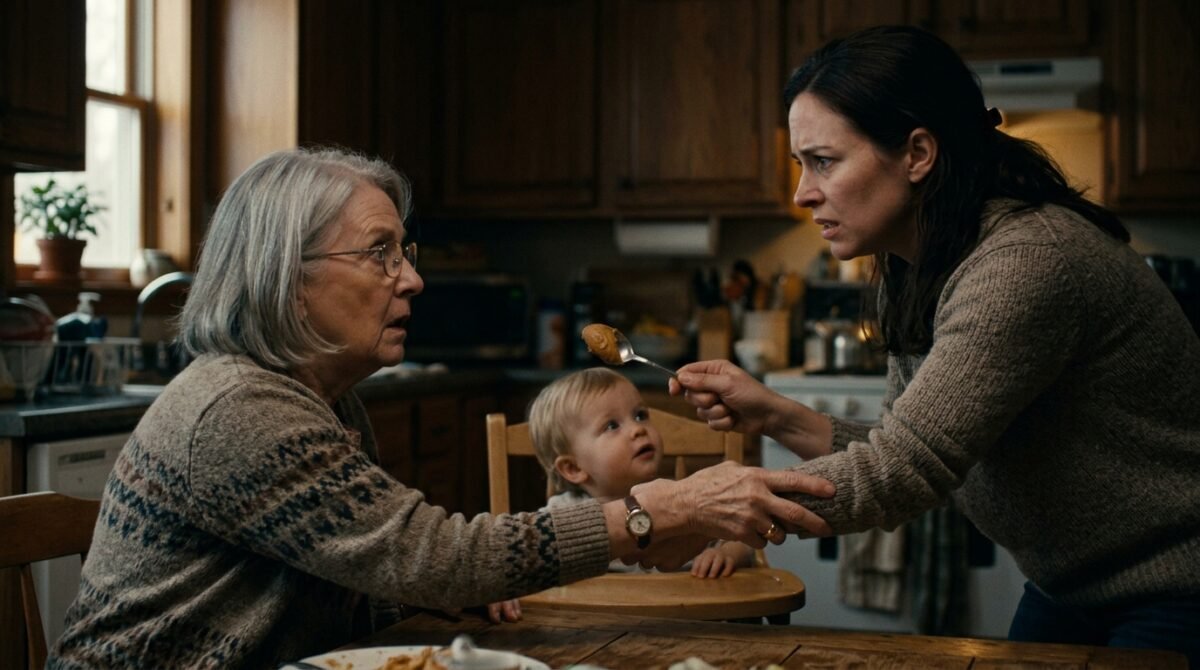
Motherhood is defined by a thousand small anxieties, but for those of us raising children with severe allergies, that anxiety is a constant, humming background noise. You learn to read labels like a cryptographer, you brief every babysitter with the intensity of a military commander, and you pray that the world—especially your family—understands that a single crumb isn’t just a snack; it could be a catastrophe.
My mother-in-law, Linda, always treated my son Leo’s peanut allergy as a ‘lifestyle choice’ or a ‘modern overreaction.’ She spent years rolling her eyes, making comments about how kids in her day ate everything and turned out fine. I thought it was just stubbornness born of generational pride. I was wrong. It wasn’t about her past; it was about her need to undermine my authority.
The breaking point didn’t come with a bang, but with a horrifying, silent realization in the middle of a mundane Tuesday afternoon. I had trusted her for two hours—just two hours—to look after Leo while I finished a work call in my home office. What I found when I walked into the kitchen will haunt me for the rest of my life.
This is the story of how a grandmother’s ego nearly cost my son his life, and why, in the aftermath, I had to sever the tie that binds, permanently. This isn’t just about peanuts; it’s about the fundamental trust required to be part of a child’s life, and what happens when that trust is shattered into a million tiny, lethal pieces.
The ‘Overprotective’ Label That Masked A Dangerous Agenda
For the first two years of Leo’s life, Linda made sure I felt like an outsider in my own home. She arrived for weekly visits armed with ‘treats’ that I had explicitly forbidden. I spent months politely repeating the same script: ‘Leo is anaphylactic to peanuts, Linda. Please, I need you to respect this.’ She would just laugh, smoothing her apron, and say, ‘You’re so dramatic, dear. A tiny lick never hurt anyone.’
I tried to bridge the gap. I brought her to the allergist’s office for a consultation, hoping the doctor’s clinical tone would break through her dismissive shell. The doctor showed her the EpiPen, explained the swelling, the airway constriction, and the terrifying speed of an allergic reaction. She sat there, arms crossed, staring at the wall, clearly unimpressed by the science.
I remember walking her to her car after that appointment. She looked at me with a smirk that felt like a cold breeze against my neck. ‘I hope you enjoyed wasting the doctor’s time,’ she said. ‘It’s just a sensitivity. He’ll grow out of it once he builds some immunity.’ I felt a shiver of dread that I couldn’t quite articulate at the time.
“You are teaching him to be weak by avoiding these things. My son never had these problems because I didn’t coddle him. You’re just looking for attention, aren’t you?”
— Linda, during a Sunday lunch confrontation
The isolation of being a ‘difficult’ mother is a specific kind of hell. My husband, David, was caught in the middle. He loved his mother, but he knew the risks. He would tell her to stop, but he never put his foot down hard enough. He viewed her behavior as ‘eccentric’ rather than ‘hostile.’ That failure to enforce boundaries created a vacuum that Linda was all too happy to fill.
By the time Leo hit his third birthday, the tension in the house whenever Linda visited was palpable. She would watch him eat, her eyes tracking every movement of his fork, as if she were waiting for him to fail. I started keeping the pantry locked. I started being ‘busy’ whenever she called. I was trying to protect my son from someone who was supposed to be his greatest ally.
The Tuesday Afternoon That Froze Time
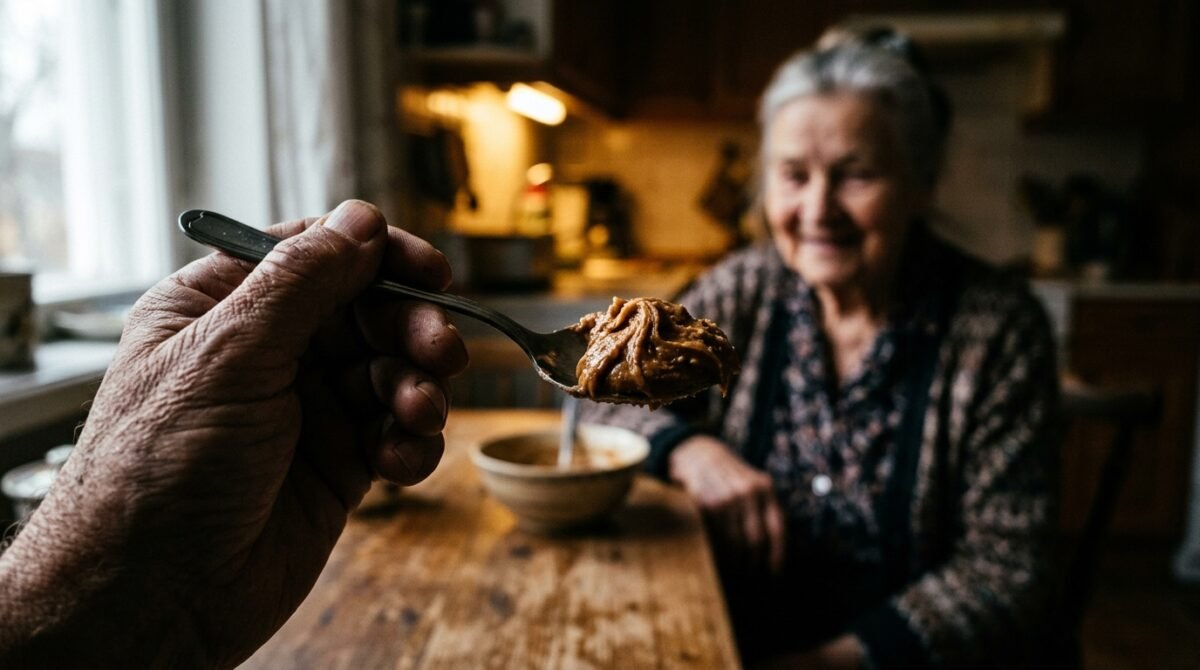
It was a standard, hectic Tuesday. I was working from home, drowning in deadlines, and Linda had offered to watch Leo. Against my better judgment, I agreed. I had left explicit instructions on the kitchen counter: no food except for the pre-portioned containers in the fridge. I had texted her three times that morning as a reminder. She had replied with a simple, curt ‘I know what I’m doing.’
Around 2:00 PM, the house went quiet. Too quiet. I finished my call and stepped out of my office to make a quick cup of coffee. As I approached the kitchen, I saw the door was slightly ajar. I heard a soft, coaxing voice. ‘Go on, Leo. It’s delicious. Just like mommy eats, right? It won’t hurt you, it’s just a little bit of butter.’
My heart stopped. I pushed the door open to see Linda sitting at the island, holding a spoon coated in creamy peanut butter. Leo was sitting on her lap, his mouth slightly open, reaching for the spoon. She was inches away from his lips, her expression one of smug, terrifying anticipation. She looked at me, caught in the act, and didn’t even flinch.
“I just wanted to prove you wrong. He’s been around it all day and hasn’t had a reaction. See? Your fears are all in your head. He’s perfectly fine.”
— Linda, when caught red-handed
I lunged forward and snatched the spoon away. I was shaking so hard that I nearly dropped it. I grabbed Leo and pulled him off her lap, my adrenaline spiking to a level I had never experienced. I didn’t scream; I was too terrified to even make a sound. I just backed away, shielding my son as if he were made of glass.
She just sat there, cleaning her hands on a napkin, completely unbothered by the fact that she had just attempted to trigger a medical emergency in a toddler. The look in her eyes wasn’t malice; it was something far worse: it was a complete, chilling lack of empathy. She believed she was right, and she was willing to gamble with a three-year-old’s breath to prove it.
The Moment The World Stopped
I didn’t yell. I didn’t cry. I felt a cold, sharp clarity wash over me. I grabbed Leo and carried him out of the room, my voice trembling as I told Linda to leave. She stood up, brushing off her skirt, and looked at me as if I were the one who had just committed a crime. She started lecturing me about how ‘modern mothers are soft’ and how ‘a little exposure’ would have made him stronger.
I stood my ground, my phone in my hand, ready to call 911 if he even looked like he was having a reaction. I wiped his mouth with a damp cloth, checking his skin for hives, checking his eyes for swelling. The terror of not knowing if she had actually let him taste it was a physical weight on my chest. I called David instantly, my voice barely audible.
“David, come home now. Your mother just tried to feed Leo peanut butter. I’m not joking. She had a spoon in his mouth. If you don’t get here, I am calling the police and I am not letting her leave.”
— The phone call to my husband
David rushed home, his face pale with panic. When he arrived, he found me standing in the driveway with Leo, waiting for him. Linda was still in the house, calmly making herself a cup of tea. She had acted as if nothing had happened, as if I were just being ‘difficult’ again. The disconnect between her calm demeanor and the life-threatening situation she had created was sociopathic.
When David confronted her, she looked at him with pity. ‘She’s hysterical, David. I was just trying to help him overcome his allergy. You should be thanking me, not taking her side.’ That was the moment David realized that his mother was not the person he thought she was. The pedestal she had stood on for thirty years finally crumbled, right there in the living room.
I packed her bags myself. I didn’t care about the social etiquette of being a polite daughter-in-law. I didn’t care about her feelings. I was a mother bear, and the threat to my cub had been identified. I told her that she was not to step foot on our property again, and that if she tried to contact us, we would involve the authorities.
The Fallout And The Silence That Followed
The weeks following the incident were a blur of cold, hard silence. Linda tried to call. She sent emails. She even had her sisters call me to tell me I was being ‘unreasonable’ and that ‘family is family, no matter what.’ I blocked every single one of them. I had no interest in negotiating my son’s safety with people who thought his life was a fair price to pay for being right.
David took it harder than I did. He was mourning the mother he thought he had. He spent nights staring at the wall, struggling to reconcile his childhood memories with the woman who had stood in our kitchen and tried to poison his son. We had to go to counseling together just to navigate the wreckage of the fallout. It was the hardest thing we had ever done.
We received a letter a month later. It was a formal, typed letter from Linda, written in that cold, detached tone she used for business documents. She didn’t apologize. She didn’t acknowledge her mistake. She simply demanded that we ‘get over ourselves’ and allow her to see her grandson, claiming that our banishment was ‘unlawful’ and ‘cruel.’ We burned it.
“Dear Daughter-in-law: You are making a huge mistake. Leo deserves to know his grandmother, and you have no right to keep us apart based on your own insecurities. I expect a call by Friday to arrange a visit.”
— A snippet from the letter sent by Linda
The audacity of the letter was almost impressive. It confirmed everything I had feared: she felt entitled to my son, and she felt that her desires outweighed his medical necessity. There was no remorse. There was no understanding of the gravity of her actions. There was only an entitlement that had grown into something truly dangerous.
We consulted a lawyer, just in case she tried to sue for grandparents’ rights. Thankfully, in our state, the law is clear: unless there is a pre-existing, long-standing, and healthy relationship that the parents are arbitrarily severing, it is very difficult for grandparents to force visitation. We were safe. The iron-clad boundary remained, and for the first time in years, the house felt peaceful.
The Digital Paper Trail Of Betrayal
The true scope of the betrayal came to light when I finally gained access to her old tablet, which she had left behind in her ‘panic’ to leave. I wasn’t looking for anything, but I found a rabbit hole that went deeper than I ever imagined. She had been keeping a log of her ‘experiments’ with Leo. She called them ‘The Peanut Trials.’
There were dates, notes, and observations. ‘Small amount of peanut butter in yogurt – no reaction. Leo is stubborn, he noticed the taste. Need to hide it better.’ ‘Tried a crushed nut in his applesauce. He coughed, but no hives. Progress.’ My skin crawled as I read through these entries. She had been dosing him behind my back for months, testing his reactions like a lab rat.
I shared the tablet with David. He didn’t say a word as he read the entries. He just kept scrolling, his face turning an ash-gray color. He realized then that she hadn’t just tried to prove me wrong that one day in the kitchen; she had been engaged in a long-term, calculated campaign of endangerment that lasted for nearly a year.
“I don’t even know who this woman is. My mother… she would never do this. This is not the woman who raised me. This is a monster.”
— David, after reading the ‘Peanut Trials’ log
We took the tablet to the police. They were horrified, but since Leo hadn’t suffered a severe reaction, they said it was difficult to press charges for assault. However, it was enough for a restraining order. The police served her the papers at her home. I can only imagine the look on her face when she realized her ‘experiments’ had been discovered and were being used against her.
The relief of knowing she couldn’t approach us was immense. But the anger remained. How could someone who supposedly loved a child be so utterly indifferent to his suffering? It was a question that kept me up at night, staring at the ceiling, wondering if I had missed the signs earlier. But eventually, I realized that some people are simply incapable of putting others before their own ego.
Reddit Weighs In: The Verdict Of The Masses

I posted about the situation on a popular subreddit, needing to know if I was the one losing my mind. The response was overwhelming. Within hours, the post had gained thousands of upvotes and an outpouring of support that left me in tears. The community was unanimous: I was not the one in the wrong, and I was absolutely right to protect my child at all costs.
The stories poured in from other parents who had dealt with similar ‘know-it-all’ family members. People shared their own terrifying brushes with death caused by relatives who thought they knew better than the doctors. The validation was exactly what I needed to stop doubting my own instincts. I wasn’t being ‘difficult’ or ‘dramatic’; I was being a parent.
“OP, you are not being ‘mean.’ You are being a mother. Your MIL is a dangerous person who actively tried to poison your child to win an argument. The fact that she was documenting it makes this premeditated child abuse. Keep her away forever. Do not look back.”
— u/MamaBearDefender (Top Comment, 32.1k upvotes)
“The ‘Peanut Trials’?! That’s not just stubbornness, that’s criminal. Please tell me you’re keeping the tablet as evidence. This woman needs to be nowhere near children, ever.”
— u/LegalEagle99 (15.2k upvotes)
The Reddit thread became a lifeline. It reminded me that I was part of a larger community of people who prioritized their children’s lives over social decorum. The comments helped me realize that my husband’s family had been enabling this behavior by normalizing her ‘eccentricities’ for years. It was a wake-up call for our entire extended family, many of whom reached out to tell me they supported our decision.
The consensus was clear: when a boundary regarding medical safety is crossed, the relationship is void. There is no ‘second chance’ for poisoning a toddler. The community helped me solidify my stance, giving me the courage to stand firm against any further attempts at manipulation or guilt-tripping from the rest of the family.
The Aftermath: Learning To Breathe Again
Life has slowly returned to a new kind of normal. Leo is thriving, blissfully unaware of how close he came to a life-threatening situation. He’s starting preschool soon, and I’ve spent the last month working with his teachers, creating an allergy plan that is as detailed as it is robust. I’m no longer afraid to be the ‘demanding’ parent. If I have to be the difficult one to keep him safe, so be it.
David and I are stronger than ever. The trauma forced us to confront the issues in his family, and we’ve come out on the other side with a partnership built on honesty and mutual protection. We don’t talk about Linda much anymore. She is a ghost, a cautionary tale we keep in the back of our minds to remind us why we draw lines, and why we hold them firm.
I still have bad days. I still get a knot in my stomach whenever we go out to eat, and I find myself checking the ingredients of every single item, over and over again. But the fear is no longer paralyzing. It’s a tool now. It’s the tool that keeps my son alive, and I’ve learned to embrace it as part of my role as his mother.
“We don’t get to choose our family, but we do get to choose who we keep in our lives. Leo’s safety is non-negotiable. If you can’t respect that, you don’t get to be a part of our story.”
— My closing thought in our final letter to the extended family
We’ve had to cut off a few other members of the family who insisted that ‘she’s just an old lady who meant well.’ It’s a small price to pay for the peace of mind we now have. The house is quiet, the pantry is safe, and most importantly, our son is happy and healthy. That, at the end of the day, is all that matters.
The Lessons Of The Unthinkable
Looking back, the biggest lesson I learned is that ‘family’ is not a blank check for abuse. We are taught from a young age to respect our elders, to forgive, and to keep the peace. But those values should never supersede the fundamental right to safety. When an elder uses their position of power to endanger a child, they have forfeited the respect that their status usually commands.
I also learned that silence is an enabler. If I had spoken up sooner, if I had refused to allow her to be alone with Leo from the very beginning, maybe it never would have reached this point. But I was trying to be the ‘polite’ daughter-in-law. I was trying to keep the peace. I know now that peace is a fragile thing if it’s built on a foundation of compromised boundaries.
I hope that if anyone is reading this and finds themselves in a similar situation, they find the courage to act. You are not being paranoid. You are not being dramatic. You are the only thing standing between your child and a world that may not always have their best interests at heart. Trust your gut. It is usually right.
“Protecting your child isn’t an act of aggression; it’s an act of love. Never apologize for being the hero your child deserves, even if the person you’re fighting is someone who should have been on your team.”
— A piece of advice from a Redditor that stuck with me
The journey has been painful, and the scars remain, but the clarity is worth it. I am a better mother for it. I am more confident, more decisive, and more focused on what matters. We are living our own life now, on our own terms, and that is a freedom that no amount of family pressure could ever provide.
The Final Verdict: Why No Contact Was The Only Way
People often ask me if I regret cutting her off completely. They ask if I ever think about ‘reconciling’ for the sake of the holidays or the family name. The answer is always the same: absolutely not. Reconciliation requires remorse, and Linda has never shown a flicker of it. To her, she is the victim, and I am the villain who stole her grandson.
There is no ground to stand on when the other person refuses to acknowledge the danger they created. If I were to open the door again, what would happen? What new ‘experiment’ would she come up with? What new boundary would she test? I cannot live in that kind of uncertainty. I owe it to my son to provide a home that is a sanctuary, not a battleground.
I’ve realized that ‘No Contact’ isn’t a punishment for her; it’s a protection for us. It’s the final wall in the fortress we’ve built around our little family. Every day that passes without her influence is a day that we grow stronger, more independent, and more aligned in our values. It’s the best decision we ever made.
“The cost of having her in our lives was our peace, our trust, and our son’s safety. When you look at it that way, cutting her off wasn’t a hard decision. It was the only decision.”
— My conclusion in a recent therapy session
For those still struggling with toxic family dynamics, know that you have permission to walk away. You don’t need a formal apology to validate your choices. You don’t need permission from anyone else to decide who gets to be in your child’s life. You are the architect of your family’s future, and you have the right to curate it to ensure your child’s safety and happiness.
Reflections On The Road Ahead
As we look to the future, I see a life where Leo grows up knowing he was always protected. I see a life where he learns to advocate for himself, knowing that his parents were his first and most fierce advocates. The trauma of the past is fading, replaced by the joy of the present. We are focused on building new, healthy traditions that don’t involve the toxicity of the past.
We have found a new ‘found family’—friends who respect our boundaries, who understand the reality of allergies, and who love Leo for who he is, not as a subject for their own experiments. These are the people who will be in our lives, who will celebrate his birthdays, and who will be there for the milestones. Quality of relationship always trumps bloodline.
I want to thank everyone who read this story and reached out with their own experiences. The solidarity is what helped me get through the darkest moments. We are not alone, and we are not wrong for choosing our children over the expectations of others. Keep protecting your little ones, and never, ever let anyone make you feel small for doing so.
“Your children are your legacy. Protect them with everything you have, and don’t let anyone, no matter who they are, tell you that your love is too much. It’s exactly the right amount.”
— My final message to the community
We are doing well. Really, truly well. And if you are in the thick of it, hold on. The storm will pass, and the clarity you get on the other side is worth every bit of the fight. Stay strong, stay vigilant, and always keep your family’s safety at the center of everything you do.
Conclusion
This experience has been a crucible. It tested everything I thought I knew about family, duty, and the limits of love. It taught me that while we cannot control the actions of others, we have absolute dominion over our own boundaries. The safety of my son is not a negotiable item, and I have found peace in the absolute, uncompromising enforcement of that reality.
The community support I received reminded me that I am part of a collective of parents who put their children’s lives above the performative expectations of toxic relatives. If you find yourself facing similar pressures, remember: you are not being ‘difficult’ for expecting the people in your life to respect your child’s medical needs. You are being a responsible, protective parent.
What about you? Have you ever had to draw a hard line with a family member who refused to respect your parenting, especially regarding your child’s health? Let’s discuss in the comments—are we too quick to cut people off, or has our culture finally started to prioritize the safety of the next generation over the feelings of the previous one? Share your stories below.
What's your verdict on this dilemma?
Vote below to contribute to the official community consensus.

Have a Dilemma Keeping You Up at Night?
Share your real-life feud, wedding chaos, or relationship crossroads anonymously with our editorial team.
What do you think ?
0 Comments🛡️ Comments are moderated to protect community integrity. Your comment will appear once approved by the editorial team.