
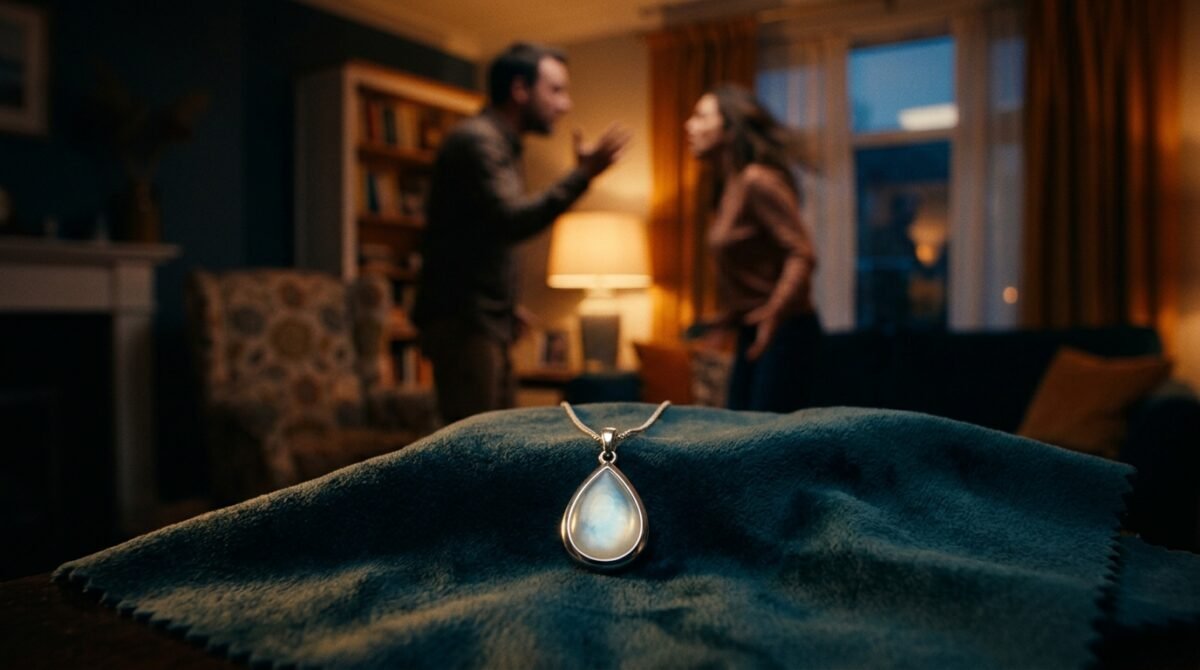
They say that marriage is built on trust, but no one prepares you for the moment that trust is shattered by a lie so bizarre, so profoundly insulting, that it redefines everything you thought you knew about your partner. My name is Elena, and for three years, I wore a modest, custom-made pendant around my neck. It wasn’t an opal, though it shimmered with a similar ethereal light. It was a breast milk pendant, created as a keepsake during the most difficult, beautiful, and raw months of my life after having my daughter, Maya. It was a silent, private tribute to the bond we shared, a symbol of the sleepless nights and the quiet strength I had found in motherhood.
My husband, Mark, knew exactly what that pendant was. He was there when I ordered it from the artisan; he held my hand as I waited for it to arrive. Yet, last Tuesday, I walked into his sister Sarah’s house to find her wearing it, beaming as she thanked Mark for the ‘gorgeous opal necklace’ he had supposedly gifted her for her birthday. The cold realization didn’t hit me all at once; it was a slow, agonizing crawl through my veins. The betrayal wasn’t just about the jewelry—it was the fact that he saw fit to strip me of a physical piece of my identity to pacify his sister’s vanity.
When I demanded an explanation, Mark didn’t apologize. He didn’t crumble under the weight of his lie. Instead, he dismissed my hurt as ‘overreacting,’ claiming that Sarah had wanted a specific look for her gala and that I ‘hardly ever wore it anyway.’ That was the moment something inside me finally snapped. It wasn’t just a pendant; it was a boundary, a sacred piece of history that he had treated like a discarded trinket. I went home, and I did the only thing that felt like an adequate response to the level of disrespect I had endured.
I gathered his expensive suits, his pristine sneakers, and every piece of clothing he had left strewn about our bedroom, and I threw them onto the front lawn. It wasn’t a petty act of violence; it was a statement. I was done being the silent observer in my own life, and I was certainly done being the source of gifts for his sister’s shallow whims. The following days have been a blur of screaming matches, frantic apologies, and the cold, hard reality of what happens when you decide you are no longer willing to be a doormat.
The Disappearing Act of a Sentimental Treasure

I remember the day the pendant arrived like it was yesterday. It came in a small, weighted box, smelling of cedar and faint resin. I put it on immediately, feeling the weight of it against my collarbone. Mark had been so supportive during the process, even offering to pay for the upgrade to the gold setting. It became my everyday accessory, something I touched when I was anxious or when I was nursing Maya in the middle of the night. It was never just jewelry; it was a piece of my soul forged into a tangible object.
Two weeks ago, my pendant went missing. I searched everywhere—the bathroom counter, the bedside table, the laundry room. I asked Mark if he had seen it, and he gave me a vague, distracted shrug, suggesting I might have left it at the gym or in the car. I spent three days turning the house upside down, feeling a strange, hollow ache in my chest. I felt like I had lost a piece of my daughter’s infancy all over again.
Then came Sarah’s birthday dinner. Sarah has always been the ‘golden child’ of the family, the one who demands elaborate gifts and complains if they aren’t expensive enough. Mark has always had a soft spot for her, often bending over backward to make sure she stays happy, sometimes at the expense of our own comfort. As I sat across from her at the dinner table, I noticed something sparkling around her neck. My heart stopped. It was unmistakably my pendant, hanging from her chain.
I felt the blood drain from my face. I sat there in stunned silence, watching her touch it while telling the table, ‘Mark found this beautiful vintage opal for me. He knows I love unique pieces.’ I looked at Mark. He didn’t even have the decency to look away; he was busy pouring wine, a smirk playing on his lips. It was then I realized that the theft hadn’t been an accident. It was a calculated move, a way for him to buy his sister’s affection without spending a dime of his own money.
“Mark, why is Sarah wearing my pendant? That is my breast milk jewelry. Tell me right now why you gave it to her.”
— My voice, trembling in the middle of the quiet restaurant.
The entire table went silent. Sarah looked confused, clutching the pendant as if I were about to snatch it off her neck. Mark’s face turned into a mask of cold irritation. He leaned in, whispering harshly, ‘Don’t make a scene. It’s just a piece of jewelry, Elena. Stop being so dramatic in front of the family.’
The Cold Reality of the Justification
The drive home was arguably the longest ride of my life. I didn’t say a word, my hands gripping the steering wheel so hard my knuckles were white. Mark kept talking, his voice dripping with condescension. He explained that Sarah had been crying to him about not having the ‘right accessory’ for her gala, and he figured since I ‘didn’t really wear it anymore,’ it would serve a better purpose on her. He genuinely thought his logic was bulletproof.
He told me that it wasn’t a big deal because Sarah didn’t know what it actually was. He had told her it was an opal—a rare, vintage find. To him, the lie was a favor to both of us. He was ‘solving’ a problem. He didn’t seem to grasp the visceral, sickening feeling of someone wearing a piece of your body, even if it was just milk, under false pretenses. He treated my personal history like a pawn in his game of keeping his sister happy.
I kept thinking about the implications. If he could take this, what else had he taken? What other boundaries had he crossed without me noticing? It wasn’t about the money; it was about the lack of autonomy. I was a person, not a supply closet for his family to raid when they needed a quick gift. The sheer entitlement was staggering, and the more he talked, the more I realized he didn’t respect me at all.
He tried to make me feel guilty, claiming that Sarah had a hard year and that I was being ‘petty and jealous’ of his own sister. He brought up past arguments, trying to deflect from the fact that he had stolen from me. When we walked through the door, the air in the house felt heavy, suffocating. I went straight to the bedroom, and he followed, still lecturing me about ‘familial bonds’ and ‘letting things go.’
“You don’t get it, do you? You didn’t just give her jewelry. You gave her a piece of me, a piece of our daughter, and you lied to her face about what it was. You’re not a good brother, Mark. You’re a thief.”
— My retort as I reached my breaking point.
He laughed, a sharp, dismissive sound that echoed in the empty hallway. ‘It’s breast milk, Elena. It’s not like it’s a diamond ring. Grow up.’ That was the moment the last thread of my patience snapped. I didn’t cry. I didn’t scream. I just started moving, with a calm, terrifying focus that surprised even me.
The Lawn Transformation
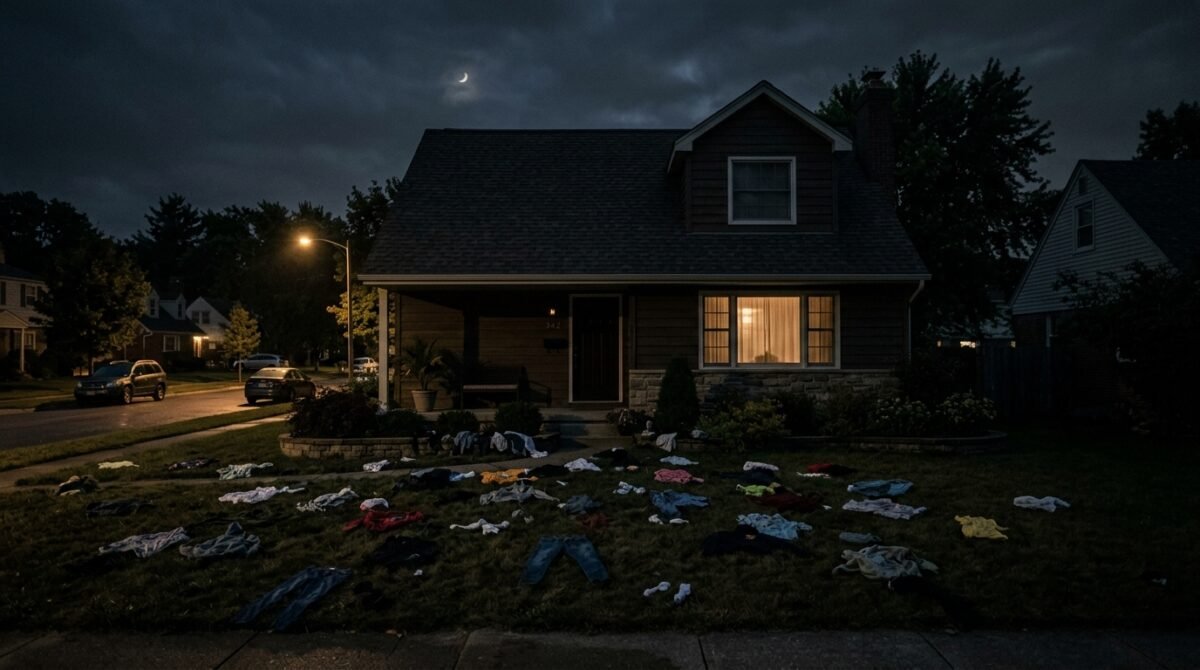
I opened the closet and started pulling his clothes off the hangers. Not carefully, but with a frantic, rhythmic intensity. Suit jackets, dress shirts, those overpriced designer jeans he loved so much—I threw them all onto the bed, then into a laundry basket, and then out the front door. I didn’t care who saw. I didn’t care if the neighbors were watching. I wanted the house to be free of him, even if it was just for a few hours.
Mark followed me, his face turning from annoyance to genuine shock. ‘What are you doing? Are you crazy? Get my clothes back inside right now!’ He tried to grab the basket from me, but I shoved it toward the open door, spilling shirts onto the walkway. I kept going, grabbing his shoes from the entryway, tossing them onto the grass. He was yelling, calling me names, but I was in a trance.
I didn’t stop until his side of the closet was empty. I felt a strange surge of liberation. Every item of clothing on that lawn felt like a piece of the control he had been exerting over me. I wasn’t just throwing out clothes; I was throwing out the expectations, the gaslighting, and the constant feeling that I had to play second fiddle to his sister’s needs. When I finally slammed the front door and locked it, I breathed for the first time in hours.
I sat on the floor of the hallway, listening to him banging on the door and shouting. My phone started buzzing incessantly. It was his mother. She had already received a frantic text from Sarah, who was apparently ‘devastated’ that her ‘beautiful opal’ had been snatched back in a fit of rage. I looked at the screen, saw the notifications mounting, and decided I wasn’t going to answer a single one of them.
“Mark, if you don’t leave the porch right now, I am calling the police. I am done. You can find somewhere else to stay until you can explain why you thought it was okay to rob me.”
— Me, speaking through the locked door.
The silence that followed was heavy, but it was mine. He eventually stopped banging, and the sound of his car pulling away left a ringing in my ears. I felt exhausted, but for the first time in years, I felt like the master of my own home. I went to the kitchen, poured a glass of water, and started typing out my story. I needed to know if I was actually the villain here, or if I had finally found my voice.
The Virtual Court of Public Opinion

I posted my story to the AITA subreddit, expecting a barrage of criticism. I thought maybe I had gone too far, that throwing his clothes on the lawn was childish. I sat there, hitting refresh on my browser, watching the comments roll in. Within an hour, the post had exploded. People weren’t just reacting; they were outraged on my behalf. The support was overwhelming, which only confirmed that I hadn’t lost my mind.
The consensus was clear: I was not the asshole. Many users pointed out the deep, psychological violation of him taking a sentimental object that represented my body and my child and rebranding it as a generic gift for his sister. It wasn’t just about the money; it was about the erasure of my motherhood experience. The comments were validation I didn’t know I desperately needed.
“This is not just about a pendant. This is a massive violation of your autonomy. He took something deeply personal to you and handed it to his sister as a trophy. The fact that he lied to her about what it was makes it even worse. NTA.”
— u/ReasonableObserver (Top Comment, 32.1k upvotes)
Another commenter pointed out the financial and emotional manipulation at play. They noted that Mark was likely using me as a resource to keep his sister happy without having to actually put in effort or money. It was a pattern, they suggested, and one that would likely continue if I didn’t set a hard boundary now. It made me realize that I had been enabling this behavior for far too long, thinking I was just being ‘the bigger person.’
I read through hundreds of responses, some sharing their own experiences with toxic in-laws and dismissive partners. The sense of community was palpable. I wasn’t alone. Other people had been in this exact position, having their boundaries trampled and being told they were overreacting. It gave me the strength to handle the next few days, knowing that my reaction, while drastic, was a natural response to a deeply unnatural situation.
The thread became a repository of advice on how to handle the inevitable fallout with the in-laws. People told me to change the locks, to keep a record of everything, and to not back down. They warned me that Mark and his family would try to gaslight me further, framing me as the unstable one. I saved their advice, treating it like a roadmap for the battle that was clearly coming next.
The In-Law Intervention
Two days later, my mother-in-law showed up at the door unannounced. She didn’t knock; she used her spare key. I had forgotten to change the locks, a mistake I corrected immediately after this encounter. She walked into the living room, looking around as if she were inspecting a crime scene, her face set in a look of performative concern. She started talking about how ‘upset’ Sarah was and how ‘disappointed’ she was in my behavior.
I stood there, arms crossed, waiting for her to finish her rehearsed speech. She kept talking about family unity and how Mark was just trying to be a ‘nice brother.’ She even suggested that I should apologize to Sarah for the public scene at the restaurant. That was when I realized the apple didn’t fall far from the tree. They all shared the same distorted view of reality, where my things were their things, and my feelings were an inconvenience to their family dynamic.
I didn’t raise my voice. I kept it cold and clipped. I told her that if she didn’t leave my house, I would be calling the police for trespassing. She looked at me like I had grown a second head. She couldn’t comprehend that I was no longer the quiet, agreeable daughter-in-law she had known for years. I told her that the pendant was stolen property, and if I didn’t have it back by the end of the day, I would be filing a police report for theft.
Her face paled. She started backpedaling, saying it was ‘just a misunderstanding’ and that Sarah would ‘happily return it.’ The pivot was instant. She went from scolding me to pleading with me, trying to minimize the whole thing. It was exhausting to watch. I realized that they only understood power, and for the first time, I was holding the cards. I told her to get out and to tell Mark he was not welcome back until he had a serious plan to address his behavior.
“You raised a man who thinks it’s okay to lie about my possessions to make himself look good to his sister. That ends today. Either the pendant comes back, or the police get involved. Your choice.”
— Me, standing my ground.
She left in a huff, muttering about how I was ‘tearing the family apart.’ I didn’t care. The family was already broken; I was just the one who finally decided to stop sweeping the shards under the rug. I walked to the door, changed the lock, and felt the weight finally lift off my shoulders. It was a small victory, but it was the start of my reclamation.
The Hidden Meaning of the Gift
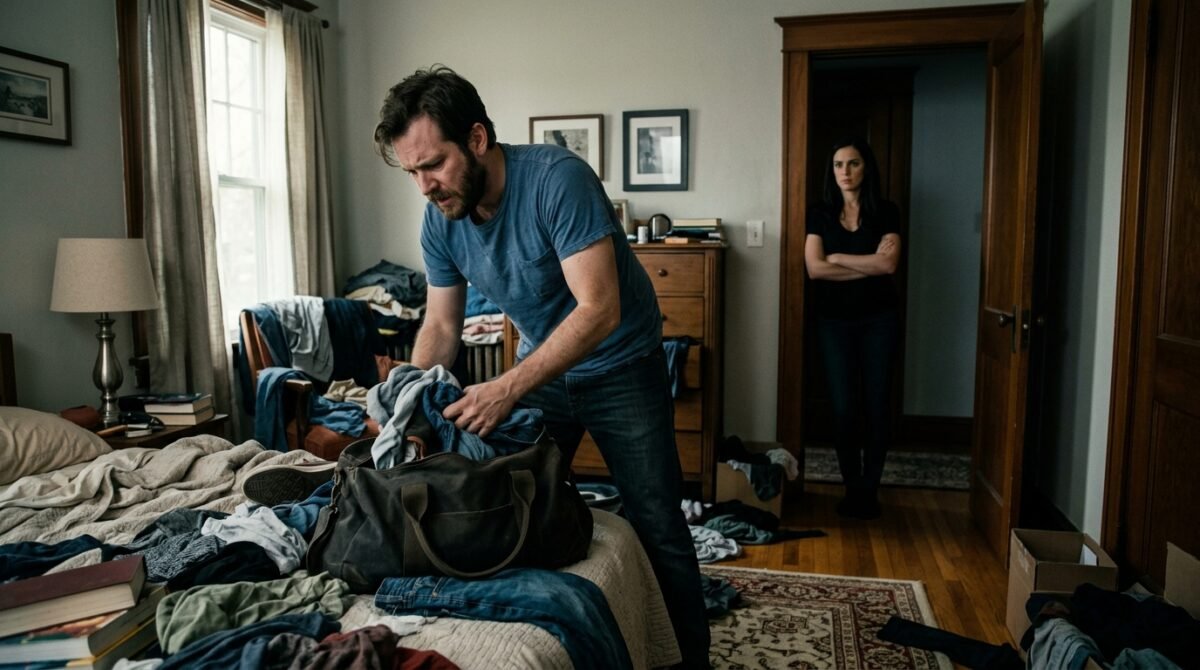
The next day, Mark returned. He didn’t come with a bouquet of flowers or a heartfelt apology. He came with the pendant in a plastic bag, tossing it onto the coffee table like it was a piece of trash. He looked disheveled, his clothes wrinkled from having spent the last two nights at his mother’s house. He wanted to talk, he said, but his tone was still one of deep resentment. He didn’t see the theft; he saw a loss of face.
I picked up the pendant. It felt cold. I cleaned it with a cloth, feeling the tears finally prick my eyes. This wasn’t just a piece of jewelry; it was the symbol of everything that had been wrong in our marriage. The underlying disregard, the way he would sacrifice my needs for his family’s approval, the way he would lie to keep the peace. It was all laid bare in this one, simple object.
He started in again, telling me that I was ‘ruining our marriage over a piece of plastic.’ That word—plastic—hurt more than the theft. To him, my motherhood, my journey, was just plastic. He couldn’t understand the depth of meaning attached to it because he didn’t want to. To understand would mean to admit he had been wrong, and he wasn’t capable of that kind of vulnerability.
I looked at him, really looked at him, and realized I didn’t know who this man was anymore. Or maybe I did, and I had just been too afraid to see it. I told him that the issue wasn’t the pendant. It was the lack of respect. It was the fact that he was willing to lie, to steal, and to gaslight me rather than just telling his sister ‘no.’ I told him that I needed space, and that he needed to leave.
“You don’t respect me, Mark. You never have. You treat me like an extension of your own family, there to be used and discarded whenever Sarah needs a boost. I’m done with that. You need to leave.”
— Me, finally saying the words I had been holding back for years.
He scoffed, but when he saw the look in my eyes—that dead, hollowed-out look of someone who has nothing left to lose—he realized I wasn’t bluffing. He started packing a bag, complaining the whole time about how I was acting like a ‘psychopath.’ I let him talk. I didn’t argue, I didn’t defend myself. I just let him leave. The house was finally, blissfully quiet.
The Aftermath and the Silence

The silence that followed his departure was deafening. I spent the first few nights just wandering the house, checking the locks, making sure Maya was sleeping soundly. It felt like living in a ghost town, but a ghost town I owned. I started the process of finding a lawyer. I knew this wasn’t going to end with him just leaving for a few days; the resentment had been building for years, and this was just the final, explosive breaking point.
His family tried to reach out, of course. My phone was blowing up with messages from his mother, his sister, and even his cousin, all telling me how ‘ashamed’ I should be for ‘kicking him out over nothing.’ I blocked them all. I didn’t need their judgment, and I certainly didn’t need their input on my marriage. It was empowering to see those ‘blocked’ notifications pile up—each one a small triumph in reclaiming my peace.
I started therapy, too. I needed to understand why I had stayed so long, why I had allowed myself to be pushed around by his family. My therapist helped me see that it wasn’t just about Mark; it was about the patterns I had developed to survive in a household where my voice was never prioritized. It was a painful, eye-opening process, but it was exactly what I needed to move forward.
I also spent time with Maya, focusing on the bond that the pendant represented. She was getting older, more curious, and I wanted her to see a mother who stood up for herself. I didn’t want her to grow up thinking that marriage meant being treated like a prop. I wanted to model strength, even if the foundation of our family was currently in pieces.
“Mommy, why is Daddy not here?”
“Daddy is taking some time to think, honey. We need to have a calm house for a while.”
— A conversation that broke my heart, yet gave me clarity on why I had to do this.
I felt a strange sense of equilibrium. I wasn’t happy, per se—the end of a marriage is never happy—but I was functional. I was in control. The panic that had defined the first few days had faded into a steady, calm resolve. I knew the road ahead would be difficult, but for the first time in a long time, I was walking it on my own terms.
The Legal Reality Check
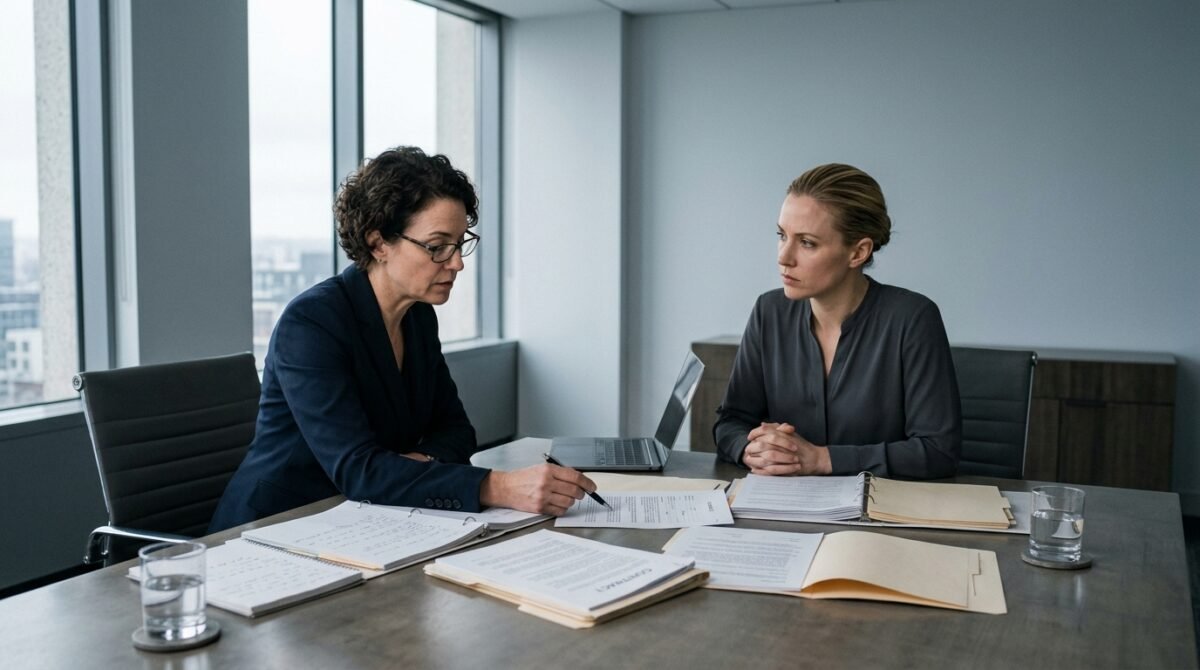
When the legal letters started coming, they were surprisingly aggressive. Mark’s lawyer claimed that I was ‘denying him access to marital property’ and that my behavior was ‘erratic and abusive.’ They wanted the jewelry back, they wanted a list of all assets, and they wanted a mediation meeting set up immediately. It was a classic projection. They were trying to paint me as the unstable one to gain an advantage in the inevitable divorce proceedings.
I sat down with my own lawyer, a sharp, no-nonsense woman who had seen it all. She laughed when she read their opening demands. She told me not to worry, that the pendant was a gift to me and therefore my personal property, not marital property. As for the ‘erratic behavior,’ she pointed out that throwing someone’s clothes on the lawn, while dramatic, was hardly grounds for anything other than a very bad fight.
She helped me draft a response that was calm, factual, and completely shut down their narrative. We didn’t play their games. We didn’t engage with the insults. We stuck to the facts: he had taken my property, he had lied about it, and he had created a hostile environment. Every step we took was calculated to protect me and, more importantly, to protect my daughter.
It was a grueling process. We had to document everything—our finances, our arguments, the history of his family’s boundary-crossing. It was like living through the most painful parts of my marriage all over again, but this time, I had a professional in my corner. I realized how much I had been carrying on my own, how much I had been apologizing for things that were never my fault.
“You are doing exactly what you need to do, Elena. Keep a record of every interaction. Let me handle the communication. Do not speak to him directly.”
— My lawyer, providing the professional anchor I needed.
The mediation was the first time I had seen him in weeks. He looked tired, older. He didn’t look at me with the same arrogance as before. He looked like a man who was realizing, perhaps for the first time, that he had actually lost. He tried to bring up the ‘opal’ again, but my lawyer shut him down instantly. It was the end of that chapter, and I was ready to close the book.
The Final Cut

The divorce was finalized six months later. It wasn’t the clean break I had hoped for, but it was over. I kept the house, I kept the pendant, and I kept my dignity. Mark moved back in with his mother, and from what I hear, he and Sarah are still the same, though I wouldn’t know—I haven’t spoken to any of them since the day he left. I’ve gone completely no-contact, and it has been the best decision of my life.
I still wear the pendant sometimes. It doesn’t hurt as much anymore. It’s just a piece of jewelry, a reminder of a time that shaped me. I look at it and I don’t see the theft; I see the woman who finally decided she was worth more than a lie. I see the woman who stood up to an entire family of entitled people and came out the other side intact. It’s a symbol of my strength now, not my victimhood.
Maya is doing well. We have our routines, our quiet moments, and our own version of a ‘family.’ It’s different, but it’s real. There’s no more walking on eggshells, no more keeping score of who is owed what, no more living in the shadow of someone else’s demands. It’s just us, and that’s more than enough.
I still get messages from the Reddit community from time to time, people finding my post and asking for updates. It’s strange to be a part of the ‘viral’ landscape, to have people I’ve never met rooting for me. But it’s also nice. It reminds me that there are people out there who value honesty, respect, and the sanctity of personal boundaries, even if they were once married to someone who didn’t.
“You didn’t just throw out his clothes. You threw out the version of yourself that let him treat you like that. You’re free now.”
— A comment from a reader that stayed with me long after I stopped checking the thread.
I don’t look back often. The past is a closed door. I’m focused on the future, on building a life where I’m not just an accessory to someone else’s drama. I’ve learned that sometimes, the only way to get the respect you deserve is to walk away from everyone who refuses to give it to you.
Lessons Learned from the Ashes

Looking back, the most profound lesson I learned wasn’t about the pendant, or the clothes on the lawn, or even the divorce itself. It was about the cost of silence. For years, I had been ‘keeping the peace,’ thinking that by ignoring small slights and enabling bad behavior, I was being a ‘good wife.’ In reality, all I was doing was teaching everyone around me that my boundaries were optional and my feelings were secondary.
I learned that when someone shows you who they are, you should believe them the first time, not the tenth. I saw the signs of Mark’s entitlement early on—the way he treated his sister, the way he spoke about my contributions to the household—but I chose to ignore them, hoping that my love would change him. It didn’t. People don’t change because they love you; they change because they have to, or because they want to. Mark didn’t want to, and I didn’t make him have to.
I also learned the value of a support system. Whether it was the anonymous users on Reddit who gave me the courage to stand up for myself or my lawyer who navigated the legal minefield, I realized I couldn’t have done this alone. There’s a stigma around asking for help, especially in marriage—like you’re ‘airing dirty laundry’—but sometimes, that laundry needs to be aired so it can finally be washed clean.
I think about the pendant now, and I see it as a catalyst. It was the spark that burned down the house, yes, but it was also the light that showed me the way out of a dark tunnel. Without that specific, insulting moment, I might still be there, still trying to accommodate a family that never once considered my needs. I’m grateful for the clarity, even if it came at such a high price.
“Be your own advocate. Because if you aren’t, nobody else will be.”
— The core truth I carry with me every day now.
I hope that anyone reading this who feels like their boundaries are being eroded, who feels like they’re being used, realizes that they don’t have to stay. You don’t have to wait for a ‘big’ betrayal to leave. You deserve to be treated with respect, every single day, by the people you call family.
Conclusion
My journey from a silent victim to a woman who finally claimed her own life was not easy. It involved heartache, legal battles, and the loss of a family I thought I was part of. But it also brought me to a place of peace, autonomy, and genuine self-respect. The story of the pendant is just one small chapter in the much larger story of rediscovering who I am when I am not defined by the expectations of others.
The debate around this situation—whether I was right to throw his clothes on the lawn or if I should have handled it more ‘maturely’—is one that continues to pop up in the comments. Some argue that I was acting out of anger, others that I was finally taking a stand. What do you think? Was the public nature of the clothing throw necessary to break the cycle of disrespect, or was there a better way to handle the betrayal? Let us know in the comments below.
What's your verdict on this dilemma?
Vote below to contribute to the official community consensus.

Have a Dilemma Keeping You Up at Night?
Share your real-life feud, wedding chaos, or relationship crossroads anonymously with our editorial team.
What do you think ?
0 Comments🛡️ Comments are moderated to protect community integrity. Your comment will appear once approved by the editorial team.