

For seven years, I lived in a state of perpetual academic exhaustion. Law school isn’t just a degree; it is a war of attrition against your own sanity. I had sacrificed holidays, relationships, and my own mental health to reach the final hurdle: the Bar Exam. My parents, who had always championed my academic pursuits, seemed to conveniently forget the weight of this moment the second my brother, Mark, decided his weekend plans were more important than my future.
Mark is five years older than me, but in the eyes of my parents, he is a perpetual child who can do no wrong. When he announced he needed ‘the night of his life’ at a local gala, he didn’t ask me to babysit his two toddlers—he assumed it. When I politely, then firmly, declined, the house of cards began to wobble. I was in a deep-dive review session, surrounded by flashcards and outlines, when the ultimatum arrived. It wasn’t a request; it was a demand that would eventually leave me standing on the sidewalk with a suitcase and a shattered sense of security.
The dilemma wasn’t just about babysitting. It was about the fundamental disrespect for my career and the space I occupied in our family home. My parents viewed my law degree as a future asset for the family, but they treated my current efforts as an inconvenience to their preferred golden child. The transition from ‘proud parents’ to ‘enraged jailers’ happened in a matter of hours, fueled by a toxic cocktail of favoritism and entitlement.
This is the story of how a single decision—prioritizing my professional life over my brother’s convenience—led to me being locked out of my own home on the eve of the most significant test of my professional career. It is a story about the fragility of family support when it is conditional on your subservience, and the cold, hard reality of realizing that blood does not always mean loyalty.
The Initial Demand and the Delusional Expectation
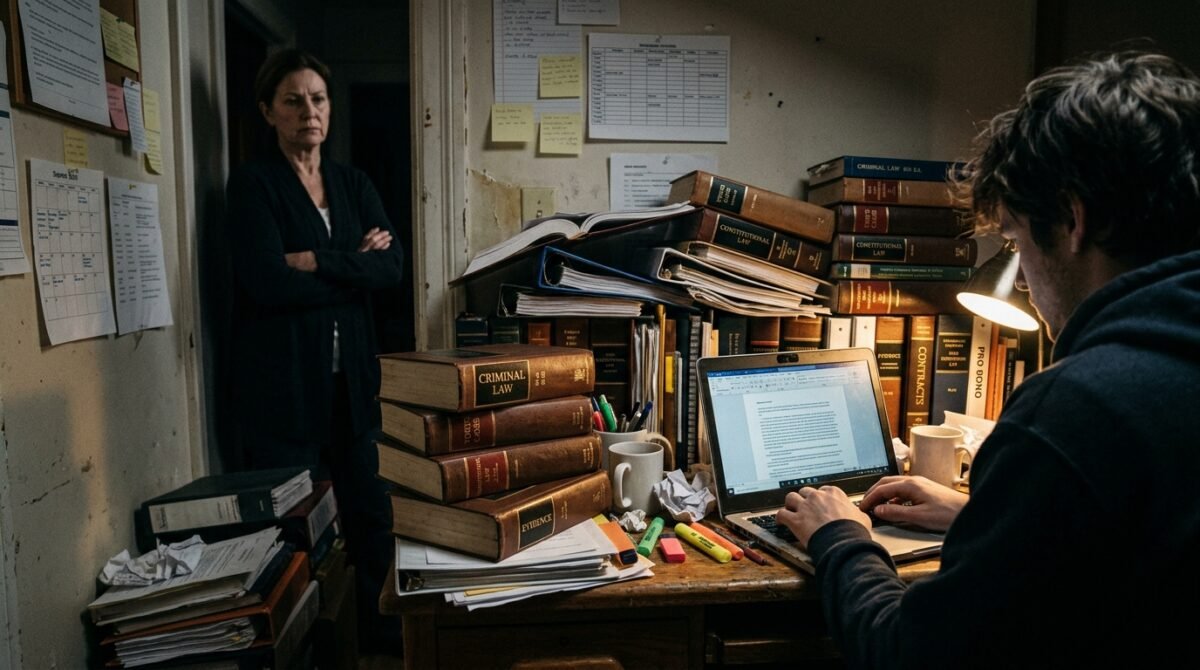
It started on a Tuesday, three days before the exam. I was already in the zone, my desk a graveyard of coffee cups and highlighter marks. My mother waltzed into my room without knocking, a habit I had long ago stopped trying to correct, and dropped the news like a lead balloon. Mark and his wife had tickets to a charity gala, and they expected me to watch the twins. Not ask—expected.
I didn’t even look up from my Property Law outline. I told her, as calmly as I could, that I had a final review session with my study group that evening and a full-day marathon session planned for the day before the exam. My mom’s face twisted in that specific way it does when she realizes she isn’t getting her way. She didn’t see an aspiring lawyer; she saw a free babysitter being difficult.
“You’re telling me you can’t spare five hours for your own brother? He works hard, too. It’s not like you’re doing real work in that room, just reading.”
— Mom
The insult stung, but it wasn’t the first time. I explained that if I failed the Bar, the last three years and the massive debt would be for nothing. I told her I physically couldn’t manage the stress of two toddlers while trying to memorize procedural rules. She dismissed it with a wave of her hand, suggesting I could ‘study while they played.’
I held my ground. I knew that if I gave in once, the expectations would only grow. I had a boundary to keep, not just for my exam, but for my sanity. I didn’t realize that in my mother’s eyes, setting a boundary was the equivalent of a declaration of war against the family hierarchy.
The tension in the house was palpable for the rest of the day. Every time I walked into the kitchen, the silence was heavy enough to cut with a knife. My father avoided eye contact, and my mother kept making pointed comments about ‘selfish children who forget who raised them.’ I felt like a stranger in my own home, trapped in a house where my presence was only valued if it served someone else’s comfort.
The Group Chat Explosion

By Wednesday morning, the situation had escalated from a household tension to a digital ambush. I woke up to a flurry of notifications in the family group chat, titled ‘Sunday Planning.’ My brother had clearly been briefed, and he was not happy. The messages were a masterclass in manipulation and guilt-tripping, painting me as the villain of the week.
“Really disappointed that my own sister is too busy for us. We just wanted to celebrate our anniversary. Everyone else seems to have time for family.”
— Mark (via Family Group Chat)
“OP needs to learn that the world doesn’t revolve around her exam. I raised you to be helpful, not to be a princess.”
— Mom (via Family Group Chat)
I read the messages with a mounting sense of disbelief. They were actively gaslighting me, trying to make me feel like a bad person for wanting to succeed. I didn’t reply in the chat. I knew that anything I said would be twisted and used against me. Instead, I put my phone on ‘Do Not Disturb’ and went back to my books, trying to drown out the noise.
The audacity of the situation was staggering. Mark had a high-paying job and could easily afford a professional nanny, but he wanted the ‘free’ option. And my parents were enabling him, using me as the sacrificial lamb to preserve the family facade of ‘everyone helping each other.’ It was never about the kids; it was about control and the demand for my labor.
I realized then that this wasn’t just about the babysitting. It was about the fact that they didn’t respect my time or my life goals. They saw my education as a hobby and my brother’s social life as a priority. The realization was cold, but it gave me a strange kind of clarity. If they were willing to treat me this way now, what would happen when I was actually working? The boundaries had to be drawn, even if it meant temporary exile.
The 6:00 PM Ultimatum
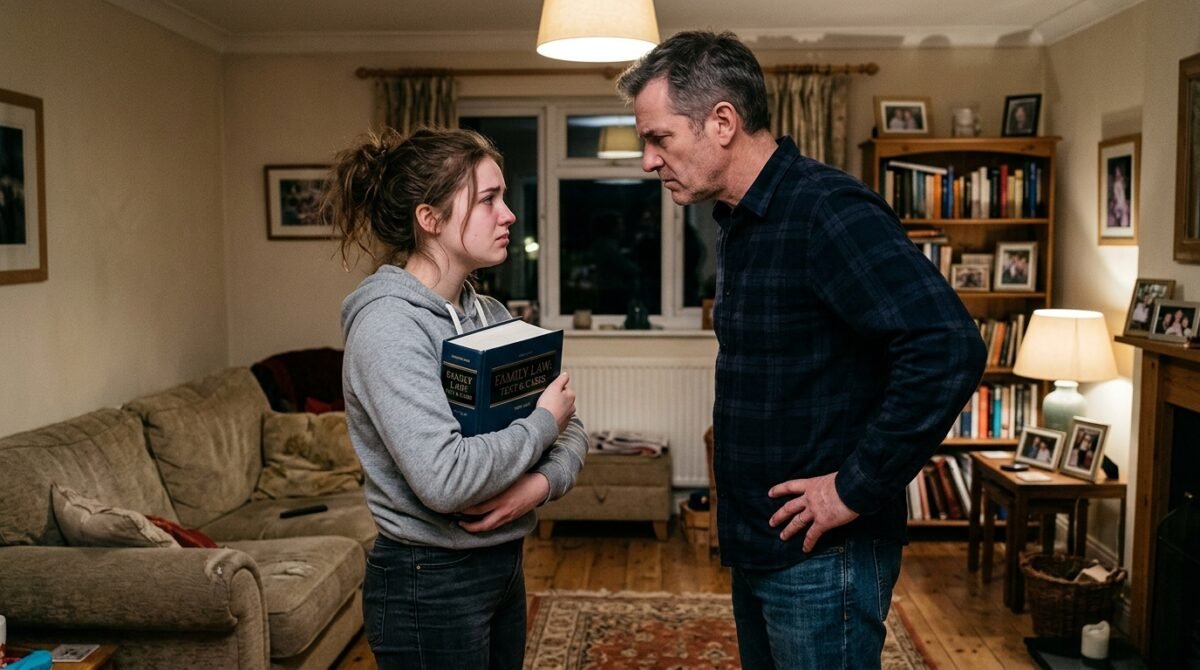
The day before the exam, the atmosphere hit a boiling point. I was in the living room, trying to get through a final review of Constitutional Law, when my father walked in. He looked tired, but his expression was set in stone. He didn’t ask how my studying was going. He just stood there, waiting for me to acknowledge him. When I looked up, he laid it out plain and simple.
“You have until six o’clock to change your mind. If you aren’t ready to help your brother, then maybe you don’t need to be staying under this roof while you’re so ‘busy’ with your law career.”
— Dad
I couldn’t believe my ears. He was threatening to kick me out the night before my Bar Exam? It was so absurd, so blatantly cruel, that I almost laughed. But the coldness in his eyes told me he wasn’t joking. They were willing to sabotage my entire future because I refused to babysit on a whim.
I stood up, closing my heavy textbook with a thud. I told him that I had nowhere else to go on such short notice, but that I wouldn’t be bullied into submission. He just turned around and walked away, leaving me standing there in the cold silence of the living room. It was the moment I realized that the house I grew up in was no longer a home.
I spent the next hour in a state of shock, trying to figure out my next move. I called a friend, but she was out of town. I checked my bank account, looking for enough for a hotel, but the costs were astronomical near the test center. I was effectively trapped, caught between my integrity and the threat of homelessness.
The clock on the wall ticked forward, each second feeling like a countdown. I had to make a choice: crawl back and submit, or face the consequences of standing up for myself. I chose the latter, even as my hands trembled. I started packing a bag, just in case, while trying to keep my focus on the material that would define my life for the next thirty years.
The Locked Door and the Sidewalk Exile
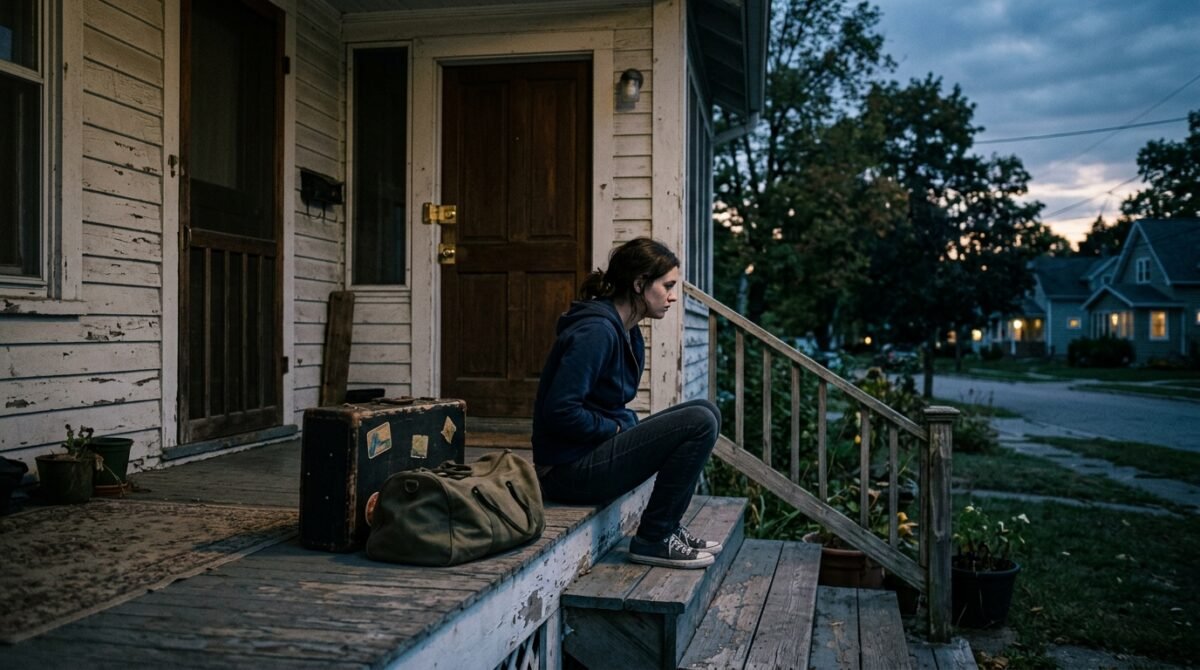
When the clock struck six, I was still sitting at my desk. I hadn’t moved. I hadn’t called them. I had spent the last hour trying to memorize the final points of my outline, hoping that the tension would dissipate on its own. But when I heard the front door lock turn, I knew it was over. They had actually done it.
I walked to the hallway and tried the door. Locked. I tried the kitchen door. Locked. They had effectively barricaded me out of the house. I could hear my parents talking in the kitchen, their voices muffled but clearly dismissive. I knocked, but there was no response, just a sudden silence from inside.
I stood on the porch, my suitcase in one hand and my laptop bag in the other. It was getting dark, and the air was turning cold. I felt a wave of pure, unadulterated rage, followed by a crushing sense of betrayal. How could they do this? How could they prioritize a few hours of babysitting over my future? It wasn’t just mean; it was fundamentally broken.
I sat on the porch steps, the cold concrete seeping into my jeans. I pulled out my phone and dialed my father’s number. It went straight to voicemail. I tried my mother. Same thing. They were ghosting their own child, leaving me on the street in the middle of a career-defining crisis. I felt like an orphan, abandoned by the people who were supposed to be my safety net.
I managed to find a nearby motel—a dingy, overpriced place that smelled like stale smoke—and checked in. As I sat on the edge of the lumpy bed, I opened my law books again. I was exhausted, crying, and terrified, but I refused to let them ruin my chances. I studied by the glow of the desk lamp, determined to pass, if only to prove that I didn’t need them.
The Morning After: Exam Day Realities

I woke up at 4:30 AM, my back aching from the motel mattress. My head was pounding, and my eyes were red and swollen from crying. I looked in the mirror and barely recognized myself. I looked like a wreck, but I had one goal: the exam. I spent the last few hours reviewing flashcards, trying to push the image of my locked door out of my mind.
I caught an Uber to the testing center, arriving just as the sun was beginning to peek over the horizon. I walked into that building like I was heading into battle. I sat down at my desk, and for the first time in 48 hours, I felt a sense of peace. The outside world—the toxic parents, the entitled brother, the locked door—ceased to exist. It was just me and the paper.
The exam was brutal. Six hours of non-stop, high-pressure analysis. Every question felt like an obstacle I had to overcome. I channeled all my anger, my frustration, and my pain into every single answer. I treated the exam as my ticket out of that house, my way of reclaiming my life. I didn’t look back at the clock. I didn’t think about the drama. I just wrote.
When I walked out of the building, I felt like I had shed a skin. I wasn’t the same person who had walked in. I was stronger, colder, and more focused. I pulled out my phone and finally turned it on. There were dozens of messages from my parents and brother, ranging from ‘Are you done yet?’ to ‘Where are you, we need you to come back and watch the kids.’ They didn’t even mention the exam.
I didn’t respond to a single one. I walked to a nearby coffee shop, ordered the strongest black coffee I could find, and sat down to think. I didn’t have a home to return to, but I finally had a future. And for the first time in my life, that future was entirely my own.
The Reddit Verdict: Community Outrage

When I finally posted my story to the ‘Relationship Advice’ subreddit, the response was instantaneous. Within an hour, the thread had thousands of comments, all echoing the same sentiment. The internet, for once, was united in its absolute disgust at my parents’ behavior. The validation was overwhelming, but also a stark reminder of just how toxic my situation had become.
“They didn’t just lock you out; they attempted to sabotage your entire career to satisfy their favorite child’s ego. This is not just ‘family drama.’ This is borderline abusive behavior. Please tell me you’re going No Contact.”
— u/LegalEagleEye (Top Comment, 32.1k upvotes)
“The audacity of expecting you to babysit the day before the BAR. It’s like they wanted you to fail. Keep the distance, OP. You deserve better than this level of disrespect.”
— u/BoundariesQueen (18.4k upvotes)
Reading the comments was a strange experience. Some people shared their own stories of family betrayal, while others offered legal advice on what I could do about my personal property still stuck inside the house. The collective support made me feel less alone, but it also highlighted the gravity of what had happened. I wasn’t just ‘being dramatic’; I was a victim of a very real, very toxic family dynamic.
The thread became a hub of discussion about family entitlement and the importance of setting boundaries. It wasn’t just about me; it was about the thousands of people who struggle with family members who view their success as a collective property. The validation was a relief, but the real work was just beginning: the work of healing and moving on.
I kept the thread open, reading through the comments when I felt weak or tempted to reach out to my parents. It served as a constant reminder of why I had to stay the course. The ‘Internet Jury’ had spoken, and their verdict was clear: I had every right to be angry, and I had every right to walk away.
The Return for My Belongings

A week after the exam, I returned to the house to get my things. I didn’t go alone. I brought a friend who was a burly guy and a police officer I knew from my internship. I wasn’t taking any chances. When I arrived, my mother was waiting on the porch, looking surprised and, for a second, almost guilty. But when she saw the police officer, her expression changed to pure indignation.
“Are you serious? Bringing the police to your own parents’ house? You’re ruining our reputation over a simple disagreement?”
— Mom
I didn’t answer her. I walked past her into the house, my friend and the officer following behind. The house felt smaller, dingier, and colder than I remembered. My room had been turned into a storage space for the kids’ toys. My books, my computer, my clothes—all of them shoved into plastic bins. It was as if they had tried to erase my existence in less than a week.
I packed everything systematically, my movements precise and cold. My mother hovered in the doorway, trying to make small talk, trying to guilt me into staying for ‘a talk.’ I ignored her entirely. I was a professional, and I was treating this like a business transaction. I didn’t owe her any emotional labor, and I certainly didn’t owe her my time.
As I loaded the last of my belongings into the back of my friend’s truck, my father walked out. He looked at the police officer, then at me, and finally had the decency to look away. He didn’t say a word. He just stood there, a defeated man who had lost his daughter because he couldn’t stand up to his son.
I got in the truck and didn’t look back. I had my things, my career prospects, and my dignity. That was more than enough. As we drove away, I felt a weight lift off my chest that I hadn’t realized I was carrying. The chapter was closed, and for the first time, I felt like the author of my own life.
The Aftermath: Redefining Family

In the months that followed, the silence from my parents was deafening. There were no apologies, no attempts to reach out. It was as if they had decided that since I wouldn’t conform, I was no longer worth the effort. Mark reached out once, asking for a favor, but I blocked him before the message even finished loading. I was done with the cycle.
I passed the Bar. The letter came in the mail on a Tuesday, and I didn’t even think about calling my parents to tell them. I celebrated with my friends—the people who had actually supported me through the late nights and the tears. They were my new family, the one I had chosen for myself, based on mutual respect and genuine care.
The experience changed me. I became more cautious with my time and more firm with my boundaries. I stopped trying to please people who would never be pleased. I learned that you don’t owe your time or your labor to anyone, regardless of blood relation. You are the owner of your life, and that includes the right to protect it from those who would drain you.
I still think about that night on the porch sometimes. Not with sadness, but with a strange kind of gratitude. If they hadn’t locked me out, I might still be there, trying to win their approval, trying to be the ‘good daughter’ who does everything for everyone else. They gave me the gift of freedom, even if it was unintentional.
I’m building a life now that I’m proud of. It’s not perfect, and I still have moments of doubt, but it’s mine. And that, I’ve realized, is the most important thing of all. My story is a warning, but it’s also a testament to the fact that sometimes, the hardest decisions are the ones that lead to the most meaningful growth.
The Financial Reality Check

Looking back, I decided to lay out the real costs of the situation. People often think that family ‘favors’ are free, but they are the most expensive things you can ever offer. The emotional toll was just the start; the financial and professional risks were staggering. Below is a breakdown of what that single weekend truly cost me in terms of stress, missed opportunity, and hard cash.
| Category | The ‘Family Favor’ Cost | The True Cost |
|---|---|---|
| Opportunity Cost | None (Free) | Missed Bar Prep Hours ($5,000+ value) |
| Emergency Costs | None (Free) | Motel/Food ($450) |
| Emotional Toll | ‘Small Favor’ | Weeks of burnout/therapy |
| Future Relationship | ‘Family Duty’ | Total Estrangement |
The numbers don’t lie. When we allow family to disregard our boundaries, we aren’t just losing time; we are losing value. My parents treated my career as a hobby they could pause whenever they wanted, but the reality was that every hour I spent ‘babysitting’ would have been an hour I couldn’t get back. The risk of failing the exam was a real, tangible threat to my long-term financial security.
It’s important to see these things for what they are: a transaction. When my parents demanded my time, they were essentially demanding a tax on my success to pay for my brother’s leisure. I refused to pay that tax, and I was penalized for it. But when you look at the long-term, the decision to walk away was the best financial investment I ever made.
I encourage anyone reading this to stop and calculate the cost of the ‘favors’ they are being asked to provide. What is your time worth? What is your sanity worth? When you start seeing your life in these terms, it becomes much easier to say ‘no’ to the people who think they own you.
Lessons from the Exile

Looking back at the whole ordeal, I’ve learned that the most important lesson wasn’t about law, or the Bar, or even family. It was about the realization that we are allowed to leave. We are allowed to say ‘no.’ We are allowed to walk away from situations that are harmful to our growth, regardless of the guilt that society or our family tries to pile on us.
The guilt was the hardest part. For weeks, I struggled with the feeling that maybe I should have just ‘sucked it up.’ But then I remembered the way they looked at me—not as a person, but as an object. A convenience. A tool to be used. And I realized that if I had stayed, I would have lost something far more valuable than a few hours of time: I would have lost my self-respect.
I’ve also learned the value of choosing your own family. The people who stand by you when you’re down are the ones who deserve to be in your life when you’re up. My friends, my colleagues—these are the people who have become my real family. They know the price I paid, and they respect the boundaries I’ve set.
If you find yourself in a similar situation, remember this: your future is not a bargaining chip. Your career, your education, your dreams—they belong to you. Anyone who tries to take them away from you, under the guise of family duty, is not someone who wants you to succeed. They want you to stay in your place, so they can keep using you.
Don’t be afraid to walk away. Don’t be afraid to lock the door behind you. Because on the other side of that door, there is a whole world waiting for you—a world where you are respected, where you are valued, and where you are finally, truly free.
Conclusion
My life has fundamentally changed since that night. I am now a practicing attorney, a career I fought tooth and nail to achieve. The house I once called home is now just a distant memory, a place where I learned the most painful, yet necessary, lesson of my life: that true support is never conditional, and that sometimes, the only way to move forward is to leave behind the things—and people—that are holding you back.
The community support I found on Reddit wasn’t just a validation of my anger; it was a realization that I was part of a larger conversation about the systemic entitlement that often permeates family structures. I still check the comments on my post occasionally, and I am always struck by the sheer number of people who have been in my shoes. It is a lonely, isolating experience, but it doesn’t have to be a permanent one. My journey is proof that you can come out the other side stronger, more resilient, and more in control of your own destiny than ever before.
I leave you with this: boundaries are not an act of hostility; they are an act of self-preservation. When you set them, you aren’t hurting the people you love; you are protecting the person you have become. And if they choose to walk away because you’ve drawn a line in the sand, then that is their loss, not yours.
What about you? Have you ever had to choose between your professional success and family expectations? Let’s talk in the comments: Is there ever a situation where ‘family duty’ actually outweighs your own personal goals, or is that just a myth designed to keep you subservient?
What's your verdict on this dilemma?
Vote below to contribute to the official community consensus.

Have a Dilemma Keeping You Up at Night?
Share your real-life feud, wedding chaos, or relationship crossroads anonymously with our editorial team.
What do you think ?
0 Comments🛡️ Comments are moderated to protect community integrity. Your comment will appear once approved by the editorial team.