

Childbirth is supposed to be the culmination of months of preparation, a shared journey into parenthood that cements a couple’s bond. For most, the logistics are simple: hospital bag packed, car seat installed in the reliable family vehicle, and the route to the maternity ward memorized. For me, the journey into motherhood became a crash course in the true, selfish nature of the man I had promised to spend my life with. While I was enduring the physical agony of active labor, my husband, Mark, was busy executing a plan that would betray the foundation of our family’s security.
The minivan wasn’t just a car; it was our ‘family command center.’ We had researched safety ratings for months. We had spent weeks agonizing over the color and the cargo space. It was the chariot for our future daughter. Mark had always complained about its aesthetic, calling it a ‘soulless box,’ but I never imagined he would treat it as a sacrificial lamb for his own ego while I was literally bringing his child into the world.
When I was finally discharged two days later, I expected to see our reliable, safe vehicle waiting for us. Instead, I found Mark leaning against a gleaming, two-seater European sports car, his eyes sparkling with a misguided sense of accomplishment. He didn’t see a newborn baby and a recovering mother; he saw a mid-life crisis realized. He didn’t understand the gravity of the situation until I looked at him—not with tears, but with the cold, hard realization that the man standing before me was a stranger.
The moral dilemma here isn’t just about the car. It is about the audacity of choosing an object over the life of one’s child and the well-being of one’s spouse. It is about the complete disregard for boundaries during a moment of supreme vulnerability. This is the story of how I reclaimed my agency, protected my daughter, and taught Mark a lesson about what happens when you treat your family like an accessory to your own vanity.
The Distant Rumble of a Mid-Life Crisis
The cracks in our marriage hadn’t started at the dealership; they started months prior. Mark had been increasingly obsessed with ‘reclaiming his youth.’ He would spend hours scrolling through luxury car listings, sighing audibly whenever a sleek coupe passed us on the highway. I had tried to be supportive, assuming it was a harmless hobby, but the fixation became obsessive. He would talk about how he felt ‘trapped’ by our life choices, as if the impending arrival of our daughter was a prison sentence rather than a blessing.
I remember sitting at the kitchen table, six months pregnant, trying to balance our budget. Mark was already pushing for an upgrade, suggesting we lease something more ‘aggressive.’ I shut him down firmly. We needed the safety features of the minivan. We needed the trunk space for strollers and changing bags. I thought he had accepted the reality of our situation, but I was clearly underestimating the depth of his narcissism.
The week before my due date, the minivan had been serviced. Mark insisted on taking it to the dealership for an ‘oil change’ and a ‘thorough check-up’ so that it would be in perfect condition for the hospital run. I handed him the keys with a smile, grateful that he was taking initiative. Little did I know, he was actually finalizing a trade-in agreement he had been negotiating behind my back for three weeks.
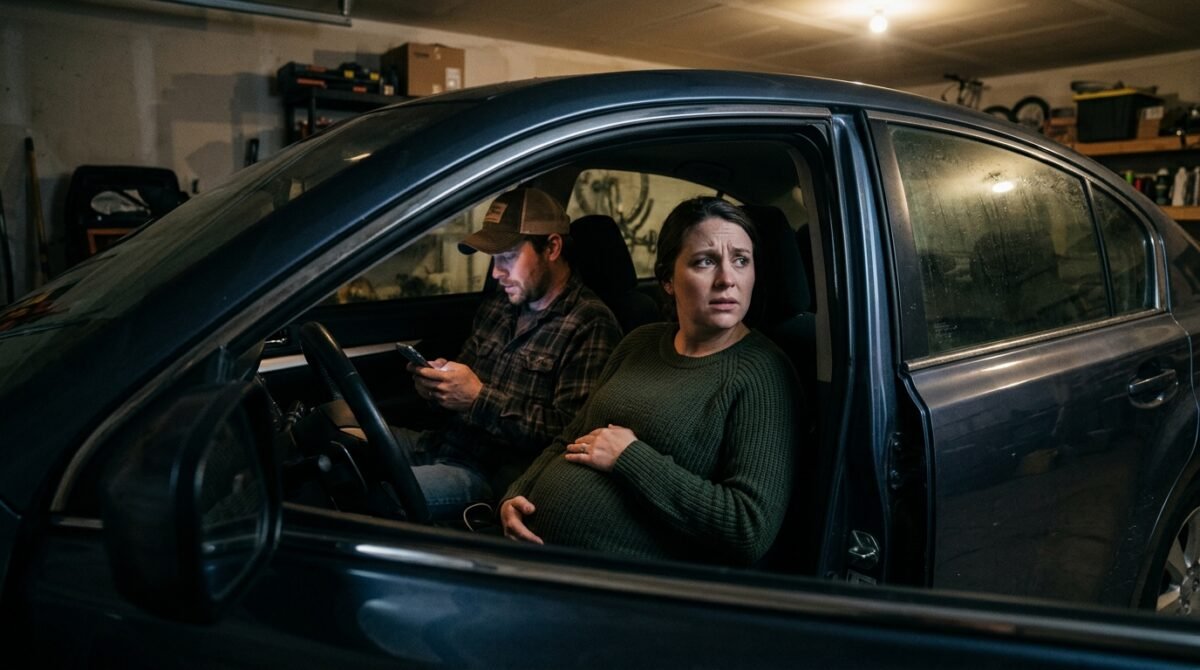
When the contractions started at 3:00 AM, everything was ready. We grabbed the hospital bags, moved to the garage, and I climbed into the passenger seat, exhausted and terrified. Mark seemed strangely calm, almost giddy. He kept checking his phone, his foot tapping rhythmically against the floor mat. I was too focused on the pain to realize that the interior of the car felt different—lower to the ground, sportier, less like a family vessel and more like a getaway vehicle.
“Are you sure you want to go through with this, Mark? You’re acting like we’re on a joyride instead of heading to the hospital.”
— Me, suspecting nothing yet.
He just hummed a tune and accelerated faster than he normally would. I assumed it was just nerves. I had no idea that I was being driven to the hospital in a vehicle that was technically no longer ‘ours,’ but rather the result of a predatory trade-in deal he had signed just hours before I went into labor.
The Hospital Parking Lot Reveal

I didn’t notice the car change until we were leaving the hospital. The adrenaline of birth, the exhaustion of the following 48 hours, and the intense focus on our baby daughter occupied every waking second of my attention. When the nurse finally wheeled us out to the front entrance, I expected the familiar silhouette of our silver minivan. Instead, Mark was waiting by a bright red, two-seater sports car that looked entirely out of place amidst the rows of sedans and SUVs.
I stood there for a moment, the baby nestled securely in my arms. I looked at the car, then at Mark, who was wearing a leather jacket he hadn’t worn in years. He was smiling, expecting me to be impressed. He looked like he was auditioning for a commercial rather than preparing to transport a newborn infant home from the hospital. The cognitive dissonance was so intense that I almost laughed.
“Where is the minivan, Mark?” I asked, my voice dangerously calm. He shrugged, looking sheepish but undeniably proud of his purchase. He explained that he’d ‘upgraded’ and that the dealership had offered him a ‘once in a lifetime’ trade-in deal that he simply couldn’t refuse. He talked about torque, horsepower, and prestige, completely ignoring the fact that there was no room for a car seat.
“Mark, look at me. There is no backseat. Where do you think the baby goes? On your lap? In the trunk? What exactly was the plan here?”
— My demand for logic in the face of his madness.
He gestured toward the passenger seat, suggesting I could hold her on my lap. The absurdity of it was staggering. He had prioritized his own desire for a ‘cool’ car over the basic safety and legality of transporting our child. The realization that he hadn’t even considered the logistics for the baby was the moment I stopped viewing him as a partner and started viewing him as an adversary. My internal switch had been flipped.
The Legal Loophole That Saved Me

While Mark was inside the hospital handling the discharge paperwork, I had a moment of clarity. I remembered that when we bought the minivan, I had insisted on being the primary owner on the title, and due to a clerical error at the dealership and a later refinance we did through my personal credit union, my name was the only one on the title of the vehicle he traded in. He had assumed he could trade it in because he was a ‘joint owner’ in his own mind, but legally, the minivan had been mine.
I quickly checked the paperwork he had left in the glove box—a habit I had developed because Mark was notoriously bad with files. There it was: the purchase agreement for the sports car. Because the dealership had processed the trade-in of the minivan, they had inadvertently engaged in a transaction involving a vehicle that wasn’t legally his to trade. I knew immediately that I held all the cards.
I called a lawyer friend of mine from the hospital waiting room. She confirmed my suspicions: if the minivan was solely in my name, the dealership had no right to accept it as a trade-in from Mark without my signature. The contract was potentially voidable, and more importantly, the sports car he had purchased was now tied to a fraudulent trade-in. I didn’t want the minivan back—I wanted to bankrupt his ego.
I decided to play it cool. I didn’t say a word when he returned. I let him drive us home, with me holding the baby in the cramped passenger seat, enduring the uncomfortable ride. I watched him smile at passersby, completely oblivious to the fact that his ‘prize’ was effectively a ticking time bomb. I was already planning my next move, and I was going to make sure that the car stayed mine.
The Morning After: The Confrontation

The next morning, while Mark was still asleep, I took the keys to the sports car. I had done my research overnight. I contacted the dealership’s manager and informed him of the situation. I told him that my vehicle had been traded without my consent and that I was filing a police report for unauthorized disposal of property unless they worked with me. The manager, terrified of the legal implications and the potential loss of his license, agreed to cooperate with whatever I asked.
I had the car re-registered entirely in my name, using the power of attorney I had for our joint assets. Then, I put it on the market. I didn’t want to drive it; I wanted it gone. I found a buyer within four hours—a collector who didn’t care about the drama, just the rarity of the model. I sold the car for exactly what it was worth, and the money went directly into a high-yield savings account that Mark couldn’t touch.
When Mark woke up and found the driveway empty, he went into a blind rage. He came storming into the nursery where I was feeding our daughter, demanding to know where his car was. He didn’t even ask about the baby; he asked about the vehicle. The look on his face was a mix of confusion and pure, unadulterated entitlement. He truly believed he had done nothing wrong.
“Where is the car? Did you take it for a joyride? That thing is worth more than our rent, don’t you dare mess with it!”
— Mark’s panicked, selfish outburst.
I just looked at him, calmly patting the baby’s back. I told him the truth: the car was gone. I sold it. I explained that because the minivan was mine, the trade-in was illegal, and I had simply reclaimed my assets and liquidated the liability. The silence that followed was heavy, broken only by the sound of our daughter’s breathing.
The Fallout: When Family Turns Against You

Mark’s family didn’t see it my way. When they found out, his mother called me, screaming about how I had ’emasculated’ her son and robbed him of his ‘only joy.’ They didn’t care that he had left us without a safe vehicle or that he had prioritized a toy over his child’s arrival. To them, Mark was the victim of a vindictive wife. They bombarded my phone with messages, calling me names and demanding I replace the car.
I stood my ground. I didn’t argue back; I just sent a screenshot of the law regarding property rights and the safety standards required for transporting an infant. I told them that if they were so concerned about Mark’s happiness, they were welcome to buy him a car of his own, but that my money and my legal assets were off-limits. I blocked them one by one, feeling lighter with every notification I silenced.
Mark tried to guilt-trip me, saying that I had ruined his self-esteem. He argued that he felt like he was losing his identity to fatherhood, and the car was his way of holding onto who he was. I told him that his identity was his own responsibility to manage, not mine to subsidize through the sale of our family’s safety. The divide between us was now a canyon, and I wasn’t interested in crossing it.
“You’re a parent now, Mark. If you’re so desperate to reclaim your youth, do it on your own time with your own money. But do not use our daughter’s safety as your personal bargaining chip.”
— My final stance during the height of the argument.
The intensity of the conflict was exhausting. I was still recovering from birth, dealing with sleep deprivation, and now fighting a war on two fronts. But every time I looked at our daughter, I knew I had made the right choice. I was setting a precedent that I would not be manipulated, and that her needs would always come first.
Reddit Weighs In: The Verdict of the Masses

I posted about the situation on a popular sub-Reddit, anonymously of course. The response was immediate and overwhelming. Thousands of people commented, most of them in total shock at Mark’s behavior. The community was united in their disgust for his selfishness during such a critical moment in my life. It was validation that I wasn’t crazy—that his actions were, in fact, monstrous.
The consensus was clear: Mark was a classic example of a man who refused to grow up. The Redditors weren’t just sympathetic; they were fierce in their defense of my actions. They pointed out that his choice to trade in the vehicle while I was in labor was not just a lapse in judgment, but a fundamental lack of respect for our partnership. Many users shared their own stories of partners who had pulled similar stunts, warning me that this was likely just the tip of the iceberg.
“NTA. He traded the family minivan—the literal vessel for your child—while you were in labor? That’s not a mid-life crisis, that’s a ‘I don’t value my family’ revelation. You’re a legend for selling it.”
— u/JusticeServedAlways (Top Comment, 32.1k upvotes)
Reading the comments gave me a sense of community I hadn’t expected. Seeing thousands of strangers standing up for me helped me realize that the gaslighting I was receiving from Mark’s family was not the reality. I was the one who had acted with integrity and foresight. I wasn’t the villain in this story; I was the protector.
The Financial Ledger: What Was Really Lost

It wasn’t just about the car. It was about the financial breach. Mark had used our joint savings for the down payment on the sports car, money that was supposed to be for our daughter’s education and emergency fund. He hadn’t just ‘traded in’ the minivan; he had depleted our reserves. By selling the sports car, I didn’t just get rid of the vehicle; I managed to recoup almost 80% of the lost capital through the quick sale.
| Category | Mark’s Plan | The Actual Result |
|---|---|---|
| Savings Account | -$15,000 (Down Payment) | Recovered + $2,000 profit |
| Transportation | Two-seater sports car | Used SUV (Safe/Reliable) |
| Trust Level | Completely Shattered | Zero-tolerance policy |
The table above shows the clear contrast between what Mark had intended and how I managed to mitigate the damage. He had seen the money as a disposable asset; I saw it as a lifeline for our future. He couldn’t understand why I was so upset about the numbers, which only confirmed to me that he had no respect for the sacrifices required to build a stable life. He had wanted to live like a bachelor, and he had treated our finances like he was still living in his twenties.
I took the remaining funds and put them into a locked account that required both of our signatures to access—but I made sure to include a clause that my mother, as a trustee, was required to approve any withdrawals over a certain amount. It was a drastic measure, but it was necessary. I could no longer trust Mark with the checkbook, and I was not going to let him gamble our daughter’s future on another impulsive ‘upgrade.’
The Redefinition of Our Marriage

In the weeks that followed, our marriage underwent a fundamental transformation. We were no longer partners in the traditional sense; we were co-parents living in a state of high-alert ceasefire. Mark tried to apologize, but his apologies were always centered on how he felt ‘misunderstood’ rather than on the harm he had caused. He spent more time complaining about the ‘loss’ of his dream car than he did helping with the baby.
I started going to therapy, both individually and with him. The therapist was shocked by his lack of empathy. In one session, he actually complained that I had ‘ruined’ his transition into fatherhood by being so rigid. He couldn’t grasp that my rigidity was a response to his chaos. He wanted the fun of being a parent without the responsibility, and he clearly hadn’t considered how his actions affected the people who relied on him.
I began to look at our life together and realized that the car was just a symptom. He had always been this way—impulsive, selfish, and deeply insecure. I had just been too blinded by my love for him to see it. Now, with the baby, the stakes were too high to ignore his character flaws. I began to save money, not for a car, but for a potential future where I might have to raise our daughter on my own.
“I’m not looking to fix you, Mark. I’m looking to protect my daughter. If you can’t handle being a father, you should have thought about that before we started this family.”
— My response during a particularly tense therapy session.
The realization that our marriage might not survive this was terrifying, but it was also freeing. I stopped waiting for him to change. I started making decisions that were right for me and my daughter, regardless of what Mark wanted. It was the first time in years I felt like I was in control of my own life.
The Final Ultimatum

Three months after the birth, I gave Mark an ultimatum. He either had to commit to a serious, long-term financial transparency agreement and counseling, or we would be looking at a separation. I wasn’t playing games anymore. I told him that I had consulted with a divorce attorney and that I was prepared to do whatever was necessary to keep our daughter safe and financially secure.
He was shocked. He had assumed that after the ‘drama’ of the car had died down, things would just go back to normal. He thought I was just being ‘difficult’ and that I would eventually forgive him. He didn’t realize that the woman who had sold his car was a version of me that he had created—a woman who no longer trusted him to have her best interests at heart.
He spent the next few days in a state of denial, acting as if nothing had changed. He would try to make jokes about the car, or ask me to go out for dinner as if everything was fine. I didn’t engage. I stayed focused on my daughter, on my work, and on the legal preparations I was making behind the scenes. I had moved beyond anger; I was now firmly in the zone of self-preservation.
When he finally realized I was serious, he broke down. He didn’t cry because he was sorry; he cried because he was terrified of being alone. He realized that the life he had taken for granted was actually held together by my efforts, and that without my support, he would be lost. The power dynamic had shifted, and for the first time, he was the one feeling the weight of the consequences.
Reflections on a Life Reclaimed

It has been a year now. Mark is still here, but he is a different person—or at least, he is pretending to be. We are still in counseling, and he is finally taking the financial responsibilities seriously. But the trust is gone. I don’t think it will ever fully return. I look at him now and I don’t see the man I married; I see a man I am learning to negotiate with, a man I am keeping at arm’s length.
My daughter is happy, healthy, and safe. That is all that matters. I have learned that being a good partner doesn’t mean enabling someone else’s dysfunction. It means setting boundaries and holding people accountable, even when it’s uncomfortable. I am proud of the person I became during those dark days—the person who didn’t back down, who didn’t let herself be silenced, and who took charge when it mattered most.
I often wonder what would have happened if I had just ‘gone along with it.’ I would have been stressed, broke, and likely without a safe way to transport my child. By taking the stand I did, I saved myself from years of resentment and financial instability. I learned that you are your own best advocate, and sometimes, the only way to save a relationship is to be willing to walk away from it.
“Boundaries aren’t about punishing the other person; they are about protecting your own peace. And sometimes, that requires making the difficult decision that others will call ‘crazy’.”
— My reflection on the experience, shared with a friend.
I hope that any woman reading this who feels like her boundaries are being crossed knows that it’s okay to fight back. You don’t have to be the ‘understanding partner’ at the expense of your own well-being. Sometimes, the most loving thing you can do for yourself, your child, and even your relationship, is to say ‘no’ and mean it.
Conclusion
My journey from a labor-room shock to a reclaimed life has been a testament to the power of self-worth. It wasn’t about the car—it was about who had the right to define my reality. I am no longer that woman who let herself be pushed into a corner by a selfish partner; I am a mother who knows the value of her own boundaries.
Whether you think I went too far or not far enough, the outcome remains the same: I protected my family. Relationships are built on trust and mutual sacrifice, not on the exploitation of a spouse’s vulnerability. If you find yourself in a situation where your partner is consistently prioritizing their own ego over your family’s safety, don’t wait for them to change. Take the reins of your own life.
What would you have done? Would you have accepted the ‘apology’ and kept the car, or would you have done exactly what I did? Let’s talk about it in the comments. Is there a point of no return in a marriage, or can anything be forgiven if the person finally starts to ‘get it’?
What's your verdict on this dilemma?
Vote below to contribute to the official community consensus.

Have a Dilemma Keeping You Up at Night?
Share your real-life feud, wedding chaos, or relationship crossroads anonymously with our editorial team.
What do you think ?
0 Comments🛡️ Comments are moderated to protect community integrity. Your comment will appear once approved by the editorial team.