

Living with friends is supposed to be the quintessential experience of early adulthood. You share pizza, you share Netflix passwords, and you occasionally share the burden of a high electricity bill. But nobody tells you that you might eventually have to share the financial liability for a literal architectural disaster caused by someone’s delusions of grandeur.
My roommate, let’s call him Jason, had been talking about his ‘fitness journey’ for months. It usually involved buying expensive protein powders that went expired before the seal was broken. I never thought his commitment to health would result in me needing to contact our landlord’s insurance company under duress, or worse, facing an invoice that would make a contractor blush.
The dilemma started as a simple request for a bit more space, but it quickly spiraled into a debate about ‘shared living expenses.’ The moment that ceiling gave way, the facade of a friendly roommate dynamic dissolved into a cold, hard legal and moral battleground. It wasn’t just about the money; it was about the staggering audacity of someone who thinks that because we share a roof, I should pay for the hole he punched through it.
In this article, I am going to break down the timeline of events—from the initial drilling to the final, infuriating confrontation. We will look at the text messages, the emotional toll, and the absolute absurdity of the argument Jason tried to construct to justify his demand for me to split the repair costs. If you think you have bad roommate stories, settle in, because this one is going to take the cake.
The Morning of the ‘Gym Installation’

It was a Saturday morning, the kind where you hope to sleep in until at least 10:00 AM. Instead, I was jolted awake by the aggressive sound of a power drill vibrating against the structural studs of our living room. I stumbled out of bed, eyes bleary and confused, wondering why anyone would be doing construction in a rental apartment on a weekend.
I found Jason standing on a step ladder, sweating profusely while holding a massive, industrial-grade metal mount. He had already marked the ceiling with a pencil, right in the center of our living room, just above where our rug sat. He looked at me with a grin that was far too confident for someone who had never held a power tool in his life.
“Hey, man! Don’t worry about the noise. I’m just setting this up so I can get some cardio in before the gym gets crowded. It’s a 150-pound bag, but I checked the joists. It’s totally fine.”
— Jason, 9:15 AM
I stood there, wrapped in my bathrobe, trying to process the sheer weight of his statement. 150 pounds? Mounted to a plaster ceiling in a building built in the 1970s? My internal alarm bells were screaming, but Jason was already drilling. He seemed so sure of himself that I hesitated, not wanting to be ‘that guy’ who ruins his workout routine.
Looking back, that moment of hesitation was my biggest mistake. I should have told him to stop immediately. I should have pointed out that we didn’t own the property. But instead, I just grumbled about the noise and went back to my room to make coffee, thinking he would surely be careful. That was the last peaceful hour I spent in that apartment.
Within forty-five minutes, the drilling stopped. I heard a heavy thud, followed by some grunting, and then the sound of chains clanking. He had done it. He had actually hung the bag. I felt a weird sense of dread, the kind you get when you see a storm rolling in on the horizon. I didn’t know how right I was.
The Sound of Structural Failure
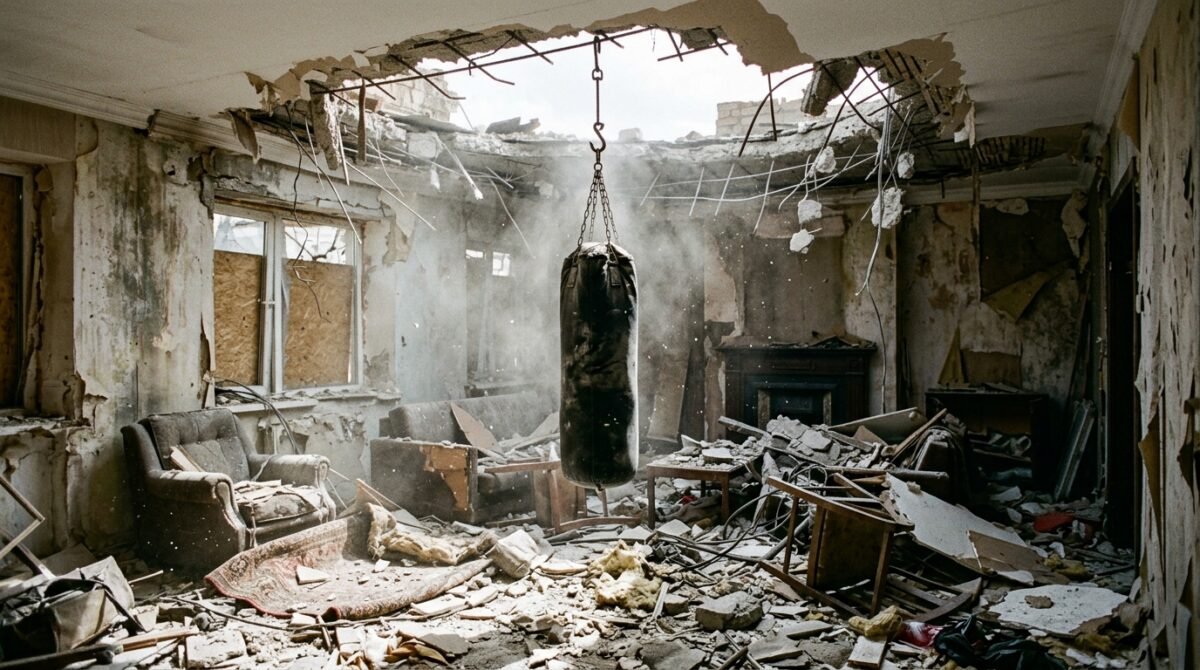
I was in the kitchen, pouring a second cup of coffee, when I heard the first ominous ‘crack.’ It wasn’t a snap, but a deep, groan-like sound coming from the living room. It sounded like the building itself was exhaling. I froze, my hand hovering over the sugar jar. Then came the second sound—a sharp, splintering wood noise that made my stomach drop.
Before I could even shout, there was a deafening roar of debris hitting the floor. It sounded like a bomb had gone off. Dust billowed through the hallway, thick and gray, choking the air. I ran to the entrance of the living room, coughing, and looked into the gloom. The sight was even worse than I had imagined.
The ceiling had not just cracked; a three-foot section of plaster and lath had completely caved in. The heavy boxing bag was hanging low, swaying slightly, anchored by a single, mangled piece of wood that was dangling precariously. Jason was sitting on the floor, covered in white plaster dust, staring up at the jagged hole with a look of absolute, slack-jawed shock.
“I don’t understand… it was supposed to be a load-bearing joist! I hit the stud, I swear I hit the stud!”
— Jason, mid-collapse
I didn’t even yell at him at first. I was too busy assessing the damage. The impact had crushed our coffee table, and the dust was settling on everything we owned. The sheer scale of the repair bill hit me instantly. This wasn’t a DIY fix; this was a professional job, and it would likely involve the landlord, which meant an eviction notice was a very real possibility.
The silence that followed was heavy and suffocating. Jason stood up, shaking off the dust, his face turning from shock to a weird, defensive mask. He wasn’t looking at the damage to the property anymore; he was looking at me, already calculating how to shift the blame. That was when I knew the conversation was going to be ugly.
The ‘Shared Asset’ Delusion
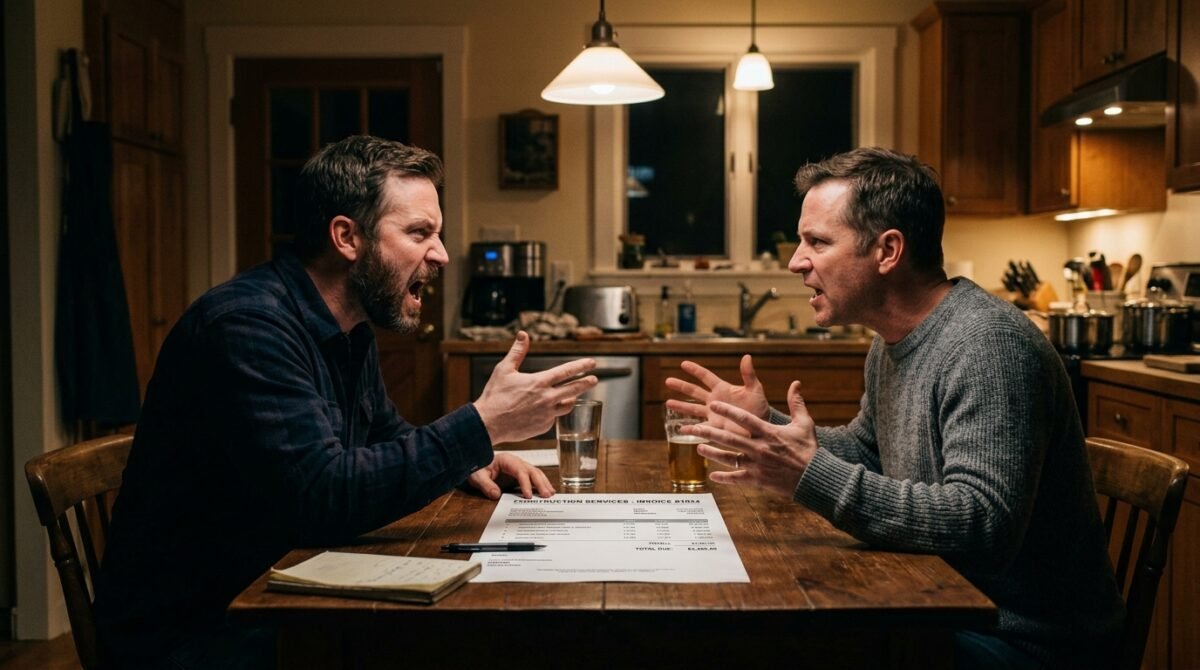
Two days later, after the landlord had come, inspected the damage, and given us a 30-day notice to vacate, the bill arrived. It was astronomical. Between the structural repair, the emergency ceiling work, and the penalty fee for unauthorized structural modifications, it totaled over $6,000. Jason sat at the kitchen table, the invoice in front of him, looking like he was about to lecture me on economics.
He pushed the paper toward me, his finger tapping the total amount. He looked calm, almost too calm, which is a trait that always indicated he was about to say something profoundly stupid. He cleared his throat, adjusting his glasses, preparing his argument for why this debt was a collective burden rather than his singular responsibility.
“Look, I know this is a lot, but we agreed to split the utility costs and the house upkeep. Since I set up the gym for ‘both’ of us to use, this repair is technically a shared maintenance cost for the household.”
— Jason, negotiating his way into a fight
I stared at him, incredulous. I hadn’t even touched the boxing bag. I hadn’t even agreed to the installation. In fact, I had explicitly told him that the noise was going to be a problem. The idea that he was categorizing this as a ‘shared maintenance cost’ was so detached from reality that I actually laughed out loud, a harsh, humorless sound that echoed off the empty kitchen walls.
He didn’t take the laughter well. His face darkened, and he started listing all the times he had ‘contributed’ to the household, as if buying a pack of napkins or cleaning the microwave once in 2022 somehow offset the fact that he had destroyed the literal roof over our heads. He was trying to gaslight me into believing that because we shared a lease, we shared the consequences of his individual recklessness.
I stood up, grabbing the invoice from the table. I told him in no uncertain terms that if he didn’t take responsibility, I would go to the landlord myself and provide the full context. He claimed I was ‘throwing him under the bus,’ as if he hadn’t driven the bus directly into the ceiling himself. The audacity was truly, impressively infinite.
Leaked Texts from the Group Chat

Things escalated when I found out he had been bad-mouthing me in our shared friend group chat. I had been added to the chat, but he clearly forgot I was still in it when he started venting to our mutual friends. The messages started popping up on my phone while I was at work, and each one made my blood boil more than the last.
“Honestly, can’t believe OP is being so petty about the ceiling. It’s an accident. We’re roommates, we’re a team. You’d think he’d want to keep our home looking good instead of trying to pin the whole $6k on me. So selfish.”
— Jason in the group chat, 2:00 PM
I didn’t respond immediately. I took screenshots. I didn’t want to get into a public argument, but I needed the evidence. A few minutes later, another text popped up, this one from a friend who was clearly trying to stay neutral, which only fueled Jason’s fire. He was painting himself as a victim of my ‘financial coldness,’ conveniently leaving out the fact that he had drilled into the ceiling against my protest.
I decided to respond, not with emotion, but with facts. I sent a message to the group, detailing exactly how the damage happened and attaching a photo of the ‘professional’ mount that had failed. I wanted everyone to see the reality of his ‘gym upgrade’ before he could rewrite history anymore. The silence in the group chat after my message was deafening.
He immediately tried to delete his messages, but the damage was done. The truth was out, and his narrative of us being a ‘team’ fell apart instantly. He texted me privately ten minutes later, accusing me of trying to ‘ruin his social life’ over a few grand. It was then that I realized he didn’t just lack responsibility; he lacked the basic capacity for empathy.
The Landlord’s Ultimatum
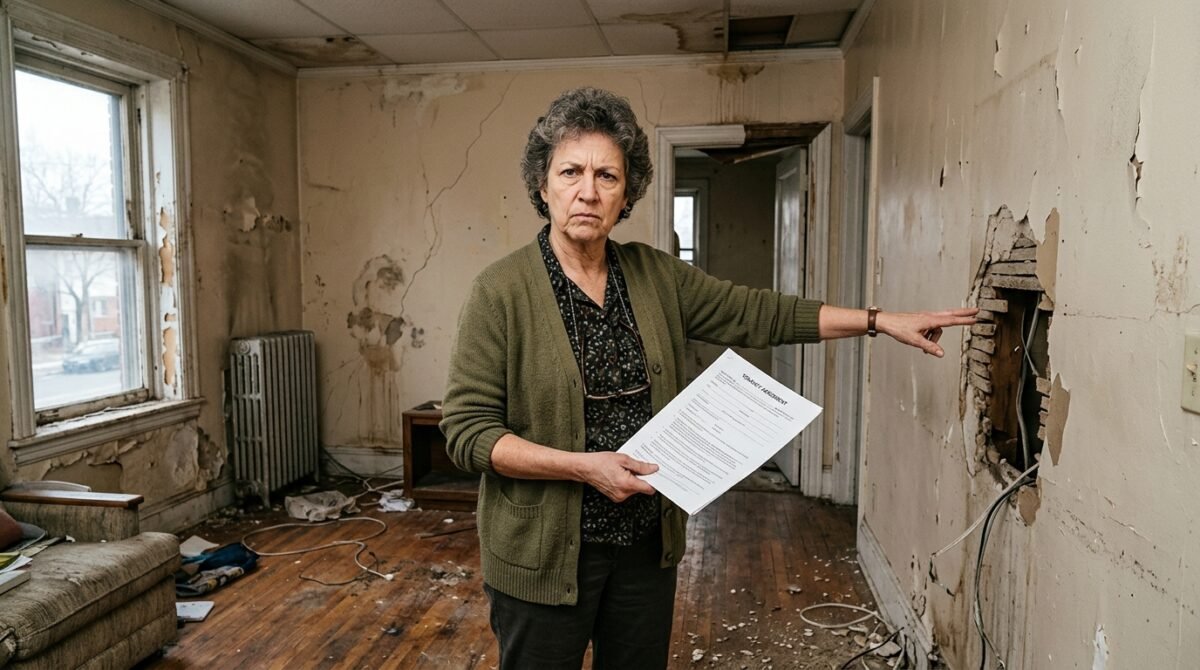
Our landlord, a no-nonsense man who had seen it all, called us both into the living room the next day. He stood in the center of the debris, hands on his hips, looking at the structural hole like he was staring at a crime scene. He didn’t care about our internal roommate politics; he cared about his property value and his legal liability.
He told us that the total cost of the repair, including the loss of rent while the unit was uninhabitable, exceeded the security deposit by a significant margin. He held up the lease agreement, pointing to the clause about unauthorized structural modifications. He made it clear that if we didn’t settle the amount, he would be taking us to small claims court—jointly and severally.
“I don’t care who drilled the hole. You are both on the lease. You both pay, or you both get sued. Sort it out amongst yourselves, but that money is due by the first of the month.”
— The Landlord, delivering the final blow
Jason tried to interject, attempting to explain his ‘gym’ plan to the landlord, but the man just walked out the door without looking back. We were left in the middle of our ruined living room, staring at the reality of our shared fate. I had to make a choice: do I pay for his mistake to avoid a lawsuit, or do I let it go to court and risk my own credit score?
I realized then that Jason had been banking on this exact scenario. He knew that as long as we were tied to the same lease, he had leverage. He thought I would pay the bill just to make him stop talking, just to make the problem go away. He was counting on my aversion to conflict to subsidize his failure.
But I wasn’t going to let that happen. I spent the rest of the day gathering my documents, my photos, and my text logs. If it was going to court, I was going to be the one who had the receipts. I was done being the ‘team player’ in a game where I was the only one losing.
Community Reaction: Is This ‘Shared’ Responsibility?

I decided to post my situation on a popular Reddit advice forum, keeping the names and locations anonymous. I wanted to see if I was losing my mind, or if this was as insane as I thought. The response was immediate and overwhelming. Within hours, the post had thousands of upvotes and a comment section filled with people who were just as shocked as I was.
“NTA. Your roommate sounds like a classic narcissist. If he makes a mess, he pays for it. A lease doesn’t mean you’re his parent or his insurance policy. Do not pay a single cent of his damage.”
— u/RoommateTruthTeller (Top Comment, 15.2k upvotes)
The consensus was clear. Hundreds of people shared stories of their own nightmare roommates, confirming that structural damage caused by individual stupidity is never a ‘shared’ cost. I read through threads about security deposit theft and roommate breakups, feeling a strange sense of comfort in knowing I wasn’t alone in this absurdity.
Some people offered legal advice, suggesting I file a police report or a counter-suit against my roommate for the damages to my personal property—the coffee table he smashed when the roof came down. It gave me the confidence I needed to push back harder. The internet, for all its chaos, was providing me with the backbone I had been missing.
However, there were a few ‘Devil’s Advocates’ in the mix, arguing that because I ‘allowed’ him to work on the ceiling, I shared 10% of the fault. I took those comments with a grain of salt. It was a good reminder that while I wasn’t liable for his stupidity, I had learned a valuable lesson about setting firm boundaries, even if it meant being ‘that guy’ who stops the fun.
The Final Confrontation

I invited Jason to sit down one last time, this time with a printed breakdown of the damages. I had calculated the cost of the repair vs. the cost of the furniture he destroyed, and I had a clear proposal: he pays the full repair, and I waive my claim to the furniture he ruined. If he didn’t agree, I would take him to small claims court, where I had every text message and piece of evidence ready to present.
He tried to interrupt, but I held up my hand. I told him that I wasn’t interested in his excuses anymore. I wasn’t interested in his ‘fitness journey.’ I was interested in leaving this apartment with my finances intact and my record clean. I placed the papers on the table, a stark contrast to his disorganized piles of protein powder and gym gear.
“You have two choices, Jason. You write a check for the full amount, or I take you to court. I have all our texts. I have the photos. You aren’t going to drag me down with your poor decisions.”
— Me, ending the negotiation
He looked at me for a long time, trying to find a way to manipulate the situation, but the air in the room had changed. He saw that I was done. He saw that the ‘team’ dynamic was dead, and he was staring at a very real, very expensive consequence. He didn’t say a word, but he picked up the papers.
That night, he finally agreed to pay the landlord directly. He didn’t apologize, and he didn’t thank me for not suing him for the furniture. He just did what he had to do to avoid the courtroom. It was the most unsatisfying victory of my life, but it was a victory nonetheless.
Moving Out and Moving On

The last week in the apartment was the longest of my life. We existed like two ghosts passing through the hall, neither of us speaking. The massive, jagged hole in the ceiling was a constant reminder of how quickly a living situation can turn toxic. I spent my time packing my things, making sure that not a single piece of my property was left behind.
As I loaded my final boxes into my car, I took one last look at the empty unit. It was stripped of its personality, just a shell of a home that had been compromised by someone who thought they were an architect. I felt a wave of relief so strong it was almost physical. I was out.
I realized that the greatest cost wasn’t the money; it was the trust. I had trusted someone to be a responsible partner, and they had proven that they viewed the world—and me—as a resource to be exploited. I learned to look for signs of entitlement much earlier in the future, and to never, ever be afraid to say ‘no’ to something that feels fundamentally wrong.
My next place is quiet, small, and utterly devoid of any gym equipment. I have a new roommate, someone who understands that if you want to drill a hole, you ask the landlord, you get written permission, and you definitely don’t attach 150 pounds of steel to the plaster. Sometimes, the most important lesson you learn is what kind of person you never want to live with again.
The Aftermath: Legal and Personal

Looking back, the legal fallout was actually quite simple once the facts were laid out. The landlord, seeing that Jason was the one who performed the unauthorized work, eventually shifted the primary liability to him, though he still kept our shared security deposit. It was a steep price to pay, but it was worth every penny to be free of the situation.
Jason tried to reach out a few months later, sending a text about how ‘tough’ things were for him financially. I didn’t reply. I had moved on. I had started a new job, settled into a new neighborhood, and I wasn’t about to get sucked back into the gravitational pull of his drama. The silence was the best boundary I could have ever set.
I kept a file of the entire ordeal—the texts, the photos, the bills. It sits in a drawer in my desk, a reminder of the time I almost let someone else’s irresponsibility define my financial future. It’s a dark, weird chapter, but it’s closed. I am finally in a place where I don’t have to worry about the ceiling falling in, literally or metaphorically.
For anyone else currently in a roommate disaster, remember this: documentation is your best friend. Don’t rely on ‘good faith’ when there is thousands of dollars on the line. Protect yourself first. Because at the end of the day, when the roof caves in, you’re the one who has to be able to stand on your own two feet.
Reflecting on the ‘Roommate Code’

People often talk about the ‘roommate code’—the unspoken rules about cleanliness, guests, and shared expenses. But we rarely talk about the boundaries of liability. We assume that if we are friends, we are also shielded from each other’s worst impulses. My experience proved that assumption to be dangerously naive. There is no code that justifies destroying someone else’s peace of mind.
I’ve spent time reflecting on why I allowed it to continue for as long as I did. I think it was the desire for harmony. I wanted to be the easygoing roommate, the one who didn’t complain. But ‘easygoing’ quickly became ‘a doormat.’ I realized that true friendship—and even true roommate-ship—requires the ability to have the hard conversations before they become disasters.
If you find yourself in a situation where you are constantly covering for someone else, or where your ‘no’ is being treated as a suggestion rather than a boundary, get out. The cost of leaving is always lower than the cost of staying in a situation that is actively damaging your life. Life is too short to live under a crumbling roof, both figuratively and physically.
I’m finally at peace with the experience. It taught me exactly who I am and exactly who I am not. I am the kind of person who stands up for themselves, and I am certainly not the kind of person who pays for someone else’s boxing bag. That, in itself, is worth the price of the chaos.
Conclusion
The story of the boxing bag and the collapsed roof is more than just a funny-bad roommate anecdote; it’s a cautionary tale about the intersection of financial responsibility and personal boundaries. We often avoid conflict to keep the peace, but when that peace comes at the cost of our own security, it’s time to re-evaluate the arrangement. Jason might still be out there somewhere, looking for another wall to drill into, but I am here, safe and sound, having learned the most expensive lesson of my life.
Do you have a roommate horror story that makes this one look like a walk in the park? Have you ever had to deal with an ‘entitled’ roommate who thought their bad choices were your financial responsibility? Let’s get a discussion going in the comments below. Does the ‘shared lease’ mean you are always on the hook, or is there a line where personal accountability should take over? I want to hear your takes, your horror stories, and your advice for anyone currently living in a ticking time bomb of a household.
What's your verdict on this dilemma?
Vote below to contribute to the official community consensus.

Have a Dilemma Keeping You Up at Night?
Share your real-life feud, wedding chaos, or relationship crossroads anonymously with our editorial team.
What do you think ?
0 Comments🛡️ Comments are moderated to protect community integrity. Your comment will appear once approved by the editorial team.