
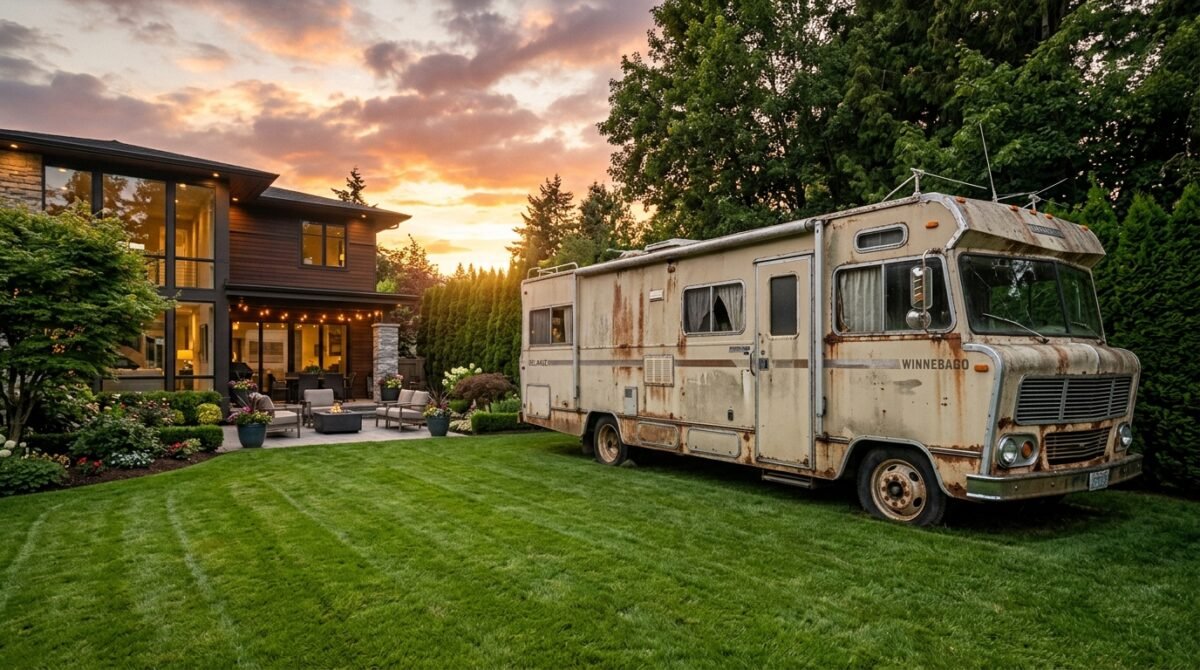
We had spent three years turning our small suburban property into a sanctuary. My husband, Mark, and I poured our savings into the landscaping, the cedar deck, and the vegetable garden that provided us with a quiet escape from our demanding city jobs. It was our ‘forever home’ project, a place meant to host summer barbecues and peaceful morning coffees, not heavy machinery.
Then came the retirement announcement from my father-in-law, Arthur. He had spent his career as a high-stakes real estate developer, and he carried that same aggressive, transactional energy into his family relationships. When he sold his house, he didn’t buy a condo; he bought a colossal, thirty-five-foot diesel pusher motorhome. He told us, quite casually over a Sunday roast, that he would be ‘basing’ himself in our backyard for the foreseeable future.
The moral dilemma felt immediate and suffocating. Arthur wasn’t just asking for a parking space; he was demanding that we sacrifice the aesthetic and functionality of our entire property. When we gently pushed back, citing local zoning laws and our own need for privacy, the tone shifted from a request to a cold, calculated ultimatum. The threat was clear: comply, or be severed from the family legacy—and the inheritance—that Arthur held over our heads like a guillotine.
What followed was an agonizing descent into family dysfunction, involving late-night shouting matches, secret legal maneuvers, and a complete breakdown of trust. This wasn’t just about a motorhome; it was about the fundamental right to own our lives, our property, and our choices without the shadow of a patriarch looming over our garden fence. This is the story of how a single parking request dismantled a family structure.
The Sunday Roast That Turned Into A Real Estate Negotiation

The atmosphere at our dinner table was initially cheerful, punctuated by the clinking of wine glasses and the smell of rosemary-crusted lamb. Arthur had been talking about ‘freedom’ and ‘the open road’ for weeks, but we assumed he meant a tour of the national parks. We were woefully unprepared for the moment he laid his plans out on the dining room table as if he were presenting a commercial development proposal.
He gestured with a steak knife toward our kitchen window, which looked out onto our prize-winning garden. ‘It’s perfectly situated,’ Arthur said, his voice brimming with professional confidence. ‘I’ve already measured the curb cut. You’ll just need to tear out those raised vegetable beds and reinforce the soil with gravel. It’ll be a hub for me while I travel the coast. You two are lucky to have the extra space.’
Mark and I exchanged a glance of pure bewilderment. The vegetable beds were not just a hobby; they were the central feature of our yard, representing months of back-breaking labor. To suggest we tear them out for a thirty-five-foot eyesore was beyond invasive; it was an act of complete erasure of our lifestyle and preferences.
“Dad, with all due respect, our garden is not a parking lot. We’ve put thousands of dollars into those beds. We aren’t tearing them out for a motorhome.”
— Mark, during the initial confrontation
The room went ice-cold. Arthur didn’t argue; he simply set his knife down, wiped his mouth with a linen napkin, and stared at us with a look of profound disappointment. It was the same look he gave his junior associates when they missed a project deadline. He wasn’t asking for our input; he was notifying us of his impending arrival.
As he stood up, he made it clear that he viewed his presence in our garden as a favor to us. He suggested that having him ‘nearby’ would increase our property value and provide us with a level of security that we somehow lacked. He didn’t seem to care that we valued our privacy more than his perceived security. The evening ended with Arthur leaving early, leaving us with a sinking feeling in our stomachs.
The First Wave Of Passive-Aggressive Text Messages
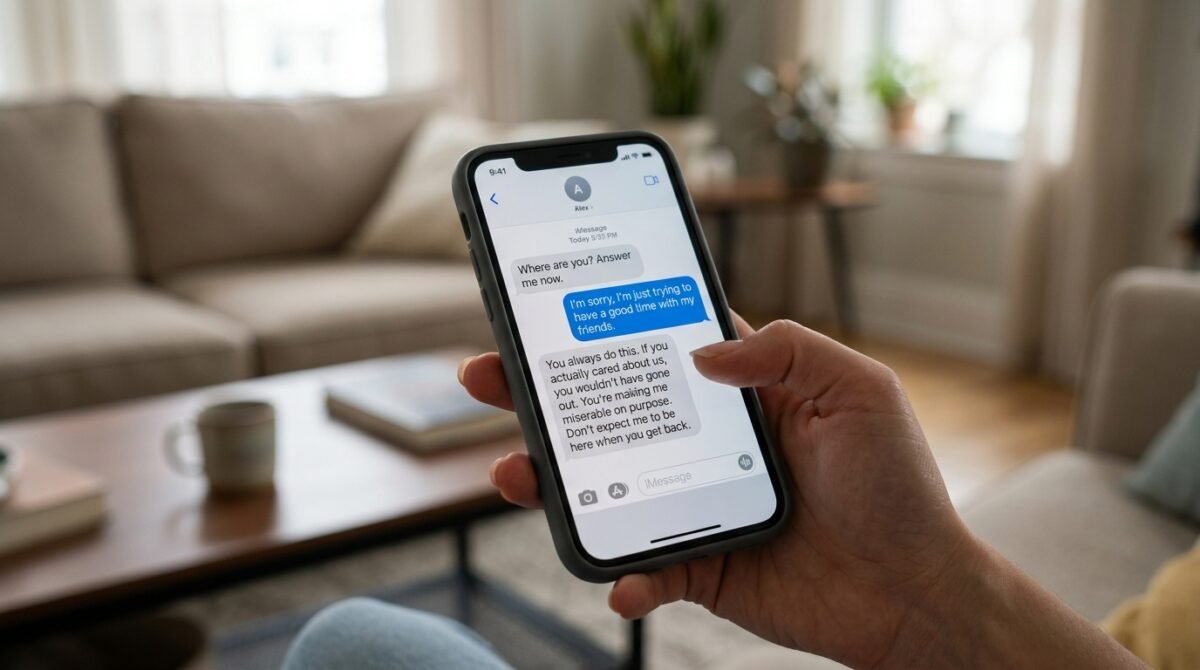
The morning after the dinner, my phone buzzed before I even had a chance to brew my coffee. It was a message from Arthur, sent to the family group chat, which included his sister and my sister-in-law. It was a masterclass in manipulation, framing his demand as a heartwarming desire to spend his retirement with his ‘only son.’
“Looking forward to getting the gravel order in for the garden project. Mark, let me know if you’ve cleared the beds yet. Excited to be close to you both! #FamilyFirst”
— Arthur, via Family Group Chat
I felt a hot surge of anger. He was intentionally ignoring our ‘no’ to create social pressure. By broadcasting his ‘plan’ to the rest of the family, he was trying to make us look ungrateful and cold-hearted. If we said no now, we would be the villains who were keeping a lonely retiree away from his family.
Mark was hesitant to respond, terrified of his father’s temper. He suggested we just ignore the text, hoping that Arthur would get the hint. But I knew Arthur. Silence, to him, was not an acceptance of refusal; it was an invitation to push harder. I drafted a message, trying to keep it polite but firm, knowing that the rest of the family was watching.
The replies started trickling in within minutes. My sister-in-law, always the mediator, tried to play both sides, suggesting that we might be able to ‘find a compromise.’ It was clear that Arthur had already poisoned the well, making it seem like we were being unreasonable about a simple request for help.
The pressure mounted as the day progressed. By noon, I had received three separate messages from various family members asking why I was being so difficult about the garden. The narrative had shifted from ‘Arthur’s audacity’ to ‘my stubbornness.’ I realized then that we were in a battle for our own home, and the entire family was being used as a weapon against us.
The Midnight Visit And The Property Line Dispute
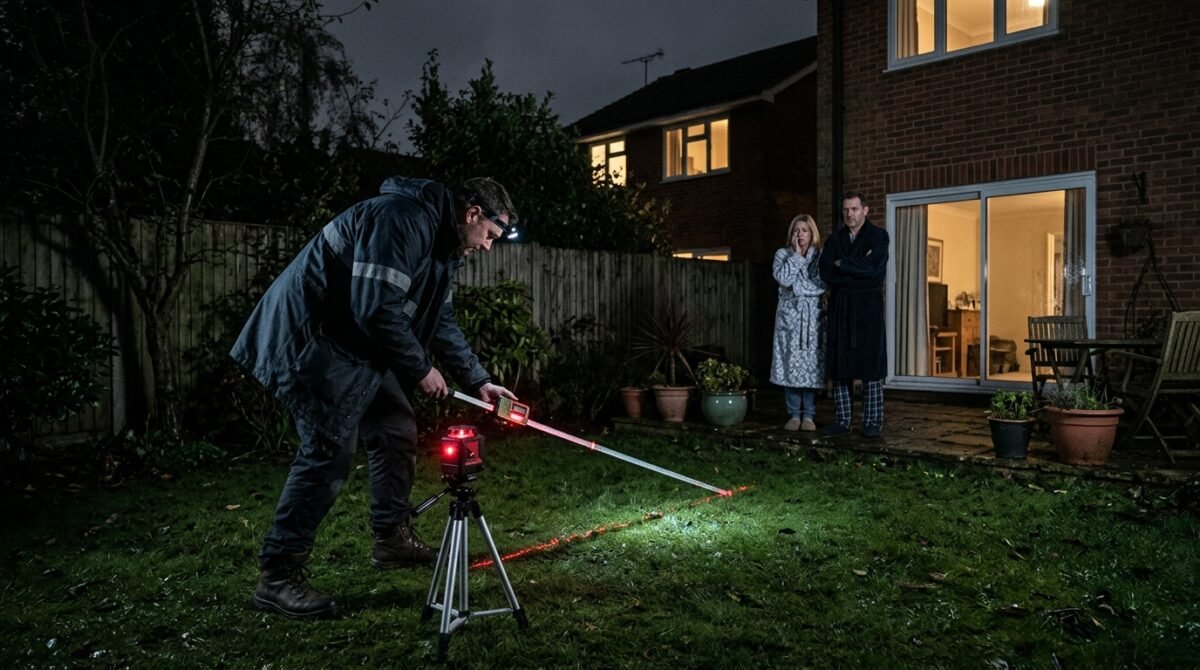
The true escalation happened on a Tuesday night. I was woken up at 11:30 PM by the low, rumbling sound of a heavy engine idling in our driveway. I scrambled out of bed, peeked through the blinds, and felt my heart drop into my stomach. A massive utility truck was parked right at our gate, and Arthur was standing there with a surveyor’s laser level, pacing out our backyard.
I threw on a robe and marched outside, my husband trailing behind me, looking miserable and terrified. Arthur didn’t even look up as I approached; he was too busy marking points on our lawn with bright orange spray paint. The sight of that neon paint on our carefully manicured grass felt like a personal violation.
“Arthur, what on earth are you doing? It’s almost midnight. You cannot just come onto our property and start marking it up like you own it.”
— OP, confronting her father-in-law in the backyard
Arthur turned slowly, his face illuminated by the harsh glare of the truck’s headlights. He looked entirely unbothered, as if this were a perfectly normal Tuesday night activity. He told us he was just ‘doing his due diligence’ to ensure the motorhome would be level. He acted as though he were doing us a favor by starting the work while we slept.
Mark finally found his voice, but it was weak. He told his father to leave, but Arthur just laughed. He pointed to a stack of papers he had brought with him—some sort of convoluted legal document he claimed gave him ‘familial access’ to our property. It was nonsense, of course, but it showed how far he was willing to go to force his way in.
The confrontation ended with us calling the non-emergency police line. Seeing the police cruiser pull up to our house was one of the most humiliating moments of my life. The officers were polite but firm, explaining to Arthur that without a lease agreement or our express permission, he was trespassing. He left, but not before promising that this wasn’t over.
The Financial Ultimatum And The Will
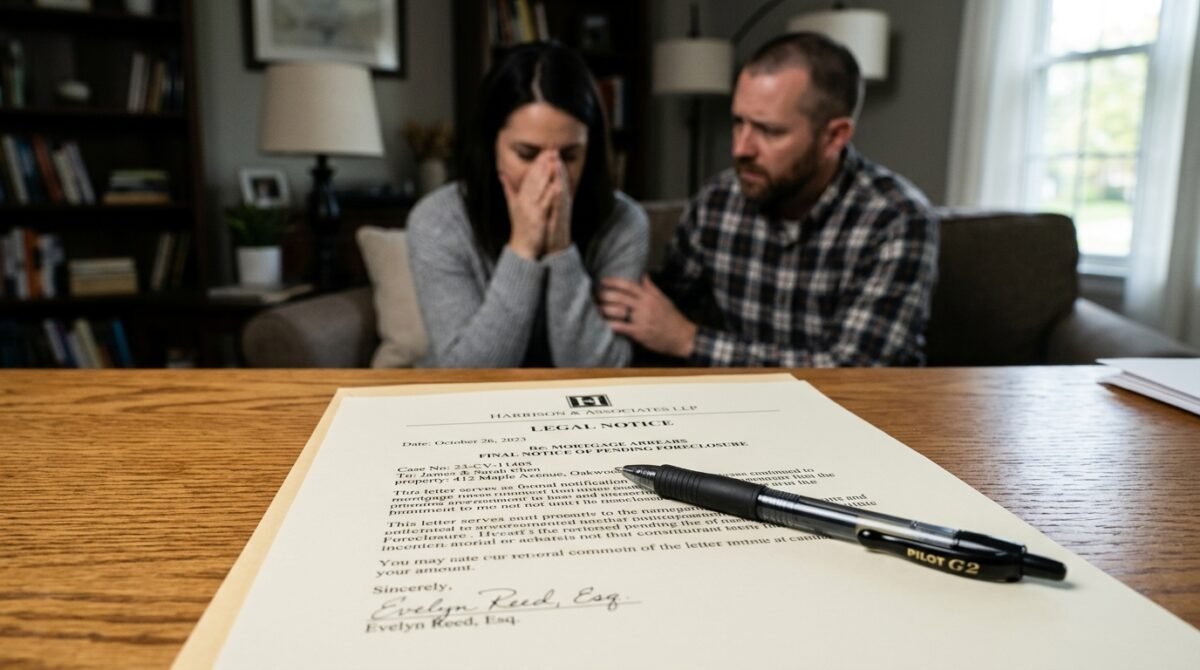
Two days after the police visit, we received a certified letter in the mail. It wasn’t from a lawyer, but it was written in a tone that suggested legal weight. It was from Arthur, and it detailed exactly what would happen if we didn’t comply with his ‘garden plan.’ He was explicitly tying his financial support—and our future inheritance—to our submission.
He reminded us of the $50,000 he had contributed to our down payment three years ago. He claimed that this money was a ‘loan’ and that if we didn’t grant him usage of the garden, he would be forced to ‘reclaim’ the principal immediately. It was a blatant lie; the money had been a gift, documented as such for the bank, but he didn’t care about the truth. He cared about leverage.
Mark was crushed. He had always been told that his father’s money would eventually provide for us, but he never realized it came with such a heavy price tag. The threat of having to come up with $50,000 on short notice, especially after we had spent so much on home renovations, was terrifying. We felt backed into a corner, forced to choose between our autonomy and our financial security.
“If you can’t show me the respect of a simple parking space, then you clearly don’t value the foundation I built for your family. I will expect the funds returned by the end of the month.”
— Excerpt from Arthur’s certified letter
We spent the entire weekend looking over our finances. We realized that while it would be painful, we could sell some stocks and scrape together the money. The question was, did we want to? By paying him back, we would be cutting the strings, but we would also be declaring a permanent, hostile war. We decided that our peace of mind was worth more than his money.
We spent hours crafting a response. We decided to be cold, clinical, and final. We would not argue about the garden anymore. We would simply inform him that the funds were being prepared and that our property was officially off-limits for his motorhome. It was the hardest thing we ever had to do, but it felt like the only way to save our sanity.
The Community Weighs In: Reddit’s Verdict

I finally broke down and posted our situation to the AITA subreddit. I needed to know if I was crazy. Was I being too sensitive? Was a motorhome really that big of a deal in the grand scheme of family relationships? The response was overwhelming, and it gave me the validation I desperately needed to hold my ground.
“NTA. Your father-in-law is a narcissist who thinks his money buys him ownership of your life. He is trying to force you into a living situation where he has total control. Give the money back, cut him off, and change your locks. This man will never stop demanding more.”
— u/FamilyDramaExpert (Top Comment, 42.1k upvotes)
The comments were almost entirely on our side. People shared their own stories of overbearing parents and the importance of establishing firm boundaries early. Many pointed out that if we gave in now, he would be living in our garden for the rest of his life, and likely making demands about our house interior, our daily schedules, and eventually, our children if we had them.
There were some dissenting voices, of course. A few people argued that we should just ‘be the bigger person’ and let him park there to avoid the drama. They called us ungrateful and reminded us of how much he had done for us in the past. But those comments were quickly buried by the sheer volume of support for our decision to stand up for ourselves.
Reading through the threads, I realized that this wasn’t just about the garden; it was about the cycle of emotional abuse that Arthur had been using to control his family for decades. The internet showed me that I wasn’t just a daughter-in-law being difficult; I was a person standing up to a bully. The support gave me the courage to stick to our plan.
The community also provided practical advice. They suggested we consult with a lawyer to ensure that the repayment of the money was documented as a total severance of his ‘investment.’ They warned us that Arthur might try to use the money as a way to keep us under his thumb, even if we tried to pay him back. It was exactly the kind of clear-headed perspective we needed.
The Public Confrontation at the Family Barbecue
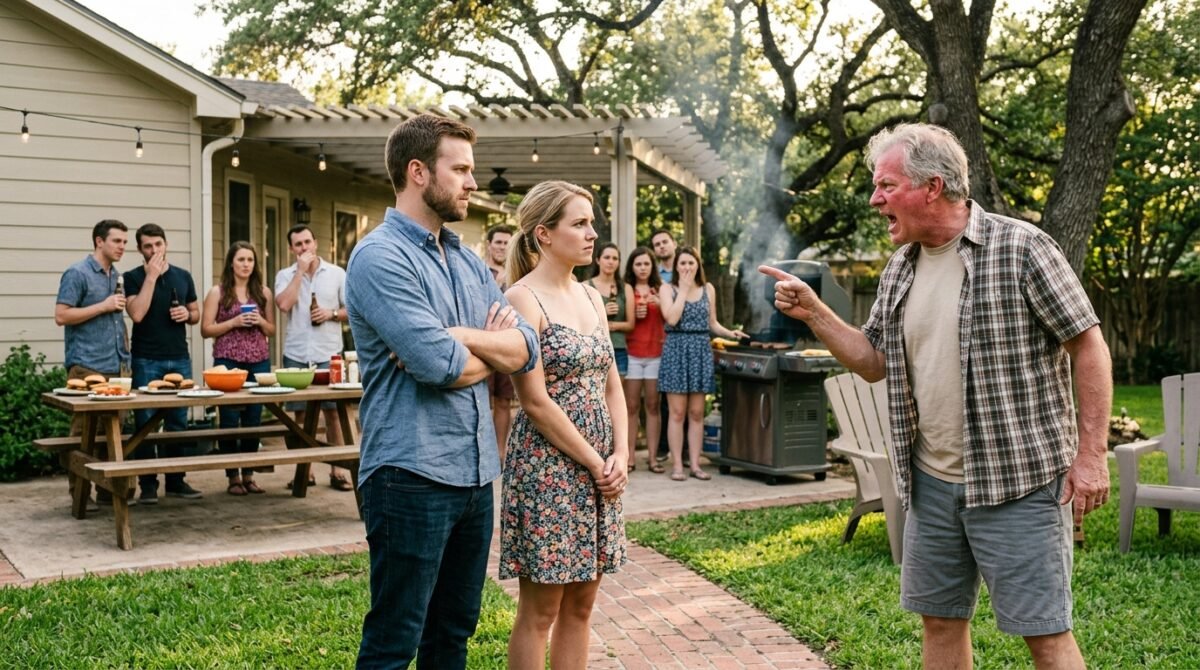
Three weeks later, we were forced to attend a family barbecue at Arthur’s sister’s house. We knew he would be there, and we knew he wouldn’t let the issue go quietly. The tension in the air was thick enough to cut with a knife. As soon as we arrived, I saw Arthur holding court, telling everyone about how ‘unreasonable’ his son had become.
We tried to stay in the background, but Arthur made a beeline for us. He didn’t say hello. He walked right up to Mark and started in on the motorhome again, louder than necessary so that the rest of the family could hear. He accused us of being ‘spiteful’ and ‘cruel’ for denying an old man his retirement dream.
“Everyone, look at them! They have a perfectly good yard, enough to fit two houses, and they refuse to let me park my rig because they’re worried about their precious petunias. It’s embarrassing.”
— Arthur, shouting at the family gathering
The room went silent. I felt my face flush with anger, but I held my composure. I stepped forward and looked him straight in the eye. I didn’t yell. I spoke quietly, firmly, and clearly, making sure everyone heard every word. I laid out exactly how he had harassed us, the midnight visit, the threats, and the financial blackmail.
The atmosphere shifted instantly. The other family members, who had only heard Arthur’s side, were visibly uncomfortable. Some of them looked at the floor; others looked at Arthur with expressions of shock. It was the first time anyone had ever openly challenged him in such a public setting, and he didn’t know how to handle it.
Arthur tried to stutter a response, to regain his footing, but he was losing his audience. He looked around for support, but nobody was offering it. The power dynamic that had governed our family for years had just been shattered in a matter of minutes. We didn’t stay for the rest of the meal. We left, head held high, knowing that the truth was finally out in the open.
The Legal Buffer and the Final Severance
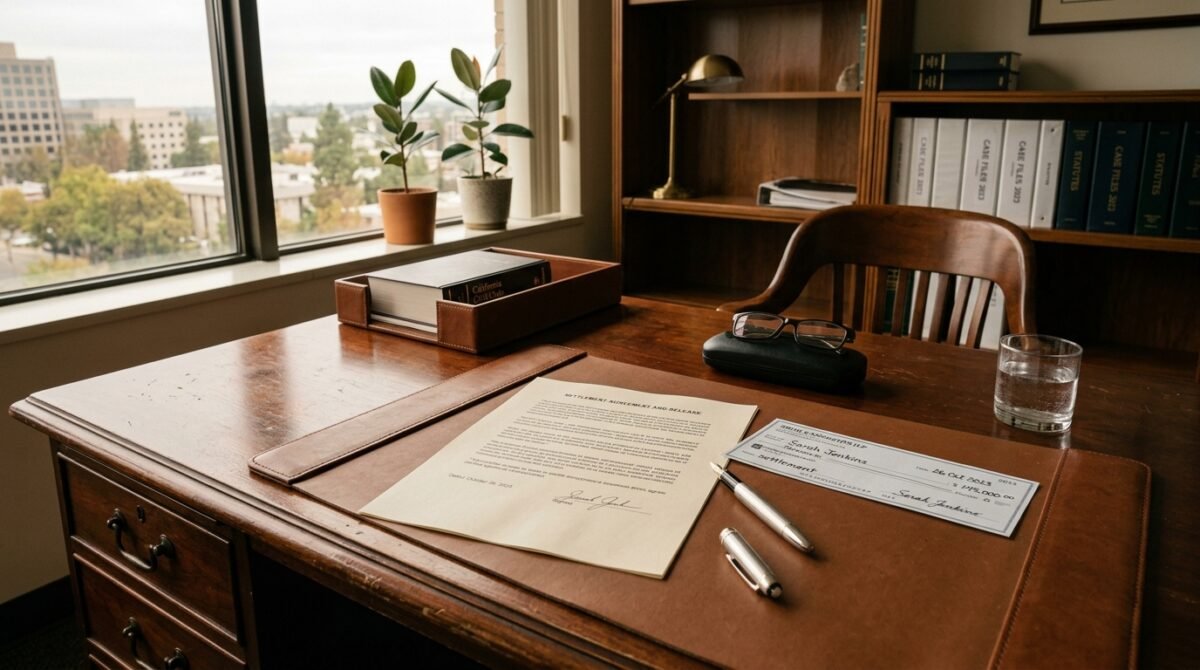
After the barbecue, we took the final step. We hired a real estate attorney to draft a formal letter to Arthur. It contained the $50,000 cashier’s check and a document stating that the payment was a complete and final settlement, acknowledging that no further financial or personal obligations existed between the parties. It was a formal, legal way of saying, ‘We are done with you.’
We delivered the letter by courier. We didn’t want to see him or talk to him again. The weeks that followed were filled with a strange, quiet anxiety. We kept waiting for the other shoe to drop, for another midnight visit, or for a smear campaign to start. But to our surprise, Arthur went silent. He didn’t cash the check for a week, and he didn’t reach out to us at all.
It was a period of intense reflection for Mark. He struggled with the guilt of cutting off his father, even though he knew it was the right thing to do. We spent our evenings talking about his childhood, about how his father had always used money as a way to maintain control and keep everyone in their place. It was a painful process, but it was necessary for us to move forward.
“I thought I was losing my dad, but then I realized I never really had a dad. I had a landlord who expected me to pay rent with my obedience.”
— Mark, reflecting on the situation
We eventually saw that the check had been cashed. There was no note, no apology, and no acknowledgment. He had taken the money and retreated into his own world. It wasn’t the resolution we had hoped for—we would have liked an apology—but it was the closure we needed to finally feel safe in our own home.
The silence from Arthur was not a sign of defeat, but it was a victory for us. We were no longer beholden to him. We could breathe in our own house again. The garden, which had been the source of so much stress, suddenly looked different. It wasn’t a battleground anymore; it was ours again, and we could finally enjoy it in peace.
The Aftermath: Reclaiming Our Space

Life returned to a semblance of normalcy. We stopped checking our phones every time they buzzed, and we stopped looking out the windows every time we heard a heavy engine. We spent the spring rebuilding the garden beds that Arthur had threatened to destroy. It was a cathartic experience, planting seeds in the very spots he had marked with his neon orange paint.
Our friends and family, the ones who really mattered, rallied around us. They saw how much happier we were without the constant shadow of Arthur’s expectations. We hosted our first big barbecue of the season, and for the first time, we didn’t feel like we were being judged or monitored. It was just us, our friends, and our home.
We also made some changes to our security. We installed a gate at the end of our driveway and a camera system that notified us of any movement. It felt like a small, practical way to protect the peace we had fought so hard to win. We weren’t just protecting our property; we were protecting our right to be ourselves.
“Sometimes you have to burn the bridge to get away from the fire. And honestly? The view from this side is much better.”
— A sentiment we shared during our first peaceful summer dinner
We still hear things about Arthur from time to time. He is still driving his motorhome around, and he still complains to whoever will listen about his ‘disrespectful’ son. But it doesn’t hurt anymore. We’ve learned that his opinion of us is not our business, and it certainly shouldn’t dictate how we live our lives.
The most important thing we learned was that love and respect are not transactional. You don’t have to earn your place in someone’s life by submitting to their demands. We are happier now than we have ever been, and we have a deeper, stronger bond with each other because we went through the fire together and came out the other side.
Lessons in Boundaries and Self-Worth

Looking back, the whole experience feels like a surreal nightmare, but it was also the most transformative period of our adult lives. We learned that ‘no’ is a complete sentence. We learned that we don’t owe our happiness to anyone, not even family. The struggle taught us the value of our own voice and the importance of holding onto it, no matter how loud the opposition.
We also learned that family is what you make it, not just the people you share blood with. We have created a chosen family of friends who support us and celebrate our boundaries rather than trying to cross them. It’s a different kind of support, one that is rooted in mutual respect rather than control.
If you find yourself in a similar situation, my advice is to trust your gut. If something feels wrong—if a request or a demand makes you feel small or controlled—it probably is wrong. Don’t feel guilty for protecting your peace. The right people will understand, and the wrong people will reveal their true colors, which is a gift in itself.
“Your home is your sanctuary. If someone threatens your peace to gain control, they have already lost the right to be a part of your life.”
— Reflection on the ordeal
We are still healing, in a way. The trauma of the experience left a mark, but it also made us more resilient. We don’t take our privacy for granted anymore, and we definitely don’t let anyone dictate the terms of our life. We are the architects of our own world now, and that is a power that can’t be bought.
We have also learned to communicate more openly with each other. The stress of the situation could have torn us apart, but instead, it brought us closer. We learned to be a team, to support each other’s decisions, and to stand as a united front against anyone who tries to come between us.
The Ongoing Journey of Healing

Even now, months later, there are moments when the anger flares up, or the sadness hits. It’s not a straight line to recovery. We still have to deal with the occasional invasive question from extended family, or the uncomfortable realization that Arthur is out there, still acting like the victim. But we’ve learned to manage those feelings.
We’ve found that the best thing we can do is focus on the present. We are grateful for every day that we don’t have to worry about our backyard, every day that our home remains our own. We have started a new tradition of ‘no-phone’ weekends where we focus entirely on each other and our projects, cementing our commitment to each other.
We have also started therapy. It has been incredibly helpful to talk through the emotional baggage that Arthur left behind. It’s helped us understand why we felt so much guilt initially and how to let go of the need for his approval. It’s a journey, but it’s one we are taking together, and we are stronger for it.
“Healing is not about forgetting what happened. It’s about remembering it without the pain dictating your present choices.”
— Our therapist’s advice
We hope that by sharing our story, we can help others who are going through the same thing. You are not alone, and you are not wrong for wanting your own space. Your life belongs to you, and you have every right to set the boundaries that keep you happy and healthy.
The motorhome is long gone from our thoughts, even if it’s still somewhere out there on the road. We are focused on our own road now, the one we are building together, mile by mile, with every boundary we set and every choice we make. And honestly? We wouldn’t have it any other way.
Conclusion
The story of the motorhome in our garden was never really about the vehicle. It was a litmus test for the integrity of our marriage and the sovereignty of our home. By choosing to prioritize our peace over Arthur’s demands, we did more than just clear a parking space; we reclaimed our identity from a system of control that had lasted far too long.
It is easy to get caught up in the ‘but he’s family’ guilt trip. However, blood ties are not a contract that allows for the exploitation of your personal space or mental health. If you are currently dealing with a boundary-crossing relative, remember that your primary obligation is to yourself and your partner. Stand firm, seek support, and do not apologize for wanting a life that is truly yours.
We invite you to share your own experiences in the comments below. Have you ever had to cut a family member off to protect your home life? What was the moment you knew you had to draw the line? Let’s keep the conversation going and continue to support one another in the difficult task of setting healthy boundaries.
What's your verdict on this dilemma?
Vote below to contribute to the official community consensus.

Have a Dilemma Keeping You Up at Night?
Share your real-life feud, wedding chaos, or relationship crossroads anonymously with our editorial team.
What do you think ?
0 Comments🛡️ Comments are moderated to protect community integrity. Your comment will appear once approved by the editorial team.