
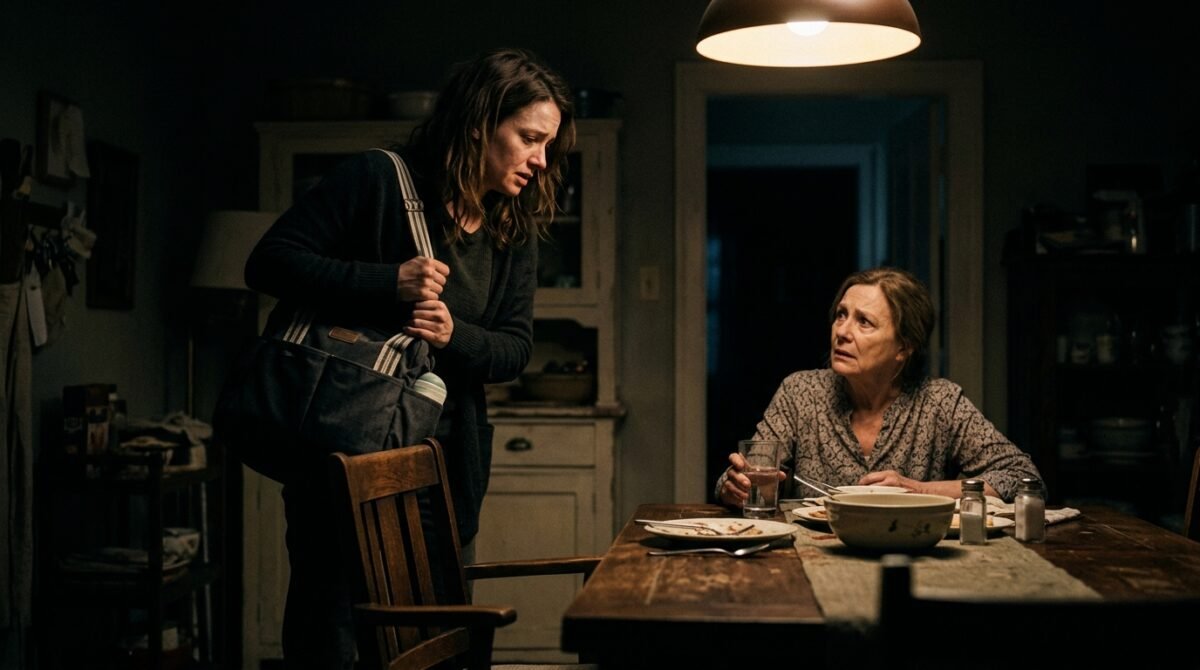
When you have a newborn, you expect unsolicited advice about sleep schedules, feeding techniques, and the best brand of pacifier. You do not, however, expect to walk into a weekly family dinner only to find that your mother-in-law has turned the salad course into an impromptu religious sacrament. My daughter, Clara, was barely four months old when my mother-in-law, Barbara, decided that her own spiritual anxieties outweighed my legal and moral rights as a parent.
We had been clear from the start: we were secular parents who intended to let Clara choose her own path when she was older. Barbara, a woman who treated church attendance as a competitive sport, had always bristled at this, but we assumed it was just one of those generational disagreements. We were wrong. This wasn’t just a disagreement; it was a premeditated boundary stomp that would ultimately force me to redefine what family meant to me.
The Sunday dinner was supposed to be routine. We had the roast, the polite small talk about the weather, and the usual inquiries about when we were planning to ‘introduce some structure’ into our lives. I didn’t realize that by ‘structure,’ Barbara meant holy water and a surreptitious ritual. The betrayal didn’t just hurt because of the religious implications; it hurt because of the sheer audacity required to attempt such a thing while I was literally sitting three feet away.
In the aftermath, the gaslighting was instantaneous. I was told I was ‘overreacting,’ ‘dramatic,’ and ‘trying to keep a grandmother from her blessing.’ But as I stood in that dining room, the diaper bag strapped over my shoulder, I knew that if I stayed, I would be signaling that my daughter was not mine to protect. I would be teaching her that her body and her life were subject to the whims of those who claimed to love her most.
This is the story of how I walked out of that house, why I severed ties, and the chaotic, enlightening, and deeply painful journey of defending my daughter’s autonomy against a woman who believed her faith gave her the right to ignore my boundaries.
The Subtle Shifts in Sunday Protocol

In the months leading up to the incident, the atmosphere at Barbara’s house had grown increasingly heavy. Every week, she would find a new way to weave religion into our casual conversations. It started with ‘accidental’ mentions of local church youth groups and escalated to buying Clara bibs embroidered with religious imagery, which I politely returned or donated. I thought it was just her way of coping with her own faith, but looking back, there was a calculated intensity to her gaze.
Barbara often commented on how ‘unprotected’ Clara seemed in our household. She would hold her tight, whispering prayers that I was never meant to hear, her fingers tracing the air above the baby’s forehead. I dismissed it as her ‘eccentricity.’ My husband, Mark, was less convinced, often getting into whispered arguments with her in the kitchen while I entertained the guests in the living room. He kept telling me, ‘She just wants to feel involved, honey. It’s harmless.’
One particular Sunday, three weeks before the incident, I walked into the kitchen to find Barbara holding a small, ornate silver bowl. She quickly hid it behind her back, her face flushing a deep, mottled red. I asked her what she was hiding, and she laughed, a brittle, high-pitched sound that set my teeth on edge. She told me it was just some herbal tea she was brewing, but the smell of nothing—no tea, no herbs—lingered in the air.
I should have spoken up then. I should have drawn a line in the sand, but I wanted to be the ‘nice’ daughter-in-law. I wanted to believe the best in the woman who raised the man I loved. That desire for harmony, however, was exactly what she was counting on. She viewed my politeness as weakness, a gap in the armor that she could eventually exploit for her own spiritual satisfaction.
“You know, it is a tragedy, really. A soul left to wander without the mark of faith. It’s like sending a soldier into battle without a helmet. I just can’t sleep at night knowing she’s so vulnerable.”
— Barbara (to Mark, during a heated private conversation)
The tension was mounting, yet we stayed. We kept showing up to those dinners, thinking that our presence was enough to mitigate her influence. We were essentially bringing the lamb to the wolf, hoping that our watchful eyes would be enough to keep the beast at bay, forgetting that the wolf doesn’t always show its teeth until it’s already sinking them into the prey.
The Sunday Dinner Sabotage
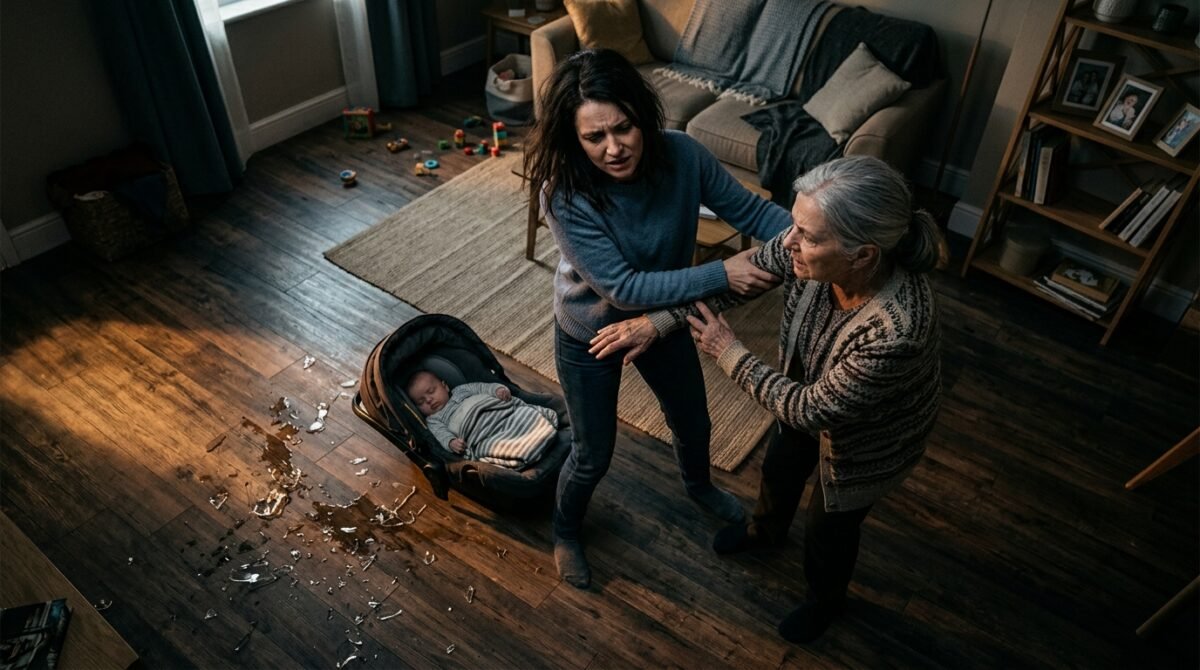
The day of the incident began like any other, but there was an unnatural stillness in the air. The roast beef was perfectly cooked, the wine was poured, and the conversation was unnervingly civil. Barbara was uncharacteristically quiet, constantly glancing at the clock on the wall. She kept fussing over Clara, who was asleep in her carrier, insisting that she stay in the dining room rather than the quiet nursery down the hall.
Halfway through the meal, while Mark was in the middle of a story about his work, Barbara stood up abruptly. She moved toward the side table where the water pitcher was kept. I didn’t think much of it until she returned, not with water, but with a small, clear glass and a look of religious ecstasy that completely transformed her features. She walked toward Clara, who was still snoozing in the carrier near my feet.
I watched, frozen, as she pulled a small vial from her apron pocket and poured a drop into the glass. The realization hit me like a physical blow. She wasn’t just ‘blessing’ the air; she was preparing to perform a rite. Before I could even stand up, she had already leaned over the carrier, her hand trembling as she brought the wet fingers toward my daughter’s forehead. The room felt like it had been sucked into a vacuum.
I lunged forward, grabbing her wrist just as a drop of water hit Clara’s skin. The baby stirred, startled by the sudden motion. The silver bowl fell from the side table, shattering against the hardwood floor with a sound that echoed like a gunshot. The entire room went silent. Mark stopped talking mid-sentence, his fork hanging in the air, his eyes darting between his mother and me.
“Get your hands off her! What in the hell do you think you are doing? You are not baptizing my daughter in my own house, and you are certainly not doing it while I’m sitting right here!”
— The Author (to Barbara, during the confrontation)
The look on Barbara’s face wasn’t one of apology. It was one of righteous defiance. She looked at the water dripping off Clara’s forehead as if she had just successfully completed a holy mission, regardless of the destruction left in her wake. She didn’t care that she had terrorized me; she only cared that she had, in her mind, ‘saved’ her grandchild from an eternity of whatever darkness she believed we had condemned her to.
The Packing of the Diaper Bag
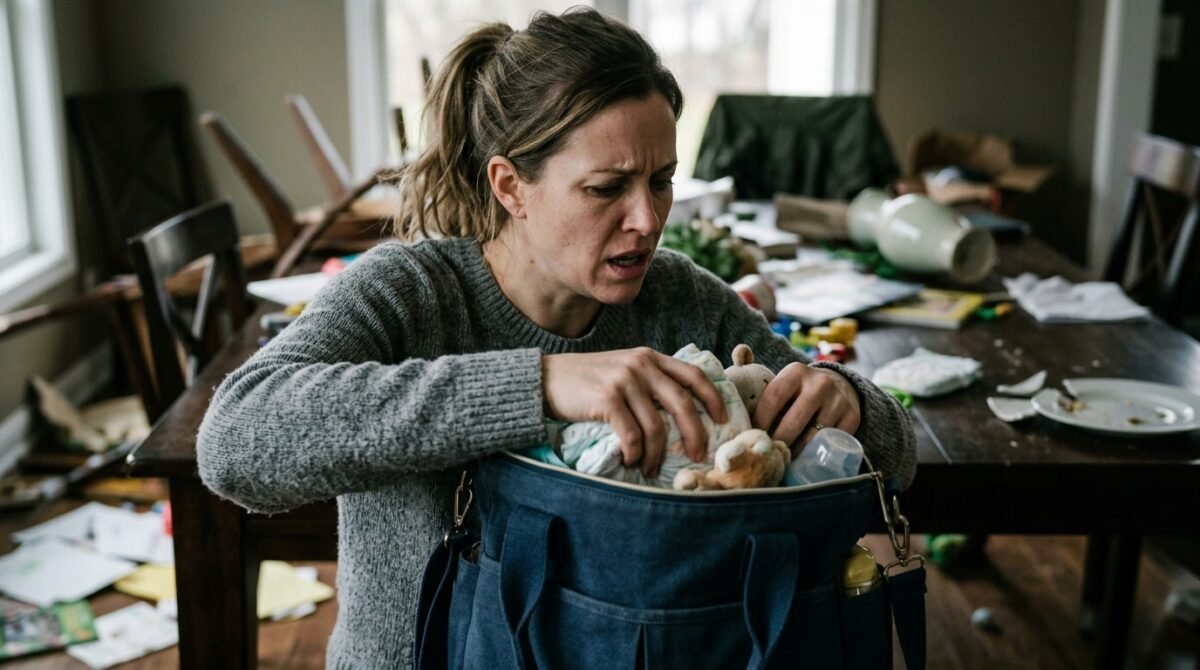
The silence that followed the shatter was suffocating. Mark looked paralyzed, his mouth agape. He couldn’t seem to process the reality of what he had just witnessed. I, on the other hand, had never felt more focused. The shock had burned away, leaving behind a cold, hard resolve. I reached down, scooped Clara out of the carrier, and pressed her against my chest. She was beginning to cry now, a sharp, frightened sound that made my blood boil.
I turned to Mark. I didn’t scream, and I didn’t beg. My voice was low, steady, and vibrating with an intensity that I knew would haunt him later. ‘Pack the car,’ I said, not as a request, but as an order. He didn’t move for a solid five seconds. He just stared at his mother, who was currently clutching her pearls and whispering a prayer for my ‘unrepentant soul.’ The contrast between his paralysis and my movement was the final nail in the coffin of my patience.
I walked to the sideboard where our things were kept. I didn’t bother folding the blankets or organizing the bottles. I shoved everything—the diapers, the wipes, the spare onesies—into the bag with reckless abandon. Every movement was a declaration of my departure. I wasn’t just leaving for the night; I was leaving for good. I knew, with absolute certainty, that this relationship had reached its expiration date.
Barbara tried to grab my arm as I walked toward the front door, her voice taking on that saccharine, patronizing tone that she used whenever she wanted to manipulate a situation. ‘You’re being so emotional, dear. It was just a little water. You’re overreacting to a simple act of love.’ That word—love—tasted like bile. She had no idea what love was if she thought it could be forced through deception and violation.
“Do not touch me. Do not touch my daughter ever again. We are done, Barbara. If you think you can use your faith to override my parental rights, you have learned absolutely nothing about me.”
— The Author (to Barbara, at the front door)
I walked out the front door, not looking back to see if Mark was following. I didn’t care. I walked to the car, strapped Clara into her seat, and sat in the driver’s seat, my hands shaking so violently I couldn’t even turn the key. When Mark finally climbed into the passenger seat, the smell of roast beef still clinging to his clothes, he didn’t say a word. The drive home was the longest, quietest hour of my life.
The Aftermath of the Silence

When we got home, the silence didn’t lift. It settled over the house like a thick, suffocating blanket. Mark sat on the couch, head in his hands, while I paced the kitchen floor, still carrying the diaper bag as if it were a shield. I wanted him to apologize. I wanted him to be angry. I wanted him to be as livid as I was, but all he seemed capable of doing was grieving for a version of his mother that I knew had never really existed.
We didn’t sleep that night. We sat in the living room, the baby monitor glowing in the dark, and debated the sanctity of our family unit. Mark kept saying, ‘She’s old, she’s set in her ways, she didn’t mean any harm.’ Every time he said it, I felt a little bit further away from him. It was as if he were mourning her right to cross our boundaries, rather than defending our right to exist as a family without her interference.
I sent a message to the family group chat the next morning. I didn’t sugarcoat it. I detailed exactly what happened, the shattered glass, the water, the lack of consent, and the immediate exit. I knew it would cause a firestorm, but I was past the point of caring about maintaining the ‘peace.’ The peace had been a lie all along, a facade maintained at the expense of my sanity and my daughter’s safety.
“For everyone asking why we left early: Barbara attempted to perform a baptism on Clara without our permission during Sunday dinner. We will be taking a long break from family gatherings. Please respect our privacy.”
— The Author (via Family Group Chat)
The replies started coming in immediately. Some were shocked, some were defensive, and some were outright hostile. My sister-in-law, who had always been a ‘peacekeeper,’ tried to tell me I was being too hard on a ‘devout woman.’ I didn’t respond to her. I just blocked the numbers of everyone who attempted to minimize what happened. It was the most liberating thing I had ever done.
The Internet’s Verdict: NTA or Overreacting?

I knew I needed perspective, so I posted the story to a popular subreddit dedicated to family drama. I didn’t expect the response I got. Within an hour, the thread had thousands of upvotes. People weren’t just angry on my behalf; they were terrified. Many shared stories of their own ‘MIL horror stories,’ where boundaries were ignored in the name of religion, tradition, or ‘family values.’ It was cathartic to see that I wasn’t alone, but it was also chilling to see how common this kind of violation was.
The comments were a mix of support and outrage. People were dissecting every detail of the encounter, pointing out that what Barbara did wasn’t just a boundary stomp—it was a form of assault. Some commenters pointed out the legal implications, urging me to keep a paper trail in case she tried to seek ‘grandparent rights’ or escalate her behavior in some other, more dangerous way. The support from strangers felt more real than the support I was getting from my own extended family.
“This is not just about a baptism. This is about her asserting dominance over your child. If she’s willing to do this in front of you, imagine what she’d do if you weren’t there. Go no-contact immediately.”
— u/FamilyBoundariesAdvocate (Top Comment, 32.5k upvotes)
There were, of course, the contrarians. A few people argued that, for a believer, the act was ‘meaningless’ and that I should just let it go to keep the family together. But those comments were quickly buried by others who understood that it wasn’t about the water; it was about the lack of respect. The debate raged on for days, turning my personal trauma into a case study on the importance of boundaries in the modern family.
Reading those comments helped me realize that my reaction wasn’t just justified—it was necessary. I wasn’t just protecting Clara from water; I was protecting her from a lifetime of being told that her parents’ wishes didn’t matter. I was setting a precedent that would last for the rest of her childhood. The Internet, for all its toxicity, had provided me with the validation I desperately needed to hold my ground.
The Confrontation Mark Couldn’t Avoid
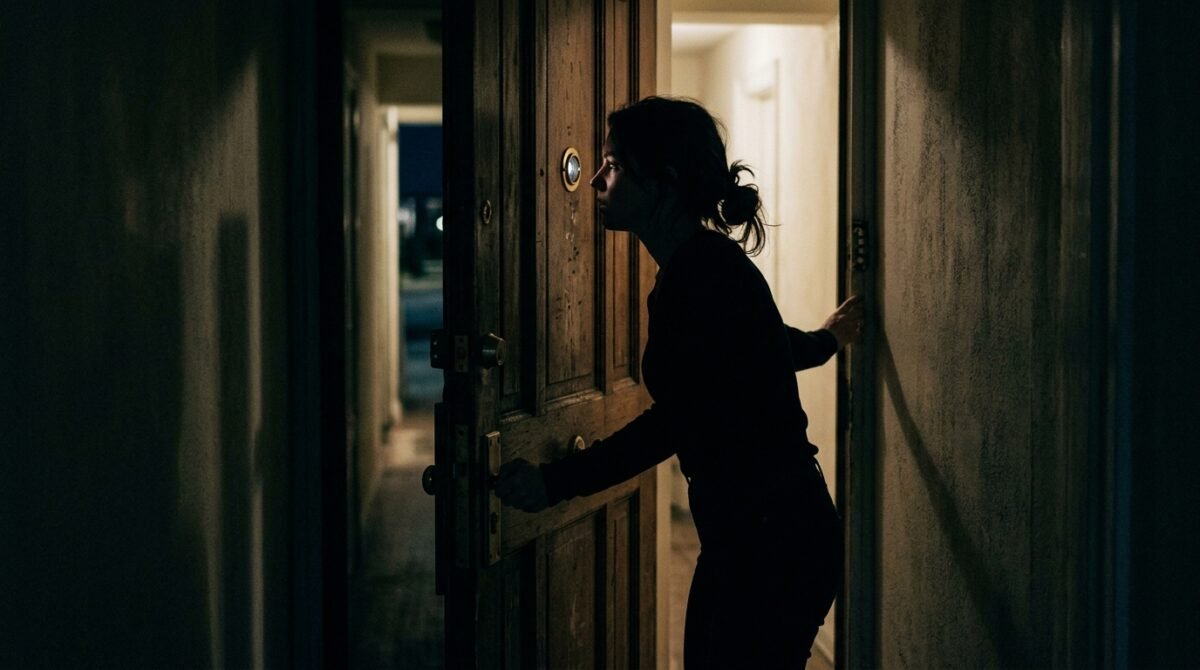
A week later, Barbara showed up at our house. She didn’t call, she didn’t text; she just appeared on our porch with a casserole dish and a look of practiced innocence. I watched through the peephole as she rang the doorbell, her posture slumped, a classic martyr’s pose. I looked at Mark. He was standing in the kitchen, his hand resting on the counter, his knuckles white. I knew he was tempted to open the door.
I grabbed his hand and held it firmly. ‘If you open that door, you’re telling her that what she did is acceptable,’ I whispered. He looked at me, his eyes pleading for a way out. He wanted to fix it. He wanted to sweep it under the rug so he wouldn’t have to face the fact that his mother had fundamentally betrayed our trust. But there was no fixing this. The bridge hadn’t just been burned; it had been dismantled, brick by brick.
Barbara knocked again, louder this time. ‘I know you’re in there! I just want to apologize for the misunderstanding!’ she called out. ‘Misunderstanding.’ The audacity was breathtaking. It wasn’t a misunderstanding; it was a coup. I walked to the door, not opening it, and spoke through the wood. My voice was clear and cold, stripped of all the polite deference I had maintained for years.
“Barbara, go home. There was no misunderstanding. You violated my trust and my daughter’s boundaries. We will not be seeing you for a very long time. If you come back, I will call the police.”
— The Author (speaking through the front door)
She stood there for another minute, fumbling with her words, trying to find a loophole in my rejection. When she finally realized I wasn’t going to budge, she turned and walked back to her car. I watched her go, and for the first time, I felt a sense of peace. I had drawn the line. I had stood my ground. And most importantly, I had protected my daughter.
The Financial and Emotional Ledger

In the aftermath of the fallout, I started keeping a ledger. Not just of the financial costs of cutting ties—the missed family dinners, the holiday gifts we no longer received, the potential legal fees—but of the emotional costs. I wanted to see clearly what this sacrifice looked like. For years, we had been dumping resources into a relationship that was fundamentally one-sided. Barbara wasn’t just taking our time; she was taking our agency.
I created a list of all the times our boundaries had been ignored, from the ‘surprise’ visits at 6:00 AM to the ‘unsolicited’ gifts that were really just ways of controlling our lifestyle. Looking at the list, I realized that the baptism wasn’t an isolated event. It was the culmination of a systematic dismantling of our parental authority. It was a pattern, and we had been too blind or too polite to see it.
| Violation Type | Frequency | Impact |
|---|---|---|
| Boundary Stomps | Weekly | High |
| Uninvited Visits | Monthly | Medium |
| Religious Imposition | Constant | Extreme |
The realization was painful, but it was also clarifying. We were spending more energy defending ourselves than we were enjoying our lives. We were living in a constant state of low-level anxiety, waiting for the next shoe to drop. By removing the source of that anxiety, we were reclaiming our time, our energy, and our sanity. It was the best investment we could have made for our future as a family.
Mark slowly started to see it too. He began to process the reality of his childhood, realizing that his mother’s ‘love’ had always been conditional on his compliance. He started therapy, and we began talking about what a healthy relationship with family actually looked like. It wasn’t about blind obedience; it was about mutual respect and, above all, the safety of our children.
The Fragile Path to Reconciliation
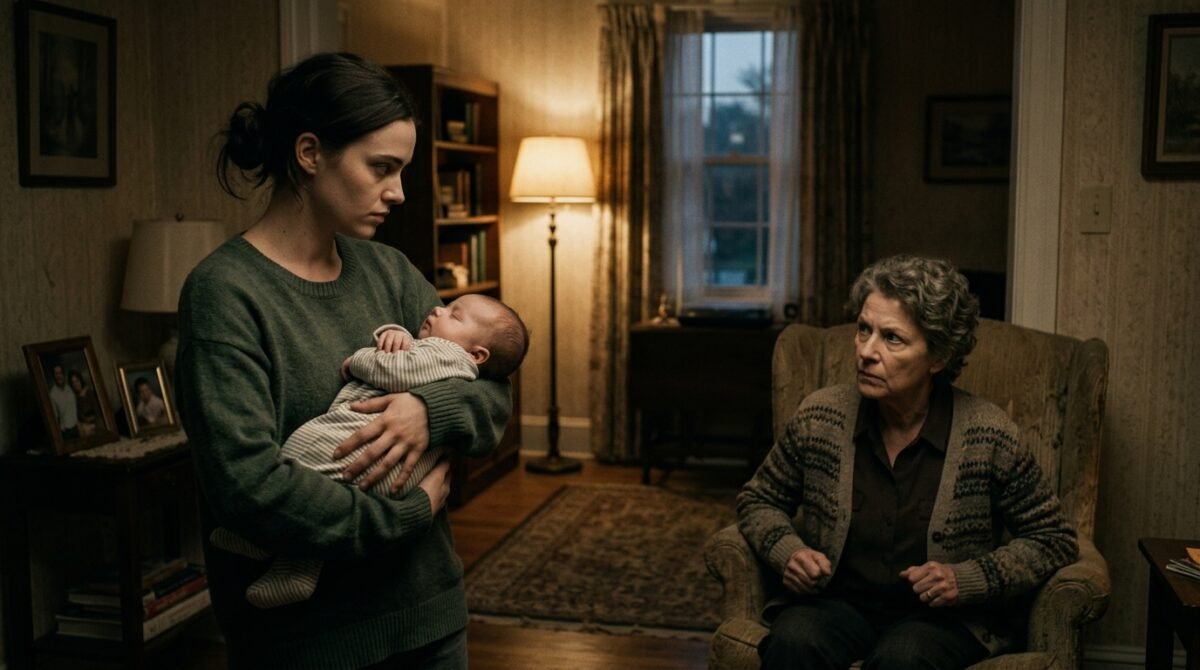
Months passed, and the silence from Barbara turned into a series of increasingly frantic letters. They were filled with apologies that weren’t really apologies—’I’m sorry you felt that way’—and promises to ‘do better’ if we just gave her another chance. Each one was a test. Did she understand what she had done? No. She just wanted access to the baby again. She wanted to return to the status quo, where she could continue her slow, quiet subversion of our parenting.
Mark and I discussed it at length. We decided on a ‘probationary period.’ No unsupervised visits, no religious talk, and a strict requirement that she respect our rules without complaint. It felt like we were navigating a minefield. We weren’t doing it for her; we were doing it for Mark, so he could feel like he had done everything possible to maintain a connection. But the tension remained, an invisible wall between us and her.
The first visit was agonizing. Every time she reached for Clara, my pulse would spike. She was on her best behavior, but the mask was slipping. She would whisper things to the baby when she thought I wasn’t listening, things that made my skin crawl. It was clear that she hadn’t changed; she had just learned to be more subtle. The experiment was failing, and we both knew it.
“I notice you aren’t teaching her her prayers yet. Don’t worry, I’ll start when she’s old enough to understand. It’s for her own good, really.”
— Barbara (whispering to Clara during a supervised visit)
That was the final straw. It wasn’t about the water anymore; it was about her inability to accept that our authority was final. She was biding her time, waiting for an opportunity to strike again. I looked at Mark, and I saw the resignation in his eyes. He finally understood. There was no ‘doing better’ with someone who didn’t believe they had done anything wrong in the first place.
The Final Severance

We made the decision together: permanent no-contact. It wasn’t a decision we made lightly, but it was the only one that felt right. We wrote a final, firm letter explaining our reasoning. No room for debate, no room for negotiation. We were closing the door on the relationship entirely. It was a heavy, emotional day, but as we walked to the mailbox, I felt a weight lifting off my shoulders that I hadn’t realized I was carrying.
The fallout was, as expected, intense. The family took sides. Some called us cruel, others praised us for our strength. We didn’t care. We were no longer participating in their drama. We were busy building our own life, our own traditions, and our own way of raising our daughter. We found that the world didn’t end when we cut ties; it actually became much brighter.
We started doing things differently. We celebrated holidays on our own terms, without the stress of visiting relatives who didn’t respect us. We taught Clara that her body was her own, that her choices were hers to make, and that no one, no matter how much they claimed to love her, had the right to cross her boundaries. It was a new way of being, and it was beautiful.
“You are not just setting a boundary for today. You are teaching your daughter what she deserves for the rest of her life. You are the hero of her story.”
— A supportive friend (during a dinner conversation)
The lessons we learned were hard-won. We learned that ‘family’ is not a blood-bound contract that excuses abuse or manipulation. We learned that we are allowed to say ‘no’ to anyone, even those we’ve known our entire lives. And most importantly, we learned that the peace we were so afraid to lose was never really there in the first place.
Reflecting on the Ripple Effects

Looking back now, it’s strange how one Sunday dinner changed everything. It felt like the end of the world at the time, but it was actually the beginning of our real life. We had been living in a shadow, trying to please someone who was never going to be pleased. By walking out that door, we didn’t just escape a bad situation; we stepped into our own power as parents.
Our daughter is thriving. She’s happy, she’s secure, and she’s growing up in a home where her boundaries are respected. She doesn’t know about the secret baptisms or the family arguments. She just knows that her parents are a team, that they love her unconditionally, and that they will always be there to protect her. That’s the greatest gift we could ever give her.
We still hear things from time to time. The rumors, the ‘concern’ from extended family, the occasional reach-out attempt. But it doesn’t touch us. We are insulated by our love for each other and our commitment to our daughter. We have created a sanctuary, a place where no one can tell us who we should be or how we should live.
“We don’t regret walking out. We regret that we waited so long to do it. The price of our freedom was high, but the cost of our captivity was higher.”
— The Author (reflecting on the journey)
If you find yourself in a similar situation, if you are being pushed around by someone who claims to love you, know this: you have the power to say ‘no.’ You have the power to walk away. You don’t owe anyone your compliance, and you certainly don’t owe anyone your children’s autonomy. You are the architect of your family’s future, and you have every right to build it exactly the way you want.
Conclusion
My journey from that chaotic Sunday dinner to our current life of peace has been one of the most difficult, yet rewarding, experiences of my life. I learned that family isn’t about shared blood or history; it’s about shared values and mutual respect. When those are violated, you have the absolute right to protect yourself and your children, no matter what society or tradition dictates.
We are now living in a state of ‘peaceful distance.’ We aren’t angry anymore; we are just indifferent. We have moved past the drama, and we are focusing on the future. The boundaries we set weren’t just for us—they were for the generations to come, ensuring that our daughter knows exactly what it feels like to be safe, heard, and deeply loved.
What about you? Have you ever had to draw a line in the sand with family, even when it cost you everything? Do you believe that family ties are meant to be broken when the relationship becomes toxic? Let’s talk about it in the comments below—I’d love to hear your experiences and how you found the courage to reclaim your life.
What's your verdict on this dilemma?
Vote below to contribute to the official community consensus.

Have a Dilemma Keeping You Up at Night?
Share your real-life feud, wedding chaos, or relationship crossroads anonymously with our editorial team.
What do you think ?
0 Comments🛡️ Comments are moderated to protect community integrity. Your comment will appear once approved by the editorial team.