
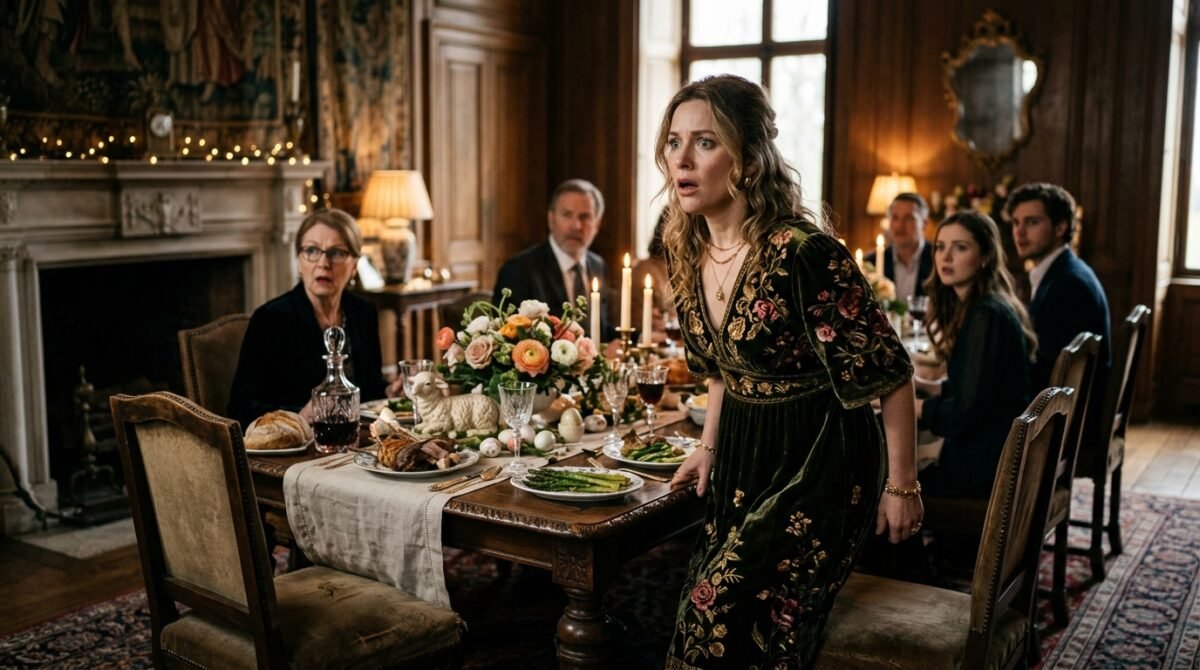
Easter is supposed to be a time of renewal, family bonding, and perhaps a bit of indulgent chocolate. For the past three years, I had navigated the treacherous waters of my husband Mark’s family with grace, patience, and a forced smile that felt more like a grimace. Mark’s mother, Linda, never quite got over his previous relationship with Sarah—a woman who was essentially the ‘golden child’ of the family. Even after three years of marriage, Sarah’s shadow loomed over every gathering, every holiday, and every birthday celebration.
I had tried to be the bigger person. I attended the dinners where Sarah was brought up in ‘fond memory,’ I sat through the stories of their high school prom, and I listened to Linda lament about what a ‘tragedy’ it was that they hadn’t worked out. I thought if I just showed enough kindness, eventually, I would be accepted as the new reality. I was wrong. The deeper I integrated into the family, the more I realized that I wasn’t just a guest; I was an intruder in a museum dedicated to a life Mark no longer lived.
The breaking point wasn’t a sudden explosion, but a slow erosion of my self-respect. It was the constant comparison, the subtle digs about my career choices, and the glaring omission of my own milestones while Sarah’s life was treated like a breaking news story. But nothing could have prepared me for the audacity of this past Easter Sunday. I walked into that house expecting ham and pleasantries; I left with a newfound clarity that destroyed my relationship with my in-laws entirely.
This isn’t just a story about a bad brunch. It is a story about the moment you realize that you cannot win the affection of people who are committed to misunderstanding you. It is about the cost of staying silent to keep the peace, and the transformative power of finally walking away when the disrespect becomes too loud to ignore. My husband, caught in the middle, had a choice to make—and watching him stumble in that moment was the final piece of the puzzle I needed to see.
The Setup: A Holiday Dressed in Staged Perfection

The morning of Easter began with the usual tension. Linda had insisted on a ‘mandatory’ brunch, demanding that everyone dress in pastels and arrive precisely at 11:00 AM. I spent the morning trying to shake off the anxiety, focusing on the small gift I had bought for Linda—a nice ceramic planter—hoping it would finally be the token that bridged the gap. Mark was unusually quiet, staring at his phone, his thumb tapping the screen with a rhythm that suggested he was communicating with someone he wasn’t happy to hear from.
When we arrived at the house, the air was thick with the smell of roasted lamb and expensive lilies. The living room was already occupied by Mark’s siblings and their partners, all of whom seemed to be in high spirits. I made the rounds, offering polite greetings, but the shift in energy was palpable the moment Linda walked into the room. She was wearing her ‘hostess’ mask, the one that looked like a genuine smile but didn’t quite reach her eyes when she looked at me.
“Oh, you’re here,” she said, her voice dripping with a mix of resignation and practiced hospitality. She didn’t offer a hug, just a quick nod toward the dining room. I felt a cold knot tighten in my stomach. I looked toward Mark, hoping for some reassurance, but he was already deep in conversation with his brother about fantasy football. I was left standing in the foyer, feeling like a stranger who had accidentally wandered into a private event.
The table was set with impeccable detail. My place card was shoved near the edge, next to the kitchen door, while the ‘family’ members were seated in the center of the table. I sat down quietly, smoothing out my dress, trying to convince myself that I was being overly sensitive. It was just a seat, right? The table conversation started, and naturally, it was about Sarah. It was always about Sarah. They were discussing her recent career move, a promotion at a local marketing firm that Linda seemed to know more about than I knew about my own husband’s career.
“I just think it’s so wonderful that Sarah finally got the recognition she deserves,” Linda said, beaming at everyone. “She always had such a bright future. Mark, did you see the email she sent about the new title? It’s truly remarkable for someone her age.”
I felt my pulse quicken. Mark kept his head down, staring intently at his water glass. “I saw it, Mom,” he replied, his voice barely audible. The table erupted into a chorus of praise for Sarah’s professional acumen, as if she were a saint being canonized, while I sat there in silence, feeling like a ghost in the room.
The Toast That Toppled the Table
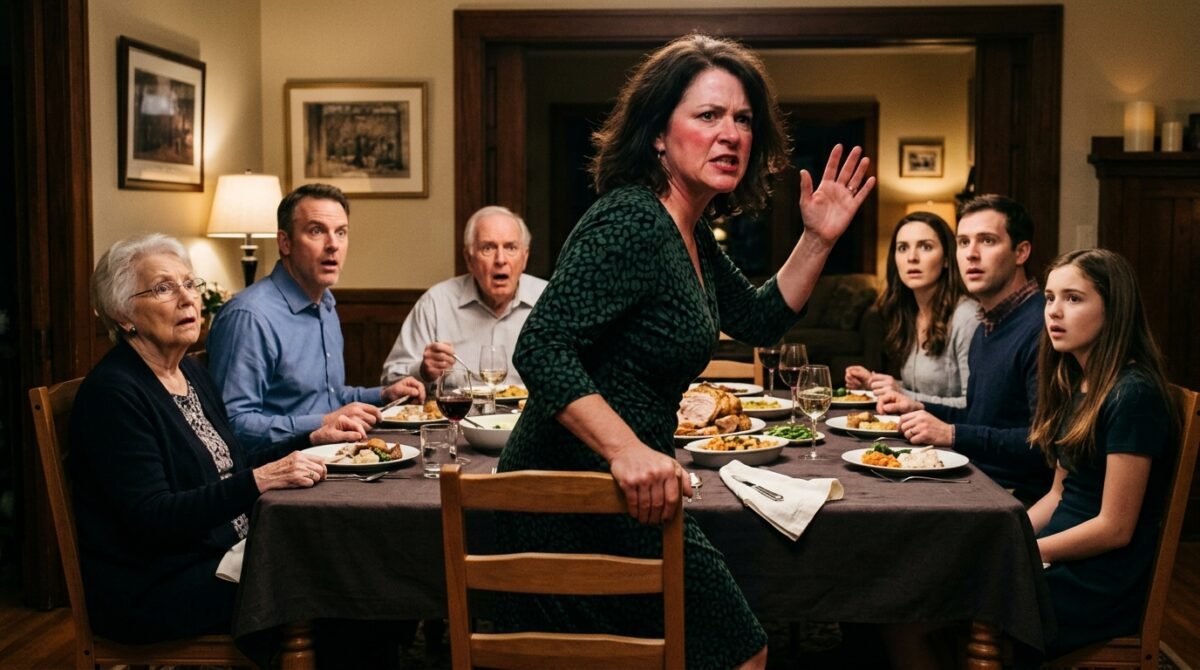
As the main course was cleared, Linda stood up. She tapped her glass with a silver knife, a sound that cut through the room like a gunshot. The table went silent, expectantly. She stood tall, a glass of champagne in her hand, looking around the room with a sense of immense pride. I had a sinking feeling in my chest—a premonition of what was coming—but I chose to stay seated, hoping that for once, she might actually acknowledge her son’s actual wife.
“I wanted to take a moment,” Linda began, her voice ringing with performative emotion, “to acknowledge something truly special today. We all know how much we love Sarah, and how she has always been a part of this family’s heart. I recently received the most wonderful news about her promotion. It’s such a testament to her character and her hard work, and I think it’s only right that we honor that success here, together, as a family.”
The room murmured in agreement. I stared at my plate, my knuckles white from gripping the edge of the table. I couldn’t believe what I was hearing. She was hosting an Easter toast for an ex-girlfriend who wasn’t even in the room. It was calculated, it was cruel, and it was meant specifically for me. I looked at Mark, expecting him to stop her, to say something—anything—about the fact that he was currently married to someone else. He didn’t.
Linda raised her glass, her eyes locking onto mine for a fraction of a second, a flicker of triumph in her gaze. “To Sarah,” she announced. “May this promotion be the first of many, and may she always find the happiness she deserves, which we all know she truly does.” The entire table clinked their glasses together. The sound was deafening. I felt like the air had been sucked out of the room. It wasn’t just a slight; it was a public erasure of my existence.
“Are you kidding me?” I whispered, the words slipping out before I could stop them. My voice wasn’t loud, but in the sudden quiet after the toast, it sounded like a scream.
Linda’s smile vanished instantly, replaced by a mask of offended innocence. “Excuse me, dear? Was that a problem?” She asked, her tone dripping with passive-aggressiveness. The entire table turned to look at me, their faces ranging from annoyed to horrified that I had dared to break the spell. Mark finally looked up, his eyes wide with fear, silently pleading with me to just let it go. But I was done letting things go.
The Unceremonious Exit

I stood up, the chair scraping loudly against the hardwood floor. The sound echoed through the room like a gavel strike. My heart was pounding so hard I could feel it in my throat. I looked at Linda, who was still holding her glass, her expression daring me to say something. I didn’t want to cause a scene, but the scene had already been created the moment she opened her mouth. I wasn’t the one who made this awkward; she was.
“Yes, Linda, it is a problem,” I said, my voice shaking but firm. “We are sitting at an Easter brunch. We are supposed to be celebrating our family. Instead, you’ve turned this into a fan club meeting for Mark’s ex-girlfriend. Do you have any idea how disrespectful that is to your son’s marriage?” The room went deathly silent. You could have heard a pin drop. Mark put his face in his hands, clearly wishing the floor would swallow him whole.
Linda’s face turned a shade of crimson that I didn’t think was biologically possible. “I am simply being supportive of a friend of the family,” she spat back, her voice trembling with rage. “Sarah is a wonderful person, and just because you are insecure doesn’t mean we have to stop acknowledging the people who actually matter to us.” The words felt like a physical blow. She had finally said the quiet part out loud.
I looked at Mark, waiting for him to defend me, to stand up and tell his mother that she was out of line. He didn’t move. He just sat there, paralyzed by his fear of his mother’s disapproval. That silence was the most painful part of the entire ordeal. In that moment, I realized that I wasn’t just fighting Linda; I was fighting an entire system that viewed me as a temporary placeholder in Mark’s life. It was a realization that shattered whatever hope I had left for this relationship.
“You’re right,” I said, grabbing my purse from the back of my chair. “She obviously matters more to this family than I do. So, I’ll leave you to your toast. Enjoy the rest of your brunch.”
I walked out of the dining room without looking back. I could hear Linda calling my name, but I kept walking. I went to the front door, grabbed my coat, and walked out into the cool spring air. The relief I felt was instantaneous, followed by a wave of intense, crushing loneliness. I walked to my car, my hands trembling as I fumbled for my keys, and started the engine, knowing that I couldn’t go back into that house ever again.
The Drive Home: A Symphony of Silence

The drive home was a blur. I didn’t call Mark, and I didn’t want him to call me. I needed to be alone with my thoughts, to process the sheer audacity of what had happened. Every few miles, my phone would light up in the cupholder, notifications from the family group chat popping up like little explosions of toxicity. I ignored them all, focusing on the road, watching the world pass by, feeling like I had just exited a reality that hadn’t been mine for a very long time.
When I finally pulled into our driveway, I sat in the car for a long time. The house was dark, reflecting the empty space I felt inside. I realized that my life had been structured around avoiding these confrontations, around walking on eggshells to keep the peace. I had traded my self-esteem for a seat at a table where I was never truly welcome. And for what? To be the ‘nice daughter-in-law’ who stayed quiet while she was belittled in front of her husband?
My phone buzzed again, and this time, I couldn’t resist. I unlocked the screen and saw a barrage of messages from Mark and his sister. They were all variations of ‘Why did you do that?’ and ‘Mom is crying.’ Not once, in any of the messages, did anyone ask if I was okay. Not once did anyone acknowledge that I had been humiliated. It was all about the status quo, and how my actions had disrupted their delicate, dysfunctional balance.
“You really ruined the day, OP. Mom is heartbroken. Can you just come back and apologize? We can talk about this later.”
— Mark (Text Message)
I stared at the screen, a hollow laugh escaping my lips. Apologize? For what? For having a backbone? For expecting to be treated like an adult in my own marriage? I typed out a quick reply, my fingers flying across the screen, before I could talk myself out of it. “I am not coming back. I think we need some space to think about what the hell just happened.” I hit send and tossed the phone into the passenger seat, feeling a strange sense of liberation.
The Reddit Verdict: When the Internet Weighs In

I knew I was in the right, but the gaslighting made me feel like I was losing my mind. That night, I sat at my kitchen table, nursing a glass of wine, and decided to post my story on Reddit. I didn’t expect much—maybe a few people telling me I was overreacting—but the response was instantaneous. Within an hour, the thread had thousands of upvotes and hundreds of comments, all confirming exactly what I had been suspecting all along.
The community was ruthless, but in a way that felt like a warm blanket. People didn’t just tell me I was right; they pointed out the patterns I had been too close to see. They saw the manipulation, the enmeshment, and the lack of support from Mark. They highlighted that the problem wasn’t just Linda; it was the fact that Mark allowed his mother to prioritize his ex-girlfriend over his wife. It was the validation I had been starved of for years.
“NTA (Not The Asshole). This isn’t about the toast. It’s about the fact that your husband lets his mother disrespect you constantly. If he doesn’t stand up for you now, he never will. You did the right thing by leaving.”
— u/RelationshipGuru (Top Comment, 32.5k upvotes)
Reading through the comments was like reading a map of my own life. People shared their own stories of overbearing in-laws and spineless partners. I realized that I wasn’t alone, and more importantly, that I wasn’t crazy. The ‘family’ dynamic that Mark had defended for years was clearly unhealthy, and by walking out, I had finally broken the cycle. It didn’t make the situation less painful, but it made it much clearer.
There were some dissenting voices, of course. A few people argued that I should have just ‘sucked it up’ to avoid causing a scene, but they were quickly shouted down by the community. It reminded me that there are always people who prioritize ‘peace’ over ‘truth,’ but that peace is usually bought at the expense of someone else’s dignity. I wasn’t interested in that kind of peace anymore.
The Confrontation: A Marriage on the Brink
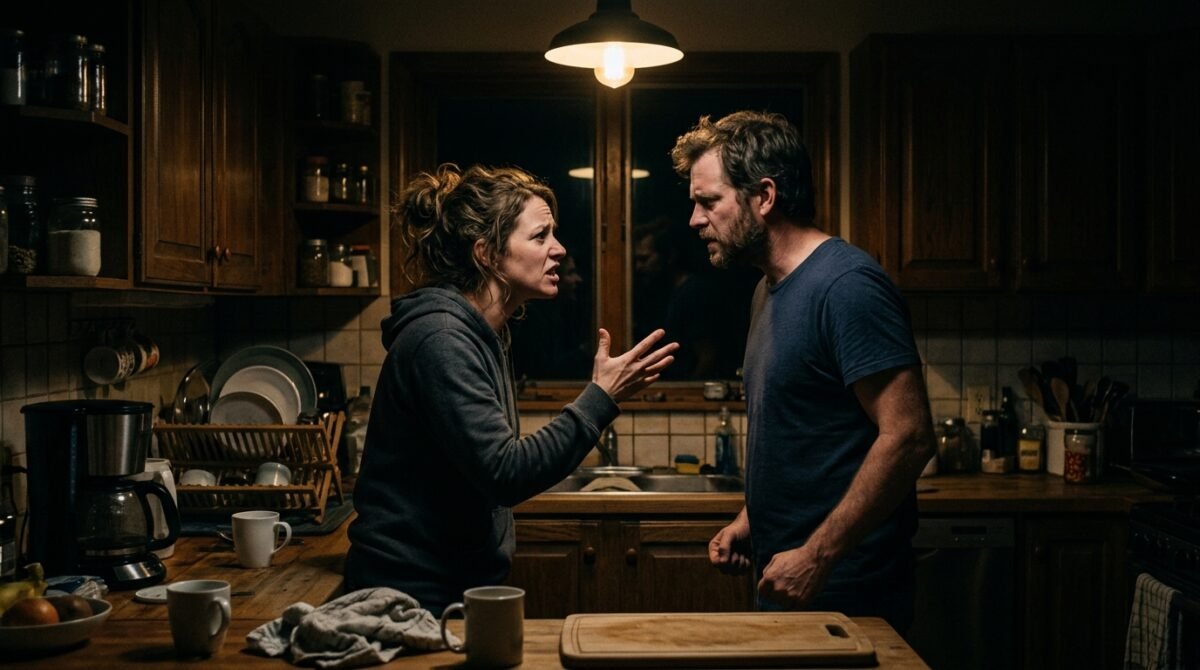
Mark didn’t come home until late that night. When he walked in, he looked exhausted, his tie undone and his jacket rumpled. He didn’t speak at first, just walked into the kitchen and poured himself a glass of water. I watched him, waiting for him to say something, anything. I realized that I was no longer afraid of the outcome. Whether this marriage survived or not depended entirely on his ability to see reality, and if he couldn’t, then the marriage was already over anyway.
“Mom is a mess,” he finally said, not looking at me. “She’s crying in her bedroom. She says she didn’t mean anything by the toast. It was just a slip of the tongue. You made a massive scene, and now the whole holiday is ruined. Everyone is talking about it.” He sounded like a child repeating his mother’s words, a script he had been reciting his entire life.
I felt a flash of anger, but it was quickly replaced by a cold, hard resolve. “Mark, it wasn’t a slip of the tongue. It was a toast. She planned it. She stood up, tapped her glass, and gave a speech. Do you realize how crazy that sounds? And you sat there and let her. You didn’t say a word. You didn’t defend me. You didn’t even look at me.”
“It’s just my mom! She’s always been like this! You know how she is. Why do you have to make everything about you? Why can’t you just be the bigger person?”
— Mark
“I have been the bigger person for three years, Mark!” I shouted, the volume of my voice startling us both. “I have been the bigger person while she compared me to Sarah, while she left me out of family photos, and while she made you feel like you were settling for me! I am done being the bigger person. I want a husband who treats me like a partner, not a roommate he’s embarrassed to introduce to his mother.”
The Aftermath: Setting New Boundaries

The next few days were the hardest of my life. I moved into the guest room, and we barely spoke. The tension in the house was so thick you could cut it with a knife. Mark continued to defend his mother, insisting that I owed her an apology for ruining the holiday. I, in turn, made it clear that I would not be returning to her house for any event unless there was a significant change in how I was treated—and even then, it was a big ‘if.’
I started seeing a therapist to help me process the last few years. She helped me see that my reaction at brunch wasn’t an overreaction; it was a long-overdue response to years of cumulative trauma. She taught me about ‘enmeshment’ and how to set boundaries with people who don’t respect them. It was a slow process, but it was the most important thing I had ever done for myself. I was reclaiming my life, one step at a time.
Mark eventually started to see a therapist as well, though he was much more resistant. He struggled to accept that his mother’s behavior was abusive, not just ‘quirky’ or ‘old-fashioned.’ It was a painful journey for him, to realize that the person he had been trying to please his entire life was the very person who had been stifling his growth and his marriage. We had a long road ahead, but at least we were finally walking the same path.
“I didn’t realize how much I was hurting you until I saw you walk out that door. I think I’ve been blind for a very long time.”
— Mark (during a therapy session)
That was the first glimmer of hope. It wasn’t a full resolution, and it didn’t fix the damage done, but it was an acknowledgement. It was the first time Mark had truly seen me, and not just the role he wanted me to play in his family’s drama. It was the beginning of a different kind of marriage, one built on reality rather than the hollow expectations of his mother.
The Unintended Consequences of Truth
The fallout from the brunch didn’t stop with us. Linda started reaching out to our friends, telling her version of the story, painting me as the ‘unhinged’ daughter-in-law who couldn’t handle a simple toast. It was a classic smear campaign, meant to isolate me and force me into submission. But something interesting happened: people didn’t believe her. They had seen how she treated me at other events, how she constantly brought up Sarah, and they were tired of it.
One by one, family members started reaching out to me, not to ask for an apology, but to tell me that they were glad I said something. They had been watching the same dynamic for years, feeling uncomfortable but never knowing how to speak up. My outburst had given them permission to finally see the elephant in the room. It was a powerful lesson: one person’s courage can change an entire environment.
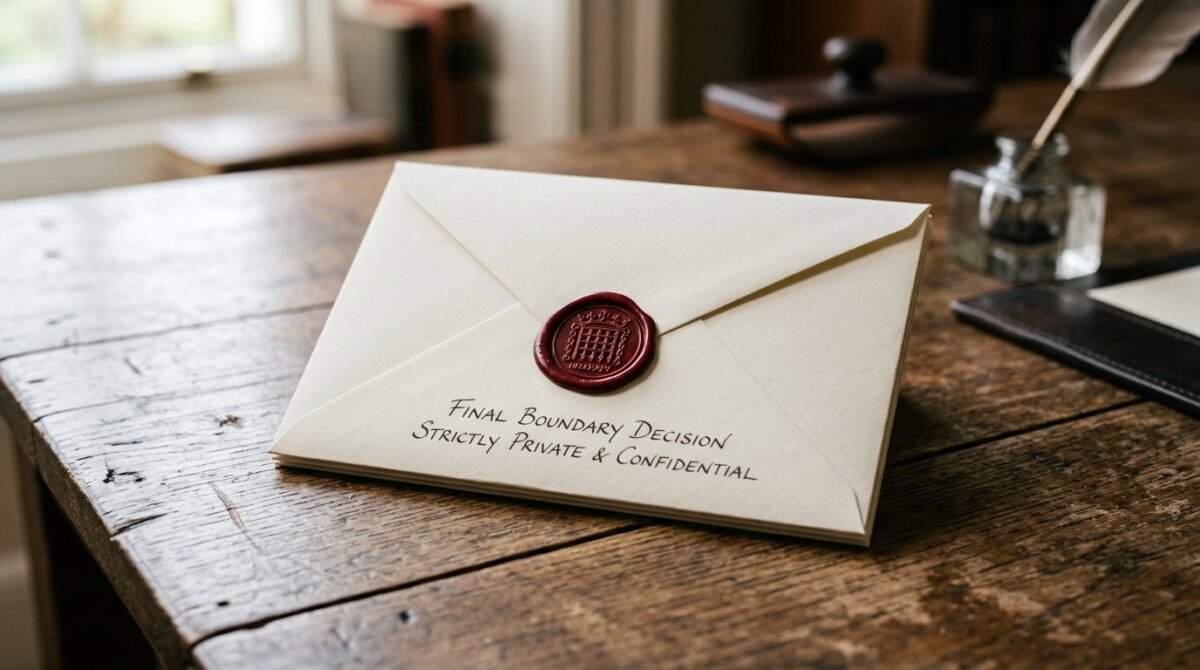
Linda, however, did not take it well. She doubled down, refusing to speak to either of us unless I sent a written apology. I didn’t. I sent her a letter instead, one that I had drafted with the help of my therapist, outlining the boundaries that would be required for any future interaction. It was firm, it was respectful, and it was non-negotiable. I wasn’t asking for her love anymore; I was demanding basic respect.
“I am not asking for your approval. I am asking for you to treat your son’s marriage with the respect it deserves. If you cannot do that, we will not be visiting.”
— Excerpt from the letter sent to Linda
The silence that followed was deafening. But it was a peaceful silence. I didn’t spend my days worrying about what she thought, or whether she was comparing me to Sarah. I was busy living my own life, focusing on my work, my friends, and my marriage. It was the freedom I had been looking for all along, found in the most unexpected of places.
The Lingering Question: Why Sarah?

I often wondered what it was about Sarah that held such a grip on Linda’s imagination. Was it just nostalgia, or was there something deeper? I started looking into their history, not to be petty, but to understand the root of the fixation. What I found was a pattern of control. Sarah had been a compliant daughter-in-law-in-waiting, someone who allowed Linda to dictate her life, her choices, and her time. I was the exact opposite, and that was the real problem.
It wasn’t that they loved Sarah more; it was that they controlled her more. By constantly holding her up as the gold standard, they were trying to shame me into submission. They wanted me to be like her, to be a puppet in their family theater. But I had my own voice, my own opinions, and my own life. That was the ‘insecurity’ Linda was talking about—it was her own insecurity, projected onto me.
Understanding this didn’t make the hurt go away, but it made it manageable. It stopped being about me and started being about them. I was never the problem; their need for control was. And once you see that, it’s much harder for their words to cut you. I was no longer a participant in their game; I was an observer, and that gave me all the power I needed to step away.
“She doesn’t want a daughter-in-law. She wants a fan. And you’re not a fan, you’re an equal.”
— My Therapist
That realization changed everything. I stopped trying to impress them. I stopped trying to earn their approval. I started living my life for myself and for Mark, and if they didn’t like it, that was their loss. I had spent so long trying to fit into a mold that was never designed for me, and now that I was out, I finally had the space to grow into the person I was meant to be.
The New Normal: Life After the Brunch

Life has settled into a new rhythm. We don’t see Linda as often, and when we do, it’s on our terms. We meet in public places, we keep the visits short, and we don’t engage in the old patterns. The first few times were incredibly awkward, but as time went on, the tension started to dissipate. Linda still tries to bring up Sarah, but we shut it down immediately, changing the subject or leaving if she persists. It’s a work in progress, but we are making progress.
Mark has become a different man. He’s more confident, more decisive, and much more supportive. He’s realized that his mother’s behavior was damaging, and he’s committed to protecting our marriage. We still have our disagreements, but we handle them differently now. We talk, we listen, and we support each other. It’s the kind of partnership I had always dreamed of, but never thought I would actually have.
I’ve learned that boundaries aren’t just for others; they’re for yourself. They’re the things you need to do to stay sane, to stay healthy, and to stay true to who you are. Walking out of that brunch was the most difficult thing I’d ever done, but it was also the most important. It taught me that I have a voice, that I have worth, and that I don’t have to settle for anything less than what I deserve.
“I’m proud of you. I’m proud of us. We made it through the fire, and we’re better for it.”
— Mark
I don’t know what the future holds, or whether we’ll ever have a ‘normal’ relationship with my in-laws. But I do know that I’m not afraid anymore. I know that no matter what happens, I can stand on my own two feet. I can advocate for myself, and I can walk away from anything that doesn’t respect the person I’ve worked so hard to become. And that, in the end, is all that really matters.
Conclusion
Looking back, that Easter brunch seems like a lifetime ago. It was a moment of profound transformation, a crucible that burned away the expectations and the fear, leaving behind something stronger and more resilient. I realize now that I didn’t just walk out of a house that day; I walked out of a life that was stifling my spirit. The pain of the experience was real, but the lessons I learned were invaluable. I discovered that I am not a supporting character in someone else’s story; I am the protagonist of my own.
I know many of you are currently navigating similar dynamics—trying to appease in-laws, hoping for acceptance, and feeling silenced by the fear of causing a ‘scene.’ I want you to know that your voice matters. You are not a guest in your own marriage, and you don’t have to sacrifice your dignity to keep the peace. The most radical act of self-love is often just saying ‘no’ to the things that diminish you. It might be scary, and it might be messy, but it is the only way to find your own path.
So, here is my question to all of you: Have you ever reached a point where you had to choose between your dignity and a family relationship? How did you handle the fallout, and what did you learn about yourself in the process? Let’s talk about it in the comments. Your stories might be the exact validation someone else needs today. We are all learning as we go, and sharing our experiences is how we heal.
What's your verdict on this dilemma?
Vote below to contribute to the official community consensus.

Have a Dilemma Keeping You Up at Night?
Share your real-life feud, wedding chaos, or relationship crossroads anonymously with our editorial team.
What do you think ?
0 Comments🛡️ Comments are moderated to protect community integrity. Your comment will appear once approved by the editorial team.