
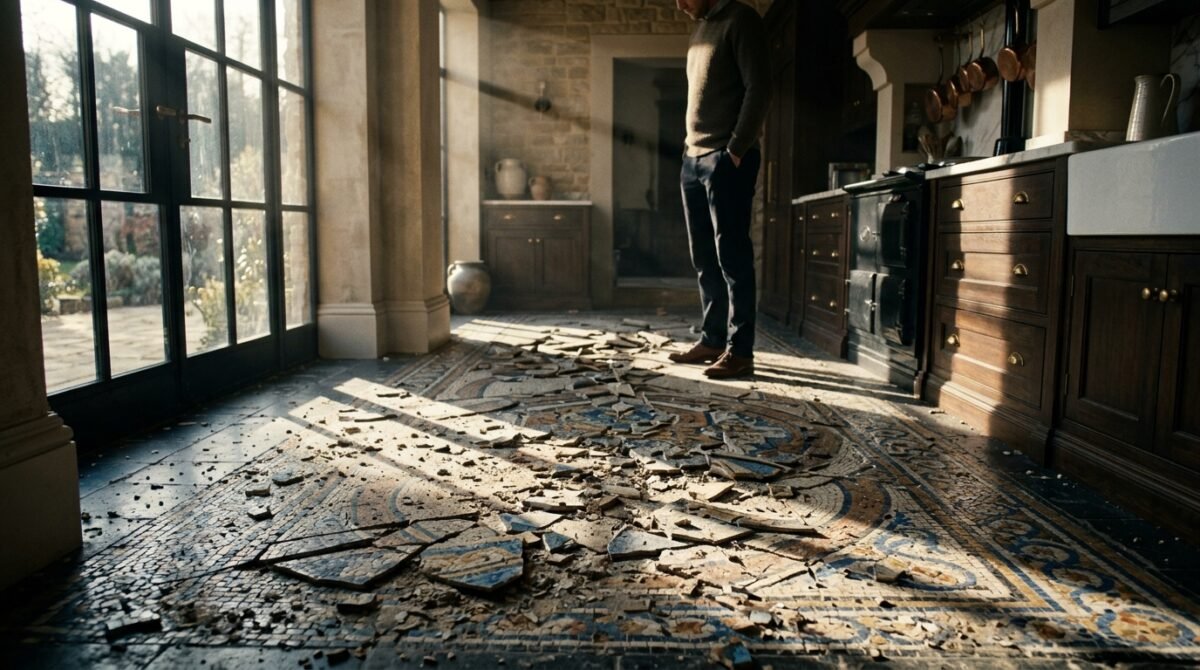
Grief is a strange, non-linear landscape, but for me, it was anchored in the kitchen. My mother, a ceramicist of local renown, had spent three years of her life hand-firing, glazing, and laying the intricate, Mediterranean-inspired tilework that defined our family home. Every crack, every unique shade of cobalt blue, and every slight imperfection in the kiln-fired clay told a story of a woman who was vibrant, artistic, and taken far too soon. After she passed, that kitchen became a sanctuary, a physical manifestation of her spirit that I visited every weekend, even after moving out to pursue my own career.
Enter Elena. My father remarried eighteen months after the funeral, a decision I was never consulted on and one that felt like a betrayal of the sanctity we had cultivated in that house. Elena was a woman of sleek, minimalist aesthetics, someone who viewed ‘clutter’—even if it were artistic legacy—as a personal affront. For years, she dropped subtle hints about ‘modernizing’ the space, to which I always responded with a cold, firm reminder that the kitchen was non-negotiable territory. It wasn’t just decor; it was my inheritance, a structural piece of my mother’s identity that I held in guardianship.
The moral dilemma began when I decided to leverage my position as the executor of my mother’s specific estate trust. Because the house remained in a complicated legal holding pattern until I turned thirty, I had the power to dictate major renovations. Elena, however, operated under the delusion that her marriage to my father entitled her to complete dominion over the property. She saw the kitchen as an eyesore; I saw it as a museum of love. We were on a collision course, and I was the only one holding the stop sign.
When I finally received the phone call that the tiles had been ripped out—supposedly to ‘surprise’ me with a fresh, clean backsplash—something inside me snapped. The rage wasn’t just about the tiles; it was about the erasure of a person who couldn’t defend herself. I had the legal authority to freeze the discretionary trust fund that provided Elena with her ‘lifestyle stipend’ from my mother’s estate, and in that moment of blinding heartbreak, I decided to exercise it.
This is not just a story about a home renovation gone wrong. It is a story about the intersection of legacy, financial control, and the bitter fallout of remarriage. It is about what happens when someone decides to delete a person’s existence, and how far the survivor is willing to go to ensure that erasure doesn’t stand. The internet has weighed in, and the discourse has been as volatile as the event itself.
The Morning the Cobalt Blue Vanished

The Tuesday morning began with a text message that would change the trajectory of my family relationships forever. I was in the middle of a client meeting when the notification chimed. It was an image from Elena, captioned with a sickeningly sweet, ‘Surprise! I knew you hated how dated it looked, so I took the liberty of updating the kitchen while you were away. You are going to love the new marble!’ My heart didn’t just sink; it plummeted into a void of pure, unadulterated coldness.
I opened the photo. The wall that had held the hand-painted, kiln-fired tiles—the pride of my mother’s career—was stripped bare. The tiles, which I had spent thousands of dollars maintaining, were piled in a dumpster visible through the kitchen window in the background of her photo. I felt a physical vibration in my chest, a mixture of nausea and a sudden, sharp clarity. I didn’t call her. I didn’t scream. I simply stared at the screen until the text message bubble turned into a blur.
I left my meeting immediately, driving the forty-five minutes to my childhood home in a fugue state. When I arrived, the sound of a contractor’s hammer echoed through the house, a rhythmic tapping that felt like a desecration. Elena stood in the middle of the dust, wearing a pristine white apron, looking for all the world like a domestic goddess who had just saved the day. She smiled when she saw me, expecting, I suppose, a thank you for her ‘thoughtfulness.’
“Where are they, Elena? Tell me you didn’t throw them all away.”
“Oh, don’t be so dramatic, darling. They were chipped and uneven. I’ve already had the crew haul the debris to the dump. The new white marble will make this house look so much more valuable. You should be thanking me for the investment.”
The sheer arrogance of her statement was staggering. She didn’t see art; she saw equity. She didn’t see a mother’s labor; she saw a ‘dated’ aesthetic that didn’t match her Instagram feed. I walked past her, ignoring her questions, and went straight to the dumpster. The tiles were shattered, pulverized by the impact of the demolition. My mother’s hands, which had shaped that clay, were effectively erased from the house. I realized then that there was no way to fix what had been done, only a way to pay for it.
I stood there for a long time, the dust of the tiles coating my shoes. I realized then that my father had likely been complicit, or at least willfully ignorant, which was arguably worse. I didn’t say another word to Elena. I turned around, walked to my car, and began drafting the emails that would initiate the freeze on the trust fund. If she wanted a new kitchen, she could pay for it herself—provided she had any money left that wasn’t tied to the very woman she had just erased.
The Discretionary Clause in the Trust

People often assume that trust funds are untouchable, but they fail to read the fine print. My mother, perhaps anticipating that my father might one day remarry someone who didn’t respect her legacy, had included a very specific ‘legacy protection clause.’ It granted the executor—me—the right to pause distributions if the primary residence was modified in a way that diminished the property’s historical or sentimental value as documented in the trust’s original appraisal.
I spent the next three hours in my study, pouring over the legal documents. The trust was designed to provide for my father’s comfort, but it was also designed to ensure that the home remained a tribute to my mother’s work. By destroying the tiles, Elena had technically violated the ‘integrity of the property’ clause. I wasn’t just reacting out of spite; I was technically enforcing a legal mandate. It was a cold, calculated move, but I felt justified in every keystroke.
The fund provided Elena with a monthly stipend—her ‘lifestyle allowance’—that funded her expensive hobbies, her boutique shopping habits, and the various ‘renovation’ projects she was constantly initiating. Without that money, she would have to rely entirely on my father’s salary, which was currently stretched thin by the very renovations she had commissioned. The house of cards she had built was about to collapse, and I was holding the match.
I sent the notice to the bank by 5:00 PM. The account was frozen pending a review of the property status. I then sat back and waited for the inevitable explosion. I didn’t have to wait long. By 6:15 PM, my phone was ringing incessantly. First it was my father, sounding confused and agitated, followed by Elena, whose voice had shifted from smug satisfaction to a high-pitched, frantic screech.
“Are you insane? My card was declined at the salon! And the contractor is telling me the deposit check bounced! What have you done?”
“I’ve exercised the protection clause regarding the property, Elena. You destroyed the primary asset of the estate trust. Until the house is restored or the value is recouped, you don’t receive another cent from the stipend.”
The silence on the other end of the line was deafening. She couldn’t fathom that I had the power to do this. She lived in a world where she was the center of the household, and I was just an ungrateful stepdaughter. She didn’t realize that my power wasn’t inherited from my father; it was bestowed upon me by the woman she had just tried to erase.
The Group Chat Explosion

By the next morning, the entire family was involved. Elena had decided to take the ‘public’ route, screenshotting the email I sent her and plastering it across the family group chat. She framed it as me being a ‘vindictive, grieving narcissist’ who was trying to control her life from afar. The responses were predictable, a mix of shock, outrage, and people who had no idea what was actually happening.
My aunt, who had always been a fan of Elena’s ‘energy,’ was the first to chime in, calling me ‘unreasonable’ and demanding that I ‘let go of the past.’ My cousin, however, who had actually helped my mother tile the kitchen, sent a single emoji of a broken heart, followed by a message that effectively silenced the group for a solid hour. The tension was palpable; it was a digital standoff that mirrored the real-life one currently unfolding in my father’s home.
“OP, you are being incredibly petty. A kitchen is a kitchen. Destroying your stepmother’s financial stability over some old tiles is childish and frankly, cruel. Your mother would be ashamed of you.”
— Aunt Sarah (Family Group Chat)
“Aunt Sarah, if you think those tiles were just ‘old,’ you clearly never knew the value of the work put into them. They weren’t just tiles; they were the only part of the house she got to keep. Elena knew that. Elena knew they were off-limits. She broke them to hurt me, and now she’s suffering the consequences.”
— OP (Family Group Chat)
The debate in the group chat was vicious. People took sides based on their own proximity to the drama. Some saw it as a power trip, others as a necessary boundary-setting exercise. I realized that the group chat wasn’t a place for resolution; it was a place for escalation. I muted the notifications and went back to work. I had a life to live, and I wasn’t going to let Elena’s financial mismanagement take up any more of my mental bandwidth than it already had.
The fallout, however, was just beginning. My father called me three times, his voice moving from pleading to threatening. He claimed that the house was his to do with as he pleased, ignoring the fact that the legal title was still held in the trust. The entitlement was generational, a firm belief that their comfort superseded any prior obligations to the past. They didn’t see the theft; they only saw the inconvenience.
Why the Sunday Dinner Table Went Silent
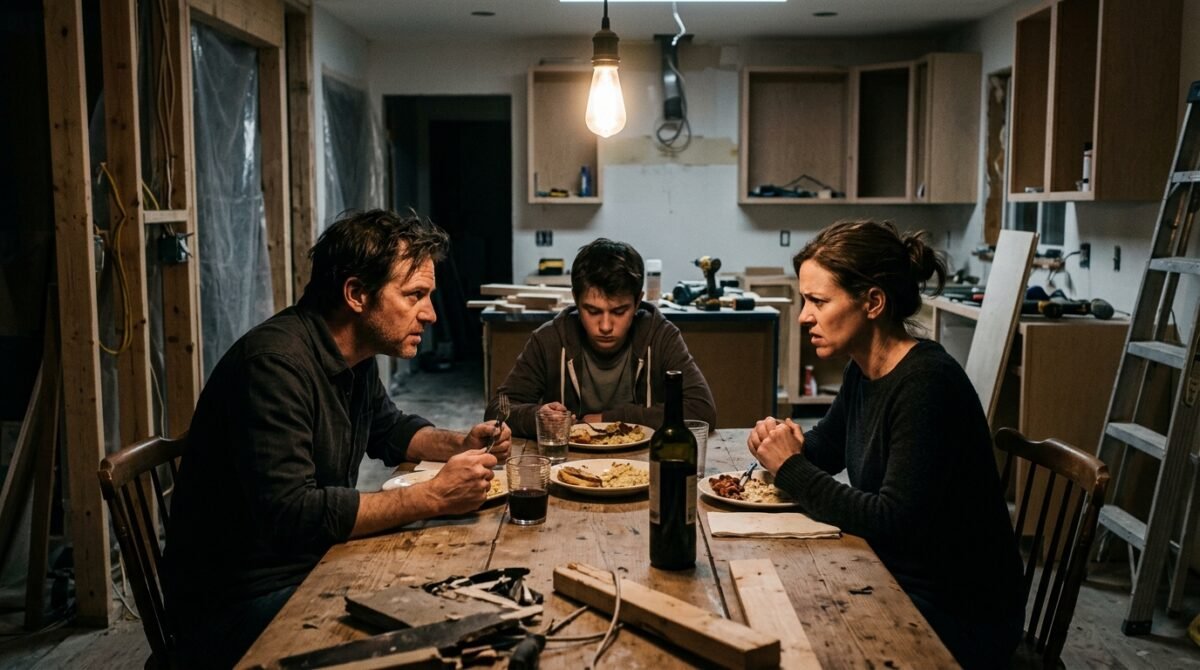
I was invited to Sunday dinner, a clear attempt by my father to ‘mediate’ the situation. I knew it was a setup, but I went anyway. I wanted to see them face-to-face, to hold my ground in the very space where the destruction had taken place. When I arrived, the kitchen was a wreck—a gaping, unfinished construction zone of bare plywood and exposed wiring. It looked like a tomb.
The table was set with the fine china, a hollow attempt at normalcy. My father sat at the head, looking aged and weary, while Elena sat opposite me, her eyes red-rimmed and her jaw set in a hard, angry line. We didn’t talk about the weather. We didn’t talk about my job. As soon as the first course was served, the topic was breached with a bluntness that only family can muster.
“The bank says I need your signature to unlock the account, OP. You have until Monday to sign it, or we’re involving our lawyers. You don’t get to treat your father’s wife like a common criminal.”
“I didn’t make you a criminal, Elena. Your actions did. The trust stipulates the maintenance of the estate. You destroyed a historical, custom-designed element of the house without permission. That’s a breach of the trust’s operational guidelines.”
My father interjected, his voice trembling. “It’s a house, OP. It’s just a house. Why are you doing this to us? Do you want me to lose the home I’ve lived in for twenty years?” I looked at him, and for the first time, I felt a wave of genuine pity. He wasn’t the victim; he was the enabler who had stood by while his wife dismantled the memory of his first marriage. He was terrified of being alone, so he had surrendered his integrity to keep the peace.
I took a bite of my salad, the silence stretching until it felt suffocating. I told them, calmly and clearly, that the trust would remain frozen until an appraisal of the lost value was completed and a restoration fund was set aside from the household budget—not the trust. If they wanted to ‘modernize,’ they could pay for it with their own money. The look on Elena’s face was one of pure, unadulterated hatred. She realized then that I wasn’t going to fold, and that her leverage over me was non-existent.
The Legal Appraisal of Sentimental Value
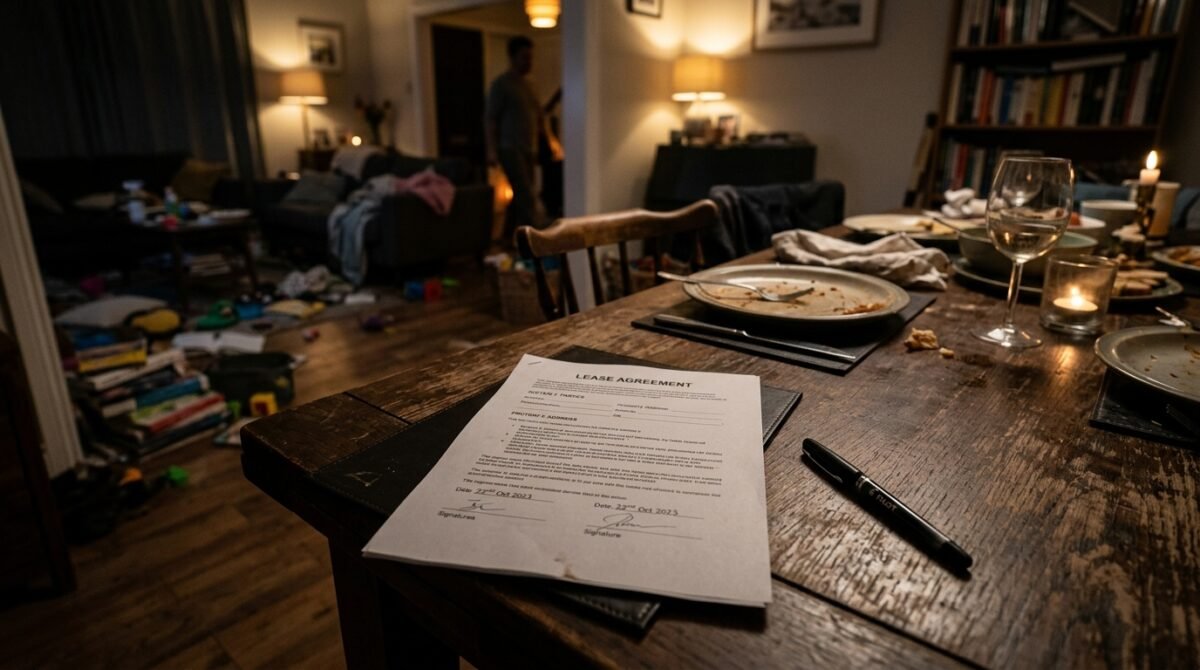
The irony of my situation was that I had to hire a professional appraiser to determine the ‘value’ of something that was, to me, priceless. The company I hired specialized in estate art and custom architectural features. When the appraiser walked into the kitchen and saw the piles of debris, he let out a long, low whistle. He knew exactly what he was looking at.
He spent hours sifting through the remains, documenting the patterns, the craftsmanship, and the historical significance of my mother’s work. He interviewed me about the timeline of the tiles, the materials used, and the documentation I had from when they were originally commissioned. By the time he was finished, he had a number—an estimate for replacement and restoration that was astronomical. It wasn’t just the cost of labor; it was the cost of artistic replication by a specialist.
I presented the bill to my father and Elena. It was not a small sum. It was, in fact, enough to make Elena turn pale. She had expected to replace the tiles with some cheap, big-box store marble, and now she was facing a bill for a custom artisan who would recreate the lost work. The trust would release the funds only if the work was completed by a reputable professional using original techniques.
“You’re bankrupting us. This is vindictive, OP. It’s a literal fortune for a backsplash!”
“It’s the cost of restoration, Elena. You destroyed an heirloom. You don’t get to choose a cheap substitute to fix the damage you caused. Either you pay to have it done right, or the trust remains frozen indefinitely.”
My father looked at the bill, then at Elena, and for the first time, he seemed to be calculating the cost of her ‘renovations’ versus his own comfort. He looked at me and said, ‘Maybe we should have asked you before we did anything.’ It was the closest thing to an apology I was going to get, but it felt empty. The damage was done, not just to the kitchen, but to the trust I had for them. I left the document on the table and walked out.
The legal appraisal was the final nail in the coffin of Elena’s plans. She was trapped by the very document she had ignored. Every time she tried to push back, the lawyer cited the trust guidelines. The, ‘we’ll just use marble’ argument was effectively neutralized by the legal requirement to restore the ‘original artistic character’ of the home. I had turned the system they relied on into their own personal prison.
The Internet Weighs In

I didn’t think the story would leave my family, but Elena’s need for validation was my undoing. She posted a lengthy, edited version of the story on her social media, framing herself as a victim of a ‘controlling, vengeful stepdaughter’ who was using money to hurt her family. She received some sympathy, but then a friend of mine, who saw the post and knew the truth, suggested I share my side on a popular online forum. I was hesitant, but I was also exhausted by the narrative she was spinning.
I wrote the post in a single sitting, detailing the history of the tiles, the broken promise, and the legal mechanism of the trust. I didn’t hold back, but I tried to remain objective. The response was immediate and overwhelming. Thousands of people, many of whom had dealt with similar family inheritance disputes, chimed in with their own experiences. The tide of public opinion shifted rapidly.
“NTA. You aren’t just ‘the stepdaughter.’ You are the executor of a trust that was clearly designed to protect exactly what this woman destroyed. She made a choice to erase your mother’s legacy for her own vanity, and now she’s dealing with the consequences of that choice. Let her suffer the financial stress; she earned it.”
— u/TrustLawExpert (Top Comment, 32.4k upvotes)
“I love the petty justice here. People think they can just bulldoze the past because they’re married to the present. Good on you for having the backbone to actually enforce the rules. Don’t back down. If you do, you’re telling her that her actions have no consequences.”
— u/RedditReader123 (15.2k upvotes)
The validation was comforting, but it also highlighted the reality of the situation. People saw the ‘why’ behind my actions. They understood that it wasn’t about the tiles; it was about the respect for a life that was gone. The comments section became a forum for discussing the importance of boundaries and the often-toxic nature of remarriage dynamics. It was therapeutic, in a way, to see that I wasn’t the only one who had to fight for the sanctity of a late parent’s memory.
There were, of course, the dissenters. Some called me a ‘spoiled brat’ and told me to move on. They didn’t understand the nuance of the trust or the fact that I was legally obligated to protect the estate. But for every critic, there were ten people who understood the gravity of what had been lost. I felt less alone, but the real challenge remained: how to move forward with a family that had fundamentally betrayed me.
The Certified Letter That Changed Everything
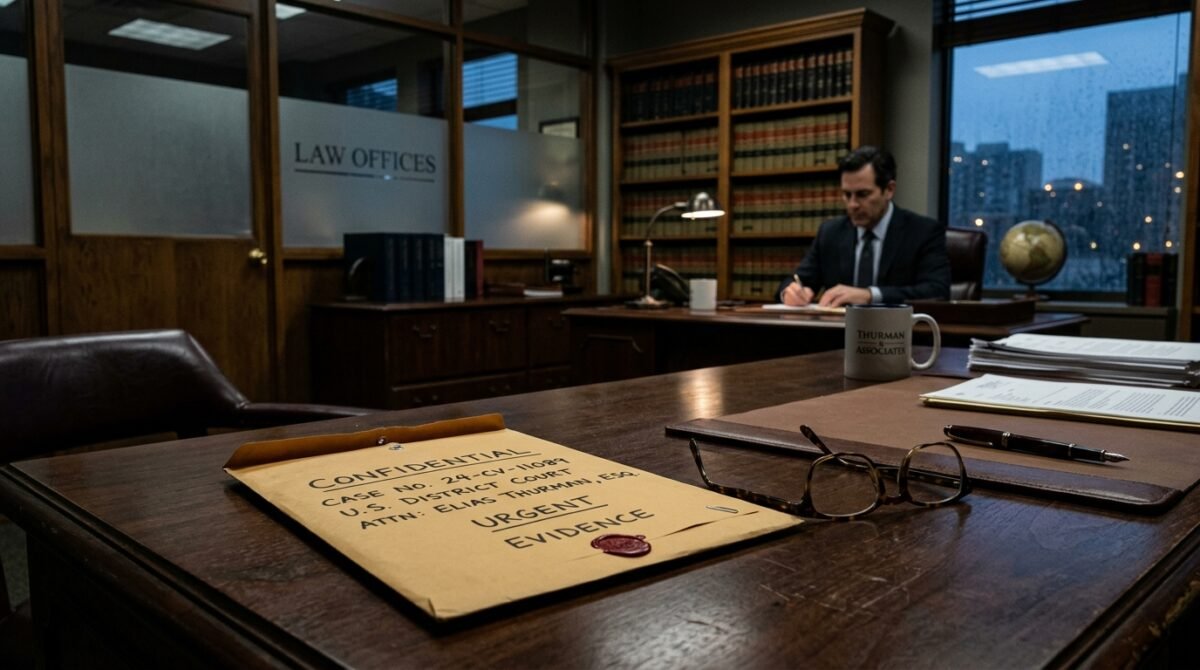
The situation took a turn when I received a certified letter from my father’s attorney. They weren’t asking for the trust to be unlocked anymore; they were threatening to sue me for ‘breach of fiduciary duty.’ They were arguing that my decision to freeze the fund was based on personal animosity rather than legal necessity. It was a bluff, and I knew it, but it was a serious enough threat that I had to retain my own counsel.
My lawyer was a shark. When I explained the situation, he didn’t blink. He looked at the original trust document, then at the photos of the kitchen, and smiled. ‘They don’t have a leg to stand on,’ he said. ‘The trust explicitly gives you the power to withhold disbursements if the property’s value is compromised. By destroying the tiles, they compromised the property. It’s an open-and-shut case.’
“If you want to sue, go ahead. My lawyer is ready to depose both you and Elena about the ‘renovations.’ I’m sure the court will be very interested in why you thought it was okay to destroy a protected asset.”
“This isn’t just about the money, OP. This is about us being a family. Can’t we just reach a settlement?”
“We can reach a settlement when the kitchen is restored to its original state. Until then, the trust remains locked.”
I felt a strange sense of liberation in that moment. For years, I had been the one trying to keep the peace, the one trying to avoid conflict. Now, I was the one setting the terms, and the power dynamic had shifted entirely. They had tried to bully me, and it had backfired. The certified letter was meant to scare me, but it only served to confirm that they were desperate.
I sent a response through my attorney, outlining the steps they needed to take to restore the kitchen. I didn’t care if it was expensive. I didn’t care if it was inconvenient. I wanted them to understand that there were costs to their actions, and that I was the one who controlled those costs. The legal process was slow and tedious, but it was also a shield. It kept them at arm’s length, which was exactly where I needed them to be.
The $1,400 Restaurant Bill Left on the Table

The final straw happened at a local charity gala that we were all required to attend. It was an awkward evening, with my father and Elena trying to play the part of a happy couple while I maintained a professional distance. At the end of the night, the bill for their table—which they had filled with their friends—was placed in front of my father. He looked at it, realized his personal account was tapped out, and then looked at me, expecting me to pick up the tab with my access to the estate account.
I didn’t blink. I stood up, excused myself from the table, and walked to the bar, leaving them to deal with the bill. I saw the look of utter panic on Elena’s face as the server waited for payment. She had to call my father’s assistant to arrange a transfer, an embarrassing scene that played out in front of everyone they knew. It was a petty moment, but it was also a necessary one.
“Are you going to pay it, or am I? Because I’m certainly not going to cover a $1,400 bill for your guests when you still owe the estate for the kitchen repairs.”
“This is public, OP! You’re humiliating us!”
“No, Elena. You’re humiliating yourselves. You don’t have the money to sustain the lifestyle you want, and you don’t have the integrity to admit you made a mistake. That’s on you.”
I didn’t feel guilty. I felt, for the first time in a long time, like an adult. I was no longer the child being told what to do, or the stepdaughter who had to accept whatever scraps of respect were thrown her way. I was the one in control, and I was holding the line. The rest of the evening was a blur of cold stares and whispered conversations, but I didn’t care. I had made my point.
When I got home that night, I realized that I didn’t want the kitchen restored anymore. I didn’t care about the tiles. I realized that the kitchen was just a symbol of something else—my need for validation from my father. By letting go of the tiles, I was finally letting go of the need for his approval. I didn’t need the kitchen to be perfect. I just needed to be free of them.
The Resolution of the Estate

We eventually reached a settlement. The trust was dissolved, and the house was sold. My father and Elena moved into a smaller, more ‘modern’ apartment, and I used my share of the estate to set up a scholarship fund in my mother’s name. It wasn’t the ending I had imagined, but it was the one that gave me the most peace. The kitchen was never restored; it was sold ‘as is,’ and the new owners ripped out the remaining debris to build something of their own.
I lost contact with my father for a while, but we have since begun a tentative, low-contact relationship. He isn’t the same man he was before, and I’m not the same person either. We both lost something in that house—he lost his comfort, and I lost my childhood sanctuary. But we also both gained a sense of reality. He realized that his life couldn’t be bought with my mother’s money, and I realized that my value wasn’t tied to an old house.
“I’m sorry, OP. I should have stood up to her. I should have protected the house. I just… I wanted to be happy again, and I thought that meant moving on.”
“You can’t build a future on the ruins of the past, Dad. You have to honor what was before you can move forward. I’m glad you’re starting to see that.”
The lesson I learned was hard, but it was invaluable. Boundaries aren’t just about saying ‘no’; they’re about enforcing the ‘no’ when things get difficult. It’s about standing up for what you believe in, even when it’s uncomfortable, and even when the people you love are the ones trying to cross those lines. I’m in a better place now, and I’ve learned that the only person whose validation I need is my own.
Looking back, I don’t regret freezing the trust. It was the only way to force them to see the reality of their actions, and it was the only way to protect what remained of my mother’s legacy. It was a painful, messy process, but it was necessary. Sometimes, you have to break things to see how they’re actually held together.
Reflecting on the Aftermath

It has been two years since the incident, and the dust has finally settled. The estate is closed, the house is under new ownership, and the drama has faded into a distant, somewhat surreal memory. I still think about the tiles sometimes—the way the light hit them in the early morning, the way they felt under my feet—but I don’t mourn them anymore. They are a part of my past, not my present.
I’ve learned that life is full of unexpected losses, and sometimes the people we expect to protect us are the ones who cause the most damage. But I’ve also learned that we have the power to define our own legacy. We don’t have to be defined by what others do to us, or by the ways they try to erase us. We can build our own lives, our own homes, and our own traditions.
“It’s strange how something as simple as a few tiles can become the center of your entire world. But when you’re grieving, everything is fragile. I’m just glad I didn’t let them take that from me, too.”
I’ve moved on, and I’m happy. I’ve found a new home, one that I designed myself, with a kitchen that is exactly the way I want it. It doesn’t have my mother’s tiles, but it has something better: it has peace. And that, I’ve learned, is the most important thing of all. I hope this story serves as a reminder to anyone who feels like they’re losing control: you have more power than you think, and it’s okay to use it to protect what matters.
Thank you to everyone who supported me through this journey. Your words, your advice, and your understanding helped me through the hardest moments of my life. To those who disagreed, thank you too; you helped me refine my own beliefs and understand the nuance of my own boundaries. It’s been a long, complicated ride, but I’m finally at the destination.
Conclusion
This saga of the shattered tilework is more than a viral Reddit story; it’s a modern parable about the collision of entitlement and legacy. The moral dilemma highlights how easily we can confuse ‘ownership’ with ‘stewardship.’ Elena viewed the house as an asset to be liquidated into her own image, while the narrator viewed it as a sacred vessel of memory. When those two worldviews clashed, the outcome was inevitably destructive.
Ultimately, the narrator’s decision to freeze the estate trust was not merely an act of revenge, but an act of restorative justice. It forced the antagonists to confront the material cost of their disregard for the past. Whether you believe the narrator went too far or acted with justified precision, the story underscores the necessity of clear, legally backed boundaries in complex family dynamics.
What would you have done? Would you have allowed the ‘renovations’ to stand to keep the peace, or would you have fought for the legacy at the cost of your family relationship? Share your thoughts in the comments below—does the preservation of a parent’s art justify the permanent severing of a familial tie?
What's your verdict on this dilemma?
Vote below to contribute to the official community consensus.

Have a Dilemma Keeping You Up at Night?
Share your real-life feud, wedding chaos, or relationship crossroads anonymously with our editorial team.
What do you think ?
0 Comments🛡️ Comments are moderated to protect community integrity. Your comment will appear once approved by the editorial team.