

For most people, a graduation ring is more than just a piece of jewelry. It represents years of late-night study sessions, the crushing weight of student loans, and the quiet pride of achieving a milestone that once felt impossible. For me, my ring was a promise I made to myself: that no matter how hard life got, I had earned my place in the world. It was a modest, gold-banded heirloom, purchased with my first real paycheck after months of penny-pinching.
My sister, Sarah, has always operated under a different set of rules. Growing up, our family dynamic was defined by a quiet, unspoken understanding that Sarah’s desires were emergencies, while mine were merely suggestions. Whether it was borrowing my clothes without asking or ‘accidentally’ losing my favorite childhood items, there was always an excuse. But I never expected her to look at my professional success and decide that its physical manifestation—my ring—was the perfect material for her daughter’s accessory.
The request came on a Tuesday, delivered with the casual air of someone asking to borrow a cup of sugar. It wasn’t a question; it was a directive. The audacity of the demand wasn’t just in the object itself, but in what it represented: a total disregard for my autonomy and the sentimental value I placed on my own achievements. Little did I know, this single conversation would serve as the bridge-burner for our entire relationship.
As I sat there, stunned into silence, the room seemed to shrink. I looked at my sister—someone I had loved, supported, and covered for my entire life—and realized that for the first time, I wasn’t just going to be the ‘accommodating sibling.’ I was going to be the one who finally drew a line in the sand, even if it meant losing my family in the process.
The Tuesday Afternoon Visit That Shattered My Peace

It started like any other afternoon. Sarah showed up at my apartment unannounced, carrying her six-year-old daughter, Lily. She wasn’t there for a social call; she had an agenda. After ten minutes of small talk about the weather and her neighbor’s new car, she spotted my graduation ring sitting on the vanity in my bedroom.
She picked it up, turned it over in the sunlight, and sighed with a look of predatory satisfaction. I didn’t think much of it until she looked me dead in the eye and laid out her plan. She told me that Lily had a ‘milestone’ coming up—a birthday—and she wanted to get her a custom charm bracelet. Not just any bracelet, but something ‘legacy-based’ and ‘meaningful.’ That was when the request dropped.
“You don’t even wear this ring that much anymore, and it’s just sitting there collecting dust. I want you to give it to me so I can take it to the jeweler. It’s the perfect gold for a charm bracelet for Lily. It’s sentimental, you know?”
— Sarah
I felt a cold shiver run down my spine. I had worked two jobs during my final year of university just to afford that ring. It wasn’t just gold; it was blood, sweat, and tears in physical form. I asked her if she was joking, but her expression remained completely flat. She wasn’t asking; she was expecting me to be grateful that she had found a ‘purpose’ for my property.
I explained to her, as calmly as I could, that the ring was not for sale, nor was it a gift. It wasn’t up for discussion. I told her that I planned to keep it for my own future or perhaps pass it down to my own child one day. I thought that would be the end of it, but Sarah had a different definition of ‘no.’
The argument escalated quickly. She started listing all the things I had ‘denied’ her over the years, framing my personal boundaries as acts of selfishness. It was the classic manipulation tactic: turn the victim into the villain. By the time she left, she was slamming my door, leaving me in a state of shock that I hadn’t felt since I was a teenager.
The Inevitable Blast In The Family Group Chat
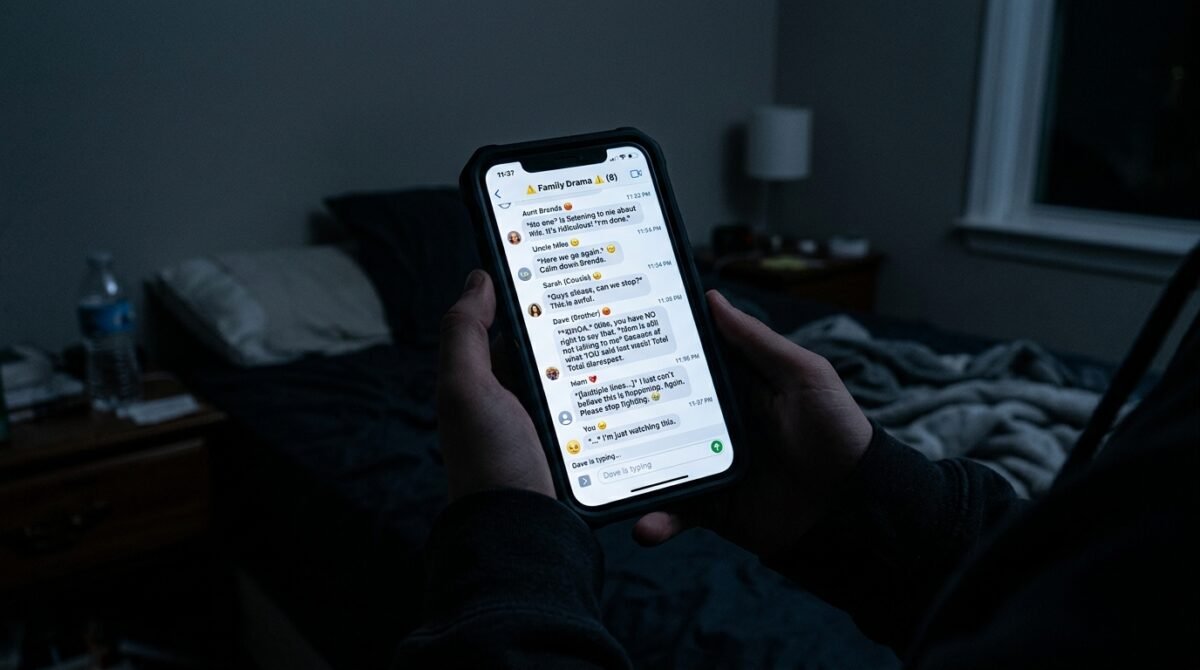
I thought the confrontation would stay between us, but I drastically underestimated Sarah’s need for validation. Within an hour of her leaving, my phone began buzzing incessantly. I opened the family group chat to find a series of messages that made my stomach turn. She hadn’t just told them I said no; she painted a portrait of me as an elitist, cold-hearted person who prioritized gold over her own niece.
“I don’t know why she’s so obsessed with material things. I asked her for a simple piece of gold to help Lily feel special, and she practically threw me out of the house. It’s honestly sad to see what she’s become.”
— Sarah in the Family Group Chat
My mother immediately chimed in, asking me why I couldn’t just ‘keep the peace’ and give my sister the ring. It was the typical refrain of a family that had spent years enabling Sarah’s bad behavior. No one asked what happened. No one asked why I was upset. They simply expected me to surrender, as I always had, to keep the ecosystem of their dysfunction stable.
I watched as my siblings started piling on, one by one. There was talk of ‘family unity’ and ‘generosity,’ words that felt like sharp glass in my throat. I realized then that my belongings were viewed as communal property, but only when Sarah wanted them. If I needed help, I was told to handle it myself. But if Sarah wanted something, the whole family became her personal collection agency.
I didn’t argue. I didn’t defend myself. I knew that anything I said would be twisted and used to further the narrative that I was the problem. I typed out a short, firm message explaining that the ring was a personal memento and that I would not be discussing it further. Then, I put my phone on silent. The silence in my apartment was deafening, but it was the first time I felt like I was actually breathing.
The Midnight Phone Call That Sealed The Deal

The night after the group chat explosion, the phone rang at 2:00 AM. I knew it was Sarah. She had a habit of calling when she knew I was vulnerable, hoping to catch me off guard. I let it go to voicemail, but she didn’t stop. She called five times in a row, each time leaving a voicemail that became increasingly unhinged.
The final voicemail was the turning point. She wasn’t even talking about the ring anymore. She was attacking my character, my career, and my choice to move out and live independently. She called me ‘unstable’ and ‘unhinged’ for ‘hoarding’ family history. It was pure projection, and listening to it felt like watching a slow-motion car crash.
“You’re really going to let a piece of metal ruin our relationship? You are pathetic. If you don’t call me back with the ring by morning, don’t ever expect to be invited to a family event again. We don’t need selfish people in this house.”
— Sarah’s Voicemail
I listened to the message twice. I felt a weird sense of clarity. For years, I had been terrified of being ostracized by my family. I had curated my life to avoid conflict, to stay small, to keep everyone happy. But Sarah had just given me a gift: she had shown me exactly where I stood in her hierarchy. I was an object, not a sibling.
I didn’t call back. I didn’t send a text. I didn’t engage in the cycle. Instead, I opened my laptop and started looking at the cost of changing my locks. I realized that the threat of ‘not being invited to family events’ wasn’t a punishment—it was a promotion. It was the permission I needed to step away from a dynamic that had been suffocating me for decades.
The next morning, I woke up early. I didn’t feel sad. I felt a strange, quiet resolve. I walked over to my desk, picked up the ring, and put it into a small, velvet-lined safe. It wasn’t just a ring anymore; it was a symbol of my independence. And for the first time in my life, I felt truly free.
Why The Internet Stood Behind Me

When I finally posted the story to a forum for family conflicts, I wasn’t expecting the tidal wave of support that came in. I thought people might call me out for being petty. I thought they might say it’s just a ring and family matters more. But the community response was overwhelming. Thousands of people agreed that the ring was a boundary, not a bargaining chip.
“She isn’t asking for a ring; she’s testing to see if she can still control you. The fact that she went to the family group chat to smear you shows she has no respect for your autonomy. Keep the ring, keep the distance, and thank yourself later.”
— u/RedditUser99 (Top Comment, 28.5k upvotes)
The consensus was clear: Sarah was using the ring as a tool to maintain power. Many users shared their own experiences with ‘entitled relatives’ who viewed their siblings as extensions of themselves. It was validating to see that I wasn’t the ‘crazy one’ for refusing to melt down a sentimental object for someone else’s vanity project.
People were particularly struck by the fact that she wanted to melt it down. It wasn’t even about keeping the ring intact; it was about destroying something that belonged to me to create something that belonged to her. The symbolism was too blatant to ignore. It was an act of erasure, and the internet saw it for exactly what it was.
The comments were a mix of practical advice and emotional support. Some recommended legal steps if she continued to harass me, while others simply told me to enjoy my ‘newfound peace.’ For the first time, I felt like the ‘villain’ narrative Sarah had constructed was crumbling under the weight of external, objective reality.
The Aftermath: When Silence Becomes A Language

The weeks that followed were quiet, but they were the most peaceful weeks of my adult life. I didn’t reach out to my parents or my siblings. I realized that by staying silent, I was no longer providing the fuel Sarah needed to keep the drama going. Without my reaction, her outbursts in the group chat started to lose their impact.
My mother eventually tried to call, but I let it go to voicemail. When I finally listened, it was the same old story: ‘Sarah is so upset,’ ‘You’re being too sensitive,’ ‘Can’t you just talk to her?’ There was never an apology for the insults, never a recognition of the boundary I had set. That silence from them told me everything I needed to know about where their priorities lay.
I started focusing on myself. I took up new hobbies, I spent more time with friends who actually respected my boundaries, and I began to heal from the years of emotional labor I had poured into my relationship with my family. It’s hard to unlearn a lifetime of ‘people-pleasing,’ but every day it gets a little easier.
I still have the ring. Sometimes, when I’m having a bad day, I look at it and remember why I kept it. It reminds me that I have value, that my achievements are my own, and that I don’t owe anyone a piece of my soul—or my jewelry—just because they demand it. The distance has been a hard choice, but it’s the only choice I could have made.
The Price Of Emotional Entitlement

Looking back, I realize that the ring was just the final domino. Sarah had been pushing boundaries for years, and I had been letting her. Whether it was borrowing money she never paid back or expecting me to host holidays I couldn’t afford, the entitlement was deep-rooted. The ring demand was simply the most absurd, and therefore the most visible, attempt to claim my space.
When you grow up with someone who is constantly taking, you lose the ability to see where your own needs end and theirs begin. You start to believe that their happiness is your responsibility. That’s a dangerous way to live. It keeps you in a state of perpetual anxiety, waiting for the next ‘demand’ that you’ll feel guilty for refusing.
Cutting contact was, in a way, an act of radical self-love. It wasn’t about hurting Sarah; it was about protecting myself. It was about saying that I am not a resource to be harvested. It’s a lesson I wish I had learned years ago, but I’m grateful I learned it at all. The price of that peace was a family rift, but the cost of staying would have been my own sanity.
I don’t know if I’ll ever speak to them again. Maybe one day, there will be an apology. Maybe one day, they will understand. But I’m not waiting for that anymore. My life is mine, my ring is mine, and my peace is finally, truly, mine.
The Final Verdict: NTA Or A Part Of The Problem?

Some of my extended family members reached out, trying to play mediator. They told me I was ‘too stubborn.’ They said that Sarah was ‘stressed’ and ‘just wanted to do something nice’ for her daughter. It’s fascinating how people always excuse the aggressor by focusing on their ‘good intentions,’ while ignoring the actual impact of their actions.
“If the sister wanted to do something nice for her daughter, she should have bought a bracelet with her own money. Using your sibling’s hard-earned graduation ring is not a ‘nice gesture’—it’s theft with a side of emotional manipulation.”
— u/FamilyDramaExpert (12.4k upvotes)
The community was firm: NTA (Not The Asshole). The fact that I was even questioning whether I was the one in the wrong is a testament to how deeply the gaslighting had taken root. We are conditioned to apologize for our boundaries, to feel guilty for saying ‘no,’ and to treat our family members as if they have an inherent right to our lives.
The debate in the comments was fierce, but it always came back to the same point: you don’t owe your family your belongings, your money, or your labor. You owe them respect, which they failed to give me, and you owe yourself self-respect, which I finally chose to give myself. The consensus was clear: the relationship was toxic, and my reaction was the only healthy way forward.
I stopped reading the comments after a while. I didn’t need the internet to tell me I did the right thing. I needed to feel it in my own life. And when I finally looked at my bank account, my schedule, and my heart, I saw that everything was better without the constant drain of Sarah’s entitlement. The ‘verdict’ was irrelevant; the reality was undeniable.
Moving Forward: The Art Of Setting Boundaries

Learning to say no is a skill, and like any other skill, it takes practice. I’ve started setting smaller boundaries in other areas of my life. I don’t answer every text immediately. I don’t agree to plans I don’t want to attend. I’m learning that my time is a non-renewable resource, and I’m the only one who can decide how it’s spent.
It’s a strange transition, moving from a life of constant compromise to a life of intentionality. Sometimes I feel lonely, especially during the holidays. There’s a part of me that misses the ‘idea’ of a sister, the ideal version of the relationship I wish we had. But then I remember the reality, and the feeling passes.
I’ve realized that the ‘family’ you choose is often more reliable than the one you’re born into. I’ve surrounded myself with friends who celebrate my wins rather than trying to melt them down. They respect my boundaries, they don’t demand my things, and they support my growth. It’s a different kind of love—one based on mutual respect rather than obligation.
For anyone else dealing with an entitled sibling, know this: you are not responsible for their feelings. You are not responsible for their life choices. You are only responsible for yourself. And if that means losing people who don’t respect you, then maybe that’s the price of a life worth living.
The Symbolism Of The Ring In My Life Today

Today, the ring sits on my finger whenever I go to a professional event. It’s a reminder of who I am and what I’ve accomplished. When someone asks about it, I tell them the truth: it’s my graduation ring. It represents a time when I had to be strong, when I had to fight for my own future, and when I had to learn that my worth isn’t defined by what I can give to others.
I don’t tell the story of the demand unless I’m asked. I don’t want to be the person who defines herself by her family trauma. I want to be the person who defined herself by her resilience. The ring is now just a ring again. It’s not a weapon, it’s not a point of contention; it’s a piece of jewelry that I love.
There is something empowering about reclaiming an object that was meant to be stolen. It’s a small victory, but it’s mine. I look at it and I don’t see Sarah’s face. I don’t see the group chat. I don’t see the arguments. I see my own path, my own decisions, and my own strength. And that’s all I ever wanted.
If Sarah ever does try to reach out—and I suspect she might, eventually—I’m ready. I have the boundaries, I have the perspective, and I have the peace of mind. I won’t be drawn back into the chaos. The ring stays, the contact stays cut, and my life continues to move forward, better than it ever was before.
Lessons Learned In The Wake Of The Feud

If I could go back and talk to my younger self, the one who was always trying to keep the peace, I would tell her that she was already enough. I would tell her that she didn’t need to give away her jewelry to be ‘a good sister.’ I would tell her that her value wasn’t something to be negotiated by other people’s wants.
The most important lesson I’ve learned is that you cannot change people who don’t want to change. You can argue, you can explain, you can beg, but at the end of the day, someone who is determined to treat you as an object will never see you as a person. That is not your fault, and it’s certainly not your responsibility to fix.
I’ve learned to appreciate the quiet. I’ve learned to trust my own voice. And I’ve learned that sometimes, the hardest decisions are the ones that lead to the best lives. I didn’t want to lose my sister, but I did want to save myself. And in the end, that was the only outcome that actually mattered.
So, here I am. A little older, a little wiser, and a lot more guarded. But I’m also happier. I’m living for myself, and for the first time, I feel like I’m actually in control of my own story. And that is a gift that no one can ever take away from me.
Conclusion
My story, while specific to a graduation ring, is a reflection of a much larger issue that many of us face: the struggle to define our identity and our boundaries in the shadow of family entitlement. It wasn’t about the gold; it was about the lack of respect for the effort and the milestones that made me who I am.
When we choose to walk away from toxic relationships, we are not just leaving behind a person or a conflict; we are stepping into the space where we can finally grow. The path is rarely easy, and it often involves heartbreak, but it is the only way to ensure that our future is defined by our own actions, not by the demands of others.
I’d love to hear your thoughts. Have you ever had to cut off a family member because of an unreasonable demand? How did you deal with the guilt, and what did you learn about your own boundaries? Share your experiences in the comments below, and let’s keep the conversation going.
Poll: If you were in my shoes, would you have given up the ring to ‘keep the peace,’ or would you have stood your ground?
- I would have given it up to avoid the conflict.
- I would have stood my ground and cut contact.
- I would have stood my ground but tried to keep the peace.
- I don’t think a piece of jewelry is worth a family relationship.
What's your verdict on this dilemma?
Vote below to contribute to the official community consensus.

Have a Dilemma Keeping You Up at Night?
Share your real-life feud, wedding chaos, or relationship crossroads anonymously with our editorial team.
What do you think ?
0 Comments🛡️ Comments are moderated to protect community integrity. Your comment will appear once approved by the editorial team.