

Growing up, my brother Leo and I were as different as night and day. While I spent my twenties grinding through entry-level jobs and saving every penny to build a secure, independent life, Leo always operated on the belief that the world owed him a soft landing. I chose a childfree path, prioritizing financial freedom, travel, and a peaceful home, while Leo married young and had two children by twenty-five.
For years, this difference in lifestyle was just a background hum in our family dynamic. I was the ‘cool’ aunt/uncle who showed up with expensive gifts, and they were the family I visited for holidays. But the atmosphere shifted the moment Leo decided to pivot his career and pursue a private university degree that carried a hefty price tag of $25,000 per year.
The request didn’t come as a polite inquiry. It arrived as a manifesto, a bizarrely drafted document that laid out why my bank account was essentially ‘community property’ for his children’s future. It was the first time I realized that my childfree status wasn’t just a lifestyle choice in my brother’s eyes—it was a moral failing he believed he had the right to tax.
This article explores the fallout of that demand, the erosion of our sibling bond, and the startling realization that some family members view your boundaries not as personal autonomy, but as a resource to be plundered. It is a story about the intersection of financial entitlement and the radical idea that we are only responsible for the lives we choose to create.
The Manifestation of the ‘Childfree Tax’

It started on a rainy Tuesday afternoon. I was sitting at my desk when a long, formatted email pinged into my inbox. I assumed it was a family update or perhaps a request to borrow a car, but as I scrolled, the tone grew increasingly demanding. Leo had spent weeks crunching numbers—not for his own budget, but for mine.
He argued that because I didn’t have the ‘burden’ of raising children, I had an excess of disposable income that was effectively sitting idle. He went as far as to create a spreadsheet documenting my ‘projected savings’ over the next five years, comparing it to his tuition costs. He framed the $25,000 payment as a contribution to ‘the next generation,’ implying that my existence as a childfree person made me a perpetual debtor to those who had offspring.
The sheer arrogance of the email left me breathless. He wasn’t asking for a loan; he was presenting me with a bill for his own life choices, masquerading it as a moral imperative. I read the email three times, wondering if this was some elaborate prank or a cry for help, but the language was cold, calculated, and terrifyingly sincere.
“You have no dependents, no school fees, and no real responsibilities. Paying for my education isn’t charity; it’s your social duty to invest in the next generation. My kids are the future, and you are the benefactor.”
— From Leo’s email to me
I realized then that this wasn’t just about the money. This was about Leo’s deep-seated resentment of the life I had built for myself. He looked at my quiet apartment and my career stability and saw a void that he felt entitled to fill with his own financial problems. It was a complete disregard for the years of sacrifice I had made to get to where I was.
I waited for a follow-up, expecting him to realize how insane his demand sounded. Instead, he sent a text message later that evening, asking if I had ‘processed the figures’ yet. The entitlement was so absolute, so unblinking, that it chilled me to the bone.
The Sunday Dinner Sabotage
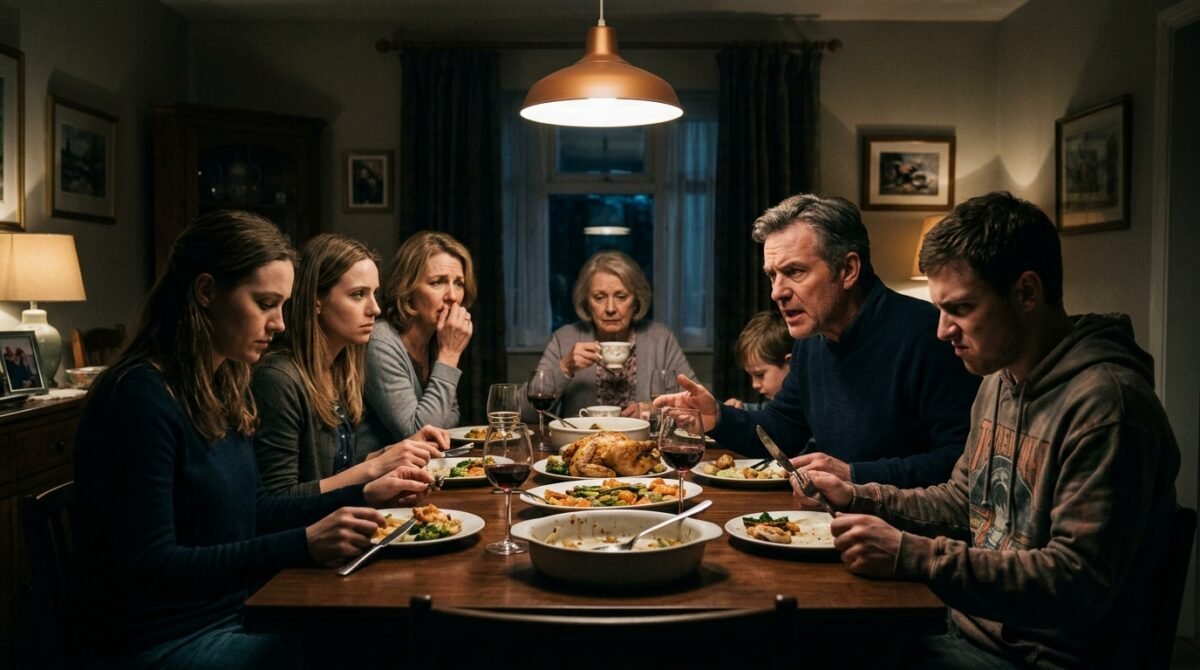
The next family dinner was an exercise in extreme, agonizing tension. I arrived expecting to talk about the weather or work, but Leo had clearly brought his artillery. The moment we sat down, he started talking loudly about the ‘value of family support’ and how ‘selfish’ some people are when they hoard their wealth while their own blood struggles to improve themselves.
My parents looked back and forth, clearly oblivious to the specific context of his rant. They were used to Leo being dramatic, but this felt pointed, sharp, and intended to cause maximum discomfort. I sat there, methodically cutting my roast beef, refusing to give him the satisfaction of a confrontation in front of our aging parents.
Finally, Leo leaned across the table, his eyes fixed on mine. He didn’t use a subtle approach anymore. He wanted an audience for his performance, and he was determined to make me the villain of his narrative. He laid out the ‘tuition argument’ in front of my mother and father, painting himself as a hardworking father trying to secure a future, while I was the cold, wealthy sibling hoarding resources.
“I don’t understand why this is even a discussion. OP has no children, no debt, and a high salary. It would be a drop in the bucket for them to ensure my kids have a father with a degree, but they’d rather spend it on designer bags.”
— Leo, at the dinner table
The silence that followed was deafening. My father stopped eating and stared at Leo with a mixture of confusion and disappointment. My mother looked at me, her face pale, clearly realizing that the situation had escalated far beyond a simple disagreement. I felt a surge of adrenaline, but I forced myself to stay calm. I knew that if I exploded, I would be the one blamed for ruining the dinner.
I put my fork down and looked directly at Leo. I didn’t yell. I didn’t cry. I simply stated that his financial choices were his own and that my bank account was not a public utility. The look on his face shifted from righteous anger to pure, unadulterated shock. He couldn’t fathom that I would dare to speak against his narrative in front of our parents.
The Leaked Family Group Chat

The fallout from the dinner was immediate. Within twenty-four hours, a group chat was created, and I was added to it without a word of warning. It wasn’t just Leo; he had brought his wife and his cousins into the mix, creating a choir of voices designed to pressure me into submission. They were sharing articles about ‘generational wealth’ and ‘family loyalty’ like it was a holy crusade.
I watched as my phone buzzed incessantly. Message after message criticized my ‘selfishness’ and ‘lack of family values.’ It was a coordinated campaign of guilt-tripping, aimed at isolating me and forcing me to capitulate. They didn’t see a human being; they saw a wallet with legs that was failing to perform its duty.
“We just want to understand why you’re being so difficult. Everyone else is chipping in a little, but you’re refusing to help your own brother. Don’t come crying to us when you’re old and alone.”
— Leo’s wife in the family group chat
I realized then that this group chat was never meant to be a conversation. It was a digital firing squad. I took a deep breath and drafted a firm response, stating clearly that I would not be participating in this discussion and that my financial decisions were final. I then muted the chat, feeling a strange sense of liberation for the first time in weeks.
The audacity of these people to think they had a say in my bank account was staggering. They had spent years mocking my childfree lifestyle, calling me ‘bored’ or ‘aimless’ because I wasn’t exhausted by the grind of parenthood. Now, they were trying to extract the fruits of that same lifestyle to fund the very things they claimed were the source of their superior status.
It was a paradoxical form of hypocrisy. They wanted the benefits of a conventional life, but they wanted the childfree to pay the tax for the privilege. I wasn’t just saying no to the money; I was saying no to the entire framework of entitlement they had built around me.
The Reddit Verdict: Echoes of Solidarity

When I finally posted my story to a popular subreddit, I wasn’t sure what to expect. I feared the internet would call me cold, or perhaps that I was being too hard on my brother. But the response was overwhelmingly, aggressively in my favor. Thousands of comments poured in, validating my boundaries and pointing out the toxic nature of my family’s expectations.
The consensus was clear: my brother’s ‘childfree tax’ was not only insane, it was predatory. People shared their own stories of relatives demanding money, of family members assuming that childfree people were ‘rich’ by default, and of the struggle to maintain healthy boundaries in the face of emotional manipulation.
“The audacity of someone telling you that your life choices make you responsible for their tuition is beyond delusional. You are not a bank, and you are not an ATM for his poor life planning. Stick to your guns, OP. You owe them nothing.”
— u/ReasonableObserver (Top Comment, 32.5k upvotes)
Reading those comments was like breathing fresh air. I had spent so long feeling guilty that I had started to doubt my own reality. Seeing thousands of people affirm that I had every right to my own money, my own time, and my own autonomy gave me the strength to stand my ground when the next wave of pressure inevitably arrived.
I spent hours reading through the advice, learning about ‘grey rocking’ techniques and how to handle familial gaslighting. I wasn’t just fighting for my $25,000; I was fighting for the right to exist on my own terms. The internet community acted as a mirror, showing me the absurdity of my brother’s claims from an objective, detached perspective.
It also made me realize that I wasn’t alone. This wasn’t a unique dilemma; it was a societal one. The pressure to conform, to sacrifice, and to prioritize family above self was a theme that resonated with millions of people who felt suffocated by the expectations of those who couldn’t respect personal boundaries.
The Unannounced Front Porch Confrontation

I thought the storm had passed when I stopped responding to the group chat, but Leo was not one to let a ‘good’ grievance go to waste. He showed up at my house on a Saturday morning, unannounced and visibly agitated. He paced on my front porch, knocking loudly, clearly expecting me to open the door and capitulate once he was in my personal space.
I opened the door, but I didn’t invite him in. I stood in the doorway, blocking the path, feeling the cold morning air. Leo looked disheveled, his eyes wild with a mixture of desperation and entitlement. He launched immediately into a speech about how his children would suffer because of my ‘greed,’ as if I were personally robbing them of an education.
“Do you have any idea how hard it is to provide for two kids while trying to better yourself? You have it so easy. You live in this house, you have this job, and you won’t even help your brother get a degree. You’re a monster.”
— Leo, standing on my front porch
I looked at him, really looked at him, and realized that he was a man who had never been told ‘no.’ He had spent his life waiting for others to fix his problems, and now that the well was dry, he was lashing out like a spoiled child. I felt no pity, only a cold, hard resolve to end the conversation then and there.
I told him that his children’s future was his responsibility, not mine, and that he needed to leave. I told him that I would not be bullied or shamed into paying for his choices. When he tried to push past me, I pulled out my phone and told him I would call the police if he didn’t leave my property immediately. The look of disbelief on his face was almost comical.
He walked away, muttering under his breath, leaving me trembling but victorious. I locked the door and slid the deadbolt, feeling the weight of the moment pressing down on me. I had finally severed the cord, and for the first time in my life, I felt truly safe.
The Financial Reality Check

After the confrontation, I decided to do some math of my own. I wasn’t interested in funding his tuition, but I was curious about where the money would have actually gone. I did some research on the university he was ‘planning’ to attend. The tuition was expensive, but there were countless grants, scholarships, and federal loans available for parents in his situation.
He hadn’t even applied for them. He had jumped straight to ‘ask my childfree sibling’ as his primary financial strategy. It was a lazy, entitled shortcut that bypassed all the actual work required to fund a degree. The realization that he hadn’t even tried to secure funding himself made his demand even more insulting.
| Source | Status | Effort Required |
|---|---|---|
| Federal Loans | Never Applied | Medium |
| University Grants | Never Applied | High |
| Sibling’s Savings | Demanded | Zero |
It was clear that Leo didn’t want a solution; he wanted a handout. He wanted to maintain his lifestyle without having to navigate the complicated, difficult world of adult financial responsibility. And he wanted to frame me as the villain for refusing to be his ‘easy’ answer. It was a calculated manipulation, and I was finished playing along.
I started to see how my family had enabled this for years. Every time Leo had a problem, someone was there to bridge the gap. My parents, my aunts, my cousins—they were all part of a network that kept Leo from ever having to face the consequences of his choices. I had been the only one to hold the line, and that was why I was the target.
I felt a strange sense of detachment from the family dynamic. They were all participating in a cycle that was ultimately destructive to everyone involved. I realized that my refusal wasn’t just a win for my bank account; it was a stand against a system of enabling that had poisoned my brother’s character.
The Fallout: Silence and Sanctions

In the weeks that followed, the family fell into a heavy, awkward silence. My mother tried to act as an intermediary, calling me to ‘hear Leo’s side’ and suggesting that ‘family is family, regardless of the money.’ I explained to her, calmly and clearly, that I would not be part of any discussion that involved my money being treated as a resource for Leo.
The family gatherings stopped. I wasn’t invited to the next birthday, and I didn’t reach out to ask why. It was a clear sign that I was being punished for my ‘selfishness.’ I spent the weekends I would have spent with them enjoying my own life—hiking, reading, and focusing on my career. The peace was worth every ounce of the isolation.
“If you can’t support your brother when he’s struggling, then don’t expect us to invite you to celebrations. You’ve made your choice, and it’s a very lonely one.”
— My mother, in a voicemail
I listened to the voicemail and felt only a mild sadness. I wasn’t lonely; I was free. I had cultivated a community of friends who respected my boundaries and who would never dream of demanding a ‘childfree tax.’ I realized that the definition of ‘family’ I had been raised with was broken—it was based on obligation, not mutual respect.
The sanctions, as they were, were a gift. They gave me the space to redefine my life without the constant pressure of family expectations. I started to see the beauty in being ‘the black sheep.’ It meant I was the one who had broken the cycle of entitlement. I was the one who had dared to say ‘no’ to the pressure to conform.
The silence didn’t feel like a punishment; it felt like a boundary. I wasn’t going to be the one to break it. I had said what I needed to say, and now the ball was in their court. If they wanted to continue the silence, that was their choice. I was happy with my own.
The Revelation of Long-Held Resentment

I eventually learned that this wasn’t just about the $25,000. Through a cousin who had finally stopped playing the middleman, I found out that Leo had been complaining about my ‘lavish’ lifestyle for years. He saw my ability to travel, my home decor, and my lack of stress as a personal slight against him and his chaotic, demanding life.
He felt that by choosing not to have kids, I was choosing to ‘cheat’ the system. He believed that the life I led—a life of stability and freedom—was essentially stolen from him, or at least a mockery of the ‘real life’ he was living. It was a deep, pathetic insecurity that he had been projecting onto me for over a decade.
This revelation shifted my understanding of the entire conflict. It wasn’t about the tuition; it was about his inability to come to terms with his own life choices. He was using me as a scapegoat for his own unhappiness, blaming my ‘childfree status’ for the weight of his responsibilities. It was a tragic, if predictable, turn of events.
“He’s always been jealous of you, OP. He thinks you’re playing the game on easy mode, and he hates that you don’t feel guilty about it. He wanted you to pay him so he could feel like your ‘struggle’ was finally real.”
— A cousin who reached out privately
Knowing this didn’t make me angry; it made me feel sad for him. What a miserable way to live, constantly comparing yourself to others and feeling entitled to their success. I realized that my refusal was actually an opportunity for him to finally face his own discontent, even if he wasn’t ready to do so yet.
I chose to let go of the anger. I realized that his resentment was a burden he had to carry, not me. I had lived my life, made my choices, and I was content with the results. If he wanted to spend his life looking at my bank account instead of his own future, that was his tragedy, not mine.
The insight provided a layer of closure I hadn’t expected. I no longer felt the need to defend my lifestyle or my financial decisions. I was comfortable in my own skin, and that was something he could never take away from me, no matter how hard he tried to manipulate the situation.
The New Normal: Boundaries as a Lifestyle

Today, my life is different. I am no longer part of the family group chat, and I don’t attend the Sunday dinners. I have established a firm boundary that has made my life exponentially more peaceful. I have learned that saying ‘no’ is not an act of hostility; it is an act of self-preservation.
I have used the money I saved to invest in my own goals, and I have found a profound sense of satisfaction in my independence. I still hear snippets of family news from time to time, but I don’t engage. I have learned to protect my peace, and I don’t apologize for it anymore.
The ‘childfree’ label, once used as a weapon against me, has become a badge of honor. It represents the freedom I have to craft my own life, to set my own priorities, and to live without the weight of expectations I never asked for. It is a life of intention, and I am grateful for it every single day.
“The most powerful thing you can do when someone tries to make you feel guilty for your success is to simply continue succeeding. Your life is not a resource for others to exploit.”
— A life coach friend
I hope that by sharing my story, others who feel pressured by entitled family members will find the strength to set their own boundaries. You don’t owe anyone your life, your money, or your future. Your choices are yours alone, and you are worthy of respect, regardless of whether you have children or not.
The journey hasn’t been easy, but it has been worth it. I am the architect of my own life, and I wouldn’t have it any other way. I have learned that the people who truly matter in your life will respect your boundaries, and those who don’t were never really on your team to begin with.
So, here I am, standing on the other side of the fire, stronger, wiser, and more committed to my own happiness than ever before. If you find yourself in a similar situation, remember: you are not a bank, you are not a tax, and you are certainly not a benefactor for someone else’s lack of responsibility.
Reflecting on the Future

Looking back, the entire experience was a crucible. It tested my values, my patience, and my resolve. It showed me exactly who I was and what I was willing to tolerate. And most importantly, it showed me that I am capable of standing up for myself, even when the pressure is intense and the voices against me are loud.
I have realized that boundaries are not just for others; they are for me. They protect my energy, my time, and my peace of mind. Without them, I would be a shell of myself, constantly drained by the needs and demands of others who feel entitled to my existence.
I am curious to see what the future holds. Will my family ever understand? Maybe, maybe not. But it doesn’t matter as much as it used to. I am no longer looking for their approval, and I am no longer waiting for them to validate my choices. I am fully, completely my own person.
“True family is built on mutual respect and genuine support, not on financial extraction and guilt-tripping. Don’t sacrifice your well-being for a definition of family that only benefits those who are taking from you.”
— A piece of advice from a supportive friend
As I move forward, I am focusing on what makes me happy. I am traveling, learning new things, and building a life that feels authentic to me. I have learned that the greatest gift you can give yourself is the freedom to be who you are, without apology or explanation.
The path I have chosen is not for everyone, and that is okay. But it is mine, and I have earned every bit of it. I am grateful for the challenges I’ve faced, because they have made me who I am today—a person who knows their worth and refuses to let anyone else define it for them.
I hope my story serves as a reminder that your life is your own. Don’t let anyone make you feel small, selfish, or ‘less than’ because you have chosen a different path. You are the architect of your own happiness, and you have every right to protect it with everything you have.
Conclusion
The story of my brother’s demand for a $25,000 tuition payment is ultimately a story about the boundaries we draw in our relationships. It is a reminder that entitlement can poison even the closest of bonds, and that saying ‘no’ is sometimes the most loving thing you can do—both for yourself and for the other person.
While the fallout has been painful, it has also been transformative. I have learned that I am not responsible for my family’s financial choices, nor am I a perpetual debtor to the ‘next generation.’ I am an individual with my own path, my own goals, and my own life to lead.
I hope this narrative has encouraged you to reflect on your own boundaries. Have you ever felt pressured to support a family member financially? How did you handle the situation? Let’s keep the conversation going in the comments below.
Poll: If a sibling demanded you fund their life choices because they felt you ‘owed’ it to them, would you cut them off or try to compromise?
What's your verdict on this dilemma?
Vote below to contribute to the official community consensus.

Have a Dilemma Keeping You Up at Night?
Share your real-life feud, wedding chaos, or relationship crossroads anonymously with our editorial team.
What do you think ?
0 Comments🛡️ Comments are moderated to protect community integrity. Your comment will appear once approved by the editorial team.