
When I purchased my professional-grade, stainless-steel stand mixer, I considered it an investment. It wasn’t just a kitchen appliance; it was a testament to my dedication to baking, a hobby that kept me sane during the grueling hours of my corporate job. I treated that machine like a member of the family, cleaning it meticulously after every use and storing it in a custom-built cabinet. My roommate, Greg, knew exactly how much that mixer meant to me. He had even joked about it during a housewarming party, calling it the ‘throne of the kitchen.’ Little did I know that his casual dismissal of my property was the precursor to a catastrophe that would ultimately land us in the sterile, fluorescent-lit halls of the local small claims court.
Living with Greg had always been a series of ‘small’ infractions. There were the unwashed coffee mugs left to mold in the sink, the borrowed clothing returned with mysterious stains, and the general disregard for shared boundaries. I had learned to compartmentalize these frustrations, telling myself that as long as my primary possessions were safe, I could survive the lease. I was wrong. The violation of my kitchen space wasn’t just about a broken appliance; it was a fundamental breach of trust that stripped away any remaining veneer of civility between two people sharing a roof.
The morning of the incident began with the sound of a mechanical drill humming through the floorboards. I was sleeping in, enjoying a rare Saturday off, when the rhythmic thudding of a construction project began in the bathroom adjacent to my bedroom. I didn’t think much of it at first—Greg was always ‘improving’ his living space—but when I finally ventured into the kitchen to make coffee, the silence was heavy, and the sight that greeted me was nothing short of a horror movie for any home cook.
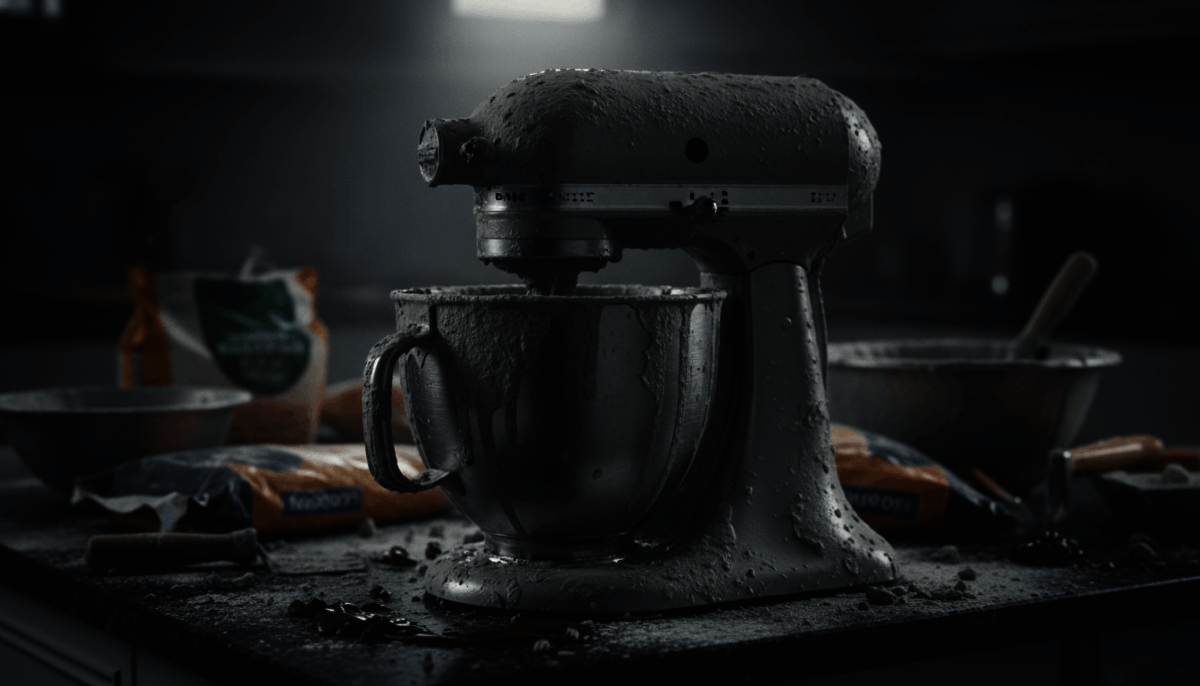
There it was, sitting on the island: my pristine, $400 stand mixer, now a tomb for industrial-grade, fast-setting tile grout. The bowl was filled to the brim with wet, abrasive sludge, and the dough hook was caked in a gray, gritty cement that was already beginning to harden. Greg was nowhere to be found, but the evidence of his laziness—his decision to choose convenience over common sense—was absolute. That moment of realization, where the absurdity of the situation collided with the cold reality of financial loss, was the exact second I decided that our friendship, and our living arrangement, had reached its expiration date.
I didn’t scream. I didn’t cry. I simply took a photo, pulled out my phone, and initiated a paper trail that would lead us to a judge. This is the story of how a single appliance destroyed a friendship and forced me to navigate the complexities of the legal system to hold someone accountable for their blatant disrespect.
The Morning of the Concrete Calamity

I stood in the center of the kitchen, frozen. The smell of wet cement hung heavy in the air, clashing with the faint, lingering scent of the vanilla extract I’d used just the night before. I reached out a finger, hesitant to touch the crusty, gray mess, and realized with a sinking heart that the motor housing was also splattered with the grit. He had forced that machine to churn heavy, abrasive material, likely grinding the internal gears into oblivion.
My phone buzzed in my pocket—a text from Greg. It was a photo of his progress in the bathroom, accompanied by a smug caption: ‘Bathroom looks amazing, floor is finally getting done.’ He didn’t mention the kitchen. He didn’t mention the stolen equipment. He didn’t even acknowledge that he had taken a piece of property that wasn’t his, let alone one that was clearly meant for food, not construction.
‘Hey, look at this progress! The bathroom floor looks pro-grade now. I’m a genius.’
— Greg, 10:14 AM
I didn’t reply to the photo of the tiles. Instead, I sent a single, clear image of the mixer, caked in cement, sitting on the granite countertop. I watched the bubbles appear on my screen, then vanish. Then they appeared again. Then stopped. He was reading it, and he was panicking, but he didn’t have the decency to come down and face the consequences of his actions immediately. He stayed upstairs, hiding in his construction zone, waiting for me to be the one to break the silence.
When he finally trudged down the stairs, he didn’t look remorseful. He looked annoyed that he’d been caught. He walked into the kitchen, glanced at the mixer, and shrugged as if it were a minor spill of flour rather than the permanent destruction of a high-end kitchen tool. ‘It’s just grout,’ he said dismissively. ‘I’ll wash it out. Don’t get your panties in a twist.’
That phrase—that specific, dismissive jab—was the match that lit the fuse. ‘Greg, that is a four-hundred-dollar motor,’ I said, my voice shaking with a controlled, icy rage. ‘You don’t put building materials in a food mixer. You’ve destroyed it. It’s not about washing it out; it’s about the fact that the internal mechanism is likely ruined, and even if it turns on, I am never putting food in that machine again.’
The Pretense of Reasonable Negotiation

I gave him a chance to do the right thing, even though I knew, deep down, that he wouldn’t. I sat him down at the kitchen table and pulled up the receipt from my email. I showed him the cost, the tax, and the warranty information. I told him that I expected him to replace it or pay for the full value of the item. I thought, perhaps, he would realize the gravity of his idiocy, but I was vastly underestimating his sense of entitlement.
‘I mean, it’s not like it’s brand new, right?’ Greg argued, leaning back in his chair with a beer in his hand. ‘I’ve seen you use it a hundred times. It’s used goods, man. I’ll give you fifty bucks for the trouble, but asking for the full four hundred is just a cash grab. You’re trying to get an upgrade on my dime.’
I stared at him, bewildered. The mental gymnastics he was performing to justify his actions were staggering. He had literally destroyed my property, rendered it useless, and he was trying to negotiate the price of his own negligence as if I were selling a garage sale item. It was a fundamental refusal to take responsibility, and it made my skin crawl with the realization of who I had been living with for the past year.
‘It’s just a machine, dude. Everything breaks eventually. You’re being incredibly dramatic about a bowl of cement. I’ll pay you fifty bucks, take it or leave it.’
— Greg, during the confrontation
I stood up and walked away. I didn’t want to engage further. The conversation was going nowhere, and every word out of his mouth was just reinforcing my decision to leave. I went into my room, locked the door, and opened my laptop. I didn’t look for advice on how to fix the friendship; I looked for advice on how to file a claim in small claims court. I was done being the ‘reasonable’ roommate.
That night, I didn’t sleep. I spent hours researching the laws in our state regarding property damage and liability. I documented everything—the texts, the photos, the original receipt, and the timeline of the events. I was methodical, turning my anger into a structured legal argument. I didn’t need to yell at him anymore. I had the system on my side, and that was far more satisfying than any screaming match could ever be.
The Certified Letter of No Return

The next day, I didn’t say a word to Greg. I went to the post office and drafted a formal demand letter. It was professional, cold, and clearly outlined that if the $400 was not received within seven business days, I would be filing a lawsuit in small claims court. I had it sent via certified mail, return receipt requested. When I handed the clerk the envelope, there was a strange, liberating feeling in the air. I was no longer a victim of his whims; I was a claimant.
When Greg received the letter, he didn’t even open it in private. He brought it to the kitchen and dropped it on the table, laughing. ‘A demand letter? Really? You’re going to sue your own roommate over a mixer? Do you have any idea how insane that makes you look to everyone else?’ He was trying to gaslight me, to make me feel like the social pariah for holding him accountable. But he didn’t realize that I had stopped caring about his opinion of me weeks ago.
‘You’re honestly going to go to court? Over a mixer? You’re going to be the laughing stock of the apartment complex. Just drop the ego.’
— Greg, after receiving the demand letter
I didn’t respond to his jab. I just picked up the letter, placed it back in my bag, and continued with my day as if he weren’t even in the room. The silence was my weapon. Every time he tried to bait me into a fight, I remained calm, detached, and utterly unimpressed. It was driving him crazy. He was used to me being the one to apologize, the one to smooth things over, the one to minimize the drama to keep the peace. By refusing to play the role of the ‘peacemaker,’ I had fundamentally altered the power dynamic of the house.
He tried to get our other roommate, Sarah, on his side. I could hear them whispering in the living room, Greg trying to frame me as a ‘petty, litigious nightmare.’ But Sarah, who had long been tired of his antics, didn’t bite. She had seen the photos of the mixer. She knew the truth. She stayed out of it, which was all I needed. The house became a tomb of silence, the tension so thick you could cut it with a knife.
The Day in Court

The court day arrived with a crisp, autumn chill. I arrived at the courthouse early, wearing my best suit, feeling a strange mix of nerves and vindication. Greg showed up twenty minutes late, disheveled, wearing a hoodie that looked like it hadn’t been washed in weeks. He looked around the courtroom with a smirk, clearly thinking that he could charm his way out of this, or that the judge would find the whole thing as trivial as he did. He was in for a rude awakening.
The courtroom was small, intimate, and smelled of old paper and floor wax. When our case was called, I stood up and presented my evidence with precision. I had the receipt, the photos of the ruined mixer, and a printed copy of our text exchange where he admitted to using the mixer for his ‘project.’ The judge, a stern woman with sharp eyes, looked over the documents in silence for a long, agonizing minute.
Greg tried to speak over me, of course. ‘Your Honor, it was an honest mistake. I offered to pay him fifty dollars, which is more than it’s worth, and he’s just trying to take advantage of me.’ The judge didn’t even look up. She raised a hand to silence him, her expression hardening. ‘Mr. Greg, this is a court of law, not a playground. The issue is property damage, not your opinion of the item’s value. Please refrain from speaking until you are addressed.’
‘It’s not just a mixer, Your Honor. It was a tool I relied on, and he destroyed it with zero regard for my property or my boundaries.’
— Me, speaking to the judge
I felt a rush of adrenaline. Finally, someone was listening to the facts, not the excuses. The judge asked Greg if he had attempted to clean the mixer. He admitted he had ‘tried,’ but that it was ‘too much work.’ The judge’s eyes narrowed. ‘You used a motorized food appliance for industrial grout, then failed to rectify the damage you caused, and now you are here arguing over the cost of replacement? This is a very clear-cut case of negligence, sir.’
The Verdict and the Aftermath

The ruling was swift. The judge found in my favor and ordered Greg to pay the full $400, plus the court fees I had fronted. Greg turned beet red, his jaw working as he tried to find a way to argue back, but the gavel had already fallen. It was over. I walked out of that courthouse feeling like a massive weight had been lifted off my shoulders. It wasn’t about the money, really—it was about the validation. It was the confirmation that my boundaries mattered, and that his disregard for them had real-world consequences.
Back at the house, the atmosphere was poisonous. Greg didn’t pay immediately, of course. He tried to claim he was ‘broke’ and needed time, but I had already researched how to garnish wages if he failed to comply. I presented him with a copy of the court order and told him he had forty-eight hours before I took the next legal step. The look of defeat on his face was one of the most satisfying things I have ever seen.
He moved out two weeks later. He didn’t say goodbye, and he left the apartment in a state that required a professional cleaning service to fix. But I didn’t care. I spent that week scrubbing the walls, repainting the living room, and finally, buying a new mixer. This time, I kept it under lock and key, and I never, ever left it out on the counter when I wasn’t using it.
‘You’re a real piece of work, you know that? I hope you’re happy with your stupid four hundred dollars.’
— Greg, as he moved his final box out
The lesson I learned was hard but necessary: you cannot change people who don’t want to change. You can only protect yourself and ensure that when they violate your boundaries, you have the systems in place to hold them accountable. I’m living alone now, and the peace and quiet of my kitchen is worth every single penny of that replacement mixer.
Reddit Weighs In: The Verdict of the Internet
I decided to post my story on a popular subreddit for roommate drama. I wasn’t looking for validation, but I was curious to see how others would handle the situation. The response was overwhelming. Within hours, the post hit the front page, with thousands of comments debating the ethics, the legality, and the sheer audacity of the situation. It was a fascinating window into how people view personal property and living boundaries.
The majority of the comments were firmly on my side. People were appalled by the idea of using a kitchen appliance for grout. It seemed to strike a nerve with anyone who has ever had a roommate who treated their belongings like public property. Many users shared their own stories of ‘roommate nightmares,’ and the thread quickly became a support group for people who had been wronged by entitled housemates.
“NTA. The level of entitlement it takes to use someone else’s $400 appliance for industrial construction is mind-boggling. You didn’t just ruin a machine; you showed him that there are consequences to his actions. Well done on the court filing.”
— u/KitchenWarrior88 (Top Comment, 18.2k upvotes)
However, there were the inevitable contrarians who thought I was being ‘too petty.’ They argued that I should have just ‘let it go’ and moved on, that the friendship was worth more than a mixer. I found these comments particularly illuminating; they usually came from the exact type of person who would be likely to destroy someone else’s property and expect a free pass. I didn’t engage with them, but I did find the debate over what constitutes a ‘friend’ versus a ‘roommate’ to be quite interesting.
The community support was a reminder that I wasn’t crazy. When you’re living in a toxic environment, it’s easy to start doubting your own perception of reality. Seeing thousands of people agree that, yes, this was a massive violation, helped me regain my confidence and move forward from the experience without carrying the guilt that Greg had tried so hard to pin on me.
The Anatomy of Entitlement

Reflecting on the whole ordeal, I realize that the mixer incident wasn’t an isolated event. It was the culmination of a year-long pattern of behavior. Greg had always assumed that my life, my time, and my property were communal assets, while his own were strictly off-limits. It’s a common trait among people who haven’t had to face real consequences for their actions. He didn’t see the mixer as an object with value; he saw it as a tool that was there, and therefore, he had a right to use it.
The problem with this mindset is that it erodes the foundation of any relationship. When one person is constantly taking and the other is constantly giving—or in this case, being robbed—the relationship becomes parasitic. I had spent so much energy trying to be the ‘cool’ roommate, the one who didn’t complain about the dishes or the noise, that I had actually enabled him to continue his behavior.
‘He’s not a friend; he’s a leach. Some people never learn to respect boundaries because they’ve never had anyone stop them. You taught him a lesson he won’t forget.’
— u/RealityChecker2024 (12.4k upvotes)
I see now that my desire to keep the peace was actually a disservice to both of us. By never standing up to him, I allowed him to persist in a state of delusion where he thought he could do whatever he wanted without consequence. The lawsuit, while painful, was actually a necessary step in forcing him to confront the reality of living in a society where actions have impacts. It wasn’t about being petty; it was about being an adult and taking responsibility for the environment I lived in.
Moving forward, I’ve set much stricter boundaries with everyone in my life. I don’t assume that people know how to respect my property, and I don’t apologize for expecting them to treat my things with care. If someone can’t handle those basic expectations, they don’t have a place in my home. It’s a simple rule, but it’s one that has saved me a lot of heartache in the long run.
The Financial Breakdown of a Friendship

I decided to put together a ledger of the costs associated with the fallout. It’s a sobering look at how much one person’s negligence can actually cost, not just in money, but in time, energy, and emotional well-being. Looking at the numbers, it’s clear that the ‘fifty dollars’ he offered was a drop in the bucket of what it actually cost to rectify the situation.
| Category | Cost | The Reality |
|---|---|---|
| Stand Mixer Replacement | $400.00 | Required due to permanent grout damage |
| Court Filing Fees | $75.00 | Essential to initiate legal proceedings |
| Cleaning Supplies | $50.00 | Needed to scrub the apartment after move-out |
| Professional Cleaning | $200.00 | Necessary to secure my security deposit |
| Total Financial Impact | $725.00 | The price of a ‘friendship’ gone wrong |
When you look at the total, it’s easy to see why he was so resistant to paying. He didn’t want to admit that his ‘quick fix’ in the bathroom had actually set him back nearly a thousand dollars. But those costs were the direct result of his decisions. I didn’t ask for any of this. I didn’t want to spend my weekends in court or scrubbing floors. He forced this reality on me, and then expected me to be the one to pay for it.
‘The numbers don’t lie. He owes you that, and honestly, you should have charged him for the emotional labor of dealing with his mess too.’
— u/FinancialFreedomSeeker (5.6k upvotes)
I don’t regret the money I spent on the legal process. It was the best investment I ever made in my own peace of mind. Every time I look at my new, clean kitchen, I am reminded that I have the power to protect myself. I have the power to say ‘no,’ and I have the power to demand that my boundaries are respected. That is a price that, honestly, is priceless.
Lessons in Radical Self-Respect

The biggest takeaway from this entire experience is that self-respect is not a passive trait; it is something you have to actively defend. For years, I had thought that being a ‘good person’ meant being a ‘doormat.’ I thought that if I were nice enough, people would naturally treat me with the same kindness. But that’s not how the world works. Some people are takers, and they will continue to take until there is nothing left unless you set a firm, immovable boundary.
I’ve learned to spot the signs of entitlement early now. I notice when someone asks for favors without ever offering them, or when they minimize my concerns by calling me ‘dramatic’ or ‘sensitive.’ These are red flags, and I don’t ignore them anymore. I address them immediately, and if the behavior doesn’t change, I remove that person from my life. It’s not about being mean; it’s about having standards for how I am treated.
My kitchen is my sanctuary now. I don’t share it with anyone who doesn’t respect the equipment, the time, and the care that goes into cooking. If I have guests, they know the rules. If they don’t like the rules, they don’t have to visit. It’s that simple. I’ve found a lot of freedom in that simplicity. I no longer feel the need to justify my boundaries to anyone.
‘Boundaries aren’t walls to keep people out; they’re gates to keep you safe. You did the right thing by teaching him that he couldn’t treat you like a doormat.’
— u/EmpoweredLiving (8.2k upvotes)
The mixer incident was a turning point. It forced me to look at my own patterns of behavior and realize where I was failing myself. I don’t miss Greg, and I certainly don’t miss the chaos of that shared apartment. I miss the person I used to be before I felt the need to apologize for expecting basic human decency. I’m glad I found her again, and I’m glad I have the legal system to thank for at least part of that journey.
Moving Forward: New Beginnings

Life after the roommate drama has been incredibly peaceful. I moved into a smaller, studio apartment that is entirely mine. No shared kitchen, no shared bathrooms, no wondering if someone has used my things without asking. It’s a quiet, controlled environment, and for the first time in years, I feel completely at home. My new mixer has a place of honor on the counter, and it is used exclusively for what it was intended for: baking.
I’ve started a baking blog as a way to share my hobby, and it’s been a great creative outlet. It’s nice to be able to focus on the things I love without the constant background noise of conflict. I’ve even started hosting small dinner parties, and the joy of sharing a meal with people who actually respect the effort is something I don’t take for granted anymore.
I still occasionally hear from mutual friends about what Greg is up to. Apparently, he’s still ‘renovating’ his current apartment, and he’s still complaining about how ‘unfair’ the legal system is. I just smile and move on. His life is his to manage, and his failures are his own. I’m not his keeper, and I’m certainly not his victim anymore.
‘You’ve turned a nightmare into a foundation for your own happiness. That’s the ultimate revenge—living well and not letting him take up any more space in your head.’
— u/HappyEndingStories (15.1k upvotes)
If you are in a similar situation—if you are being walked all over by a roommate or a friend—don’t wait for them to change. They won’t. Take the steps you need to protect yourself, document everything, and don’t be afraid to use the legal system if you have to. Your peace of mind is worth more than any ‘friendship’ that requires you to sacrifice your self-respect.
Conclusion
Looking back at the entire saga of the grout-covered mixer, it’s clear that this wasn’t just about a kitchen appliance. It was a catalyst for a necessary evolution in my life. By taking a stand, I reclaimed my autonomy and learned that boundaries are not just suggestions—they are essential to a healthy life. The experience, while frustrating and financially taxing, provided a clarity that I had been lacking for years.
We live in a world where we are often told to ‘be the bigger person’ or ‘keep the peace,’ but sometimes, the biggest thing you can be is someone who holds others accountable. Accountability isn’t about being petty; it’s about upholding a standard of behavior that respects everyone involved. I’m proud of the way I handled it, and I’m even prouder of the life I’ve built since.
What about you? Have you ever had a roommate or a friend cross a line that made you rethink everything? Have you ever had to take someone to court just to get them to respect your basic boundaries? I’d love to hear your stories in the comments below. Let’s discuss how to handle these situations with grace, firmness, and, when necessary, the full force of the law.
Poll: If you were in my position, would you have filed the court claim or just walked away to avoid the drama?
- I would have filed—accountability is key!
- I would have walked away—peace is worth more than money.
- I would have demanded payment without court first.
- I’ve been there, and I chose the legal route.
What's your verdict on this dilemma?
Vote below to contribute to the official community consensus.

Have a Dilemma Keeping You Up at Night?
Share your real-life feud, wedding chaos, or relationship crossroads anonymously with our editorial team.
What do you think ?
0 Comments🛡️ Comments are moderated to protect community integrity. Your comment will appear once approved by the editorial team.