
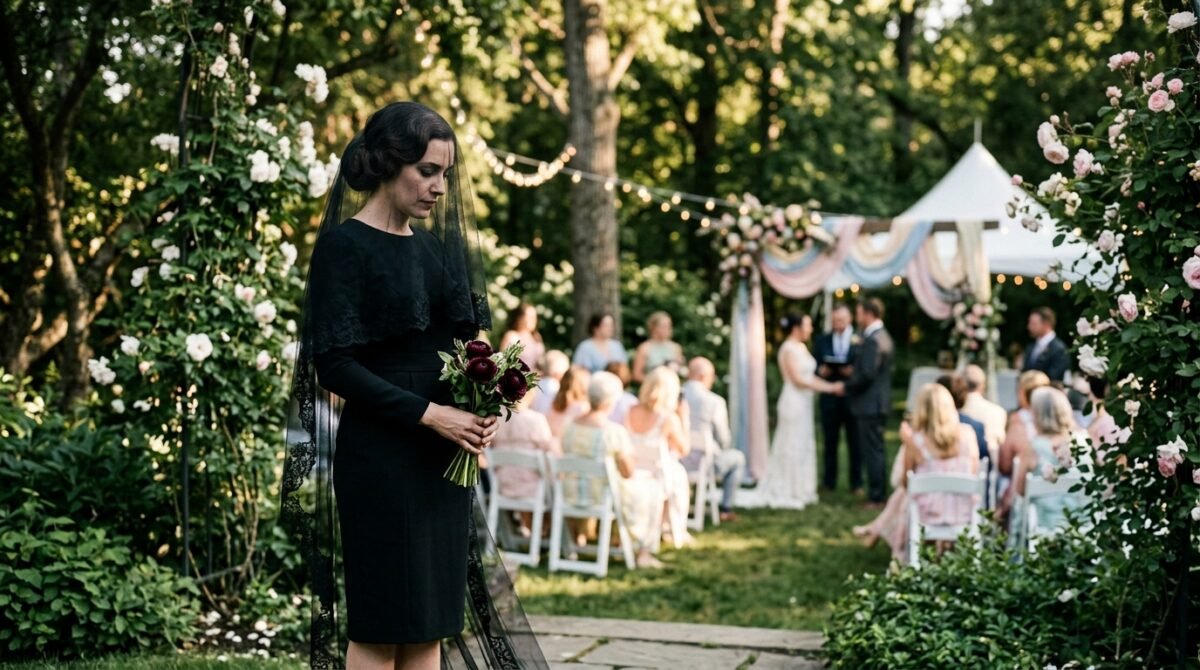
It was supposed to be a ‘Diamond Jubilee’ of love, a vow renewal designed to make the neighborhood weep with envy. My mother-in-law, Barbara, has always lived for the spectacle, but this time, the spectacle required my participation in a charade that felt fundamentally cruel. Only three months prior to the scheduled event, I had suffered a traumatic miscarriage—a loss that left me hollow, grieving, and entirely uninterested in celebrating the supposed ‘perfection’ of a marriage that Barbara spent years using to belittle my own.
When I informed her that I would be attending but would not be participating in the ‘bridal party’ festivities, the vitriol began. She didn’t offer comfort; she offered a schedule. She wanted me to wear a specific shade of champagne silk, walk down the aisle as a ‘symbol of the family’s legacy,’ and stand beside her as she bragged about her ‘perfectly curated life.’ The irony was suffocating. She wanted to present a picture of domestic bliss while I was still trying to figure out how to wake up in the morning without feeling the phantom weight of what I had lost.
The tension didn’t build overnight. It was a slow, agonizing crawl toward a confrontation that I knew was inevitable. Barbara saw my grief as an inconvenience to her aesthetic, a ‘mood killer’ that threatened to overshadow her spotlight. Every conversation was a thinly veiled jab at my ‘lack of spirit,’ and every request was a demand masquerading as a favor. I realized then that my presence wasn’t wanted because they cared for me, but because they needed a prop.
So, I made a choice. I would show up, but I would not be the prop. I decided that if they wanted a performance, I would give them a truth they couldn’t ignore. I chose a mourning veil—not as an act of pettiness, but as an act of survival. It was my way of honoring the life I had lost in the middle of a room screaming for a celebration I couldn’t emotionally afford to fake.
What followed was not just a family argument; it was a societal collision. When I arrived, the air in the garden didn’t just chill; it solidified. The whispers were loud enough to be heard over the string quartet, and the look on Barbara’s face was one of pure, unadulterated fury. This is the story of why I refused to apologize, why the family is now split down the middle, and why I finally learned that sometimes, burning a bridge is the only way to see the light.
The Champagne Silk Ultimatum
The initial request arrived via a thick, embossed card delivered by mail, which was the first sign that this wasn’t a casual gathering. Inside, a detailed ‘itinerary’ for the weekend was included, specifying my role in the processional. I was to be a ‘pillar of the family,’ wearing a custom-made champagne silk dress that had already been ordered in my size without my consent. The cost, which was conveniently included on an attached invoice, was a staggering $800.
I called Barbara immediately, my hands shaking as I held the phone. I explained, as calmly as I could, that I wasn’t in a place to be a centerpiece. I was barely functioning, struggling through therapy, and the idea of wearing champagne silk felt like a physical assault on my senses. I told her I would attend in a simple black dress, support my husband, and stay in the background. Her response was immediate and cold.
“This is not about you or your current ‘situation.’ This is a celebration of fifty years of devotion. If you cannot put aside your personal drama for one afternoon to support this family, then you are telling us exactly how little we matter to you.”
— Barbara, via phone call
The audacity of calling the loss of my child ‘personal drama’ left me breathless. My husband, Mark, who was sitting next to me during the call, stared at the floor, his jaw tight. He wanted to avoid conflict, as he always did, but even he looked uncomfortable with the dismissal of my pain. He suggested I just wear the dress to keep the peace, but for the first time, I felt a sharp, clear sense of resolve. I wasn’t going to do it.
The weeks leading up to the event were filled with passive-aggressive texts. Every time I tried to set a boundary, it was met with a lecture on ‘tradition’ and ‘family loyalty.’ I felt like I was being slowly suffocated by their expectations. I realized that Barbara didn’t want a daughter-in-law; she wanted a mannequin who didn’t talk back. I decided that if I were going to be a prop, I would be a prop with a message.
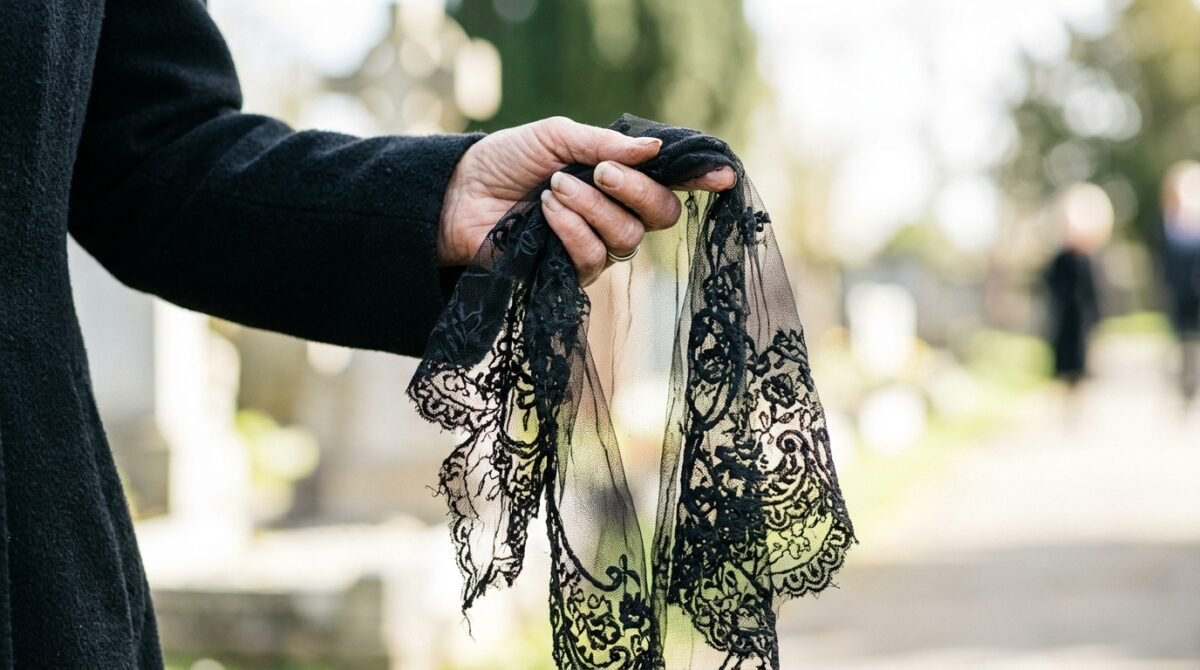
I went to a vintage shop, found a heavy, black lace veil from the 1940s, and paired it with a simple black tea-length dress I already owned. It felt heavy, not just in weight, but in meaning. It wasn’t about spite; it was about visibility. I was tired of being told to hide my grief to make others comfortable. This was going to be the most honest outfit at the party.
The Garden Path of Frozen Smiles
When I walked into the garden, the silence was immediate and heavy. The air was filled with the scent of expensive lilies and the sound of a string quartet playing a jaunty, upbeat tune that felt jarring against the scene I had created. I stood at the entrance for a moment, the veil obscuring my face just enough to create a barrier between me and the judging eyes of the guests. I saw Barbara standing near the altar, her face pale, her lips thin and white.
People parted as I walked through, their whispers like buzzing insects. Some looked away, uncomfortable with the sight of overt mourning in a place of joy. Others stared with undisguised curiosity. I didn’t care. I felt a strange sense of peace, a grounding that I hadn’t felt in months. I walked to the seat reserved for me, pulled out a chair, and sat down, my veil still securely over my face. I wasn’t going to remove it.
“What on earth is she doing? Is she trying to ruin the photos? Get her to take that thing off, Mark. Now.”
— Barbara to Mark, overheard by guests
Mark looked at me, his face torn between his mother’s demand and the look of cold, hard steel he saw in my eyes. He whispered for me to take it off, saying that I was making everyone uncomfortable. I looked at him, lifted the veil just enough to make eye contact, and spoke softly. I told him that if his mother wanted a perfect photo, she should have considered that grief doesn’t disappear just because the sun is shining. I wasn’t taking it off.
The ceremony proceeded in a blur of forced smiles and rehearsed vows. Barbara stood there, radiating a kind of desperate, performative happiness that made my skin crawl. Every time she looked at me, she didn’t see her daughter-in-law; she saw a stain on her perfect afternoon. I sat there like a statue, a monument to the things we weren’t allowed to say out loud. The contrast between her joy and my mourning was the most honest moment of the entire afternoon.
By the time the vows were finished, the tension was palpable. Guests were avoiding my gaze, and the ‘joyful’ atmosphere had dissolved into something brittle and fragile. I saw friends of the family trying to steer conversations away from my presence, acting as if I were a ghost haunting a celebration. I stayed through the ceremony, but as the reception began, I knew it was time to leave. I had made my point, and I had survived the day.
The Fallout in the Family Group Chat
By the time I reached my car, my phone was vibrating incessantly. The family group chat, which had been silent for weeks, was now exploding with messages. It was a digital firing squad, led by Barbara and supported by my sister-in-law, Jessica. They weren’t just angry; they were terrified that my actions would become the defining memory of their ‘perfect day.’ They wanted an apology, and they wanted it in writing.
“That was a disgusting display of narcissism. You turned a beautiful celebration into a funeral for your own ego. I hope you’re happy, because you have effectively destroyed any chance of being seen as a member of this family moving forward. Apologize or stay away.”
— Barbara in the Family Group Chat
I read the messages, one after another, feeling a strange sense of detachment. It was almost funny how quickly they pivoted from ‘tradition’ to ‘narcissism.’ They didn’t see the irony of calling *me* a narcissist for grieving while they were demanding I participate in a show of their own self-importance. I didn’t respond. I didn’t need to. I knew that anything I said would be twisted and used against me. Instead, I took a screenshot of the entire thread.
Mark eventually texted me, asking me to just send a simple apology to smooth things over. He argued that it wouldn’t cost me anything to say I was sorry for the ‘distraction.’ That was when I realized the depth of the betrayal. He wasn’t just asking me to apologize; he was asking me to validate their disregard for my pain. He wanted the peace, but he wanted it at the expense of my dignity.
I replied to him, short and final. I told him that the only thing I was sorry for was that I hadn’t realized earlier that his family’s comfort would always come before my humanity. I told him I was going to my mother’s for a few days to get some space. When I turned my phone off, the silence was the most beautiful thing I had heard in months. The digital war had started, but for the first time, I wasn’t fighting it on their terms.
The Internet Weighs In: A Viral Reckoning

I didn’t intend for the story to go viral. I posted the incident on a popular relationship forum, seeking nothing more than an objective opinion from strangers who didn’t know my mother-in-law’s ‘curated’ life. The response was immediate and overwhelming. Within hours, the post had thousands of comments, and the community was fiercely divided. It wasn’t just about the veil; it was about the fundamental right to grieve versus the social pressure to perform.
“NTA. Your in-laws sound like they live in a reality distortion field where their need for a perfect party overrides your actual, literal human tragedy. A mourning veil is a powerful, silent protest against people who refuse to acknowledge your pain. Keep the veil, lose the in-laws.”
— u/GriefWarrior (Top Comment, 32.5k upvotes)
The support was validating, but there were also the ‘traditionalists’ who argued that I should have just stayed home if I couldn’t be ‘supportive.’ They called me petty, dramatic, and a ‘glutton for attention.’ It was fascinating to see how many people believe that one’s personal suffering should be kept behind closed doors so that it doesn’t inconvenience others. It confirmed that my decision to wear the veil was, in fact, the only way to make the invisible visible.
“ESH. The MIL is clearly toxic, but wearing a mourning veil to a vow renewal is objectively a ‘look at me’ move. You could have just stayed home. By going and wearing that, you ensured the day was about your drama rather than their anniversary. You proved them right by being difficult.”
— u/DevilAdvocate_99 (6.2k upvotes)
Reading these comments, I realized that the internet is just a mirror of the society I was living in. Some people value decorum over humanity, and others value truth over comfort. I didn’t regret my choice, but I did see how it was perceived. The ‘drama’ wasn’t something I created; it was something I revealed. The tension was already there, simmering under the surface; I just turned up the heat until it boiled over.
The viral nature of the post brought a weird kind of clarity. I saw hundreds of other people sharing their own stories of being forced to ‘perform’ during times of grief—weddings they didn’t want to attend, funerals they weren’t allowed to mourn at, and families who valued optics over empathy. I wasn’t alone. This wasn’t just about me and Barbara; it was about a culture that treats people like accessories and punishes them for having feelings.
The Sunday Dinner That Never Happened
After the viral post, the silence from my in-laws turned into a frantic, panicked noise. They realized that their ‘perfect’ reputation was now being scrutinized by the entire internet. Barbara tried to frame the incident as a ‘misunderstanding’ in a new round of emails, claiming she never meant to invalidate my grief, but that I had ‘chosen to create a spectacle.’ She wanted a sit-down, a ‘rational conversation’ where she could regain control of the narrative.
We had a scheduled Sunday dinner, a tradition I had been dreading for years. Before the event, Barbara sent a message to the group chat, demanding that ‘all past grievances be left at the door’ so we could move forward. She clearly wanted to pretend the wedding incident never happened, to sweep the entire thing under the rug and move on to the next display of family perfection. She was effectively trying to gaslight me into believing that my pain was just a ‘misunderstanding.’
“Let’s all act like adults and enjoy a nice meal. No more talk about the wedding. We are moving forward as a family, and that requires us to leave the negativity behind. See you at 6:00.”
— Barbara, via email
I didn’t go. I sent a simple, polite message to the group stating that I wasn’t ready to ‘move forward’ when the fundamental issues of disrespect and gaslighting hadn’t been addressed. I didn’t want a seat at a table where my existence was conditioned on my silence. The response from my husband was immediate. He was furious that I was ’embarrassing’ him further by not showing up, as if his mother’s pride was more important than my mental health.
That night, I sat at home alone, eating dinner and watching a movie, feeling a lightness in my chest I hadn’t felt in years. The ‘Sunday Dinner’ was the symbol of everything I hated about that family—the performance, the forced smiles, the walking on eggshells. By staying home, I was finally breaking the cycle. I was choosing my own peace over their performative unity, and it felt like the first step toward reclaiming my life.
The fallout from missing the dinner was predictable. My husband didn’t speak to me for three days, and my sister-in-law sent a series of passive-aggressive texts about how ‘selfish’ I was. But I didn’t care. The more they acted out, the more I realized that I wasn’t the problem; I was the one who was refusing to be part of the solution that required my self-destruction. I was finally, truly, out of the loop.
The Financial Ledger of Control
As I started to distance myself, I began to look at the financial strings they had attached to our lives. For years, Barbara had been ‘gifting’ us things—a down payment on our car, ‘support’ for our holidays, even a portion of our mortgage payments. At the time, it felt like generosity. Now, looking at the bank statements, I realized it was a leash. Every dollar came with an expectation, a hidden demand for compliance and participation in their family branding.
| Contribution | The ‘Cost’ | Reality Check |
|---|---|---|
| Down Payment | Mandatory Holiday Hosting | Loss of Personal Time |
| Mortgage Aid | Subject to Approval | Zero Financial Autonomy |
| Wedding Dress | Emotional Submission | Total Loss of Identity |
I sat Mark down and showed him the breakdown. I asked him if he realized how much of our lives were being bought. He tried to brush it off, saying that ‘family helps family,’ but I pointed out the specific instances where the ‘help’ was conditional on our behavior. It was eye-opening for him, but also deeply painful. He didn’t want to see his mother as a manipulator, and he didn’t want to admit that his comfort was predicated on my submission.
We had a long, difficult conversation about our future. I told him that I couldn’t be a part of this arrangement anymore. I was willing to pay back the money if it meant we could be free, if it meant we could live our lives without someone looming over our shoulders, judging our decisions, and demanding our participation in their performances. I wanted a marriage that belonged to us, not to his mother’s vision of what a family should look like.
He was hesitant, scared of the confrontation and the potential for being cut off. But seeing the look on his face, the realization that he had been living in a cage his entire life, was enough. We agreed to start a plan to pay back the ‘loans’ and cut the financial ties. It wasn’t going to be easy, and it would mean a tighter budget for a while, but the idea of independence was worth more than any amount of money they could offer.
This was the moment the real shift happened. It wasn’t about the veil anymore; it was about the power dynamic. Once I stopped accepting the money, I stopped being a pawn. They tried to use the finances as a weapon, threatening to ‘reclaim’ their investments, but we were ready. We had already started the process, and for the first time, I felt like an equal partner in my own life.
The Confrontation at the Cafe

Barbara finally cornered me at a neutral location—a local cafe—after weeks of refusing to speak to her. She didn’t come for an apology this time; she came for a negotiation. She thought she could win me back with a mix of emotional manipulation and a reminder of all she had done for me. She sat down, looking perfectly put together, and launched into a monologue about how ‘unfortunate’ everything had become.
“You need to understand, this isn’t about me. It’s about the family legacy. We’ve built a life of respect and standing, and you are actively working to dismantle it with these stunts. I want you to tell me exactly what you want, so we can put this behind us.”
— Barbara, at the cafe
I looked at her, really looked at her, and realized how small she actually was. Her entire life was a house of cards, and she was terrified that one breeze would knock it all down. I told her that I didn’t want anything from her. I didn’t want her money, her approval, or her ‘legacy.’ I wanted to be treated like an adult who had suffered a tragedy and deserved to be seen, not managed.
She sputtered, trying to interrupt, but I kept going. I talked about the wedding, the veil, the texts, and the way she had treated my grief like an inconvenience. I told her that the ‘stunt’ wasn’t mine; it was her own behavior reflecting back at her. She didn’t like what she saw, so she blamed the mirror. It was the most honest conversation we had ever had, and it was also the last.
She left the cafe in a huff, promising that I would ‘regret’ my attitude. I didn’t feel fear. I felt a sense of finality. I had stated my boundaries, and I was prepared for the consequences. It didn’t matter what she threatened; the power she once had over me was gone because I was no longer afraid of the fallout. I had survived the worst, and I could survive her disapproval.
That day, I walked out of the cafe and went straight to the park to sit for a while. I felt lighter than I had in years. I realized that the mourning veil had been a catalyst, a way to force a change that needed to happen a long time ago. I wasn’t mourning my marriage to Mark, but I was mourning the illusion of the family I had hoped to have. And that was okay.
Reframing the Narrative
The weeks that followed were a whirlwind of ‘low contact’ and hard boundaries. We stopped attending the big family events, stopped answering the unsolicited advice, and stopped trying to explain ourselves. Mark and I had to learn how to communicate without the interference of his family, which was its own challenge. We had to build a language of our own, one that didn’t rely on the scripts his mother had written for us.
It wasn’t a perfect recovery. There were moments of doubt, times when I wondered if I had been too harsh. But then I would look at the photos from the vow renewal—not the professional ones, but the ones I took myself—and remember the feeling of the lace against my skin and the, for once, genuine silence of the garden. I realized that I hadn’t been harsh; I had been clear. And clarity is often interpreted as harshness by those who depend on ambiguity.
I started focusing on my own healing. I went back to therapy, not just for the grief, but to work on the habits of people-pleasing that had made me so vulnerable to Barbara in the first place. I learned that my value wasn’t determined by my ability to be ‘the perfect daughter-in-law’ or ‘the supportive wife.’ It was inherent, and it didn’t need to be earned through performance.
The family started to see that I wasn’t coming back to the status quo. Some of the relatives were disappointed, others were relieved that the tension had finally broken. The ‘perfect’ family narrative was slowly unraveling, and in its place, a new, more honest reality was beginning to form. It wasn’t the picture-perfect life they had envisioned, but it was real, and it was ours.
Mark eventually started to see it too. He began to disconnect from his mother’s orbit, and our relationship deepened in ways I hadn’t thought possible. We stopped being two people playing parts in a play and started being two people living a life. It was messy, and it wasn’t always easy, but it was ours. And for that, I would wear the veil a thousand times over.
Lessons from the Lace
Looking back, I realize that the veil was a symbol of more than just my grief. It was a symbol of the truth. We are so conditioned to hide our pain, to put on a happy face for the sake of ‘tradition’ and ‘politeness.’ We are told to keep our struggles to ourselves so we don’t ‘ruin the moment.’ But what happens when the moment is built on the denial of our pain? Is it really a moment worth preserving?
I think about the people who reached out to me after my story went viral, the ones who told me that my ‘spectacle’ gave them the courage to set their own boundaries. It made me realize that we are all carrying around our own veils, our own hidden pieces of grief that we are told to set aside for the comfort of others. And maybe, just maybe, it’s time we all stopped hiding them.
“Thank you for sharing your story. You helped me realize that I don’t need to apologize for my trauma, even if my family thinks it ruins their ‘aesthetic.’ You are a hero to those of us who have been silenced for too long.”
— A reader, via private message
The lessons I learned were simple but profound. First, your grief is yours alone, and you owe no one an apology for it. Second, people who demand your compliance at the expense of your humanity do not have your best interests at heart. And third, setting a boundary often feels like an act of war to those who benefit from your lack of one, but that is a reflection of their character, not yours.
I’m not the same person I was before the vow renewal. I’m stronger, more guarded, and significantly more comfortable with the idea of being ‘difficult.’ I don’t want to be easy; I want to be authentic. If that means I’m no longer invited to the Sunday dinners or the ‘Diamond Jubilee’ celebrations, then so be it. I’d rather have a small, honest life than a large, performative one.
The mourning veil is still in my closet, tucked away in a velvet box. I don’t wear it anymore—I don’t need to. The lesson it taught me is etched into my skin, and the strength it gave me is now a part of who I am. I’m no longer the prop in someone else’s play. I’m the director of my own life, and for the first time, I’m finally enjoying the show.
The Final Verdict: Community Consensus
When the story finally settled, the internet’s verdict was clear. While there were always the voices that clung to ‘politeness’ as a moral imperative, the overwhelming consensus was that the family’s demand for performative happiness was, in fact, a form of emotional abuse. The veil was not a ‘stunt’—it was an act of non-compliance that challenged the very foundation of their toxic dynamic.
“The fact that the MIL was more worried about the photos than the fact that her daughter-in-law just lost a child says everything you need to know. The veil was the perfect response to a situation where words wouldn’t suffice. Brava.”
— u/TruthSeeker_44 (18.2k upvotes)
The community support helped me navigate the difficult months of distancing myself from the family. It reminded me that I wasn’t just ‘the daughter-in-law who caused a scene.’ I was a person who had stood up for her right to exist in her own reality. The feedback loop of the internet, for all its toxicity, had served as a mirror, showing me that the world is full of people who understand that sometimes, you have to break the rules to stay whole.
I learned that there is no ‘right’ way to grieve, and there is certainly no ‘right’ way to act when you’re being coerced into silence. The pressure to conform to someone else’s image is one of the most insidious forms of control, and identifying it is the first step toward freedom. I am grateful for the Reddit community, for the harsh truths, and for the validation that helped me realize I didn’t need their approval to be valid.
I’m looking forward now. I’m building a life that is mine, surrounded by people who support me, not people who require me to be a prop. I’m still grieving, and I’m still healing, but I’m doing it on my own terms. And that, in the end, is the most important thing of all. I may have lost a relationship with my in-laws, but I found myself, and that is a trade I would make every single time.
Conclusion
The story of my mourning veil isn’t really about a veil at all. It’s about the cost of being ‘polite’ in a world that demands you sacrifice your truth for the comfort of others. It’s about the realization that some family ties are meant to be broken when they become nooses. And it’s about the courage to stand in the middle of a celebration and say, ‘I am here, I am hurting, and I will not look away.’
I have learned that boundaries are not just suggestions; they are the foundation of self-respect. When we allow others to define our experience, we lose a piece of ourselves. By choosing to wear that veil, I wasn’t just protesting their behavior; I was reclaiming my right to my own experience. It was the most difficult, terrifying, and liberating thing I have ever done, and I don’t regret a single second of the backlash.
Life is not a curated gallery of perfect moments. It is a messy, painful, beautiful, and chaotic experience. We don’t owe anyone a performance of happiness, especially when we are grieving. If you find yourself in a situation where your pain is an ‘inconvenience’ to those around you, take this as your sign to step back, re-evaluate, and protect your peace. You are not a prop in someone else’s life.
Now, I turn it over to you. Have you ever been in a situation where you felt forced to perform or hide your true feelings for the sake of ‘keeping the peace’? Did you set a boundary, or did you cave to the pressure? Let’s talk about it in the comments below. Your stories might just be the strength someone else needs to stand up for themselves today.
What's your verdict on this dilemma?
Vote below to contribute to the official community consensus.

Have a Dilemma Keeping You Up at Night?
Share your real-life feud, wedding chaos, or relationship crossroads anonymously with our editorial team.
What do you think ?
0 Comments🛡️ Comments are moderated to protect community integrity. Your comment will appear once approved by the editorial team.