
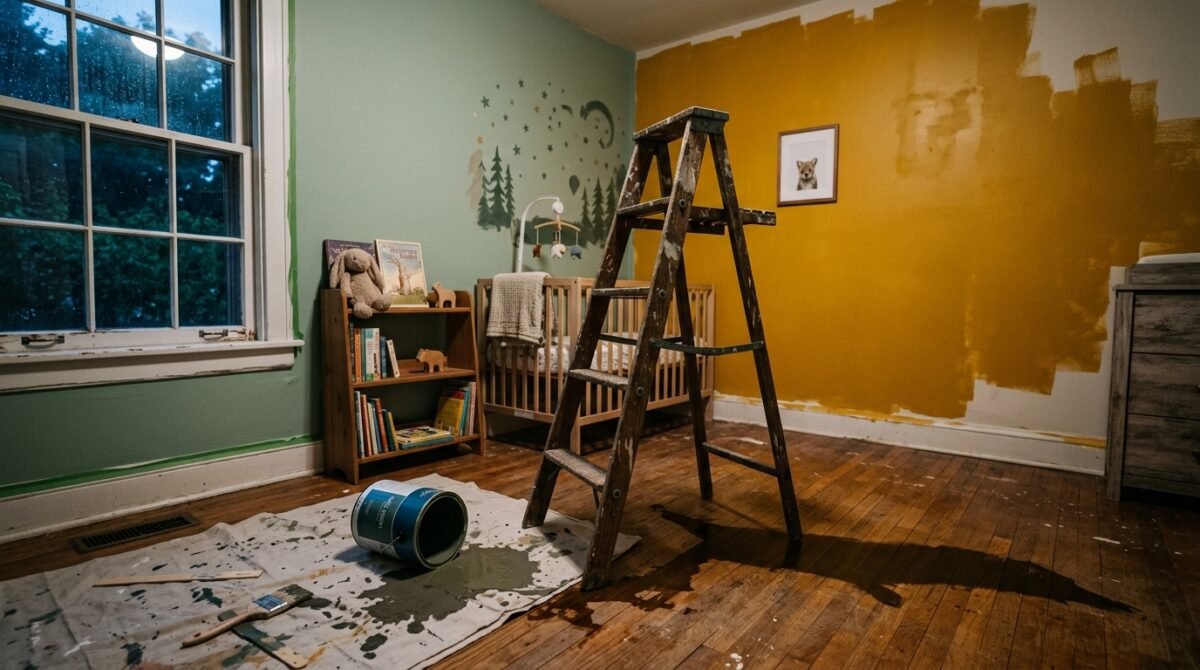
We had spent months curating the perfect aesthetic for our first child’s room. Every piece of furniture, every textile, and specifically the soothing ‘Morning Mist’ paint color had been chosen with meticulous care. For me and my husband, Mark, the nursery was a sanctuary—a physical representation of the peace and calm we wanted to provide our incoming bundle of joy. We had explicitly asked our families to refrain from buying heavy nursery items, preferring to handle the decorative choices ourselves.
My mother-in-law, Linda, had never been one for subtle hints, but I believed she respected our autonomy. She was a woman of strong opinions, often viewing them as universal truths, but I kept the peace, assuming she would eventually learn that our home was not an extension of her own living room design aesthetic. I was wrong.
The day the incident occurred started like any other, mundane and peaceful. I returned from a routine prenatal check-up early, expecting to find the house quiet. Instead, the smell of cheap latex paint hit me before I even reached the hallway. As I rounded the corner into the nursery, the sight that met my eyes was nothing short of a violation.
Linda was there, in her Sunday best, frantically brushing a garish, bright yellow over the muted green wall we had spent three days painting. The silence in the house, broken only by the rhythmic scrape of the brush, felt deafening. My heart hammered against my ribs—not from panic, but from a cold, sharp, and sudden realization that she would never respect my authority unless I forced the issue. I didn’t scream. I simply walked into the room, reached out, and pulled the ladder out from beneath her feet.
The Morning Mist Massacre

The sight of the yellow paint dripping down the wall was nauseating. It wasn’t just a design choice; it was a total erasure of the work Mark and I had put into our space. Linda barely looked down as I grabbed the ladder’s side rails. Her shock was palpable, not because she was afraid of falling, but because the daughter-in-law she deemed ‘soft-spoken’ was suddenly taking physical control of the situation.
I didn’t let go of the ladder. I moved it a full five feet away, forcing her to step down onto the floor. The paint brush clattered onto the drop cloth, leaving a jagged streak of mustard yellow across the carpet. She stood there, hands on her hips, looking at me as if I were a child who had misunderstood a chore.
“I honestly don’t know what you’re thinking, OP. That green is sickly. I’m doing you a favor by brightening this place up before the baby arrives. You’ll thank me when you see how much happier the room feels.”
— Linda, during the initial confrontation
I felt a vibration in my pocket. It was Mark, texting to ask if I had picked up the grocery items. I took a deep breath, staring directly into Linda’s eyes. My pulse was steady now. I was done with the ‘please and thank you’ routine that had characterized our relationship for three years.
I looked at the paint bucket, then at her. I walked to the hallway closet, grabbed a heavy-duty trash bag, and began scooping every single one of her brushes and paint trays into it. Her protest was immediate and sharp, filling the small room with a shrill, demanding frequency that made my skin crawl. I didn’t answer her. I didn’t try to explain the color theory or our emotional attachment to the room. I simply walked the bag to the front door and set it on the porch.
The Digital Paper Trail of Resentment
The fallout was not limited to the physical space of the nursery. Within an hour of Linda being escorted out of our house, my phone began to chime with a relentless, rhythmic intensity. The family group chat, usually reserved for mundane updates and birthday wishes, had become a war zone. My husband, Mark, was caught in the middle, his messages to me revealing a level of stress that I hadn’t realized he was harboring.
“Mark, your wife just threw me out like a common criminal. I was only trying to help. This is what happens when you marry someone with no taste and no respect for family tradition. Tell her to open the door and let me finish.”
— Linda, in the family group chat
I didn’t respond to her. Instead, I sent a photo of the ruined carpet and the partially painted yellow wall to the entire group. I added a simple, cold caption: ‘Our home is not a community project. If this continues, the door will remain locked for the foreseeable future.’ The silence that followed was heavy, broken only by a few frantic pings from my sister-in-law, who was clearly trying to de-escalate a situation she didn’t fully understand.
Mark eventually called me, his voice trembling. He was at work, trying to manage a client call while his phone was blowing up. He wasn’t mad at me, but he was terrified of the fallout. He knew his mother’s temperament—she didn’t just hold grudges; she weaponized them. He told me that his father was already calling him, demanding to know why I had been ‘so aggressive’ toward his mother.
I realized then that the paint wasn’t the point. The paint was a test of power. She wanted to see if she could leave a permanent mark on my life, literally and metaphorically. The text messages continued to pour in, a stream of guilt-tripping and gaslighting that sought to minimize the boundary I had set. I muted the thread and turned my phone face down on the counter.
The Sunday Dinner Cold War
By the time Sunday dinner rolled around at my in-laws’ house, the air was so thick with tension you could have cut it with a knife. Mark had begged me to skip it, but I refused. I wasn’t going to let them paint me as the ‘difficult’ one who was alienating their son. I walked into that dining room with my head held high, though my hands were shaking beneath the table.
Linda didn’t speak to me. She addressed everything through Mark, asking him to pass the salt, the butter, and the water as if I were a ghost sitting in the chair next to him. It was a classic power move, designed to make me feel invisible and unwelcome in my own family circle. The conversation was stilted, revolving entirely around neighborhood gossip and the weather, with every mention of the ‘renovations’ being met with a sharp, pointed look from Linda.
“Some people just don’t understand the effort that goes into making a home welcoming. They think they know best, even when they’ve never managed a household of their own. It’s sad, really.”
— Linda, speaking to the table but staring at me
I felt the rage bubbling up, but I channeled it into a calm, measured smile. I turned to his father and asked him about his recent golf game, purposefully ignoring her comment. The look on Linda’s face was priceless—a mixture of confusion and genuine irritation that her baiting wasn’t working. It was the first time I realized that emotional detachment was my greatest weapon.
Mark sat between us, his head in his hands. He was clearly exhausted. The pressure to choose between his mother and his wife was eating him alive. As the meal progressed, I started to notice small things—the way the siblings whispered, the way Linda kept checking her watch. They weren’t just eating dinner; they were waiting for a reaction. They wanted me to blow up so they could call me ‘unstable’ in front of everyone.
The Unauthorized Key Copy

Two days after the dinner, the real horror began. I returned home to find the front door slightly ajar. My heart stopped. I immediately thought of an intruder, but then I saw the familiar beige coat hanging in the entryway. Linda hadn’t just painted the nursery; she had entered my house using a spare key I had given her for emergencies. The violation was so profound I felt physically ill.
I didn’t call out. I walked slowly through the house, my eyes scanning for her. I found her in the kitchen, casually rearranging our pantry, ‘organizing’ our spices by the brand name rather than the expiration date. She didn’t look up when I entered. She acted as if she lived there, as if my presence was the intrusion.
“You really need to label these. I can’t find anything in this mess. Also, I decided to fix the guest room curtains while I was at it. They were sagging.”
— Linda, as if she hadn’t just trespassed
I didn’t yell. I didn’t throw her out. I calmly walked to the entryway, picked up the spare key from the bowl, and walked back to her. I held it out on my palm. It was a quiet, firm request for her to leave. When she hesitated, I picked up the landline phone and began dialing the police non-emergency line. She was out the door before the dispatcher even answered.
That night, I had the locks changed. I didn’t tell Mark until the locksmith was already gone. When he came home and saw the new deadbolt, he didn’t complain. He looked at the floor, sighed, and kissed my forehead. He knew he had failed to protect our sanctuary, and he was ready to let me take the lead.
The Reddit Verdict: A Community Divided
I turned to the internet for validation, posting the entire saga on a subreddit dedicated to difficult in-laws. I expected a few supportive comments, but what I got was a full-blown discourse. Thousands of people weighed in, and the debate was as fierce as the argument in my kitchen.
“NTA. The moment she entered your home without permission, it stopped being a ‘misunderstanding’ and started being harassment. Change the locks? No, you should have called the police. This is a massive boundary violation that will only escalate when the baby arrives.”
— u/ReasonableBoundary (14.2k upvotes)
Some users, however, argued that I was being too harsh, citing ‘traditional family values’ and suggesting that I should just let her ‘help’ to maintain the peace. I spent hours reading through the threads, watching as people dissected my relationship, my marriage, and my mother-in-law’s psyche. It was exhausting but strangely liberating to see so many people agree that my sanity was worth more than her feelings.
The most insightful comments weren’t the ones telling me to ‘cut her off’ immediately, but the ones that warned me about the ‘slow burn.’ They explained that people like Linda don’t stop; they change tactics. They pivot from overt violations to subtle manipulations, poisoning the well of the family dynamic until you’re the one who looks like the villain.
One user, a therapist, provided a deep dive into the ‘entitlement complex’ of aging parents who see their children as extensions of themselves. It was the missing piece of the puzzle. She wasn’t trying to ruin my house; she was trying to reclaim her relevance. It didn’t make her actions right, but it made them understandable, which allowed me to stop taking the personal insults so deeply to heart.
The Financial Ultimatum
The situation escalated when Linda decided to stop paying for the ‘baby fund’ she had been contributing to. She sent an email detailing every dollar she had ‘invested’ in our household since we were married, including the cost of the yellow paint she had wasted. It was a petty, transparent attempt to reclaim control, but it was also a blessing in disguise.
I printed out the email and sat Mark down. We created a spreadsheet. We calculated every cent she had contributed, every ‘gift’ that came with strings attached, and every piece of furniture she had forced upon us. We decided, right then and there, that we were going to pay her back every single penny and return every item. It would be expensive, but it would buy us our freedom.
| Category | Amount | Status |
|---|---|---|
| Paint/Supplies | $450.00 | Refunded |
| Baby Furniture | $1,200.00 | Returned |
| Miscellaneous Decor | $350.00 | Donated |
| Total Buy-Out | $2,000.00 | Paid in Full |
The check was delivered by courier. No note, no explanation, just a copy of the bank draft and a receipt for the returned goods. The look on Linda’s face when she received it, according to his sister, was one of pure, unadulterated shock. She had used money as a tether, and we had cut the rope.
The Silence After the Storm
For three weeks, there was total silence. No texts, no surprise visits, no passive-aggressive comments in the group chat. It was the most peaceful time of my pregnancy. Mark and I finally finished the nursery, repainting the yellow wall back to our original ‘Morning Mist’ green. The room felt calm, quiet, and ours. Every time I walked into it, I felt a sense of pride that had nothing to do with the design and everything to do with the strength it took to protect it.
Mark started attending counseling, finally addressing the years of enmeshment he had suffered under his mother. He began to see that his ‘protective’ nature toward her was actually a survival mechanism he had developed as a child. He was learning how to be a husband first and a son second, a shift that changed the entire foundation of our marriage.
“I’m sorry I didn’t see it sooner. I was so used to her presence that I didn’t realize how suffocating it was. Thank you for being the one to finally say ‘no’ when I couldn’t.”
— Mark, during a quiet evening in the nursery
We began to talk about how we would handle the baby’s arrival. We decided on strict boundaries: no unannounced visits, no keys, and a firm rule that the nursery would remain a private space. If anyone, including Linda, couldn’t respect that, they would not be seeing the baby. The peace we had achieved was fragile, but it was ours to defend.
The Unexpected Olive Branch
Linda eventually reached out, but it wasn’t the explosive confrontation I expected. She sent a short, handwritten letter. It didn’t apologize for the paint, and it didn’t acknowledge the locks, but it expressed a desire to ‘move forward’ for the sake of the grandchild. It was a classic ‘rug-sweeping’ maneuver, but I was willing to accept a superficial truce if it meant keeping our household calm.
We agreed to meet in a neutral location—a coffee shop, not our home. The meeting was civil but cold. She made a few comments about how ‘thin’ I looked and asked if I was eating enough, but when I shifted the conversation back to neutral ground, she didn’t push. She was testing the waters to see if she could get back into our inner circle.
I kept my guard up. I didn’t tell her about our medical plans or our upcoming weekend trips. I treated her like a distant acquaintance who needed to earn trust back one step at a time. It felt like a fair compromise. She didn’t get what she wanted—unfettered access to our lives—but she got the opportunity to rebuild a relationship on my terms.
The Final Boundary Check
Months later, the final test occurred. My mother-in-law asked to babysit for a few hours while I had an appointment. This was a massive ask given our history. I agreed, but with conditions: we installed a nanny cam, and I gave her a very specific list of rules. She was not allowed to rearrange anything, not allowed to invite anyone else over, and definitely not allowed in our master bedroom or the nursery.
I returned home early, just to see. She was sitting in the living room, reading a book. The house was exactly as I had left it. She didn’t look thrilled, but she looked resigned. She had finally realized that the new boundaries weren’t a phase; they were the new reality. It was the most satisfying moment of my journey as a new parent.
“Everything is just as you left it. I didn’t touch a thing, just like you wanted. I suppose you’re happy now?”
— Linda, at the end of her first babysitting shift
I told her I was happy, and I meant it. I realized then that I didn’t need her to apologize. I didn’t need her to understand why I felt the way I did. I just needed her to follow the rules, and for the first time in our relationship, she was actually doing it.
Lessons in Autonomy
Looking back, the paint and the ladder were just symbols. The real victory wasn’t keeping my wall green; it was finding my own voice. I learned that being the ‘polite daughter-in-law’ was costing me my peace of mind. By standing my ground, I forced everyone around me to redefine their relationship with me. It wasn’t easy, and it certainly wasn’t without conflict, but it was necessary.
Mark has become a much stronger partner, and our home feels like a true reflection of our life together. We are no longer waiting for permission to live our lives or decorate our spaces. We have learned that the discomfort of setting a boundary is temporary, but the relief of living within that boundary is permanent.
For those of you dealing with similar situations, know that your home is your sanctuary. You have the right to define who enters it and how they behave while they are there. It takes courage to say no, especially to family, but the peace on the other side of that ‘no’ is worth every uncomfortable moment of the process.
Conclusion
The story of the nursery wall is now just a distant memory, a cautionary tale I tell friends who are struggling with overbearing in-laws. We have a healthy, albeit distant, relationship with Linda. We keep our boundaries firm, our doors locked, and our communication clear. The baby is happy, the walls are still ‘Morning Mist’ green, and we finally have the home we always dreamed of.
If you have ever had to draw a line in the sand with family, you know it isn’t easy. But the act of choosing your own happiness over the comfort of others is a radical, necessary act of self-care. Do you think I was too hard on her, or was the ladder incident exactly what she needed to hear? Share your thoughts below.
Discussion Poll:
1. You are 100% right; boundaries are vital.
2. You were a bit harsh; family is family.
3. I have a similar story—let’s vent in the comments!
What's your verdict on this dilemma?
Vote below to contribute to the official community consensus.

Have a Dilemma Keeping You Up at Night?
Share your real-life feud, wedding chaos, or relationship crossroads anonymously with our editorial team.
What do you think ?
0 Comments🛡️ Comments are moderated to protect community integrity. Your comment will appear once approved by the editorial team.