

They say you marry the family, not just the person, but nobody warns you about the specific brand of entitlement that comes with a mother-in-law who views your property as an extension of her own social theater. For fifteen years, I have meticulously cultivated my backyard. The centerpiece was a magnificent, twenty-year-old Southern Magnolia that I planted the month we bought our fixer-upper. It wasn’t just a tree; it was a sanctuary of shade, white blooms, and deep, glossy leaves that marked the passage of every summer we spent building our lives together.
My mother-in-law, Brenda, has always been the type to rearrange furniture in my house while I’m in the kitchen, but I tolerated it. I told myself it was her way of ‘helping,’ a quirk of a woman who felt she had to be in charge of every aesthetic detail in her orbit. That tolerance died the Tuesday she decided the tree stood in the way of her daughter’s—my sister-in-law’s—impromptu backyard bridal shower. I had been at work, blissfully unaware, while Brenda hired a landscaping crew to ‘clean up’ my yard.
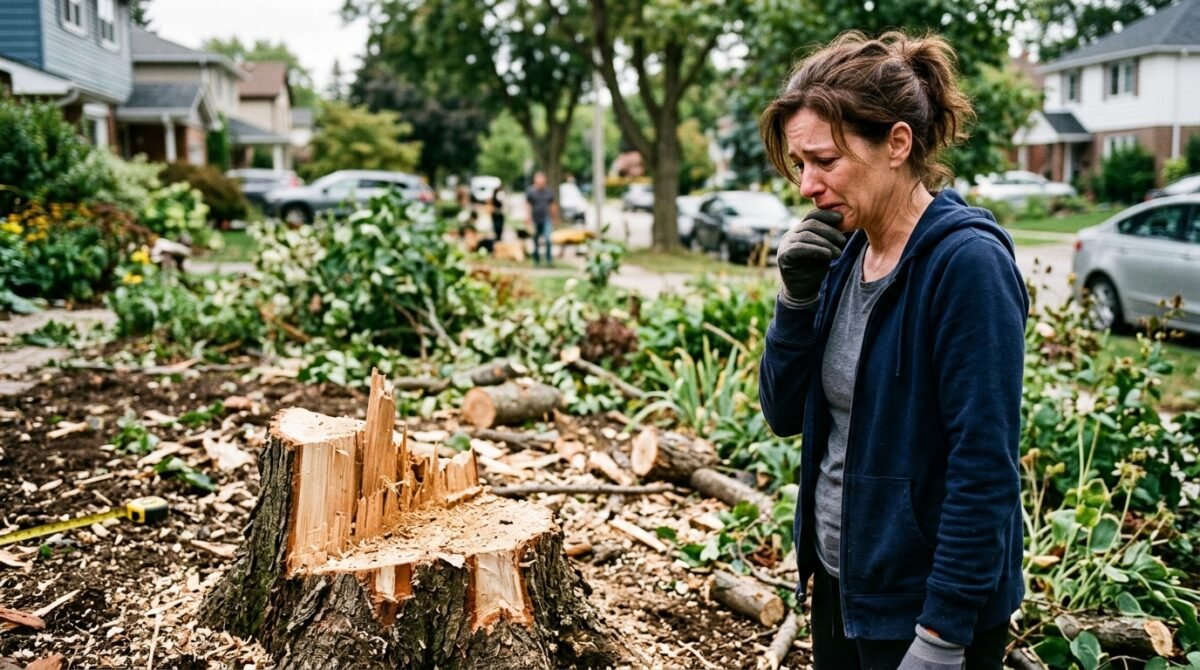
When I pulled into the driveway that evening, the silence was deafening. The vibrant, leafy canopy that usually greeted me was gone. In its place stood a jagged, weeping stump, surrounded by a mess of shredded branches and crushed hydrangeas. Brenda wasn’t even apologetic; she was standing on my patio, checking her phone, looking for all the world like a general surveying a conquered territory. She actually had the audacity to tell me it ‘opened up the space’ for the party planners.
The moral dilemma here isn’t just about the tree. It’s about the total annihilation of personal boundaries and the assumption that my home, my labor, and my property are merely props for her family’s convenience. I didn’t scream. I didn’t cry. I went inside, sat at my computer, and pulled up the contact information for the local arborist who had consulted on the tree’s health just last spring. I calculated the value, the cost of removal, and the price of a mature replacement, then I printed an invoice.
This is the story of how a single decision to hold someone accountable turned into a full-blown family war. It’s a story about what happens when the ‘polite’ thing to do is no longer an option, and why, for some people, the only language they truly understand is a line item on a bill. The fallout has been swift, expensive, and deeply revealing about who in this family respects the sanctity of a home and who thinks everything is up for grabs.
The Morning of the Unannounced Landscaping
The morning of the incident started with a text message I ignored, assuming it was just another request for me to host the bridal shower that I had already politely declined due to a work trip. Brenda had been relentless about the venue. She insisted that my garden was the ‘only location with the right vibe,’ ignoring the fact that my backyard was currently a work-in-progress zone that I hadn’t prepared for a catered event.
I left for my office at 7:30 AM, noting a white van parked near the curb, but I dismissed it as city utility workers. I should have known better. Brenda had spent the last three weeks oscillating between guilt-tripping me about ‘family unity’ and passive-aggressively commenting on the ‘overgrown’ state of my lawn during Sunday dinners. She didn’t want a garden; she wanted a stage, and she was going to clear the debris regardless of who owned the land.
By 10:00 AM, my neighbor, Sarah, sent me a photo that made my blood run cold. It showed a crew of men in high-visibility vests dragging massive, heavy branches toward a woodchipper parked in front of my house. I tried calling Brenda immediately, but she went straight to voicemail. I called my husband, Mark, who was in a meeting and couldn’t answer. I felt a surge of helplessness, trapped in an office building miles away while my home was being dismantled.
“Hey, do you know why there are tree trimmers cutting down the Magnolia? Brenda is standing there pointing at the trunk. They are taking the whole thing down, not just trimming it.”
— Text message from Sarah, my neighbor
I left work in a panic, speeding home with my heart hammering against my ribs. I kept telling myself it was a misunderstanding—maybe they were only pruning a diseased branch, or maybe she had hired a professional arborist to clean up the crown. But the image Sarah sent haunted me. The sheer size of the branches hitting the pavement told a much more violent story.
When I finally turned onto my street, the sight hit me like a physical blow. The Magnolia, which had been the pride of my landscaping efforts for twenty years, was nothing more than a waist-high stump. The lawn was scarred, covered in sawdust and woodchips, and the beautiful, fragrant shade was gone. Brenda was standing near the stump, talking to the crew leader, seemingly oblivious to the destruction she had orchestrated.
The Confrontation on the Patio
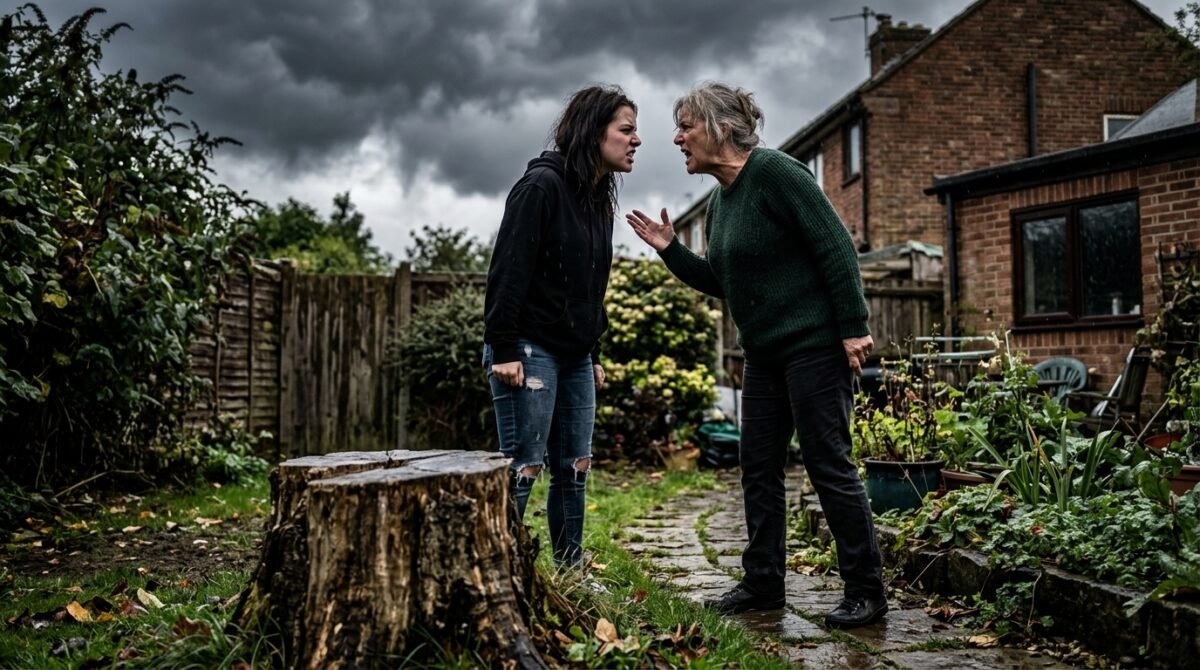
I didn’t even turn off the engine before I was out of the car. My legs felt shaky, but my resolve was hardening into something cold and sharp. Brenda looked up, smiled, and actually had the audacity to wave. She looked proud, as if she had just saved me from myself by removing an ‘eyesore’ that was blocking her vision for a tent placement.
I walked up to her, ignoring the contractors who were still packing up their gear. I asked her, in a voice that was eerily calm, exactly what she thought she was doing to my property. She wiped her hands on her apron and gestured at the empty space where the tree had been, talking about sunlight and better flow for the tables.
“I did you a favor, darling. That tree was blocking all the light. For Sarah’s shower, we need an open space, and frankly, it was looking a bit raggedy lately. You should be thanking me for the update.”
— Brenda, my mother-in-law
I stared at her, genuinely unable to process the level of narcissism required to destroy property that didn’t belong to you. I told her that the tree wasn’t just ‘raggedy’; it was a mature, expensive asset that provided shade and privacy. I asked her who gave her the authority to contract a landscaping company to work on my land without my permission or consent.
She scoffed, waving a hand dismissively as if I were being overly dramatic about a bit of wood. She told me to stop being so sensitive and that the family would benefit from the open space. It was the classic ‘I know better than you’ attitude that had defined our relationship for years, but this time, it felt different. It felt like an act of aggression, not just a boundary violation.
I told her the contractors were leaving and that I wanted her off my property immediately. She looked shocked, her mouth dropping open as if I had just slapped her. She tried to pivot, talking about the ‘party budget’ and how the garden would look so much better with fairy lights once the ‘clutter’ was gone. I didn’t engage. I just pointed to the gate and waited for her to realize I wasn’t joking.
As she left, she muttered something about how ‘ungrateful’ I was and how she would have to explain my ‘meltdown’ to the rest of the family. I stayed standing by the stump for an hour, watching the shadows stretch across the yard where the tree used to be. It was the first time I realized that for Brenda, there was no line she wouldn’t cross to get what she wanted.
The $4,200 Invoice Arrives

That night, I didn’t sleep. I spent the hours between midnight and dawn researching the value of a mature Magnolia tree. I found an arborist, a man who had actually looked at that tree three years ago for a routine check-up. I called him first thing in the morning and explained the situation. He was appalled. He explained that a twenty-year-old tree of that size isn’t just wood; it’s a significant piece of landscaping value that adds to the property’s appraisal.
He provided me with a formal estimate for the removal of the debris, the grinding of the stump, and the cost of installing a similar-sized mature tree, including the labor and the equipment required to transport such a thing. The total came to $4,200. It was a steep number, but it was an accurate reflection of what it would take to restore my yard to its original state. I didn’t hesitate. I typed up an invoice, attached the arborist’s report, and sent it to Brenda via certified mail.
I also sent her an email, keeping it brief and professional. I stated that she had authorized unauthorized work on my property and that I expected to be reimbursed for the damages. I didn’t include any emotional language, no talk about how much I loved the tree or how hurt I was. I treated it like a business transaction, which was the only way I knew how to handle her.
“Attached is the invoice for the unauthorized destruction of my property. Payment is expected within 14 days. Failure to remit payment will result in further legal action, including potential charges for property damage and trespassing.”
— Email sent to Brenda
The response was immediate. Within twenty minutes, my phone was blowing up with texts, not just from Brenda, but from my sister-in-law and even my husband, who had been blindsided by the whole situation. Brenda was playing the victim card, telling everyone that I was ‘billing the family’ and acting like a cold-hearted, greedy person who cared more about money than her daughter-in-law’s happiness.
I saw the messages rolling in, one after another. They were filled with accusations of being ‘divisive’ and ‘petty.’ My sister-in-law, who was the beneficiary of the shower, sent a long, tearful message about how the party was now ‘ruined’ because of the tension. It was incredible how they all focused on the social consequences for them while ignoring the complete annihilation of my property rights.
I chose not to respond to the group chat. I knew that anything I said would be twisted and used to fuel the fire. I kept my phone on silent and went back to my work, focusing on the cold, hard numbers. For the first time in years, I felt a sense of control. I wasn’t just a bystander in my own life anymore; I was holding them accountable for their actions.
The Sunday Dinner Silence
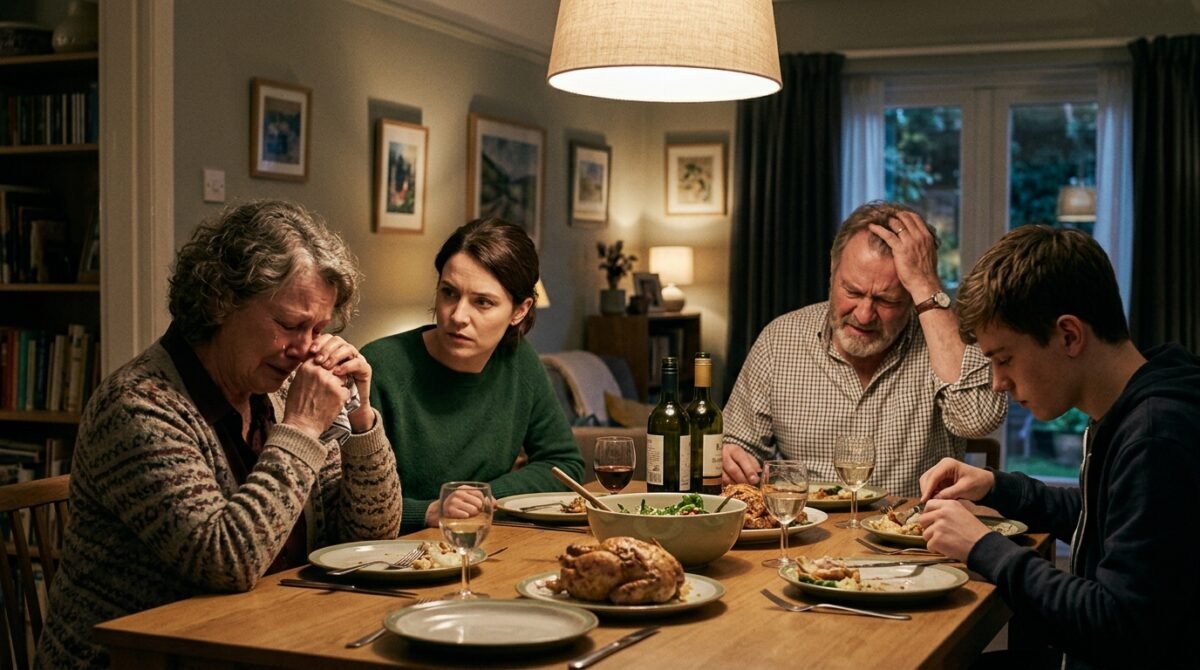
The inevitable showdown occurred at the next Sunday dinner. I didn’t want to go, but Mark insisted that we show up to ‘clear the air.’ He was clearly caught in the middle, trying to balance his love for his wife with his lifelong conditioning to appease his mother. The moment we walked through the door, the temperature in the room dropped ten degrees. The entire family was there, and the atmosphere was thick with unspoken tension.
Brenda didn’t even offer us a drink. She sat at the head of the table, looking like a martyr, her eyes red as if she’d been crying. The dinner conversation was forced and shallow, revolving around the weather and the upcoming bridal shower plans. Nobody mentioned the tree, but the giant, empty space in the backyard was the elephant in the room that everyone was dancing around.
Finally, halfway through the main course, Brenda brought it up. She sighed loudly and looked at me, her voice dripping with artificial sadness. She told the table that she was ‘deeply hurt’ by the invoice I had sent, claiming it was an attack on the family’s integrity. She tried to frame the whole thing as a misunderstanding, saying she had ‘heard’ someone else suggest cutting the tree back and she was just trying to help make things beautiful for the party.
“I honestly don’t understand how someone can value a tree over their own family. It was just a plant, and I was trying to make sure the shower was perfect. Billing me? That’s just cruel.”
— Brenda, addressing the table
I looked her straight in the eye and kept my voice steady. I told her that it wasn’t about the tree, and it wasn’t about the money. It was about the fact that she had entered my home, disregarded my expressed wishes, and made a permanent change to my property without even asking. I reminded her that my house is not her playground, and that she needs to learn that her actions have consequences, regardless of how ‘well-intentioned’ she thinks she is.
The table went silent. My father-in-law looked down at his plate, and my husband sighed, rubbing his temples. Brenda started to cry, saying she was just trying to be a good grandmother/mother-in-law and that I was pushing her away. It was a classic manipulation tactic, but it wasn’t working anymore. I didn’t apologize. I didn’t soften my stance. I simply told her that the bill remained due, and if she didn’t want to pay it, we could discuss it through legal mediation.
The dinner ended early. There were no pleasantries, no hugs, just a cold, awkward exit. As we walked to the car, Mark was quiet, clearly processing the reality of the rift his mother had created. I didn’t push him to take my side; I just needed him to understand that the boundary I had drawn was necessary for my own sanity. I wasn’t the villain in this story, no matter how much Brenda tried to rewrite the narrative.
The Online Court of Public Opinion

When I finally vented about the situation on an anonymous forum, I wasn’t expecting the outpouring of support I received. I typed out the story, detailing everything from the morning the tree was chopped down to the silence at the dinner table. Within hours, the post had gone viral, with thousands of people chiming in on the audacity of the situation. It was validating to see that I wasn’t crazy for being angry about the destruction of my property.
The comments were a mix of outrage on my behalf and advice on how to handle the legal side of things. People from all over the world shared stories of their own ‘entitled’ in-laws and the battles they had to fight to keep their homes and their boundaries intact. It felt like I had found a community of people who understood that ‘family’ doesn’t mean you have to be a doormat.
“This is textbook entitlement. She didn’t just cut down a tree; she signaled that she owns you and your space. The bill is the only way to make her realize there are real-world consequences. Don’t back down. If you do, she’ll just do it again with something else.”
— u/PropertyRightsAdvocate (Top Comment, 32.1k upvotes)
There were, of course, the contrarians who claimed I was being too harsh, or that money shouldn’t come between family. But they were heavily downvoted and quickly shut down by people pointing out the sheer absurdity of someone entering a home and making permanent structural changes without consent. It was a stark reminder that most people value basic respect and boundaries over the ‘keep the peace at all costs’ mentality that Brenda was pushing.
The comments also gave me some practical advice. People suggested I look into local ordinances about tree removal and damage to property, and warned me that Brenda might try to retaliate in other ways. One user, who identified as a lawyer, even recommended that I document everything—every text, every email, every conversation—in case this ever had to go to small claims court. I spent the next few days systematically organizing my evidence.
I found myself reading through the comments late into the night, feeling a strange sense of comfort. I realized that my situation wasn’t unique, but that the outcome depended entirely on my ability to stand firm. The support I received online gave me the strength to maintain my boundaries even when my own family members were trying to guilt-trip me into letting it go. It was a digital armor that I wore every time I had to interact with Brenda.
The thread became a repository of stories that proved the same thing: boundaries are only as strong as your willingness to enforce them. If I had let this slide, it would have been a blueprint for Brenda to continue making decisions about my life. The fact that the internet overwhelmingly supported my decision to send the bill made me realize that my feelings were valid, and that protecting my home was the right thing to do.
The Legal Threat and the Standoff

Two weeks after I sent the invoice, I received a letter in the mail from an attorney. I opened it with shaking hands, expecting a lawsuit. Instead, it was a letter from Brenda’s ‘family friend’ who was a lawyer, essentially telling me that the bill was ‘baseless’ and that if I attempted to pursue payment, they would countersue for ‘harassment’ and ‘creating a hostile family environment.’ It was a bluff, and a poorly constructed one at that.
I laughed when I read it. It was so transparently Brenda’s voice coming through the legal jargon. I took the letter to my own lawyer, a local professional I had consulted previously about property rights, and we drafted a response. We outlined the exact laws regarding destruction of property and provided the arborist’s report as evidence. We made it clear that if she didn’t pay the invoice by the end of the month, we would be filing in small claims court.
The shift in power was palpable. Suddenly, the silence from Brenda’s camp turned into a frantic scramble. She started texting Mark, begging him to get me to ‘drop this ridiculous lawsuit.’ She claimed she was ‘broke’ and that the landscaping company had overcharged her anyway. It was a classic pivot from righteous indignation to playing the victim of financial hardship. I didn’t care. I hadn’t asked her to hire the landscapers.
“We are not dropping the invoice. This is a matter of property damage, and the amount remains the same. If you have issues with the landscaping company, you should take that up with them, not me. The payment is due on the 30th.”
— My response via my attorney
The days leading up to the deadline were tense. Mark was caught in the middle, and I could tell the strain was starting to affect our marriage. We spent long evenings talking about the importance of boundaries and how his mother had spent years conditioning him to feel responsible for her emotional state. It was a difficult conversation, but it was necessary. I told him that I wasn’t going to let her turn our home into her project, and that he had to be on my team.
To his credit, Mark finally started to see the bigger picture. He stopped trying to mediate and started setting his own boundaries with her. He told her that he supported my decision to hold her accountable and that if she didn’t pay the bill, she would be facing the consequences of her actions. It was the first time I felt like we were truly on the same side, and it made the stress of the standoff worth it.
The deadline came and went. She didn’t pay. On the 31st, we filed the papers in small claims court. The relief I felt was immense. It wasn’t about the money anymore; it was about the principle of the matter. I had stood up for my home, my property, and my right to live my life without interference. The court date was set for two months out, and for the first time in a long time, I felt like I had the upper hand.
Why the Sunday Dinner Table Went Silent

The next time we saw Brenda, it was at a different venue—neutral ground, a restaurant, to avoid the ‘my house, my rules’ dynamic. She looked tired, the fight having clearly taken a toll on her. But she hadn’t given up. She started the lunch by talking about how much she missed the ‘old us’ and how she wished we could just move on. She was trying to rewrite history, acting as if the tree incident was a minor misunderstanding that we were all blowing out of proportion.
I didn’t let her get away with it. I kept the conversation focused on the reality of the situation. I asked her why she felt the need to make decisions for my property in the first place. She tried to deflect, talking about how ‘the family’ expects certain things, and how she was just trying to maintain the family image. I told her that my home isn’t the family image; it’s my home. I told her that she needs to stop looking at me as a prop in her life.
The restaurant went quiet as I spoke. I wasn’t shouting, but I was firm. People at nearby tables were looking over, which only made Brenda more uncomfortable. She hates public scenes, and the fact that I was willing to hold her accountable in a public space was a new, terrifying variable for her. She tried to interrupt, but I kept going, detailing the impact her actions had on our lives and the trust she had broken.
“You destroyed a part of my home because you couldn’t be bothered to ask me. That isn’t family love, Brenda. That’s a lack of respect. And I’m done with it.”
— My statement at the restaurant
She tried to play the victim, saying I was ‘attacking’ her. I looked at her and said, ‘No, I’m holding you accountable for your actions.’ It was a distinction that she didn’t seem to understand. She was so used to getting her way by making others feel guilty that she couldn’t comprehend a world where she had to pay for her mistakes. The look on her face was a mix of shock, anger, and for the first time, a glimmer of realization that she couldn’t manipulate me.
Mark sat there, silent, his hand on mine. It was the first time he had seen me stand up to her so clearly, and I could tell it gave him a sense of relief. He didn’t say a word, but he didn’t have to. His presence was enough. We weren’t just a couple; we were a unit, and we were standing our ground against the tide of his mother’s entitlement. It was a powerful moment that solidified our relationship.
We left the restaurant before the dessert arrived. I told her that we would see her in court, and that until then, we needed some space. She tried to call after us, but we kept walking. It was the first time I had ever walked away from one of her ‘discussions’ without feeling guilty or apologetic. It was liberating to realize that I didn’t owe her anything—not my home, not my silence, and certainly not my peace of mind.
The Small Claims Court Verdict

The day of the court hearing was surprisingly uneventful. We arrived early, sitting on the wooden benches, the smell of old paper and dust filling the air. Brenda was there with her ‘legal friend,’ looking nervous. I had my documents organized in a binder, every piece of evidence cataloged and ready. My lawyer had prepared me for the possibility that the judge might be lenient, but I was confident in the facts of the case.
When our case was called, the judge was professional and to the point. He listened as my lawyer presented the evidence of the destruction of property and the cost of the damages. He then listened as Brenda’s representative tried to argue that it was a ‘good-faith attempt’ to improve the yard. The judge cut him off, asking simply, ‘Did the property owner give permission?’ The answer was a quiet, ‘No.’
The judge then looked at Brenda. He told her that property rights are sacred, and that no one has the authority to make permanent changes to another person’s home without express permission. He pointed out that the cost of the damages was well-documented and that the lack of consent was the deciding factor. It was a short, sharp rebuke that felt like a vindication of everything I had been fighting for.
“The court finds in favor of the plaintiff. You are ordered to pay the full amount of $4,200 for the damages caused to the property, plus court fees. This matter is closed.”
— The judge’s ruling
I felt a massive weight lift off my shoulders. It wasn’t about the money, but it was about the validation. The court had confirmed what I had known all along: I was in the right, and Brenda was in the wrong. As we walked out of the courtroom, she wouldn’t even look at me. She just walked away, her face tight with anger. It was the end of the road for her entitlement.
Mark and I walked to the car in silence, the sun shining brightly on the courthouse steps. It was over. We had won, and more importantly, we had established a boundary that could never be crossed again. We didn’t talk about the money; we talked about the future. We talked about how we were going to move forward, how we were going to rebuild our garden, and how we were going to protect our home.
I realized then that this whole experience, while painful, had been a necessary step in our growth as a couple. We had faced a trial, both literally and figuratively, and we had come out the other side stronger. We had learned that we were capable of standing up to anyone, even those who thought they were entitled to control our lives. It was a hard-won victory, but it was one that I would never regret.
The Garden Reborn

Months later, I finally started the process of replanting. I chose a new Magnolia, one that would take time to grow but that was mine, planted on my terms. I didn’t want it to be a replacement for the old one; I wanted it to be a symbol of a new beginning. I worked in the garden on weekends, feeling the soil between my fingers, enjoying the silence and the peace of my own space.
Brenda hasn’t been back to the house since the court date. We haven’t seen her at family dinners, and the communication has been minimal. It’s for the best. We needed the space to heal, and she needed the time to realize that she couldn’t control us. It’s not a perfect situation, but it’s a healthy one, and that’s all that matters to me.
Mark and I have started a new tradition: Sunday brunch, just the two of us. We talk about our plans, our goals, and our life together. We don’t talk about his mother, unless it’s to laugh at the absurdity of it all. We have moved past the drama, and we have found a sense of peace that I never thought possible when we were in the middle of it.
“The garden is finally coming back to life. It’s not the same, but it’s growing. And that’s what matters. We’re growing, too.”
— A thought from my journal
I look out at the yard now, and I don’t see the stump anymore. I see the new growth, the promise of the future. I see a home that is mine, protected by the boundaries that I fought so hard to establish. It was a long, difficult journey, but I’ve learned that the most important thing you can ever own is your own autonomy.
I hope that if anyone is reading this who is going through a similar situation, they know that they aren’t alone. You don’t have to accept someone else’s definition of your life. You have the right to your home, your boundaries, and your peace. And sometimes, the only way to get that is to hold people accountable for their actions, no matter how hard it might be.
The garden is mine, and it will stay that way. The memories of the old tree will always be there, but they’ve been replaced by the strength and resilience of the new one. It’s a garden of my own making, and I wouldn’t have it any other way.
Reflecting on the Aftermath

Looking back, I realize that the tree was just the catalyst. The underlying issue had been festering for years—a lack of respect, a disregard for boundaries, and an assumption that family ties meant unconditional submission. When Brenda took that chainsaw to my property, she wasn’t just clearing a view; she was asserting dominance over a space she felt she had a right to control. The legal battle was the only way to force her to acknowledge that my home was not her domain.
There’s a strange kind of freedom that comes with no longer trying to please someone who fundamentally doesn’t respect you. I spent so much energy trying to be the ‘good’ daughter-in-law, always careful to avoid conflict, always bending just a little bit more. And all it did was teach her that I was a flexible limit. The moment I stopped bending, the structure didn’t break; it solidified.
The fallout within the extended family was complex. Some cousins felt I was too aggressive, while others secretly told me they were glad I did it. It’s funny how a single act of defiance can act as a mirror for everyone else’s buried frustrations. I stopped caring about the gossip. I realized that the people who were truly on my side were the ones who respected the boundary I had set, not the ones who thought I should just take it.
“You didn’t ruin the family dynamic; you just exposed the cracks that were already there. It takes courage to stand up to that kind of entitlement.”
— A supportive message from my sister-in-law’s partner
I also learned that money is often the only language that people like Brenda understand. When I talked about ‘feelings’ and ‘boundaries,’ she heard ‘options.’ When I sent an invoice and followed up with a lawsuit, she heard ‘consequences.’ It was a cold realization, but a necessary one. If you’re dealing with someone who doesn’t respond to empathy, you have to be prepared to use the tools that they actually respect.
Ultimately, this experience taught me that my home is my sanctuary, and I am the only one who gets to decide what happens within its walls—and its garden beds. I don’t regret the legal battle. I don’t regret the broken relationship. I regret that it had to come to that, but I take full pride in the fact that I stood my ground. My home is now mine in a way it never was before, and that is a victory that no amount of money could ever buy.
Conclusion
My life has changed significantly since the lawsuit. The boundary I established has become a permanent feature of my relationship with the entire family. It’s not always comfortable, but it’s always clear. I’ve learned that the price of freedom is often the willingness to be the villain in someone else’s story. If being the ‘bad guy’ means I get to keep my home and my dignity, then I’ll wear that label with pride.
I wonder, though, how many of you have faced this kind of entitlement in your own lives? Have you ever had to send a bill to a family member just to get them to stop stepping over your lines? Or have you found a different way to handle the ‘Brendas’ of the world? Share your stories below. I’m curious to know if I’m alone in this, or if the struggle for boundaries is a universal experience that we’re all just starting to talk about.
Community Poll: Would you have taken your mother-in-law to court for destroying your property?
1. Yes, absolutely—property is property.
2. No, I would have just let it go for the sake of family harmony.
3. I would have cut her off, but not sued her.
4. I would have handled it in a completely different way (please specify in comments).
What's your verdict on this dilemma?
Vote below to contribute to the official community consensus.

Have a Dilemma Keeping You Up at Night?
Share your real-life feud, wedding chaos, or relationship crossroads anonymously with our editorial team.
What do you think ?
0 Comments🛡️ Comments are moderated to protect community integrity. Your comment will appear once approved by the editorial team.