
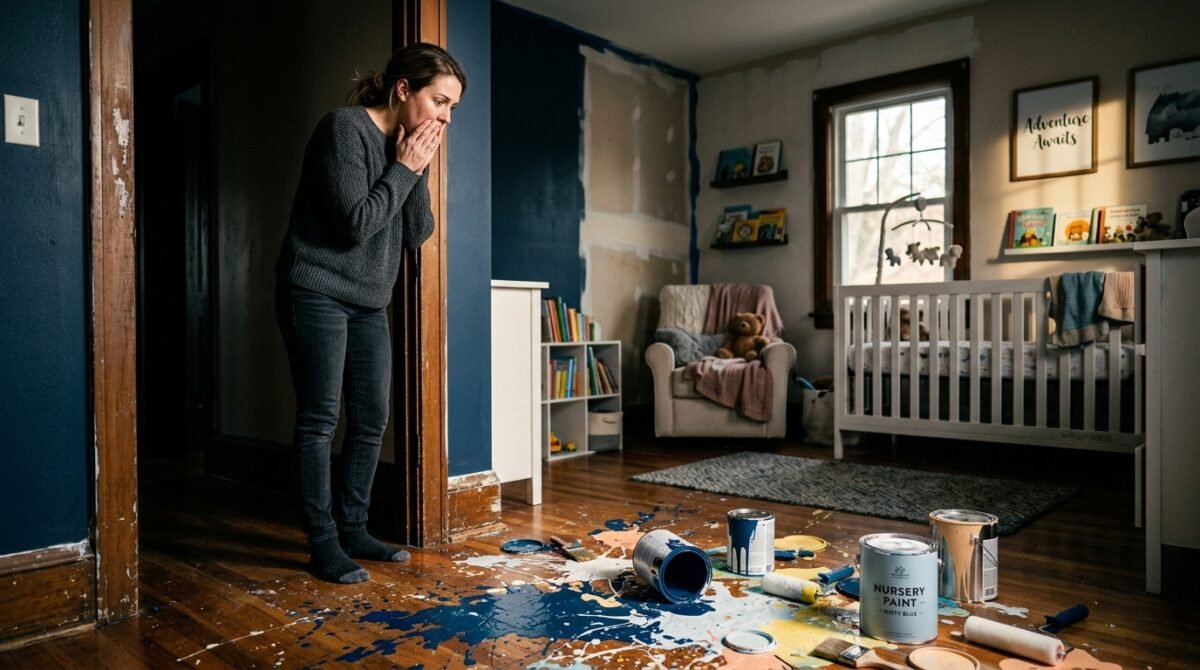
When my husband and I found out we were expecting, we spent months meticulously planning the nursery. It was supposed to be a sanctuary—a soft, gender-neutral space featuring sage greens, warm woods, and minimalist textures. It was our first home as a growing family, and every single detail was chosen with intention. My mother-in-law, Linda, was always ‘vocal’ about her opinions, but I truly believed that when it came to our child’s personal space, she would respect the lines we had drawn in the sand.
I was wrong. The violation didn’t happen overnight; it was a slow, creeping invasion of my privacy and my autonomy as a mother. It started with unsolicited suggestions about crib safety, migrated to comments about my ‘lack of traditional aesthetic,’ and culminated in the most brazen act of boundary-stomping I have ever witnessed. I walked into my house after a long shift, expecting to find the peaceful, unfinished sanctuary I had left behind, only to find the air thick with the pungent, suffocating smell of industrial-grade bubblegum pink paint.
Linda had not just suggested a change; she had taken it upon herself to execute a ‘surprise’ renovation while we were at work. She had entered our home with the spare key we provided for emergencies, and she had dismantled the calm, serene vision I had worked so hard to cultivate. The walls were unevenly coated in a shade so aggressive it felt like an assault on the senses. In that moment, the exhaustion of pregnancy turned into a cold, sharp clarity: this was not about the paint. It was about power.
Standing there, staring at the ruin of our nursery, I realized that I had two choices. I could swallow my anger, apologize for her ‘good intentions,’ and let the resentment fester until it poisoned my marriage, or I could draw a line so sharp that she would never dare to cross it again. I chose the latter. I didn’t just tell her to stop; I changed the locks, I revoked her access, and I set in motion a chain of events that would force my husband to finally choose a side.
This is the story of how a nursery became the battlefield for my family’s future, the text messages that shattered my trust, and the fallout that forced me to realize that sometimes, being the villain in someone else’s story is the only way to protect your own child’s peace.
The Premeditated Floral Invasion

Looking back, the signs were always there, hidden behind thin veneers of ‘grandmotherly concern.’ Linda had been dropping heavy-handed hints for weeks, lamenting that my choice of sage green was ‘too gloomy’ for a child. She insisted that babies need ‘vibrant, stimulating colors’ to develop properly, a claim she backed up with printouts from questionable mommy-blogs she found on Facebook. I would smile, nod, and change the subject, never realizing that my politeness was being interpreted as a lack of conviction.
The week before the incident, she had asked for the spare key ‘just in case’ she needed to drop off some hand-me-down clothes while we were out. I hesitated, but my husband, Mark, convinced me it was harmless. ‘She just wants to help,’ he said, his voice laced with the kind of naivety that only comes from being the golden child of a controlling mother. I gave her the key, feeling a knot of anxiety in my stomach that I stupidly ignored.
On that Tuesday, I came home early. I had been feeling lightheaded and just wanted to rest in my quiet, unfinished nursery. As soon as I opened the front door, the chemical stench hit me. It was visceral. I walked toward the upstairs bedroom, my heart pounding against my ribs, and there she was—standing on a step stool, roller in hand, dripping bright, neon pink paint onto our hardwood floors.
“Linda, what on earth are you doing? Get down from there right now!”
— Me, the moment I discovered the intrusion.
She didn’t even look guilty. She turned, a smug, satisfied smile plastered on her face, as if she had just finished a masterwork. She truly believed she was doing me a favor, and that the sheer ‘generosity’ of her labor would override any possible objection I could have. The arrogance of it was staggering. It wasn’t just the color; it was the total erasure of my autonomy.
I saw the drop cloths on the floor, the discarded remains of my soft sage-colored supplies, and the utter disregard for the furniture we had already assembled. The room looked like it had been vandalized by a toddler, and the realization that she had been in my private space, making executive decisions for my child without a word of consultation, sent a wave of cold fury through me that I hadn’t known I possessed.
The Gaslighting Theater of Good Intentions
When I demanded an explanation, Linda didn’t apologize. Instead, she launched into a well-rehearsed performance of the misunderstood martyr. She clutched her chest, her eyes widening in mock hurt, as if I were the one who had just committed a grave injustice. She told me that she had spent her own money on the paint and her own precious time on a Tuesday afternoon just to make sure the baby had a ‘happy, bright environment’ to grow up in.
She kept insisting that she was ‘only trying to help’ and that I should be grateful for a mother-in-law who cares enough to be involved. It was classic gaslighting—shifting the narrative so that I became the ungrateful, hormonal bride who was lashing out at an act of grandmotherly love. She even had the audacity to call my husband mid-argument, putting him on speakerphone to ‘explain’ the situation to him before I could.
“Mark, honey, I just wanted to surprise you both. I thought the room looked so depressing, and I knew you guys were too overwhelmed to get it done properly. Why is she acting like I committed a crime?”
— Linda, playing the victim over the phone.
Mark’s reaction was the first real crack in our foundation. Instead of standing up for my boundaries, he sounded conflicted, almost apologetic. He told me, ‘I know she shouldn’t have done it, but she is here now, and the paint is already on the walls. Let’s just talk about it calmly.’ That ‘calm’ conversation was the last thing I wanted. I wanted accountability. I wanted the locks changed. I wanted her gone.
I realized then that my battle wasn’t just with Linda; it was with the entire family structure that had enabled her behavior for thirty years. I wasn’t just fighting a paint color; I was fighting the expectation that my home was an extension of her own. I told her to leave immediately, and when she refused, claiming she had to finish the ‘base coat,’ I finally snapped and threatened to call the police for trespassing. That finally got her off the property, but the damage was already done.
The silence that followed her departure was heavy and suffocating. I spent the rest of the night scrubbing the floor, the smell of paint sticking to my hair and clothes, crying not because of the ruined walls, but because of the terrifying realization that my husband didn’t have the spine to defend our home against his own mother. I knew then that the nursery would be the site of a much larger war.
The Midnight Group Chat Exposure

The next morning, I woke up to a barrage of notifications. Linda had been busy. She had created a new family group chat—excluding me—and had been curating a narrative of my ‘outburst.’ She sent photos of the ‘beautifully improved’ room, painting me as a hysterical, unhinged pregnant woman who was ‘punishing’ her for trying to provide for her grandchild. I only saw the messages because Mark had left his iPad open on the nightstand, syncing his messages to the screen.
“I just wanted to make it beautiful for the baby. She screamed at me like I was a criminal in my own son’s house. I’m just heartbroken. Mark needs to get a handle on her temper before the baby arrives.”
— Linda, in the family group chat.
Reading those words, I felt a physical sickness. It wasn’t just that she was lying; it was the way she was weaponizing my pregnancy against me. She was framing my boundaries as a mental health crisis. And the replies? They were worse. Mark’s siblings were chiming in, talking about how I was ‘always sensitive’ and how I needed to ‘let go’ of my ego for the sake of the family. Mark hadn’t defended me. He had just stayed silent, liking a few of their messages, as if he were observing a minor disagreement from a distance.
I took screenshots of every single message. I didn’t say anything to Mark at first. I let the silence stretch for hours, watching him walk around the house like nothing had happened. He tried to offer me coffee, tried to make small talk, completely oblivious to the fact that I had seen the betrayal playing out in real-time. I felt like a stranger in my own home, living with a man who was more committed to his mother’s comfort than his wife’s peace of mind.
By the time I finally confronted him, my voice was steady, cold, and entirely devoid of the ‘hormonal hysteria’ they were accusing me of. I showed him the screenshots. His face went pale, his excuses dying in his throat as he realized he had been caught in the middle of a campaign to undermine our marriage. The mask of ‘we’re a family’ was slipping, revealing the toxic codependency that had been there all along. It was the most important conversation of our marriage, and for the first time, he had no choice but to look at the reality of his mother’s manipulation.
The Sunday Dinner Cold Shoulder
The following Sunday, we were expected at Linda’s for the traditional weekly dinner. Usually, I would have been helping in the kitchen, playing the role of the dutiful daughter-in-law. This time, I walked into her house with a singular goal: to set the record straight. I didn’t come to argue; I came to state facts. The atmosphere in the dining room was thick enough to cut with a knife. Linda was beaming, acting as if the ‘incident’ was just a silly misunderstanding we were all going to laugh about.
When she tried to bring it up, aiming for a performative apology that would make me look petty, I cut her off. I didn’t raise my voice. I didn’t make a scene. I simply looked her in the eye and laid out exactly why her actions were unacceptable. I brought up the trespass, the damage to the property, and the lies she had spread in the group chat. The room went absolutely silent. Even the silverware stopped clinking against the plates.
“Linda, I want to be crystal clear. You are not a co-parent. You do not have access to my home. And I will not tolerate you talking about me behind my back to your other children. If you cannot respect my boundaries, you will not be a part of our child’s life.”
— Me, delivering the ultimatum at the dinner table.
The look on her face was priceless—a mixture of shock and pure, unadulterated indignation. She tried to deflect, looking to her other children for validation, but they stayed quiet. They knew the truth, and for once, they couldn’t ignore it. Mark, to his credit, finally stood up. He told his mother that she had gone too far, and that he was standing with me. It was the most satisfying moment of my life, even though it meant the bridge was effectively burnt.
We left before dessert. As we walked to the car, my hands were shaking, but my heart was light. I had done it. I had finally stopped being the ‘accommodating’ one. The relief I felt was immense, but I knew this was just the beginning. The fallout would be messy, and the family would likely try to pressure us, but for the first time, I felt like I was actually the one in control of my own life.
That night, I went to the nursery and looked at the neon pink walls. They were ugly, but they were also a reminder. A reminder of what I had been willing to put up with, and a reminder of the day I stopped. I decided then and there that I wouldn’t repaint them immediately. I would keep them as they were until the day I decided to finally tear them down and build something truly mine. A symbol, not of her victory, but of my resilience.
The Reddit Verdict: Echoes of the Internet
I posted about this on a popular subreddit the next day, needing to know if I was actually the villain. I expected some backlash, some ‘she’s family, you should forgive her’ comments, but I was overwhelmed by the sheer volume of support. Thousands of people, many of them mothers themselves, validated my rage. They told me that the nursery was a sacred space and that her actions were not just rude—they were a profound violation of trust.
“This isn’t about paint. This is about a woman who believes her son is still her property and that you are just a temporary occupant of his life. You did the right thing. Don’t look back.”
— u/MamaBearBoundaries (Top Comment, 32.5k upvotes)
There were hundreds of comments like that. People shared their own stories of overbearing in-laws, of ‘hidden’ keys, of boundary-stomping that turned into years of resentment. It was a community of people who had been through the exact same struggle, a collective voice of support that I hadn’t realized I needed. It felt less like I was complaining and more like I was finally speaking a truth that had been silenced for too long.
Of course, there were the dissenters. A few people argued that I was ‘ruining the family dynamic’ over paint, that I should have just ‘let it go’ for the sake of the baby. I read those comments too, and they didn’t hurt. They actually helped me realize how deeply ingrained this ‘keep the peace at all costs’ culture is. If keeping the peace means letting someone walk over your life, then it’s a peace that isn’t worth having.
The thread became a repository of advice. People gave me legal tips about property rights, psychological advice on dealing with narcissists, and even design ideas for when I finally decided to fix the room. It was a turning point. It shifted my focus from the anger I felt toward Linda to the power I felt in protecting my family. I wasn’t just a victim of a bad mother-in-law anymore; I was a protector of my own home.
By the end of the week, the thread had gone viral. It was being shared on other platforms, and I saw screenshots of my own post on social media. It was surreal, but it gave me the courage to move forward. If strangers on the internet could see the boundary violation for what it was, then I didn’t need the validation of my in-laws. I had my own back, and that was enough.
The Locks Are Changed: A New Reality
The most tangible step toward reclaiming our life was changing the locks. It sounds like a small thing, but for someone who had allowed access to be a symbol of ‘closeness,’ it was monumental. I hired a local locksmith on Thursday, and when the new deadbolts clicked into place, the sound was the most beautiful thing I had ever heard. I gave the new keys to only my parents and our trusted neighbors, and for the first time, I felt like the door to our home was actually closed.
When Linda inevitably showed up the next day, ‘just to drop off a blanket,’ she was met with a locked door. She pounded on it for several minutes, calling out, acting as if she had the right to enter. I watched from the upstairs window, my breath steady. I didn’t go to the door. I didn’t engage. I let her stand there, realizing that the access she had taken for granted was gone. It was a powerful, silent message: the days of her coming and going as she pleased were over.
Mark was at work, and I had already warned him she might try this. He was prepared, and when she called him later, furious that she had been ‘locked out of her son’s house,’ he stood his ground. He told her that our home was not an open-access facility and that she would need to be invited if she wanted to visit. The panic in her voice was palpable—the realization that she was losing her control was setting in.
“I just wanted to drop off a gift! Why are you treating me like a stranger? This is my son’s home, I have a right to be here!”
— Linda, on the phone with Mark.
She tried to use the ‘grandchild card,’ saying the baby would miss out on a relationship with her. Mark’s response was perfect. He told her that a relationship is built on respect, and if she couldn’t respect the parents, she wouldn’t be seeing the baby. It was the hardest thing he had ever had to say to her, and I could hear the pain in his voice, but I also heard the resolve. He was finally, truly, stepping up.
The fallout lasted for weeks. There were guilt trips, there were fake health scares, there were pleas to other family members to intervene. But we stayed firm. We had established a new reality, one where our home was ours alone, and our nursery was a place of our own design. It was a hard-won peace, but it was a peace that felt real, solid, and undeniably ours.
The Psychological Toll of the ‘Perfect Grandmother’
As the weeks progressed, I started to process the deeper psychological impact of the incident. It wasn’t just about the paint; it was about the ‘Perfect Grandmother’ archetype Linda was so determined to maintain. She wanted the status of a doting grandmother without the work of actually being a respectful human being. She wanted to be the architect of my baby’s life, and my refusal to play along was a direct threat to that identity. It made me realize how many other things I had been forced to conform to over the years.
I started seeing a therapist to talk through the resentment, and she helped me understand that Linda’s behavior was a manifestation of deep insecurity. She was terrified of being irrelevant, and she was trying to force her way into my life to maintain her sense of purpose. But that didn’t make her behavior okay. It didn’t excuse the manipulation, the lying, or the blatant disregard for my feelings. Understanding the ‘why’ didn’t mean I had to accept the ‘what.’
I also realized how much of my own identity I had surrendered to ‘keep the peace.’ I had spent years shaping myself into the daughter-in-law she wanted, the one who never complained, the one who was always ‘easygoing.’ It was exhausting, and it was a lie. This incident was the catalyst that forced me to reclaim myself. I wasn’t just the wife or the mother-in-law’s target; I was a person with my own thoughts, my own values, and my own right to a life lived on my own terms.
The impact on my marriage was, in the long run, actually positive. Mark and I had to have the hard conversations we had been avoiding for years. We had to talk about what our family looked like, what our values were, and how we would handle external pressure. It brought us closer than we had ever been, because for the first time, we were a true team. We weren’t just two people living in a house; we were a unit, protecting our shared vision.
I began to look at the nursery differently. Instead of just seeing the paint, I saw the space where my child would grow up, loved and respected, in a home that was safe and secure. It was no longer just a room; it was a testament to the boundaries we had built. And that, I realized, was the best gift I could give my child—a mother who knew how to say ‘no’ to ensure that ‘yes’ meant something.
The Long-Term Boundary Reformation
Establishing long-term boundaries with Linda was a marathon, not a sprint. We had to implement a strict ‘no unannounced visits’ policy, a rule that she fought tooth and nail. She would show up at our door, ‘just in the neighborhood,’ and we would have to turn her away, time and time again. It was awkward, it was painful, and it was absolutely necessary. Every time we turned her away, the message became clearer: we are in charge, and you are a guest, not a resident.
We also stopped sharing information about our plans. We stopped letting her know when we were out, when we were at work, or what our schedules were. We created a wall of privacy that she couldn’t penetrate. It felt like we were living in a fortress, but it was a comfortable one. It was a space where we could just be us, without the constant looming threat of her interference. It was the freedom I had been craving for so long.
Of course, the rest of the family had their opinions. Some called us ‘cold,’ some called us ‘unforgiving.’ We chose to ignore them. We knew that they hadn’t seen the manipulation, the lying, and the absolute disregard for our home. We knew that they were judging us based on a version of the story that Linda had crafted to make herself look like the victim. We didn’t owe them an explanation, and we stopped trying to convince them.
“You guys are being so harsh. She’s your mother, Mark. You can’t just cut her out because she wanted to paint a room.”
— Mark’s sister, during a tense phone call.
Mark’s response to his sister was legendary. He simply said, ‘It’s not about the room. It’s about the respect. If you don’t understand that, then you don’t understand our marriage.’ That ended the conversation. We had stopped seeking their validation, and that was the ultimate form of liberation. We were no longer playing their game, and we were no longer defined by their expectations.
We started focusing on our own traditions, our own way of doing things. We spent holidays the way we wanted to, we decorated our home the way we liked, and we made decisions for our child based on our own research and values. It was a new beginning, and it felt like we were finally building the life we had always wanted, free from the shadow of someone else’s control.
The Final Repainting: A New Beginning

Six months after the incident, the day finally came to paint over the neon pink. I had been waiting for the right moment, and when I looked at the nursery, I no longer felt the sharp, stinging anger. Instead, I felt a sense of closure. It was time to make the room truly ours, a space that reflected our own vision, our own love, and our own boundaries. We bought the paint together—a soft, calming color that felt like a breath of fresh air.
The process of painting the room was a cathartic experience for both of us. We put on music, we talked, we laughed, and we worked together to cover up every single trace of the pink. It was as if we were erasing the last remnants of the intrusion, replacing it with something new and beautiful. As the last stroke of the roller hit the wall, I felt a weight lift off my shoulders that I hadn’t even realized I was carrying.
When the room was finished, it was exactly what I had envisioned. It was soft, peaceful, and welcoming. It was a space designed for our child, not for anyone else’s approval. It was a symbol of our resilience, our growth, and our commitment to each other. It was the perfect ending to a chapter that had been so difficult, and a beautiful beginning to the next one.
I looked around the room and felt a sense of peace that I hadn’t known was possible. We had come through the fire, and we had come out stronger. We had learned the value of our boundaries, the importance of our partnership, and the necessity of protecting our own happiness. We were ready for the next phase of our lives, and we knew that whatever challenges came our way, we could handle them together.
Looking back, the nursery drama was the best thing that could have happened to our marriage. It forced us to confront the issues we had been avoiding, and it empowered us to take control of our own lives. I am grateful for the lessons learned, for the growth experienced, and for the peace that now resides in our home. And most importantly, I am grateful for the knowledge that I am the one who holds the key to my own life.
The Power of the ‘No’
In the end, the most important lesson I learned was the power of the word ‘no.’ For years, I had been taught that saying ‘no’ was selfish, that it was a sign of being difficult or uncooperative. But in the context of my family and my home, ‘no’ was a protective barrier. It was the word that kept our space safe, that preserved our sanity, and that allowed us to build the life we wanted. It was the word that saved our marriage.
I’ve realized that boundaries aren’t just for ‘difficult’ people; they’re for everyone. They’re the foundation of a healthy life, the lines we draw to protect what we value, and the structure that gives our relationships meaning. Without them, we are just drifting, letting others define our reality and dictate our choices. And that is a way of living that is far more costly than the temporary discomfort of setting a boundary.
I’ve started teaching my own child about boundaries, about the importance of respecting others and the right to expect respect in return. It’s a lesson I wish I had learned sooner, but it’s a lesson I’m grateful to be able to pass on. It’s the legacy of that neon pink nursery, a reminder that the most important space to defend is the one you call your own.
I don’t regret the way I handled the situation. I don’t regret the change of locks, the firm words, or the distance I created. I don’t regret putting my own family first, even when it meant being the villain in someone else’s story. I am at peace with my choices, and I am proud of the life we have built, one boundary at a time.
So, to anyone struggling with an overbearing in-law, a boundary-stomping relative, or a situation where you feel your autonomy being eroded: know that you have the right to say no. You have the right to your own space, your own choices, and your own peace. Don’t be afraid to draw that line, because on the other side of that boundary is the freedom to finally live your own life.
Conclusion
The story of the nursery is a stark reminder that our homes are the physical manifestations of our boundaries. When we allow others to disregard the sanctity of that space, we are signaling that our needs and our autonomy are negotiable. My journey from a passive, ‘easygoing’ daughter-in-law to a protective mother and wife was painful, but it was the only way to ensure the long-term health of my family.
Boundary enforcement is rarely met with applause. It is often met with resistance, gaslighting, and the inevitable cries of ‘you’re being dramatic.’ But as I learned, those cries are merely the sounds of a power dynamic shifting. When you reclaim your authority, you aren’t being difficult—you are being an adult in your own life. And for that, there is no apology required.
What about you? Have you ever had to draw a line in the sand with family members, only to be met with total disbelief? Did you find that the fallout was worth the peace you eventually gained? Let’s talk in the comments: Is it ever okay to prioritize ‘keeping the peace’ when it comes at the expense of your own mental health and home autonomy? I’m curious to hear your stories of boundary-setting, the good, the bad, and the truly unbelievable.
What's your verdict on this dilemma?
Vote below to contribute to the official community consensus.

Have a Dilemma Keeping You Up at Night?
Share your real-life feud, wedding chaos, or relationship crossroads anonymously with our editorial team.
What do you think ?
0 Comments🛡️ Comments are moderated to protect community integrity. Your comment will appear once approved by the editorial team.