
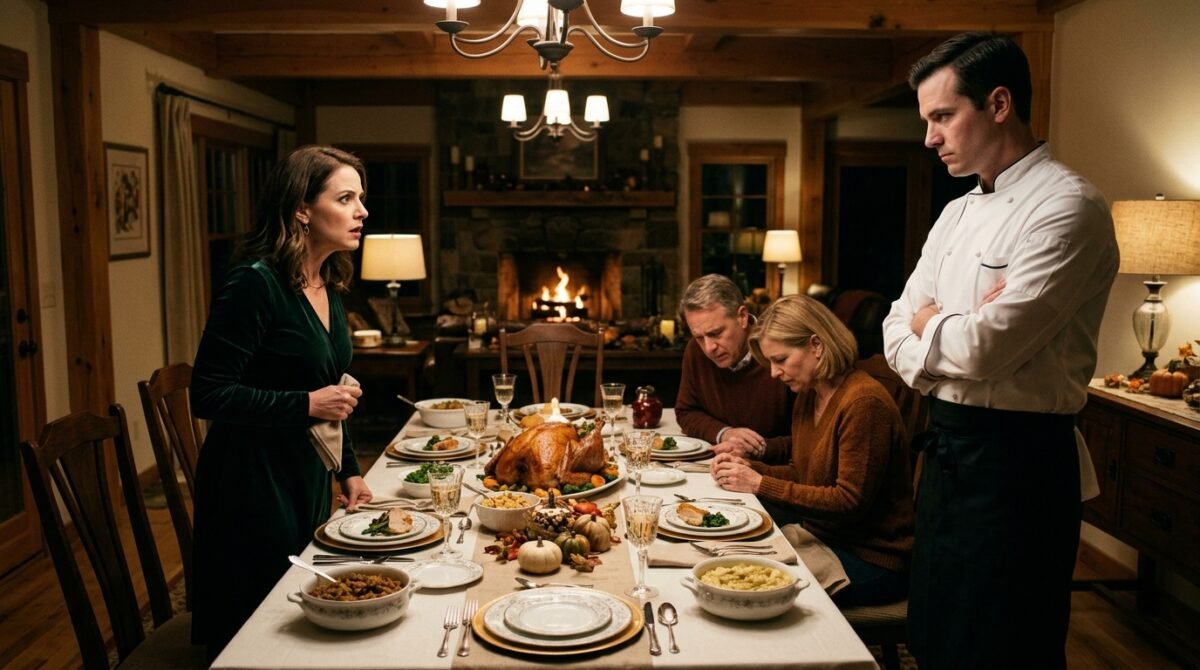
Thanksgiving has always been my favorite holiday. It is the one time of year where I feel like I can truly pour my love into something tangible—a meal that takes days of preparation, a home filled with the smell of roasting herbs, and a table set with my grandmother’s china. This year, however, I invited my husband’s parents to our home for the first time since we moved into our new house. I wanted it to be perfect. I spent weeks planning the menu, sourcing organic turkeys from a local farm, and hand-selecting wine pairings.
My husband, Mark, told me his parents were ‘particular,’ but I assumed that meant they didn’t like cranberries or perhaps preferred a specific type of stuffing. I never imagined that ‘particular’ was a polite euphemism for extreme, classist elitism. When they pulled into our driveway at 2:00 PM, I didn’t just see a black SUV; I saw a small catering van following behind it. I thought it was a delivery error, perhaps a gift they had sent ahead. I was wrong.
As the door opened, my mother-in-law, Eleanor, stepped out wearing a cashmere coat that cost more than my first car. She didn’t offer a hug or a compliment on the house. Instead, she gestured toward the catering van with a flick of her manicured wrist. That was the moment the dream of a peaceful holiday dissolved into a nightmare. They didn’t just bring themselves; they brought an entourage to bypass the ‘labor’ I had been slaving over for days.
The moral dilemma here wasn’t just about the food—though the insults cut deep—it was about the fundamental disrespect for my home, my labor, and my role as a host. When they finally walked into my kitchen and looked at my perfectly golden, herb-crusted turkey with a sneer of pure disdain, I knew I had reached a breaking point. What followed wasn’t just a ruined dinner; it was a total collapse of our familial boundaries, leading to a confrontation that would eventually spill over into the digital court of public opinion.
In the pages that follow, I will detail the absolute absurdity of that afternoon, the scathing insults that were hurled at my kitchen table, and the subsequent fallout that saw our family divided by pride, money, and an ungodly amount of spite. This is the story of how a single holiday meal became the battlefield for a war I never wanted to fight.
The Arrival of the Catering Entourage
When Eleanor stepped onto our porch, the air felt thick with a sudden, icy tension. She looked at my apron, spotted with flour, and then behind her at the catering van that had just parked across our lawn. My heart sank. Mark was standing next to me, looking equally confused, until his father, Richard, stepped out and signaled for the catering van driver to begin unloading.
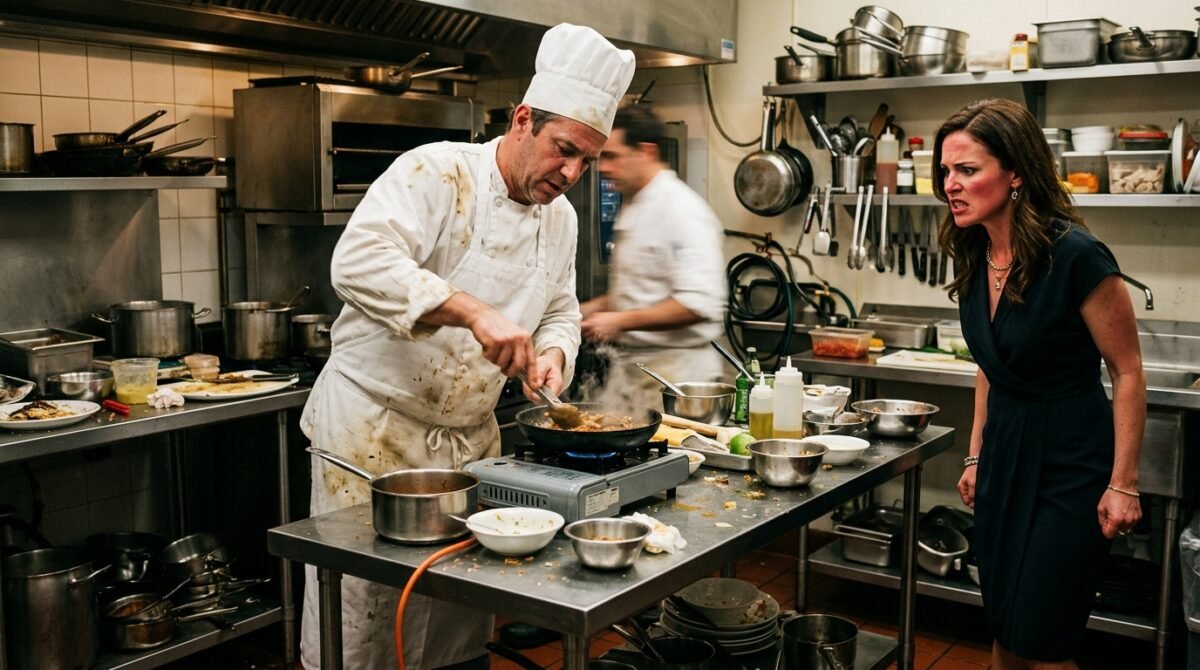
I watched in total disbelief as a man in a pristine white chef’s uniform began hauling portable stainless-steel warming racks and high-end induction burners toward my front door. It looked like a mobile kitchen unit was being deployed to my foyer. Eleanor didn’t even acknowledge the chaos; she just walked past me, touching the wallpaper with a critical eye, as if she were inspecting a hotel room that didn’t meet her standards.
“I hope you don’t mind, dear. We simply couldn’t risk the food poisoning that often comes with amateur preparations. We’ve brought Chef Julian to ensure we actually have something palatable to eat today.”
— Eleanor, arriving at 2:15 PM
I stood frozen, my hands still holding the oven mitts I had been wearing to baste the bird. Mark looked at his mother, then at me, stammering something about how he thought they were just bringing a dessert. The sheer audacity of it left me speechless. They weren’t just guests; they were an invading force, intent on proving that my home wasn’t good enough for their refined, aristocratic palates.
The Chef, a man who looked like he’d rather be literally anywhere else, began setting up shop in my kitchen. He moved my carefully arranged platters of appetizers aside to make room for his professional-grade equipment. He didn’t even ask; he acted as if he owned the kitchen. I felt like a stranger in my own home, watching my space be systematically dismantled by a man I had never met on behalf of people who clearly despised me.
I tried to intervene, walking into the kitchen to find the chef slicing up a piece of artisanal wagyu beef he had brought along. I asked him politely what he was doing, and he simply pointed to Richard, who was standing in the doorway holding a glass of scotch he’d brought himself. The power dynamic was clear: I was no longer the hostess. I was a tenant in my own house, sidelined by money and arrogance.
The ‘Peasant Food’ Verdict
The dinner service began, and it was the most uncomfortable hour of my life. My turkey, which had been brined for twenty-four hours and roasted to perfection, sat untouched in the center of the table. In its place, the private chef had laid out delicate portions of truffle-infused scallops and that wagyu beef. Eleanor looked at my turkey with an expression of pure, unadulterated disgust.
She gestured at the turkey with her crystal wine glass, her nose wrinkled as if she were smelling something putrid. The conversation had been strained, mostly consisting of Richard complaining about the lack of valet parking in our suburban neighborhood. When Eleanor finally spoke about the food, the temperature in the room seemed to drop ten degrees.
“Honestly, I don’t know how anyone eats this. It’s just so… rustic. It feels like peasant food. We really needed something with a bit more sophistication, wouldn’t you agree, Mark?”
— Eleanor, addressing the table
Mark looked down at his plate, clearly wanting the floor to open up and swallow him whole. He didn’t say a word to defend the meal I had spent three days preparing. His silence was the loudest thing in the room. I felt a hot, prickling sensation in my eyes, but I refused to cry in front of these monsters. I looked Eleanor dead in the eye and kept my voice perfectly level, despite the trembling in my hands.
I asked her if she had any idea how much effort goes into preparing a meal for guests. I explained, quite calmly, that the ‘peasant food’ she was mocking was a traditional recipe from my grandmother, a woman who had worked the land to provide for her family. I told her that in this house, we valued the time and effort put into a meal over the price tag attached to it. She merely scoffed, taking a bite of the wagyu.
The rest of the table fell silent. Even the children, who were usually loud, could sense the toxic energy radiating from their grandmother. Richard continued to eat, completely oblivious to the emotional violence his wife was inflicting. I realized then that this wasn’t just an accident; it was a calculated power play designed to humiliate me and re-establish their hierarchy within our family.
The Secret Group Chat Revelation
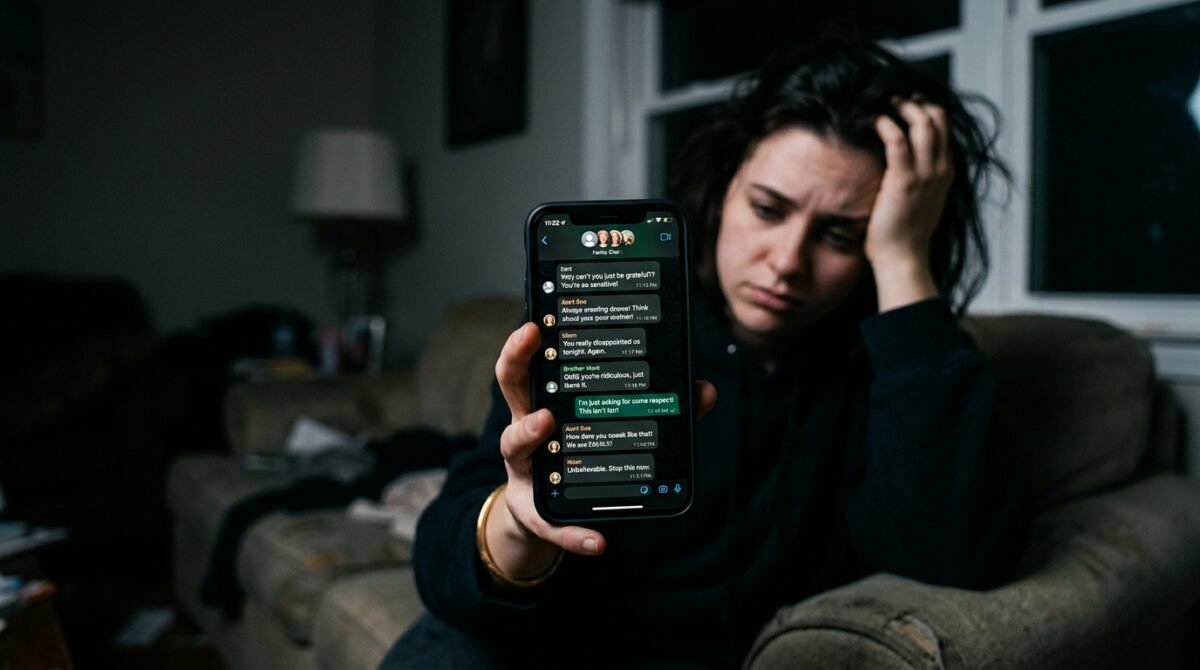
The breaking point didn’t come during dinner. It came later that night, after they had finally left, taking their ‘chef’ and their arrogance with them. Mark had gone to bed, exhausted from the tension, leaving his phone on the kitchen counter. A notification pinged—the family group chat. I normally wouldn’t look, but curiosity, mixed with the lingering anger of the day, got the better of me.
I unlocked the phone and opened the messages. What I found was a thread that had been going on for weeks, long before Thanksgiving. It wasn’t just about the food. It was a systematic dissection of my worth, my career, my home, and my personality. They had been planning this ‘intervention’ of a dinner for an entire month, discussing how to ‘rescue’ Mark from my ‘common’ lifestyle.
“Don’t worry, Mark will be so embarrassed by her little dinner that he’ll finally see why we’ve been pushing for a move to the city. We’ll save him from that dump yet.”
— Text from Eleanor in the family group chat
My stomach churned. It wasn’t just the snobbery; it was the betrayal. Mark had been reading these messages and not saying a word. He had been complicit in the narrative that my home was a ‘dump’ and that I was a burden to be saved from. Every warm moment I thought we had shared over the last few weeks felt like a lie. I stood in the dark kitchen, the glow of the phone illuminating the remnants of the ‘peasant’ turkey still on the counter.
I took screenshots of everything—the plans for the chef, the insults about my cooking, and the disparaging remarks about my career. I didn’t wake Mark up. I didn’t want to fight him while he was sleeping. Instead, I sat at the island, typing out a response to the group chat, knowing full well it would burn every bridge I had with his parents. I didn’t care anymore. The bridge was already ashes; I was just making sure they knew who had started the fire.
The final message I sent was simple: ‘I saw everything. Don’t ever step foot in this house again.’ Then, I blocked them all. I felt a strange sense of calm wash over me. The confusion of the day was replaced by the clarity of finality. I knew that tomorrow morning would be the hardest fight of my life, but for the first time in my marriage, I felt like I was actually standing on my own two feet.
The Morning After: A House Divided
When Mark woke up the next morning, the house was silent. I had already packed a bag and was sitting on the sofa with his laptop open, waiting for him. He walked in, looking for coffee, and asked why the kitchen was so clean. I told him I had thrown out everything his mother had touched and that I had seen the group chat. The color drained from his face.
He tried to apologize, to make excuses, saying that he didn’t want to cause trouble by confronting his parents. He said, ‘They’re just like that, you know how they are.’ But that was the problem—I didn’t know, and I refused to accept that ‘they’re just like that’ was an excuse for abuse. I told him he had to choose. It wasn’t an ultimatum; it was a boundary. He could have a relationship with his parents, but it wouldn’t happen in our home, and it wouldn’t involve me.
“You chose to let them disrespect me in my own home because you were afraid of them. I’m not asking you to cut them off, but I am done being the punching bag for their insecurities.”
— My words to Mark
He broke down, admitting that he had always felt like an outsider in his own family and that he thought by going along with them, he could gain their approval. It was a tragic realization. He had spent his entire life trying to satisfy people who were incapable of love that wasn’t tied to status or performance. We talked for hours, the emotional exhaustion of the previous day finally spilling over into a raw, honest conversation about our future.
I realized then that my husband was a victim of their cycle of abuse as much as I was. We had to decide if we were going to stay in this cycle or break it. For the first time, he admitted that his parents’ behavior was toxic and that he had been blinded by years of conditioning. We made a pact that day: our marriage would come first, or there wouldn’t be a marriage at all.
By the afternoon, the house felt lighter, even though the weight of our decision hung in the air. I knew the fallout would be immense. His parents wouldn’t take this silence lightly. They were used to control, and when you take that away from people who define themselves by it, they tend to lash out in unpredictable ways. We were preparing for a storm.
The Fallout: Legal Threats and Family Pressure
It started with the phone calls. My phone lit up with missed calls from Richard, then Eleanor, then his sister, Sarah, whom I’d always liked. I kept them blocked. Then came the emails—long, rambling diatribes about how we were being ‘unreasonable’ and ‘dramatic’ and that we needed to apologize for the ‘impoliteness’ shown to the private chef. The irony was so thick you could cut it with a knife.
They even threatened legal action, claiming that because Richard had ‘contributed’ to the Thanksgiving meal, he had a right to be there. It was nonsense, of course, but it showed just how far they were willing to go to force their presence on us. Sarah eventually sent a text that broke through my resolve to stay silent, suggesting that I was overreacting and that ‘family is family.’
“You’re ruining the holidays for everyone because you can’t take a joke about a turkey. Do you know how much they spent on that chef? Show some appreciation.”
— Text from Sarah
I didn’t reply to Sarah. I just sent a screenshot of the group chat to her. She didn’t respond. I think she realized then that her parents weren’t just being ‘quirky’ or ‘snobbish’; they were actively malicious. It was a wake-up call for the rest of the family, too. Suddenly, the relatives who had been neutral started questioning what was going on. The narrative that I was a ‘sensitive, ungrateful daughter-in-law’ was beginning to crumble.
The pressure to cave was enormous. Every time I went to the store or checked social media, I felt like I was being watched or judged. My in-laws had deep pockets and a long reach. They started planting seeds in the family, telling everyone that I had a breakdown and was keeping Mark away from them. It was a classic gaslighting campaign, and it was working on the older generation of the family.
I had to start documenting everything. I kept a folder of all their communications, their threats, and their lies. I spoke to a lawyer, just in case, who confirmed that they had absolutely no standing. It was a strange, bureaucratic nightmare to be in, but it was necessary. We were in a war of attrition, and I was determined to be the one who stayed standing.
The Reddit Trial: How the Internet Reacted
I finally posted our story on Reddit, using a throwaway account. I didn’t expect much, just a place to vent and see if I was truly the one out of line. The response was immediate and overwhelming. Thousands of comments poured in within hours. The consensus was shockingly unanimous: I was not the villain of this story.
The sheer number of people who shared similar stories of in-laws overstepping boundaries was staggering. It made me feel less alone. People were outraged on my behalf, dissecting the behavior of my in-laws with a precision that I hadn’t been able to muster in my own anger. It wasn’t just support; it was a validation of my sanity.
“This isn’t just about the food. It’s about the absolute, calculated humiliation of your host. Your in-laws are textbook narcissists. Go no-contact and never look back. NTA (Not The Asshole) a million times over.”
— u/FamilyDramaExpert (Top Comment, 32.1k upvotes)
Others were more practical, offering advice on how to handle the smear campaign that was happening in the family. They warned me that the in-laws would escalate once they realized they couldn’t control me through guilt. They advised me to keep the screenshots, keep the records, and stay firm. The community was a lifeline during those dark weeks of social isolation.
There were a few dissenters, of course—people who argued that I should have ‘taken the high road’ and just eaten the chef’s food. But they were quickly shouted down by the majority. The prevailing sentiment was that kindness has limits, and when those limits are crossed with malice, you have every right to stand your ground. It gave me the strength to keep the boundaries firm.
Reading the comments, I realized that I wasn’t just fighting for my turkey or my kitchen; I was fighting for the principle that a person’s home is their sanctuary. The support of thousands of strangers, people who had nothing to gain from my situation, was the most healing thing I could have asked for. I wasn’t crazy. I was just the first person to call them out on their nonsense.
Finding Common Ground in the Chaos
Mark and I spent the weeks following Thanksgiving in a bubble. We stopped checking the family news feed and stopped worrying about what they were saying. We focused on us. We started therapy, which was grueling but necessary. It helped us understand why Mark had been so hesitant to speak up and gave us tools to communicate better under pressure.
We also started to see who our real friends were. Some people in our circle were uncomfortable with the ‘drama’ and sided with the in-laws. We let them go. It was surprisingly easy to prune our lives of the people who didn’t respect our boundaries. We found that the people who stayed were the ones who truly cared about us, not about the social status or the ‘prestige’ of the family name.
We even started a new tradition. For Christmas, we did a potluck with our friends—people who actually appreciated the food and the company. No private chefs, no wagyu, just good, simple, homemade food and genuine laughter. It was the most peaceful holiday I had ever had. I realized then that the ‘peasant food’ had a flavor that their expensive, sterile meals would never have: love.
“You know, I haven’t enjoyed a holiday this much in my entire life. It’s not about what’s on the table, it’s about who’s sitting around it.”
— Mark, during our quiet Christmas dinner
We were still dealing with the legal threats and the occasional nasty email, but the sting was gone. We had replaced the fear of their judgment with the security of our own values. It was a powerful transition. We weren’t just surviving the situation; we were thriving in spite of it. We were building a life that was authentic to us, and that was something they could never touch.
The lessons learned were hard-won, but they were invaluable. I learned that you don’t owe anyone your time, your space, or your dignity. I learned that family is a choice, not a biological mandate. And most importantly, I learned that the most delicious meals are the ones cooked with respect, not pretension.
The Final Confrontation

Eventually, the in-laws realized their tactics weren’t working. They tried one last time to force their way into our lives, showing up unannounced on a Saturday afternoon. I was in the garden when I saw their car pull up. I didn’t panic. I didn’t run inside to hide. I walked out to meet them at the end of the driveway, looking them in the eye.
Richard stepped out, looking furious, while Eleanor stayed in the car, her face a mask of cold fury. He started shouting, demanding that we ‘stop this nonsense’ and start acting like a family again. I didn’t shout back. I stood there, silent and firm, until he finished his rant. Then, I told him the only thing I had to say.
“You are not welcome here. If you don’t leave right now, I will call the police and file a trespassing report. This is the last time you will ever speak to me this way.”
— My final words to Richard
He looked at me, really looked at me, and saw that I wasn’t the scared, polite daughter-in-law he had expected to find. He saw a woman who was done. He huffed, got back in the car, and they drove away. They never came back. It wasn’t the dramatic finale I had imagined—no shouting, no tears—just a quiet, firm assertion of my rights. It was the most satisfying thing I have ever done.
We didn’t hear from them for months. The silence was golden. It was the peace we had been fighting for. We didn’t know what the future held, or if they would ever try to reach out again, but we knew one thing: we were ready. We were stronger than they ever were.
Reflecting on the Cost of Boundaries
Looking back, I realize that the cost of setting those boundaries was high. We lost relationships, we dealt with a lot of stress, and we had to face some ugly truths about the people we loved. But the cost of *not* setting those boundaries would have been much higher. We would have lost ourselves.
We would have become just another footnote in their long history of controlling people. We would have spent our lives performing for their approval, never truly being happy. I see now that the ‘peasant food’ insult was actually a gift. It was the moment they finally showed their true colors, and it gave us the ammunition we needed to escape their grasp.
I think about the other families out there, the ones struggling to assert their boundaries against toxic in-laws. I hope they find the strength to do what we did. I hope they realize that they don’t have to tolerate disrespect in the name of ‘family.’ It’s a hard road, but it’s worth it. It’s the road to freedom.
“Boundaries aren’t about being mean. They’re about protecting your own peace. And sometimes, you have to be the ‘bad guy’ to keep that peace.”
— My therapist, during our final session
I still make the same turkey recipe for Thanksgiving. I don’t invite his parents. I don’t invite people who make me feel small. I invite the people who love me for who I am, and we share a meal that tastes like home. And every year, I add a new ingredient, just for fun. It’s my way of celebrating that I survived the storm and came out the other side.
Life Beyond the Holiday Table
Today, Mark and I are closer than ever. We’ve built a life that feels authentic to us, free from the expectations of his parents. We’ve even moved to a new neighborhood, one where our neighbors are just people, not judges. We’ve found a new normal, and it’s a beautiful one.
We still get the occasional update from the extended family, but we’ve learned to filter it out. We don’t get sucked into the drama anymore. We have our own traditions, our own rules, and our own happiness. We’ve realized that the best revenge isn’t success; it’s living a life that they will never understand or be a part of.
We are currently expecting our first child, and we’ve already discussed how we will handle the grandparents issue. We will be firm. We will be fair. But most importantly, we will be protective. We will ensure that our child grows up knowing that they are loved for who they are, not for what they can do for others.
“We’re going to be better than them. We’re going to teach our child that kindness is more important than status, and that home is where you are treated with love.”
— Mark, looking at the nursery
I look back on that Thanksgiving, not with anger, but with a strange sense of gratitude. It was the catalyst for our growth, the fire that forged us into the couple we are today. I would never choose to go through it again, but I wouldn’t trade the lessons it taught me for anything. We are free, we are happy, and we are finally, truly, ourselves.
Conclusion
Reflecting on this journey, I’ve learned that the true essence of family isn’t found in shared DNA or inherited wealth, but in the radical act of mutual respect. When we prioritize the comfort of our guests over our own worth, we invite a toxic dynamic that can eventually suffocate our happiness. The ‘peasant food’ incident wasn’t an isolated event; it was the final warning sign that I was ignoring in favor of keeping the peace.
The peace we kept was a false one—a fragile glass house that shattered the moment a little bit of reality was introduced. Choosing to stand up for myself was the most difficult, yet most liberating, decision of my life. It required me to strip away the expectations of others and face the raw, uncomfortable truth about my relationships. If this story resonates with you, know that your boundaries are not negotiable, and your home is your sanctuary.
I invite you to share your thoughts in the comments below. Have you ever had to choose between keeping the peace with your family and maintaining your own self-respect? What was the moment you realized the dynamic was toxic? Let’s keep this conversation going.
Community Poll: What would you have done?
A) Confronted them immediately in front of everyone.
B) Stayed silent to keep the peace and gone low-contact later.
C) Kicked them out the moment the catering van arrived.
What's your verdict on this dilemma?
Vote below to contribute to the official community consensus.

Have a Dilemma Keeping You Up at Night?
Share your real-life feud, wedding chaos, or relationship crossroads anonymously with our editorial team.
What do you think ?
0 Comments🛡️ Comments are moderated to protect community integrity. Your comment will appear once approved by the editorial team.