

Marriage is often described as a partnership, a sacred contract where two people combine their resources, time, and hearts to build a life. But what happens when that contract becomes a literal spreadsheet? For Sarah, the realization didn’t come in the form of a dramatic revelation or a secret lover, but through a piece of crisp, white printer paper sitting atop the kitchen island. It was an invoice.
Her husband, Mark, had decided that his Saturday morning—spent watching their two-year-old son while Sarah caught up on essential housework and errands—was worth exactly $45 an hour. As she stared at the itemized list, featuring line items for ‘diaper changes’ and ‘playtime supervision,’ the silence in the room felt suffocating. It wasn’t just a request for payment; it was a manifesto of his detachment from their family unit.
The emotional toll of seeing their life reduced to billable hours hit Sarah like a physical blow. She had spent years prioritizing their family’s stability, often sacrificing her own career growth to ensure their son had a present, loving environment. To see that effort quantified and billed back to her wasn’t just insulting; it was the final, definitive proof that they were no longer operating as a team.
As she stood there, clutching the invoice, the memories of their early, idealistic years began to blur. They had talked about ‘everything being ours,’ but somewhere along the line, Mark had shifted the goalposts, viewing the household not as a sanctuary, but as a business venture where he was the primary shareholder and she was merely an underperforming contractor.
This is not just a story about a petty argument over money. It is a story about the death of intimacy, the toxicity of transactional love, and the moment one woman realized that her dignity was worth far more than the maintenance of a failing, one-sided relationship. The divorce filing wasn’t a snap decision; it was the only logical reaction to a reality that had become entirely unrecognizable.
The Morning the Spreadsheet Landed
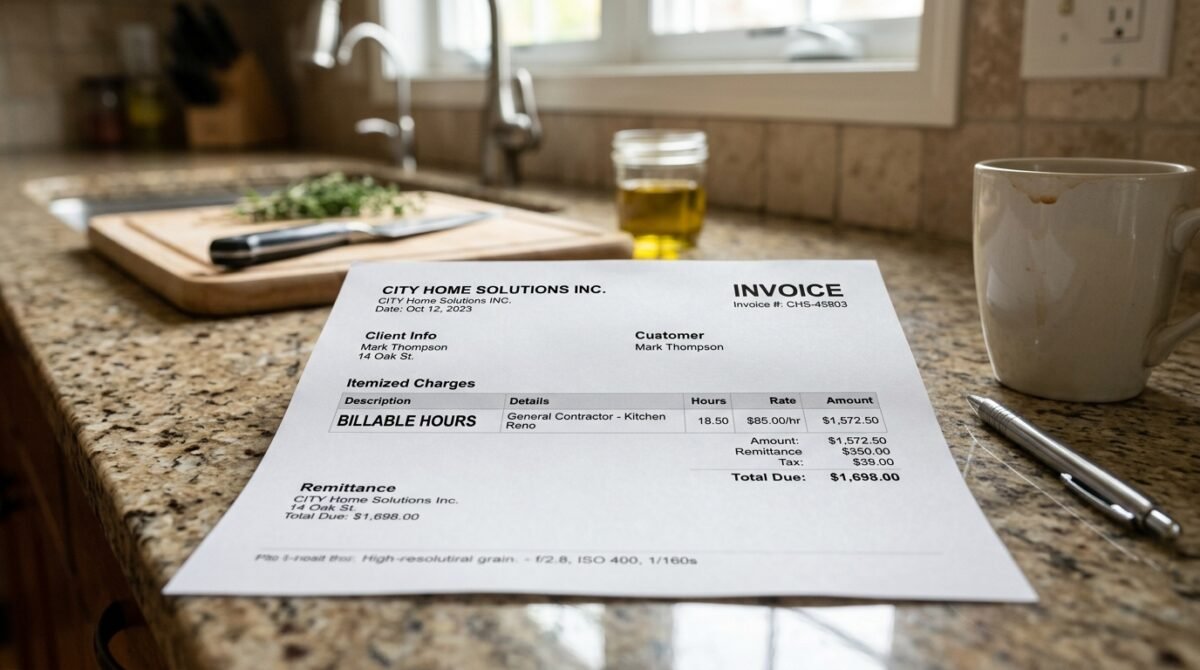
It was a Saturday morning, the kind that usually felt like a rare, precious respite. I had planned to spend the three hours Mark was watching our toddler, Leo, finally organizing the mountain of paperwork that had been accumulating for weeks. I came downstairs at noon to find the kitchen clean, which was a nice surprise, but then I noticed it: a neatly printed document sitting right next to the coffee maker.
At first, I thought it was a joke. I actually chuckled as I picked it up, expecting a silly list of chores he wanted me to do in exchange for him taking the boy to the park. But as my eyes scanned the columns—’Childcare Services Rendered,’ ‘Hourly Rate: $45,’ ‘Total Due: $135’—the humor vanished. My hands began to shake as I realized he wasn’t joking at all.
I walked into the living room where he was watching TV, the toddler happily playing with blocks on the rug nearby. Mark didn’t even look up as I approached, his eyes fixed on a sports game. I held the paper in front of him, my voice barely a whisper. ‘Mark, what is this?’
“I thought you were becoming a bit too dependent on my weekend hours. If you want me to be a ‘babysitter’ for the entire morning, there’s a market rate for that. You’re always busy with your own projects, so I figured we should balance the ledger.”
— Mark, during the initial confrontation
I felt a coldness wash over me that I had never experienced before. It wasn’t just the audacity of the money; it was the way he used the word ‘babysitter’ to describe his own flesh and blood. I looked at our son, laughing in the corner, and then back at the man I had promised to spend my life with. In that single, fleeting moment, the foundation of my world shifted.
I didn’t yell. I didn’t cry. I simply walked over to the desk, pulled out the manila envelope I had been keeping for months—my ‘just in case’ folder—and placed it on the table. It was time for a very different kind of document to be discussed.
The Slow Decay of Our Partnership

Looking back, the signs of this transactional rot had been there for years. It started small—the ‘my money’ vs. ‘your money’ arguments, even though we had a joint account. Mark would often bring up his salary as if it were a weapon, a way to ensure his opinion always held more weight during household disputes. He viewed the home not as a place of rest, but as a cost center.
He would frequently track grocery receipts, questioning why I bought the ‘expensive’ organic milk or why we needed so many fresh vegetables. He treated my role as a stay-at-home parent as a luxury he was funding, rather than a full-time, unpaid contribution to our family. He often referred to the house as ‘my house,’ despite my name being on the deed.
The resentment grew in the silence. I stopped asking for help because help always came with strings attached. If he took out the trash, he wanted a thank-you note. If he mowed the lawn, he expected dinner to be served the second he walked through the door. It was a constant game of score-keeping, and somehow, I was always losing by a landslide.
“You don’t understand how hard it is to earn this paycheck. When I’m out there in the real world, you’re here, and that’s fine, but don’t act like your contributions are equal. They aren’t.”
— Mark, reflecting his worldview months prior
I tried counseling. I tried explaining how his attitude was alienating me. I suggested we read books, go to retreats, talk to professionals. He dismissed every attempt as ‘therapy-speak’ or a waste of money. To him, there was no problem that couldn’t be fixed by simply adjusting the budget or having me work ‘a few more hours’ at my freelance job, which he constantly belittled.
The isolation was deliberate, I realize now. By turning our domestic life into a transaction, he made it impossible for me to feel like a partner. He wanted a subordinate, someone who would provide domestic services without demanding equity. When I handed him those divorce papers, I wasn’t just ending a marriage; I was reclaiming my autonomy from a man who viewed me as an employee.
The Unveiling of the Secret Ledger

After the initial shock wore off, the discovery of his ‘side project’—the spreadsheet—became the centerpiece of our legal proceedings. My lawyer was actually fascinated, in a morbid way. It wasn’t just the Saturday invoice; it was a digital trail. When we gained access to his laptop, we found folders labeled ‘Domestic ROI’ and ‘Household Depreciation.’
He had been tracking every single expense since the day Leo was born. He had calculated the cost of diapers, the percentage of the utility bill attributed to ‘the child,’ and even the ‘labor cost’ of the time he spent playing with his own son. It was a level of sociopathic precision that chilled me to my core. He had a column for ‘unpaid chores’ that he claimed I owed him for.
He had even been using a specialized app to track these costs, treating our family life like a startup he was trying to optimize for tax efficiency. It wasn’t just that he was stingy; he was fundamentally incapable of seeing people as anything other than assets or liabilities. My lawyer described it as a ‘transactional pathology’ that made him look completely unreasonable in the eyes of any judge.
“I just wanted to see where our money was going. I’m a numbers guy, Sarah. Everything has a value. Why is it so wrong to track our household expenditures? You’re just being emotional.”
— Mark, defending his spreadsheet in mediation
The look on his face when the judge saw those spreadsheets was the only moment of satisfaction I had in those months. The judge didn’t even have to say a word; just the act of presenting the documents proved that Mark had effectively weaponized our marriage. The ‘numbers guy’ defense didn’t hold up when the number being calculated was the cost of his own son’s affection.
I realized then that I wasn’t just fighting for my half of the assets; I was fighting to prove that my life, my labor, and my love had inherent value that couldn’t be indexed on a spreadsheet. He had tried to devalue me so he could control me, but all he had succeeded in doing was documenting his own moral bankruptcy.
The Group Chat That Blew It All Open

The real explosion happened when my sister-in-law, who had always been surprisingly supportive of me, leaked a group chat thread I wasn’t supposed to see. Mark had been complaining to his brothers about ‘the cost of the divorce,’ and the messages were a treasure trove of entitlement and delusion. He was framing the entire split as a ‘hostile takeover’ by me.
“She’s trying to take half of everything, but she doesn’t account for the fact that I’ve basically been subsidizing her lifestyle for years. I have a literal spreadsheet proving she owes me for the childcare I provided. She’s lucky I didn’t charge her for the cooking.”
— Mark in a leaked family group chat
My sister-in-law, bless her, decided that enough was enough. She forwarded the entire thread to my brother, who sent it to me. Seeing his words in black and white, the way he openly mocked me to his family, stripped away any lingering doubt I had about whether I was doing the right thing. He wasn’t just a partner who lost his way; he was a man who truly believed he was superior.
The community’s reaction to this leak, once I shared the gist of it online, was immediate and fierce. People were horrified by the way he tried to quantify his role as a father. The idea that a father would demand payment for ‘supervising’ his own child in a group chat was the tipping point for many who thought I might have been overreacting. It wasn’t just a disagreement; it was a character flaw that was now public knowledge.
His brothers tried to defend him, saying it was just ‘guy talk’ or ‘frustration,’ but the optics were devastating. When you try to defend the indefensible, you end up looking just as bad as the person you’re defending. The leaked messages served as the final nail in the coffin of his public image within our social circle, making it very clear who the aggressor in this situation was.
I felt a strange sense of vindication. For so long, I had been the one apologetic, the one trying to make sense of his ‘numbers,’ the one trying to fix the unfixable. Now, the mask was off. Everyone could see the man behind the spreadsheet, and he wasn’t the hardworking provider he claimed to be. He was a man who had built a wall of numbers to keep his own heart from connecting with his family.
Community Perspectives: The Reddit Verdict

When the story finally hit the forums, the response was overwhelming. Thousands of people weighed in, and for once, the internet seemed to reach a rare, near-universal consensus. The analysis wasn’t just focused on the invoice; it was focused on the profound psychological damage that such a mindset inflicts on a marriage.
“This isn’t about the $45. This is about the fundamental inability to perceive a spouse as a human equal. He’s running a ledger on your soul, and you’re right to get out before he charges you for the oxygen you breathe in his house.”
— u/LogicAndGrace (Top Comment, 32.1k upvotes)
Other users shared their own experiences with ‘transactional partners,’ citing the exhaustion of constantly negotiating basic human decency. It was a wave of validation that I hadn’t realized I needed. Seeing thousands of strangers call out the toxic behavior for exactly what it was—financial abuse and emotional manipulation—gave me the strength to stand firm during the final legal hearings.
There were, of course, the contrarians—the ones who argued that ‘fairness’ is important in marriage and that maybe I hadn’t contributed enough to the household income. But even they were quickly drowned out by the majority who understood that marriage is not a 50/50 business venture. It’s a 100/100 commitment, and when one party starts charging for basic parental duties, the commitment is already dead.
“I had an ex who wanted to split the cost of the shampoo, even though I did all the cleaning, cooking, and child-rearing. It’s a power play. It’s never about the money; it’s about control. OP, keep those divorce papers filed and don’t look back.”
— u/BrokenSpreadsheetSurvivor (15.2k upvotes)
The discussion also turned to the long-term impact on our son. Many parents weighed in on how growing up in a home where parental time is monetized creates deep-seated anxieties in children. They would grow up believing that time and affection are commodities to be bought and sold, rather than gifts to be shared. That was the point where I knew I had made the right decision for my child’s future, not just my own.
The Legal Showdown over ‘Domestic Labor’

The divorce court proceedings were a spectacle of absurdity. My husband’s attorney, clearly embarrassed by the evidence, tried to frame the invoice as a ‘misguided attempt at communication’ rather than a demand for payment. It was a laughable defense, and the judge wasn’t having any of it. Every time my ex tried to bring up his ‘contributions,’ the judge pointedly brought the conversation back to equitable distribution.
We had to go through every single line item he had tracked. I had to testify about the hours I spent cooking, cleaning, and caring for our son, which I had never thought to track. When the judge asked my ex how he valued my labor, he was silent. He couldn’t put a price on it because, in his mind, my labor was ‘expected’ and therefore worthless.
“Mr. Anderson, you are comfortable charging your spouse for childcare, yet you have no methodology for valuing the domestic labor she provided? How do you reconcile that disconnect?”
— The Judge, during the final hearing
The silence in the courtroom was deafening. My ex tried to stutter out an explanation about how his job was ‘high stress,’ but the judge cut him off. The court recognized the pattern of abuse—not just financial, but the psychological erosion of my self-worth. They awarded me a settlement that reflected the years I had spent sacrificing my career to support his, regardless of his spreadsheets.
The settlement was fair, but the real prize was the freedom. As I walked out of the courthouse, I realized I was no longer an employee in my own home. I was a person again. I was Sarah, not ‘the person who owes $135 for Saturday morning.’ The weight that had been on my shoulders for years seemed to evaporate in the afternoon sun.
My ex, however, was left to his spreadsheets. He was still trying to justify his actions to his lawyers, still trying to find a way to minimize the payout, still trying to win the argument. But the game was over. He had lost the one thing he couldn’t quantify: a partner who loved him unconditionally, despite his flaws, until he made it impossible to love him at all.
Life After the Ledger

The months following the divorce were a period of intense reconstruction. I had to learn how to live without the background noise of his constant criticism and the fear that every action would be audited. My son and I moved into a smaller, simpler place, but for the first time in years, the house felt like a home, not a business.
I went back to school to finish my degree, something I had put off for years because my ex didn’t think it was a ‘sound investment.’ I found a part-time job that I actually enjoyed, and the money I earned was mine to spend or save as I pleased. There were no spreadsheets, no invoices, and no one tracking how much I spent on groceries.
The healing process wasn’t linear. There were days when I still felt the phantom weight of his expectations, especially when I was caring for Leo. But then I would catch myself—I wasn’t doing it for an invoice; I was doing it for my son. That realization was liberating. My affection for my child was no longer something I had to defend or justify; it was natural, and it was enough.
“I used to think my worth was defined by how much I could balance the books. Now, I realize my worth is defined by how I choose to live my life, free from the constraints of someone else’s greed.”
— Personal reflection, three months post-divorce
My ex, I heard through the grapevine, is still struggling to maintain his ‘numbers-based’ lifestyle. He’s dating someone new, and the rumors are that he’s already introduced his ‘shared expense’ app to their relationship. It seems some people are incapable of learning from their mistakes, even when they cost them everything they once held dear.
I don’t harbor hatred anymore. Hatred is a heavy thing to carry, and I’m done carrying anything that weighs me down. I feel a sense of pity for him. He will spend his life measuring the world in dollars and cents, never realizing that the things that truly matter—love, trust, partnership—are the only things that remain when the numbers don’t add up.
The Psychological Toll of Transactional Love

When you strip away the drama of the invoices and the courtroom battles, what remains is a profound psychological lesson. Transactional love is a contradiction. You cannot hold a ledger in one hand and a heart in the other. By turning our marriage into a series of debits and credits, my ex had effectively replaced intimacy with accounting.
This kind of behavior is a hallmark of narcissism and emotional abuse. It’s designed to keep the other person in a state of constant, low-level anxiety. By making me feel like I was always in his debt, he ensured that I would never be able to demand equality. It was a brilliant, albeit cruel, way to maintain control without ever having to raise a hand.
The impact on my own self-perception was the most difficult thing to reverse. I had started to believe that I was ‘expensive’ and ‘unproductive,’ labels he had used to shame me. It took months of therapy and the support of my friends to realize that I had been contributing in ways that were invaluable—emotional support, child development, household management—even if they didn’t have a dollar sign attached.
“He wasn’t just counting money. He was counting my worth, and he always kept the total just low enough to keep me under his thumb. That’s the real tragedy of transactional relationships.”
— Reflections on the recovery process
The lesson here is simple: never stay in a relationship where you have to justify your existence as a partner. You are not a freelancer; you are a human being with inherent value. If your partner starts talking about ‘return on investment’ or ‘market rates’ for household chores, it’s not a joke. It’s a red flag that the relationship is fundamentally flawed.
Don’t be afraid to walk away. The fear of being ‘single’ or ‘starting over’ is nothing compared to the fear of spending your life with someone who views you as a line item on their tax return. You deserve a partner who sees you for who you are, not for what they can get out of you for $45 an hour.
Reclaiming the Narrative

Sharing this story wasn’t just about vindication; it was about reclaiming my narrative. For so long, I had been the one being defined by someone else’s terms. My ex-husband wanted the world to see me as a lazy, dependent spouse, and he used his spreadsheets to sell that story. Now, the world sees him for who he is: a man who lost his family over a petty, transactional obsession.
I want other women—and men—who find themselves in similar situations to know that they aren’t crazy. You aren’t ‘too sensitive,’ and you aren’t ‘expecting too much’ by wanting a partner who loves you without keeping score. If you find yourself in a situation where your contributions are being minimized, start documenting. Not for a divorce, but for your own reality check.
Keeping a private record of your own labor—the hours, the mental load, the emotional support—can be a powerful tool for your own mental clarity. When someone tries to gaslight you into believing you do nothing, you’ll have the truth to fall back on. It’s not about being petty; it’s about protecting your sanity in a world that often ignores the work that happens inside the home.
“I am no longer the balance sheet of a failing company. I am the CEO of my own life, and the only account I’m worried about is the one that brings joy, love, and growth to my son and myself.”
— Empowerment statement
This experience has made me stronger, more confident, and more intentional about the relationships I choose to cultivate. I no longer tolerate ‘score-keeping’ in any of my interactions. Whether it’s with friends, family, or potential partners, I value authentic connection over transactional convenience. And if someone can’t offer that, they have no place in my life.
So, here’s to the divorce filings, the hard conversations, and the moments when we choose ourselves over the toxic expectations of others. It’s a scary path, but it’s the only one that leads to true freedom. I am finally, truly, mine.
Lessons from the Ledger

In the final analysis, the $45 invoice was the best thing that ever happened to me. It acted as a catalyst, forcing the internal rot of our marriage out into the open where it couldn’t be ignored. If he hadn’t been so audacious, so arrogant, so utterly detached, I might have spent another ten years trying to fix something that was never meant to be whole.
I’ve learned that the most important thing you can invest in is your own intuition. If something feels wrong—if a joke feels like a jab, if a demand feels like an insult, if a ‘budget’ feels like an imprisonment—trust that feeling. You are the only person who has to live in your own skin, and your dignity is not negotiable.
My son is happy, thriving, and surrounded by a mother who is present and fulfilled. He won’t grow up believing that love is a transaction. He will grow up seeing that his mother had the courage to walk away from a life that didn’t respect her, and that is the greatest lesson I could ever teach him. We are doing just fine.
“The price of freedom is often the loss of the comfortable, but it’s a small price to pay for the chance to breathe again.”
— Final reflection on the journey
To everyone still struggling with the spreadsheets of their partners: you are more than a number. You are more than a line item. You are the author of your own story. Don’t let someone else hold the pen, especially when they’re only interested in writing a tragedy about your worth. It’s time to write your own chapter.
Thank you for letting me share my story. It’s been a long road, but I wouldn’t change a single step of it, because every step led me back to myself. And that, I’ve found, is worth far more than any hourly rate could ever measure.
Conclusion
The saga of the $45 invoice reminds us that marriage requires more than just financial equity; it requires emotional empathy. When one partner begins to treat the other as a contractor rather than a soulmate, the bond is already fractured. Sarah’s choice to file for divorce was not a failure; it was a necessary boundary in a relationship that had lost its moral compass.
We invite our readers to join the conversation in the comments section below. Have you ever faced a partner who turned your domestic life into a transaction? How did you define your worth when it was being challenged? Let’s keep this discussion respectful, supportive, and focused on the importance of healthy, non-transactional relationships.
Poll: If your spouse suddenly sent you an invoice for household chores, would you:
A) Treat it as a dark-humored joke and discuss boundaries.
B) Immediately recognize it as emotional abuse and consult a lawyer.
C) Try to negotiate the ‘market rate’ just to prove a point.
D) Be completely heartbroken and try to fix the marriage through intensive therapy.
What's your verdict on this dilemma?
Vote below to contribute to the official community consensus.

Have a Dilemma Keeping You Up at Night?
Share your real-life feud, wedding chaos, or relationship crossroads anonymously with our editorial team.
What do you think ?
0 Comments🛡️ Comments are moderated to protect community integrity. Your comment will appear once approved by the editorial team.