

Marriage is built on a foundation of shared trust, and for Mark and me, that trust was supposed to be as solid as the financial future we were building for our two children. We spent over a decade meticulously saving, sacrificing vacations, and working overtime to ensure that when our kids turned eighteen, they would have the freedom to pursue higher education without the crushing weight of student debt. It was our North Star, the single most important financial goal we shared.
But cracks began to form silently. Mark, usually a prudent, if somewhat boring, accountant, started spending hours in his home office late at night. There were whispers of ‘market opportunities’ and ‘unprecedented growth potential’ that I dismissed as him simply being interested in his hobby. I never imagined that his interest would morph into a pathological obsession, nor that he would view the sanctity of our children’s college trust fund as his personal playground for high-stakes gambling.
The moral dilemma I faced when I finally clicked ‘refresh’ on our joint brokerage account was not just about money; it was about the fundamental erosion of our partnership. How do you look at the person who sleeps next to you every night and realize they are capable of burning your children’s future to the ground for a shot at a pipe dream? The discovery wasn’t just a shock—it was a total existential collapse of my reality.
This article chronicles the harrowing unraveling of my marriage, the devastating betrayal of financial infidelity, and the cold, hard decision to prioritize my children’s safety over my husband’s ego. It is a story of what happens when the person you trust most decides to gamble with your legacy, and why, sometimes, the only way to save your family is to tear it apart.
The Late Night Spreadsheet Ritual

It began with the clicking of a mouse in the early hours of the morning. Mark had always been a night owl, but recently, the rhythm of his late-night sessions changed. He wasn’t working on tax returns for his clients anymore; he was staring intently at charts that turned bright red and aggressive green. I would often wake up to find him hunched over the desk, his face illuminated by the harsh blue glow of dual monitors, his jaw clenched tight.
When I questioned him, he brushed me off with dismissive comments about ‘diversifying our assets’ and ‘maximizing our returns.’ He sounded so confident, so professional. I had no reason to doubt him. He was the one who managed the books, the one who handled the heavy lifting of our long-term investments. I trusted him to navigate the complexities of interest rates and market fluctuations because, frankly, he was better at it than I was.
“Mark, why are you always looking at these volatile stocks at 3:00 AM? Don’t we have a financial advisor for that?” I asked one Tuesday, leaning against the doorframe, my voice heavy with exhaustion. He didn’t even turn around, his eyes glued to a rapidly oscillating line on the screen. “You don’t understand the market, honey. The advisor is playing it too safe. I’m just taking control of our destiny,” he replied.
That word—‘destiny’—should have been a red flag. It wasn’t a plan; it was a delusion. He had become convinced that he could outsmart the system, that he was the exception to every rule of financial prudence. He was intoxicated by the possibility of turning a modest college fund into a windfall that would allow us to retire early. He didn’t see the children’s faces when he looked at those numbers; he only saw potential percentages.
I went back to bed, naively believing that it was just a temporary phase, a mid-life desire for excitement. I didn’t realize that in those midnight hours, he wasn’t just looking at charts—he was transferring the first five thousand dollars from the children’s educational savings account into a penny stock that was currently being touted by anonymous forums on social media.
The First Five-Figure Discrepancy

The first sign that something was truly wrong came when I went to pay for our son’s summer camp tuition. It was a routine transaction, something we had done for years without a second thought. I logged into our primary joint checking, which was supposed to be replenished by a transfer from our savings, but the balance was lower than expected. It wasn’t a massive gap, but it was enough to make me pause. I checked the transaction history and saw a large, unexplained withdrawal to a brokerage firm I didn’t recognize.
I called Mark immediately, my heart hammering in my chest. He was in a meeting, so I left a calm, curious voicemail asking about the transfer. When he finally called back, his tone was defensive, almost condescending. He told me it was a ‘margin call’—a term he knew I didn’t fully understand—and that he had already moved funds to cover it. He insisted it was an accounting error on the bank’s end and that I shouldn’t worry my pretty little head about it.
“Mark, this wasn’t a bank error. It was a transfer to a trading platform. Why are we moving money out of the kids’ savings for a margin call? We aren’t supposed to be trading on margin,” I pushed back, my voice gaining a sharper edge. There was a long, uncomfortable silence on the other end of the line. I could hear him breathing, processing his next excuse. He was a good liar, but he was getting sloppy.
“I just needed the liquidity to secure a position. It’s temporary, and the returns are going to cover the transfer ten times over by next week. Just stay out of the accounts for a few days while things settle,” he snapped. That was the moment my blind trust shattered. He wasn’t just managing our money; he was hiding, diverting, and lying. The ‘liquidity’ he spoke of was meant for our children, not for his high-risk gambles.
I spent the rest of the day in a state of paralysis. I felt like a stranger in my own life. I checked our statements again, going back six months. The evidence was there, buried in small, incremental withdrawals that had started to grow in frequency and scale. He had been bleeding our future dry, one thousand dollars at a time, betting on companies that were essentially digital casino chips.
The Morning of the Digital Bank Run

I didn’t sleep that night. I sat in the living room with my laptop, methodically documenting every single illicit transaction. By 4:00 AM, I had a spreadsheet that looked like a crime scene report. The total amount missing was staggering. It wasn’t just ‘some’ money; it was nearly forty percent of the entire college trust fund. I felt physically sick, as if the oxygen were being sucked out of the room.
When Mark finally emerged from the bedroom at 7:00 AM, smelling of stale coffee and desperation, I was waiting for him at the kitchen table. I had the printed statements laid out in front of me like a deck of cards. I didn’t yell. I didn’t throw anything. I just pointed at the papers. “Sit down, Mark. We need to talk about the kids’ college fund. Or rather, what’s left of it.”
He looked at the papers, and for a split second, his mask slipped. He didn’t look angry; he looked terrified. He knew he had been caught, and he knew there was no mathematical way to explain away the numbers. “It’s not what you think,” he began, his voice trembling. “It’s a strategic pivot. The market is volatile, and I needed to be aggressive to hedge against inflation. This is all part of a larger plan.”
“Strategic pivot? You’ve gambled away nearly half of our children’s future on penny stocks that are being investigated for fraud,” I replied, my voice cold and steady. “You didn’t hedge anything. You just destroyed the safety net we promised them.” He started to stammer, trying to justify the trades, talking about ‘insider tips’ and ‘market cycles,’ but it was all white noise. He was a man drowning in his own hubris, and he was trying to drag me down with him.
The conversation lasted for hours, a grueling dissection of his failures. Every time I asked him why he didn’t tell me, he had a new lie. He said he wanted to surprise me with a ‘financial breakthrough’ that would change our lives. He said he was trying to provide for us because he felt inadequate. It was a masterclass in manipulation, but it couldn’t change the reality of the empty accounts. By the end of it, I realized that I wasn’t married to an accountant—I was married to an addict.
The Confrontation in the Kitchen

“How could you do this to them, Mark? How could you look at their college savings and think it was yours to lose?”
— Me, during the final confrontation.
The intensity in the kitchen was palpable. It wasn’t just a disagreement; it was the end of a partnership. Mark kept trying to minimize the damage, claiming that if I just let him ‘ride it out’ for another month, the stocks would recover. He was delusional, clinging to the hope that a miracle would save him from the consequences of his actions. I was done with hope. I needed action.
“I am not letting you touch another cent,” I told him, standing up. “I’ve already contacted the bank. I’ve frozen the accounts. From now on, you are not authorized to make any transactions involving our joint assets. You are done.” He stood up too, his face flushing with anger. He felt cornered, and his instinct was to lash out, to blame me for his lack of success, to claim that I was ‘limiting’ his potential.
“You’re ruining everything! If you freeze those accounts, we’re going to lose what’s left because I can’t cover the margin!” he shouted, slamming his hand on the counter. His rage was a stark reminder of how far he had fallen. He wasn’t worried about the kids; he was worried about his trading position. That was the final, definitive proof I needed to know that our marriage was over.
I grabbed my keys and my purse. “Then let it be lost, Mark. It’s already gone as far as I’m concerned. You’ve prioritized your ego over your children, and I will not be a party to it.” I walked to the door, feeling a strange sense of clarity. For the first time in weeks, the fog of confusion had lifted, replaced by the sharp, cold reality of survival.
He followed me, still pleading, still trying to negotiate. “Don’t do this. We can fix this together. Please, just give me one more week.” I didn’t even look back. I knew that if I stayed for one more week, I would lose my sanity. I left the house and didn’t look back until I was in the car, driving toward my sister’s house, the engine humming in the morning silence.
The Reddit Verdict: Financial Infidelity

I posted my story on a popular forum under an anonymous handle, needing to know if I was overreacting. The response was overwhelming. Within hours, thousands of people had weighed in, and the consensus was absolute. It wasn’t just a mistake; it was a profound betrayal of trust that left little room for reconciliation. The internet, for once, was united in its assessment of the situation.
“This isn’t just bad investment strategy; this is financial infidelity. He treated your children’s future as his personal gambling fund. Do not trust him with another cent. Lawyer up immediately.”
— u/FinanceExpertUser (Top Comment, 28.5k upvotes)
Reading the comments was both validating and terrifying. People shared stories of spouses who had drained retirement accounts, racked up secret credit card debt, and destroyed entire families through financial lies. I saw my own story reflected in dozens of others, and it became clear that this was a pattern of behavior that rarely ended with an apology. The ‘gambling addict’ persona was common, and the destruction was almost always total.
Some users warned me about the legal implications. They pointed out that if we were married, his debts could become my debts, and the losses he incurred might be seen as ‘joint’ losses in a divorce. I needed to act fast to protect what remained of my assets and to document his unauthorized spending. The advice wasn’t just emotional support; it was a roadmap for survival.
“Get a forensic accountant. Now. You need to prove that he acted unilaterally and in bad faith. If he’s been lying, you need a paper trail to show a judge when you file for divorce.”
— u/LegalEagle88 (14.2k upvotes)
The community support helped me realize that I wasn’t the ‘controlling wife’ he had painted me as during our argument. I was a mother protecting her children. The validation gave me the strength to follow through with the divorce proceedings. It wasn’t an easy step, but it was the only one that led toward safety.
The Fallout: Changing the Locks

When I returned to the house the next day with my brother, the locks were the first thing to go. It felt like a symbolic act, a reclaiming of my space and my safety. Mark was nowhere to be seen, but his presence still lingered in the house—the stacks of papers, the screens, the lingering smell of his anxiety. My brother helped me pack his things into boxes, a process that felt both clinical and heartbreaking.
We found more than just files. We found secret burner phones, printouts of ‘get rich quick’ schemes, and letters from debt collectors I had never heard of. The scope of his deception was deeper than I ever could have imagined. He hadn’t just been gambling with the kids’ fund; he had been borrowing money from predatory lenders to feed the habit. The house of cards was falling, and I was just clearing the rubble.
When Mark eventually showed up, he found me standing in the driveway, the boxes sitting by the curb. He looked defeated, but there was still a flicker of arrogance in his eyes. “You’re really doing this? You’re kicking me out of my own home?” he asked, his voice low and threatening. I didn’t flinch. I just pointed to the boxes. “You left this home the moment you decided your ego was worth more than our family.”
He tried to argue, to claim he had rights, but I had already spoken to a lawyer. I had an order of protection in hand. It was a heavy piece of paper, but it was the most powerful thing I had ever held. He had no leverage, no defense, and no right to stay. The look of disbelief on his face as he realized he had finally lost everything was a memory I will carry for the rest of my life.
Watching him drive away was the hardest part. It wasn’t because I wanted him to stay, but because of the finality of it. The marriage I had built, the future I had envisioned, was gone. But as I walked back into the house and locked the door behind me, I felt a weight lift. The house was quiet, but for the first time in months, it felt like it belonged to me and my children again.
The Financial Forensic Audit

The weeks that followed were a blur of bank statements, legal consultations, and the cold, hard reality of audits. My lawyer recommended a forensic accountant to trace every penny Mark had moved. The results were worse than I had feared. It wasn’t just the college fund; he had been siphoning off bits and pieces from our mortgage payments, our emergency savings, and even the kids’ birthday money.
We sat in the accountant’s office, a sterile, white-walled room that smelled of old coffee, as he laid out the map of the betrayal. “He wasn’t just trading, ma’am,” the accountant said, his voice devoid of judgment. “He was cycling money to hide the losses. He’d take from this account to cover the deficit in that one, hoping for a win that never came. It’s a classic gambling addiction pattern.”
I looked at the charts. They were cold, objective proofs of his failure. There was no ‘strategy,’ no ‘market pivot.’ Just a desperate, hollow man trying to win back his pride with money that didn’t belong to him. Seeing the numbers written out in black and white took away the last bit of doubt I had. It made the divorce not just a necessity, but a logical conclusion.
The financial impact was devastating, but the legal trail was my salvation. By documenting the exact amounts and the timelines, my lawyer was able to secure a settlement that prioritized the children’s needs over his debts. It was a battle, but it was one I could win. I wasn’t fighting for ‘my’ share; I was fighting for the future I had promised my kids.
Every time I felt a pang of guilt, I looked back at the audit. I looked at the line items where he had stolen from our daughter’s dance classes or our son’s soccer registration. The guilt evaporated, replaced by a fierce, protective resolve. I was the one who had to clean up his mess, and I would do it with everything I had.
The Silent Dinner Table

Explaining it to the children was the hardest conversation of my life. How do you tell your kids that their dad isn’t coming home because he gambled away their future? I kept it simple, focusing on the fact that their father had made mistakes that meant he couldn’t live with us anymore. I didn’t want to poison their memories, but I also couldn’t hide the reality of his absence.
Our first dinner alone was painfully quiet. We sat at the table, the space where he used to sit now empty. The kids were scared, their eyes darting around the room, waiting for him to walk through the door with his usual jokes. I had to be the anchor, the steady hand in the storm. I talked to them about how we were going to make new traditions, how we were going to be okay.
“Is Dad coming back for my birthday?” my son asked, his voice small. I swallowed the lump in my throat and reached out to hold his hand. “Not for your birthday, honey. But we’re going to celebrate in a way that’s special for just us. It’s going to be a different kind of year, but it’s going to be a good one.” I lied, in a way. I didn’t know if it would be a good year, but I knew it would be a safe one.
The silence in the house was no longer the heavy, suffocating silence of his deception. It was the quiet of healing. We started to reclaim the space, moving his things out of the living room, setting up a new area for their toys. It was a physical manifestation of our new reality: we were a family of three, and we were enough.
We started doing things we never would have done when he was around. We ate breakfast for dinner, we watched movies until late, we laughed at the small things. The grief was still there, lurking in the corners, but the fear was slowly beginning to recede. We were building a new life, brick by brick, away from the wreckage of the old one.
The Final Legal Settlement
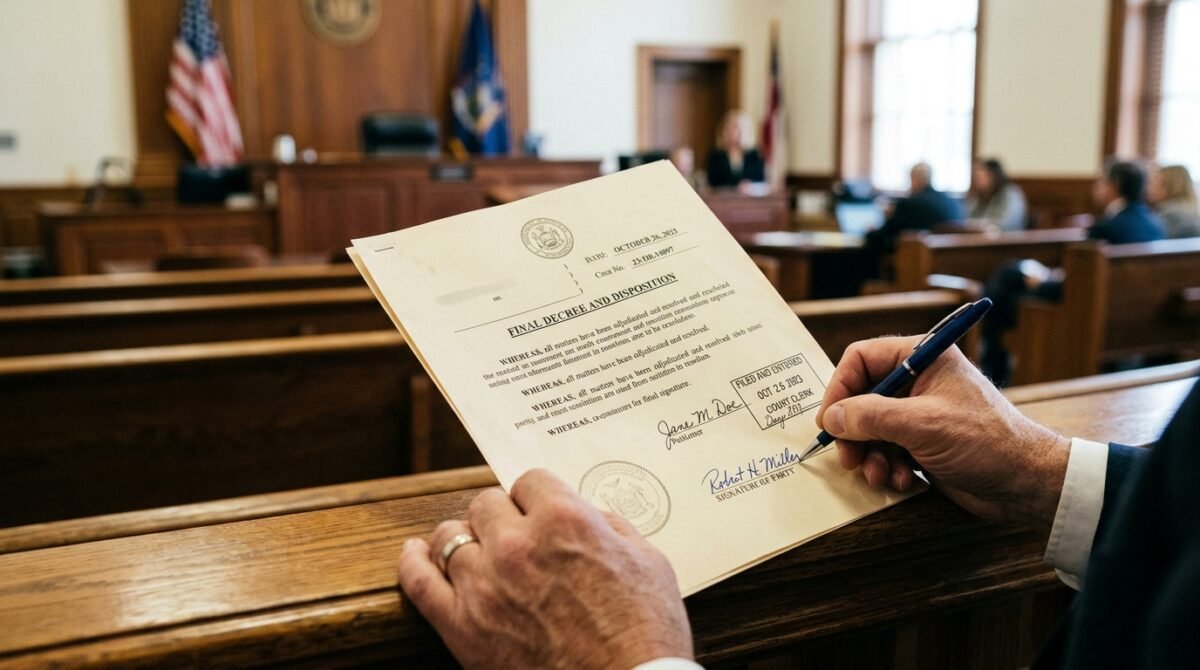
The day the divorce was finalized, I felt nothing but relief. There were no tears, no dramatic outbursts, just the scratching of a pen on a document that signaled the end of the war. Mark was absent, his lawyer handling the details, which was for the best. I didn’t want to see him; I didn’t want to hear his excuses. I wanted the chapter closed.
The settlement was fair, given the circumstances. I received the house, the remaining assets were divided, and he was required to make payments toward the children’s college fund, though we both knew that was a long shot. The court recognized the financial dissipation he had caused, which helped protect my remaining equity. It was a victory, even if it felt like a hollow one.
“It’s over,” my lawyer said, handing me the folder. I walked out of the courthouse, the air outside feeling crisp and clear. I looked up at the sky, really looked at it, for the first time in months. The sun was shining, and the world was still turning. I hadn’t been destroyed by his mistakes; I had survived them.
I drove home, not to the house of secrets, but to my home. I unlocked the door and stepped inside. It was still the same house, but it felt entirely different. The shadow of his deception was gone. I had reclaimed my life, my finances, and my future. It was a hard-won peace, but it was worth every ounce of effort.
I called my sister and told her the news. She cheered, and for the first time, I laughed. It was a genuine, full-throated laugh. The nightmare was over. I was a single mother, I was financially challenged, but I was free. And in that moment, that was more than enough.
Lessons in the Rubble

Looking back, the lessons are clear, though they were learned at a high price. Never again will I surrender control of my financial future to someone else, regardless of how much I love or trust them. Financial intimacy is just as important as emotional intimacy, and it requires transparency, not just at the beginning, but every single day. I learned that silence in a marriage is often not a sign of peace, but a mask for something much more sinister.
I learned that an addict’s charm is a weapon, and their promises are just another layer of the trap. I learned that you cannot save someone who does not want to be saved, and that trying to do so only leads to your own destruction. My kids learned, in their own way, that family is about honesty and safety, not just presence. They are resilient, and they have grown in ways that I never could have predicted.
Today, I am more cautious, but I am also more empowered. I manage my own investments, I track my own spending, and I am open about my finances with the people who matter. I don’t hide, and I don’t let others hide. The betrayal was a catalyst for a life that is truly mine, a life built on a foundation of integrity rather than the shifting sands of someone else’s greed.
If you find yourself in a similar situation, know that you are not alone. There is no shame in being deceived, but there is power in choosing to walk away. Do not wait for the ‘right’ time. Do not hope for a change that will not come. Protect yourself, protect your children, and don’t look back until you are safe. Your future is yours to build, and it starts the moment you stop letting others tear it down.
Conclusion
The story of my marriage ended in a courtroom, but the story of my life as a mother and an individual is just beginning. By standing up for what was right, I didn’t just save our remaining finances—I saved my children from a future of instability and uncertainty. It wasn’t an easy road, but it was the only one that led to true peace.
The betrayal of financial infidelity is a wound that takes time to heal, but it does heal. What remains is a newfound strength and a clarity of purpose that I never had before. I hope my story serves as a reminder that trust is a privilege, not a given, and that your highest responsibility is to the future you are building for your children, not to the ego of a partner who has lost their way.
How do you handle financial transparency in your own relationships? Have you ever had to draw a hard line when a partner’s habits threatened your family’s future? Share your thoughts and experiences in the comments below. Let’s discuss how to navigate these difficult waters and prioritize the people who matter most.
What's your verdict on this dilemma?
Vote below to contribute to the official community consensus.

Have a Dilemma Keeping You Up at Night?
Share your real-life feud, wedding chaos, or relationship crossroads anonymously with our editorial team.
What do you think ?
0 Comments🛡️ Comments are moderated to protect community integrity. Your comment will appear once approved by the editorial team.