
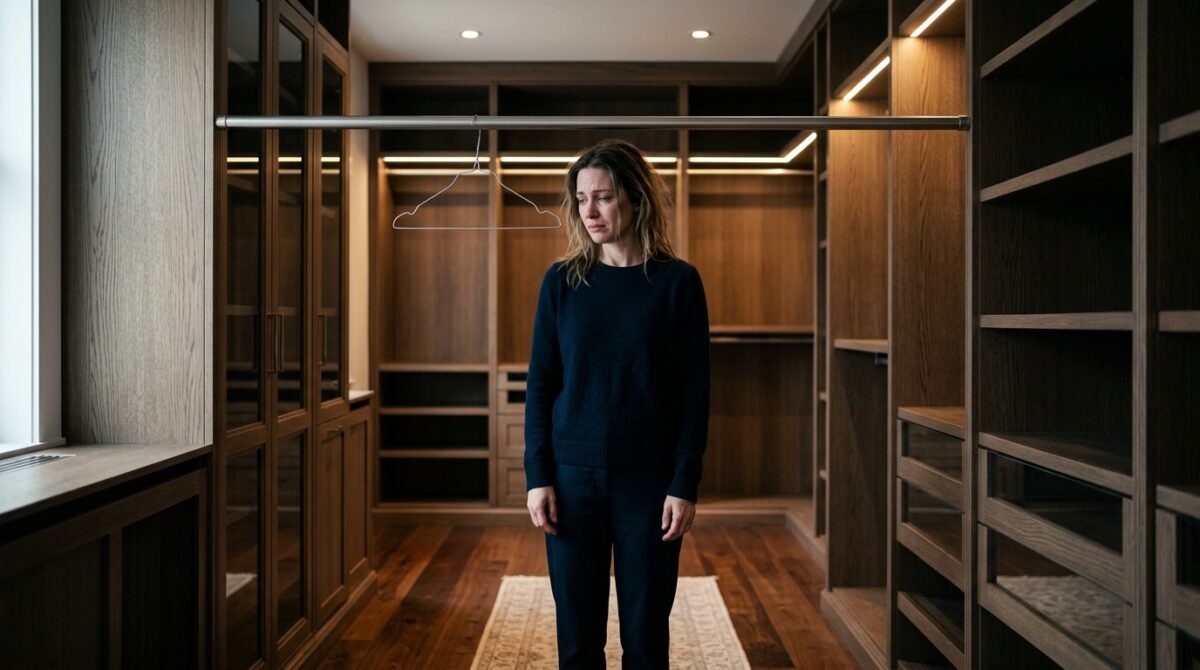
Marriage is built on the bedrock of mutual respect and shared property, or so we are told in the vows. For Elena, a high-powered marketing executive with a penchant for vintage Chanel and bespoke tailoring, her wardrobe wasn’t just a collection of clothing; it was an investment portfolio and a curated archive of her professional life. Her husband, Mark, a man who constantly preached the virtues of ‘minimalism’ and ‘financial efficiency,’ had always made passive-aggressive comments about her spending habits, but she never imagined he would take matters into his own hands.
The day began like any other Tuesday, with a rush to get through the door for an 8:00 AM board meeting. Elena left behind a closet that was the result of a decade of hard work, filled with pieces that held significant resale value and deep sentimental meaning. She walked into her home that evening, expecting the usual quiet hum of domestic life, only to find the door to her dressing room standing wide open. What she found inside was nothing short of a psychological assault.
The shelves were bare. The racks were stripped of every single hanger. Even the shoe rack, usually lined with Italian leather and artisan-made heels, was hollowed out. There was no note, just the faint smell of Mark’s citrus-scented cleaning spray lingering in the air. When she confronted him, he didn’t apologize; he smiled, claiming he had performed a ‘service’ to their household productivity. The scale of the betrayal was staggering, and the silence that followed the realization was the beginning of a cold war that would end in the driveway.
This story captures the essence of a modern boundary collision—the intersection of personal autonomy, financial abuse disguised as ‘lifestyle coaching,’ and the nuclear fallout that occurs when one partner treats the other’s property as their own. It is a narrative that asks a fundamental question: when the trust in a marriage is dismantled through blatant disrespect, is retaliation the only way to re-establish the balance of power?
The Empty Hanger Incident
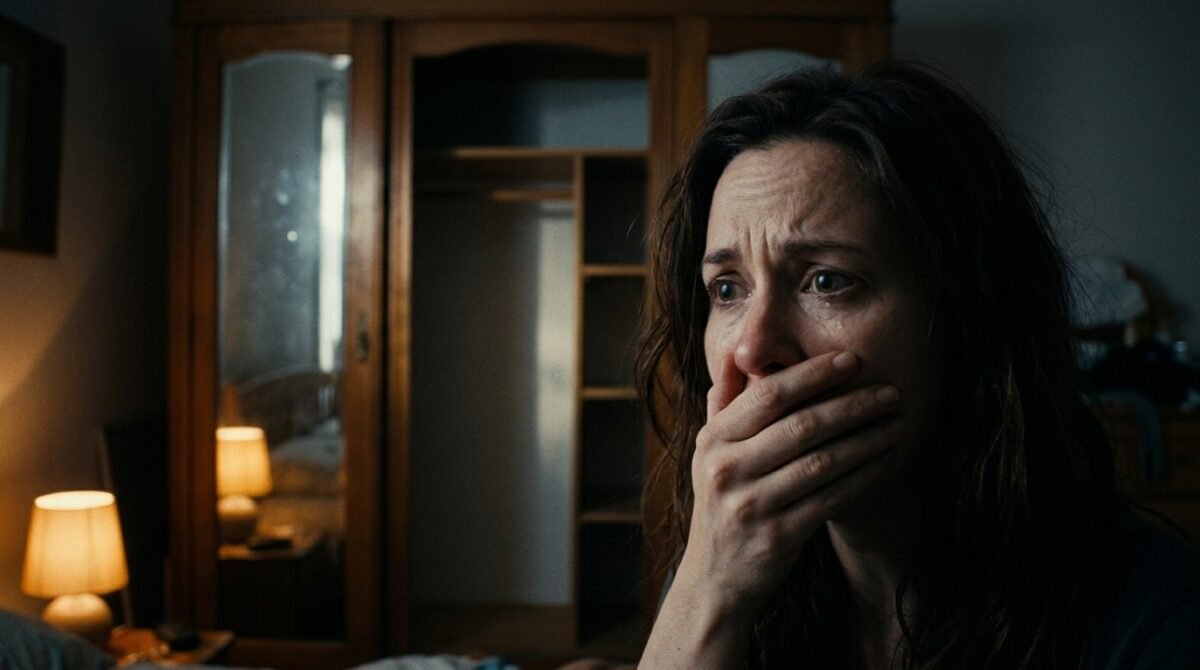
I stood in the center of the closet, the echo of my own heavy breathing sounding deafening in the hollow space. My mind raced, trying to convince me that I had walked into the wrong house, or perhaps that I had entered some bizarre, alternate reality. I looked at the floor—not a single stray thread, not a box, not a garment bag. Everything was gone.
Mark was in the kitchen, casually scrolling through his phone while an espresso machine hissed in the background. I walked in, my heart hammering against my ribs, unable to process the sheer audacity of what I was witnessing. I didn’t shout; I couldn’t. I was frozen in a state of absolute, icy shock.
“Mark, where are my things? Where is my entire closet? Please tell me you moved them for a renovation or something.”
He didn’t even look up from his screen. He took a sip of his coffee, his expression one of calm, detached satisfaction. It was the face of a man who thought he had finally solved a problem that only existed in his own head.
“I took care of it, Elena. You’ve been talking about needing more space for months. The clutter was affecting our mental clarity. I donated everything to the local women’s shelter this morning. It’s a fresh start for both of us.”
I felt a coldness wash over me that I had never experienced in my life. This wasn’t ‘clutter.’ This was over forty thousand dollars worth of designer goods, heirlooms from my grandmother, and clothes I wore to represent my firm in high-stakes negotiations. He had decided, unilaterally, to dispose of my identity to suit his aesthetic preference for ‘minimalism.’
The Justification of a Minimalist Zealot

As I started to process his words, the sheer, patronizing arrogance of his ‘generosity’ began to sink in. He wasn’t just clearing space; he was exerting control. He had spent months making snide remarks about my ‘consumerism’ and ‘excess,’ but I had always brushed it off as a quirk of his personality. Now, the mask was fully off.
He continued to talk, explaining how he had researched the best charity shop and how he felt ‘liberated’ by his own actions. He was so proud of himself. He actually believed he was the hero of this story, the man who saved his wife from her own choices. He spoke about ‘intentional living’ while I stood there, reeling from the realization that I was married to a stranger.
“Do you have any idea what you’ve done? Those weren’t just clothes, Mark. That was my career, my personality, and my savings. You stole from me. You didn’t ‘declutter,’ you committed theft.”
He laughed—a short, dismissive sound that cut me deeper than the words themselves. He thought I was being dramatic. He thought I was being ‘materialistic’ because I cared about property that belonged to me. The gaslighting was immediate and total. He pivoted the conversation back to how ‘grateful’ I should be for his ‘initiative’ in managing the household, as if I were a child who couldn’t be trusted with her own possessions.
I realized then that this wasn’t about the clothes. It was about power. He wanted to see if he could strip away my autonomy and have me thank him for the privilege. He wanted a partner who was a minimalist accessory to his life, and when I refused to be that, he forced the change upon me.
The Silent Countdown

I didn’t yell. I didn’t cry. I simply walked out of the kitchen and went to the garage. My mind was eerily quiet, functioning with a clinical, tactical efficiency I didn’t know I possessed. I looked at his motorcycle—a limited-edition Ducati that he spent every Saturday polishing and talking about like it was a holy relic. It was his pride, his joy, and his escape.
I remembered the conversations we’d had. How he constantly complained that I didn’t ‘appreciate’ his hobbies while he systematically dismantled mine. I pulled out my phone and sent a quick text to a contact I hadn’t spoken to in months—a local buyer who dealt in high-end vehicle flips. I told them I had a bike to sell, and I needed it gone immediately.
“I have a Ducati, mint condition, all papers available. You can have it for half the market value if you come with a trailer and cash by 9:00 PM tonight. No questions asked.”
The deal was struck in minutes. The buyer was ecstatic, clearly knowing they were getting the steal of a lifetime. I walked back inside, calm as a lake. Mark was still in the living room, reading a book on ‘Essentialism.’ He didn’t even notice me go to the garage or make the call. He was so comfortable in his role as the master of the house that he didn’t suspect a single thing.
The next few hours were spent in a surreal silence. We ate dinner in the kitchen—pasta, as if nothing had happened. He asked me how my day was, and I told him, ‘It was life-changing.’ He smiled, thinking I was coming around to his way of thinking. He had no idea the clock was ticking, not just on his bike, but on our entire marriage.
The Arrival of the Trailer
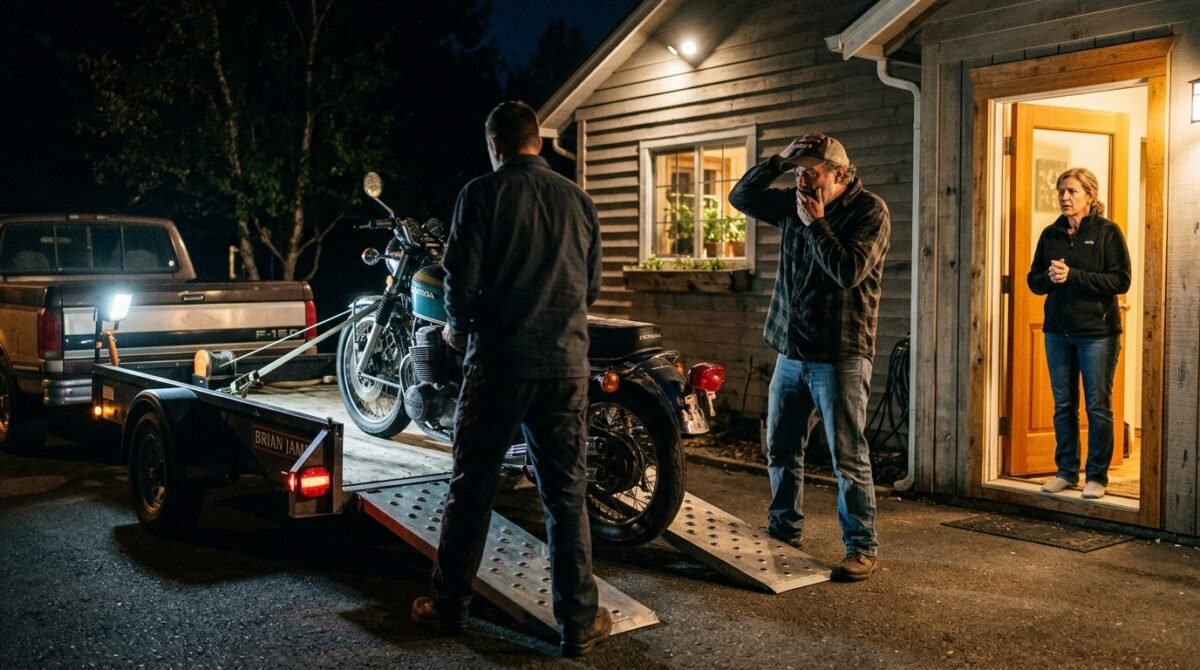
The sound of a heavy diesel truck pulling into the driveway at 8:45 PM was the signal. Mark looked up from his book, frowning. He walked toward the window, pulling back the curtain, his brow furrowing in confusion. I stood by the door, my coat already on, ready to watch the finale of his little ‘decluttering’ project.
“What is that? Who is that in the driveway? Is that a flatbed?”
I walked past him and opened the garage door. The buyer stepped out, a man with a thick beard and an appreciative look on his face. He nodded at me, and I pointed toward the bike. Mark scrambled after me, his face turning from confusion to absolute horror as he realized exactly what was happening.
“What are you doing? Elena, stop him! He’s touching my bike! That’s a limited edition, do you have any idea how much that’s worth?”
I didn’t even look at him. I handed the title, which I had retrieved from the safe earlier that afternoon, to the buyer. The buyer started winching the bike onto the trailer. It was a beautiful, mechanical process—efficient, fast, and completely irreversible. Mark was shouting now, his face turning a shade of purple I had never seen before.
He tried to step between the buyer and the bike, but the buyer was a large man who simply shoved him aside with a stern warning. Mark turned to me, his eyes wide with a mixture of betrayal and disbelief. He looked like he was going to have a stroke, but all I felt was a profound sense of justice. He took my life; I took his hobby. It seemed like a fair trade in the landscape of our crumbling union.
The Aftermath of the Transaction

The truck pulled away, and with it, the pride of my husband’s existence. Mark stood in the driveway, looking at the empty spot where his bike had been for three years. He looked smaller somehow, stripped of the one thing that gave him an air of superiority. He turned to me, his voice trembling with an rage that was no longer controlled or condescending.
“You sold it. You actually sold my motorcycle. You are insane! That was worth more than a dozen of your stupid designer bags! How could you do this to me?!”
I looked him directly in the eyes. I didn’t feel the need to explain. I didn’t feel the need to justify. I simply stood my ground, feeling the cool night air on my face. The house felt lighter, not because of his ‘minimalism,’ but because of the truth we were finally living in.
“You wanted to live a minimalist life, Mark. You said things are just objects. You said we should be free from the burden of possession. I decided to help you achieve that goal. Now, your garage is just as empty as my closet. I think we’re finally perfectly balanced, don’t you?”
He didn’t have an answer for that. He just looked at me, realizing for the first time that his ‘decluttering’ had backfired in the most catastrophic way possible. He had tried to break me, but he had only succeeded in breaking the last thread of respect I held for him. I walked back inside, leaving him alone in the dark driveway to contemplate the philosophy of nothingness.
The Reddit Trial

That night, I opened my laptop and wrote everything down. I didn’t change names or locations; I just spilled the story into a forum I had frequented for years. I needed to know if I had lost my mind or if I was merely the executioner of a long-overdue justice. The response was instantaneous and, to be honest, overwhelming.
“This is the most satisfying thing I’ve read all year. He thought he could gaslight you into minimalism while keeping his own luxury toys? NTA. You didn’t just sell a bike; you sold his entitlement.”
— u/JusticeForElena (15.2k upvotes)
The thread exploded. Within hours, there were thousands of comments. Some were from people who had experienced similar ‘decluttering’ abuse, sharing stories of partners who threw away childhood photos or family heirlooms under the guise of ‘tidying up.’ Others debated the legality of selling the bike, but the consensus was clear: the emotional trauma of losing the wardrobe far outweighed the financial loss of the motorcycle.
“ESH. You are both incredibly toxic. Selling his property behind his back is illegal in many jurisdictions. You should have filed for divorce and taken the bike in the settlement, not committed theft. You’ve just given him grounds for a massive legal counter-suit.”
— u/LegalEagleEye (8.4k upvotes)
I read through the comments for hours, feeling a strange sense of detachment. The legal warnings were real, but they didn’t scare me. I was already planning to leave. The bike was just the catalyst. The community was divided, but for every critic, there were ten people cheering for the ‘scorched earth’ approach. It was a mirror held up to my life, and I finally liked what I saw, even the ugly parts.
The Lawsuit and the Settlement

Mark actually tried to sue me. He had a lawyer friend send a certified letter within forty-eight hours, demanding the value of the bike plus damages for ’emotional distress.’ It was laughable. I hired a divorce attorney who specialized in high-asset cases, and when she heard the story of the donated wardrobe, she didn’t just laugh—she started building a case for financial abuse.
My husband didn’t realize that in our state, the ‘gift’ of my wardrobe to a charity without my consent was documented as a destruction of marital assets. My attorney found the records of the donations, the receipts he had tucked away, and even his own text messages to a friend where he bragged about ‘purging’ my belongings. It was a goldmine of evidence.
“He wanted to play games with our finances, Elena. He thought he could control you by stripping your independence. Now he’s going to find out that a judge doesn’t look kindly on a man who treats his wife’s property like trash.”
We met in mediation, the atmosphere thick with resentment. Mark sat there, still trying to project his ‘minimalist’ calm, but he was sweating. He realized that the bike was gone, the wardrobe was gone, and his chance at a ‘fresh start’ was ending in a bankruptcy filing. We didn’t talk; we let the lawyers do the work. The division of assets was brutal, but for the first time, I felt like a human being again.
The Silence of a New Apartment

Moving day was surprisingly easy. I had very little to pack—ironic, considering the whole ordeal started because I had ‘too much.’ I took my books, my laptop, and a few essential pieces of furniture that hadn’t been ‘purged.’ I left the house keys on the kitchen counter, right next to the empty space where the espresso machine used to be.
My new apartment was small but mine. There were no ‘minimalist’ rules imposed on me by a partner. I could have a messy desk. I could keep a collection of shoes by the door. I could buy a designer bag if I wanted to, and nobody would tell me it was ‘clutter.’ It was the most liberating feeling I had experienced in a decade.
I started therapy the following week. I needed to understand why I had stayed so long. Why I had allowed someone to treat me like a roommate who was failing a probation period. I learned that my self-worth had become tied to his approval, and that was the most dangerous part of the entire marriage. The loss of the clothes was a tragedy, but the recovery of my voice was worth every penny.
“You weren’t just losing a wardrobe, Elena. You were losing your boundaries. Don’t look back at the empty closet—look forward to the space you’ve created for yourself.”
The advice from my therapist stayed with me. Every morning, I would walk to my closet, even if it was sparse, and appreciate the freedom of it. It was a blank canvas, and for the first time in years, I was the one holding the brush.
Reflecting on the ‘Decluttering’ Fallacy

It has been six months since the divorce was finalized. Mark is living in a tiny studio, practicing his extreme minimalism, and from what I hear, he is miserable. Without me to serve as the ‘excess’ in his life, he has nothing to focus on. He has discovered that minimalism without purpose is just poverty, and that he has no personality outside of his judgment of others.
I, on the other hand, have started rebuilding. Not just my wardrobe, but my life. I’ve started a small business, I’m dating someone who actually respects my space, and I find myself laughing more. The trauma of the ’empty closet’ still lingers, but it’s becoming a memory rather than a defining moment. It was a harsh lesson, but a necessary one.
“Minimalism is about choosing what brings you joy. He tried to turn it into a tool of oppression. He failed, and you won. Remember that the next time someone tries to define what is ‘essential’ for you.”
I keep in touch with some of the people from that original Reddit thread. We share updates, offer advice, and sometimes, we just vent. The community support was a lifeline when I felt like I was losing my mind. I realize now that I wasn’t the crazy one; I was just the one who refused to be erased.
Lessons from the Rubble

Looking back at the debris of my former life, I see patterns I was blind to before. The small comments, the ‘helpful’ suggestions, the way he would move things around to see how I’d react—it was all a slow-motion dismantling of my identity. I was so busy trying to keep the peace that I didn’t see the war being waged on my autonomy.
If there is one thing I’ve learned, it is that you should never, ever let someone else define your ‘excess.’ Your belongings, your time, and your energy are yours. When someone tries to take them under the guise of ‘helping’ you, run. That is not love; that is a power play. And if they take your things, don’t be afraid to take something of theirs, just to balance the scales of justice.
“The most important thing I ever owned was my dignity. He thought he could trade it for a cleaner closet. He was wrong.”
I’m finally at peace. The house is quiet, but it’s a good kind of quiet. It’s the silence of a life being lived on my own terms. And if I ever feel the urge to declutter? I do it myself. I decide what goes, what stays, and what truly matters. I am the curator of my own existence now, and that is a power no one will ever take away from me again.
Conclusion
The story of the empty closet and the sold motorcycle is more than just a viral tale of revenge; it is a profound reflection on the boundaries that define a healthy partnership. Elena’s journey from victim to architect of her own destiny serves as a reminder that respect is the most essential item in any household, far more valuable than any designer handbag or limited-edition Ducati.
We invite you to reflect on your own experiences: have you ever had a partner or family member infringe upon your personal space or property under the guise of ‘helping’? How do you maintain your identity while sharing a life with someone else? Share your thoughts in the comments below—let’s keep the conversation going.
Community Poll: Do you believe the ‘scorched earth’ retaliation was justified, or should Elena have sought a different path? Cast your vote and share your reasoning!
What's your verdict on this dilemma?
Vote below to contribute to the official community consensus.

Have a Dilemma Keeping You Up at Night?
Share your real-life feud, wedding chaos, or relationship crossroads anonymously with our editorial team.
What do you think ?
0 Comments🛡️ Comments are moderated to protect community integrity. Your comment will appear once approved by the editorial team.