

Marriage is supposed to be a partnership of trust, but that trust has a specific price tag in our household: $8,400. That is the exact amount my husband, Mark, deemed acceptable to siphon from my corporate American Express account to fund his sister’s ‘dream’ bachelorette weekend in Tulum. He didn’t ask. He didn’t even hint at it. He simply assumed that because I held a senior management position, my company card was an infinite slush fund for his family’s extravagant whims.
The realization didn’t come from an honest confession, but from a routine expense reconciliation report that nearly cost me my security clearance. When I saw the block of charges—boutique hotel stays, open-bar tabs, and a private yacht rental—I didn’t feel rage at first. I felt a cold, clinical detachment. This wasn’t just a spouse borrowing money; this was a fundamental violation of my professional integrity.
Mark has always been the ‘golden boy’ of his family, the one who facilitates their lifestyle while I, the high-earner, am expected to provide the capital. My refusal to play that role any longer has turned a domestic dispute into a full-scale social war. By flagging those transactions as fraud, I didn’t just stop a payment; I detonated a bomb that has left my in-laws reeling and my marriage standing on the thinnest of ice.
This is not a story about petty jealousy or a grudge over a few drinks. It is a story about the boundaries of autonomy, the consequences of financial entitlement, and why I chose to protect my career over my husband’s embarrassment. The backlash from the ‘family group chat’ was immediate, vicious, and entirely devoid of accountability. But as I look at the wreckage, I realize that for the first time in years, the account is balanced.
The Tuesday Morning Audit of Betrayal

It was 7:15 AM when the email arrived from my company’s finance department. The subject line was chillingly neutral: ‘Discrepancy in Q3 Expense Report.’ I opened it while still in my bathrobe, sipping coffee that had gone cold. Attached was a spreadsheet listing eight transactions from ‘Tulum Paradise Resorts’ and ‘Yacht Charters Mexico,’ all processed on my corporate card within the same forty-eight-hour window.
My heart hammered against my ribs. I had been in meetings all week; I hadn’t been to Mexico, nor had I authorized any travel. I scrolled through the line items, the numbers blurring into a nauseating haze. $1,200 for ‘VIP Cabana Access.’ $950 for ‘Group Concierge Services.’ My hands began to shake as I realized the gravity of the situation. This wasn’t just a stolen credit card; it was an internal audit waiting to happen.
Mark was in the kitchen, casually scrolling through his phone and laughing at a video. The contrast between his relaxed demeanor and the professional guillotine hanging over my head was surreal. I walked into the kitchen, the laptop still open, and placed it on the island between us. I didn’t yell. I didn’t cry. I simply pointed at the screen.
“Mark, why is my corporate card being billed for a weekend in Tulum that I never authorized, and why is your sister’s name listed as the primary account holder on these reservations?”
He didn’t even look up at first. He just shrugged, a look of mild annoyance flickering across his face. “Oh, that? Sarah’s card got declined at the resort and the group was stuck. I just used your card to save the trip. It was an emergency, and I knew you wouldn’t mind helping family. I was going to pay you back once she settled her accounts.”
The audacity of his response left me breathless. He had used my company’s money as a personal bailout without a second thought, assuming my professional reputation was a fair price to pay for his sister’s convenience. I looked at him, truly seeing the entitlement that had been festering in our marriage for years. “It wasn’t an emergency, Mark. It was a luxury bachelorette party. And this card is tied to my job. This is fraud.”
The Moment of Professional Reckoning

After the confrontation, I didn’t wait for him to explain further. I went straight to the American Express portal. My heart was pounding, the adrenaline coursing through my veins. I hovered over the ‘Dispute Transaction’ button for each individual charge. The screen reminded me of the consequences: filing a fraud report against these charges would trigger an automatic investigation by the bank and, eventually, my company’s compliance team.
Mark walked back into the room, his voice rising in volume. He realized I wasn’t just fuming—I was acting. “What are you doing? If you report those, the bank is going to flag the account! You’re going to get Sarah in trouble! Are you really going to try to ruin her wedding month over a few grand?”
I didn’t answer him. I clicked ‘Confirm’ on the first charge. Then the second. Then the third. Every click felt like a weight lifting off my shoulders, even as it tightened the knot in my stomach. The reality of what I was doing hit me: I was choosing my career, my reputation, and my integrity over the comfort of my in-laws. For the first time, I felt like a stranger in my own home.
“You didn’t ask, Mark. You stole. This is my professional reputation on the line. If my company finds out I’m using their funds to subsidize your sister’s lifestyle, I’m fired. I am not losing my career for your family’s lack of planning.”
He lunged for the laptop, but I closed it shut before he could reach it. The silence that followed was suffocating. He stared at me with pure, unadulterated shock, as if he couldn’t comprehend that I would prioritize my job over his family’s social standing. He walked out of the room, slamming the door, and the sound echoed through the house like a final verdict.
Within twenty minutes, my phone started buzzing. Not from the bank, but from Sarah. The messages came in rapid-fire, each one more toxic than the last. She had clearly been told a version of the story where I was the villain, the cold, corporate sister-in-law who wanted to ruin her big day over a ‘trivial’ clerical error. I turned my phone face down and walked into the office to draft my own report to HR.
The Group Chat Explosion

By noon, the family group chat—a thread I usually muted to avoid the constant stream of drama—was blowing up. My phone was vibrating off the desk. I finally picked it up to see the chaos. Sarah had screenshotted the transaction declined notification from the resort and sent it to the entire family, painting me as a heartless monster who was ‘taking food out of her mouth’ during her wedding prep.
The messages were a mix of insults and demands. Mark’s mother chimed in, telling me I needed to ‘get over myself’ and ‘support family during their time of need.’ They weren’t just mad; they were convinced that my money was their money. The entitlement was so deep that they didn’t even see the criminal nature of what had occurred.
“I don’t care how much you make. You’re family now. That means your money is our money. How could you be so petty over a few thousand dollars? Sarah is crying because the resort is threatening to kick her out. Fix this now or don’t bother coming to the wedding.”
— Mother-in-law, Family Group Chat
I read the message and felt a strange sense of relief. The threat of not going to the wedding? It wasn’t a punishment; it was a gift. I typed a short, clear message that I knew would cause an uproar, but I didn’t care anymore. I had crossed the Rubicon. There was no going back to the way things were.
I replied: ‘The charges were fraudulent and have been reported to the bank. My company handles all unauthorized use of corporate funds as a legal matter. This is no longer in my hands.’ I then blocked every single one of them. The silence that followed was the most peaceful thing I had experienced in months. I sat in my chair, staring at the wall, knowing that the real war was just beginning.
Mark finally returned, pacing the living room. He looked frantic. “They’re threatening to call your boss, you know that? They think you’re being vindictive. Sarah is going to lose her reservation. Can you just call the bank and say it was a misunderstanding? Please, just tell them you authorized it so the charges go through.”
An Unexpected Ally in HR

I didn’t call the bank to lie. Instead, I called my HR representative, Sarah (no relation), and laid out everything. I brought the logs of the messages, the timeline of when I was at work, and the evidence that my husband had accessed my card without my knowledge. I was prepared to be fired. I was prepared for the worst.
Instead, Sarah sighed with relief. “Honestly? We’ve seen this before, but it’s usually the employee stealing. Since you brought this to us voluntarily and filed the fraud report, you’ve protected your position. We’ll need to issue you a new card and have you sign an affidavit about the unauthorized access, but you’re in the clear. And frankly, this is a major security breach on your husband’s part.”
She told me that since I had taken the steps to flag it as fraud, the company had grounds to pursue the charges if they chose to. That was the leverage I needed. I didn’t want to send my husband to jail, but I needed him to understand that the ‘family money’ dynamic was over. I returned home that evening with a new sense of power.
“I spoke to HR. They have the records. If this goes any further—if your family contacts my office—they will be the ones dealing with legal counsel. I suggest you tell your mother to back off before this turns into a criminal investigation for credit card fraud.”
Mark’s face went white. The reality of ‘legal consequences’ had finally sunk in. He had assumed I was just playing the ‘mean wife,’ but the threat of a genuine criminal investigation changed the math. He stopped pacing and looked at me with a mix of fear and confusion. He realized he had pushed me far past the point of reconciliation.
I spent the night in the guest room, not as a punishment, but as a boundary. I needed to sleep without the weight of his family’s expectations crushing my chest. For the first time in our marriage, I wasn’t the one apologizing. I wasn’t the one trying to smooth over the edges of his family’s narcissism. I was just myself, and for the first time, that felt like enough.
The Sunday Dinner Silence

We were supposed to attend a family dinner that Sunday. It was a standing commitment, one I usually dreaded because of the constant barbs about my career and my ‘lack of family spirit.’ I told Mark I wasn’t going. He begged, he pleaded, he argued that my absence would be seen as an admission of guilt. I told him he could go, but I was staying home.
He went alone, and the dinner, according to later reports, was a disaster. His mother spent the entire time railing against my ‘coldness’ and ‘greed,’ while Sarah sat there playing the victim. Mark, true to his nature, didn’t defend me. He spent the evening apologizing for my ‘unreasonable behavior,’ trying to keep the peace by throwing me under the bus.
When he came home, he expected me to be waiting for him with dinner or a glass of wine, ready to hear about how ‘everyone missed me.’ Instead, the house was dark. I had spent the afternoon reading and catching up on projects. He walked into the kitchen, his tie loosened, looking exhausted. He started recounting the evening, but I cut him off.
“I don’t want to hear about it, Mark. And I don’t want to hear about how you apologized for me. I didn’t ask for your defense, and I certainly didn’t ask for you to represent me. Whatever they think of me is their business. I’m done being the villain in their narrative.”
He sat at the table, his head in his hands. “They think you’re a monster. My mom said you’re just waiting for a reason to divorce me. She says you’ve been planning this for years.” I felt a strange, cold laugh bubble up inside me. Maybe she was right. Maybe I had been waiting for a reason to see clearly, and the bachelorette party was just the catalyst.
I looked at him, really looked at him, and realized that our marriage had been a slow-motion car crash. His need to please his family was stronger than his commitment to our life together. I asked him if he would have done the same thing if I were his boss, or if he only felt comfortable stealing from me because I was his wife. He didn’t have an answer.
The Reddit Community Weighs In
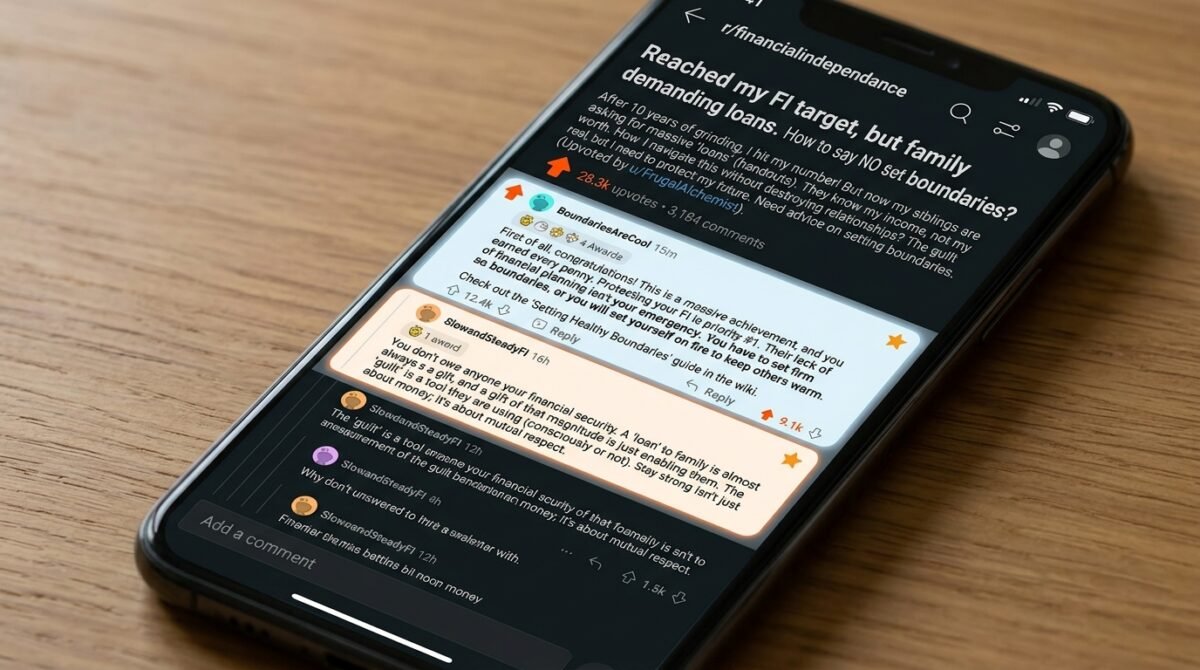
That night, I did something I had never done before. I posted a throwaway account summary on r/relationship_advice. I needed to know if I was losing my mind, if I was truly the ‘monster’ they all claimed I was. I laid out the facts, the corporate card usage, the fraud report, and the fallout. I hit ‘post’ and went to bed, expecting a flood of judgment.
When I woke up, the post had over 50,000 upvotes and thousands of comments. I scrolled through them, stunned. The consensus was overwhelmingly in my favor, but it was the nuance in the comments that hit the hardest. People weren’t just calling Mark names; they were breaking down the financial abuse that had clearly been happening for years.
“This is not a ‘misunderstanding.’ This is blatant financial abuse. Your husband didn’t just borrow money; he put your career and your legal standing at risk for his sister’s vanity. Do not apologize. Do not ‘fix’ this for them. If he wants to be a golden boy, let him pay the price for his own family’s mess. NTA, and get a lawyer.”
— u/FinanceExpert_Throwaway (Top Comment, 32.4k upvotes)
Reading these comments felt like a validation I had been starved of for years. The internet wasn’t blinded by his family’s ‘good intentions’ or his sister’s ‘dream trip.’ They saw the cold, hard reality: my husband had crossed a boundary that should be non-negotiable in any marriage. It gave me the strength to stop feeling guilty.
Another commenter pointed out the legal danger: “If you don’t keep that fraud report active, you are essentially condoning the behavior. If the company audits that card and finds out you knew about it and didn’t report it as fraud, you are complicit. By reporting it, you are doing exactly what a responsible employee should do. Your husband is the one who broke the law, not you.”
I realized then that I wasn’t just defending my paycheck; I was defending my sanity. The reddit thread became a mirror for my own life, showing me that I had been tolerating things that were fundamentally wrong. It was the push I needed to take the next step: consulting with a divorce attorney to understand my own financial protection.
The Legal Ultimatum

I met with a lawyer the following Tuesday. I brought everything—the bank statements, the emails, the screenshots of the family chat. She went through it with a fine-tooth comb, and her advice was simple and terrifying: ‘Your husband has been setting you up for liability for a long time. This wasn’t the first time he used your accounts, was it?’
I thought back to the smaller charges: the ’emergency’ grocery runs, the ‘gift’ for his mom that I never authorized, the ‘surprise’ restaurant bills. She was right. It was a pattern of behavior that I had ignored because I was a high earner and it was ‘easier’ to just pay it than to fight about it. That convenience had become my downfall.
She drafted a letter for Mark to sign, an acknowledgment of the debt and a promise to never access my corporate or personal accounts without explicit, written consent. It was an ‘ultimatum’ in the truest sense of the word. If he signed it, we could move forward with counseling and strict financial separation. If he refused, I was looking at a clean break.
“This is not a suggestion, Mark. This is a condition of our marriage moving forward. You have proven that you cannot be trusted with my financial security. If you want to stay in this house, you sign this, or I file for separation. I am done being your family’s silent benefactor.”
He read the document and his face crumbled. He didn’t see it as a path to reconciliation; he saw it as an insult. ‘You want me to sign a contract to be your husband?’ he asked, his voice shaking. I realized then that he didn’t want a partner; he wanted a manager who would keep the funds flowing.
The standoff lasted for hours. He tried every tactic: guilt, anger, ‘think of the family,’ even tears. But I remained unmoved. I had seen the comments on my post, I had talked to my HR rep, and I had looked at my bank statements. I knew the truth. I was not the villain. I was the person who had finally woken up.
The Final Breaking Point

The breaking point didn’t come with a shout, but with a quiet, devastating realization. Mark told me that his sister was still calling him, demanding he ‘fix’ the fraud report because she had now received a letter from the bank. She was being questioned about the transactions, and she was terrified. He wanted me to tell the bank it was all a big mistake.
I looked at him, and for the first time, I didn’t see a husband. I saw a man who was willing to let me face legal consequences just so his sister wouldn’t have to deal with the fallout of her own entitlement. That was the moment the last of my affection died. I realized that my safety was, and would always be, secondary to his family’s comfort.
I didn’t argue. I didn’t get angry. I simply stood up and walked to the closet, pulling out a suitcase. I told him he had until the end of the week to decide if he was signing the document or if I would be finding a new place to live. The power dynamic had shifted completely, and he had no idea how to handle it.
“You’ve made your choice, Mark. You’ve chosen their comfort over our marriage. I’m going to stay at my sister’s place for a few days to give you time to decide. If the paper isn’t signed by Friday, don’t worry about finding me. I’ll have my lawyer reach out.”
The look on his face was one of genuine terror. He finally realized that I wasn’t just threatening to leave; I was ready to go. The ‘golden boy’ who had never had to face a real consequence in his life was suddenly standing in the middle of a house that he hadn’t realized was being held up by my labor and my income alone.
As I packed my bags, he didn’t try to stop me. He stood in the doorway, watching, as if he expected me to turn around at any moment. But I didn’t. I walked out of the house, drove to my sister’s, and for the first time in years, I breathed a sigh of relief. The weight of the world wasn’t on my shoulders anymore.
The Aftermath and the New Reality

By Friday, the document was sitting on my sister’s coffee table, signed, notarized, and delivered by courier. He had signed it. But it didn’t feel like a victory. It felt like a funeral. I looked at the signature—his signature, the one I had known for years—and realized that the marriage we had was gone. The trust was irreparably damaged.
We tried counseling, but the resentment was too deep. Every time he spoke about his family, I saw the man who had tried to sacrifice my career for his sister’s vacation. Every time he mentioned ‘family,’ I heard the sound of the fraud report being filed. The distance between us was a chasm that no amount of therapy could bridge.
I eventually decided to file for divorce. It wasn’t just about the money; it was about the fundamental misalignment of values. He wanted a partner who would subsidize his life; I wanted a partner who respected my boundaries. Those two things could never coexist. The fallout with the family was swift and brutal, but I found I didn’t care.
“I’m not looking for a payout. I’m looking for a life where I’m not constantly looking over my shoulder to see if my own spouse is draining my accounts. I’ve realized that this isn’t a marriage. It’s an arrangement, and it’s one that I no longer wish to be a part of.”
I moved into my own apartment, a small, quiet place that was entirely mine. I changed my passwords, secured my accounts, and started over. The first night in my new place, I sat on the floor, drank a glass of wine, and realized I hadn’t felt this light in years. I was alone, but I was free.
My company stood by me through the whole thing. The investigation into the fraud resulted in the bank putting a permanent ban on my sister-in-law, and she had to deal with the consequences of her ‘dream trip’ on her own. I heard through the grapevine that the wedding was a nightmare, but for once, I wasn’t the one who had to deal with any of it.
Final Reflections on Boundaries

Looking back, the entire experience was a wake-up call I hadn’t known I needed. We spend so much of our lives trying to keep the peace, trying to be the ‘bigger person,’ that we lose sight of the fact that the ‘bigger person’ is often just the one who gets stepped on the most. I learned that boundaries are not acts of aggression; they are acts of self-preservation.
The internet was right: when you allow someone to repeatedly overstep, you are teaching them that your boundaries are flexible. And once they learn that, they will never respect them again. I had been teaching my husband and his family that my money, my reputation, and my security were all up for grabs. It took a massive, explosive act of defiance to stop that cycle.
I also learned that true family—the people who actually care about you—will never ask you to destroy yourself for their benefit. My own family, my friends, and even my colleagues stood by me, while the ones who claimed ‘family above all’ were the first to turn on me when I stopped providing for them. That realization was the most painful, but also the most clarifying.
“You are not a bad person for choosing yourself. You are not a villain for refusing to be a victim. Sometimes, the most loving thing you can do for yourself is to walk away from the people who don’t know how to treat you with respect.”
I am still in the process of healing, still learning how to trust again, but I’m doing it on my own terms. I’ve realized that I don’t need to be part of a ‘unit’ to be whole. I am enough on my own. And that, in the end, is the only thing that really matters. The bank accounts are safe, the career is secure, and for the first time, my life is my own.
If you find yourself in a similar position, please listen: do not wait for a ‘bigger’ betrayal. Do not wait for someone else to tell you that you are being abused. If your boundaries are being violated, act immediately. Do not worry about being the ‘bad guy.’ The people who call you the bad guy are usually the ones who are benefiting from your silence.
Conclusion
My journey from a ‘supporting spouse’ to a woman who chose her integrity over her marriage has been long and difficult, but it has been worth every second of the struggle. I have learned that the hard decisions are often the right ones, and that true strength is found in the ability to walk away when the cost of staying becomes too high.
The fallout from my decision to report the fraud didn’t just end a marriage; it ended a life I had outgrown. I am now in a place where my finances, my professional life, and my personal boundaries are all mine to manage. I no longer have to worry about who is accessing my cards or who is planning their next ’emergency’ on my dime.
To those of you who have been in similar situations, I urge you to prioritize your own well-being. Do not let someone else’s sense of entitlement dictate your worth. Do not let the pressure to be ‘family’ override the necessity of respect. You are your own best advocate, and you deserve a life built on trust, not exploitation.
What about you? Have you ever had to draw a line in the sand with family or a spouse when it came to your financial or professional integrity? Did you feel the guilt they tried to place on you, or were you able to see it for what it was—manipulation? Let’s discuss in the comments below.
What's your verdict on this dilemma?
Vote below to contribute to the official community consensus.

Have a Dilemma Keeping You Up at Night?
Share your real-life feud, wedding chaos, or relationship crossroads anonymously with our editorial team.
What do you think ?
0 Comments🛡️ Comments are moderated to protect community integrity. Your comment will appear once approved by the editorial team.