
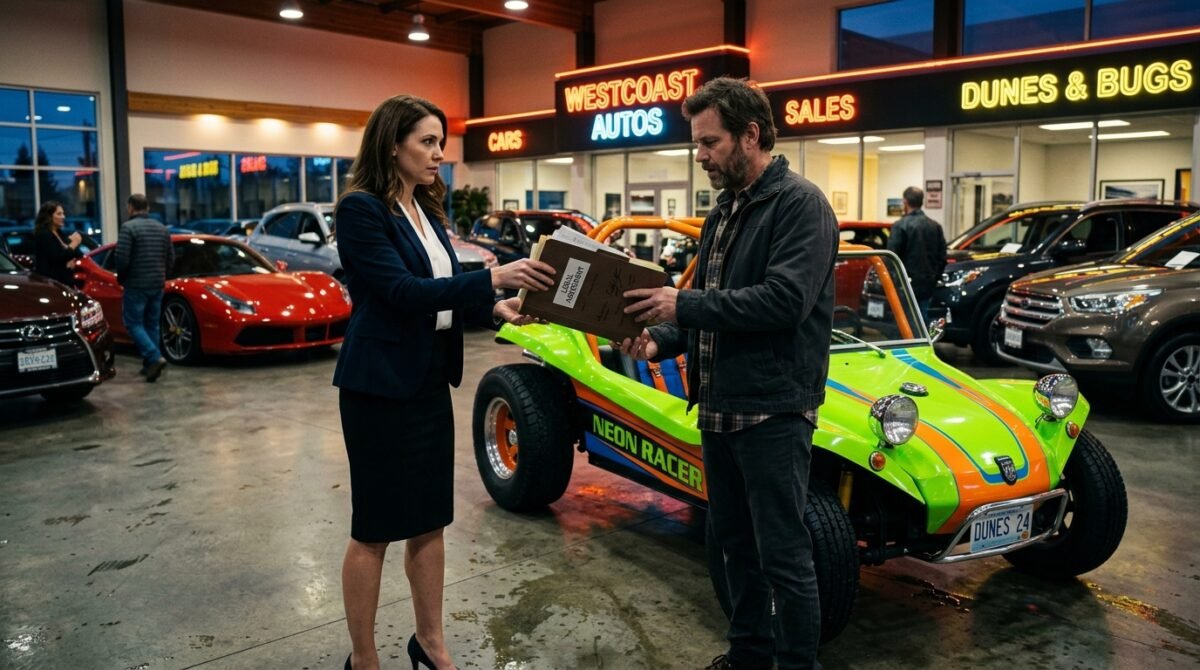
Marriage is built on foundations of trust, shared finances, and the unspoken rule that you do not dispose of your spouse’s primary mode of transportation without their express permission. My husband, Mark, has always had a penchant for ‘impulse adventures,’ a trait I once found charming but eventually recognized as a profound lack of respect for our shared reality. We had built a life together—a suburban home, two kids, and a meticulously managed budget that accounted for every cent of our combined income.
My sedan was my lifeline. It was a reliable, fuel-efficient vehicle that I used to commute to my corporate job, handle the school runs, and manage the logistics of our family life. When I woke up on a Tuesday morning to find my parking space empty, my initial thought was that it had been stolen. I spent two hours on the phone with the police before a sinking feeling in my gut led me to check our shared banking app, where I saw a strange pending transaction at a local powersports dealer.
The realization didn’t hit me all at once; it came in waves of cold, blinding fury. Mark hadn’t just ‘borrowed’ the car; he had traded it in. He had taken my title—which he had access to from our home safe—and exchanged my functional, paid-off vehicle for a loud, impractical, neon-orange dune buggy that he claimed was ‘for the family.’ He hadn’t even consulted me. He hadn’t just crossed a boundary; he had demolished the entire fence.
This wasn’t about the car. It was about the audacity to assume that my autonomy was secondary to his desire for a mid-life crisis toy. I didn’t scream, I didn’t cry, and I didn’t call him to argue. I simply gathered my composure, contacted my lawyer, and made a plan. If he wanted to live in a world where he could make massive unilateral life decisions, he was going to get exactly what he bargained for.
The following pages detail the dissolution of a partnership that had been fraying at the seams for years. This is a story about the breaking point, the moment of clarity, and the quiet, calculated dismantling of a marriage that could no longer survive the weight of one person’s unchecked ego.
The Morning the Parking Spot Went Cold
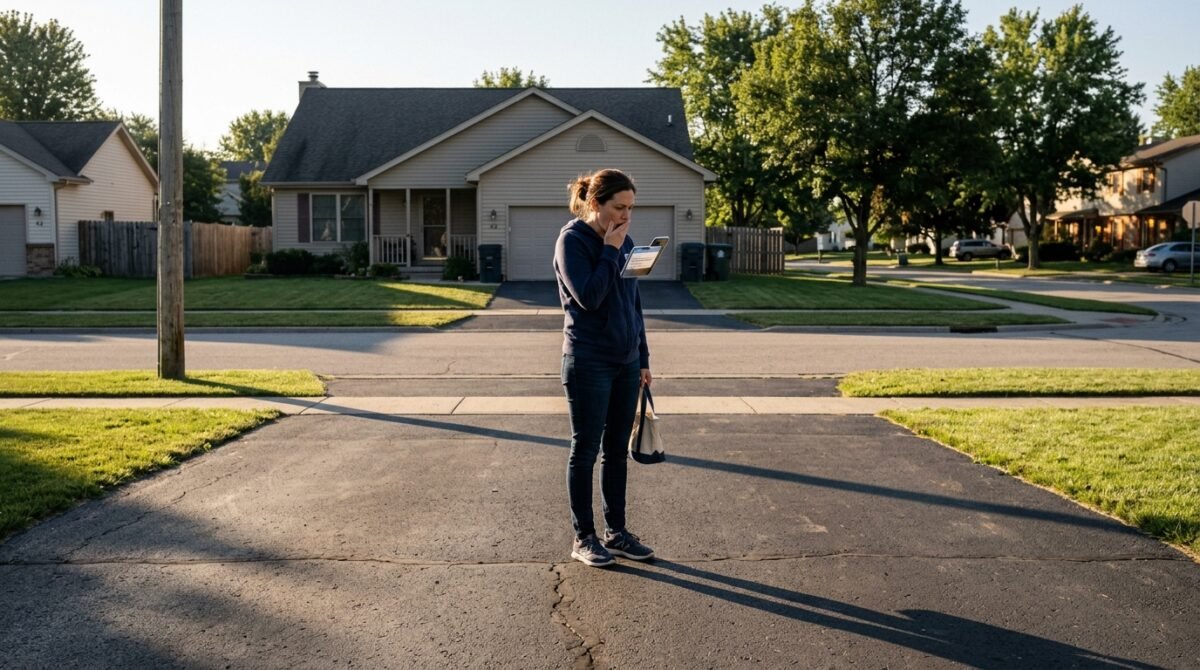
The Tuesday morning began with the rhythmic chirping of the birds and the mundane expectation of a regular workday. I walked out to the driveway with my coffee in hand, ready to begin the forty-five-minute trek to the office, only to find an empty patch of asphalt where my silver sedan should have been. My heart skipped a beat, the kind of visceral panic that comes from losing something essential.
I immediately assumed the worst. I called the local police department, my hands shaking as I gave them my license plate number and reported a grand theft auto. I stood in my driveway, watching the neighbor’s golden retriever chase a squirrel, feeling like a stranger in my own life. I was preparing to call my insurance agent when I decided to check our joint bank account one last time, just to see if there were any suspicious charges that might explain a late-night tow truck encounter.
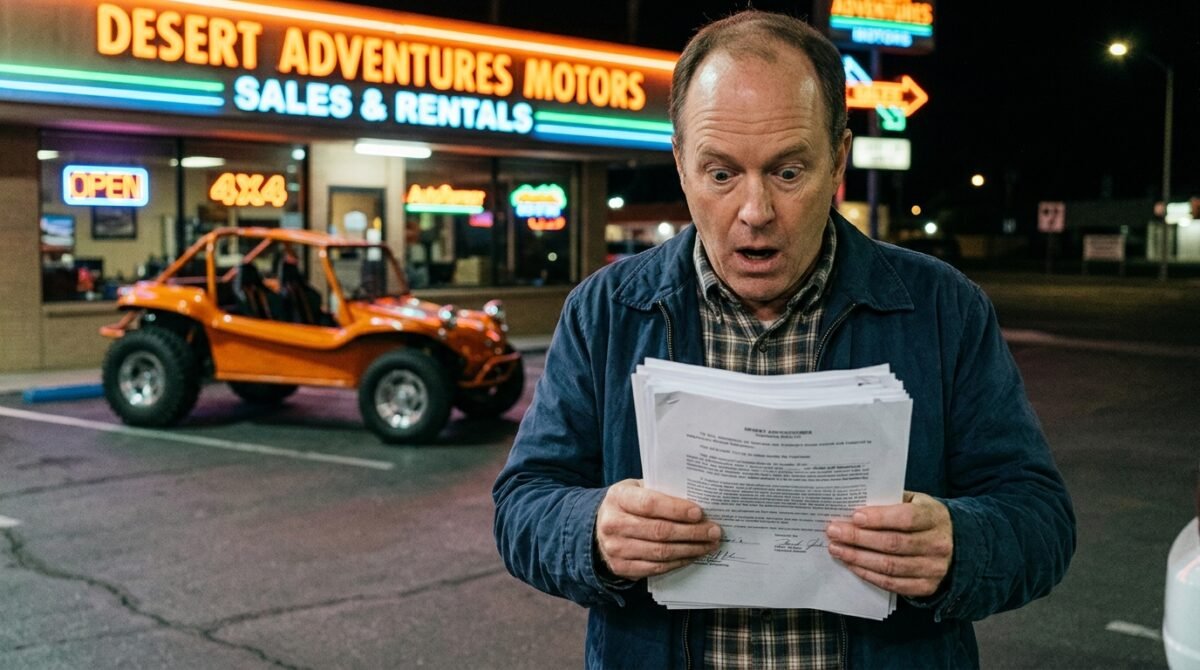
Instead of a theft report, I found a digital receipt from ‘Apex Powersports & Off-Road.’ The transaction was dated 8:00 PM the previous evening. The amount was staggering—a transfer of equity and a significant cash down payment that emptied our vacation savings account. I stood there, frozen, as the absurdity of the situation started to sink in.
“Mark, why is there a five-thousand-dollar charge at a dune buggy dealership on our joint account? And why is my car gone? Please tell me you didn’t do what I think you did.”
— Sent via text at 8:15 AM
The response didn’t come for an hour. When it finally arrived, it was dismissive and sickeningly casual. He told me that life was too short for boring sedans and that he had ‘upgraded’ us to something that would make our weekends memorable. He truly believed that the inconvenience to me was a reasonable price to pay for his new hobby.
A Conversation That Never Should Have Happened
I drove to the dealership in a rental car, my blood boiling so hot I felt like I might actually combust. When I arrived, there it was—a monstrous, bright orange dune buggy sitting right in the center of the showroom floor, looking like a neon middle finger pointed directly at my sanity. Mark was there, too, laughing with a salesman as they discussed tire pressure and off-road trail maps.
He looked up, saw me, and actually had the gall to grin. He walked over with his arms wide open, as if I were there to celebrate his purchase. The disconnect between his reality and mine was absolute. He thought this was a quirky marriage moment; I knew it was the final nail in the coffin. I didn’t say a word about the car at first; I simply walked up to him and handed him the envelope I had picked up from my lawyer’s office an hour prior.
“What is this? Are you serious right now? We’re supposed to be celebrating! Look at the suspension on this beast, honey. You’re overreacting.”
— Mark, moments before realizing the severity of the situation
The salesman awkwardly backed away, sensing the sudden, sharp drop in temperature. I looked Mark dead in the eye, my voice steady and devoid of the usual emotional spikes that characterized our past arguments. The power dynamic shifted in that moment. He wasn’t the husband making a ‘fun’ decision; he was a defendant being served in public.
I explained, calmly and clearly, that the marriage had been on life support for months. The car was just the physical manifestation of his disregard for me. As he opened the folder and realized these were not legal documents for a simple dispute, but formal divorce papers, his face drained of color. The silence in the dealership was deafening.
The Anatomy of a Disappearing Savings Account

It wasn’t just the car. In the weeks that followed, as the divorce proceedings began to ramp up, I started digging into the financial history of our marriage. I discovered a pattern of behavior that was far more insidious than a single bad purchase. Mark had been funneling money into ‘investment opportunities’ that were really just get-rich-quick schemes, draining the college funds we had set aside for our children.
I felt a deep, hollow shame for not having looked sooner. I had trusted him implicitly, thinking that our shared finances were a symbol of our unity. Instead, they were a weapon he had been using to gamble with our future. I spent hours sitting at the kitchen table with spreadsheets, documenting every unauthorized transfer, every ‘loan’ to a friend who never paid him back, and the consistent erosion of our net worth.
The dune buggy was merely the catalyst. It was the moment I stopped being a passive participant in my own financial ruin and started becoming an active archivist of his incompetence. I took all this documentation to my lawyer, who, frankly, looked impressed by the sheer volume of evidence. The look on Mark’s face when he realized that I had every receipt, every text message, and every bank statement was worth more than any vehicle.
We had a brief, explosive meeting with the lawyers where he tried to claim that the money was ‘his’ because he worked overtime. My lawyer, a shark in a tailored suit, didn’t even blink. He simply laid the bank records on the table and asked Mark to explain the transfer to a crypto-currency exchange that had shuttered months ago. Mark had no response.
Family Intervention and the Blame Game

Once the news of the divorce broke, the ‘family experts’ came out of the woodwork. Mark’s mother, in particular, was relentless. She called me three times a day, insisting that I was being ‘too cold’ and ‘throwing away a perfectly good marriage over a hunk of metal.’ It was classic enabling, the kind of rhetoric that had likely fueled Mark’s behavior for his entire adult life.
I had to set a firm boundary. I told her that if she continued to minimize the financial abuse and the breach of trust, I would have no choice but to block her number. She didn’t believe me until the fourth call, when I simply hung up and hit the block button. It was incredibly liberating. I wasn’t just divorcing a husband; I was divorcing the entire toxic system that protected him.
“You’re making a mistake, OP. Every man goes through a phase. You should be supporting him, not punishing him like he’s a child. Think of the kids!”
— Mother-in-law, in a voicemail I kept for evidence
The irony of her claiming I was punishing him like a child was lost on her. I wasn’t punishing him; I was holding him accountable for adult actions. The kids were my priority, which was exactly why I was so determined to secure our remaining assets before he could sink them into another ‘investment’ or another vehicle.
I held a meeting with my own parents, explaining the situation honestly. They were supportive, which surprised me. I had feared they would tell me to try harder, to forgive, to make it work. Instead, they saw the weariness in my eyes and told me they were proud of me for finally putting my foot down. Having that validation was the final piece of the puzzle I needed to move forward.
The Internet Weighs In: Reddit’s Verdict
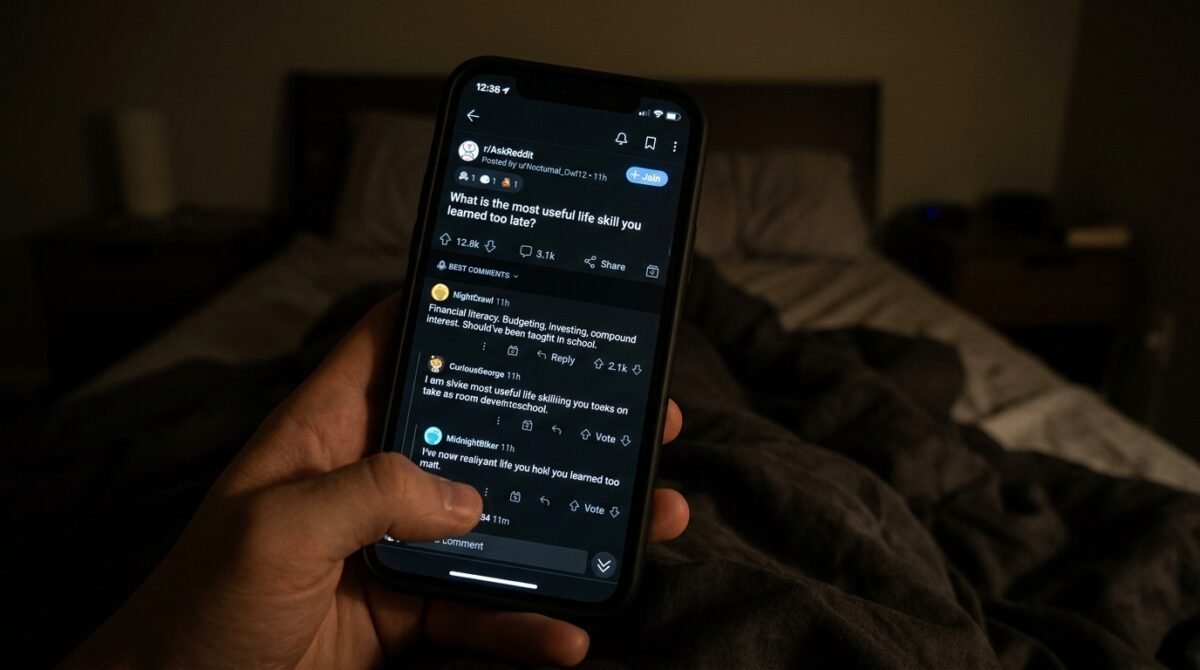
I posted my story anonymously on a popular relationship subreddit, expecting a mix of criticism and support. I wasn’t prepared for the sheer volume of responses. Within twelve hours, the post had reached the front page, with thousands of people commenting on the financial betrayal and the absurdity of the dune buggy purchase.
“OP, you are NTA (Not The Asshole). This isn’t about the car. It’s about him having no respect for your autonomy, your career, or your shared future. Serving him at the dealership was a power move—don’t back down now.”
— u/FinanceExpert99 (Top Comment, 32.4k upvotes)
The community support was overwhelming. People shared their own stories of financial infidelity, describing how they had been trapped in similar cycles of debt and neglect. Reading through the comments made me feel less alone. It was a digital validation of the reality I had been living but was too afraid to name.
There were, of course, the contrarians. Some people argued that I should have discussed it with him before escalating to divorce, but the majority of the thread pointed out that you cannot ‘discuss’ a betrayal that has already been executed. He didn’t ask for my input; he acted. The consequences were simply the natural result of his own choices.
I kept the thread open on my phone for weeks. Whenever I felt a twinge of guilt, or whenever he tried to gaslight me into believing I was the one who destroyed the family, I would reread the top comments. It served as a reminder that my perception of reality was intact, and that the boundaries I was setting were not only necessary but healthy.
The Legal Tangle of Asset Division

The divorce process was a slog of paperwork and depositions. We had to account for every asset, which, thanks to my thorough documentation, was relatively straightforward. Mark fought me on every single item, from the furniture to the kitchen appliances. He seemed to think that if he could just make the process miserable enough, I would give up and agree to a more favorable settlement for him.
He tried to argue that the dune buggy was a ‘business expense’ for a venture he was planning. My lawyer had a field day with that. There was no business plan, no registration, and no revenue. It was just a expensive hunk of metal sitting in his brother’s garage, gathering dust. The judge wasn’t buying his narrative for a second.
During one of the hearings, Mark attempted to paint me as an ‘unreasonable’ spouse who was obsessed with control. My lawyer simply handed the judge the list of unauthorized transactions and the texts where he dismissed my concerns about the car. The judge looked at me, then at Mark, and the look on his face said everything. It wasn’t about control; it was about survival.
We eventually reached an agreement, though it was far from amicable. I walked away with the house, the primary custody of the kids, and a significant portion of the remaining savings. He was left with the dune buggy and a massive amount of credit card debt that he had accumulated in his own name. It was the price he paid for his autonomy, and I finally felt like I could breathe.
The Quiet After the Storm

After the divorce was finalized, there was a strange, quiet period where I had to learn how to exist in a house that was finally my own. I had replaced the locks, changed the passwords on all our accounts, and redecorated the living room. It felt like living in a new space, one that wasn’t cluttered with his ‘projects’ or his moods.
The kids adjusted surprisingly well. They were happier without the tension in the house, without the arguments about money, and without the constant uncertainty of what their father would do next. We established a routine—school, dinner, homework, play—that was stable and consistent. For the first time in years, I wasn’t walking on eggshells.
I started focusing on my career, which had been put on the back burner for so long. I took a certification course, updated my portfolio, and within six months, I was promoted to a senior role. The financial independence was intoxicating. I was no longer dependent on a partner who might decide to trade our stability for a toy.
I still see the occasional orange dune buggy on the road, and every time I do, I feel a flicker of annoyance, followed by a profound sense of relief. That car was the best thing that ever happened to me, in the most twisted way possible. It was the loud, neon-bright signal that the marriage was over, and that I was finally free to build something worth having.
Reflecting on the Red Flags

Looking back, I realize there were signs for years. The ‘investments’ that never paid off, the way he would buy gadgets without telling me, the way he would dismiss my input on large purchases as ‘worrying too much.’ I had categorized these as character flaws rather than red flags. I thought I could manage him, that if I just kept the books balanced tightly enough, he would eventually grow up.
I was wrong. You cannot manage someone else’s character. You can only decide whether or not you want to live with the consequences of their actions. I spent so much energy trying to protect the marriage that I forgot to protect myself. That realization was the most painful part of the entire process.
I’ve learned that trust isn’t just about not cheating; it’s about financial transparency and respect for the partnership. When those things are missing, the marriage is essentially a business transaction gone wrong. Once I stopped looking at it as a sacred bond that I had to save and started looking at it as a bad investment that I needed to liquidate, the decision to divorce became easy.
I have no regrets about the way I handled it. Serving him at the dealership was dramatic, yes, but it was the only way to make him understand that the game was over. He had spent years ignoring my boundaries; I just made sure he couldn’t ignore the legal reality of our separation.
Moving Forward into a New Chapter

Today, my life is unrecognizable compared to the one I lived with Mark. I have a new car, a reliable sedan that I bought myself, and I know exactly what is in my bank account at all times. I have a healthy co-parenting relationship with my ex, which is strictly professional and centered entirely around the needs of the children.
He has moved on, too. I hear he’s still into the off-road scene, and he’s currently on his third dune buggy. It doesn’t bother me. Let him have his toys. I have my peace, my career, and my kids. We are thriving, and that’s all that matters.
I occasionally get messages from his friends or family members, trying to see if I’ve ‘cooled off.’ I just delete them. There’s no cooling off from a betrayal that deep. The trust is gone, and in its place is a hard-won wisdom that I wouldn’t trade for anything. I am stronger, more independent, and far more discerning than I ever was before.
If you find yourself in a situation where you feel your partner is eroding your autonomy, trust your gut. Don’t wait for a dune buggy moment. If the foundation is cracked, you don’t have to spend your life trying to patch it. Sometimes, the bravest thing you can do is walk away and build something better on your own.
The Final Verdict: Why Boundaries Matter

The core lesson of this entire experience is that boundaries are not negotiable. In a healthy relationship, they are the parameters of mutual respect. In a toxic one, they are the first things to be tested and broken. I allowed mine to be broken for years, and it almost destroyed everything I had worked for.
I hope that by sharing this, someone else might recognize the signs of financial and emotional neglect before they reach their own ‘dune buggy moment.’ It’s easy to get caught up in the routine of life and ignore the subtle erosion of your own needs. But you are a person, not a secondary character in your partner’s hobby-filled life.
Stand up for yourself. Demand transparency. And if you are ever forced to make a choice between your dignity and a relationship, choose your dignity every single time. It is the only thing that you will have left when the dust settles and the keys to the dune buggy are long gone.
I am now focusing on the future. The kids are doing well in school, I’ve started a small business on the side, and for the first time in over a decade, I am genuinely excited about what tomorrow brings. I’m not just surviving; I’m living, and for the first time, it’s completely on my own terms.
Conclusion
My journey from a neglected, financially exploited spouse to an independent, empowered individual was not an easy one. It required me to face the harsh reality of a failing marriage and to take the steps necessary to secure my future. The dune buggy was just the catalyst for a much-needed transformation.
I have learned that my worth is not defined by the person I am married to, nor is it dependent on the approval of his family. I am a capable, resilient individual who is capable of building a life of stability and joy. I hope my story serves as a reminder to anyone feeling unheard or disrespected in their own relationship—you have the power to change your circumstances.
Discussion Poll: Have you ever had to draw a hard line in your relationship when a partner disrespected your boundaries? What was the moment that changed everything for you? Share your stories below—your perspective might be the validation someone else needs today.
What's your verdict on this dilemma?
Vote below to contribute to the official community consensus.

Have a Dilemma Keeping You Up at Night?
Share your real-life feud, wedding chaos, or relationship crossroads anonymously with our editorial team.
What do you think ?
0 Comments🛡️ Comments are moderated to protect community integrity. Your comment will appear once approved by the editorial team.