
When Mark and I moved in together two years ago, we envisioned a partnership built on transparency and mutual respect. We were both young professionals in a high-cost city, and the dream was simple: share the rent, split the chores, and navigate the complexities of life side-by-side. For the first eighteen months, everything functioned as one would expect. We shopped at the same grocer, cooked dinners together on Tuesday nights, and maintained a relatively egalitarian approach to our shared space.
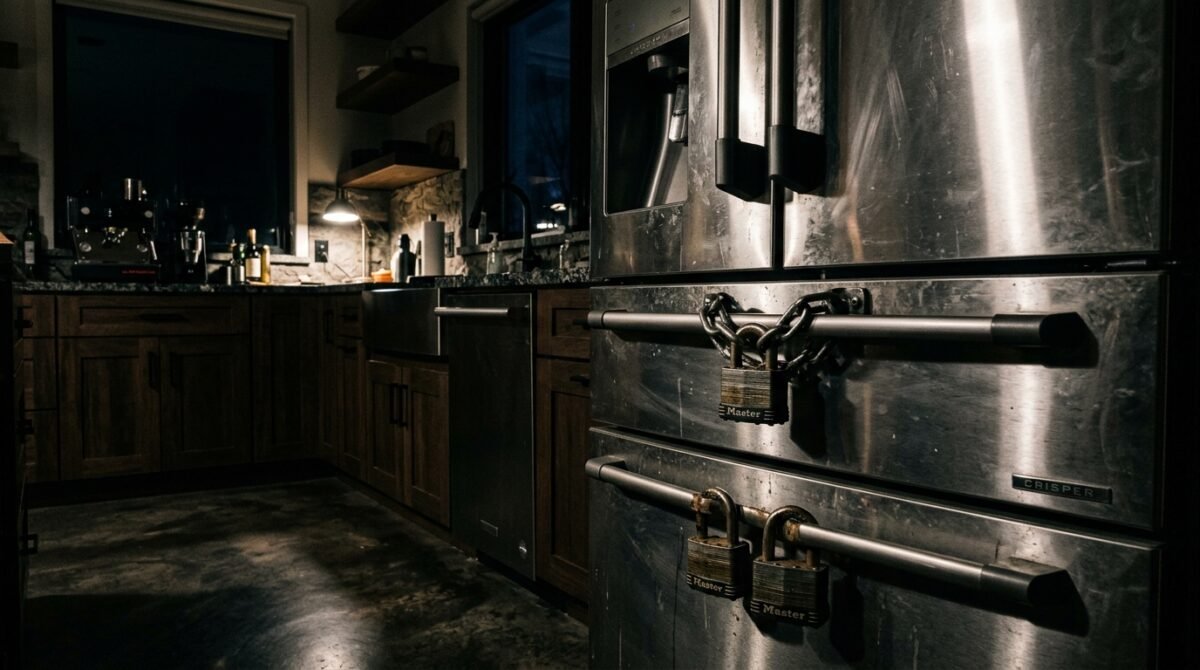
However, the shift began subtly. It started with comments about how he ‘needed’ specific, high-protein, organic ingredients to sustain his performance at his demanding corporate firm, while my standard grocery run was, in his words, ‘filler.’ Then, the passive-aggressive notes appeared on the pantry shelves. But nothing could have prepared me for the morning I walked into the kitchen to find my own groceries shoved to the side, blocked by a physical barricade of chain and steel.
The moral dilemma here isn’t just about food; it is about the fundamental erosion of equality in a relationship. By partitioning the refrigerator, Mark didn’t just lock away kale and grass-fed beef; he locked away the basic assumption that we were partners. He transformed our shared sanctuary into a hierarchy defined solely by his annual salary, setting a precedent that everything in our home is subject to a transactional audit.
This story of how a kitchen grew a padlock is not merely a tale of a petty roommate-style dispute. It is an exploration of how power dynamics manifest in the most intimate corners of our lives. It raises the question: if someone believes their income allows them to own the basic necessities of a household, where does the control end? As I navigate the wreckage of this relationship, I am looking to the community to tell me if I am overreacting, or if this is the canary in the coal mine for a much larger, more dangerous issue.
The Morning of the Metal Barricades
I woke up on a Tuesday with the usual intention of grabbing a yogurt and some fresh fruit for breakfast before heading to my office. The air in our apartment felt heavy, a lingering residue from the conversation we had the night before regarding our grocery budget, but I pushed it aside, hoping that a night of sleep had smoothed out the friction. As I turned the corner into the kitchen, the sight stopped me dead in my tracks.
The refrigerator, a high-end unit we had split the cost of purchasing, looked alien. Two heavy-duty, keyed padlocks were latched onto the metal framing of the crisper and deli drawers. Inside, through the glass, I could see the expensive produce and organic meats Mark had purchased, shielded from my touch. My own eggs and milk sat on the top shelf, exposed and feeling strangely vulnerable in the now-divided landscape.
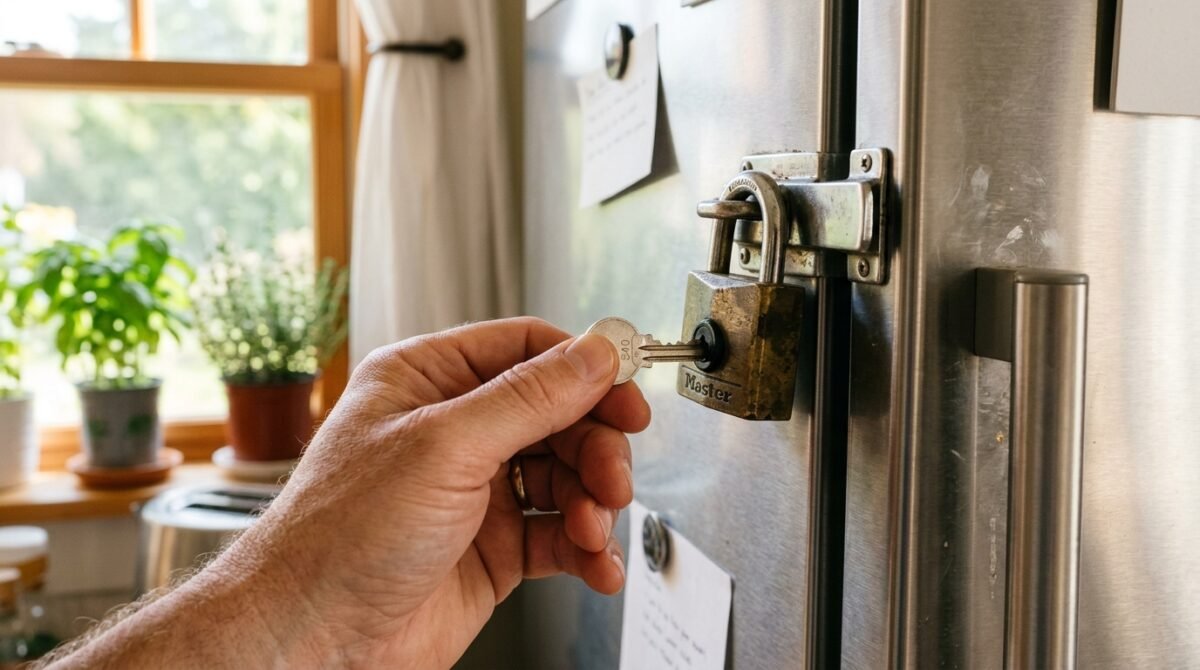
I stood there for several minutes, waiting for the absurdity of the situation to dissipate, thinking perhaps this was a cruel prank. When Mark emerged from the bedroom, he wasn’t laughing. He walked past me, pulled a key from his pocket, opened the drawer, and retrieved a single container of expensive blueberries. He didn’t even look at me as he closed it again and relocked it with a satisfying, metallic click.
“Are you actually serious with these locks, Mark? We live together. This is our home, not a hotel with restricted access.”
— Me
“Look, I’m tired of subsidizing your diet while mine is curated for my health. If you want the premium items, you can buy them. Until then, I’m protecting my investment.”
— Mark
The coldness in his voice was more jarring than the locks themselves. It was the tone of a landlord speaking to a squatter, not a partner speaking to his girlfriend of two years. He had equated his salary—which was indeed higher than mine—with a moral right to dominate the shared resources of our kitchen. The implication was clear: if I wasn’t pulling in his numbers, my needs were secondary to his luxury.
The Calculus of Financial Entitlement

The days following the installation of the locks felt like living in a state of occupation. We moved through the kitchen like strangers, avoiding eye contact while the metal locks glared at us. I tried to maintain a sense of normalcy, but the silence in the apartment was deafening. I found myself eating cereal for dinner, avoiding the kitchen altogether when Mark was home, and feeling a strange, hollow resentment settle deep in my chest.
I kept wondering when the shift in his personality had accelerated. Was it the promotion he received six months ago? Or was the entitlement always there, masked by the initial excitement of moving in together? He started keeping a ledger on his iPad—a spreadsheet where he tracked his ‘contributions’ to the household. He would point to the mortgage portion he paid—roughly 60% to my 40%—and use it to justify why he should have the final say on everything from the thermostat settings to the quality of our groceries.
I attempted to sit him down on the weekend, hoping that a calm, rational discussion would break the spell of his obsession. I brought a glass of wine, sat at the kitchen island, and waited for him to finish his protein shake. I wanted to appeal to his better nature, to remind him that our relationship was supposed to be a team effort, not a corporation where the majority shareholder dictated the terms of service.
“Mark, I feel like you’re treating our life like a business transaction. You’re holding the fridge hostage because you make more money. Do you realize how damaging that is to us?”
— Me
“It’s not about the money, it’s about standards. I work sixty hours a week to ensure I have the best life possible. If you can’t keep up with that level of standard, you can’t expect to benefit from it. That’s just economics.”
— Mark
The word ‘economics’ made my blood run cold. To him, our relationship was no longer an emotional connection but a series of inputs and outputs. He wasn’t just locking up food; he was locking up his empathy, ensuring that his ‘standard’ was never compromised by the perceived inferiority of mine. It was a terrifying realization to know that the man I loved saw me as a liability in his financial portfolio.
The Group Chat Exposed

The true breaking point came on a Thursday evening. Mark had left his laptop open on the coffee table while he was in the shower. It’s a violation of privacy, I know, but a notification popped up on the screen from a group chat titled ‘The Boardroom.’ It was Mark and three of his work friends, and the most recent message was a photo of the locked refrigerator.
I didn’t mean to read it, but my eyes scanned the text before I could stop them. The caption underneath the photo was mocking, laughing at my ‘inability to manage my own calories’ and suggesting that I was ‘too frugal to appreciate the value of high-performance nutrition.’ They were placing bets on how long I would last before I caved and started buying the expensive items for him.
“She’s so annoyed by the locks. It’s hilarious. She thinks this is about money, but it’s really about teaching her how to prioritize properly. She’ll come around once she gets hungry enough.”
— Mark (in group chat)
Reading those words felt like a physical blow. It wasn’t just a misunderstanding or a quirk of his personality; it was a deliberate, calculated campaign to demean me. He was discussing our private lives as if I were a pet he was training, someone to be shaped and molded to fit his own narrow, self-important worldview. The fact that he was sharing our most intimate conflicts with his friends to get a laugh made me feel small and exposed.
I left the room before he could catch me, my heart pounding in my ears. I didn’t confront him about it immediately—I couldn’t. I needed time to process the sheer audacity of his behavior. He wasn’t just a man who liked control; he was a man who felt a deep, intrinsic need to diminish my dignity to elevate his own sense of self-worth. Every interaction we’d had for weeks was suddenly recontextualized through this lens of calculated manipulation.
The First Confrontation After the Discovery
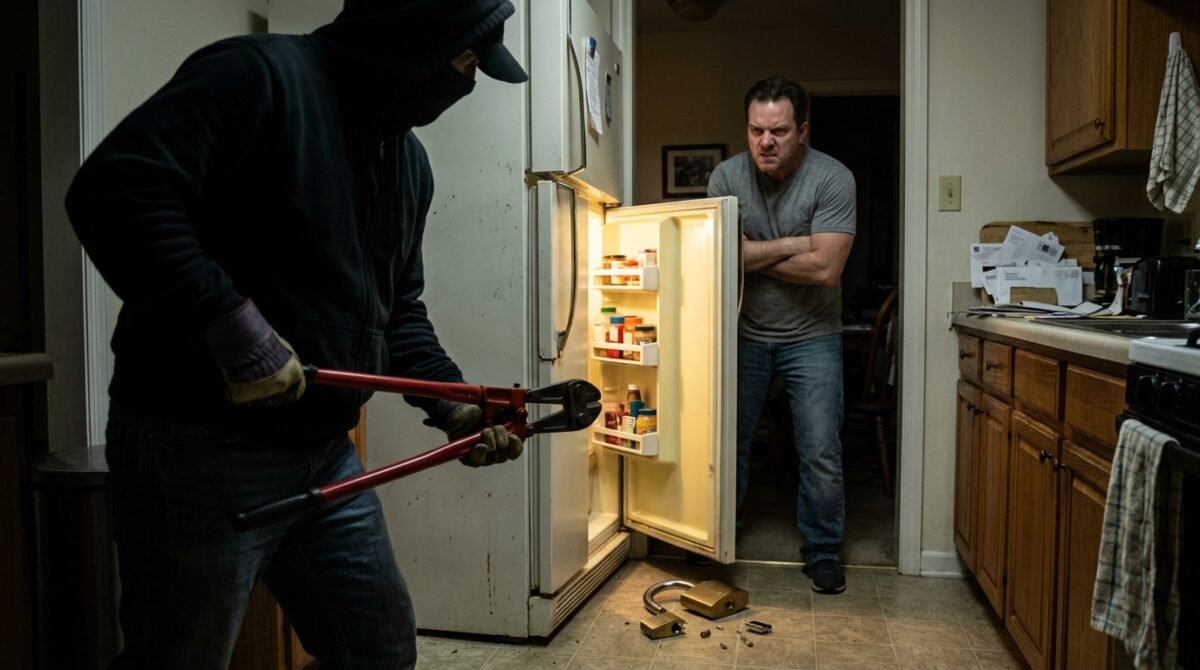
I waited until he was in the middle of a phone call for work before I walked into the kitchen. I didn’t care about the timing. I walked to the drawer, pulled out my own set of heavy-duty bolt cutters I had purchased at the hardware store earlier that morning. He stopped mid-sentence, his eyes widening as he watched me approach the refrigerator. He hung up the phone slowly, his face contorting with a mix of shock and rage.
I didn’t say a word. I simply positioned the bolt cutters against the shackle of the padlock on the crisper drawer. He rushed toward me, shouting, but I moved with a cold, detached precision. The sound of the metal snapping was loud, echoing through the quiet apartment. It was a sound of liberation. I pulled the drawer open, grabbed a handful of his precious produce, and tossed it onto the counter with a clatter.
“What the hell is wrong with you? Do you know how much that lock cost? You’re acting like a child!”
— Mark
“I read the chat, Mark. I know exactly what you’re doing. This isn’t about food. This is about you needing to feel superior because you have no other way to feel important.”
— Me
He stood there, stunned into silence for a moment, his ego visibly bruised by my directness. He tried to pivot back to his standard argument about income and ‘standards,’ but the power dynamic had shifted. I wasn’t the submissive partner he was trying to train anymore. I was a person reclaiming my space. The fear I had felt for weeks was replaced by a sharp, clear-eyed resolve. I was done being a project.
The Silent Treatment and the Financial Ultimatum

Following the ‘bolt cutter incident,’ as I mentally dubbed it, the apartment descended into a glacial silence. We existed in separate rooms, passing each other in the hallway like ghosts. Mark didn’t replace the locks; instead, he took to carrying his own mini-fridge into the kitchen—a loud, buzzing monstrosity that occupied the space where the dining chair used to be. It was the ultimate statement of his unwillingness to compromise.
He then sent me an email—not a text, an email—outlining a ‘revised living arrangement.’ It was a formal document, itemizing every expense, every chore, and every minute of space usage. He demanded a pro-rated reimbursement for the groceries I had ‘damaged’ during my act of defiance. It was, in essence, a bill for his own petty behavior. He truly believed that if he framed it in formal, business-like language, it would become legitimate.
“Per our previous discussions, I require compensation for the destroyed produce. Additionally, all future grocery expenses will be strictly audited. Failure to comply will result in a re-evaluation of our cohabitation agreement.”
— Mark (via email)
The absurdity of it was almost impressive. He was trying to treat our living situation like a corporate merger gone wrong. I spent the evening reading the document, feeling a strange mix of laughter and sorrow. How did we get here? How did the person who once wrote me love letters now write me invoices for missing blueberries? The transformation was complete. The person I loved was buried under layers of corporate-speak and bottom-line obsession.
The Reddit Community Weighs In
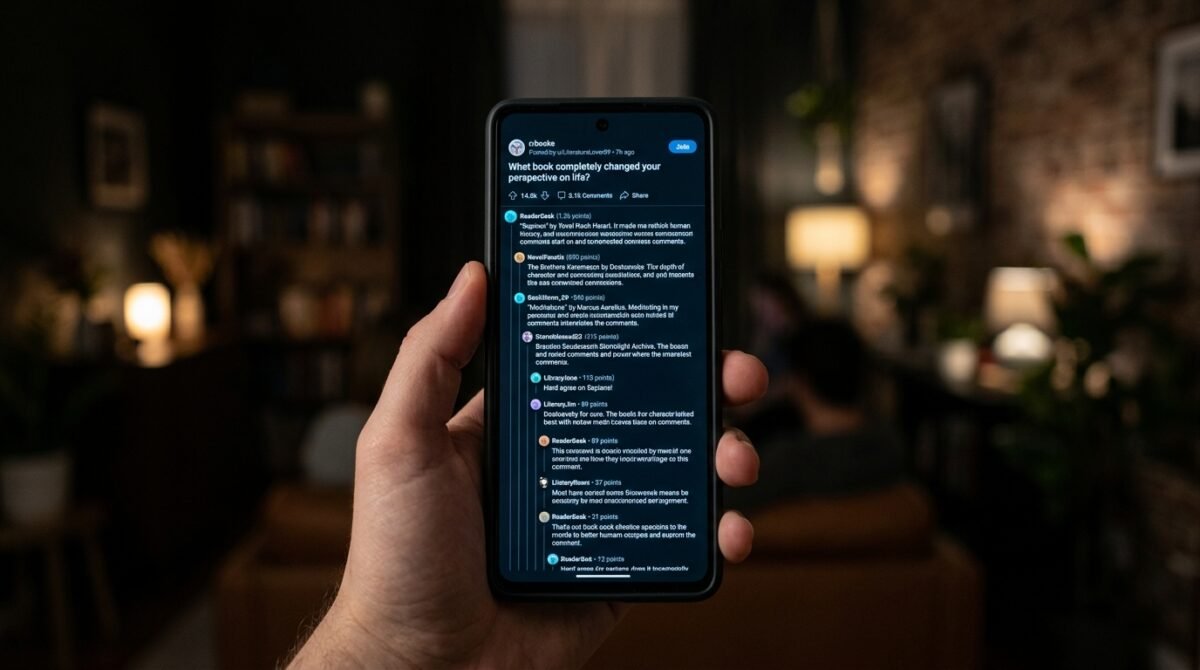
I finally decided to post about the situation online. I needed a mirror, a way to see if I had truly lost my mind or if this was as insane as it felt. I kept the post anonymous, laying out the timeline, the locks, the group chat, and the corporate-style email. The response was immediate and overwhelming. Thousands of people reached out, sharing similar stories and warning me of the patterns I was ignoring.
“This isn’t about food, OP. This is financial abuse disguised as ‘standards.’ He is conditioning you to accept his authority in every aspect of your life. Get out. Now.”
— u/RelationshipWarrior (Top Comment, 32.4k upvotes)
“The moment he brings his work friends into your private conflicts to mock you is the moment the relationship is dead. He doesn’t respect you. He views you as a subordinate.”
— u/TruthSeeker88 (18.2k upvotes)
The consensus was unanimous. There was no ‘middle ground’ here, no healthy way to negotiate with a man who felt entitled to treat me like a subordinate. The Reddit community provided the validation I had been missing, pointing out that his behavior was a classic marker of narcissism and a desperate need for control. Reading these comments helped me realize that my attempts to ‘reason’ with him were futile because he didn’t want a partner—he wanted an employee.
The Final Dinner Table Standoff
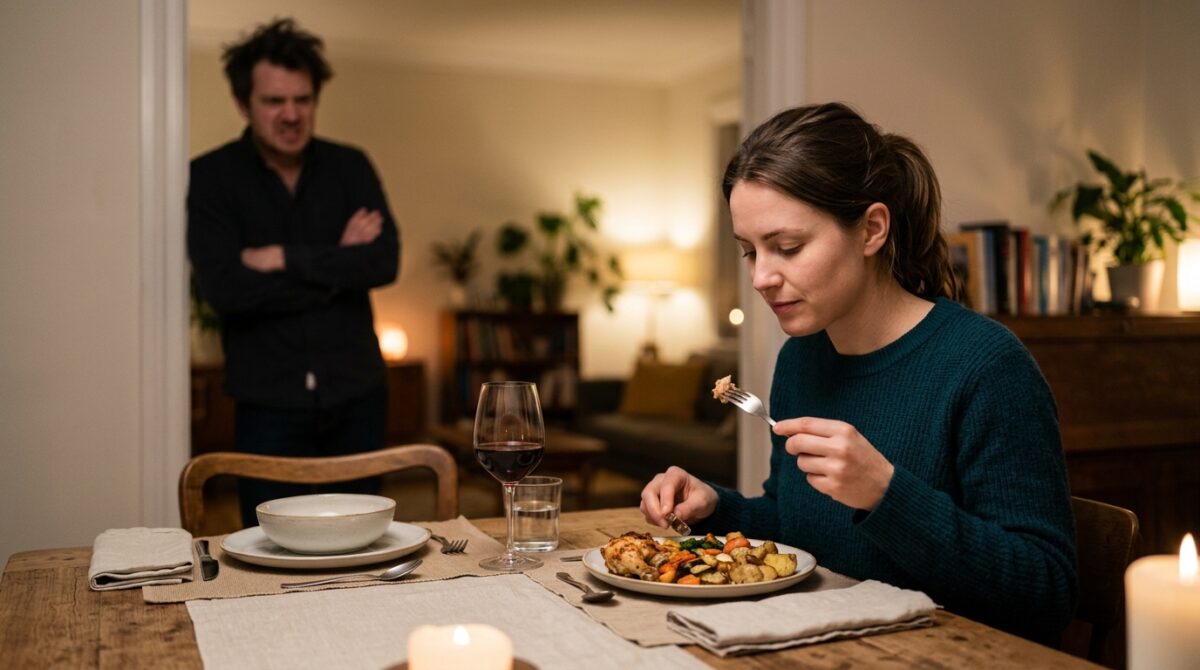
I set the table for one. I made a meal I loved—nothing expensive, just a simple pasta dish with vegetables—and sat down to eat in the kitchen. Mark was at the island, eating his own high-protein, perfectly measured meal from his mini-fridge. He looked at me, then at the empty chair across from me, and sighed. The silence was heavy, but for the first time, it didn’t feel like my fault. It felt like his.
He tried to start a conversation about our ‘financial plan’ again, his voice carrying that familiar, condescending tone of a manager trying to explain a failing quarter. I didn’t look up from my pasta. I let him talk for a minute, his words floating in the air, unacknowledged. When he stopped, confused by my lack of reaction, I finally looked at him. I wasn’t angry anymore; I was just done.
“Mark, I’m not interested in your spreadsheets. I’m not interested in your locks. And I’m certainly not interested in being a part of your ‘boardroom’ of friends.”
— Me
“You’re being irrational. This is how successful people manage their lives. You’re just proving that you aren’t at my level.”
— Mark
His need to be at a ‘higher level’ was the most pathetic thing about him. He had spent so much energy building this pedestal that he had forgotten how to stand on the ground. I realized then that I didn’t want to drag him down, nor did I want to climb up to his miserable, lonely height. I just wanted to leave.
The Packing Process

The next three days were a blur of boxes, bubble wrap, and quiet determination. Mark watched me, his expression fluctuating between genuine confusion and indignant outrage. He couldn’t understand why I was throwing away what he considered ‘a perfectly logical arrangement.’ He even tried to suggest that we go to couples therapy, provided I agreed to ‘adjust my expectations’ regarding his financial autonomy.
I didn’t argue. I didn’t explain. I just kept packing. Every item I wrapped—my books, my clothes, my kitchenware—felt like a layer of the cage being dismantled. He tried to claim that some of the kitchenware was ‘joint property’ because he had paid for the shipping, but I handed him a list of the costs I had incurred during our time together, which more than balanced out his claim. He fell silent, realizing he couldn’t use his ledger against me.
As I walked out the door for the last time, the apartment felt colder than it ever had. The buzz of his mini-fridge was the last sound I heard. I didn’t look back. I didn’t take any of the ‘shared’ furniture we had bought together, leaving it all for him to manage in his empty, perfectly curated apartment. He had his locks, his spreadsheets, and his high-performance diet. He had everything he wanted, and he was completely, utterly alone.
Reflecting on the Financial Power Imbalance

Looking back, it’s easy to identify the red flags. The constant talk about his ‘career trajectory,’ the way he subtly criticized my spending habits while splurging on his own ‘essentials,’ and the gradual shift from ‘we’ to ‘I.’ It’s a subtle kind of control that feels like a natural progression of adulthood until you realize you’ve been sidelined in your own life.
The lesson I learned was about boundaries. I allowed myself to be defined by his financial status, believing that his money entitled him to a greater share of our mutual life. But money is just a resource; it is not a currency for control. A partnership is defined by the equal value placed on both individuals, regardless of the bank account balance. I had forgotten that my time, my energy, and my presence were worth just as much as his paycheck.
The aftermath has been a period of intense healing. I’ve had to untangle my self-worth from the transactional mindset he forced upon me. I’ve realized that I am more than the sum of my contributions to a household. I am a person with needs, desires, and a right to exist in a space without having to buy my way into the refrigerator.
A New Beginning, Without the Locks

My new apartment is small, but it’s mine. There are no locks on the fridge, no spreadsheets on the counter, and no group chats mocking my life. Every day is a reminder of the freedom that comes with equality. I still find myself sometimes hesitating when I reach for something, a ghost of the habit he instilled, but that hesitation is fading.
I’ve started dating again, but the first thing I look for now is a sense of mutual respect. I don’t care about the salary or the career level as much as I care about how they treat the space we share. If someone ever mentions a ‘contribution ledger’ or tries to hoard the groceries, I know exactly what to do. I’ve already bought my own set of keys, and they aren’t for locking people out—they are for opening new doors.
The experience taught me that we teach people how to treat us. For a long time, I taught him that he could control me by holding my needs hostage. Now, I’ve taught myself that I deserve better. And that, in itself, is the most valuable lesson I could have ever learned from such a bitter, frozen conflict.
Conclusion
The story of the locked refrigerator is a stark reminder that entitlement is a quiet, creeping poison. It starts with a demand for efficiency and ends with a demand for dominion. By documenting my exit and sharing this experience, I hope to encourage others who feel that their relationships have become transactional or controlling to reclaim their agency. You are not a subordinate in your own life.
We invite you to share your thoughts in the comments below. Have you ever been in a relationship where money or perceived status was used as a tool for control? What were your ‘red flag’ moments that forced you to re-evaluate your partner’s entitlement? Let’s keep this conversation open and supportive.
Poll: What is the most toxic behavior you’ve ever witnessed in a ‘shared’ household?
A) Financial gatekeeping (like the fridge incident)
B) Passive-aggressive chore-tracking spreadsheets
C) Publicly mocking partners in private group chats
D) Using ‘higher income’ as an excuse for weaponized laziness
What's your verdict on this dilemma?
Vote below to contribute to the official community consensus.

Have a Dilemma Keeping You Up at Night?
Share your real-life feud, wedding chaos, or relationship crossroads anonymously with our editorial team.
What do you think ?
0 Comments🛡️ Comments are moderated to protect community integrity. Your comment will appear once approved by the editorial team.