

Ten years. A full decade of shared life, joint bank accounts, and the inevitable accumulation of domestic habits that often calcify into silent, resentful expectations. My husband, Mark, and I decided to celebrate our milestone anniversary by renting a secluded, high-end cabin in the Pacific Northwest. The brochure promised wood-fired saunas, floor-to-ceiling windows overlooking a misty valley, and a total disconnect from the noise of our daily grind. It was supposed to be a sanctuary of romance and rest.
The reality, however, began to unravel the moment we turned the key in the lock. For Mark, this cabin wasn’t a place for us to reconnect as equals; it was an extension of our home life, albeit with a better view. He immediately assumed the role of the ‘guest’ who had arrived to be catered to, despite us both being on vacation from our demanding corporate jobs. I had envisioned mornings spent drinking coffee on the deck and evenings reading by the fire. Mark had envisioned a private chef who worked for free.
When the first demand came—a pointed request for a four-course dinner after a day of hiking—I laughed it off as a joke. But Mark didn’t laugh. He looked at me with a mixture of confusion and genuine irritation, as if the concept of me not serving him was a violation of some unspoken, ironclad contract. By the second day, the ‘joke’ had become a list of chores, and the resentment I had been burying for years began to surge to the surface like a tidal wave.
This isn’t just a story about a bad vacation. It is a story about the breaking point—the exact moment when a partner realizes that their contribution to the relationship is valued only in terms of utility. It’s about the silent erosion of self-respect and the radical, terrifying, and necessary act of walking away when the person who promised to love you treats you like an accessory to their comfort.
The Illusion of the Romantic Getaway

When we arrived, the cabin was breathtaking. Cedar planks, a stone fireplace, and a kitchen that looked like it belonged in a magazine. Mark walked in, tossed his luggage onto the pristine hardwood, and immediately opened his laptop. I went to the bedroom to unpack, expecting us to spend our first afternoon exploring the nearby trails or just soaking in the mountain air. Instead, I heard the telltale sound of him ordering groceries for delivery.
I emerged from the bedroom to find him sitting at the kitchen island. He didn’t look up. He simply said, ‘I grabbed some staples. Should be here in an hour. We need to make sure we don’t waste money eating out every night, especially since we paid so much for this place.’ I blinked, confused. We had budgeted specifically for fine dining in the local town, a treat we had been looking forward to for months.
“I thought we agreed on the local bistro for tonight, Mark? I’m not really in the mood to spend our anniversary cooking in a kitchen I don’t know.”
Mark sighed, a long, dramatic sound that signaled he was already annoyed by my ‘lack of pragmatism.’ He explained that the grocery delivery was a better use of our funds, and that he ‘just wanted a nice, home-cooked meal’ that wouldn’t break the bank. He didn’t ask if I wanted to cook; he stated it as if the labor was already allocated to my column in the ledger of our marriage.
I felt a cold sensation in the pit of my stomach. This wasn’t about groceries. This was about control and the default assumption that my leisure time was secondary to his hunger. I told him he was free to cook whatever he wanted, but I was going to the bistro alone if I had to. He dismissed this as me being ‘dramatic’ and ‘difficult,’ setting the stage for the next forty-eight hours of escalating tension.
The 6:00 AM Kitchen Ultimatum
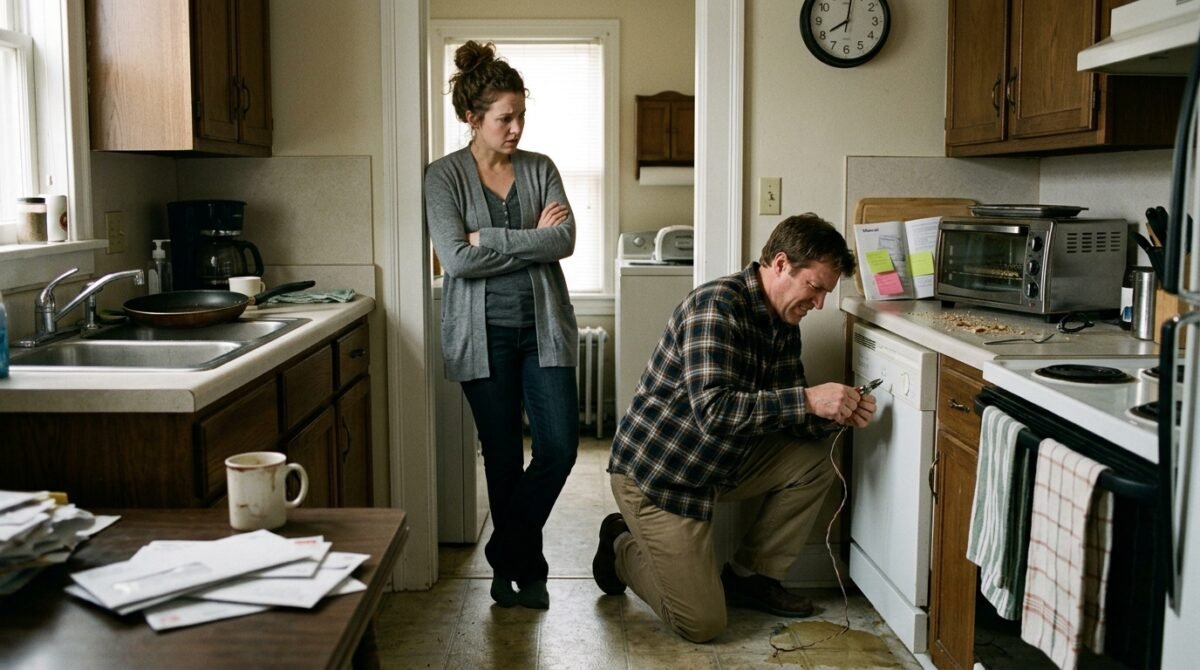
The second morning started with a jarring clatter. I woke up at dawn, hoping to catch the sunrise from the deck, only to find Mark standing in the kitchen, frantically trying to locate a frying pan. He hadn’t just woken up; he had decided that the ‘vacation’ required a full breakfast spread, and he expected me to be the one to produce it. When I walked in, he didn’t say good morning. He asked why the coffee wasn’t on.
I stood there in my robe, staring at the man I had lived with for a decade, wondering when he had lost the ability to perform basic human tasks for himself. It was a cognitive dissonance that made my head spin. He looked at me with expectation, his hand hovering over the stove dial, waiting for me to take over the role of provider. The silence in the room was heavy, thick with the weight of years of unchecked entitlement.
“I’m not making breakfast, Mark. There’s a cafe in the village. If you’re hungry, we can go there. Or you can figure out the stove yourself. I am on vacation.”
His face darkened. He told me that he worked hard all year and that the least I could do was ‘ensure the trip was comfortable.’ He used the word ‘comfortable’ as a synonym for ‘serviced.’ The argument that followed was the first real crack in the foundation. He listed everything he ‘did’ for me—the mortgage, the car payments, the vacations—as if these financial contributions bought him a lifetime of my domestic labor. It was a transactional view of marriage that I had ignored for too long.
I realized then that he didn’t see me as a partner; he saw me as a support system. The breakfast didn’t happen. He ended up eating cold cereal while I sat on the deck, watching the sun hit the peaks, feeling the familiar pull of guilt fighting against the sudden, sharp clarity of my own self-worth. I wasn’t just tired of cooking; I was tired of being an extension of his convenience.
The Group Chat Confession
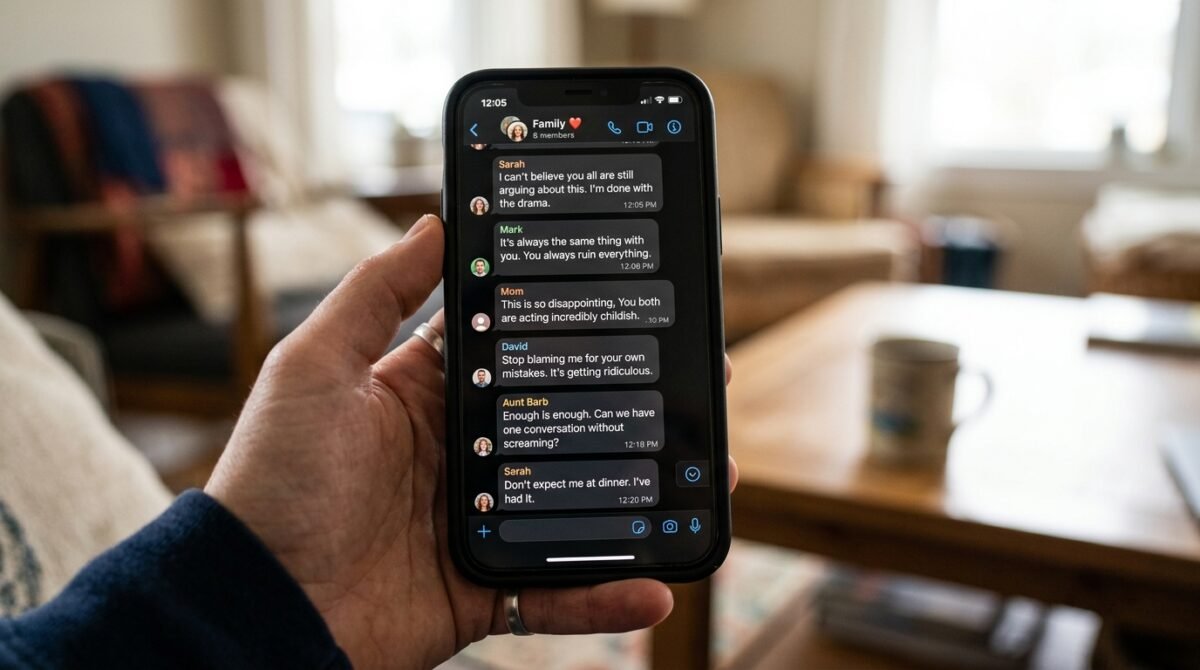
While Mark went for a hike—alone, as he was still punishing me for my ‘insubordination’—my phone pinged incessantly. It was our family group chat, where Mark had evidently been complaining about my ‘moodiness’ and lack of ‘wifely spirit’ during our anniversary trip. He hadn’t explicitly mentioned the cooking, but he had painted a picture of a spoiled, ungrateful wife ruining his peaceful mountain retreat.
My sister-in-law chimed in, supporting him with the usual platitudes about how ‘marriage takes work’ and how I should ‘just put in the effort to make him happy.’ The irony was suffocating. They were discussing my behavior as if I were a teenager throwing a tantrum, completely ignoring the fact that I was a thirty-four-year-old woman being treated like a live-in housekeeper at a luxury rental.
“She’s probably just stressed. Just do the dishes and let it go. It’s one weekend! Don’t let her ruin the anniversary. — Sarah (Sister-in-law)”
I didn’t respond. I watched the messages scroll by, feeling a strange sense of detachment. It was like watching a play where I was the villain, but I had a different script. I realized that my family had been conditioned to view Mark’s comfort as the primary metric of our marital success. If Mark was happy, the marriage was good. If Mark was slightly inconvenienced, I was the one failing.
I took screenshots. Not because I wanted to start a fight, but because I wanted to keep a record of the gaslighting. I needed to see, in black and white, how they twisted the narrative. By the time Mark returned from his hike, I wasn’t angry anymore. I was cold, and that coldness was far more dangerous for our relationship than any shouting match could ever be.
The Breaking Point Over Dinner
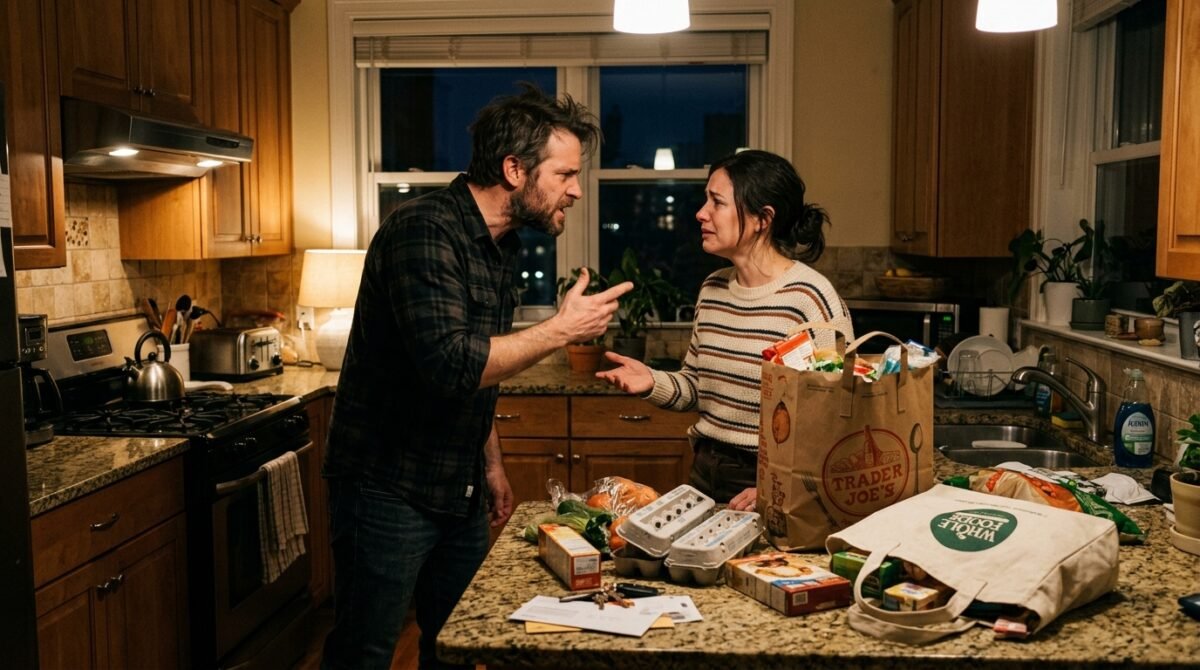
The dinner confrontation was the final act. Mark had gone out and bought groceries—expensive steaks, sides, wine—and had left them on the counter with a note: ‘Dinner needs to be ready by 7:00. I’m going to shower.’ It wasn’t a request. It was an expectation. He had essentially set up a situation where I would either have to cook for him or deal with the fallout of him throwing a tantrum about wasted food.
When he came downstairs at 7:15, expecting a plated meal, he found the kitchen exactly as he had left it. The steaks were still in their packaging. The wine was unopened. I was sitting on the couch, reading a book. He looked at the counter, then at me, his face turning a shade of red I had rarely seen. He didn’t even ask what happened; he just demanded to know why I had ‘sabotaged’ our anniversary dinner.
“I’m not your servant, Mark. I am your wife. If you wanted a chef, you should have hired one. I’m not spending my anniversary standing over a hot stove because you think that’s what I’m here for.”
He started shouting about how much money he spent on the cabin, how he deserved to relax, and how I was being ‘pathologically selfish.’ He used words like ‘abandonment’ and ‘failure.’ He tried to frame my refusal to cook as a refusal to love him. It was a classic manipulation tactic—equating a specific, unreasonable demand with the entirety of my commitment to him.
I stood up, walked into the kitchen, picked up the bag of groceries, and placed it right in front of him. I told him he had an hour to cook his own steak or he could go hungry. Then I walked back to the living room and put on my noise-canceling headphones. The sound of him slamming cabinets and cursing in the kitchen was the soundtrack of our marriage ending.
The Packing of the Suitcase
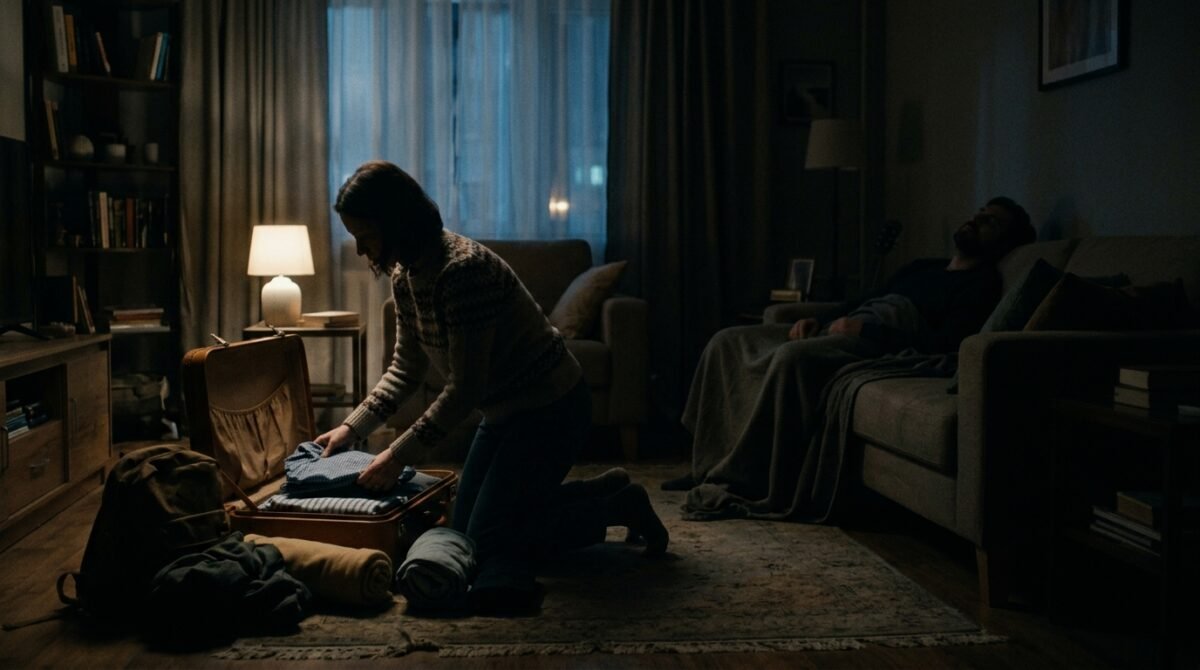
That night, I didn’t sleep. I lay in bed, listening to him pace in the living room, listening to the logs in the fireplace burn down to ash. I realized that I couldn’t stay. Not for the rest of the trip, and perhaps not for the rest of our marriage. The realization wasn’t dramatic or explosive; it was quiet, heavy, and absolute. It was the feeling of a rope finally snapping after being frayed for years.
At 4:00 AM, I started packing. I didn’t pack everything—just the essentials, my documents, and my dignity. Mark was asleep on the couch, the remnants of his solitary, self-made dinner still cluttering the island. I felt a surge of pity for him, but it was quickly replaced by a fierce, protective instinct for myself. I was done being the supporting character in his life.
I left a note on the island. It was short, not because I didn’t have words, but because I had said enough. I told him that I was going to my sister’s house, that I needed space, and that the anniversary trip was over for me. I didn’t apologize for leaving. I didn’t apologize for not cooking. I just stated my actions and left it at that.
Walking out to my car in the pre-dawn silence was the most exhilarating feeling I’ve had in years. The mountain air was crisp, the sky was just starting to turn a pale, bruised purple, and for the first time in a decade, I wasn’t thinking about what anyone else needed from me. I was just thinking about the drive ahead and the life I was going to reclaim.
The Digital Firestorm

The fallout was instantaneous. By the time I arrived at my sister’s place, my phone was blowing up with messages from Mark, his mother, and several of our mutual friends. They had all been fed his version of the story: the ‘ungrateful’ wife who abandoned her husband on their anniversary over ‘something small’ like a dinner request. The narrative was being constructed in real-time, and I was the villain.
I didn’t respond to any of them. I knew that engaging would only give them more material to twist. Instead, I posted a brief, factual account on a throwaway account on Reddit, just to see if I was losing my mind. I needed an objective perspective, even if that perspective came from strangers on the internet. I was tired of the gaslighting within my own social circle.
“My husband demanded I cook every meal on our anniversary trip because he didn’t want to spend money on restaurants. When I refused, he called me selfish and ruined the mood. I packed up and left. AITA? — u/throwaway_anniversary”
The response was overwhelming. Within hours, the post had thousands of upvotes and hundreds of comments. The consensus was clear, and for the first time in years, I felt validated by something other than my own internal monologue. It wasn’t just about the food; it was about the fundamental imbalance in our marriage, and the internet saw it clearly.
I spent the afternoon reading the comments. Some were funny, some were deeply empathetic, and some were brutally honest about the patterns they saw in Mark’s behavior. Seeing my reality reflected back at me by thousands of strangers gave me the strength to turn my phone off and finally get some sleep. I wasn’t alone, and more importantly, I wasn’t crazy.
Reddit Weighs In: The Verdict

The community support was a mix of outrage and shared trauma. People shared their own stories of ‘vacation labor’ and the expectation that women should be the default ‘camp counselors’ for their families. It was cathartic to see how many people recognized the red flags I had been ignoring for so long. The thread became a masterclass in identifying emotional labor imbalances.
“NTA. The fact that he called you ‘selfish’ for not serving him at a luxury cabin is the definition of projection. He wanted a maid, not a wife. You did the right thing by leaving. Do not go back until there is a massive shift in how he views your role.”
— u/RelationshipGuru88 (Top Comment, 32.5k upvotes)
“My ex-husband did this. It starts with ‘let’s save money on dinner’ and ends with him expecting you to do the laundry, cleaning, and emotional labor while he ‘relaxes.’ Run, don’t walk.”
— u/SurvivorOfEntitlement (12.4k upvotes)
There were, of course, a few dissenting voices—the ‘marriage is about compromise’ crowd who argued that I should have just cooked the meal to keep the peace. But they were quickly drowned out by the majority. The discourse shifted from the dinner itself to the deeper, systemic issue of why women are expected to sacrifice their time and autonomy for the ‘comfort’ of their partners.
Reading these comments felt like a dam breaking. I realized that the guilt I had been feeling was a social construct, a byproduct of years of conditioning. I wasn’t failing my marriage; I was failing to be a servant, and that was a distinction I should have made a long time ago. The internet hadn’t just validated my decision; it had given me the vocabulary to articulate why it was necessary.
The Confrontation at Home

When I finally went back home to retrieve my remaining belongings, Mark was there, waiting. He looked haggard, a mix of genuine confusion and performative victimhood. He tried to start the same argument again, talking about how ‘overblown’ the situation was and how he was ‘just joking’ about the cooking. He wanted me to return to the status quo, to forget the last three days and return to our routine.
I didn’t give him the satisfaction of a debate. I moved through the house with purpose, packing my things while he followed me from room to room, pleading and then eventually accusing me of ‘destroying’ our decade of marriage over a ‘couple of meals.’ He couldn’t grasp that it wasn’t the meals; it was the total disregard for my personhood.
“It’s not about the steaks, Mark. It’s about the fact that you think my time has no value unless it’s spent serving you. I’m done with that. I’m done with all of it.”
He stopped, looking at me as if he were seeing me for the first time. For a moment, the silence was deafening. He didn’t have a rebuttal because he didn’t actually listen to what I was saying. He was only listening for the cue to start arguing again. It was a pathetic display of emotional immaturity that only confirmed I was making the right decision.
I left with the last of my boxes, and as I drove away, I didn’t look back. I wasn’t just leaving a house; I was leaving behind the version of myself that had allowed this to happen for ten years. The road ahead was uncertain, but for the first time, it was entirely my own.
The Legal Reality Check

Once the initial shock wore off, the reality of the separation began to set in. We had joint assets, a mortgage, and a decade of shared life to untangle. I consulted with a lawyer, primarily to understand my rights and to ensure that I wasn’t being manipulated into a position of weakness. The financial aspect was, unsurprisingly, another battleground.
Mark had tried to freeze our joint account, claiming that I had ‘abandoned’ our marital home. My lawyer laughed, explaining that move was largely performative and easily contested. It was just another attempt by Mark to assert control when he realized he no longer had access to my labor. He was trying to use money as a weapon, the same way he had used the ‘vacation’ to force me into a role I never signed up for.
| Asset | Mark’s Claim | Legal Reality |
|---|---|---|
| Joint Savings | ‘I earned it, it’s mine’ | Marital property, 50/50 split |
| Rental Cabin Fee | ‘She ruined the trip’ | Irrelevant to asset division |
| House Equity | ‘I put down the deposit’ | Jointly owned, equal division |
The process of separation was grueling. It involved hours of documentation, financial disclosures, and the inevitable emotional toll of dividing a life. But throughout it all, I felt a strange sense of peace. Every form I filled out, every conversation with my lawyer, was a step toward a life where my autonomy was no longer up for negotiation. I was no longer an accessory to Mark’s life; I was the architect of my own.
The financial stress was real, but it was nothing compared to the stress of being in a marriage where I was constantly being diminished. I learned that my value wasn’t tied to what I provided for someone else. I learned that walking away from a toxic situation is the most powerful thing you can do for your future self.
Finding the New Normal

Six months later, life looks completely different. I have my own apartment—small, quiet, and exactly as clean or messy as I want it to be. There is no one demanding breakfast at 6:00 AM. There is no one leaving notes about what I should be doing with my day. I have reconnected with friends I hadn’t seen in years, and I’ve picked up hobbies I had long abandoned.
I look back on that anniversary trip not with regret, but with gratitude. It was the catalyst I needed to wake up. Without that cabin, without that ridiculous demand for a four-course dinner, I might still be there, slowly disappearing into the background of Mark’s life. It was the straw that broke the camel’s back, and I will always be thankful for that break.
I still get messages from Mark, occasionally. They range from angry accusations to pathetic attempts at reconciliation, usually involving him telling me how ‘hard’ his life is without me. I don’t respond. I’ve blocked his number and his social media. I have nothing left to say to him, and he has nothing to offer me that I want.
The journey has been long and often painful, but I am stronger for it. I am no longer defined by someone else’s expectations. I am defined by my own choices, my own boundaries, and my own sense of self-worth. And that is a price I would pay a thousand times over.
Conclusion
Walking out on my anniversary wasn’t a snap decision; it was the final, inevitable outcome of a decade of being treated as an secondary character in my own marriage. The mountain cabin wasn’t the cause of my unhappiness—it was the mirror that finally forced me to look at it. We often talk about ‘marriage as a partnership,’ but in reality, many of us are living in structures of convenience, where one partner’s comfort is prioritized at the expense of the other’s humanity.
The lessons from this experience are clear: your time, your labor, and your autonomy have intrinsic value. You do not exist to serve your partner, and your partner does not ‘buy’ your service through financial contribution. A partnership is only as strong as the respect shared between both individuals. If you find yourself in a position where your role is defined by utility rather than love, it is time to have a hard conversation, or perhaps, a hard exit.
I am curious to hear from you. Have you ever reached a point where a ‘small’ demand felt like the breaking point for a much larger, systemic issue in your relationship? When was the moment you realized that your boundaries were no longer optional, but essential for your survival? Share your thoughts below; I am reading every single one.
What's your verdict on this dilemma?
Vote below to contribute to the official community consensus.

Have a Dilemma Keeping You Up at Night?
Share your real-life feud, wedding chaos, or relationship crossroads anonymously with our editorial team.
What do you think ?
0 Comments🛡️ Comments are moderated to protect community integrity. Your comment will appear once approved by the editorial team.