
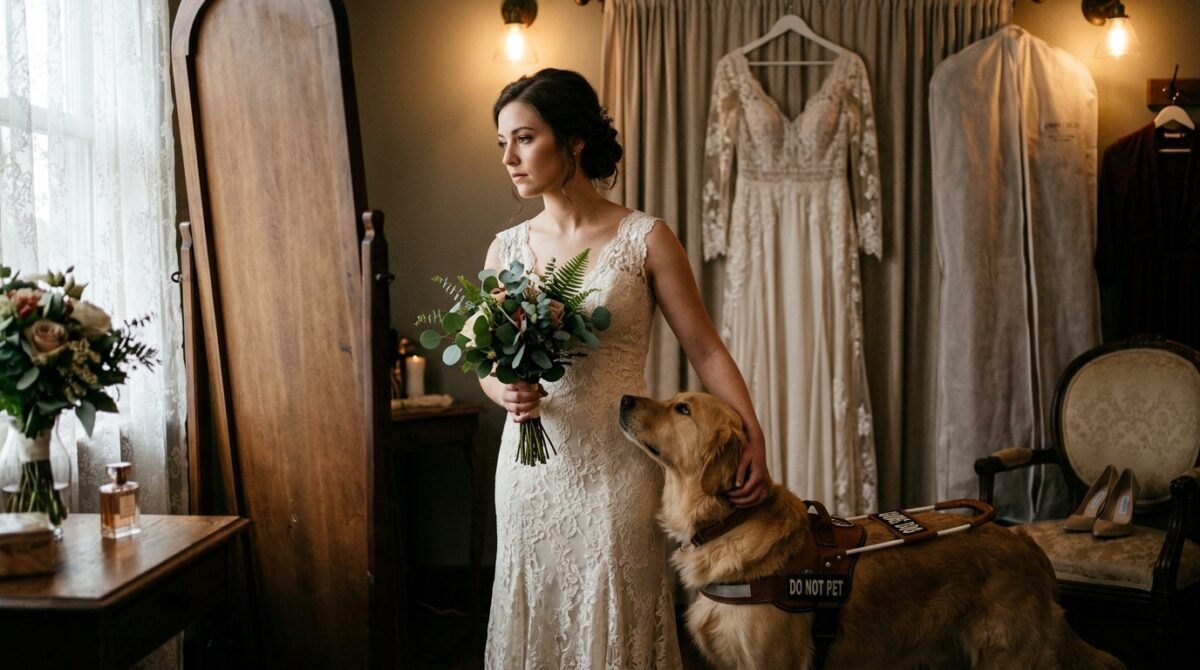
I have lived with Stargazer, my Golden Retriever guide dog, for six years. He isn’t just a pet; he is my eyes, my mobility, and my lifeline. When I met Mark, he seemed to understand this perfectly. He was charming, attentive, and even helped me train Stargazer to better navigate the local transit system. We built a life together, or so I thought, based on mutual respect and an understanding of my needs.
However, the mask began to slip six months before our wedding. It started with small comments—remarks about how ‘hairy’ the house was, or how Stargazer’s presence made dinner parties feel ‘less professional.’ I dismissed them as stress, foolishly believing that marriage would cement our partnership. I was dead wrong. The real nightmare began when we finalized the wedding venue, a posh, high-end hotel that Mark had hand-picked for its aesthetic perfection.
The moral dilemma hit me like a physical blow when Mark pulled me into our kitchen, his face cold and unreadable. He told me that the wedding photos needed to be ‘perfect’ and ‘uncluttered.’ He informed me that he had already booked a luxury kennel service near the venue to ‘look after’ Stargazer during the ceremony and reception. He didn’t ask; he dictated. He expected me to navigate a labyrinthine hotel ballroom while blind, alone, and surrounded by hundreds of people, all for the sake of his vision of aesthetic harmony.
This isn’t just a story about a wedding. It is a story about the true meaning of ‘in sickness and in health.’ It is a story about the invisible lines people cross when they decide that their vanity is more important than their partner’s basic autonomy. As I sat there in the silence of my home, staring at the man I was supposed to marry, I realized that the man I loved had never actually existed. The person in front of me was a stranger, and my dog was the only one who truly had my back.
The 6:00 AM Ultimatum in the Kitchen
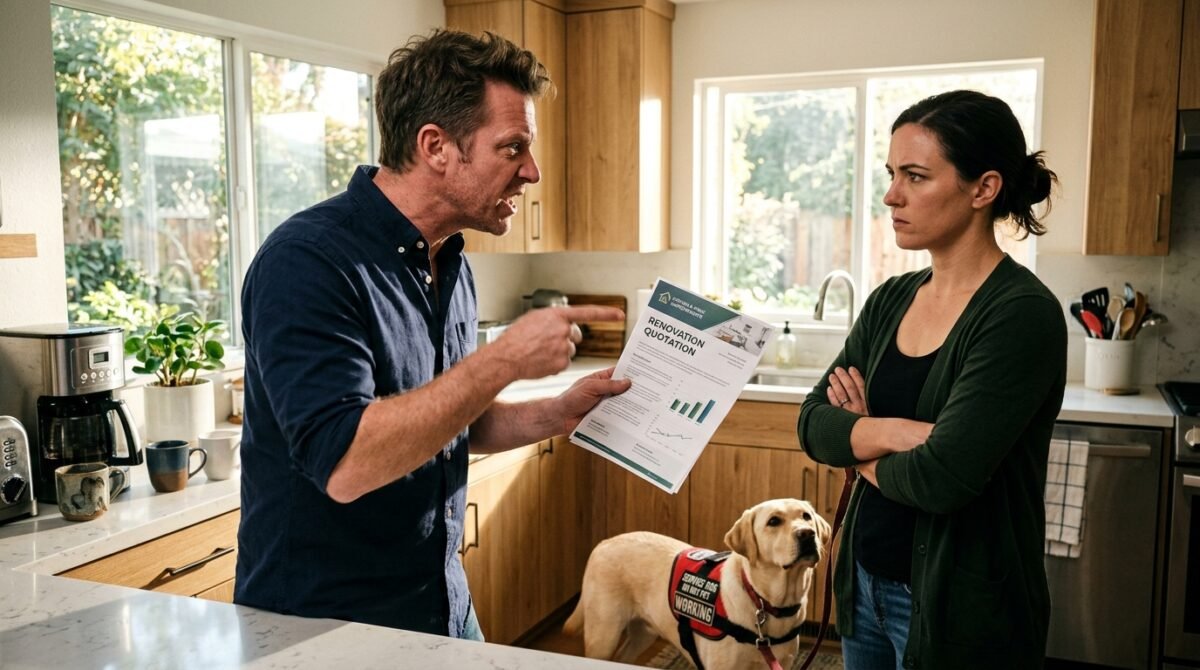
The morning light hadn’t yet hit the kitchen floor when the conversation that changed everything began. I was making coffee, my hand resting gently on Stargazer’s flank, as I did every morning to center myself. Mark walked in, not with a kiss or a ‘good morning,’ but with a printed itinerary that he slammed onto the granite countertop. His eyes were hard, lacking the warmth I had grown accustomed to.
He started by talking about the logistics of the hotel. He mentioned the photographer, the lighting, and the flow of the ceremony. Then, he pivoted. He spoke about ‘distractions’ and ‘visual clutter.’ It felt like a corporate briefing on a failing project, not a discussion about our union. He reached out to show me a brochure for a nearby kennel, a place that promised ‘top-tier comfort for your furry companions’ while you enjoy your big day.
“I’ve booked it for the entire weekend, Sarah. Stargazer needs a break, and quite frankly, our guests need to focus on us, not on a service animal panting in the front row. It’s a formal event. It needs to be polished.”
— Mark, during the ultimatum
I stood there, feeling the blood drain from my face. My breath caught in my throat. I tried to explain that Stargazer wasn’t a ‘furry companion’—he was a vital medical necessity. I told him I couldn’t navigate a new, crowded environment without him. He waved my concerns away with a dismissive gesture, as if my disability were merely a bad habit I could break for a few hours.
The audacity of his demand was staggering. He had spent months telling me how much he loved the ‘whole package,’ yet now he was treating my guide dog like an ugly accessory to be tucked away in a closet. I felt small, vulnerable, and deeply betrayed. The kitchen, once a place of morning warmth, felt like an interrogation room where my independence was the thing being put on trial.
I looked at Stargazer, who sat calmly by my side, his tail thumping once against the floor. He knew I was distressed, sensing the spike in my adrenaline. Mark didn’t see a partner in need; he saw an obstacle to his perfect photos. I realized then that the ‘perfect wedding’ was actually a cage he was building around me, one where my needs would be systematically silenced for his convenience.
The Secret Group Chat Revelations
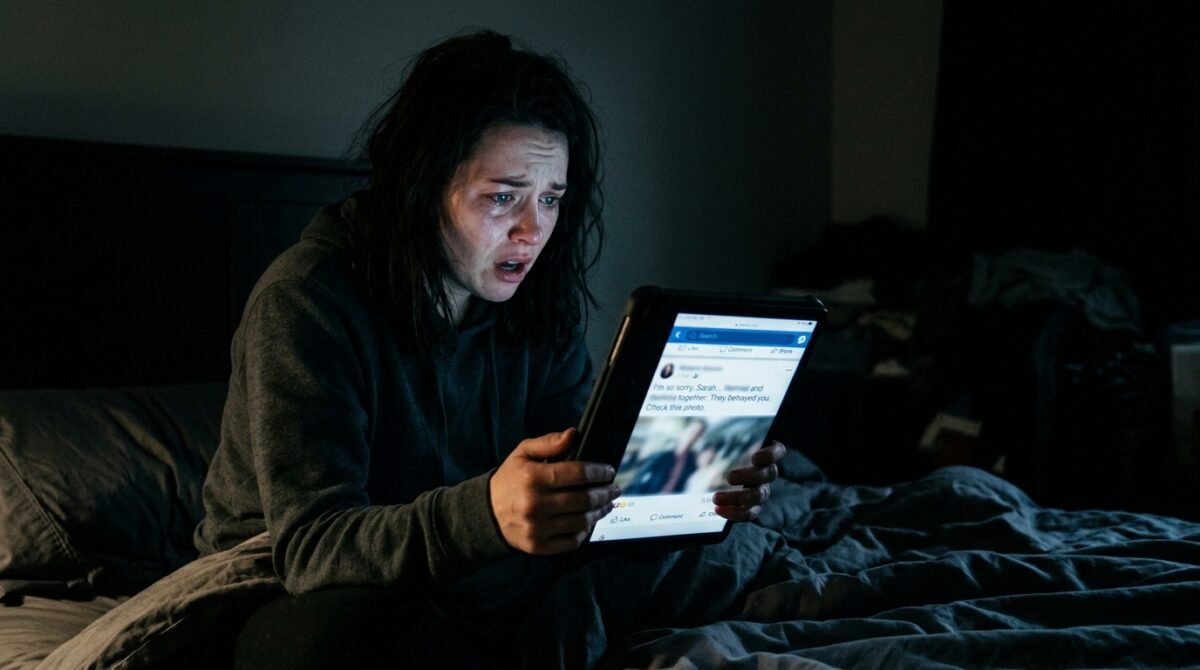
I didn’t want to believe that Mark was truly this shallow, so I did something I had never done before: I checked his iPad, which he had left unlocked on the coffee table. I wasn’t looking for cheating, but I found something equally devastating. There was a message thread titled ‘Wedding Vision’ involving his groomsmen and his sister, who had been orchestrating much of the planning.
The thread was filled with discussions about how to ‘manage’ my disability. They treated me like a logistical burden that needed to be mitigated. They discussed how to ensure I wouldn’t ‘bump into things’ while being led by a bridesmaid, rather than simply letting me keep my dog. The language they used was chilling—cold, clinical, and utterly devoid of empathy.
“We need to make sure the bridesmaids are ready to guide her the moment she walks through the lobby. We can’t have the dog in the photos. It ruins the aesthetic. Mark is paying a fortune for this. Sarah needs to understand that her ‘special need’ ends at the altar.”
— Mark’s sister, in the group chat
Reading those words felt like reading an obituary for our relationship. I felt physically ill. They were planning my wedding experience as if I were a toddler or a piece of furniture that needed to be positioned correctly. The dehumanization was absolute. They had spoken to me about ‘inclusivity’ and ‘accessibility’ during the planning stages, but it was all a ruse to make sure I was compliant.
I sat on the sofa for hours, the iPad screen glowing in the darkened room. My heart was pounding, a rhythmic thudding that echoed the internal breakdown I was experiencing. I realized that Mark hadn’t just made a mistake in judgment; he had been actively conspiring to strip me of my agency and my safety under the guise of ‘polishing’ our wedding day.
The betrayal was multi-layered. It wasn’t just Mark; it was the entire support system he had surrounded himself with. They were all in on the plan to treat my guide dog as an annoyance. I felt a surge of cold, hard clarity wash over me. I realized that I couldn’t marry into a family that viewed my existence as a defect to be hidden for the sake of a magazine-worthy snapshot.
The Confrontation in the Living Room
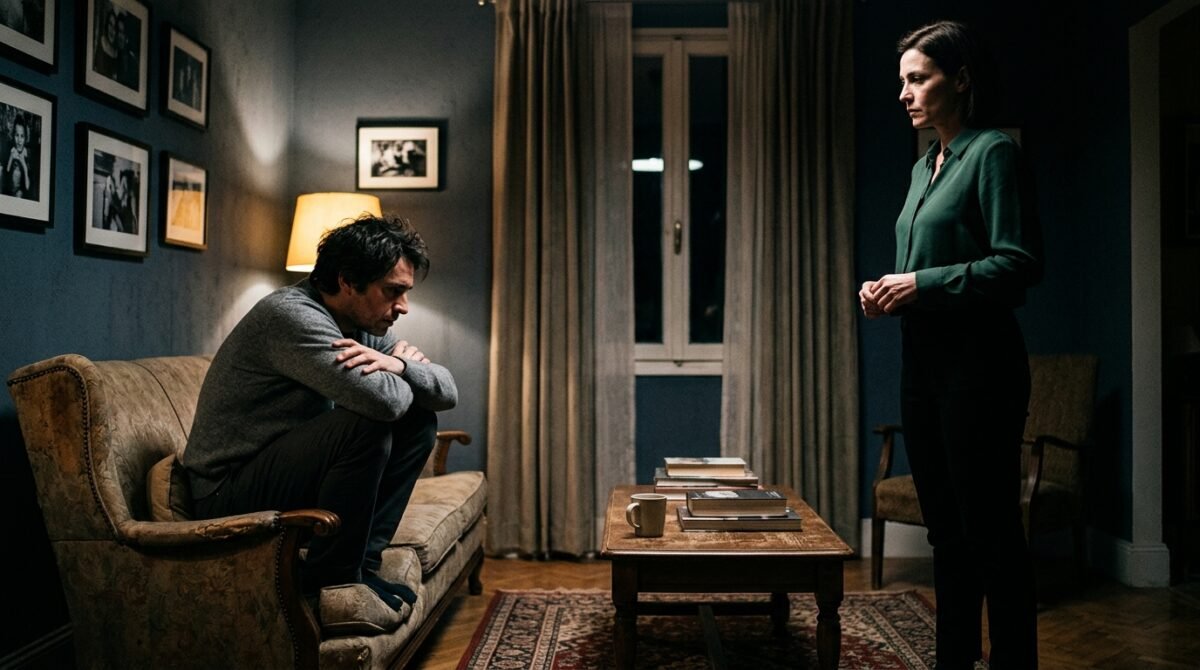
When Mark returned home from work that evening, he was whistling, likely thinking about the ‘logistical hurdles’ he had cleared. He walked into the living room, ready to resume his campaign to convince me that the kennel was a generous gift. I didn’t wait for him to start. I had the iPad open, the group chat visible on the screen, sitting right on the table.
I didn’t scream. I didn’t cry. I spoke with a quiet, icy resolve that I didn’t know I possessed. I asked him how he could possibly reconcile the vows he was going to take with the way he and his family were discussing my life. He looked at the iPad, his face turning from smug to pale in a matter of seconds. He didn’t even try to deny it; he pivoted immediately to defense.
“You weren’t supposed to see that! It was just a discussion about how to make sure the day goes off without a hitch. You are overreacting, Sarah. I’m just trying to make sure our wedding is everything we dreamed of. Don’t you want that?”
— Mark, trying to gaslight me during our confrontation
I looked at him, truly looked at him, and saw the selfishness that had been hidden under layers of charm. I told him that my dream was to be safe and respected, not to be a prop in his vanity project. He tried to touch my shoulder, to soothe me, but I stepped back, Stargazer stepping with me in perfect sync. The physical distance between us was a chasm that could no longer be crossed.
He insisted that ‘everyone’ would agree with him—that a service dog in a tuxedo-and-gown formal setting was simply ‘not done.’ He argued that my medical needs were a private matter and that exposing them to the guests was unfair to the grandeur of the event. He kept doubling down on the idea that I was the one being unreasonable for not wanting to conform to his arbitrary standards of normalcy.
The conversation lasted for hours, spiraling into a toxic whirlpool of blame-shifting and manipulation. He brought up every time he had ‘helped’ me in the past, weaponizing his support as if it were a debt I owed him. I stood my ground, my voice steady, realizing that every minute I spent arguing was a minute I was reclaiming from his control. By the end of the night, I had my answer. He wasn’t a partner; he was a gatekeeper.
The Impact on My Independence
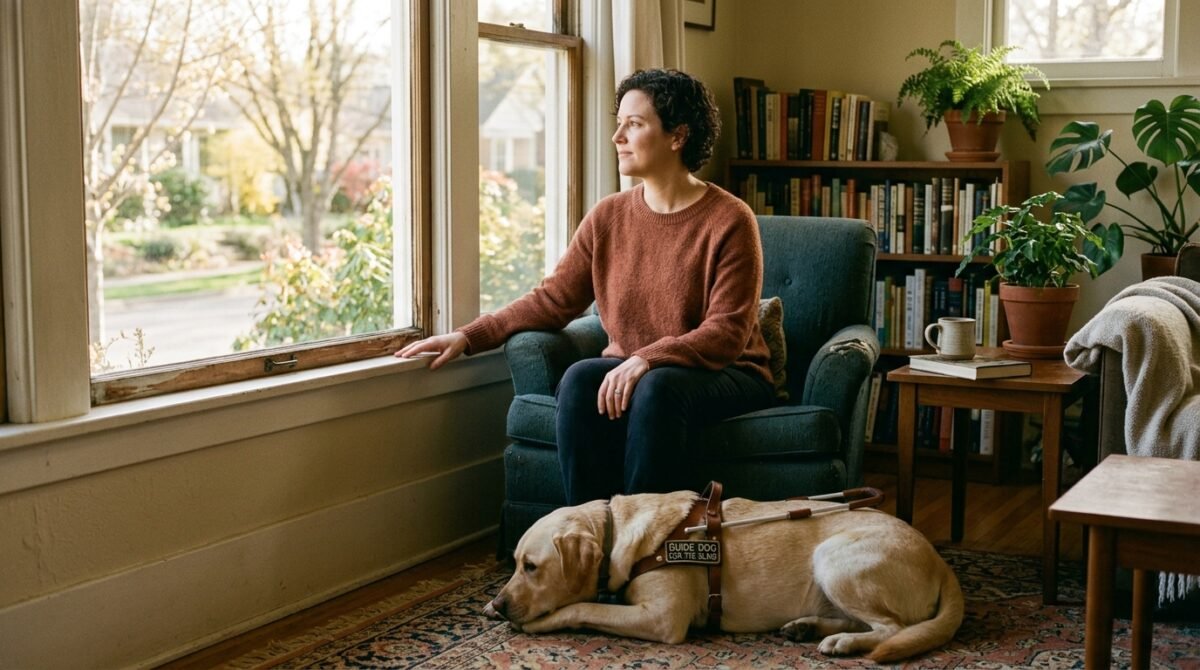
Following the confrontation, I spent the next few days in a fog of introspection. I thought about the many times I had compromised for Mark—taking the longer, ‘easier’ route to avoid stairs that he found annoying, or staying home from events where he felt Stargazer ‘drew too much attention.’ I realized that my life had been slowly shrinking to fit the dimensions of his comfort zone.
The psychological toll of his demand was profound. It wasn’t just about the dog; it was about the implication that my disability was a shame to be hidden. If he couldn’t handle a service dog at our wedding, how would he handle the realities of aging, of chronic illness, or the unpredictable nature of my condition? He had effectively told me that his love was conditional upon my ability to pass as ‘normal.’
I reached out to my mentor, a woman who had been blind since birth and had faced these types of ‘polite’ discrimination for decades. She didn’t offer pity; she offered perspective. She reminded me that my value wasn’t tied to his aesthetic, nor was it tied to his ability to understand my needs. She told me that the fact that I was even considering his demand was a sign of how deeply I had internalized his gaslighting.
Stargazer remained the constant in my world. He didn’t care about the wedding plans or the hotel or the guests. He cared about my safety, my hydration, and my well-being. Looking into his eyes, I felt a sense of grounding that Mark had never been able to provide. The dog was more loyal and more honorable than the man I had planned to spend the rest of my life with.
I started to realize that the wedding was never really about us. It was about Mark’s need to project an image of perfection to his peers. He wanted a trophy, not a partner. The revelation was painful, but it was also liberating. I no longer felt the pressure to be the ‘perfect bride’ for someone who didn’t even see the person behind the veil.
The Internet Weighs In: The Reddit Explosion

I finally posted my dilemma on a popular subreddit, needing an outside perspective to confirm that I hadn’t lost my mind. I wrote the post without using names, detailing the ultimatum and the group chat. Within an hour, the notifications were non-stop. The community support was overwhelming and, at times, brutal toward Mark.
“OP, run. Seriously, pack your bags and get out. This man doesn’t just want to ‘hide’ your dog; he wants to hide your disability. He is showing you exactly who he is before you sign a legal contract. Believe him. This isn’t about the wedding—it’s about his total lack of respect for your bodily autonomy and safety.”
— u/SupportiveStranger (Top Comment, 32k upvotes)
The comments sections were a mix of outrage, disbelief, and personal anecdotes from others who had faced similar situations with partners who couldn’t handle the reality of disability. People shared stories of ‘groomzilla’ behavior, but the consensus on my post was that this went far deeper than a wedding planning disagreement. It was a massive red flag for a future of coercive control.
There were those, a small minority, who argued that perhaps I could have compromised by having a ‘handler’ for the dog, but they were quickly drowned out by the majority who pointed out that a guide dog is a medical device, not a pet. The logic was clear: you don’t ask someone to leave their insulin in a hotel room during a wedding; you don’t ask someone to ditch their wheelchair. A guide dog is no different.
Reading the comments felt like having thousands of people hold up a mirror to my life. They saw the manipulation that I had been trying to minimize for months. They identified the patterns of entitlement and the subtle degradation of my needs. It was the wake-up call I needed to stop negotiating and start planning my exit.
I saw comments from other disabled women who had left partners for exactly this reason. Their stories were filled with relief and the eventual discovery of partners who truly cared for them. It gave me the courage to stop seeing myself as a ‘problem’ that needed to be managed and start seeing myself as someone who deserved genuine, uncompromised love.
The Final Meeting with the Wedding Planner

I decided to attend one last meeting with the wedding planner, just to see how deep the rabbit hole went. Mark was there, looking confident, clearly expecting me to have ‘cooled off’ and accepted his terms. The planner, a woman named Elena, was polite but clearly uncomfortable, likely sensing the tension that was radiating off me.
Mark immediately started talking about the ‘dog-free’ policy we had supposedly ‘agreed upon.’ He looked at me with a smirk, waiting for my confirmation. I looked at Elena and told her that there had been a misunderstanding. I informed her that Stargazer would be at my side for every moment of the wedding, or there would be no wedding. The silence that followed was deafening.
“Mark, you seem to be under the impression that you have the authority to decide my medical needs. You don’t. And Elena, if you cannot accommodate a legally registered service animal, then you are breaking the law. I suggest you consult your contracts.”
— Me, standing my ground in the planner’s office
Mark turned bright red, his composure shattering. He tried to interrupt, but I didn’t let him. I stood up, my hand on Stargazer’s harness, and told them both that my life was not a negotiation. I walked out of the office, leaving them in the middle of a very awkward, very uncomfortable silence. I didn’t look back.
The walk to the car was the most liberating experience of my life. I felt the weight of expectation falling away, replaced by the crisp, cool air of reality. I wasn’t just walking out of an office; I was walking out of a relationship that was built on the foundation of my own erasure. I was reclaiming my life, one step at a time, with my best friend by my side.
Mark tried to call me a dozen times on the ride home. I didn’t answer. I didn’t feel the need to explain myself further. The conversation was over. I had spent enough time trying to convince him that I was worth more than his wedding photos. I was finally done with the performative nature of our engagement.
The Unraveling of the Engagement
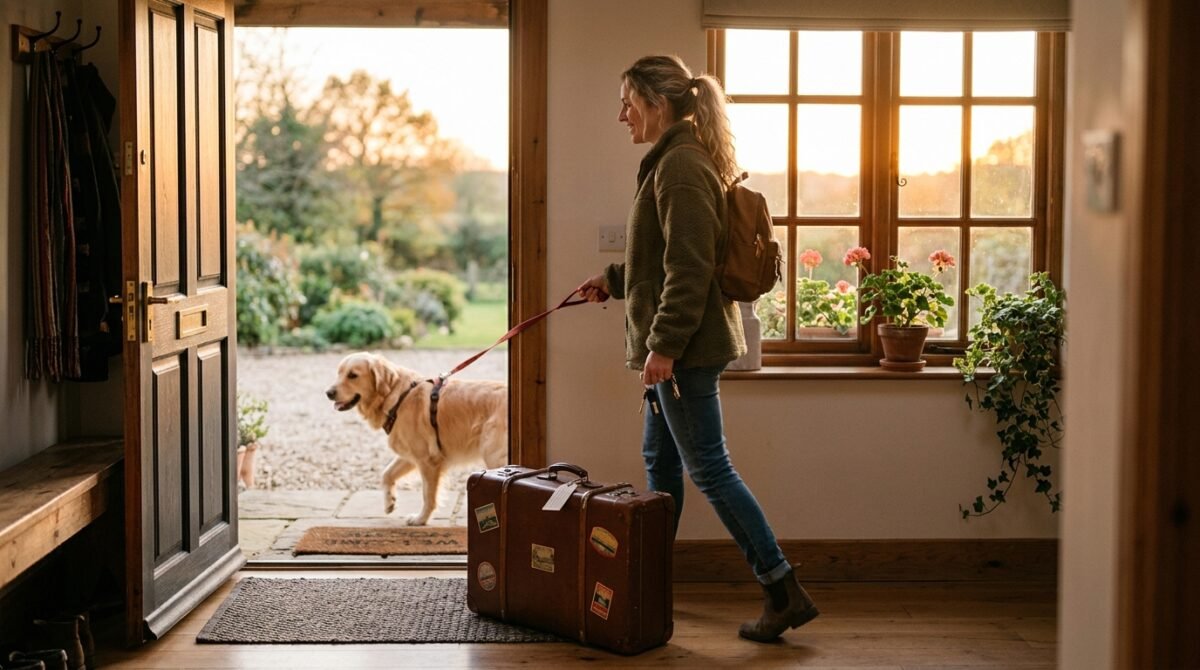
When I got home, I didn’t pack everything at once. I took my time, gathering my most important belongings and my dog’s gear. Mark came home an hour later, his face twisted in a mixture of anger and confusion. He still believed that this was all a tantrum, something that could be smoothed over with the right words and a bit of ‘reasoning.’
He didn’t yell; he pleaded. He talked about the money already spent, the guests who had already booked flights, and the ‘shame’ of calling it off so close to the date. He appealed to my sense of duty, trying to frame the wedding as a commitment to the ‘future we built’ rather than the reality of our present.
“Do you have any idea how crazy you look? Calling off a wedding over a dog? People will think you’re insane. We have deposits down! You’re throwing away a perfect life because you’re being stubborn about a rule that can be bent for one day.”
— Mark, during the final argument
I told him that the only thing ‘crazy’ was the expectation that I would discard my medical support for a photo op. I told him that if the wedding was so fragile that a service dog could break it, then it was never a solid foundation to begin with. He looked at me with a mix of pity and frustration, still fundamentally incapable of seeing the world through my eyes.
I left that night. I didn’t have a plan, just a suitcase and my dog. I stayed with a friend, a woman who had seen the red flags long before I did. We sat up late, drinking tea and talking about the future. For the first time in years, I didn’t feel the need to be anything other than who I was. I felt a profound sense of peace.
The next few days were a whirlwind of logistics—canceling vendors, notifying the few family members who needed to know, and the painful process of closing the bank accounts we shared. It was a messy, exhausting, and emotional time, but it was also the most honest I had been with myself in a long time. I was finally free from the role of the ‘accommodating partner.’
The Fallout: Dealing with the Family
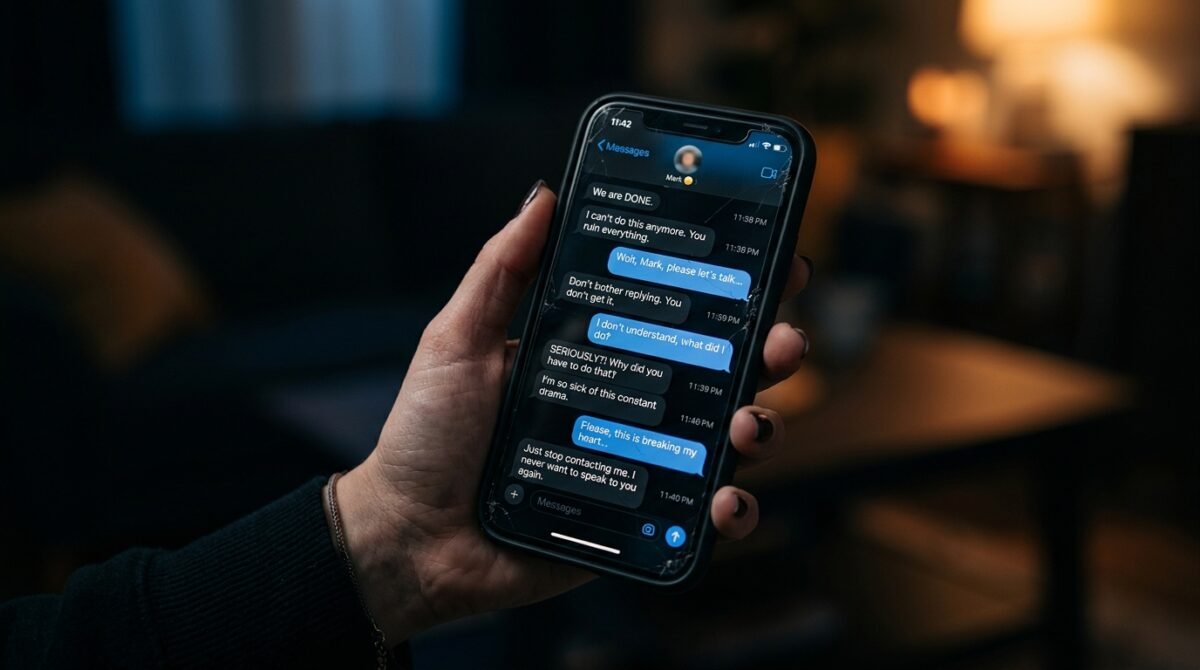
The blowback from his family was immediate. My phone was flooded with messages from his mother and sister, calling me ‘selfish’ and ‘unstable.’ They accused me of ruining a beautiful day and being ‘inconsiderate’ of their effort. They didn’t care about the reason; they only cared about the event they were losing.
I didn’t engage. I blocked them, one by one. I realized that they had been enabled by Mark to view me as a project, and I had no obligation to educate them on the realities of my life. The vitriol they spewed only confirmed that I had made the right choice. They were a microcosm of the environment Mark had created—one that was hostile to anything that didn’t fit their narrow, shallow definition of ‘normal.’
“You are being incredibly selfish. Mark has done so much for you. You’re throwing it all away over a dog? You’ll never find someone who puts up with your ‘condition’ like he did. You’re going to regret this.”
— A text from Mark’s sister after the breakup
Reading that text hurt, but it also made me laugh. The idea that I was lucky to have Mark ‘put up’ with me was the ultimate insult. I realized that my own self-worth had been eroded to the point where I actually believed that for a while. I was grateful for the distance now, for the ability to see his family for exactly who they were: people who prioritized appearance over substance.
The support I received from my own family was a stark contrast. My parents, who had seen me struggle with the loss of my vision, were relieved. They had never really liked the way Mark looked at me—the way he often spoke for me or steered me away from things he thought were ‘too much.’ They were proud of me for setting a boundary, even if it cost me the wedding.
I started to realize that the ‘shame’ Mark’s family kept mentioning wasn’t mine—it was theirs. They were ashamed of the reality of my life, not because there was anything wrong with it, but because it didn’t align with their carefully curated image of perfection. By walking away, I had stripped them of their ability to control the narrative, and that was the ultimate victory.
Reclaiming My Narrative
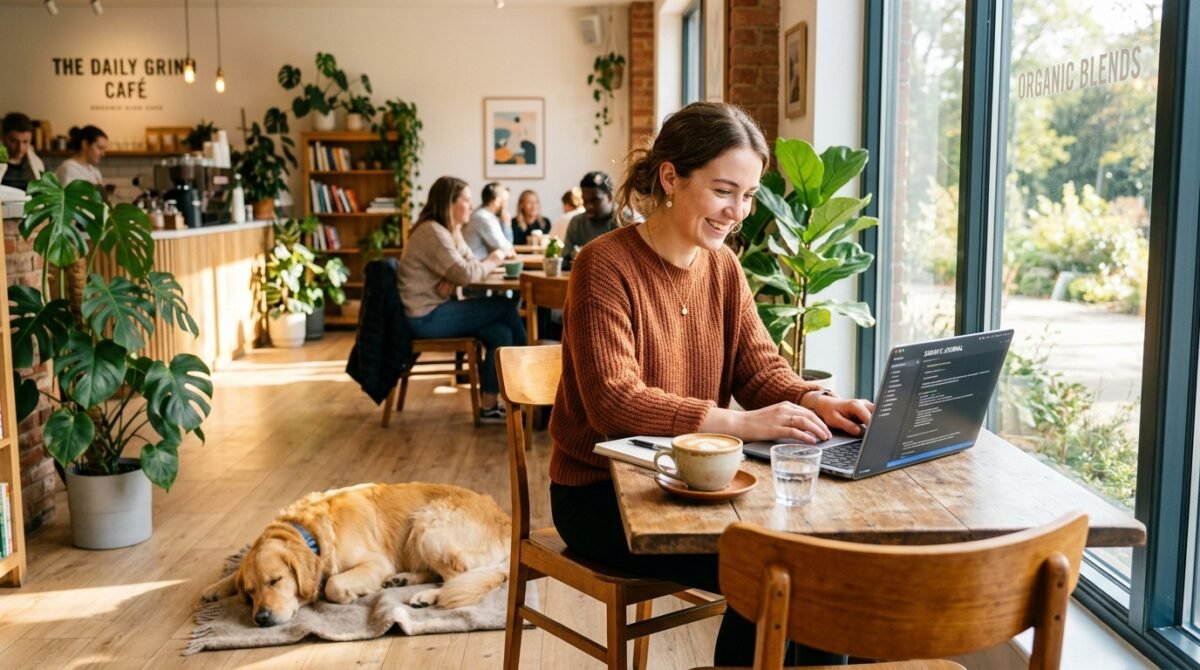
In the weeks following the breakup, I started to rebuild my life from the ground up. I focused on my health, my work, and my relationship with Stargazer. I took up new hobbies, spent more time with friends who truly valued me, and started seeing a therapist to help untangle the effects of the gaslighting. It wasn’t easy, but it was authentic.
I realized that for years, I had been living in a world that was constantly asking me to apologize for existing. Whether it was the way I walked, the way I ate, or the way I navigated public spaces, I was always trying to minimize my presence. With Mark, that pressure was magnified, and I had foolishly thought that marriage would be the end of it, rather than the beginning of a lifetime of subservience.
I started sharing my story in more detail, not just on Reddit, but in small blog posts and community forums for disabled advocacy. I wanted others to know that they didn’t have to choose between their dignity and their relationships. I wanted them to know that their medical needs were not negotiable points in a marriage contract.
The feedback was humbling. I received messages from dozens of people thanking me for speaking out. They shared their own stories of being forced to hide their disabilities, of being told to be ‘less,’ and of the relief they felt when they finally walked away. I wasn’t just healing myself; I was part of a larger conversation about equality and respect.
I learned that boundaries aren’t just for ‘difficult’ people; they are the bedrock of healthy relationships. If someone cannot respect the fundamental requirements of your life, they don’t deserve a place in it. I am no longer looking for someone to ‘put up’ with my ‘condition.’ I am looking for someone who sees me—all of me—and loves the life I lead, exactly as it is.
Reflecting on the ‘Perfect’ Wedding

Looking back, the entire wedding planning process feels like a fever dream. The obsession with the aesthetic, the endless list of ‘dos and don’ts,’ and the pressure to perform a version of myself that was palatable to others—it all seems so trivial now. The wedding was a performance, and I was the reluctant lead, cast in a role that didn’t fit.
I often wonder what would have happened if I had just given in. If I had locked Stargazer in that kennel, if I had struggled through the wedding, if I had spent the rest of my life trying to live up to Mark’s impossible standards of perfection. I know the answer: I would have disappeared. I would have become a shadow of myself, hidden behind the mask of a ‘perfect’ marriage.
“The most important thing I learned is that when someone shows you they don’t value your autonomy, you don’t argue with them. You leave. You don’t owe anyone a performance, especially at the cost of your own safety and sanity.”
— My concluding thought on the experience
The money spent, the guests disappointed, the ‘shame’—none of it matters. What matters is the fact that I woke up this morning, took a walk with my dog, and didn’t have to apologize for a single thing. I am free. And that freedom is worth more than any wedding ceremony, no matter how ‘perfect’ the photos might have been.
I’ve also realized that the people who were truly ‘disappointed’ by the cancellation were the ones who were most invested in the image of the wedding, not in me or my future. It was a litmus test, and it was one that I’m grateful I didn’t have to pass through a marriage to see the results. I have a much clearer idea now of who my true friends are.
I am moving forward with a sense of purpose. I am no longer waiting for permission to be myself. I am building a life that is truly mine, and I have the most loyal companion in the world to help me navigate it. The wedding may be gone, but I am still here, and for the first time in a long time, I am whole.
Conclusion
This experience has been a stark, painful, but ultimately necessary lesson in the power of boundaries. My journey from a ‘perfect’ engagement to a liberating breakup was not easy, but it taught me that my value is not something to be negotiated. No one has the right to demand that I diminish my existence for the sake of their comfort, their photography, or their social standing.
I have learned that the people who truly care about you will celebrate your needs, not try to hide them. If you find yourself in a situation where your partner or your community is asking you to compromise on your basic rights or your safety, take a step back. Listen to your gut. You are not a ‘burden’ or a ‘distraction.’ You are a person who deserves to be seen, fully and completely, in all your reality.
I am curious, dear readers: have you ever had to walk away from a situation—wedding or otherwise—because your boundaries were being systematically ignored? What was the moment you realized you had to prioritize yourself over the expectations of others? Share your thoughts below, let’s keep this conversation open and supportive.
What's your verdict on this dilemma?
Vote below to contribute to the official community consensus.

Have a Dilemma Keeping You Up at Night?
Share your real-life feud, wedding chaos, or relationship crossroads anonymously with our editorial team.
What do you think ?
0 Comments🛡️ Comments are moderated to protect community integrity. Your comment will appear once approved by the editorial team.