

When you marry someone, you enter into a silent pact that your future, your children’s future, and your shared dreams are protected by mutual stewardship. For ten years, Mark and I worked in lockstep, meticulously saving every spare cent into the ‘Evergreen Education Fund.’ It was a dedicated account, established the day our son, Leo, was born, specifically designed to bridge the gap between public education and the specialized private school environment he needed. It was never just ‘money’; it was his future.
Mark had always been a tinkerer. His garage, which he affectionately dubbed ‘The Arcade Sanctuary,’ was a place where he spent his weekends restoring broken electronics. I encouraged it. I saw it as a healthy outlet for his stress, a way for him to disconnect from the pressures of his corporate job. I never imagined that his love for glowing CRT monitors and joystick controls would eventually eclipse his responsibility as a father.
The realization didn’t come with a bang, but with a piece of mail. A simple, innocuous envelope from the bank stating that our account had reached a balance of zero due to ‘authorized liquidation.’ My heart stopped. I stood in the kitchen, the cold linoleum biting into my feet, staring at the paper as the world tilted on its axis. I knew he was in the garage. I could hear the rhythmic clacking of buttons—a sound that used to bring me peace, now sounding like the ticking of a bomb.
This wasn’t just a financial discrepancy; it was a betrayal of the highest order. He had taken everything—the tuition for the next six years—and converted it into physical inventory. As I walked toward the garage, I wasn’t just walking toward a confrontation; I was walking toward the end of the version of my marriage that I had foolishly assumed was unshakable.
The Glow of the Neon Betrayal
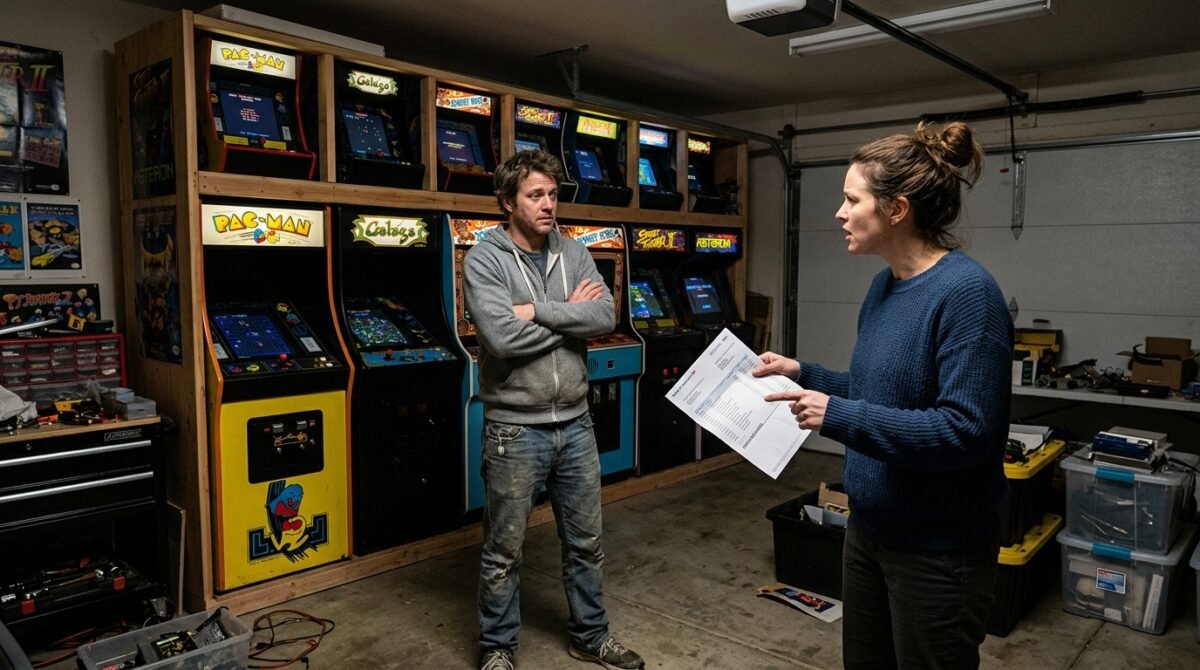
I opened the door to the garage and was immediately hit with the smell of ozone and old dust. The room was transformed. Where there had once been a single modest ‘Pac-Man’ cabinet, there was now a wall of glowing, flickering screens. ‘Galaga,’ ‘Street Fighter II,’ ‘Donkey Kong’—it looked like an 80s time capsule, lit in hues of neon pink and electric blue. Mark was hunched over a ‘Teenage Mutant Ninja Turtles’ machine, his face illuminated by the harsh glow of the monitor.
He didn’t hear me enter. He was humming, focused on soldering a wire deep within the bowels of the machine. I stood there for a long moment, the bank statement trembling in my hand. The contrast was sickening; here was my husband, obsessively tending to a piece of furniture while our son’s future lay in ashes on his bank account dashboard.
“Mark, look at me. Tell me why our tuition fund is empty. Tell me how you justified taking every single cent we saved for Leo’s education for… this?”
He jumped, the soldering iron slipping slightly before he set it down. He turned, his expression shifting from focused concentration to a flicker of guilt, followed immediately by defensive irritation. He didn’t look horrified. He looked annoyed that his work had been interrupted. He stood up, wiping his hands on a rag, and sighed as if I were asking him to take out the trash.
“It was an investment, Sarah. You don’t understand the market for these things. That TMNT cabinet? It’s one of three left in the state. I didn’t just spend the money; I moved it into a different kind of asset. These cabinets are skyrocketing in value. In five years, they’ll be worth double what I paid.”
I felt a scream building in my throat, a primal sound of rage that I had to physically suppress. He truly believed that a collection of plastic and wiring was a suitable substitute for a child’s schooling. He wasn’t apologetic. He was justifying his addiction as a financial maneuver, completely ignoring the reality that you can’t pay for private tuition with a vintage joystick.
The Math of a Lost Future

I pulled out my phone and pulled up the bank app, scrolling through the transactions that I hadn’t been privy to because he had changed the notification settings on our joint account. The list was a slaughterhouse of fiscal recklessness: eight transfers of four thousand dollars each, all made in the dead of night over the last three weeks. He had drained the account in a systematic, calculated manner.
“You didn’t ‘invest,’ Mark. You liquidated our son’s future so you could play games in a shed. Do you have any idea what this money was for? Do you even remember the meetings we had with the school counselor? We are three weeks away from the enrollment deadline for the upcoming academic year. How do you propose we explain this to Leo?”
He paced the small space between the cabinets, his face tightening. He kept glancing at the machines, as if checking to make sure they were still there. It was the body language of an addict protecting his supply. He wouldn’t look me in the eye. He was calculating how to win this argument, not how to fix the mess he had created.
“I’ll just flip the cabinets. I have a buyer lined up for the Donkey Kong one. It’s not like the money is gone forever, it’s just tied up in hardware. You’re being dramatic about the timing.”
I felt the blood drain from my face. ‘Dramatic.’ That was his word for the destruction of our child’s educational security. I realized then that he didn’t see me as a partner; he saw me as an obstacle to his personal gratification. The trust I had built over a decade evaporated in that realization. There was no ‘flipping’ these machines in time for the tuition payment. The damage was done.
The Silence at the Sunday Dinner Table

The next morning was a masterclass in performative normalcy. We sat at the kitchen table, Leo between us, eating pancakes as if the foundation of our life hadn’t crumbled overnight. Mark was trying to play the part of the devoted father, asking Leo about his science project, but every word sounded hollow. I couldn’t eat. I just stared at the wall, thinking about the phone call I had to make to the school’s bursar.
Leo, oblivious to the storm, was chattering about his friends. ‘Mom, did you know I’m going to be in the advanced math track next year? My teacher says it’s going to be hard, but the school has the best program for it.’ My heart shattered all over again. The advanced math track was the primary reason we had fought so hard to save for that specific private school.
“Leo, honey, did you hear about the new game room Dad is setting up in the garage? It’s going to have all the classics. We should go check it out after breakfast,” Mark interrupted, clearly trying to steer the conversation away from anything related to school.
I looked at Mark, and I saw a stranger. I saw a man who would rather curate a museum of childhood nostalgia than invest in his own child’s actual childhood. The resentment was so thick I could taste it. I excused myself from the table, my stomach turning, and retreated to the guest room to hide the tears that were finally spilling over. I wasn’t just angry anymore; I was grieving.
I sat on the edge of the bed and opened my laptop, looking for legal options. Is ‘financial infidelity’ grounds for an emergency freeze on assets? I didn’t know. I was navigating a crisis I never thought I’d encounter, and the isolation of it was suffocating. I couldn’t tell his parents; they still thought he was the ‘responsible one’ of the family. I was truly on my own.
The Inevitable Reddit Judgment

I did what any desperate, sleep-deprived person does—I turned to the internet. I posted on a popular relationship subreddit, laying out the timeline, the dollar amounts, and the chilling lack of remorse. I didn’t hold back. I needed to know if I was crazy. Was I overreacting? Was there any universe where his behavior was considered ‘investing’?
The response was immediate and overwhelming. Within an hour, I had hundreds of comments. The consensus was not what I expected. I thought I might get a few ‘he’s just a hobbyist’ types, but instead, the internet was a chorus of outrage. They didn’t just tell me I wasn’t crazy; they told me to run.
“This is not a hobby. This is a severe, compulsive addiction, and he has effectively stolen from your son to feed it. Do not let him ‘flip’ these machines. Call a lawyer and freeze his access to all remaining household funds immediately. You are not dealing with a rational man right now.”
— u/LegalEagleEye (Top Comment, 32.4k upvotes)
Reading the comments felt like being slapped into wakefulness. I wasn’t the one being dramatic; I was the one being gaslit. The stories in the comments were hauntingly similar—spouses who drained accounts for crypto, for cars, for ‘business ventures’ that never materialized. I wasn’t alone in this nightmare, and that realization gave me a strange, cold clarity. I needed to move.
The Confrontation in the Garage

I marched back to the garage, phone in hand, ready to confront him with the reality that he wasn’t just fighting with me—he was fighting with the reality of his own destruction. He was still in there, tinkering. He looked up, his expression defensive again, but this time, I didn’t give him the floor. I held my ground.
“I’ve talked to a lawyer, Mark. The account is frozen. You are not selling these machines to ‘fix’ this. You are going to be held accountable for the money you withdrew. This isn’t about your ‘investments’ anymore. This is about the fact that you prioritized toys over your son’s education.”
“You talked to a lawyer? Over this? Sarah, you’re blowing up our marriage over a temporary dip in liquidity. I was going to replace the money. You’re being incredibly petty and short-sighted.”
I laughed, a harsh, humorless sound. He was still doing it—still gaslighting, still calling me the problem. He looked at me like I was the one who had committed the crime. The audacity was breathtaking. I turned around and walked out, leaving him standing there in his ‘sanctuary,’ surrounded by the machines that had effectively signaled the end of our life together.
The Fallout and the False Apologies

Three days later, Mark tried to ‘make it right.’ He came to me with a printed spreadsheet, showing the projected resale value of every single machine he had bought. He was trying to treat our marriage like a business negotiation, thinking that if he could just show me the ‘math,’ I would forgive him. He didn’t understand that the issue wasn’t the money—it was the secretiveness, the entitlement, and the lack of empathy.
“Look, I’ve found a buyer for the ‘Street Fighter’ cabinet. That’s five thousand right there. If I sell three of them, we can cover the first term of tuition. See? It’s not an issue. We just need to pivot.” He was so focused on the logistics of the sale that he couldn’t see the wreckage of his own character.
I sat him down, not for a negotiation, but for a final delivery of truth. I didn’t scream. I didn’t cry. I was completely composed. “Mark, you don’t get it. You treated our son’s future like your personal piggy bank. You broke my trust in a way that can’t be repaired by selling a refurbished arcade cabinet. I’m not interested in your business plan. I’m interested in how we tell Leo that his dad chose pixels over his education.”
He finally went quiet. The silence stretched between us, heavy and suffocating. He realized, perhaps for the first time, that I wasn’t playing the game anymore. The panic began to set in, not because of the money, but because he saw the vacancy in my eyes. I had checked out. I was already living in a world where he wasn’t the primary partner.
The Discovery of the Secret Group Chat
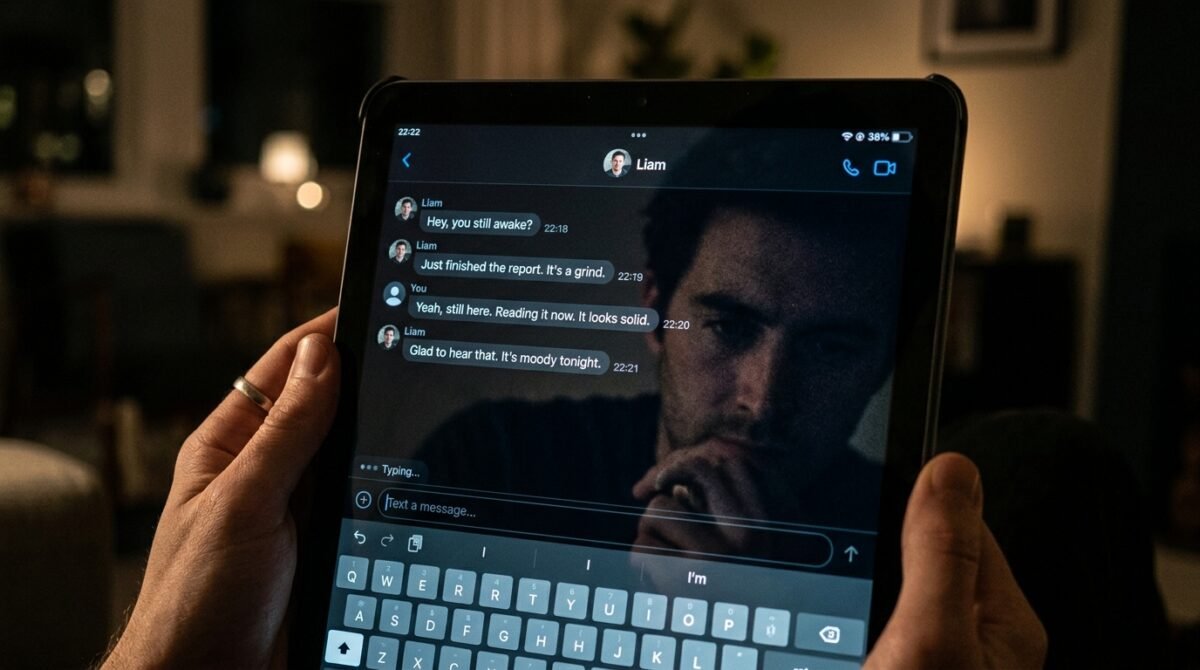
The final straw wasn’t even about the money; it was about the lack of shame. While Mark was ‘working’ to sell the cabinets, I found his tablet unlocked on the counter. It was open to a messaging app—a group chat with his friends called ‘Arcade Kings.’ I shouldn’t have looked, but I did. And what I saw broke what little hope I had left.
“Wife is losing her mind over the tuition fund thing. Like, relax, I’ll make it back in six months. She’s just being a typical nag. Don’t worry, the collection is worth way more than what she thinks.”
— Leaked Message from ‘Arcade Kings’ Group Chat
The group chat was full of his friends congratulating him on his ‘finds,’ calling me ‘controlling’ and ‘stifling.’ He had painted me as the villain, the shrew who was keeping him from his dreams. He had been laughing about my heartbreak with a group of strangers while I was sitting in the guest room, crying over the loss of our family’s stability. That was the moment the last shred of empathy I had for him vanished.
I took screenshots of every single message. I didn’t confront him. I simply saved them to a cloud drive. These were no longer just text messages; they were evidence. They were a map of his priorities, his disrespect, and his complete inability to take accountability for his actions. He wasn’t just a man with a hobby; he was a man who actively mocked the woman who was trying to save their family.
The Legal Reality Check

I walked into the lawyer’s office on Tuesday morning. I wasn’t just asking about the money anymore; I was asking about the divorce. I had the screenshots, the bank statements, and the history of our shared expenses. My lawyer, a stern woman who had seen it all, looked over the documents and gave me a look that was both sympathetic and bracingly professional.
“This is what we call financial dissipation,” she said, tapping the folder. “By liquidating a joint educational fund for personal assets, he’s opened himself up to significant liability. We can force the sale of these assets, but more importantly, we can establish a pattern of behavior that will be very relevant for the custody and support arrangements.”
The word ‘custody’ hit me like a physical blow. I hadn’t wanted it to come to this. I wanted a marriage, not a courtroom battle. But as I sat there, listening to the legal realities of my situation, I realized that I wasn’t the one who had destroyed the family. Mark had done that the moment he decided that his ‘sanctuary’ was more important than our son’s future. The legal route wasn’t a choice; it was a necessity.
I left the office feeling a strange sense of lightness. The uncertainty was gone. I knew what the next six months would look like. I knew the battles ahead. But for the first time in weeks, I wasn’t alone in the struggle. I had the law, I had the evidence, and I had the resolve to ensure that Leo’s future would be protected, with or without his father’s cooperation.
The Final Auction of the Sanctuary
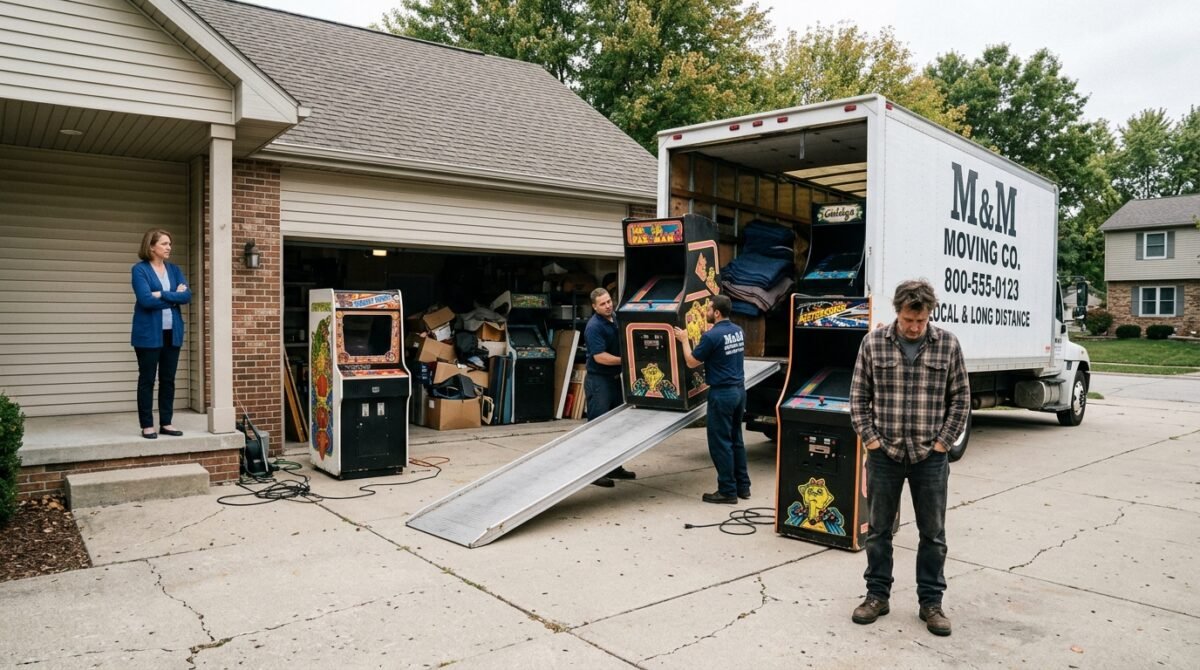
The day the bailiffs arrived to catalog the cabinets was a surreal experience. Mark was standing on the driveway, his face a mask of disbelief and rage. He had tried to hide a few of the machines in his brother’s garage, but our legal filing had been thorough. The sheriff’s deputy was polite but firm as he tagged each machine with an inventory sticker.
I watched from the living room window, feeling a profound sense of closure. The ‘Arcade Sanctuary’ was being dismantled, piece by piece. The very things that had cost me my marriage were being loaded into a truck to be sold at auction to repay the fund he had drained. It was the most expensive garage cleanup in history, and it was a necessary cleansing of our life.
“You’re really going through with this? You’re destroying everything because of a few machines? This is the most insane thing I’ve ever seen. You’re ruining our family for money.”
I walked out onto the porch, looking him in the eye for the last time. “You ruined our family, Mark. I’m just tidying up the mess you left behind. The money goes back into the fund, and then we go our separate ways. You have your machines. I hope they keep you warm at night.”
He had no answer. He stood there, watching as his ‘investment’ was hauled away, realizing too late that his obsession had cost him more than he could ever possibly recoup. The silence that followed as the truck pulled away was the quietest moment of my life, but for the first time in years, it felt peaceful.
The Aftermath: Rebuilding from the Ashes

Six months later, the dust has finally settled. Leo is enrolled in his school, the tuition is paid, and my life has taken a completely different trajectory. I live in a smaller apartment now, but it’s quiet, it’s ours, and there are no secrets hidden in the garage. I’ve started a new career path, focusing on financial planning—partly because I never want to be in the dark about our family finances ever again.
Mark is living in a studio apartment, and from what I hear, he’s still trying to ‘flip’ vintage electronics. We talk only through a co-parenting app, and our conversations are strictly limited to Leo’s schedule. There is no warmth, no apology, and no hope of reconciliation. I don’t harbor anger anymore; I harbor a deep, firm boundary that I will never let anyone cross again.
The lessons learned were hard, but they were worth it. I learned that trust is a fragile thing, easily broken by those who put their own desires above the needs of the family. I learned that ‘financial infidelity’ is a real, devastating force that can destroy lives if left unchecked. And most importantly, I learned that I am capable of standing up for myself and my son, even when the world feels like it’s falling apart.
To anyone reading this who suspects their partner is hiding assets or prioritizing a toxic hobby over their family’s future: stop waiting. Look at the numbers, talk to a professional, and protect yourself. You are not being ‘petty’ for wanting security for your children. You are being a protector. And that is the most important role you will ever play.
Conclusion
This journey has been a testament to the fact that money is rarely just about the currency—it is about the values we share with the people we love. When those values diverge, the financial fallout is often just a symptom of a deeper, structural failure in the partnership. I chose to share my story not for sympathy, but to remind others that you are not alone in these struggles, and that your instincts are often more accurate than the gaslighting you might be receiving.
The internet community, while occasionally harsh, served as a catalyst for me to take the steps necessary to secure my son’s future. It reminded me that there is no shame in seeking justice when your family’s foundation is threatened. I hope that by sharing this, it gives others the courage to audit their own lives, to stand firm in their boundaries, and to realize that a ‘sanctuary’ built on the ruin of others is never worth preserving.
What about you? Have you ever had a partner prioritize a hobby or a ‘side hustle’ over the essential needs of the family? How did you handle the betrayal, and what advice would you give to those currently living in the middle of a financial crisis? Let’s talk in the comments below.
What's your verdict on this dilemma?
Vote below to contribute to the official community consensus.

Have a Dilemma Keeping You Up at Night?
Share your real-life feud, wedding chaos, or relationship crossroads anonymously with our editorial team.
What do you think ?
0 Comments🛡️ Comments are moderated to protect community integrity. Your comment will appear once approved by the editorial team.