

When I signed the lease on our two-bedroom apartment, the wall-to-wall beige carpet was one of the first things I complained about. It was drab, dated, and perpetually prone to staining, but it was part of the contract. My roommate, Greg, always had an opinion on everything. He was the kind of person who spent thousands on designer sneakers but couldn’t be bothered to pay his portion of the electricity bill on time. Still, we had coexisted for eighteen months without any major catastrophes, until the fateful week I left for a corporate conference in Chicago.
I had been dreading the trip for months, but it was a career necessity. I left on a rainy Tuesday, leaving Greg with clear instructions: don’t touch the kitchen pipes, and definitely don’t let anyone in for ‘renovations.’ I thought I was being paranoid, but looking back, the signs were all there. The way he kept obsessing over those ‘man cave’ aesthetic videos on Instagram, the constant complaints about how our living room lacked ‘vibe’ and ‘natural energy.’ I didn’t realize that in his mind, natural energy meant synthetic plastic blades glued to the floor.
The return flight was delayed, adding to the exhaustion that was already gnawing at my bones. All I wanted was to collapse onto my sofa, watch some mindless television, and forget the office politics I’d been navigating for fourteen days. I pulled into our driveway, dragged my luggage up the stairs, and unlocked the door with a sense of profound relief that was about to be shattered in the most visceral way possible.
As I pushed the door open, the smell hit me first. It wasn’t the fresh, ozone-heavy scent of a meadow, as Greg would later claim in his warped defense. It was the pungent, suffocating chemical stench of industrial-grade adhesive and cheap, mass-produced polypropylene. My eyes adjusted to the living room, and for a second, my brain refused to process the reality of the scene. The beige carpet was gone. In its place was a sea of neon, high-pile AstroTurf, meticulously cut around the radiator and bubbling in the corners where the glue hadn’t quite set.
I stood there for a long time, the silence of the apartment broken only by the hum of the refrigerator. My phone pinged—an email notification from our landlord. The subject line was simply: ‘IMMEDIATE EVICTION NOTICE AND LEASE VIOLATION.’ I knew then that the next few weeks were going to be the most expensive and exhausting of my life. This wasn’t just a design choice; it was a total violation of our rental agreement, and I was holding the bag for every cent of the restoration costs.
The Green Plague Unveiled
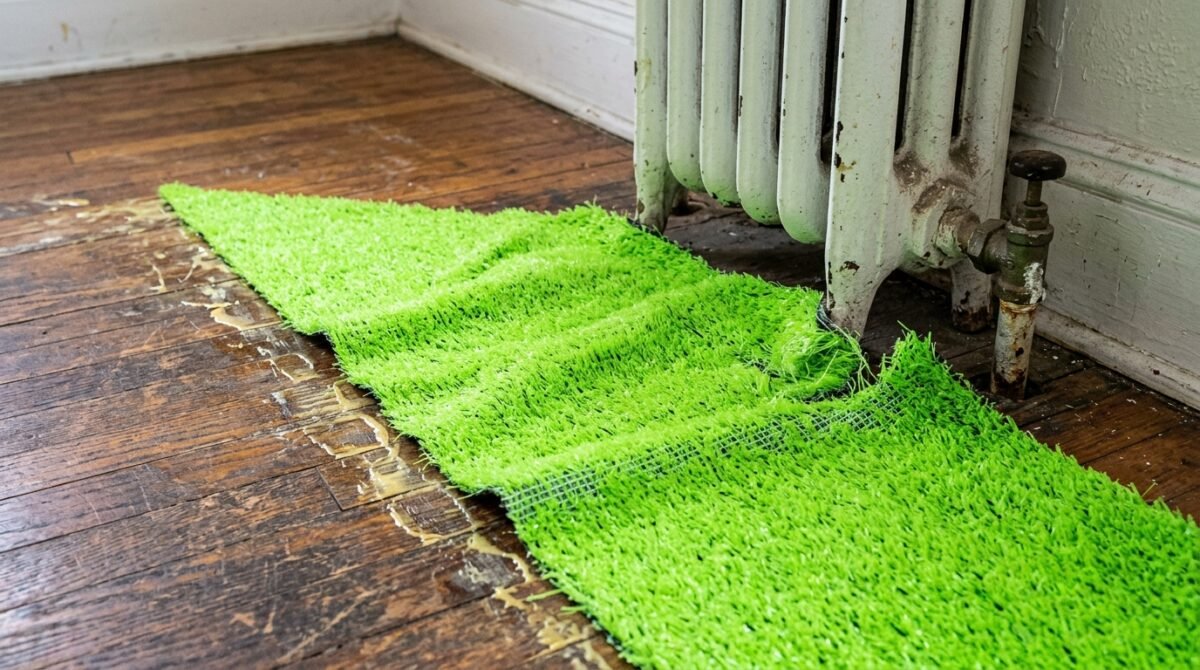
The visual was truly jarring. It wasn’t just that he had installed fake grass; he had done it with the artistic sensibility of a toddler holding a pair of craft scissors. The edges were uneven, frayed, and clearly hacked away at the corners. He had even tried to ‘anchor’ it down with duct tape in the spots where the industrial glue had failed, creating a trip hazard that spanned the entire length of the living room.
I walked further into the room, my boots making a sickening, crunchy sound against the plastic fibers. I felt like I was standing in the middle of a failed miniature golf course. Everything I owned—my coffee table, my bookshelf, my reading chair—looked ridiculous sitting on top of this lawn. It was as if Greg had decided that the only way to combat the ‘boredom’ of our apartment was to turn the floor into a literal outdoor space.
I pulled out my phone and dialed his number. He didn’t pick up on the first ring, which was typical. I paced the room, my heart hammering against my ribs, feeling a mixture of pure rage and deep, cold despair. How could someone who supposedly understood the concept of a rental agreement think this was acceptable? The sheer audacity required to peel up a landlord’s property and replace it with home-improvement-store garbage was staggering.
“Greg, pick up the phone right now. I am standing in the living room. What on God’s green earth have you done to the floor? There is AstroTurf everywhere. The landlord is already emailing about an eviction notice. Answer me!”
— A panicked voicemail left at 8:42 PM
When he finally texted back, it wasn’t an apology. It was a defensive, almost proud explanation of his ‘vision.’ He honestly believed that he had increased the value of the property. He talked about ‘bringing the outside in’ and ‘creating a sensory environment.’ I felt like I was talking to a wall, or perhaps a person who had spent too much time huffing the very glue he used to secure this disaster.
The Landlord’s Crimson Rage

By the next morning, the landlord, Mr. Henderson, was at the door. He was a man who lived for the details of his leases, and he didn’t appreciate surprises. He didn’t even say hello when I opened the door. He just pushed past me, his eyes widening as he caught sight of the floor. For a moment, he was genuinely speechless, his face turning a shade of purple that I hadn’t realized was possible in a human being.
When he finally spoke, it wasn’t a shout; it was a cold, precise dismantling of our tenancy. He pointed out the damage to the original subflooring beneath where the carpet had been. He explained that the industrial adhesive Greg had used was permanent, meaning the subfloor would likely need to be sanded or replaced entirely. The costs were mounting in my head before he even finished his first sentence.
“Do you have any idea what you’ve done? This isn’t just a decorating choice. You’ve destroyed the integrity of the flooring in this unit. I want this trash ripped out by tomorrow morning, and I want a professional floor restoration team in here by Monday. If not, consider this your formal notice to vacate.”
— Mr. Henderson, Property Manager
I tried to explain that I had been away, that I had no part in this, but Henderson didn’t care about the internal dynamics of our apartment. To him, we were a single entity on the lease. If Greg was a vandal, I was a co-conspirator. The legal weight of our shared responsibility was crushing, and I realized I was trapped in a situation where I would have to pay to clean up someone else’s delusion.
As he left, he handed me a list of approved contractors. The estimated price for the removal and restoration was $4,200. My stomach dropped. That was my entire emergency fund, a buffer I had been meticulously building for a year. Greg, meanwhile, was still hiding out at his girlfriend’s place, texting me about how the landlord was just ‘a hater’ who didn’t understand ‘modern interior design trends.’
The Text Message Manifesto
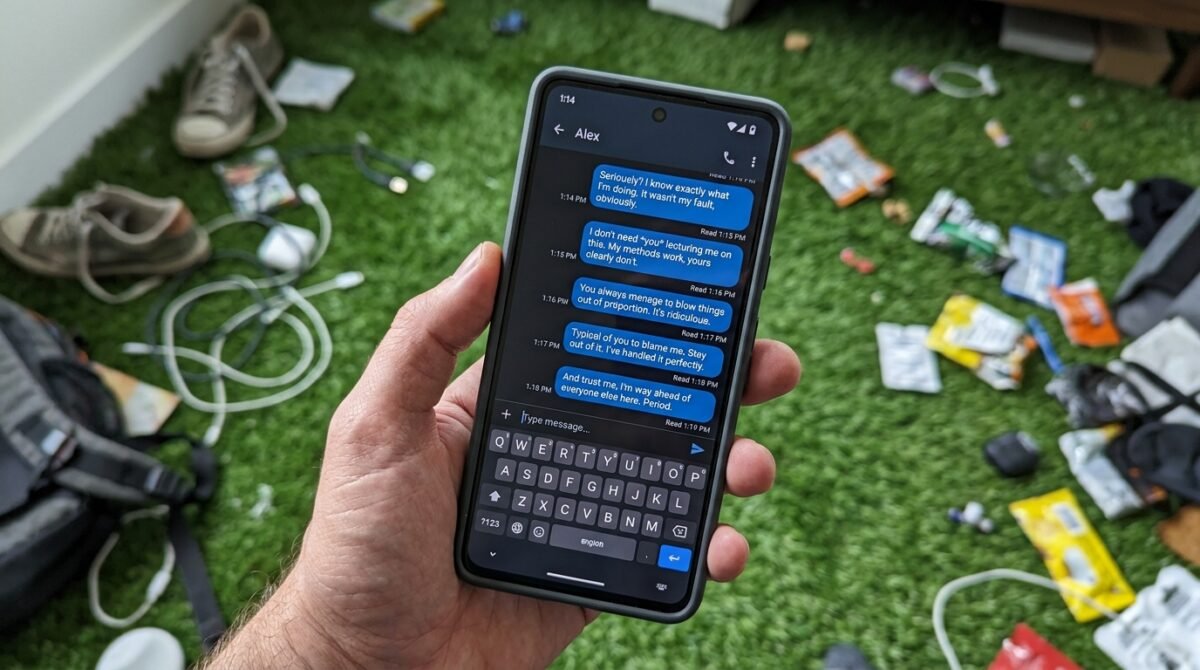
While I was busy scraping hardened glue off the floorboards with a putty knife, my phone kept buzzing. Greg was in full defensive mode. He wasn’t apologizing; he was trying to convince me that I was the one being unreasonable. He sent screenshots of Pinterest boards, arguing that ‘indoor lawns’ were the next big thing in urban design. He seemed entirely disconnected from the reality of the financial fallout.
“Seriously, you’re acting like I committed a crime. This is an upgrade! People pay thousands for biophilic design. You’re just too stuck in your boring, corporate mindset to see the potential. If you’d just chill, you’d see it actually makes the space feel bigger.”
— Message from Greg, 11:30 PM
I didn’t bother responding to his design philosophy. I focused on the practicalities. I sent him a breakdown of the costs: the contractor’s quote, the cleaning fee, and the potential late-fee penalty from the landlord. His response was typical of someone who had never had to worry about a budget in his life. He told me he was ‘short on cash’ and suggested we ask the landlord to just ‘live with it’ for a few months until he could save up.
It was clear then that Greg had no intention of paying for his ‘masterpiece.’ He expected me to handle the landlord, talk them down, and absorb the cost because I was the one with the steady salary and the ‘responsible’ reputation. I felt the slow burn of resentment turning into something much sharper. He had violated our home, destroyed our security, and now he was trying to gaslight me into paying for the privilege.
I started documenting everything. I took photos of the damage, saved every text, and started a log of my conversations with the landlord. I wasn’t just a roommate anymore; I was a witness to a crime against property. If I had to move out, I was going to make sure that the financial burden of this disaster landed exactly where it belonged: on Greg’s shoulders, regardless of his current ‘financial situation.’
The Reddit Trial: Am I The A**hole?

I finally broke down and posted the whole saga to a popular subreddit. I needed a gut check. Was I crazy? Was I overreacting to someone trying to be ‘creative’? I typed it all out in a fever of frustration, including the photos of the ruined floor. Within an hour, the post had blown up. The consensus was immediate, overwhelming, and surprisingly cathartic.
“NTA (Not The A**hole). This isn’t interior design, this is a property destruction case. You need to get his name off the lease if possible, or at least document that he did this while you were gone. Do not pay a cent of that restoration bill until you have his written admission that he did this without your permission.”
— u/PropertyLawyerFan (Top Comment, 32.1k upvotes)
The comments section became a fountain of advice. People suggested everything from small claims court to contacting my renters’ insurance. Some people shared their own horror stories about nightmare roommates, which made me feel slightly less alone in my misery. It was a bizarre, digital support group formed in the wake of my living room’s transformation into a golf course.
However, there were also the contrarians. A few users suggested that perhaps I had been ‘too controlling’ in the past, leading Greg to act out. I ignored them, but it reminded me of how easily the narrative could be spun. If I didn’t handle this with clinical precision, Greg would try to paint me as the villain in this story, the ‘stuffy’ roommate who didn’t appreciate his ‘genius’ invention.
I kept reading, watching the upvotes climb. It felt like a weight was being lifted, just knowing that thousands of strangers agreed that I was being subjected to something insane. It gave me the courage to take the next step: a formal, legal ultimatum to Greg. No more casual texts. It was time to treat this like the contract dispute it actually was.
The Confrontation at the Kitchen Table

Greg finally showed up at the apartment on a Saturday morning. He walked in like he owned the place, stepping onto the plastic grass with a grin that quickly faded when he saw my expression. I had the lease agreement spread out on the kitchen table, highlighted in neon yellow. I also had the contractor’s invoice sitting right in the middle.
He tried to make a joke about how the ‘vibe’ was still a work in progress, but I shut him down immediately. I didn’t raise my voice. I spoke with the kind of calm, terrifying authority that comes from being absolutely, objectively in the right. I laid out the facts: the cost of the repair, the threat of eviction, and my intention to sue him in small claims court if he didn’t pay for the entire restoration.
“I don’t care about your vision, Greg. I care about my credit score and my housing status. You did this, you broke the lease, and you are going to pay for the professional restoration. If you don’t, I’m taking you to court, and I’m showing the landlord every single text you sent me bragging about this install.”
— The direct ultimatum delivered to Greg
He started to backpedal, his voice dropping from ‘artistic visionary’ to ‘petulant teenager.’ He tried to claim he didn’t have the money. I didn’t care. I told him he could sell his designer sneakers, borrow from his parents, or take out a loan, but that invoice was being paid by him, in full, by the end of the week. The shift in his demeanor was palpable; for the first time, he realized that his entitlement had met a hard, immovable boundary.
He started crying—a pathetic, watery attempt at manipulation. He told me he was going through a hard time and that he just wanted to feel ‘at home’ in his own space. It was a classic deflection, an attempt to make me feel guilty for holding him accountable. I looked him right in the eye and didn’t blink. I didn’t offer a hug or a tissue. I just kept pointing at the invoice.
The Legal Threat and the Parental Intervention

The next day, I received a call from someone I didn’t expect: Greg’s mother. Apparently, he had gone running to her with a version of the story where I was ‘bullying’ him over a ‘minor design disagreement.’ She sounded incredibly entitled, lecturing me about being a ‘bad influence’ and ‘unsupportive’ of her son’s creative journey. I let her finish, then calmly laid out the legal reality of the situation.
I explained that I had photos of the damage, the lease agreement, and the landlord’s demand letter. I told her that if her son didn’t pay for the damage, my next step was to file a suit against him in small claims, which would result in a permanent public record that wouldn’t exactly help his future professional prospects. The tone of her voice shifted almost instantly from accusatory to panicked.
“He is a young man, he made a mistake! You can’t just threaten to ruin his life over some carpet! Surely there is a compromise? Could he just pay half? We don’t want to see this go to court over something so small.”
— Greg’s mother, attempting to negotiate on her son’s behalf
I stood my ground. I told her that if she wanted to protect her son, she could pay the $4,200 herself, but I wasn’t going to absorb a single dollar of the cost. The silence on the other end of the phone was deafening. It was clear that she was realizing her son wasn’t just ‘misunderstood’—he was a liability. She ended the call with a curt ‘I’ll see what we can do,’ which was as good as a confession of guilt.
Within forty-eight hours, the money hit my account. It was a direct bank transfer from his mother. I didn’t even get an apology from Greg, but I didn’t need one. The money was all the acknowledgment I needed. I immediately forwarded it to the landlord and scheduled the contractors to come in on Monday morning. The nightmare was finally coming to an end, but the damage to our relationship was total.
The Professional Restoration
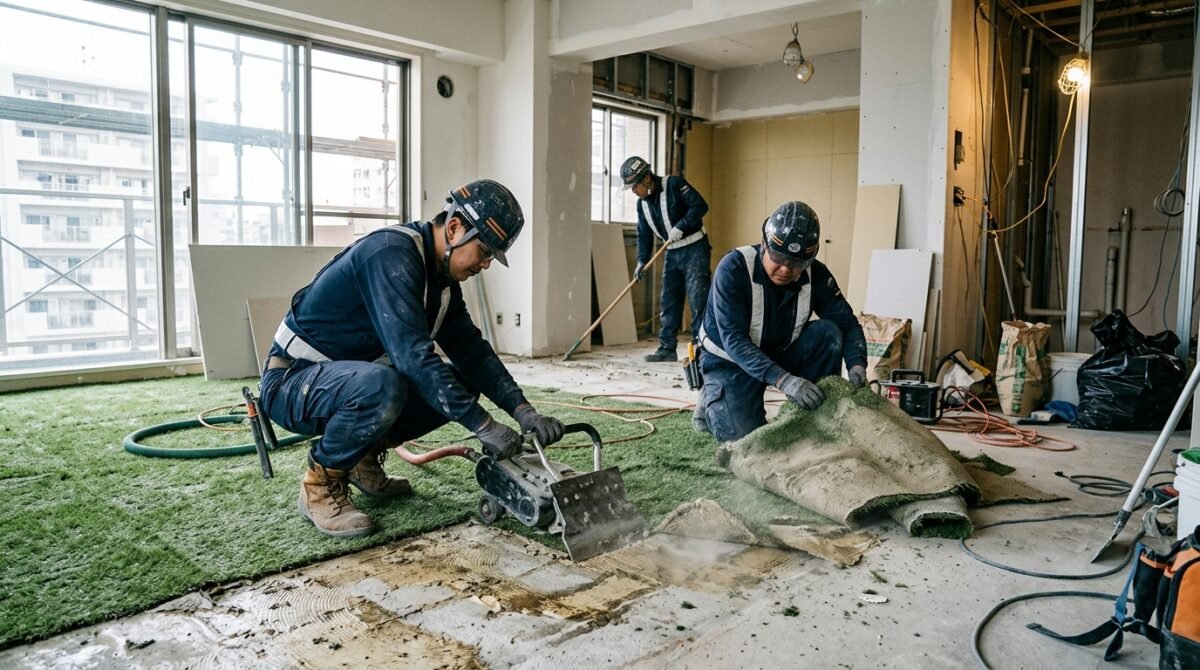
The restoration team arrived promptly at 8:00 AM. They were a professional, no-nonsense group who had clearly seen everything. Watching them peel away the plastic grass was like watching an archaeologist remove a cursed artifact. Underneath, the floor was covered in a thick, sticky layer of adhesive that required heavy-duty solvent to remove. It was loud, it was messy, and it was a stark reminder of the chaos Greg had introduced into our lives.
I sat in the kitchen, drinking coffee, watching them work. The smell of chemicals was overpowering, a sharp, industrial scent that seemed to burn away the last remnants of Greg’s presence. Every strip of plastic they removed made the apartment feel more like my own space again. I realized that for the last year and a half, I had been compromising on everything to keep the peace with someone who didn’t respect my boundaries.
The lead contractor walked over to me mid-morning, shaking his head. He pointed to a spot where the glue had seeped into the cracks between the floorboards. ‘Whoever did this didn’t just ruin the surface,’ he explained. ‘They compromised the wood itself. You’re lucky you caught it this early, or you’d be looking at a total floor replacement in six months. This was a disaster waiting to happen.’
I felt a strange sense of vindication. It wasn’t just a ‘design choice’; it was a structural assault. I had been right to be angry, right to demand accountability, and right to involve the law. As the final sections of the green plastic were carried out to the dumpster, the apartment suddenly felt light, clean, and—most importantly—normal. I was ready to move on, but I knew I couldn’t stay here with Greg any longer.
The Final Moving Out Countdown

Living with Greg for the final two weeks of our lease was a masterclass in awkwardness. He barely looked at me, retreating into his room whenever I was in the common area. The living room was now bare, the original wood floor exposed and waiting for a light sanding and refinish. It was a blank slate, reflecting the state of my own life—I was essentially starting over, moving to a new apartment in a different part of the city.
I kept to myself, packing my things with a surgical efficiency. Every item I wrapped in bubble wrap was a step toward freedom. We didn’t talk about the carpet, the landlord, or his mother. We didn’t talk about anything. It was a cold, silent war of attrition where the only goal was to reach the end of the month without any further incidents. It was the longest two weeks of my adult life.
“I just wanted to make the place look cool. I didn’t think it would be such a big deal. You always overreact to everything. I hope you’re happy now that you’ve got your boring, beige floors back.”
— Greg’s final, parting shot as he moved his last box out
I didn’t argue. I didn’t even look up from the box I was sealing. His comment was the final proof that he had learned absolutely nothing. He still saw himself as the victim of my ‘overreaction,’ unable to grasp the basic concept of property rights or the consequences of his own actions. It was a pathetic, empty attempt to reclaim some dignity, but it fell completely flat.
The day he moved out, I felt a physical lightness. I stood in the empty living room, the sun streaming through the windows and reflecting off the clean, polished wood. It wasn’t perfect, and the ordeal had cost me a month of sleep and a significant amount of stress, but it was mine. I had stood my ground, protected my credit, and successfully navigated a crisis that could have ruined me.
Reflecting on the Boundaries We Set

Looking back, the entire experience was a crash course in the necessity of boundaries. I had spent so long trying to be the ‘easygoing’ roommate, the one who looked the other way when dishes piled up or when the rent was a few days late. I thought I was keeping the peace, but all I was doing was training Greg to walk all over me. My silence had become his permission.
The AstroTurf was just the breaking point of a much larger failure in communication. I had allowed him to think that his whims were equal to my rights as a tenant. By failing to set firm, non-negotiable boundaries early on, I had created an environment where he felt comfortable enough to literally destroy my living space. It was a hard, expensive lesson, but one I wouldn’t soon forget.
Now, in my new place, the dynamic is entirely different. I have a clear, written agreement with my new roommate. We have weekly check-ins, a shared expense tracker, and a strict rule about any modifications to the apartment. It’s not about being controlling; it’s about being responsible. It’s about ensuring that we both have a space where we feel secure, respected, and, most importantly, free from the threat of ‘creative’ renovations.
I still see the occasional post on social media about roommates doing crazy things, and I don’t laugh anymore. I feel a genuine sense of empathy for the people on the other side of those posts. I know exactly how that sinking, sick feeling in the stomach feels when you walk through your front door and realize that your sanctuary has been violated. It’s a feeling of betrayal that goes much deeper than the cost of the damage.
The Aftermath: Moving On and Moving Up

I have fully recovered from the financial impact of the renovation. It took a few months of tighter budgeting, but I’m back on track. My credit score is pristine, and I have a much better relationship with my landlord, who actually thanked me for how I handled the situation. It turns out that property managers value tenants who don’t let their roommates destroy the building.
Greg and I haven’t spoken since the day he moved out, and frankly, I prefer it that way. I’ve heard through mutual friends that he’s currently living in a place with a ‘shared garden’ setup, which I assume means he’s finding new ways to annoy his new housemates. Some people never change, and I’ve accepted that it wasn’t my job to fix him—it was only my job to protect myself.
I’ve learned to trust my gut. When something feels off, or when a boundary is being pushed, I don’t wait for it to become a disaster. I address it immediately, calmly, and firmly. It’s saved me countless hours of stress and, ironically, has made my relationships with my friends and housemates much stronger. There is a real freedom in knowing that you have the tools to stand up for yourself when it counts.
And every now and then, when I’m walking through a park or a sports arena, I see a patch of AstroTurf. I don’t feel anger anymore; I just chuckle to myself. It’s a reminder of a time when I learned that I am capable of handling the unexpected, the absurd, and the truly infuriating. I survived the green nightmare, and I came out the other side stronger, more focused, and much more careful about who I decide to share a roof with.
Conclusion
This story is a stark reminder that your home is your sanctuary, and the people you share it with have a profound impact on your mental, financial, and emotional well-being. What started as a ‘design upgrade’ turned into a legal and financial battle that tested my resolve and my bank account. The most important takeaway? Never assume your standards for what constitutes ‘normal’ are shared by those you live with. Always have clear, written boundaries, and never be afraid to enforce them when things go off the rails.
I’d love to hear your thoughts on this. Have you ever had a roommate pull a stunt that left you speechless? How do you handle it when your home environment is compromised by someone else’s impulsive decisions? Let’s talk in the comments below—have you ever had to choose between keeping the peace and protecting your own interests?
What's your verdict on this dilemma?
Vote below to contribute to the official community consensus.

Have a Dilemma Keeping You Up at Night?
Share your real-life feud, wedding chaos, or relationship crossroads anonymously with our editorial team.
What do you think ?
0 Comments🛡️ Comments are moderated to protect community integrity. Your comment will appear once approved by the editorial team.