

They say that marriage is a partnership, but for Dr. Elena Vance, a fellowship-trained surgeon, it had quietly become a negotiation of her own existence. For years, she had balanced the grueling demands of residency and surgical rotation with a relationship that seemed, on the surface, to be the perfect counterweight to her high-stress career. Mark, a charming corporate analyst, had always been supportive—or so she thought.
The tension began to bubble over during the wedding planning process. It wasn’t about the color of the napkins or the choice of flowers; it was about the fundamental way Elena presented herself to the world. Mark’s mother, a woman who prided herself on being the matriarch of a traditional, old-money family, had always been difficult, but the friction reached a fever pitch when she visited their home for the first time following the engagement.
Standing in the hallway, staring up at the framed board-certification certificate that Elena hung with pride, Mark’s mother had remained silent. That silence, however, was deafening. By the time dinner was served, the air was thick with unspoken criticism, leading to a sequence of events that would force Elena to choose between the life she had built through blood, sweat, and tears, and a man who expected her to hide it.
The moral dilemma is as sharp as a scalpel: should a partner be expected to dampen their professional light to preserve the comfort of their future in-laws? Elena’s story is a sobering reminder that when someone asks you to shrink yourself to fit into their family’s box, it is rarely the last time they will ask you to dim your shine.
The Wall That Sparked a Silent War
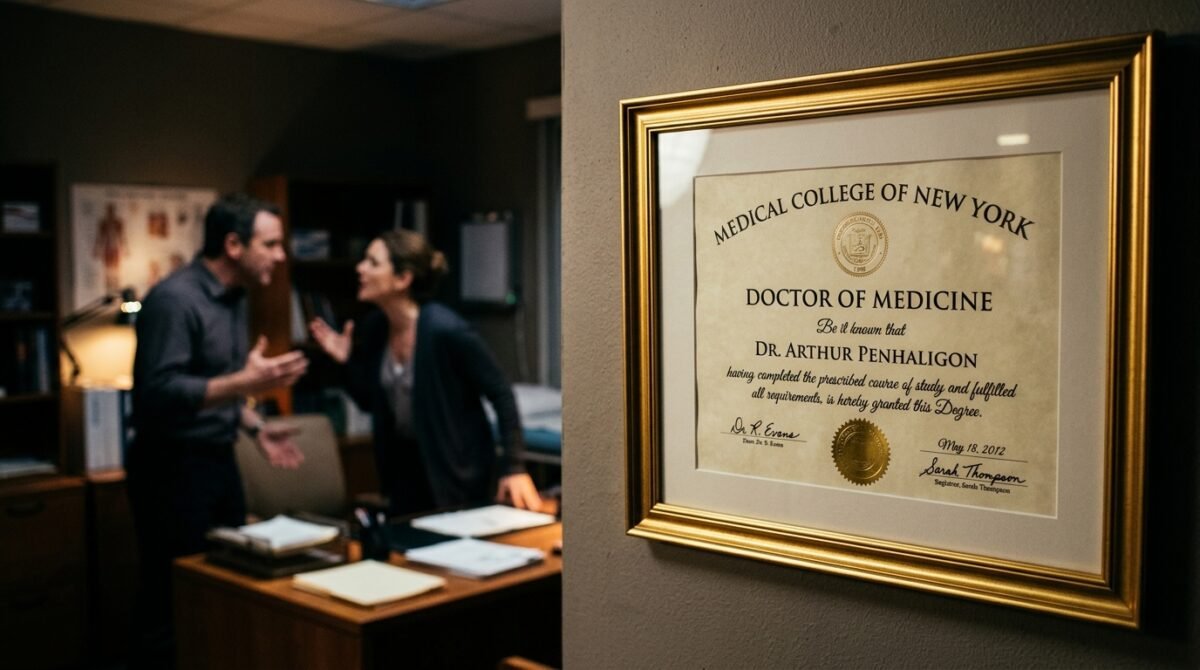
It started on a Tuesday evening. The house was finally quiet after a long weekend of hosting Mark’s parents. Elena had spent months curating the decor of their condo, ensuring that every piece reflected her journey from medical school to surgical fellowship. The centerpiece of her hallway, right by the entryway, was her framed American Board of Surgery certificate.
During the visit, Mark’s mother, Evelyn, had paused before it. She didn’t offer congratulations. She didn’t ask about the years of sleep deprivation or the thousands of hours in the OR. Instead, she smoothed her skirt and looked at Mark, her expression one of polite, icy disapproval. It was the kind of look that suggested Elena was ‘too much’—too loud, too successful, too independent.
Mark had noticed his mother’s hesitation. That night, after the wine had been cleared and the guests had left, he didn’t debrief about the visit’s success. Instead, he paced the living room, his brow furrowed with a familiar, anxious tension that Elena had learned to recognize as a precursor to a lecture.
“You know, El, Mom isn’t used to… how independent you are. She thinks it’s a bit overwhelming for her to see that certificate right when she walks in. She feels like it’s a statement, you know? Like you’re reminding everyone you’re the smartest person in the room.”
Elena stood frozen, still wearing her scrubs. “Mark, it’s not a statement. It’s my qualification. It’s who I am. Why would your mother be intimidated by a piece of paper that proves I’m competent at saving lives?” The conversation devolved quickly, with Mark insisting that ‘adjusting’ to family dynamics was just part of the marriage package.
The Passive-Aggressive Group Chat Leak

The next morning, the fallout began in the digital arena. Elena was between cases at the hospital when her phone buzzed incessantly. It was the family group chat, one she had been added to just weeks prior. The tone was saccharine, but the subtext was venomous.
“It’s so important to keep a warm, welcoming home for your husband-to-be. A house should be a sanctuary, not an office. I hope we can find a way to make the home feel less… clinical? I’m sure Elena understands the importance of softening her edges before the wedding.”
— Evelyn, Mother-in-Law to be
Elena felt her blood pressure spike. She replied with professional brevity, but the damage was done. Mark had clearly been feeding his mother’s insecurities, painting Elena as a ‘career-obsessed’ woman who didn’t know how to turn off the professional switch. When she confronted Mark about the message, he claimed it was just ‘motherly advice’ and that she was overreacting.
The resentment started to calcify. Elena realized then that Mark wasn’t just trying to keep the peace; he was actively enabling his mother’s attempt to diminish her professional identity. He wanted a wife who was successful enough to be ‘impressive’ at dinner parties, but not so successful that she made his family feel inadequate.
She spent the rest of the day in a haze of professional duty, performing two laparoscopic procedures while her mind drifted to the life she was building with a man who seemed to view her achievements as a threat to his family’s social hierarchy.
The Ultimatum in the Kitchen
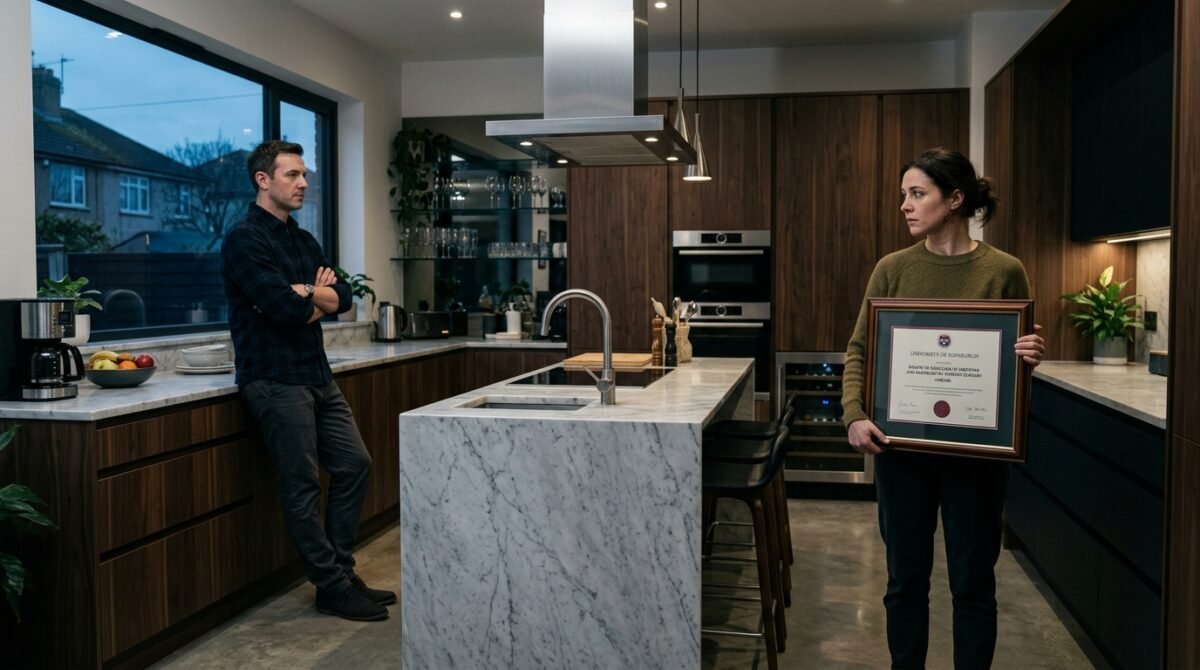
The situation reached a breaking point on a Friday. Elena returned home to find that her certificate had been taken down. It was leaning against the wall, face-in, on the hallway floor. Mark was in the kitchen, casually making coffee, acting as if nothing had changed.
Elena walked over to the framed certificate, her hands trembling. She felt a profound sense of violation. This wasn’t just a frame; it was her life’s work. It represented the years she spent in the anatomy lab while her friends were out traveling, the missed holidays, the crushing debt, and the sheer grit required to survive the residency gauntlet.
“Mark, why is this on the floor? Did you move this?”
Mark turned, his expression carefully neutral. “I thought we discussed this, El. It’s just too much. I want our home to be about us, not your career. Mom is coming over for brunch on Sunday, and I really don’t want to start another argument about your professional life. Just… leave it in the guest closet for now.”
The audacity of his request caught her off guard. He wasn’t just asking her to hide a piece of paper; he was asking her to hide her identity. She realized in that moment that this wasn’t about his mother at all. It was about Mark. He needed her to be smaller so he could feel bigger. The power dynamic he was attempting to enforce was clear, and it was absolutely unacceptable.
The Silence That Spoke Volumes
Elena didn’t yell. She didn’t throw the frame. She simply placed it back on the wall, hammering the nail back into the drywall with a precision that bordered on surgical. She did it in total silence, while Mark watched, his face transitioning from irritation to a genuine, confused fear.
“Are you not listening to me?” Mark asked, his voice rising. “My mother is going to be incredibly upset. She feels like you’re flaunting your success because you know she never finished her degree. It’s just a kind thing to do, to take it down for a couple of hours.”
“It’s not just for a couple of hours, Mark, and we both know it,” Elena replied, her voice steady and cold. “This is who I am. If your mother is so insecure that a piece of paper on my wall makes her feel diminished, that is her problem to solve with a therapist, not mine to solve by erasing my accomplishments.”
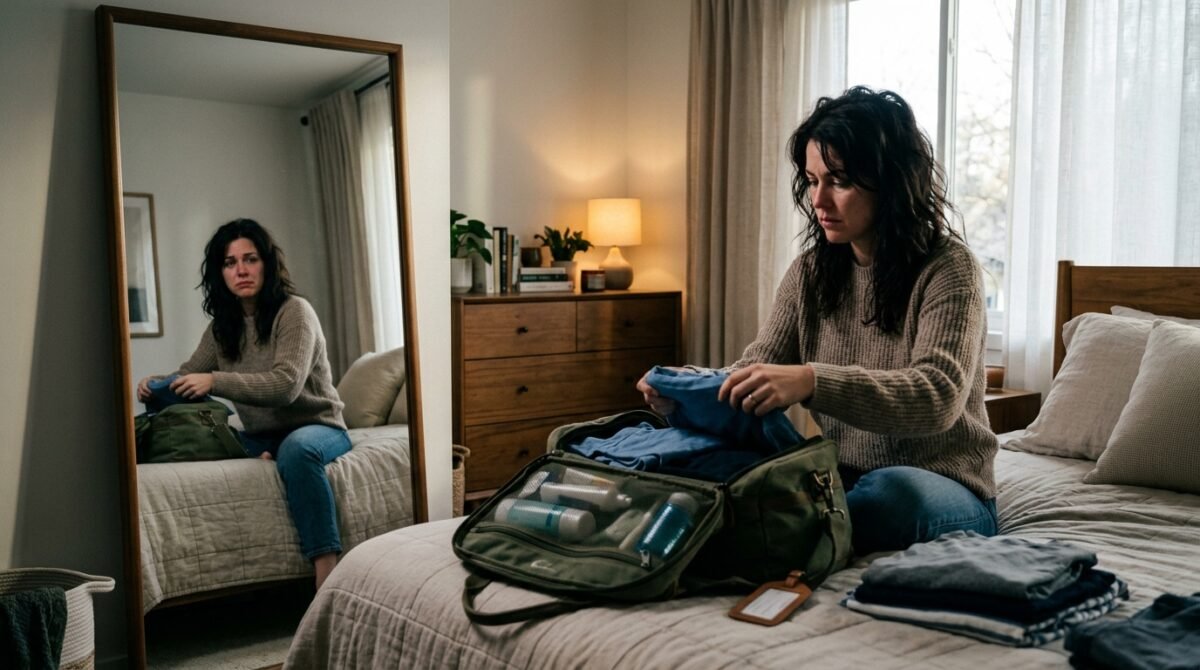
She walked into the bedroom and began to pack a small bag. She knew she couldn’t stay there. Not tonight. She needed space, and more importantly, she needed to see if this man was someone she could realistically spend the next forty years with. She looked at the ring on her finger—a beautiful, expensive rock that now felt like a shackle.
The Ring on the Counter

When Elena returned to the hallway, she didn’t take the certificate. Instead, she took the engagement ring off her finger. She placed it right on the kitchen counter, next to the half-empty coffee mug Mark had left behind. It was a heavy, cold sound as the diamond hit the marble.
Mark appeared from the living room, his expression shifting from annoyance to pure shock. “What are you doing? Are you serious? This is because of a picture on the wall?”
“It’s not about the picture, Mark. It’s about the fact that you think my life is something I should apologize for to keep your family comfortable. If you can’t stand by me, I don’t need you standing next to me at the altar.”
She grabbed her keys and walked out the door. The feeling of freedom was almost immediate, mixed with the sharp, burning grief of a relationship ending. She didn’t look back to see how he reacted. She didn’t care. She was a surgeon; she knew how to handle crisis situations, and this was simply the end of a failed experiment.
She drove to a hotel nearby, checked in, and finally allowed herself to cry. Not because she was losing the man, but because of the realization that she had been compromising her own worth for someone who didn’t even recognize the cost of what she was giving up.
The Digital Jury Responds

The next day, Elena found herself scrolling through Reddit, unable to sleep. She posted her story anonymously, needing an objective perspective. The response was overwhelming. Within hours, the post hit the front page with thousands of comments.
“NTA. He is asking you to hide your identity to soothe his mother’s ego. This is a massive red flag. If he’s doing this now, what will he demand when you have kids? Or when you get a promotion? Run.”
— u/SurgeonSupport, 15.2k upvotes
The community was unanimous. The narrative that she was being ‘unreasonable’ or ‘intimidating’ held no weight in the comments. Instead, hundreds of women shared their own experiences of partners who resented their success. It was a stark reminder that she wasn’t alone in this struggle.
Another user noted: “The fact that he didn’t defend you in the group chat and instead chose to enable his mother’s behavior tells you everything you need to know about where his loyalties lie. He isn’t your partner. He’s his mother’s proxy.”
Reading the comments, Elena felt a strange sense of vindication. It wasn’t about being ‘right’; it was about validating her own boundaries. She realized that the ‘professional’ life she had cultivated was not an obstacle to a happy marriage; it was a filter that only the right person would be able to pass through.
The Aftermath and the ‘Apology’

Two days later, Mark showed up at the hotel. He looked disheveled, clearly having had a rough forty-eight hours. He stood in the lobby, clutching a bouquet of flowers that looked like a pathetic gesture compared to the gravity of the situation. He tried to speak, his voice cracking.
“I talked to Mom. She’s… she’s willing to apologize if you just come back home. We can talk about the wall, we can find a compromise. I just want us to be okay again. Please, El. This is ridiculous.”
Elena didn’t invite him up. She met him in the lobby, standing tall, wearing her hospital scrubs, the symbol of her life’s work. She looked at him with a clarity she had lacked for months. There was no ‘compromise’ to be had here. The compromise was her dignity.
“Mark, you still don’t get it,” she said quietly. “An apology isn’t the issue. The issue is that you view my achievements as a liability. You view me as an accessory to your family’s status, and when I don’t fit the mold, you try to reshape me. I’m not interested in being a project.”
She left him there in the lobby. She didn’t take the flowers. She walked back to her room, knowing that the chapter with Mark was officially, permanently closed. It was the hardest thing she had ever done, but it was also the most surgeon-like decision: excise the infection before it causes systemic failure.
Why the Sunday Dinner Never Happened

Sunday came and went. The dinner that was supposed to be the moment of ‘reconciliation’ never happened. Instead, Elena spent the day catching up on research and enjoying the quiet of her temporary apartment. She didn’t check her phone for messages from Mark or his mother.
She realized that by not participating in the Sunday dinner, she had effectively liberated herself from a lifetime of such events. She had escaped the cycle of performance that Mark’s family demanded. For the first time in years, she didn’t have to worry about who she was ‘intimidating’ or whether she was being ‘too much.’
She sat down at her laptop and wrote a formal email to her wedding vendors, canceling the contracts. It was a heavy financial loss, but compared to the loss of her own self-respect, it was a bargain. Every cancellation email was a step toward a version of herself that she recognized again.
She felt a profound sense of peace. The house was no longer a stage for a family performance; it was just a place to live. She was finally living for herself, not for the approval of people who saw her hard-earned success as a personal affront to their fragile egos.
Navigating the Social Fallout

Of course, the breakup caused waves. Mark’s family was not quiet about it. They painted Elena as the ‘difficult’ woman who couldn’t handle a simple request. But Elena found that she no longer cared about the narrative they were weaving. The truth was her own, and she didn’t need their validation.
Some of their mutual friends were confused, but those who truly knew Elena—her colleagues at the hospital, her mentors, her true friends—stood by her completely. They reminded her of the resilience she had shown during the most difficult years of her training. They saw her for who she was: a brilliant, dedicated surgeon.
“I saw you survive the most grueling residency program in the country without losing your mind. If you think you can’t survive a breakup with a guy who wanted to hide your degree, you’re selling yourself short, Elena.”
— Dr. Marcus Reed, Chief of Surgery
His words were the final nail in the coffin of her doubt. She was exactly where she needed to be. She started focusing on her professional goals again, applying for a new, prestigious fellowship, and feeling more energized than she had in years.
The Lessons of the Scalpel

In the end, Elena’s life became a testament to the idea that some things simply cannot be compromised. You cannot compromise on your identity. You cannot compromise on the work that makes you who you are. And you certainly cannot compromise on the people who are supposed to be your foundation.
She eventually moved into a new place. She made sure the first thing she hung in the foyer was her certificate. It wasn’t a boast; it was a declaration. It was a reminder that she belonged to herself. She no longer had to navigate the minefield of other people’s insecurities.
She found that the people who were truly worthy of being in her life were the ones who celebrated her accomplishments, not the ones who felt diminished by them. The man who would eventually enter her life would be someone who walked into her home, saw the certificate, and instead of asking it to be hidden, would ask her how she managed to achieve it—because he would be someone who valued the person behind the credentials.
Elena’s journey was a difficult one, but it was a necessary surgery. She had to cut away the toxic parts of her life to ensure her own health and success. And looking back, she knew she would make the same decision a thousand times over.
Conclusion
Elena’s story serves as a powerful reminder that professional success should never be a bargaining chip in a relationship. When a partner suggests you ‘soften’ or ‘hide’ your achievements to accommodate their family, they are essentially asking you to diminish your own worth. True partnership is about lifting each other up, not keeping one person in the shadows to make the other feel secure.
It is easy to get caught up in the pressures of family expectations and social hierarchies, but your self-respect is the one thing you can never afford to sacrifice. Elena’s decision to walk away was the ultimate act of self-preservation, and it led her to a place where she can finally thrive without apology.
What about you? Have you ever had to choose between your career achievements and a partner’s family expectations? Or have you found yourself in a situation where your success was treated as a threat? Share your experiences in the comments below; let’s discuss the importance of setting boundaries in the face of insecurity.
What's your verdict on this dilemma?
Vote below to contribute to the official community consensus.

Have a Dilemma Keeping You Up at Night?
Share your real-life feud, wedding chaos, or relationship crossroads anonymously with our editorial team.
What do you think ?
0 Comments🛡️ Comments are moderated to protect community integrity. Your comment will appear once approved by the editorial team.