

Grief is a ghost that never truly leaves the house. For three years, my home remained a sanctuary for the memories of my late wife, Sarah. Her books were on the shelf, her favorite throw blanket was draped over the armchair, and her jewelry box—a handcrafted walnut chest—sat precisely where she left it on the vanity. When my younger brother, Mark, went through his messy divorce, he had nowhere to go. I thought I was helping him find his footing, but I was actually inviting a wolf into the fold.
Mark was always the charming one, the golden boy who could talk his way out of any scrape. Our parents doted on him, often at the expense of my own needs, but I held no grudges. I loved my brother. When he showed up on my doorstep with two suitcases and a broken spirit, I didn’t hesitate. I gave him the guest room and a set of keys, hoping that a stable environment would help him rebuild. I wanted to be the supportive older brother, the rock he could lean on.
But the house started feeling different almost immediately. It wasn’t anything I could put my finger on at first—just a general sense of unease. Things would be slightly shifted. A coaster moved, a drawer left a fraction of an inch ajar. I dismissed it as paranoia, a symptom of my own lingering sorrow. I told myself I was just being territorial over the space I had shared with Sarah. I was wrong to be so forgiving.
The breaking point arrived on a rainy Tuesday. I was doing laundry, and I found a crumpled piece of paper in the pocket of Mark’s corduroy jacket. It wasn’t a receipt for groceries or a dry cleaner; it was a transaction slip from a local pawn shop dated three days prior. My heart hammered against my ribs as I read the line item: ‘Antique Emerald Locket – $450.’ The room went cold. I knew that locket. It was the piece Sarah wore on our wedding day.
What followed was not a conversation; it was an excavation of betrayal. I didn’t confront him immediately because the sheer audacity of the act paralyzed me. I spent the afternoon walking through the house, checking the jewelry box piece by piece. The gold chains, the sapphire earrings—they were all gone. He hadn’t just taken a trinket; he had liquidated my past to pay for his present. This is the story of how I drew the line, and how my family turned their backs on me for protecting what was left of my wife’s memory.
The Initial Warning Signs I Ignored
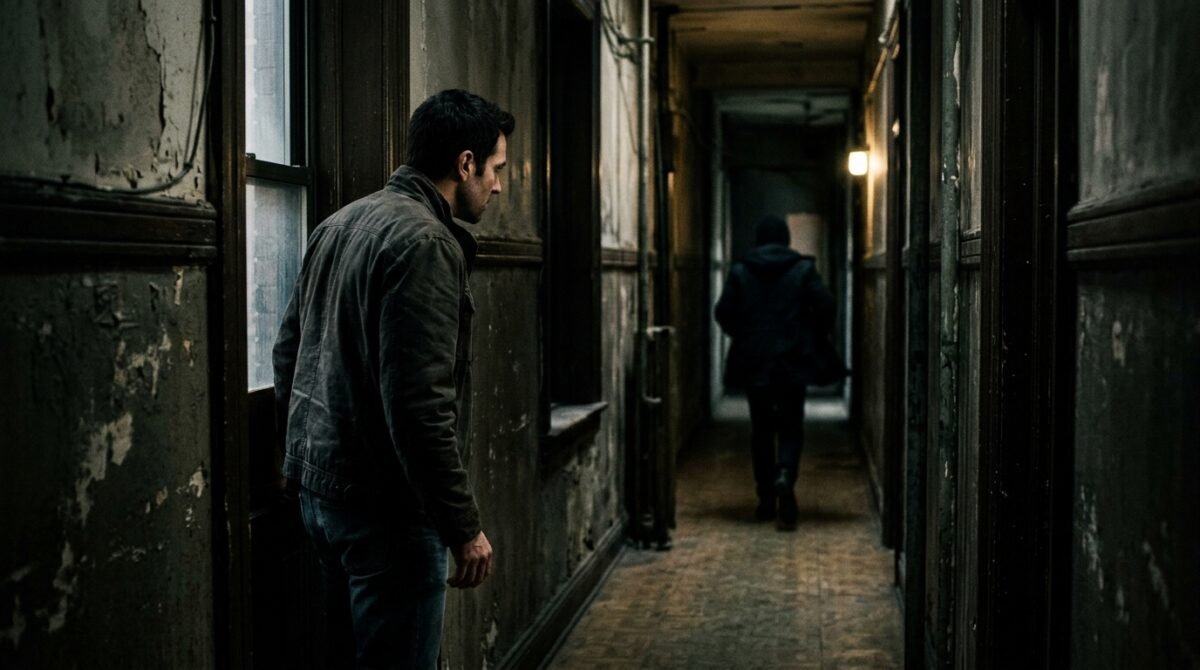
Looking back, the signs were there, but I was blinded by a misplaced sense of loyalty. Mark had been living in my guest room for four months. At first, he was the model houseguest, cooking dinner and keeping the place tidy. But then the ‘accidents’ began. I’d come home from work to find he’d been rooting through my desk, claiming he was looking for a stapler or a pen, but he always seemed flustered when I walked in.
He started asking questions about Sarah’s estate. He wanted to know which items were ‘sentimental’ versus which ones were ‘worth money.’ I felt a shiver down my spine when he asked about the emerald locket during a casual conversation over coffee. He told me he was just curious about history and vintage values, but his eyes were darting around the room, assessing the value of our surroundings like a vulture surveying a carcass.
“You know, honestly, Sarah would have wanted you to have money to move forward. Why keep all this expensive stuff locked away? It’s just metal and stones, big brother. It isn’t her.”
— Mark, during a tense breakfast conversation
I brushed it off, but the comment lingered. It was a cold, calculated attempt to devalue the items that held the most emotional weight for me. I should have kicked him out right then. I should have realized that he wasn’t mourning his divorce; he was looking for a way to monetize my loss to fund his own lifestyle changes.
Instead, I doubled down on my trust. I gave him more space, thinking he was just spiraling. I even offered to pay for a few therapy sessions for him, thinking he was depressed. I was so worried about him hurting himself that I failed to see he was hurting me. I was the fool in the narrative, the one who believed that family was an unbreakable bond, regardless of the person on the other end.
The subtle shifts in the house continued. I’d notice my mail was opened before I got to it, or my bank statements were sitting on the kitchen counter instead of in the drawer. He was looking for vulnerabilities, looking for my passwords, looking for a way to get his hands on more. I was so focused on being a ‘good brother’ that I was blind to the fact that I was actively facilitating my own victimization.
Finding the Pawn Shop Receipt
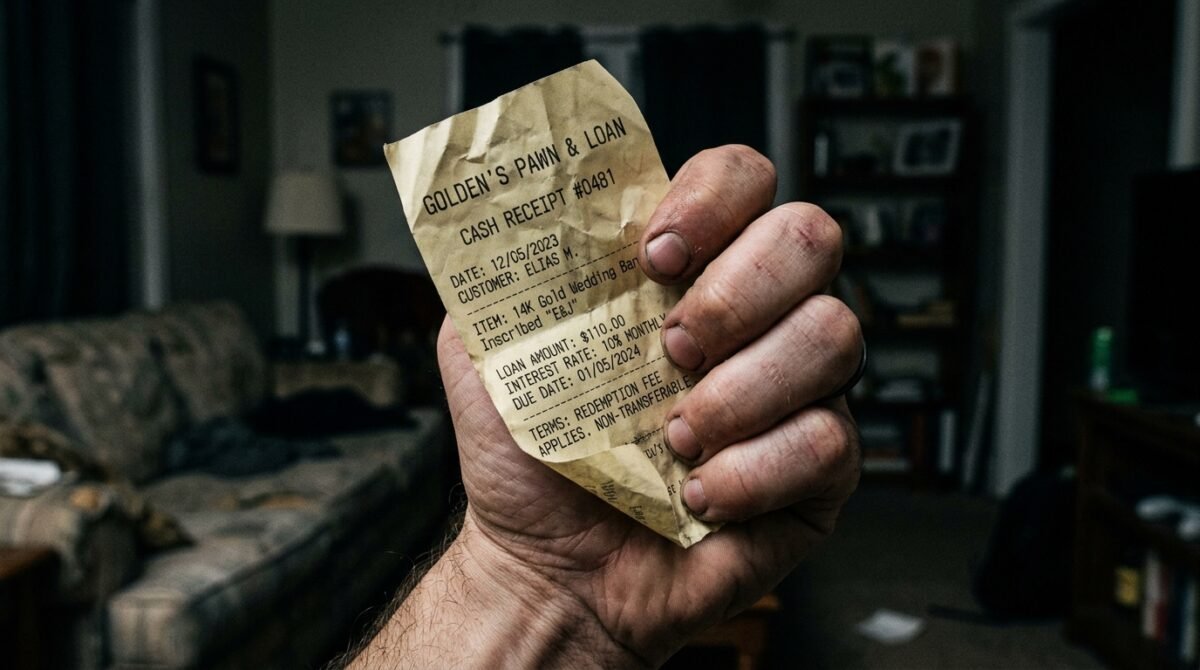
When I pulled that slip of paper from his jacket, the world stopped spinning. It was a crisp, white receipt with the name of a seedy shop across town printed in bold, dark ink. The description of the item was unmistakable: ‘Estate Emerald Locket, gold filigree, initial S.M.’ My breath hitched. It was like a physical punch to the gut. The realization didn’t come as a shock—it came as a sickening confirmation of the fear I had been suppressing for weeks.
I sat on the edge of the laundry room floor, the receipt trembling in my hands. How could he? Sarah had worn that locket to our wedding. She wore it when we bought our first house. She wore it in the final photograph we took together. To Mark, it was just a payday. It was just another way to get his hands on cash to pay off his gambling debts or his bar tabs. The betrayal felt like a betrayal of Sarah herself.
I went to the bedroom and opened the walnut chest. It was hauntingly light. I pulled out the velvet trays, one by one. The pearl necklace from her grandmother? Gone. The gold watch her father gave her for graduation? Gone. My house had been hollowed out. He hadn’t just taken one item; he had systematically stripped away the physical manifestations of my wife’s life while I was at work, trusting him to occupy my home.
“How do you explain this? How do you look at yourself in the mirror knowing you sold our past for a few hundred dollars?”
— My internal monologue, while staring at the empty velvet trays
The anger that followed wasn’t hot; it was cold and precise. I didn’t want to scream. I didn’t want to have an argument. I wanted him out. I wanted the infection removed from my life. I gathered the evidence—the receipt, the empty boxes, the photos of what used to be there—and placed them on the kitchen table, creating a shrine to his theft. I was ready for him to come home.
When I heard his key in the lock at 6:00 PM, I didn’t stand up. I just sat in the dim light of the dining room, waiting. The sound of his whistling, so light and carefree, was a razor blade against my nerves. He walked into the kitchen, saw the evidence, and the whistling stopped instantly. The silence that filled the house was heavy, suffocating, and final.
The Confrontation in the Kitchen
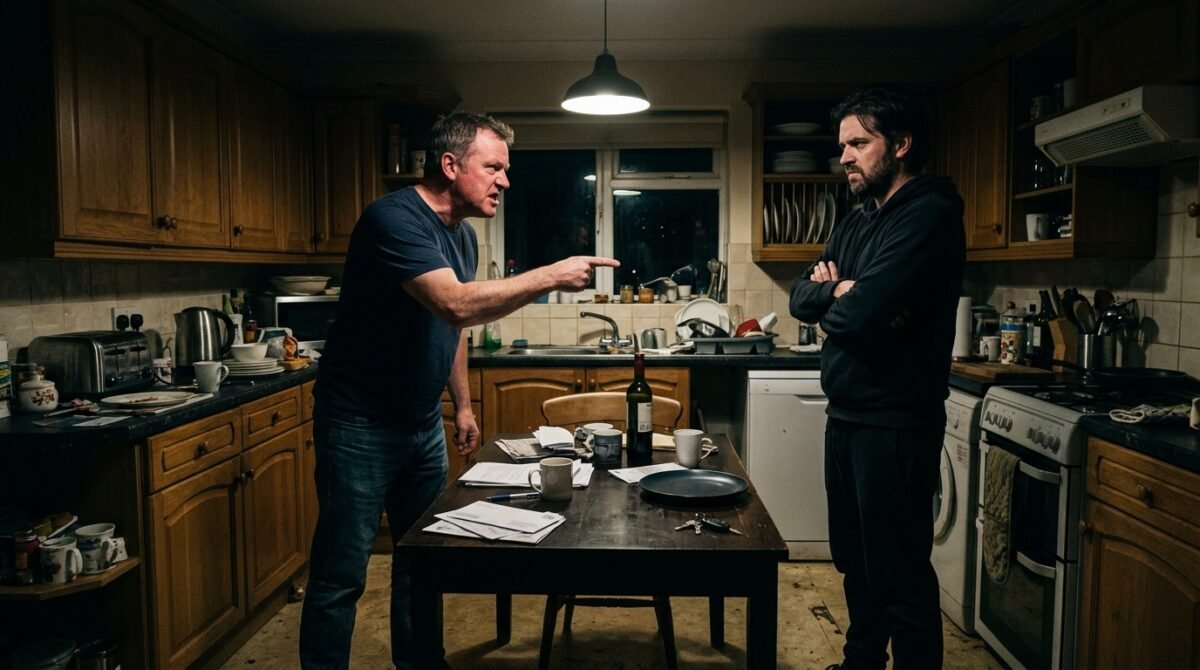
Mark didn’t try to deny it. He didn’t even have the decency to lie. He just stood there, looking at the receipt, and let out a long, heavy sigh as if I were the one inconveniencing him. ‘You weren’t supposed to find that yet,’ he said, his voice flat. His lack of remorse was more jarring than the act itself. He acted as though he had simply borrowed a cup of sugar, not stolen the irreplaceable remnants of a dead woman’s life.
I stood up, the chair scraping loudly against the hardwood floor. My voice was steady, which surprised me. I told him he had until morning to pack his things. I told him that if he didn’t leave, I would call the police. I didn’t want to hear his excuses. I didn’t want to hear about his divorce, his financial struggles, or his ‘intentions’ to pay it back. He had crossed a line that can never be uncrossed.
“I needed the money, okay? She’s gone! She doesn’t need a piece of metal around her neck anymore. I was drowning! You have everything, and I have nothing. Why are you being so selfish?”
— Mark, screaming at me in the kitchen
The audacity of his claim that I was the selfish one left me speechless for a second. He was standing in my house, eating my food, wearing clothes I’d likely paid for, and he had the nerve to call me selfish for wanting to keep my dead wife’s belongings. It was the ultimate gaslight. He tried to pivot the conversation to his trauma, but I wasn’t having it. My grief was not a resource for him to exploit.
He tried to argue that he would get the items back once he ‘got on his feet.’ He promised he had a plan, that it was just a temporary measure. But I saw through it. There was no ‘getting on his feet’ for Mark. There was only the endless cycle of taking, burning bridges, and moving on to the next victim. I told him he was no longer my brother in my house. I was done.
He spent the next hour throwing his clothes into suitcases, muttering under his breath about how ‘cold’ and ‘unforgiving’ I was. He actually tried to guilt me into letting him stay for just one more week. I didn’t budge. I watched him zip the bags, watched him shove my life into the back of his car, and for the first time in months, I felt the air in my home begin to circulate again. The parasite was leaving the host.
The Family Group Chat Explosion
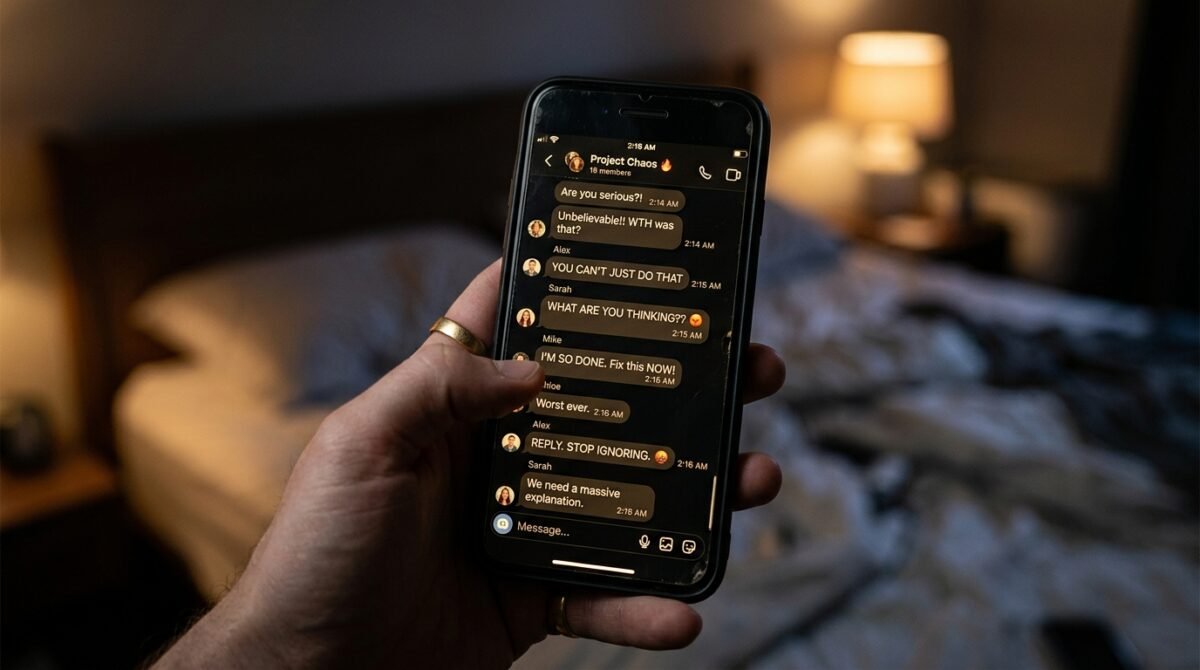
I thought the ordeal would end when he walked out the door, but I underestimated the reach of his manipulation. Within two hours of him leaving, my phone started vibrating incessantly. My mother, my aunt, and several cousins were blowing up the family group chat. Mark had spun a sob story, painting himself as the victim of a ‘heartless brother’ who threw him out onto the street in the middle of a divorce.
“I cannot believe you kicked your brother out when he is at his lowest. Family is supposed to help, not abandon! How can you be so cruel? Bring him back home this instant!”
— My Mother, in the Family Group Chat
I didn’t argue with them. I didn’t defend myself with a paragraph of text. I simply took a photo of the pawn shop receipt and the list of missing items, and I sent it into the chat. Then, I turned off my notifications. The silence that followed was deafening. No one had anything to say after they saw the proof of his betrayal. The narrative shifted, but not as quickly as I had hoped.
Even with the proof, some family members tried to make excuses. My aunt messaged me privately, suggesting that maybe I should have ‘addressed it differently’ or that ‘reporting him to the family’ made me look like the bad guy. The cognitive dissonance was staggering. They wanted to hold onto the image of Mark as the golden boy, and the reality of him as a thief threatened their entire worldview.
I realized then that my family was complicit in his behavior. They had spent a lifetime enabling him, making excuses for his failures, and shielding him from the consequences of his actions. By demanding I take him back, they were telling me that my boundaries—and my wife’s memory—were less important than keeping the peace. I decided right then that I wasn’t going to play that game anymore.
I blocked the group chat. I didn’t need to explain myself to people who would choose the comfort of a lie over the truth of my reality. The fallout was immediate. The phone calls started coming in, but I ignored them all. I was done being the family martyr. I was done sacrificing my peace for their dysfunction. For the first time, I felt truly autonomous.
The Reddit Verdict: NTA vs. ESH

I posted my story on Reddit to see if I was losing my mind. The response was immediate and overwhelming. I was bracing myself for judgment, wondering if I had somehow failed as a brother, but the collective voice of the internet was clear. Thousands of people agreed that I was in the right. They saw the theft for what it was: a violation of the most sacred space imaginable.
“NTA. He didn’t just ‘borrow’ money. He sold your late wife’s property to fund his own life. That’s not a mistake; that’s a deep moral failure. You aren’t just ‘kicking him out,’ you are protecting yourself from a predator.”
— u/JusticeForOP, Top Comment (35.2k upvotes)
There were, of course, the contrarians. A few users argued that ‘family is family’ and that I should have handled it with therapy or an intervention. They suggested that ‘maybe he was just desperate,’ as if desperation justifies the systematic looting of a home. I found those comments surprisingly easy to dismiss. It was clear that these people were likely enablers in their own lives, projecting their own fears onto my situation.
The most helpful comments were the ones from people who had been through similar betrayals. They shared stories about ‘the black sheep’ of the family, the ones who drain their relatives dry and then play the victim. Reading their stories made me feel less alone. It validated the anger I had been suppressing, the rage that I was told was ‘unbecoming’ of a brother.
I spent hours reading through the thread, finding comfort in the consensus. It wasn’t about the money. It was about the violation of trust. People understood that my home was a memorial, a place of peace, and Mark had turned it into a crime scene. The validation gave me the strength to stand my ground when the family members finally stopped texting and started showing up at my door.
The discussion also pushed me to take legal action. Several users suggested that I file a police report, not necessarily to get him arrested, but to create a paper trail in case he tried to lie about where he got the items. I decided to take their advice. I went to the station the next day. It was another step in reclaiming my life, another action that signaled to everyone—and especially to myself—that I was no longer a victim.
The Unannounced Visit from My Parents

The weekend after the blowup, my parents arrived at my house unannounced. I saw their car pull into the driveway, and for a moment, I considered not answering the door. But I knew if I didn’t, they would just keep knocking. I opened the door, and they walked right in, looking around the living room as if they owned the place. My mother immediately started in on how I needed to ‘forgive and forget’ for the sake of the family.
I held up my hand to stop her. I told them that the conversation was over. They started talking about Mark being ‘homeless’ and ‘suicidal’—the classic manipulation tactics they had used for years. They didn’t mention the jewelry. They didn’t mention the betrayal. To them, the theft was a footnote, an unfortunate incident that I should have been ‘big enough’ to overlook.
“He is your brother! He made a mistake! Do you really want to be the reason he has nowhere to sleep? Think about what Sarah would say!”
— My Mother, trying to manipulate me with my wife’s memory
I felt a cold rage settle over me when she mentioned Sarah. I told her that Sarah would have been the first person to hold Mark accountable, and that using her name to defend a thief was the most disgusting thing I had ever heard. I opened the door wide and told them both to leave. I told them that if they didn’t, I would call the police on them for trespassing. They looked at me, shocked that I would finally stand up to them.
They left, but not before my father called me a ‘disappointment.’ That word, which used to haunt me, felt hollow this time. I was a disappointment to them because I wouldn’t let them treat me like a doormat anymore. I realized that my value in their eyes was only as high as my willingness to accommodate Mark. The realization was liberating. I didn’t need their approval; I needed my peace.
I changed the locks the next day. I installed a security system. I spent the afternoon cleaning the guest room, throwing away the junk he had left behind. I scrubbed the floors and opened the windows to air out the room. It felt like I was exorcising a ghost. The house was finally mine again, quiet and serene, just as it had been before he arrived.
The Legal Reality Check

The police visit was surreal. I sat in a sterile room, explaining to an officer how my brother had stolen my wife’s jewelry. I had the pawn shop receipt, which I had retrieved from the shop itself after showing them the proof of ownership. They were cooperative, and I had managed to get the locket back, but the other items were already gone—melted down or sold to private buyers. The loss of those items hit me harder than I expected.
The officer explained that since I had let him stay in the house, it was technically a civil matter in many ways, but the theft of the property was criminal. He asked if I wanted to press charges. It was a crossroads. If I pressed charges, Mark would likely go to jail. He would have a record. It would be the final, irreversible break with my family. I thought about it for a long time, sitting in my car in the station parking lot.
I realized that if I didn’t press charges, I was just teaching him that he could get away with it again. If he didn’t face consequences now, he would just move on to the next person—a friend, a new partner, or maybe even my parents. I realized that pressing charges wasn’t an act of cruelty; it was an act of public service. I was holding him accountable for the life he had chosen to lead.
“I want to press charges. I have the receipts, the photos, and the proof. I am done being the one who covers for him.”
— Me, speaking to the police officer
I filed the report. It was the hardest thing I’d ever done, but as I walked out of the police station, I felt a weight lift off my shoulders. I wasn’t just reacting to his betrayal; I was setting the terms of my own future. I was no longer the victim of Mark’s choices; I was the architect of my own justice. The fear that had been gnawing at me for months finally began to dissipate.
The legal process would be long and difficult, and I knew the family would try to intervene. My lawyer had already warned me about potential pressure from relatives to drop the charges. I was ready. I had documented everything, from the initial move-in to the pawn shop receipts. I had prepared myself for the long haul. I was ready to face whatever came next, knowing I had finally done the right thing for myself.
The Aftermath and My New Normal

It has been six months since I kicked Mark out. The dust has settled, and the silence in my house is no longer heavy—it is peaceful. I have spent this time rebuilding my life, one day at a time. I started going to therapy to deal with the grief of losing Sarah and the trauma of the betrayal. I learned how to set boundaries, how to say no, and how to value myself beyond my usefulness to others.
My family still doesn’t talk to me, and honestly? I don’t miss it. The distance has given me a clarity I never had before. I realize now that they were never a source of support; they were a source of drain. By cutting them off, I have made room for people who actually respect me, people who don’t view me as a resource to be exploited. I have built a new, smaller, more authentic support system.
The legal case against Mark is ongoing. He has tried to reach out several times, begging me to drop the charges and offering hollow apologies that didn’t include a single mention of the stolen items. I haven’t replied to a single message. I have blocked every number he uses. I am not interested in his performance of remorse. I am interested in justice, and I am interested in moving forward.
“I’ve learned that the most difficult thing to do is to love someone enough to let them face the consequences of their own actions. I loved him, but I love my own peace more.”
— Reflections from my journal
I have filled the empty spaces in my home with new memories. I bought new art, changed the furniture arrangement, and made the house feel like mine again—not a museum for the past, but a home for my present. I still miss Sarah every single day, but her memory is no longer tainted by the shadow of the theft. I can look at her photos and smile, knowing that I protected the legacy she left behind.
I am not the person I was before Mark moved in. I am stronger, more guarded, and more aware of the traps that family dynamics can set. I know now that loyalty should be earned, not just assumed because of a shared bloodline. I have found a new sense of purpose in my life, and I am finally, truly, moving forward.
Conclusion
My journey from a grieving widower to someone who had to stand up against his own blood was not a path I would have chosen, but it was a journey that saved me. The betrayal by my brother was a catalyst for a radical shift in my life. It forced me to confront not just his toxicity, but the enabling culture of my entire family. When you are in the middle of it, you think you’re being kind, you think you’re being the ‘bigger person,’ but sometimes, the bigger person is the one who says ‘no’ and walks away.
The jewelry is just stuff. It was the violation that mattered. By reclaiming my home, I reclaimed my boundaries and my dignity. If you are in a situation where you feel obligated to support someone who is actively harming your peace, take this as your sign: you are allowed to close the door. You are allowed to prioritize yourself. You are not a bad person for choosing your own sanity over someone else’s dysfunction.
I am curious, though—what would you have done? Would you have pressed charges against a sibling? Would you have cut off the rest of the family who demanded you facilitate the abuse? Let me know your thoughts in the comments below. Let’s start an honest discussion about the limits of familial loyalty and the necessity of self-preservation. I’ll be reading.
What's your verdict on this dilemma?
Vote below to contribute to the official community consensus.

Have a Dilemma Keeping You Up at Night?
Share your real-life feud, wedding chaos, or relationship crossroads anonymously with our editorial team.
What do you think ?
0 Comments🛡️ Comments are moderated to protect community integrity. Your comment will appear once approved by the editorial team.