
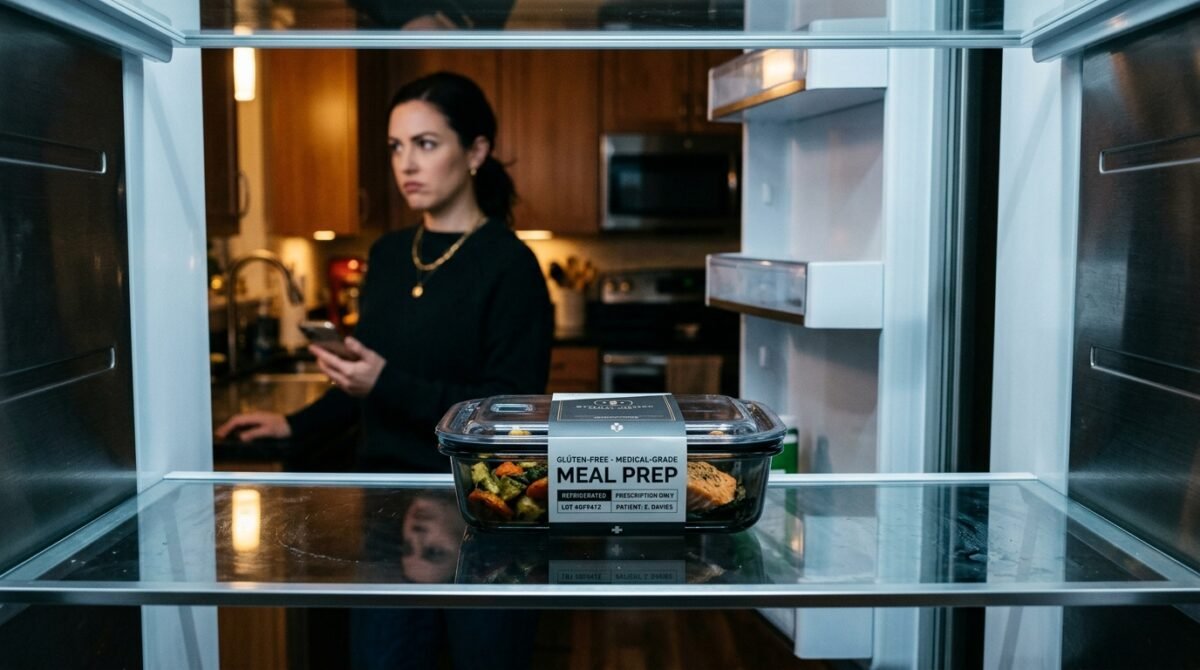
Living with a roommate is rarely a seamless experience, but for most people, it remains within the realm of polite compromises and shared chore charts. However, my living arrangement with Sarah shifted from ‘annoying’ to ‘medically dangerous’ the moment she decided my dietary restrictions were merely a suggestion. As someone with severe Celiac disease, my food isn’t a lifestyle choice; it is a clinical requirement. When I store my prescription-grade, certified gluten-free meals in the fridge, it is a matter of physical safety, not personal preference.
For months, I had been the ‘easygoing’ roommate, ignoring the occasional missing snack or the ‘borrowed’ milk. I thought we had an understanding. But last Tuesday, I came home to find my entire week’s worth of specialized, high-cost meals sitting in the trash, replaced by rows of identical, plastic-wrapped chicken and broccoli containers. Sarah had cleared my shelf to make room for her ‘Sunday Reset’ meal prep, apparently deciding my food was taking up too much ‘real estate.’ She didn’t even apologize; she simply told me I should ‘stop being so dramatic’ and ‘just buy cheap stuff from the grocery store’ like everyone else.
The audacity of the move triggered something in me that had been dormant for months. It wasn’t just the food; it was the blatant disregard for my health and the financial hit I took, which amounted to nearly four hundred dollars. I realized that if I let this slide, I was essentially telling her that my health was disposable. So, I took a step that most would consider nuclear: I calculated every penny, printed a formal invoice, and taped it to the refrigerator door.
This story isn’t just about a fridge war; it’s about the crushing entitlement that arises when one person decides their needs outweigh the physical health of another. It’s about the silent buildup of resentment, the explosion of a confrontation, and the aftermath of setting a boundary that the other person was never prepared to respect. What followed was a week of escalating tensions, group chat drama, and a housemate who suddenly found herself playing the victim in a game of her own making.
The Sunday Evening Kitchen Confrontation
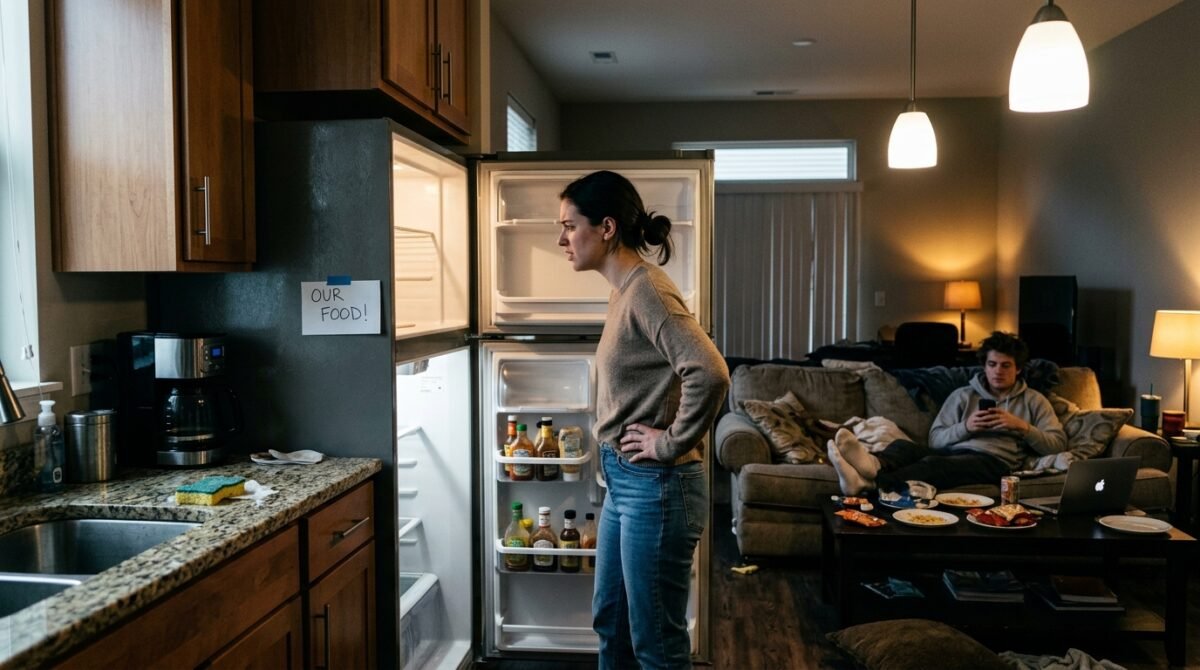
The confrontation started the moment I opened the refrigerator door. The smell of her overly-seasoned meal prep hit me first, but it was the visual void where my carefully organized, medically-approved meals should have been that stopped me cold. My heart rate spiked, not just because I was hungry, but because the realization of what she had done crashed over me in a wave of disbelief.
I walked into the living room, where Sarah was lounging on the sofa, scrolling through her phone, looking perfectly content with her ‘productive’ weekend. I didn’t raise my voice, but my hands were shaking as I held up the empty space where my life-sustaining food had been. I needed to know exactly what she was thinking, or if she was thinking at all.
“Sarah, please tell me you didn’t throw away the meals that were labeled with my name and medical instructions. I spent four hours prepping that food, and it cost me a fortune because of my Celiac diagnosis. Where is it?”
She didn’t even look up from her screen at first, dismissively waving a hand toward the kitchen. She acted as though I was bothering her over a trivial matter, completely failing to acknowledge the severity of her actions. Her nonchalance was more infuriating than the act itself, a clear indicator that she saw me as an inconvenience rather than a co-habitant.
“Oh, honestly, stop with the drama. Your food takes up way too much space, and it looks weird anyway. I needed the shelf for my meal prep, and I thought you’d appreciate me cleaning up the fridge. It’s just food, you can go buy more at the store. It’s not like it was expensive.”
I felt the blood drain from my face. The idea that she could unilaterally decide to dispose of hundreds of dollars of medically necessary items because she wanted a more aesthetically pleasing fridge was a new low. The sheer arrogance of her assumption that my life and health were something she could simply reorganize was the breaking point.
I realized then that there was no point in arguing about the ‘value’ of the food with her. She had already decided that her convenience was the priority. I simply turned around and walked back to my room, my mind already calculating the damages. If she wanted to play a game of professional fridge management, I was going to provide her with a professional invoice.
Drafting the Four Hundred Dollar Invoice
That night, I didn’t sleep. Instead, I sat at my desk and pulled up my bank statements and receipts. Every ingredient, every specialized flour blend, every organic protein source—I itemized it all. I wasn’t just counting the cost of the food; I was factoring in the wasted time and the immediate replacement cost I would now incur because I couldn’t simply walk into a store and buy a safe alternative.
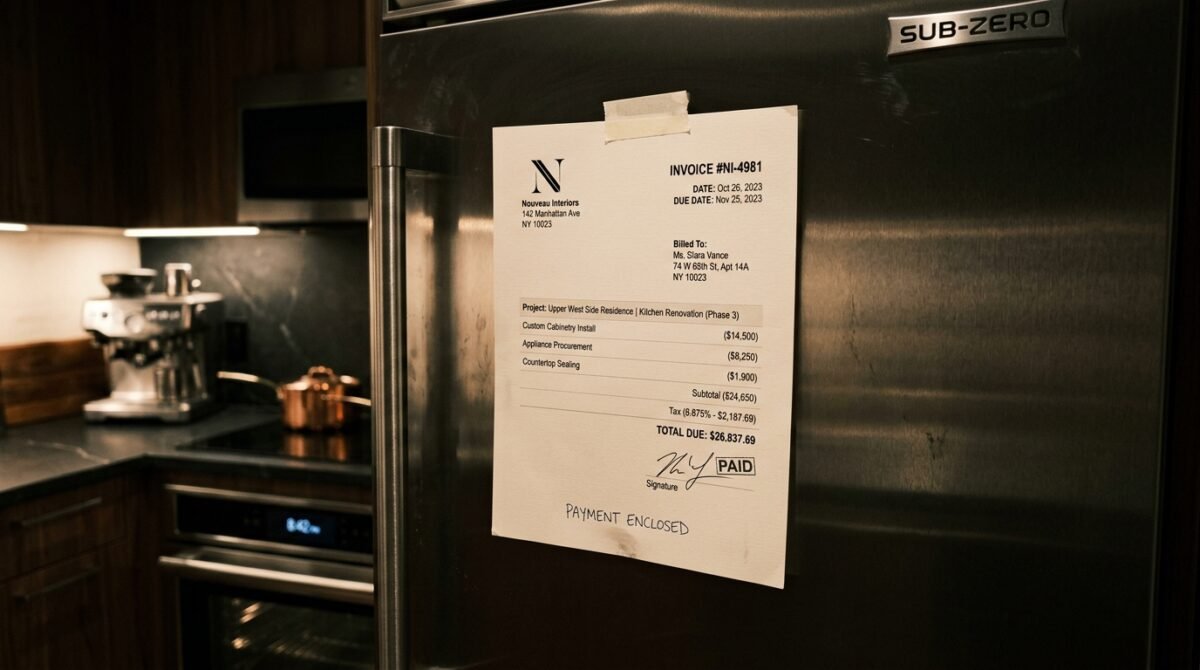
The total came to $412.50. I rounded it down to $400 for the sake of simplicity, but I made sure the document looked official. I used a spreadsheet template, added a formal header, a due date, and a ‘description of services rendered’ that highlighted the cost of medical-grade ingredients and the labor required to prepare them. I wanted her to see that this was not a petty request; it was a demand for restitution.
I knew Sarah would be furious. She had a habit of spending money on expensive skincare and designer gym gear, yet she constantly complained about ‘the economy’ whenever the rent was due. Seeing a demand for payment—especially one that she felt was ‘unnecessary’—would shatter her fragile sense of entitlement. I printed three copies: one for her, one for our landlord (who was copied on the email), and one for my own records.
“Itemized Invoice: Disposal of Medical-Grade Nutritional Supplies. Replacement cost for 12 units of gluten-free, cross-contamination-free prepared meals. Total Due: $400.00. Payment required within 48 hours or further action will be taken regarding the lease agreement.”
Walking to the kitchen in the morning, I felt a strange sense of calm. I felt like an actor in a play I hadn’t auditioned for, but one where I had finally decided to take control of the script. I taped the invoice directly to the refrigerator, right over the middle of her precious meal prep containers. It was a statement, a boundary, and a warning all in one.
I didn’t wait for her to come out. I went to work, knowing that by the time I returned, the house would be a pressure cooker. I was ready for the explosion, but for the first time in months, I felt like the person who had been wronged was finally standing up for herself. The emotional exhaustion was still there, but the uncertainty of how to handle the situation had vanished.
The Group Chat Explosion

By noon, my phone was vibrating incessantly. A flurry of messages had flooded our shared house group chat, where Sarah had looped in our mutual friends to ‘expose’ how crazy I was. She hadn’t bothered to mention that she had thrown out my food first; she only painted the picture of a roommate who was shaking her down for money over a ‘simple misunderstanding.’
“Can you guys believe this? OP just taped a formal bill for $400 to the fridge because I moved some old containers. She’s acting like I committed a crime. I’m literally shaking right now. I just wanted a clean fridge!”
— Sarah, House Group Chat
I read the messages as they came in. It was fascinating to see how she curated the narrative to suit her needs. She had completely omitted the fact that the food was marked, that it was medical-grade, and that it had cost me a significant amount of money. My friends were jumping to her defense, echoing her sentiments about me being ‘unreasonable’ and ‘overreacting.’
I waited until the conversation reached a fever pitch before responding. I didn’t use emojis, and I didn’t use flowery language. I simply laid out the facts in a way that made it impossible to ignore the reality of the situation. I knew that once the truth was out, the tide of opinion would shift, and I was eager to watch it happen.
“Sarah, the food you threw away was medically necessary for my Celiac disease. It wasn’t ‘old.’ It was fresh prep for the week. You admitted to throwing it out to make room for your meal prep. You had no right to touch my things, and because of you, I have to pay for a replacement immediately. The invoice stands. Pay it by Friday, or we can discuss this with the landlord.”
— OP, House Group Chat
The silence that followed was deafening. Even through the screen, I could feel the tension shift. The friends who had been quick to call me ‘crazy’ were suddenly silent. The realization that this was about a medical condition rather than a petty food dispute was the turning point I needed. Sarah didn’t reply to the chat, but I saw the ‘read’ receipts pop up one by one.
Later that evening, I walked into the kitchen to find her standing there, staring at the invoice. She looked tired, and for a brief moment, I thought she might actually apologize. But she didn’t. She looked at me with cold, hard eyes and asked how I could possibly think this was the right way to handle a roommate situation. I didn’t back down.
The Landlord’s Unexpected Involvement

The next morning, I received an email from our landlord. Sarah had tried to go over my head, claiming that I was creating a ‘hostile living environment’ by posting financial demands on the common areas. She was hoping he would intervene and tell me to back down. Little did she know, I had already sent him a detailed email with photos of the food containers, the labels, and the cost breakdown before I even posted the invoice.
The landlord, a man who valued peace and quiet above all else, was not impressed by Sarah’s dramatics. He had dealt with her complaining about everything from the noise levels to the color of the kitchen walls. He saw right through the attempt to frame me as the aggressor. His reply was short, professional, and exactly what I needed to keep the pressure on.
“I have received both sides of the complaint. Sarah, please note that tenants are prohibited from disposing of other tenants’ personal property. This is a violation of the lease terms regarding mutual respect and common area usage. OP, the invoice is a personal matter between you both, but I strongly advise you to resolve this amicably to avoid a breach of lease notice for all parties.”
— Mr. Henderson, Property Manager
I felt a massive weight lift off my shoulders. The landlord had essentially sided with me by clarifying that Sarah’s actions were a lease violation. It gave me the legal standing I needed to keep the invoice on the fridge. I didn’t care if it made the house look ‘ugly.’ The ugly part was her lack of respect for my health, not the piece of paper demanding payment.
Sarah, however, was livid. She interpreted the landlord’s email as a personal attack. She spent the entire day slamming doors, playing loud music, and intentionally making noise in the kitchen. It was the behavior of a teenager, not a grown woman. I stayed in my room, working on my own projects, ignoring the noise, and feeling a strange sense of satisfaction.
I began looking for new apartments. I knew this living arrangement was beyond saving. The damage was done, the trust was incinerated, and I couldn’t imagine living with someone who would gamble with my health for the sake of a clean fridge. The invoice was just the beginning; the final step was finding a way out of this lease, and now I had the ammunition to make that happen without penalty.
Why the Internet Took My Side

When I finally posted the story to Reddit, I expected to be called the ‘asshole.’ I thought people would say I was being too petty, or that I should have just let it go. Instead, the response was overwhelming. Thousands of people, many of whom also dealt with autoimmune conditions or chronic health issues, rallied behind me. The community didn’t see a petty roommate dispute; they saw a serious violation of bodily autonomy.
“NTA. People really don’t understand that for someone with Celiac, that food isn’t just ‘groceries.’ It’s medicine. To throw it away to make room for meal prep is so incredibly entitled that I’m actually shocked she’s even questioning the bill. She owes you every cent.”
— u/CeliacWarrior99 (Top Comment, 18.2k upvotes)
The thread exploded. People began sharing their own stories of roommates who had destroyed their food, their equipment, or their sanity. It was a validation I hadn’t realized I needed. The consensus was clear: Sarah was the one in the wrong, and my decision to bill her was not only justified but necessary to establish that my boundaries would not be ignored.
Other comments were more practical, offering advice on how to legally break the lease or how to handle the situation if she refused to pay. I read through hundreds of comments, feeling less isolated. It wasn’t just about the $400 anymore; it was about standing up to the kind of entitlement that so many people in the workforce and the rental market face every single day.
“The $400 is the ‘stupid tax’ she has to pay for being an entitled jerk. If you don’t charge her, she will absolutely do it again. Don’t budge on the amount, and keep that invoice right where it is until she pays up. This is a textbook case of needing to set a hard boundary.”
— u/BoundarySetter (12.4k upvotes)
The overwhelming support gave me the courage to stay the course. I realized that my own self-doubt—that nagging feeling that maybe I *was* being too dramatic—was a byproduct of years of being told to ‘just be nice’ and ‘go along to get along.’ The internet had cleared the fog. I was in the right, and Sarah was going to pay the consequences of her choices.
The community reaction also served as a sanity check. Whenever I felt like I might be taking it too far, I would re-read the top comments. They reminded me that my health, my time, and my money were valid. The support wasn’t just digital noise; it was a rallying cry that empowered me to finish what I started, regardless of how much Sarah complained.
The Bitter Confrontation and the Final Payment

Friday arrived, the deadline I had set on the invoice. Sarah had spent the week avoiding me, but I knew she wouldn’t pay without a direct demand. I waited for her in the kitchen that evening, my laptop open, prepared to document the entire exchange if necessary. When she walked in, she looked at the kitchen table, then at me, then at the invoice, which was still taped to the fridge.
“Are you really doing this? You’re ruining our friendship over $400? I thought we were roommates, not business partners. This is so petty, and I can’t believe you’re putting me in this position.”
I didn’t blink. I looked her directly in the eyes. The ‘friendship’ she was talking about had been a one-sided arrangement where I supported her lifestyle, and she treated me like a convenience. I wasn’t the one ruining it; she had ruined it the moment she decided to throw away my health-essential food.
“Sarah, you ruined our living arrangement when you threw away my food. You didn’t ask, you didn’t apologize, and you didn’t think about the consequences. This isn’t about being petty; it’s about being held accountable for your actions. I need the money for the replacement, or I’m taking this to small claims court. The choice is yours.”
She huffed and stormed over to her laptop. She was shaking with anger, and for a moment, I thought she might throw something. But she knew that I wasn’t bluffing. She went to her banking app and started the transfer. The ping of the notification on my phone a minute later was the most satisfying sound I had heard in months.
She didn’t speak to me as she walked out of the kitchen. The air was thick with resentment, but the battle was over. I had my money, and I had my answer: she would never truly understand why she was wrong, but she had been forced to respect the boundary. I felt a sense of finality that was almost physical. The room felt lighter, even though the tension remained.
The Aftermath: Moving Out

With the money paid and the boundary established, the environment in the apartment became increasingly unbearable. We were effectively living as strangers, avoiding eye contact in the halls and timing our kitchen usage so we wouldn’t have to interact. It was the inevitable end of a relationship that had clearly been decaying for a long time.
I didn’t waste any time looking for a new place. Within two weeks, I had found a studio apartment that was smaller but entirely my own. The thought of having a fridge that was exclusively mine, where I could store my food without fear of it being tossed, felt like a luxury I couldn’t wait to afford. I started packing my boxes, each one representing a step toward freedom.
When the day came for me to move out, I didn’t say goodbye to Sarah. I didn’t feel the need to. Our interaction was strictly transactional, and that was exactly how I wanted it to be. I left the keys on the kitchen counter, right next to the spot where the invoice had been taped, a silent reminder of the event that changed the trajectory of my year.
Leaving that apartment felt like escaping a prison. The stress of the last few months seemed to evaporate as I loaded the last of my boxes into the moving van. I felt a sense of lightness that I hadn’t experienced since I first moved in. I had learned the hard way that when someone tells you who they are—even through something as ‘small’ as throwing away your food—you should believe them.
I realize now that the $400 was a small price to pay for the clarity I gained. I lost a roommate, sure, but I also lost a source of constant, low-level anxiety. I regained my own space, my own boundaries, and the knowledge that I am capable of standing up for myself even when the pressure is at its highest.
Reflecting on the ‘Petty’ Label

I’ve had time to think about the ‘petty’ label people love to throw around in these situations. Is it petty to demand compensation for stolen or destroyed goods? We don’t call it petty when a store charges a customer for damages, yet when it happens between individuals, especially roommates, there’s an expectation that we should just ‘suck it up’ to maintain the peace.
I think this expectation is dangerous. It encourages people to violate boundaries because they know they won’t face any real consequences. If I hadn’t billed her, she would have learned that my space and my health are things she can mess with whenever she wants. By making her pay, I changed the dynamic and ensured that she would think twice before doing it again to someone else.
I’ve also realized that the people who called me petty are often the same people who have never had to deal with a serious dietary restriction or a chronic health condition. They don’t understand the effort that goes into living safely in a world that isn’t designed for you. My food isn’t just fuel; it’s a carefully curated part of my health routine.
I’m not ashamed of what I did. In fact, I’m proud of it. I’m proud that I didn’t let my anger turn into a shouting match, but rather into a structured, reasonable demand for justice. I’m proud that I didn’t compromise my own needs to make someone else feel comfortable. And most of all, I’m proud that I recognized a toxic situation and took the necessary steps to leave it.
The internet debate proved that this isn’t just about me. It’s about a cultural shift in how we view roommates, boundaries, and personal responsibility. We are finally starting to see that being a ‘good roommate’ doesn’t mean being a doormat. It means mutual respect, which is a two-way street.
Lessons in Setting Boundaries

Looking back, the biggest lesson I learned is that boundaries aren’t just for others to follow—they are for me to enforce. It’s easy to say you have boundaries, but it’s much harder to follow through when the other person is your roommate and you have to see them every single day. The invoice was my way of signaling that my boundaries were serious, and it worked.
I’ve also learned that I need to be more selective about who I live with. In the future, I will be upfront about my dietary needs and the importance of kitchen space. I will treat the living arrangement like a contract, because, in many ways, that’s exactly what it is. I won’t just assume that everyone understands the importance of food safety or shared respect.
I’ve also realized that standing up for yourself can be lonely. During the week when the group chat was against me, I felt a deep sense of isolation. But I also found that the people who really mattered—the ones who supported me once they understood the facts—were the only ones whose opinions I should have been concerned with anyway. The ‘friends’ who didn’t care about my health were never really friends to begin with.
Moving forward, I’m taking these lessons with me into every relationship, professional or personal. I know now that I don’t have to apologize for my needs. I don’t have to apologize for taking up space. And I certainly don’t have to apologize for holding others accountable when they cross the line.
The $400 was a small investment in my self-worth. Every time I look at my new, clean, and safe refrigerator, I’m reminded of how far I’ve come. I’m no longer the person who lets others dictate my health; I’m the person who takes charge of my life, one invoice at a time.
Community Perspectives and Final Thoughts

The Reddit community feedback has continued to roll in, and it’s been eye-opening to see the diverse perspectives on the situation. Some have focused on the financial side, others on the medical urgency, and some have simply applauded the sheer boldness of the move. It’s clear that this issue resonates with so many people because we have all, at one point or another, felt our boundaries violated in our own homes.
“You absolutely did the right thing. I’m a landlord, and I tell my tenants that if they ever have a dispute, keep receipts. You were professional, you were fair, and you followed through. That’s how you get things done. Don’t let anyone tell you you were petty.”
— u/LandlordPro (5.2k upvotes)
It’s interesting to see how the ‘NTA’ (Not The Asshole) verdict has held up over time. It confirms that the majority of people understand that actions have consequences. The fact that the story went viral suggests that many people are looking for a way to assert themselves in similar situations but are afraid of the social fallout. I hope my story serves as an example that you can hold your ground without losing your cool.
I have no regrets about how I handled things. I was pushed to a corner, and I used the tools I had to get back to a position of stability. The fact that Sarah had to pay the price for her lack of awareness is simply a consequence of her own choices. I hope she learned something from this, though I’m not holding my breath.
As for the future, I’m moving on. I’m focused on my health, my work, and creating a life that is safe and fulfilling. I’ve learned that when you stand up for yourself, you don’t just gain respect from others; you gain a profound sense of self-respect that is worth far more than any amount of money.
I invite you all to share your own stories in the comments. Have you ever had to draw a hard line with a roommate or a friend? How did it go? Did you hold your ground, or did you cave to the pressure? Let’s talk about what it really means to set boundaries in a world that often demands we sacrifice them for the sake of ‘keeping the peace.’
Conclusion
My journey through this roommate dispute has been one of the most unexpected chapters of my life. What began as a simple disagreement over refrigerator space spiraled into a test of character, boundaries, and self-worth. By standing my ground and demanding accountability, I didn’t just fix a financial problem; I reclaimed my autonomy.
The takeaway here is simple: your health and your boundaries are not negotiable. Whether it’s an autoimmune condition, a strict budget, or just the basic need for a peaceful home, you have the right to protect your environment. Don’t be afraid to demand what is owed to you, especially when your well-being is at stake.
What about you? Have you ever had to issue a formal ‘invoice’ to a friend or roommate to make them realize the severity of their actions? Or do you think there’s a better way to handle these explosive domestic conflicts? Share your thoughts in the comments below—I’m eager to hear how you navigate the tricky world of shared living.
What's your verdict on this dilemma?
Vote below to contribute to the official community consensus.

Have a Dilemma Keeping You Up at Night?
Share your real-life feud, wedding chaos, or relationship crossroads anonymously with our editorial team.
What do you think ?
0 Comments🛡️ Comments are moderated to protect community integrity. Your comment will appear once approved by the editorial team.