
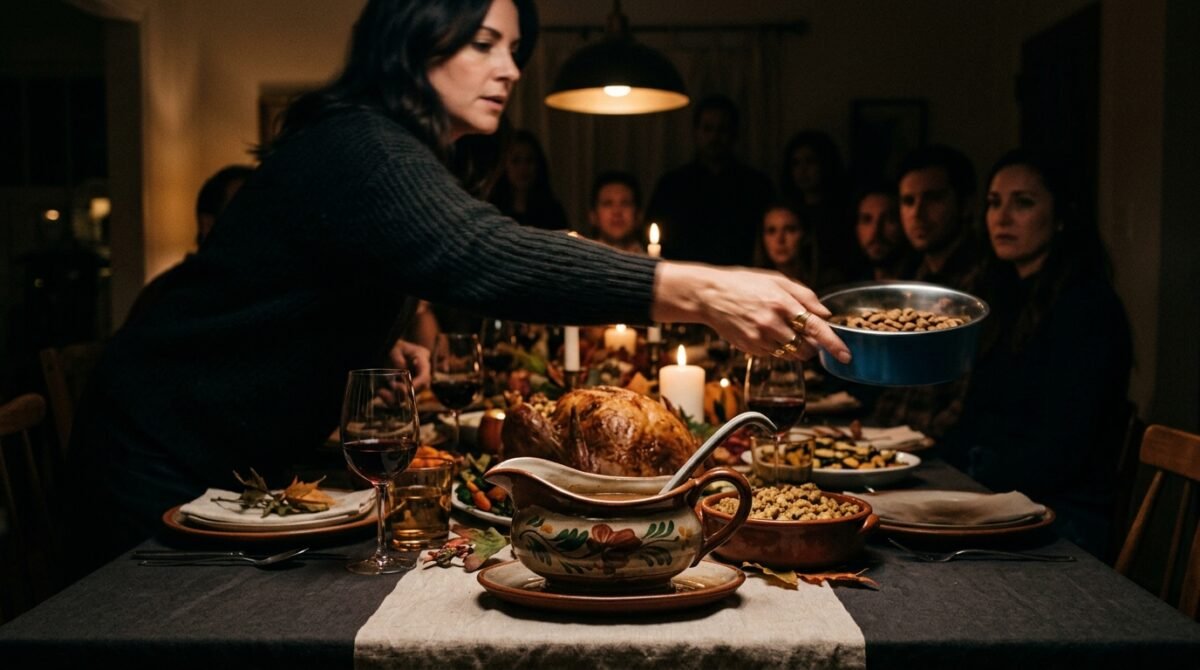
Thanksgiving has always been a complicated affair in our house, but I never expected the holiday to end with me standing on the front lawn, keys in hand, shivering in the November cold as I realized my mother’s sense of humor had officially crossed the line from ‘eccentric’ to ‘psychotic.’ For years, my mother has prided herself on being the family ‘joker.’ She viewed holidays not as moments of gratitude or connection, but as elaborate stages for her latest social experiments. From ‘accidental’ hair dye in the shampoo to swapping salt for sugar in the morning coffee, her pranks were the stuff of legend, often whispered about with a mix of dread and amusement by my cousins and siblings.
But this year was different. This year, my mother decided that the Thanksgiving gravy—the absolute centerpiece of the meal—was the perfect vessel for her twisted brand of comedy. She had been acting strangely all day, hovering over the stove with a manic energy that kept me on edge, but I chalked it up to the pressure of hosting a party of twelve. I was wrong. I was so incredibly wrong.
As we gathered around the table, the smell of turkey and sage filled the air, promising a perfect evening. The wine was poured, the prayers were said, and the anticipation was palpable. My father looked tired, perhaps already sensing the inevitable fallout, but he remained silent, eyes fixed on his plate. I didn’t know then that I was about to participate in a culinary betrayal that would fundamentally change my relationship with my family forever.
The moral dilemma here isn’t just about the food; it’s about the relentless erosion of trust. When your parent views your discomfort as entertainment, where do you draw the line? The incident wasn’t just about a distasteful ingredient; it was about the power dynamic, the lack of respect, and the sheer audacity of someone who believes they can feed their family pet food under the guise of ‘fun’ and expect everyone to laugh it off.
This story is about the breaking point. It’s about the moment you realize that the person you’re supposed to trust most in the world has lost their grip on what it means to be a decent human being. As the first spoonful of gravy touched my tongue, I felt a wave of nausea that had nothing to do with the flavor profile, and everything to do with the realization that my mother had made me, and everyone else at that table, a participant in her sickness.
The Setup in the Kitchen
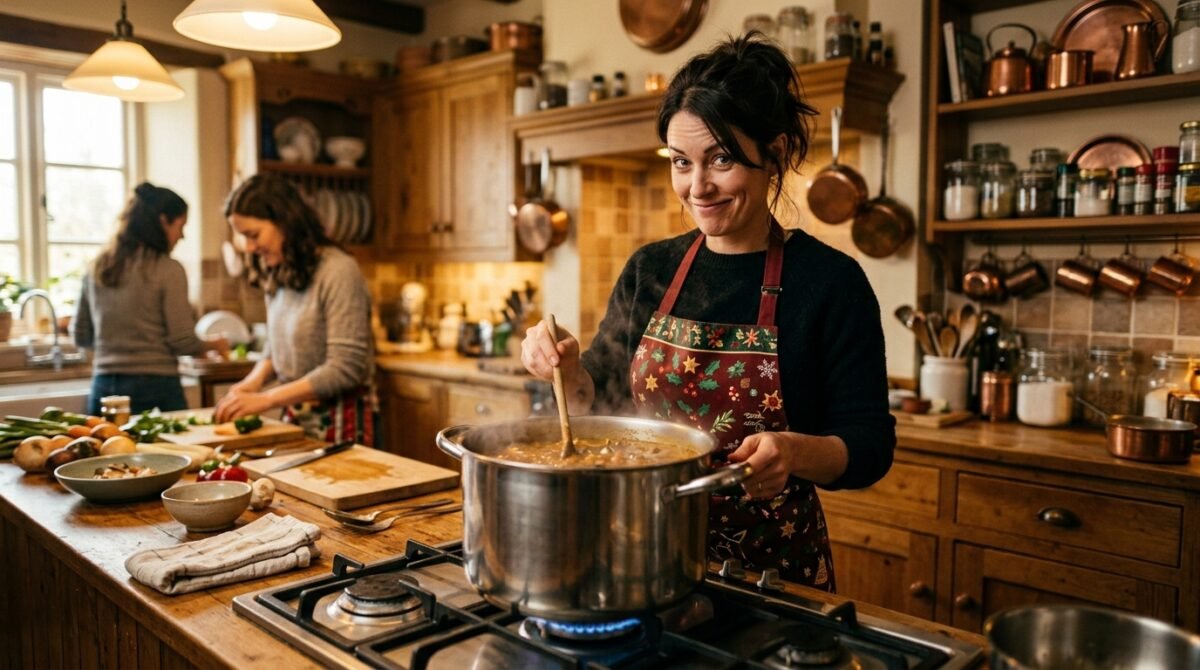
The morning started with an unnatural amount of activity in the kitchen. My mother, usually a frantic cook, was unusually calm, almost serene, as she stirred the gravy. She told me to stay out, claiming she was perfecting a ‘secret family recipe’ that had been passed down from my great-grandmother. I didn’t think much of it, although the faint, earthy scent emanating from the pot was distinctly different from the usual poultry-based aroma of a standard gravy.
I tried to poke my head in a couple of times, but she was quick to push me out, her smile a little too wide, her eyes darting toward the pantry. I noticed a large bag of grain-free dog food sitting on the counter, but I assumed she was getting ready to feed our golden retriever, Buster, before the guests arrived. I never questioned it until later.
“Mom, is everything okay? You’ve been in there for hours. Let me help with the mashed potatoes at least.”
— Me, trying to be helpful
“No, no, darling! This is my masterpiece. Go change into something nice. And don’t you dare touch that gravy boat until I’m ready to serve!”
— My Mother, with an unsettling grin
The tension in the house was thick enough to cut with a knife, but everyone was trying to be on their best behavior for the sake of the holiday. My siblings arrived, children were playing in the living room, and the house felt like a powder keg waiting for a match. Little did I know, the match had already been lit in the kitchen.
Looking back, I should have seen the signs. The way she kept looking at the pantry, the way she was humming a tune that sounded vaguely like a funeral march. But we were all so hungry and so eager for a pleasant evening that we ignored our intuition. We allowed ourselves to be lulled into a false sense of security, believing that even my mother wouldn’t ruin Thanksgiving.
She carried the gravy boat to the table with the ceremony of a queen delivering a crown. She set it down right in the center, and for a moment, the room went silent. She looked around, her eyes sparkling with a mischievousness that I now recognize as pure malice. She was waiting for the reactions. She was waiting for the first taste.
The First Taste and the Realization
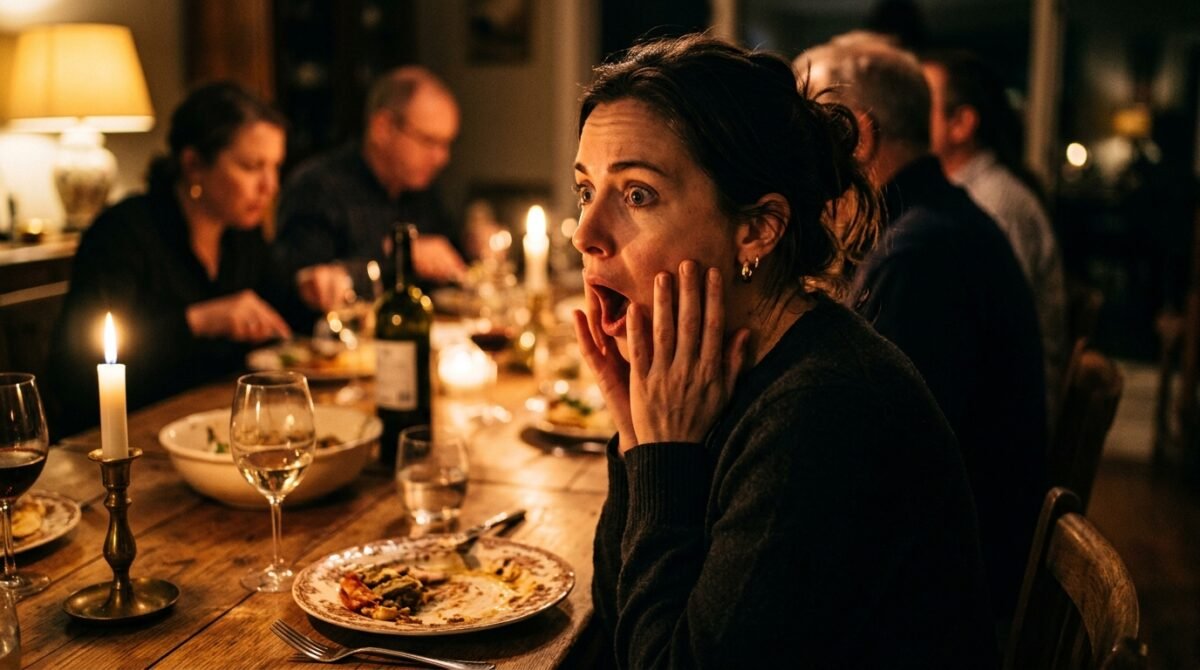
I was the first to ladle the gravy onto my turkey and potatoes. It looked slightly darker than usual, with a strange, grainy texture that I tried to dismiss as ‘rustic’ or ‘homemade.’ I took a bite, and immediately, my palate felt wrong. There was a dense, salty, metallic aftertaste that definitely didn’t belong in a traditional turkey gravy. It was savory, yes, but in a way that felt processed and artificial.
I looked at my brother, who was already halfway through his plate. He had a look of confusion on his face. He slowed down, his fork hovering mid-air. My mother was watching us intently, her hands folded in her lap, her posture perfectly still. She wasn’t eating. She was waiting.
“Mom, what is in this? It tastes… weird. Like liver, but not the good kind of liver.”
— My brother, squinting at his plate
“Oh, you’re just sensitive! It’s a classic European technique. It adds depth. You kids don’t know real cooking,” she replied, her voice far too high-pitched.
I pushed my plate away. The smell hit me again—that distinct, earthy, dry-kibble smell. It wasn’t the smell of herbs and stock. It was the smell of the stuff we poured into Buster’s bowl every morning. My stomach dropped through the floor. I looked at the bag of dog food that had been on the counter earlier, and then I looked at my mother’s triumphant, twisted smile.
The horror of it started to spread around the table. One by one, my aunts, my uncle, and my cousins stopped eating. The room, which had been filled with laughter and conversation only minutes before, became deathly quiet. You could hear the clink of silverware hitting china, a sound that suddenly felt like a gavel hitting a block.
“Is this… did you?” I couldn’t even finish the sentence. My voice was shaking, not with anger yet, but with pure, unadulterated disbelief. I felt like I was in a nightmare. I looked at my father, who was still chewing, his face turning a shade of pale that I had never seen before.
The Confession of a ‘Prankster’
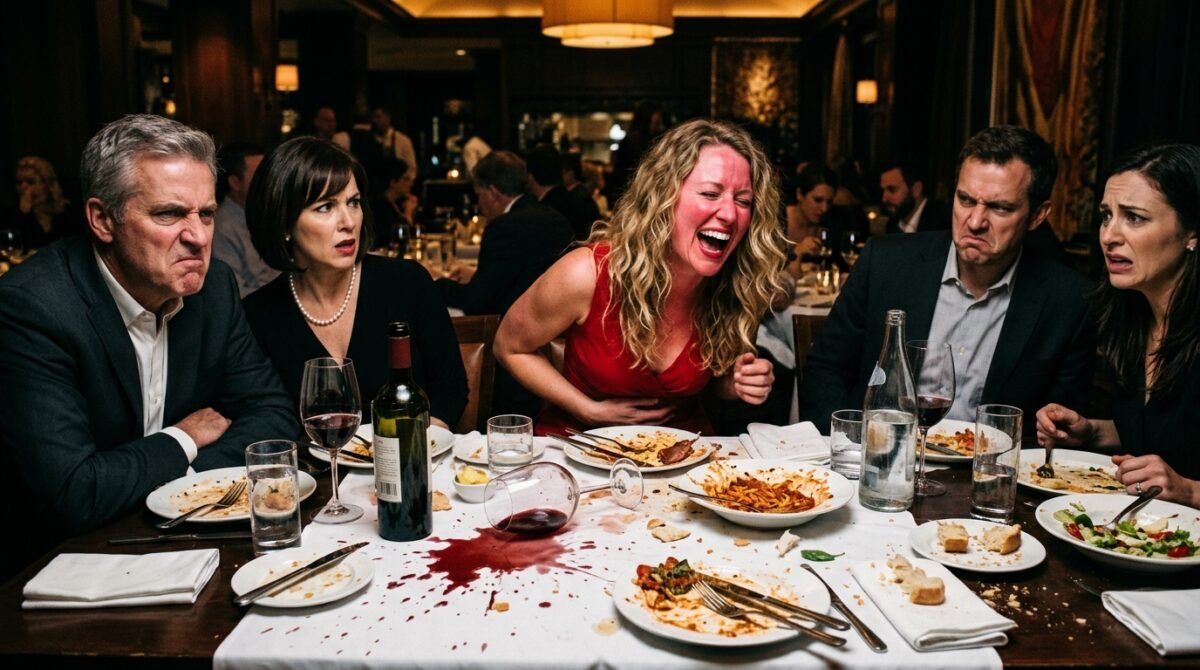
My mother didn’t even try to hide it. As soon as the realization hit the table, she burst into a peal of laughter—not a light, bubbly laugh, but a loud, harsh sound that grated against the silence. She clapped her hands together like she had just performed a successful magic trick.
“You should see your faces!” she shrieked, tears of laughter streaming down her cheeks. “The look on your faces when you thought you were eating dog food! The ‘classic European technique’ was just the bag of premium lamb kibble I ran through the food processor. It’s essentially just meat and grains, right? It’s not like it’s poison!”
“Are you serious? You fed us dog food? You literally put animal feed in our Thanksgiving dinner and thought it was a joke?”
— Me, standing up from the table
“Oh, loosen up! It’s Thanksgiving. We’re supposed to be grateful. I wanted to see if anyone would even notice, and you all acted like it was a gourmet meal for ten minutes!”
— My mother, still laughing
The anger hit me then, a hot, searing wave of fury that wiped out any attempt at diplomacy. My aunt looked like she was going to be sick, and my younger cousin started to cry. The audacity was simply staggering. It wasn’t just a prank; it was a total violation of our health and our trust. She had manipulated us into consuming something meant for an animal, and she thought it was funny.
My father finally put his napkin down. He stood up, his chair scraping loudly against the floor. He didn’t look angry; he looked defeated. He had lived with this behavior for thirty years, but even he seemed to have reached a limit. “That’s enough, Linda,” he whispered, his voice trembling with a lifetime of pent-up exhaustion.
“Oh, don’t be such a wet blanket, Tom,” she snapped back, her mood shifting instantly from jovial to defensive. “It’s just a bit of fun. You people take everything so seriously. Nobody is going to die from a little bit of processed lamb and rice!” The way she dismissed our genuine revulsion was the final nail in the coffin of my patience.
The Walkout and the Silence

I didn’t argue. I didn’t yell. I didn’t try to explain why it was wrong, because at that moment, I realized that explaining it was futile. She was incapable of understanding why feeding her family pet food was a problem. So, I just grabbed my coat from the hallway closet. My siblings followed suit, their faces set in grim lines of solidarity.
“Are you really leaving?” my mother asked, her voice turning into a wounded whine. “After all the work I put into this? You’re going to walk out on your own family on Thanksgiving over a silly little joke?” I stopped at the door, my hand on the handle. I looked back at the table, where the gravy boat sat like a trophy of her insanity.
“It’s not a joke, Mom. It’s a boundary, and you’ve crossed it for the last time. Enjoy your dinner.”
— Me, walking out the door
The drive home was silent. We were all in shock. We stopped at a fast-food drive-thru, the only place open on the holiday, and ate burgers in the parking lot. It was the most depressing meal of my life, yet it tasted better than anything I had eaten at my mother’s house. I realized then that my childhood was defined by these moments—the constant gaslighting, the ‘pranks,’ the feeling that I was an extra in a play written by a madwoman.
By the time I reached my apartment, my phone was blowing up with notifications. My mother was sending messages to the family group chat, painting herself as the victim. She was claiming that she had been ‘misunderstood’ and that we were all ‘spoiled brats’ who couldn’t appreciate a sense of humor. It was the same script she had used every time one of her stunts backfired.
I didn’t answer. I didn’t block her yet, but I silenced the notifications. I needed space to process the fact that I had just spent my Thanksgiving dinner as a test subject for my mother’s cruelty. I sat in the dark for a long time, watching the lights of the city and wondering how many other ‘pranks’ I had unknowingly participated in over the years.
The Digital Fallout and Family Pressure
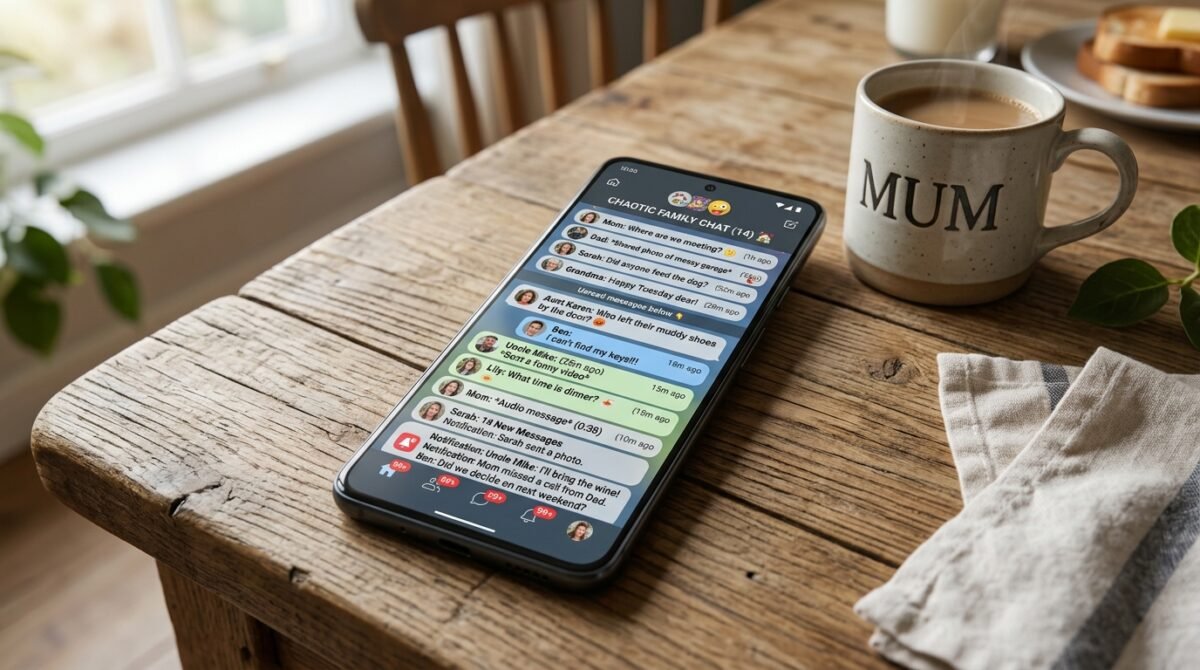
The next morning, the group chat was a battlefield. My aunts and cousins were divided. Some were mortified, siding with me and my siblings. Others, likely fearful of my mother’s wrath or simply conditioned by years of enabling, were trying to play the mediator, suggesting that we were being ‘too dramatic’ and that she ‘didn’t mean any harm.’
“Look, she’s always been like this. It’s just how she shows she’s excited. Why don’t you guys just apologize and go over for leftovers? She’s really upset.”
— My Aunt Karen, defending the indefensible
“She fed us kibble, Aunt Karen. Are you insane? If you want to eat dog food, go right ahead, but don’t tell us we’re being dramatic.”
— My brother, in the group chat
It was fascinating to see how the family dynamics played out in real-time. The people who had been the most vocal about their disgust at the table were now backtracking, trying to keep the peace. It made me realize how deep the rot went. My mother had spent years conditioning everyone to accept her behavior as ‘eccentric’ rather than abusive. By challenging it, I wasn’t just fighting my mother; I was fighting an entire system of dysfunction.
I decided to stop reading the messages. I drafted a short, clear response to the group, stating that I would be taking a break from family gatherings until I could feel comfortable that my boundaries would be respected. I didn’t mention the dog food again. I didn’t need to. The fact spoke for itself. I was done being a character in her twisted theater.
My phone continued to buzz for hours. Calls from my mother, calls from my father, calls from relatives who wanted to ‘get my side’ so they could gossip about it later. I finally put the phone in a drawer and turned it off. The silence was golden. It was the first time in my life I felt like I was actually in control of my own holiday.
The Reddit Trial: Searching for Perspective

I knew I needed a reality check, so I turned to the only place that could provide an objective, albeit brutal, perspective: Reddit. I wrote up the story in the AITA sub, trying to keep it as factual as possible, though the disgust was clearly seeping through the prose. I titled it: ‘AITA for walking out of Thanksgiving because my mother put kibble in the gravy?’
I waited for the verdict. Within an hour, there were hundreds of comments. Most of them were absolute shock. People were calling it everything from ‘abuse’ to ‘a health hazard.’ It was validating to read that I wasn’t the crazy one, that my reaction was perfectly normal for someone who had just been fed animal feed as a prank.
“NTA. This isn’t a prank. This is poisoning. Kibble is not meant for human consumption, and the fact that she did this to her own family, to her own children, is honestly sociopathic. You need to go NC immediately.”
— u/ReasonableObserver (Top Comment, 32.4k upvotes)
“The way she laughs at your discomfort is the biggest red flag. This is a power play. She wanted to see how far she could push you before you broke. She won, because you left, but she lost because you realized the truth. Stay away from her.”
— u/PsychologyBuff (15.2k upvotes)
Reading the comments was like receiving a masterclass in boundary setting. People shared their own stories of parents who treated them like toys, and it made me feel less alone. The consensus was overwhelming: I was not the asshole. My mother was abusive, and the ‘prank’ was just the latest in a long history of boundary violations that I had been too close to see clearly.
Some comments were even more practical, suggesting that I contact my father to ensure he wasn’t eating the rest of the ‘gravy’ over the weekend. That was a chilling thought. I picked up the phone, still in the drawer, and hesitated. Should I check on him? Would he even listen to me? I decided to send him one final text, warning him about the potential health issues of the kibble, and then left it at that.
The Aftermath: A Change in the Family Dynamic

In the weeks following Thanksgiving, the family shifted into a cold war. My mother kept trying to reach out, sending gifts and ‘apology’ notes that basically boiled down to ‘I’m sorry you felt that way.’ She refused to acknowledge that her actions were inherently wrong. Meanwhile, my father stayed in the middle, trying to play peacemaker but clearly suffering from the tension.
I stayed firm. I didn’t go to the December holiday gatherings. I spent Christmas with friends, which felt like a massive victory. It was peaceful, it was honest, and there was absolutely no kibble in the gravy. I realized that my family was a choice, not just a biological obligation. I was finally building the life I wanted, one that didn’t involve navigating the landmines of my mother’s ego.
My siblings were divided. My younger sister felt that we were being ‘too hard’ on Mom, that we should just forgive and move on. My brother, however, was in the same boat as me. We formed a little ‘rebel’ faction, checking in on each other and making sure we didn’t fall back into the habit of excusing her behavior. We were the only ones who really understood the gravity of that night.
“I just can’t shake the memory of her face while she watched us eat. It’s like she wasn’t even there. It was like she was observing an experiment. I don’t think I can ever look at her the same way again.”
— My brother, during a phone call
The distance helped me heal. I started therapy, which was the best decision I ever made. The therapist helped me understand that my mother’s behavior was a manifestation of deep-seated narcissism. She didn’t want a family; she wanted an audience. And when the audience stopped applauding, she lashed out.
I stopped waiting for an apology that would never come. I stopped hoping that she would suddenly have a ‘lightbulb moment’ where she realized that her pranks were cruel. I accepted her for exactly who she was—a person who was incapable of empathy—and by doing that, I freed myself from the need to please her.
Reflecting on the ‘Prankster’ Mentality

I often wonder what she was thinking, truly. Was it purely a power move? Or was there some twisted logic where she thought this was a way to bond with us? The more I learned about the psychology of the ‘joker’ personality, the more I understood that it was always about control. By making us eat something gross, she was asserting that her word, her kitchen, and her ‘fun’ were more important than our bodily autonomy.
It’s a terrifying thing to realize that the person who raised you doesn’t see you as a person with feelings, but as a prop in their own life. It’s a violation that goes deep. It affects how I approach other relationships now, making me more aware of the signs of manipulation. I find myself much quicker to set boundaries with friends and partners, not out of fear, but out of a newfound respect for my own well-being.
“The most dangerous people are the ones who hide their cruelty behind the mask of a joke. When you call them out, they make you the villain for ‘not having a sense of humor.’ It’s the ultimate gaslighting tool.”
— My therapist, during our session
I feel sorry for her in a way, but it’s a distant, detached kind of pity. She’s trapped in her own ego, doomed to repeat these cycles until she’s completely alone. And while that’s a sad reality, it’s not my responsibility to fix it. I’ve done my time in the trenches of her drama, and I’m ready to move on.
This whole ordeal has taught me that silence is a powerful tool. When you stop engaging, when you stop providing the reaction that they crave, the power dynamic collapses. She didn’t have a ‘show’ if I wasn’t there to watch it. By leaving, I took away her stage, and that, more than any argument, was the most effective punishment I could have given her.
Lessons in Boundaries and Self-Worth

If I could talk to the person I was on that Thanksgiving morning, I’d tell them to trust their gut. I’d tell them that the moment the food smelled wrong, they should have walked away. I’d tell them that they didn’t owe anyone a ‘polite’ holiday meal if it meant compromising their dignity.
We are taught to respect our elders and to keep the peace, especially during the holidays. But those expectations are often used as weapons to keep us silent. We accept behaviors from family members that we would never tolerate from a stranger. Why? Because we’re told that ‘family is family.’ But being family doesn’t give someone the right to dehumanize you.
“Boundaries aren’t about being mean. They’re about protecting your peace. If someone can’t handle your boundaries, they aren’t someone you need in your life.”
— A piece of advice I read online that stuck with me
I’m proud of myself for leaving. It wasn’t the easy choice; it was the hardest one. It meant losing a family tradition, it meant dealing with the fallout, and it meant facing the reality that my mother isn’t the person I wanted her to be. But it was the only choice that allowed me to keep my self-respect intact.
I’m moving forward now. I’m hosting Thanksgiving this year, and I’ve made it very clear that there will be no ‘secret ingredients.’ It’s going to be simple, it’s going to be safe, and it’s going to be exactly what I want it to be. And for the first time in my life, I’m actually looking forward to the holiday.
Moving Forward: Life Beyond the Gravy

Life is quiet now. I’ve gone low-contact with my mother, which has been a relief. We exchange polite, short messages on holidays and birthdays, but the deep, emotional connection is gone. And surprisingly, I don’t miss it. The weight of the constant anxiety—the fear of what she would do next—has finally lifted.
I’ve learned to value the people who don’t need to be managed, who don’t need to be ‘pranked’ into showing their love. My friends are a family of my own making, and they treat me with a respect that I finally feel I deserve. We have a rule in our group: if something isn’t funny to everyone, it’s not a joke. It’s a simple rule, but it’s one that keeps us safe and happy.
“The best revenge is living a happy, peaceful life where you don’t even think about the people who tried to hurt you.”
— My brother, during a recent dinner
I still think about that gravy sometimes. It’s a vivid memory, a marker of the point where the illusion of a ‘happy family’ finally shattered. But it doesn’t hurt anymore. It’s just a fact, a piece of my history that I’ve integrated and left behind. I am more than the daughter of a woman who fed her family dog food. I am a person who knows her worth, and that is a victory that no amount of gravy can diminish.
As I look toward the future, I feel a sense of lightness that I never thought possible. I’ve broken the cycle. I’ve shown that I’m not a prop, and I’m not a victim. I’m the author of my own life, and I’m writing a much better story from here on out.
Conclusion
The story of the ‘kibble gravy’ is, at its heart, a story about the transition from childhood dependency to adult sovereignty. It’s a reminder that we are not obligated to tolerate abuse simply because it comes from a parent or is wrapped in the guise of a holiday tradition. The moral of this story isn’t just about the dangers of pranking; it’s about the necessity of boundaries.
When we look at our own family dynamics, it’s easy to dismiss small slights as ‘just how they are.’ But often, those small slights are the foundation for much larger betrayals. By identifying these behaviors and choosing to prioritize our own well-being, we aren’t being selfish; we’re being responsible. We’re acknowledging that our health—both mental and physical—is worth more than the comfort of maintaining a dysfunctional status quo.
What about you? Have you ever had a ‘prank’ go so far that it changed your relationship with a family member forever? How did you handle it, and what did it teach you about your own limits? Join the debate in the comments below: Is there ever a line that shouldn’t be crossed in the name of ‘family fun,’ or is this just a classic case of generational differences?
What's your verdict on this dilemma?
Vote below to contribute to the official community consensus.

Have a Dilemma Keeping You Up at Night?
Share your real-life feud, wedding chaos, or relationship crossroads anonymously with our editorial team.
What do you think ?
0 Comments🛡️ Comments are moderated to protect community integrity. Your comment will appear once approved by the editorial team.