
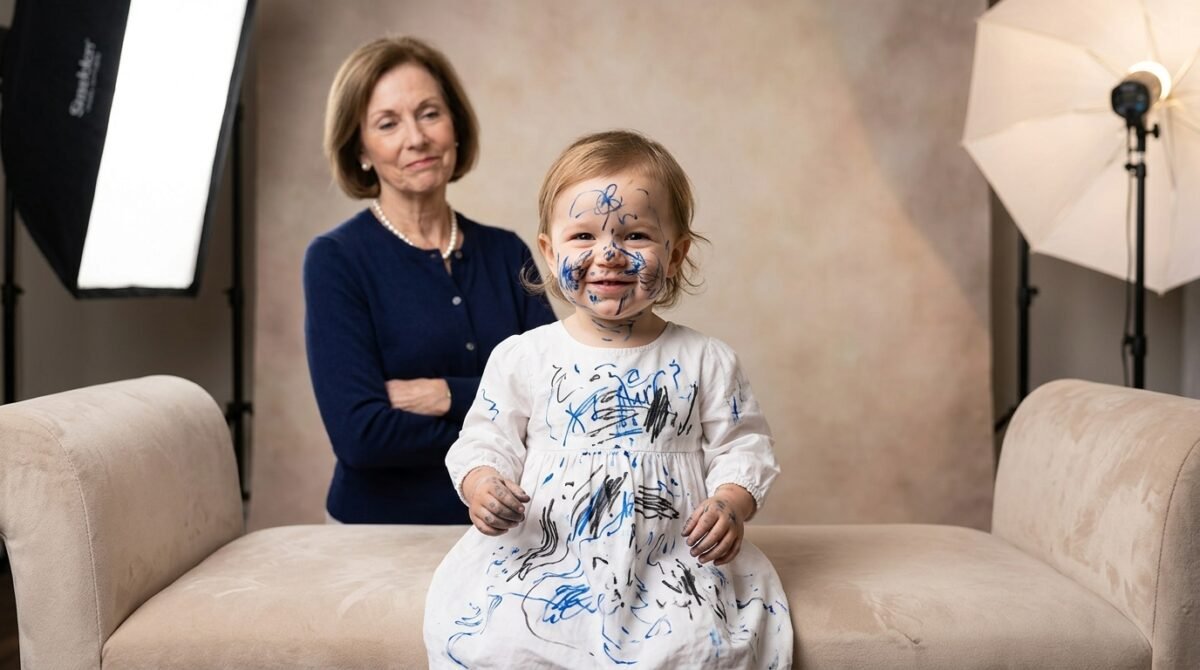
Family portraits are supposed to be a hallmark of domestic harmony—a snapshot of a moment captured in time to display on mantels and digital frames for years to come. For my family, this was supposed to be the first time we were all together since my son, Leo, turned two. We had invested over $800 in a professional photographer, coordinated outfits for six adults and one toddler, and spent weeks preparing for the perfect aesthetic. Little did I know that my mother-in-law, Brenda, viewed our family legacy through a very different, more chaotic lens.
Brenda has always struggled with the concept of boundaries. Since Leo was born, she has consistently undermined my parenting choices, from feeding him sugary snacks right before dinner to ignoring nap schedules. I usually brush it off, telling myself that it is just a generational difference. But the morning of our portraits, the tension was palpable. She arrived uninvited, claiming she just wanted to ‘help’ get the kids ready, despite my specific instructions that we had a professional stylist.
The moral dilemma here wasn’t just about the ruined photos; it was the blatant disregard for my authority as a parent and the complete destruction of a costly, once-in-a-lifetime event. When I walked into the playroom, I found Brenda handing my toddler a set of permanent, oil-based tattoo markers—the kind that don’t come off for days—under the guise of ‘artistic expression.’ My heart sank as I saw my son’s face, neck, and beautiful white silk outfit covered in thick, dark blue ink.
The air in the room grew heavy with the smell of sharpie markers and my own rising panic. I didn’t scream, and I didn’t cry. Instead, a cold, hard resolve settled into my chest. I knew that I couldn’t undo the damage in the next thirty minutes, but I also knew that I would be the one living with these photos for the next twenty years. That was the moment I decided that Brenda would be immortalized in our family history, but not quite in the way she anticipated.
The Strategic Sabotage in the Playroom
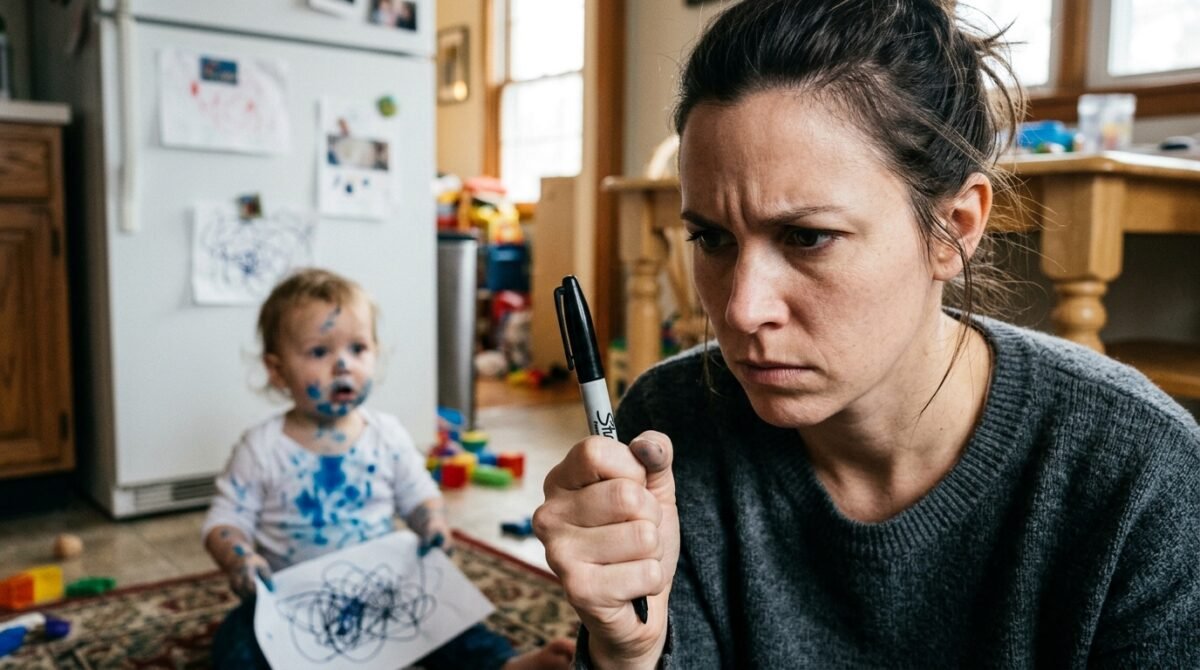
The playroom had been a sanctuary of calm until I entered that morning. I had specifically chosen non-toxic crayons and paper, but Brenda had brought her own ‘gifts.’ As I pushed open the door, I saw my son Leo laughing, his hands and face a canvas of deep navy blue. Brenda was leaning over him, guiding his hand as he pressed a permanent marker directly into the soft skin of his cheek.
I felt the blood drain from my face. I looked at the markers on the floor—professional-grade permanent markers that I had specifically told the family not to bring into the house. I walked over, my voice trembling with controlled fury, and asked her what on earth she thought she was doing. She didn’t even look up, just wiped a smudge of ink off his nose with her thumb, smearing it further.
“He was so bored, dear. Children need to be creative. If you were a more relaxed mother, you wouldn’t be so stressed about a little bit of ink. It makes the photos more ‘authentic,’ don’t you think?”
— Brenda, responding to my shock
I realized then that this wasn’t an accident. It was a power play. She wanted to see if she could ruin my plans, if she could push me to lose my temper in front of the extended family. She wanted to be the one to dictate how the day went. I grabbed the markers, threw them into the trash, and told her that we were going to the studio immediately.
The drive to the studio was filled with silence. Leo was confused, and I was frantically scrubbing his face with alcohol wipes, which only succeeded in making his skin raw and red. My husband, Mark, kept glancing at me, clearly sensing the storm clouds, but he chose to look at his phone instead of intervening. That was the moment my respect for him—already on thin ice—finally fractured.
By the time we reached the studio, I had reached a state of numbness. I looked at my toddler, who looked like a miniature convict, and then at Brenda, who was applying lipstick in the mirror with a look of extreme self-satisfaction. I knew what I had to do. I pulled the photographer aside, explained the situation with a cold, clear voice, and made a request that would change the trajectory of our relationship forever.
The Professional Request That Shocked the Studio

The photographer, a woman named Sarah, looked at my son and then at my mother-in-law. She had seen difficult families before, but she hadn’t seen this level of petty interference. I looked her in the eye and asked, ‘Can you edit the photos so that everyone is in them, but for the specific shots where she is standing, can you simply blur her face into a soft focus?’
Sarah raised an eyebrow. ‘I can do that, but people will notice. They will ask why only one person in the group is blurred while everyone else is in perfect focus. It will look like a mistake or a stylistic choice that doesn’t fit the rest of the set.’
“I don’t care if it looks like a stylistic choice. I don’t care if people think it’s a glitch. I want her removed from the focal point of my memory. Make it look like she wasn’t even meant to be seen clearly.”
— My response to the photographer
The session lasted an hour. Leo was miserable, crying for most of it, and the photos were a disaster of tear-streaked faces and ink-stained skin. Brenda, however, posed with the grace of a queen, her chin held high, oblivious to the fact that she was ruining the aesthetic of every single frame we were paying to capture. I didn’t say a word to her. I let her believe she had won.
I paid the bill in full, added a generous tip for the ‘extra processing,’ and sent the final approval for the retouching. When the digital gallery arrived a week later, I didn’t send the link to anyone. I waited. I knew that Brenda would be the first one to ask for the files, and I wanted to be ready for the reveal.
The tension during that week was unbearable. Mark kept asking me when the photos would be ready, and I kept stalling. I was internally debating whether I had gone too far, but every time I looked at the blurry, ink-stained photos of my son, the guilt evaporated. She had sabotaged my son for a power trip; I was simply correcting the narrative.
The Group Chat Explosion

When the link finally went live, I shared it in our family group chat. I had set the permissions so that Brenda’s face was consistently blurred in every single group shot, while everyone else remained crystal clear. It wasn’t just a slight blur—it was a heavy, artistic distortion that made her look like a ghostly presence or an accidental background blur.
The silence in the group chat lasted for exactly twelve minutes. Then, the pings started coming in, rapidly and aggressively. Brenda was the first to react, sending a barrage of question marks and exclamations. She clearly hadn’t looked at the photos closely yet, just the thumbnails.
“What is this? Is the photographer blind? Why do I look like a smudge in every single picture? This is an insult! Take these down immediately!”
— Brenda in the Family Group Chat
My phone buzzed constantly. Mark’s family began weighing in, some asking if it was a technical glitch, others realizing the malice behind it. I finally typed out my response, my hands shaking but my heart steady. I didn’t apologize. I didn’t lie. I simply stated the facts in a way that made it impossible to argue against.
I wrote that since the photos of my son were permanently ruined by the ‘artistic’ choices made by his grandmother, I decided to extend that same ‘artistic’ treatment to her. I told them that if she didn’t want to be a clear part of our family portraits, she wouldn’t be. The response was immediate and vitriolic.
Mark finally entered the conversation, taking his mother’s side. He told me that I was being childish and that I had embarrassed the entire family. But for the first time in our marriage, I stood my ground. I told him that if he wanted clear photos of his mother, he could go back and pay for a new session himself, because I was done footing the bill for her ego.
The Fallout at the Sunday Dinner
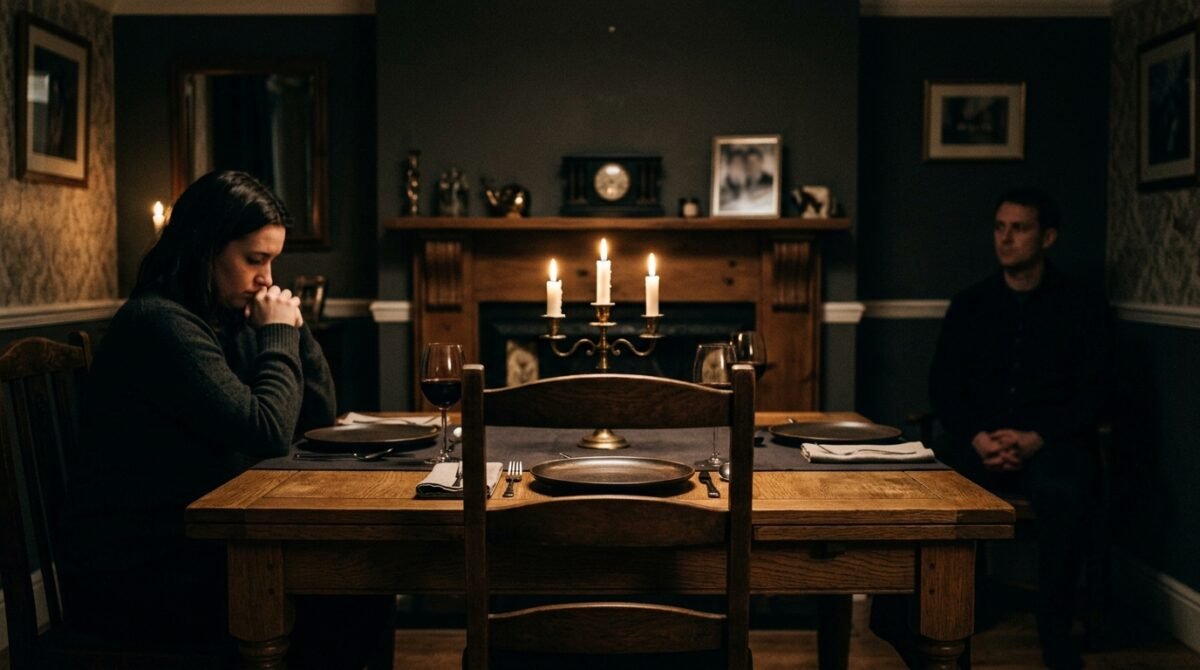
The next Sunday was a scheduled dinner at Brenda’s house. I debated not going, but I knew that if I didn’t show up, the narrative would be that I was ‘hiding’ from the consequences. I walked into that dining room with my head held high, clutching Leo’s hand. The atmosphere was colder than a winter storm.
Brenda didn’t even acknowledge me when I walked in. She went straight for Leo, trying to hug him, but I pulled him back slightly. She looked at me, her eyes narrow and sharp. She had a framed print of one of the photos on her mantle—but she had edited it herself, poorly cropping me out and sharpening her own face. It was pathetic.
“I hope you’re happy with yourself. You’ve humiliated me in front of the entire family. A mother-in-law deserves respect, not this petty, digital vandalism.”
— Brenda, cornering me in the kitchen
I laughed. I couldn’t help it. The audacity was just too much. I looked her right in the eye and told her that respect is a two-way street, and she had spent three years driving the wrong way down a one-way road. I told her that if she wanted to be a part of our lives, she had to stop treating my son like her personal experiment.
The rest of the family sat at the table, picking at their food, terrified to speak. It was the longest meal of my life. Every time a spoon hit a plate, it sounded like a gavel. I knew that this was the end of our old dynamic. The question was whether we were headed toward a permanent rift or a new, healthier set of boundaries.
By the time we left, I felt lighter. I hadn’t apologized, I hadn’t backed down, and I hadn’t let her define the parameters of the conflict. I had stood up for myself for the first time, and while the dinner had been a disaster, it was a disaster that felt entirely necessary.
Internet Verdict: The Reddit Thread
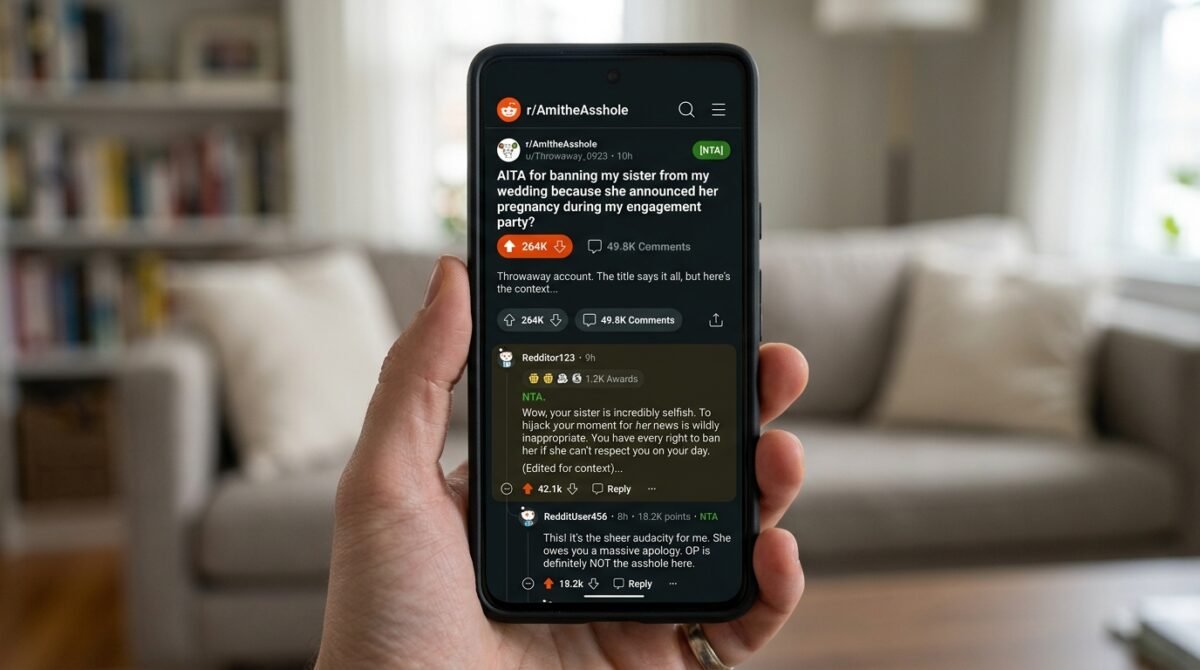
I posted the story on a popular subreddit later that night, not for validation, but for perspective. I titled it ‘AITA for blurring out my MIL after she ruined my son’s face with permanent markers?’ Within an hour, it had thousands of comments. The division was fascinating to watch, but the support for my decision was overwhelming.
“NTA. This isn’t just about a photo. This is about a pattern of behavior where your MIL actively undermines your parenting. The marker incident was a ‘test’ to see what she could get away with. By blurring her out, you didn’t just fix a photo; you established a boundary that said: ‘Your actions have consequences.’ Don’t back down.”
— u/BoundariesMatter (Top Comment, 32.1k upvotes)
Other comments were more skeptical, suggesting that I had been too petty and that I should have handled it through a conversation instead of a public stunt. I read through all of them, the support and the criticism alike. It was eye-opening to see how many people struggle with the same types of manipulative family members.
Some users shared their own stories of ‘passive-aggressive’ revenge, and it made me feel less alone. The consensus seemed to be that while my reaction was indeed petty, it was a ‘justified’ petty. When someone pushes you to the brink, sometimes a mirror is the only way to show them how they look to everyone else.
I kept the thread open on my phone for days, checking it whenever I felt a wave of guilt. It served as a constant reminder that I wasn’t crazy, that my anger was valid, and that my desire for boundaries was not a sign of a bad daughter-in-law, but a sign of a mother protecting her child.
The Financial Cost of Ego

Following the chaos, I sat down to calculate exactly how much Brenda’s ‘little experiment’ had cost us. It wasn’t just the $800 portrait session. It was the cost of the professional cleaning for the dress, the cost of the time we lost, and the emotional toll it took on my son, who had to be scrubbed raw to get the ink off.
| Expense | Cost | Reason |
|---|---|---|
| Photo Session | $850 | Ruined due to sabotage |
| Cleaning Services | $120 | Ink-stained clothes |
| Skin care/Treatment | $45 | Soothing lotions |
| Total | $1,015 | Brenda’s ‘Artistic’ Lesson |
I sent the invoice to Brenda with a note: ‘Since you wanted to be an active participant in the creative process, I thought you would want to contribute to the overhead.’ I didn’t actually expect her to pay it, but I wanted her to see the tangible cost of her actions. It was a move that, unsurprisingly, led to a phone call from my husband, who was now being pressured by his mother to ‘make me stop this madness.’
The conversation with Mark was the most difficult. He argued that we were family, and that family doesn’t send invoices to one another. I asked him, ‘Does family sabotage family? Does family ignore direct requests to keep a toddler safe? Because if that’s the definition of family you want to uphold, then I’m not sure we’re looking at the same picture.’
Mark had no answer. He knew I was right, but he was too afraid of his mother’s wrath to admit it. That was the moment I realized the problem wasn’t just Brenda—it was the enabling system that had been in place for decades. I decided then that I would not be a part of that system anymore.
The Silence That Followed

After the invoice incident, everything went quiet. No calls, no texts, no surprise visits. It was the peace I had been craving for years, but it was a heavy, ominous kind of peace. I knew that Brenda was likely plotting her next move, or perhaps she was finally realizing that the rules of engagement had changed permanently.
I spent that time focusing on my son. We did art projects with washable paint. We went to the park. We lived our lives without the constant anxiety of a ‘surprise’ visitor or a judgmental comment. I realized that my previous stress wasn’t just about the occasional disagreement; it was the constant, low-level hum of dread that accompanied any interaction with her.
Mark eventually started to come around, too. Without his mother constantly in his ear, he began to see things from my perspective. He admitted that the marker incident was a line crossed, even if he still felt that the ‘blurring’ was a step too far. We were finally talking, really talking, about the future of our family.
It was a slow process of rebuilding, but it felt genuine. We weren’t just sweeping things under the rug anymore. We were laying the rug out, cleaning it, and deciding if it even belonged in our house in the first place.
The Apology That Never Was

A month later, I received a letter in the mail. It wasn’t an apology. It was a formal request to ‘move past this petty drama’ for the sake of the family. It was full of phrases like ‘if you feel that way’ and ‘I’m sorry you were offended.’ It was a masterclass in non-apology.
“I hope we can put this behind us. It was a simple misunderstanding about the markers. I only wanted Leo to have fun. Please stop the nonsense with the photos and the invoices so we can return to normalcy.”
— A snippet from Brenda’s letter
I read the letter and tossed it into the fireplace. There was no ‘returning to normalcy’ because the old normal was broken. If she wanted a relationship with us, it would have to be on our terms, with respect for our boundaries and our parenting. If she couldn’t offer that, then the status quo would remain.
I didn’t reply to the letter. I didn’t send a follow-up invoice. I simply let the silence do the talking. Silence is a powerful tool when you’ve been the one providing all the noise for years. It forces the other person to confront their own actions, and for someone like Brenda, that is the most terrifying thing of all.
The family gatherings continued without us. We heard rumors that Brenda was telling everyone we were ‘difficult’ and ‘unstable,’ but we didn’t care. We had our own community, our own friends, and most importantly, our own peace of mind. The blurry photos stayed in the gallery, a permanent reminder of a line that would never be crossed again.
Reflecting on the Blurring of Boundaries

When I look back on that day now, I don’t feel the rage I felt in the studio. I feel a sense of satisfaction, not because I was ‘right,’ but because I was authentic. I refused to be a victim of someone else’s insecurity. I turned a moment of sabotage into a lesson that lasted, not just for her, but for me.
The blurring of her face was a metaphor for our new relationship. She was still present, she was still part of the family, but she was no longer allowed to be the focal point. She had to stay in the background, out of focus, while we lived our lives in the foreground. It was the only way to keep the picture of our life from being ruined by her ink.
I’ve learned that you don’t always have to win a fight to change a relationship. Sometimes, you just have to stop playing the game. When you stop reacting the way they want you to, the whole dynamic shifts. You become the one in control, even when you’re just sitting there, doing nothing at all.
If you find yourself in a situation where your boundaries are being ignored, don’t be afraid to take the ‘petty’ path if that’s what it takes to show them the mirror. Just make sure that the path you choose is one you can live with, and that the ultimate goal is not revenge, but your own peace.
Lessons Learned and Moving Forward

Today, our family life is completely different. We have clear, non-negotiable boundaries. We don’t do uninvited visits. We don’t do ‘gifts’ that violate our rules. And most importantly, we don’t do things that compromise our son’s wellbeing just for the sake of appearances. It took a while to get here, but it was worth every ounce of effort.
Mark and I have grown stronger. He is no longer the man who looks at his phone when his mother acts out. He is a partner who stands with me, even when it’s uncomfortable. We are a united front, and that is the strongest defense we have against any outside interference.
We still have family portraits taken, but we do them on our own terms now. We choose the photographer, we choose the outfits, and we make it clear that the focus is on our immediate family. It’s a joy, not a chore. And you know what? There isn’t a single person in the background who doesn’t belong there.
Life is too short to let people ruin the things that matter. Protect your peace, defend your boundaries, and never be afraid to blur the people who only bring chaos to your frame. Your story is yours to write, and you’re the one holding the pen—and the eraser.
Conclusion
The story of the blurred face is more than just a viral anecdote; it’s a testament to the power of self-advocacy. When we allow others to dictate our reality, we lose the ability to see ourselves clearly. By taking control of the final image, I reclaimed my right to define my family’s narrative, regardless of how much ‘ink’ was thrown my way.
This journey taught me that while we cannot control the actions of others, we can control how we integrate them into our lives. Sometimes, that means keeping them at a distance, and sometimes, it means literally blurring them out of the picture. Whatever your own ‘Brenda’ situation looks like, remember that your worth and your family’s happiness are not negotiable.
What about you? Have you ever had to take a stand against a boundary-crossing family member in a way that left everyone shocked? Did you regret it, or was it the turning point you needed? Join the discussion below and share your own stories of setting firm, uncompromising boundaries in the face of family drama. The community is listening.
What's your verdict on this dilemma?
Vote below to contribute to the official community consensus.

Have a Dilemma Keeping You Up at Night?
Share your real-life feud, wedding chaos, or relationship crossroads anonymously with our editorial team.
What do you think ?
0 Comments🛡️ Comments are moderated to protect community integrity. Your comment will appear once approved by the editorial team.