

Thanksgiving has always been a complicated affair in our family, but it was supposed to be a time of truce. For years, I had navigated the subtle jabs and the persistent, low-level toxicity that radiated from my stepdad, Richard. I had moved out, built a career, and finally felt like I was standing on my own two feet. Returning home for the holidays was a concession I made for my mother, who insisted that we all play nice for the sake of appearances.
The atmosphere in the dining room was heavy with the scent of roasted turkey and the sharp, metallic tang of suppressed resentment. We were halfway through the meal when Richard signaled for silence, his face wearing that smug, self-satisfied grin I had learned to dread. He didn’t want to talk about sports or the weather; he wanted to talk about my ‘financial contribution’ to the family legacy.
As he slid a crisp, white envelope across the mahogany surface, I didn’t think much of it—I assumed it was a birthday card I had missed or perhaps some legal document regarding a property transfer. I was completely unprepared for the reality of the situation. Inside that envelope was not a gift, but a ledger. An itemized invoice, complete with interest, calculating the cost of my childhood, from the groceries I consumed in grade school to the insurance premiums paid during my teenage years.
The air left the room. My mother stared at her plate, her hands trembling, while Richard sat back, awaiting my reaction as if he were a debt collector presenting a final notice. In that moment, the years of feeling like a guest in my own home, a burden to be quantified and liquidated, finally snapped. I didn’t scream, and I didn’t cry. I simply stood up, looked him dead in the eye, and realized that my freedom was worth far more than the comfort of a holiday tradition.
The Envelope That Turned the Table Cold
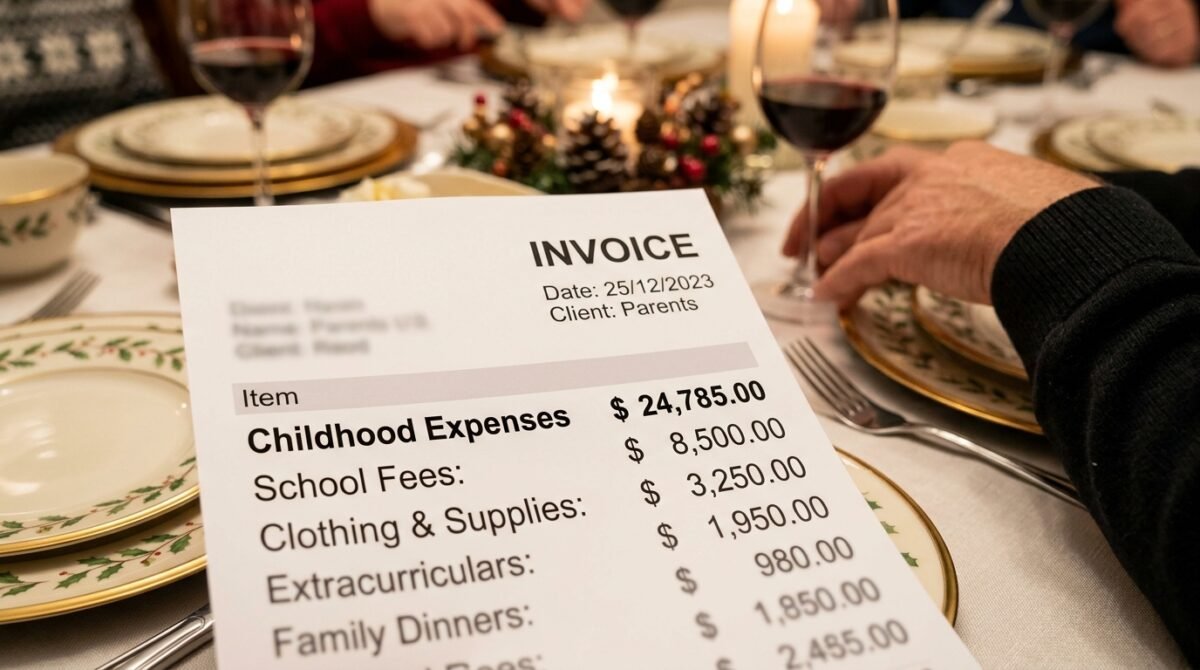
The clinking of silverware against fine china was the only sound in the room for several agonizing seconds. Richard had been talking about the ‘rising cost of living’ and how ‘no one gets a free ride in this world’ for the better part of the appetizer course. I had tuned him out, focusing instead on the cranberry sauce, trying to maintain a facade of neutral interest. But when he finally pushed that heavy-stock paper toward my plate, the shift in energy was palpable.
I pulled the document out slowly, thinking it was a joke. Maybe it was a budget request for the family kitchen remodel he’d been pestering me to help fund. As my eyes scanned the top line—’Childhood Maintenance and Maintenance of Living Standards: 1998-2016’—the humor vanished instantly. It was a formal, typed invoice with a company logo he had clearly created in a word processor, listing everything from ‘Basic Sustenance’ to ‘Extracurricular Transportation Fees.’
“I figured it was time you understood the true cost of your upbringing. You’ve enjoyed the fruits of this household for two decades, and it’s only fair that you balance the ledger now that you’re doing so well for yourself.”
— Richard, while sliding the invoice across the table.
My mother wouldn’t look up. She kept her gaze fixed on a stray piece of stuffing, her face pale. I realized then that she had known about this. She had been part of the planning. The betrayal stung worse than the absurdity of the document itself. I looked around the table at my aunts and cousins, who were all pretending to be deeply interested in their wine glasses, creating a vacuum of silence that was suffocating.
I felt a strange, cold clarity wash over me. It was the realization that I wasn’t their child; I was an asset that had failed to provide a return on investment. The itemization included interest rates that seemed pulled from a predatory loan contract. It wasn’t just a request for help; it was a shakedown, designed to ensure I would never be fully independent of them, even as a grown adult.
I didn’t reach for my wallet. I reached for my coat. The dining room felt like a cage, and for the first time in my life, I recognized that the bars weren’t made of iron—they were made of guilt. And I was finally ready to stop paying the subscription fee for my own existence.
The Specifics of the Extortion Ledger

Once I reached my car, I finally unfolded the paper completely. It was four pages long. The level of detail was pathological. Richard had kept records for nearly twenty years. There were entries for ‘Cost of Electricity Incurred During Homework Hours’ and ‘Wear and Tear on Living Room Furniture.’ It was as if he had been living with a hidden camera and a calculator since I was seven years old.
The math was intentionally convoluted, designed to make the total look astronomical. He had factored in inflation, the ‘opportunity cost’ of the space I occupied in the attic, and even the cost of the ’emotional labor’ he claimed to have provided during my teen years when I was ‘being difficult.’ The total came out to a figure that would have bankrupted me—a five-figure sum meant to keep me tethered to him for the next decade.
“I’ve broken it down by year. You’ll see that the college years were particularly expensive, given the car insurance premiums. I’ve been generous with the interest rate, but I expect a payment plan to be established by the end of the year.”
— The cover letter attached to the invoice.
I took a photo of the first page and sent it to my sister, who had skipped the dinner to avoid the tension. Her response was immediate. She was horrified, noting that she had received a similar, albeit smaller, invoice two years ago, which she had paid off in installments just to keep the peace. That was the ‘why’ behind the madness. It was a cycle of financial control.
The audacity of it was breathtaking. He had framed it as ‘teaching me responsibility,’ but it was clearly a power play. He wanted to ensure that I would always see my life as a debt to be serviced. He wanted to be the primary stakeholder in my future success, siphoning off my hard-earned income under the guise of paying back a ‘debt’ that never existed in any moral sense.
I sat in the dark of my car, the cold air biting at my skin, and felt a surge of rage that was purely liberating. I wasn’t just a child to them. I was a tenant who hadn’t been paying the ‘landlord’—and now, the landlord was trying to backdate the lease. I knew right then that I would not pay a single cent, not even as a gesture of goodwill.
The Aftermath: A Digital Storm of Guilt

I didn’t answer my phone for the first three hours. It rang incessantly. It was my mother, then Richard, then my aunt, all calling to ‘check in’ and suggest I calm down. They were framing my exit as a ‘tantrum’—a childish display that ruined a ‘perfectly lovely evening.’ By the time I finally turned my phone on, the family group chat was a war zone of passive-aggressive messaging.
“OP, your behavior was incredibly disrespectful. Richard did so much for you, and your reaction was a slap in the face. Please call your mother and apologize for making such a scene.”
— Aunt Susan, in the family group chat.
I didn’t apologize. Instead, I screenshotted the group chat and added my own commentary. I didn’t do it to start a fight; I did it because I wanted the truth to be on the record. I knew if I didn’t stand up for myself now, the narrative would be rewritten by the time I saw them next. They would tell everyone that I was ungrateful and unstable.
The replies were predictably defensive. My mother claimed I was ‘misinterpreting’ the invoice—that it was just a ‘joke’ to highlight how expensive life is. A joke? I asked if they usually printed ‘jokes’ on professional letterhead with a calculated amortization schedule. The gaslighting was so transparent it was almost pathetic. They weren’t just trying to control me; they were trying to convince me that I was crazy for noticing the leash.
Some cousins started messaging me privately. A few told me I was wrong for ‘ruining’ the holiday, while others admitted they had always thought Richard was overbearing. It was a microcosm of how toxicity spreads through a family—some people prioritize peace, even when that peace is bought with someone else’s dignity.
I realized then that this was the end of my relationship with that household. The bridge wasn’t just burned; it had been rigged with explosives by the very people who claimed to love me. I blocked Richard’s number. I blocked my aunt. My mother, I kept unblocked, but I turned off notifications for her messages, knowing exactly what they would contain.
Reddit Weighs In: The Verdict of the Masses

I posted my story on a popular subreddit the next morning, needing to know if I was actually the one who had lost my mind. The response was immediate and overwhelming. Thousands of people chimed in, and the consensus was not what my family had expected. It wasn’t ‘You’re being ungrateful.’ It was ‘This is financial abuse.’
“My father tried this exact thing. It’s a classic move by narcissistic parents to keep you under their thumb forever. Do not pay, do not negotiate, and do not apologize. They don’t want money; they want control.”
— u/FinancialFreedomSeeker (Top Comment, 32k upvotes)
The thread became a repository for others who had been subjected to the same kind of ‘parental debt’ extortion. Stories poured in about parents demanding rent from their kids at fifteen, or charging for ’emotional support’ during college. It was a phenomenon, a dark side of parenting that isn’t talked about enough because of the societal pressure to respect and honor our elders, no matter how they treat us.
The community support was validating in a way I hadn’t expected. I felt less like a ‘rebellious child’ and more like a survivor of a psychological operation. The legal advice was also enlightening; several users pointed out that there is no legal basis for charging a child for their own upbringing, and that any such ‘contract’ would be laughed out of a courtroom.
It helped me realize that the guilt I felt was a tool, not a reflection of my character. I had been programmed to feel bad for standing up for myself, and the Reddit community helped me reprogram that response. I stopped checking the thread after a while, because I didn’t need the validation anymore. I had the truth, and for the first time, that was enough.
The Legal Reality Check
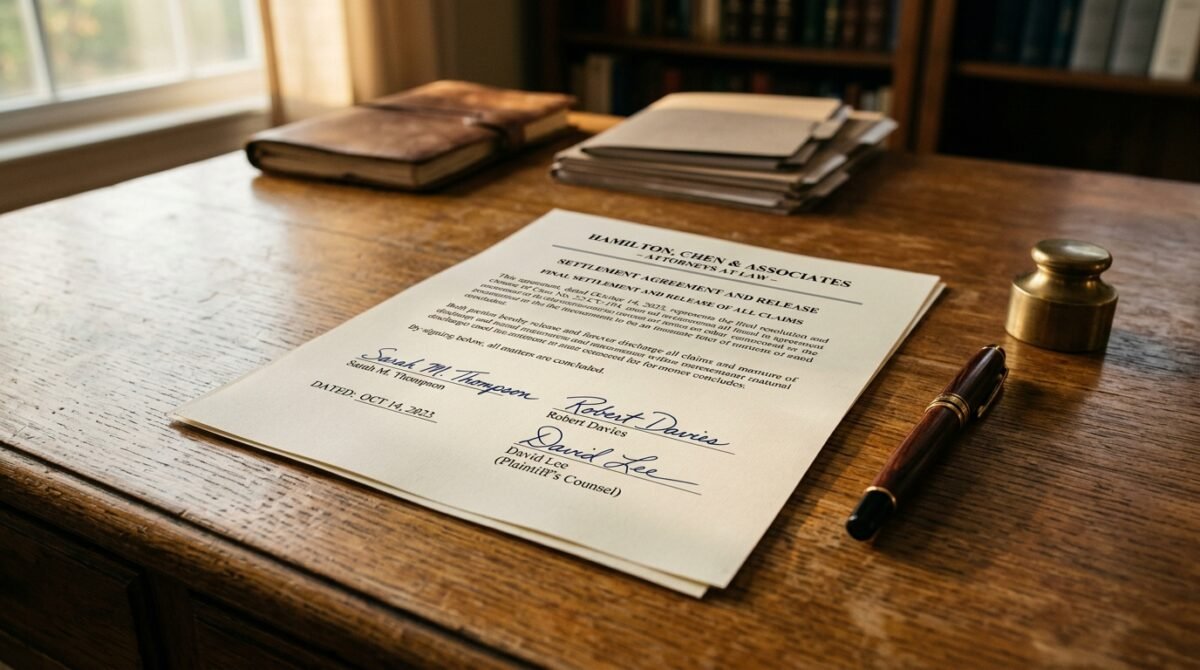
I did consult with a lawyer, just to be safe. I wanted to make sure that this ‘invoice’ couldn’t be used against me in some obscure way. My lawyer laughed for a full minute after reading the document I had scanned and sent over. He explained that parents have a legal obligation to provide for their children, and that this obligation is not a loan, not a debt, and certainly not a contract.
He drafted a very short, very professional letter to Richard, stating that any further attempts to harass me regarding these non-existent financial obligations would be treated as harassment. It was a formal way of saying, ‘Back off or face the consequences.’ I had it sent via certified mail. The notification that it had been delivered was one of the most satisfying moments of my life.
“There is no legal concept of ‘back-billing’ a child for their own upbringing. It is a fundamental misunderstanding of the parental duty. Do not worry about this document. It is essentially a piece of fiction.”
— My Attorney.
Richard tried to call me once after he received the letter. I didn’t pick up. I saw his name on the caller ID, and for a split second, I felt the old urge to answer, to explain, to plead for understanding. But I looked at the letter he had sent me, the one that had started this whole ordeal, and the urge evaporated. He didn’t want understanding. He wanted a victim.
The lawyer also helped me understand that this was a way of testing my boundaries. If I had paid even a dollar, he would have known that I was still susceptible to his manipulation. By refusing, I had signaled that the dynamic was permanently altered. It was a power shift that he could not undo, and that was why he was so furious.
I felt a strange sense of mourning, though. Not for Richard, but for the version of my family I had imagined existed. The version where parents love their children unconditionally, without attaching a price tag to the time spent raising them. That dream was officially dead, and as painful as it was, it was also necessary for me to move on.
The Quietest Christmas in Memory

Christmas followed shortly after Thanksgiving, and for the first time in my life, I wasn’t there. I spent the holiday with friends, eating food that I had cooked myself, in a home that I paid for. There were no invoices, no passive-aggressive comments about my career choices, and no forced smiles for the sake of a photo. It was the most peaceful holiday I had ever experienced.
My mother sent me a message on Christmas morning. It wasn’t an apology, but it wasn’t an attack either. It was a simple, ‘We missed you today. Things are very quiet.’ I didn’t respond. I knew that if I opened that door, even a crack, the pressure would come rushing back in. I needed to protect my peace, and that meant keeping the distance that had finally allowed me to breathe.
“I don’t think you realize how much you’re hurting everyone. You’re punishing your family for a moment of frustration, and that’s not fair to anyone.”
— A follow-up message from my mother.
The irony was not lost on me. I was the one being ‘unfair,’ even though I was the one who had been treated like a business venture. The gaslighting was so ingrained in her that she truly believed I was the villain in this story. It was sad, truly, but I couldn’t be her emotional support system while she was enabling Richard’s toxic behavior.
I started a new tradition that year. I made a list of the things I was grateful for—things that were truly mine, that I hadn’t ‘bought’ from anyone. My health, my friends, my autonomy. It was a small list, but it was authentic. I realized that the best gift I could give myself was the permission to walk away from people who didn’t respect me.
The silence of the house that Christmas wasn’t lonely; it was spacious. I finally understood that being alone is not the same as being lonely. Being with people who make you feel like a debt is much lonelier than sitting in a room by yourself, knowing that you are free.
Reflecting on the ‘Parental Debt’ Myth

I spent a lot of time in the months that followed thinking about why some parents feel entitled to treat their children like investments. It seems to stem from a fundamental misunderstanding of the parenting contract. We didn’t ask to be born, and we certainly didn’t ask for the specific ‘lifestyle’ we were raised in. When a parent provides for their child, they are fulfilling their own moral and legal obligations, not performing a service that requires repayment.
The concept of ‘parental debt’ is a psychological weapon used to keep children in a perpetual state of childhood. If you are ‘in debt’ to your parents, you can’t be their equal. You can’t criticize them, you can’t set boundaries, and you can’t pursue a life that they don’t approve of. You are a permanent subordinate, and that is exactly what Richard wanted.
“The moment you realize your parents aren’t gods, but fallible people with their own insecurities, is the moment you become an adult. If they use your past against you, they aren’t parents anymore—they’re just bullies.”
— Reflection from a personal journal entry.
It’s a toxic cycle that passes down through generations. I’m sure Richard’s parents did something similar to him, and he internalized it as the ‘right’ way to raise a child. But breaking that cycle is hard. It requires the courage to be called ungrateful, to be labeled the ‘difficult one,’ and to endure the social pressure that comes with distancing yourself from your family.
I’ve learned that setting boundaries isn’t about being mean. It’s about being clear. It’s about defining what kind of behavior you will accept and what you won’t. And when people push against those boundaries, the solution isn’t to negotiate; it’s to enforce them. The invoice was a test of my boundaries, and by walking out, I had passed that test.
I don’t hate Richard, and I don’t hate my mother. I just have no space for them in my life as it is currently constructed. They occupy a place in my history, but they no longer have a place in my present. And that, I’ve found, is the ultimate form of self-preservation.
The Social Pressure to Forgive

The hardest part of this entire ordeal wasn’t dealing with Richard; it was dealing with the people on the outside who insisted that I ‘just forgive and forget.’ ‘They’re family,’ people would say, as if that simple phrase was a magical incantation that erased all the harm. It felt like a betrayal every time someone told me I was being too harsh.
I had to learn how to explain my situation without apologizing for my choices. I stopped saying ‘I’m sorry’ when I talked about the split. I started saying ‘I made a decision that was necessary for my mental health.’ The change in phrasing was subtle, but it was powerful. It reclaimed the narrative from one of guilt to one of health.
“Family is not a suicide pact. If being around them is killing your spirit, you have the right to leave. It doesn’t matter how long the history is; you don’t owe them your sanity.”
— Wisdom from a therapist during a session.
I started to lose touch with some of my extended family members who were firmly in the ‘family first’ camp. It was another price I had to pay, but it was one I was willing to cover. The people who truly cared about me, the ones who listened to the story without trying to fix it or blame me, those were the people who stayed in my life. The ones who demanded I keep the peace at my own expense? They faded away.
It’s a thinning of the ranks, but the quality of the connections that remain is infinitely better. I’m no longer surrounded by people who view me as a piece on a chessboard. I’m surrounded by people who view me as a friend, an equal, and a person worthy of love, regardless of what I ‘owe’ them.
The social pressure to conform is intense, especially during the holidays. But I’ve learned that the ‘holiday spirit’ is not a requirement to tolerate abuse. You can have a wonderful, fulfilling life without the approval of people who hurt you, and that is a lesson that has made my life richer than any inheritance could.
Reclaiming My Narrative

I am writing this now, months later, from a place of genuine contentment. The invoice sits in a file cabinet with my other important papers, not as a symbol of debt, but as a reminder of the day I stood up for myself. It’s a trophy of sorts—a testament to the fact that I survived the fire and came out stronger on the other side.
I still have days where I feel a pang of sadness. I miss the idea of having a family that supports me. I miss the simple joy of a holiday meal without strings attached. But I know that those things were never real for me; they were illusions that I had to maintain by keeping my head down. And I’m no longer willing to keep my head down.
“You are not a project to be completed. You are not a debt to be repaid. You are your own person, and your only obligation is to live a life that makes you proud.”
— My own mantra, written on my bathroom mirror.
My mother still reaches out occasionally. I keep the door cracked, but only slightly. I’ve made it clear that I’m happy to talk about our lives, our hobbies, and our futures, but that the past—specifically the ‘invoice’ and the toxic expectations—is off-limits. If she can’t respect that, the conversation ends. It’s a boundary she finds difficult, but she’s starting to learn that I’m not playing by the old rules anymore.
Richard has been silent. I think he’s realized that the ‘invoice’ strategy backfired in a spectacular way. He lost control, he lost his leverage, and he lost the ability to dictate my actions. It wasn’t the result he wanted, but it was the one he earned.
I look forward to the future with a sense of excitement I never had before. I don’t know what it holds, but I know it’s mine. I’m not living for anyone else’s ledger. I’m living for my own, and for the first time, the numbers are exactly where they need to be.
Lessons Learned from the Dinner Table Collapse

Looking back, the most important lesson I learned is that you are the primary architect of your own dignity. No one is going to hand it to you, especially not people who benefit from your lack of it. When someone shows you how they view you—whether through a snide comment, a boundary violation, or an itemized bill for your childhood—believe them. Don’t wait for them to change, and don’t try to prove them wrong. Just believe them and act accordingly.
The ‘Thanksgiving Invoice’ was the best thing that ever happened to me, even if it didn’t feel like it at the time. It stripped away the last of the illusions I held about my relationship with my stepdad. It forced me to face the truth, and it gave me the push I needed to sever a connection that was draining my spirit. It wasn’t a tragedy; it was a liberation.
“Sometimes, the most loving thing you can do for yourself is to walk away from people who don’t know how to love you without a contract.”
— Closing reflection.
If you find yourself in a similar situation, know this: you aren’t alone. You aren’t crazy. And you aren’t wrong for wanting to be treated with respect. Don’t let anyone make you feel like you owe them your life for the simple act of being raised. That is the bare minimum expectation of parenthood, not a favor that requires a lifelong repayment plan.
I hope that by sharing my story, someone else might find the courage to walk away from their own version of an invoice. It’s scary, it’s painful, and it’s transformative. But on the other side of that fear is a life that is entirely, authentically yours. And that, I promise you, is worth every single penny you don’t have to pay.
I am still here, still standing, and still free. I hope that if you are reading this and struggling with your own family boundaries, you realize that you have the power to draw that line. The table is yours, the life is yours, and the invoice is nothing more than paper.
Conclusion
My journey from a trapped child to an autonomous adult was accelerated by that single, absurd piece of paper. The fallout changed my family dynamics forever, forcing a painful but necessary separation. While I am still navigating the complexities of low-contact with my mother, the decision to walk away from that table remains the most empowering act of my life.
We often carry the weight of our family’s expectations as if they were iron shackles, forgetting that we hold the key all along. Your past is yours to own, not a commodity to be traded for parental approval. I hope this story serves as a reminder that your worth is not a financial calculation.
Now, I turn it over to you. Have you ever encountered a ‘debt’ imposed on you by family that was never yours to pay? How did you navigate the pressure to comply, and what was the breaking point that finally set you free? Let’s talk about it in the comments below.
What's your verdict on this dilemma?
Vote below to contribute to the official community consensus.

Have a Dilemma Keeping You Up at Night?
Share your real-life feud, wedding chaos, or relationship crossroads anonymously with our editorial team.
What do you think ?
0 Comments🛡️ Comments are moderated to protect community integrity. Your comment will appear once approved by the editorial team.