

We all have that one story that defines the moment we realize our parents view us not as children to be nurtured, but as resources to be tapped. For me, that realization didn’t come with a bang, but with a series of quiet, pathetic omissions. My father, a man who built a comfortable life in the suburbs while I clawed my way through student loans and double shifts, was a ghost during the defining moments of my adulthood.
He wasn’t at my high school graduation. He wasn’t there when I signed the lease on my first apartment. He didn’t even send a card when I got married, citing a ‘business trip’ that, according to social media, involved a golf course in Scottsdale. I had accepted his absence as the status quo. I had learned to build my own village, one composed of friends and chosen family who actually showed up.
But the silence was shattered last Tuesday. My phone lit up with a notification from the man himself—a man I hadn’t spoken to in six months. It wasn’t an apology for the missed years or an inquiry about my health. It was a digital invoice, a demand for a staggering sum to fund a milestone he had never cared about for me. The audacity was not just insulting; it was a wake-up call that required a final, decisive response.
This story is about the day I decided to stop being the invisible daughter and started being the woman who holds the pen. It covers the breakdown of a long-festering family dynamic, the shock of a ten-thousand-dollar demand, and the inevitable fallout that followed. If you have ever felt like a supporting character in your own family’s narrative, you might find this story uncomfortably familiar.
The following account details how the demand was made, the family pressure that followed, and why I chose to walk away entirely. Some things are too expensive to keep, and my relationship with my father was officially one of them.
The Digital Summons in My Inbox
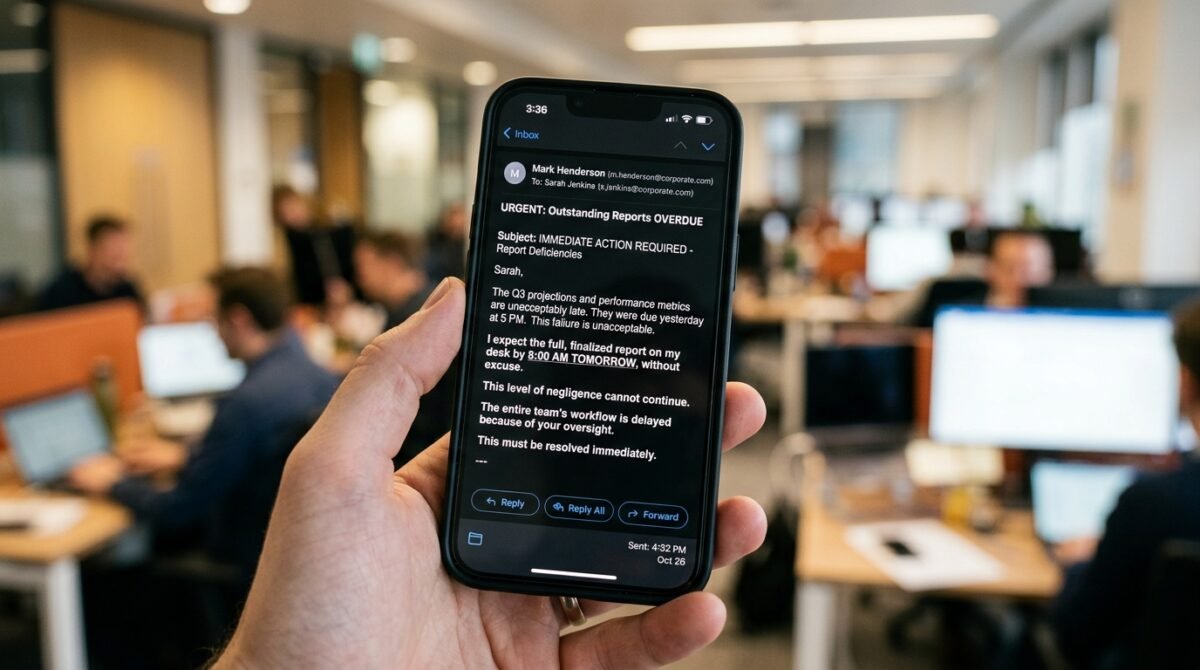
It began as a mundane Tuesday evening. I was wrapping up a project at my desk when the chime of a new email broke the silence. The sender was ‘Dad,’ a name I had kept in my contacts mostly out of obligation, though we hadn’t exchanged a word since the previous Christmas. The subject line was chillingly administrative: ‘Budgetary Requirement for Chloe’s Sweet 16.’
I opened the email with a sinking feeling in my stomach. It wasn’t a request; it was a mandate. He explained, with the casual tone of someone delegating a task to an employee, that his daughter Chloe—my stepsister—was turning sixteen, and that he had ‘committed’ to a lavish event that had gone over budget. He didn’t ask if I could help; he stated that as a ‘successful young professional,’ it was my turn to contribute to the family legacy.
“I know you’ve been doing well for yourself lately. I’ve taken on the bulk of the catering and venue costs for Chloe’s party, but there is a $10,000 shortfall. I’ve put you down as the primary donor. Expect the wire transfer instructions by Friday. It’s time you showed some real investment in this family.”
— Email from my Father, 6:42 PM
I stared at the screen until the words blurred. The arrogance was staggering. He had never once contributed to my own milestones, yet here he was, treating my hard-earned savings as his personal slush fund. My hands shook as I typed out a reply, my heart hammering against my ribs. I felt a mixture of nausea and cold, hard clarity.
I didn’t need to consult a lawyer to know this was absurd. My father had skipped my graduation because he ‘didn’t want to deal with the parking.’ He hadn’t attended my wedding because he said it was ‘too expensive to travel.’ And yet, for a girl I barely knew and a party I had no interest in, he expected me to foot the bill? The hypocrisy was not just a side note; it was the entire foundation of his request.
I chose not to reply immediately. Instead, I took a walk. I walked until my feet ached, thinking about every time I had waited for him to show up. The anger began to sharpen into something useful. I wasn’t going to argue. I wasn’t going to justify my finances. I was going to shut this down, permanently.
The Group Chat Intervention
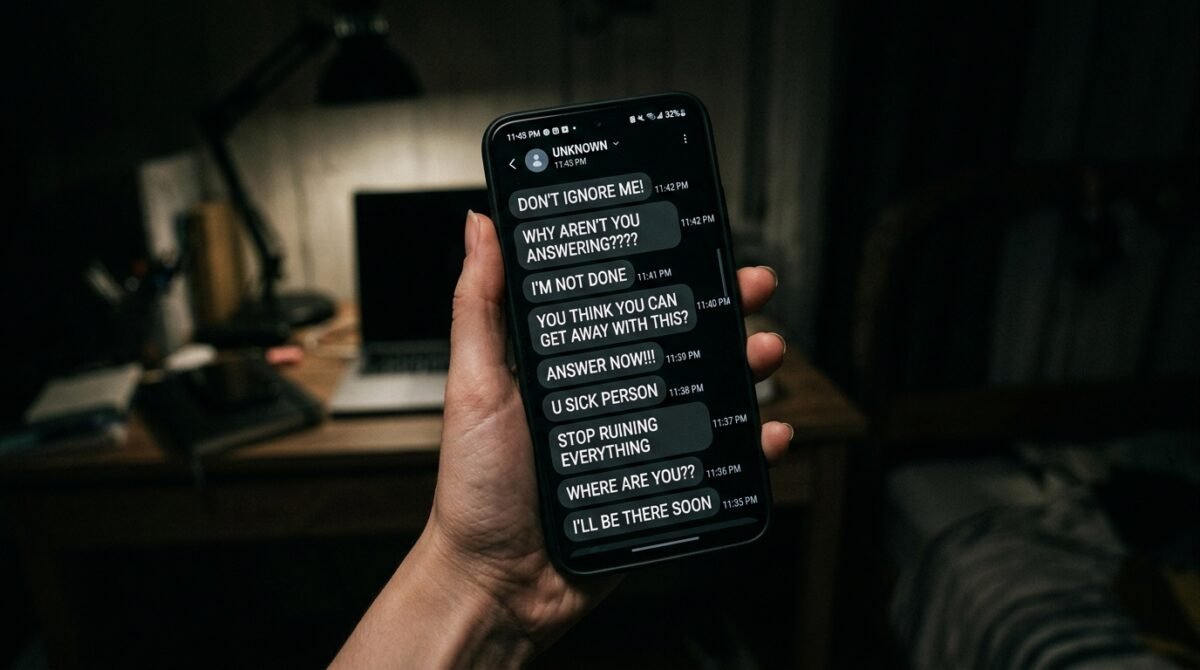
Two days later, the pressure arrived in the form of a buzzing group chat. ‘The Family Circle,’ it was called—a digital cage where my stepmother, my father, and an assortment of aunts and cousins lived. I had muted the chat months ago, but the sheer volume of notifications forced me to look. The messages were coming in fast, a coordinated effort to shame me into submission.
My stepmother had taken the lead, posting photos of the venue—a sprawling, over-the-top banquet hall—and tagging me directly. She spoke about how ‘everyone’ was chipping in and how disappointed she was that I was being ‘slow’ to respond. It was a classic guilt trip, weaponizing the concept of family unity against me.
“@OP, your father is waiting for the confirmation. It’s a milestone event for your sister. Don’t be the person who ruins this by being selfish. We’ve all made sacrifices for this family. You can afford it.”
— Stepmother, via Family Group Chat
I watched as cousins I barely knew chimed in with supportive emojis or vague comments about how ‘important it is to support your own.’ They were being fed a narrative where I was the wealthy, ungrateful daughter refusing to help a sweet girl have her moment. It was gaslighting, pure and simple. They were manipulating the optics to make my boundary-setting look like an act of malice.
I didn’t respond in the chat. I waited, observing the chaos. It was fascinating to see how quickly people would jump to defend someone else’s entitlement. I realized then that my father had likely been painting me as the ‘difficult’ one for years, paving the way for this moment. They weren’t just asking for money; they were testing to see if I would still perform the role of the submissive child.
The chat continued to blow up. There were mentions of ‘legal obligations’ and ‘family honor.’ I felt like a spectator in a play I hadn’t auditioned for. My phone became a hot coal in my pocket. Every notification was a reminder of why I had distanced myself in the first place. The facade of the ‘happy family’ was falling apart, and underneath, there was only greed and control.
The Confrontation at the Sunday Roast
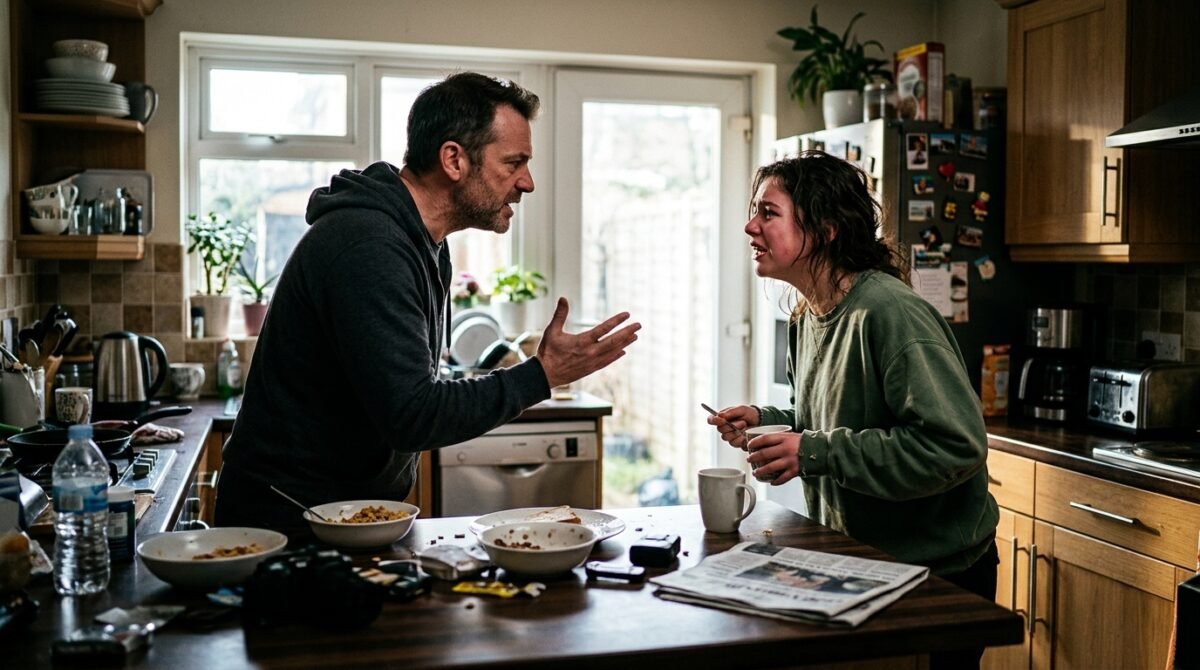
I knew they wouldn’t stop with the messages. My father was the type to force a resolution in person, believing that his physical presence was enough to cow me. He showed up at my apartment on Sunday morning, unannounced. When I opened the door, he looked exactly as he had for the last decade: polished, entitled, and utterly incapable of empathy.
He walked past me without an invitation, heading straight for my kitchen. He started making coffee as if he lived there. I stood in the doorway, my arms crossed, watching him. The sheer audacity of his intrusion was almost impressive. He didn’t acknowledge my cold demeanor; he simply started talking about the ‘logistics’ of the wire transfer as if I hadn’t already sent a clear ‘no’ via email.
“Look, stop being difficult. I’ve already told the caterers we’d have the funds by Monday. You’re making a scene over nothing. Chloe expects you to be there, and she expects you to be generous. It’s a small price to pay for the position you’re in now.”
— My Father, standing in my kitchen
I felt a strange, icy calm wash over me. The rage had burned itself out, replaced by a crystalline realization that I owed him nothing. I spoke, my voice steady and quiet. I reminded him of the graduation he missed, the wedding he skipped, and the silence that had defined our relationship for years. I told him that my money was not his inheritance to spend on a party he could clearly not afford himself.
He laughed, a dismissive, patronizing sound. He tried to pivot, talking about how ‘the past is the past’ and how ‘family has to stick together.’ He didn’t understand that for me, the past was the evidence of his character. He was asking for an investment in a future he had no interest in being a part of, other than as a beneficiary of my labor.
The argument escalated. He started shouting, his face turning a mottled red. He called me ungrateful, cold, and a failure as a daughter. I didn’t shout back. I simply opened the front door and waited. The contrast between his volatility and my stillness was the most powerful weapon I had. He eventually stormed out, leaving the door swinging in his wake.
The Fallout and the Legal Threat

The day after he left my apartment, I received a formal letter from a law firm. I laughed when I read it. It was a thinly veiled attempt at intimidation, suggesting that because I had ‘implied’ support in past family gatherings—which was a complete fabrication—I was somehow legally bound to contribute. It was a desperate move, the last gasp of a man who realized he had lost his leverage.
I immediately forwarded the letter to my own lawyer, a friend who specializes in contract law. She spent exactly five minutes reviewing it before calling me back, laughing. There was no case. There was no contract. It was pure harassment, designed to scare me into compliance. I felt a surge of relief; the legal threat had actually been the best thing he could have done, as it solidified my decision to cut ties completely.
The family group chat, meanwhile, was still active. They were now calling me a ‘cold-hearted brat’ and circulating rumors about my finances. I read them all, feeling like a ghost. None of these people were my friends. None of them had been there for me. Why was I still even remotely concerned with their perception of me? The realization hit me: I was mourning the loss of a father who never existed.
“You are dead to this family if you don’t do this. Your sister will never speak to you again. Think about what you’re throwing away for ten grand. Is your pride really worth it?”
— Text from Stepmother, 11:22 PM
I replied to the group chat for the first and only time. I didn’t argue. I didn’t justify. I simply stated that I would not be funding the party and that I was withdrawing from all family communications until further notice. Then, I blocked every single one of them. The silence that followed was the most beautiful thing I had ever experienced.
I went to bed that night feeling lighter than I had in years. The threat of the legal letter had been the final push I needed to sever the cord. I wasn’t just refusing to pay; I was refusing to be a participant in a cycle of emotional abuse. The cost of my freedom was $10,000, but I was keeping it, and I was keeping my dignity along with it.
The Reddit Verdict
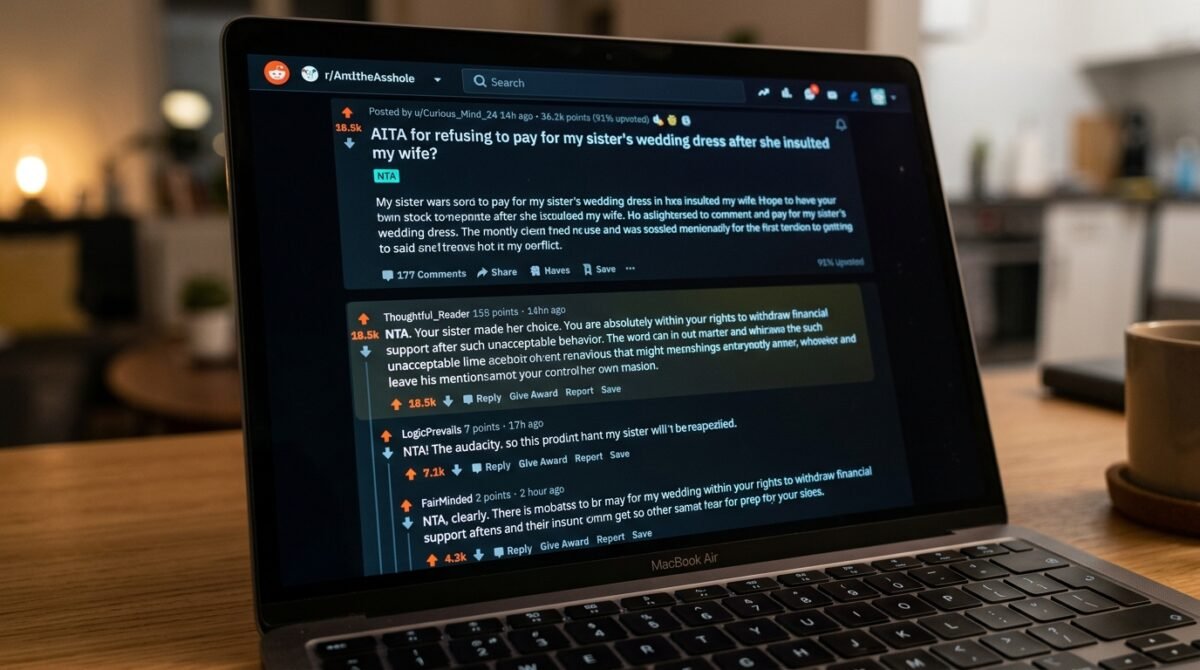
I decided to post my story on a popular forum, not for validation, but for perspective. I needed to see if I was losing my mind, if the ‘family first’ narrative was as ingrained in others as it was in my own upbringing. The response was immediate and overwhelming. Thousands of people weighed in, and the consensus was not just supportive—it was protective.
The top comment came from a user who had been through a similar situation. They pointed out that the $10,000 was never about the party; it was about power. My father wanted to see if he could still command my resources. By refusing, I hadn’t just saved money; I had reclaimed my autonomy. It was a powerful reminder that boundaries are not just requests; they are life-saving walls.
“NTA. This isn’t about the money. This is a classic test of boundaries. If you paid, he would know he has control over your finances for life. You did the right thing by cutting them off. Never look back.”
— u/FamilyBoundariesRule (Top Comment, 32.4k upvotes)
Other users shared stories of how they had dealt with toxic parents who used money as a weapon. Some talked about the guilt they felt for years before finally breaking free. Reading those stories made me realize that my struggle was not unique, but that the outcome—choosing oneself—was the only way to break the cycle. I felt a profound sense of community with people I would never meet.
There were a few dissenters, of course. Some argued that ‘family is family’ and that I should just pay the money to keep the peace. But their arguments were quickly dismantled by the community. It was clear that the tide was turning, and people were no longer willing to accept the ‘blood is thicker than water’ excuse for abusive behavior.
I spent the entire weekend reading the comments. Every story of liberation and every piece of advice about maintaining no-contact solidified my resolve. I had done the right thing. The initial shock had turned into a steady, quiet resolve. I was officially finished with that chapter of my life, and for the first time, I felt genuinely ready to start the next one.
The Aftermath: Finding My Own Peace

Three months have passed since the ‘Sweet 16 incident.’ The silence from my father’s side of the family has been absolute. There were no more legal letters, no more threatening texts, and no more unannounced visits. It turns out that when you remove the incentive—the money—the interest in maintaining a relationship disappears entirely. That was the most painful, yet necessary, lesson of all.
I used the $10,000 I *would* have spent on the party to invest in something for myself: a long-delayed trip to Europe and a down payment on a small, personal studio space where I can work on my own creative projects. Every time I look at that space, I don’t see a party I missed out on; I see the freedom I bought myself. It was the best investment I ever made.
I’ve started going to therapy to process the years of neglect and the final, jarring confrontation. My therapist keeps telling me that the anger I feel is a sign of healing. I am learning to identify when I am being manipulated and how to say ‘no’ without feeling the need to provide a twenty-page explanation. It’s a work in progress, but for the first time, I am the one in control.
“You don’t owe your parents your future just because they provided your past. You are the architect of your own life now. Keep building it without their interference.”
— Quote from my therapist, during our session
My friends have been incredibly supportive. They threw a small ‘Freedom Party’ for me when the dust settled, which felt like a beautiful, ironic contrast to the ‘Sweet 16’ I had avoided. I am surrounded by people who love me not for what I can give them, but for who I am. That is the true definition of family, and I finally understand that now.
I still occasionally wonder if my stepsister knows why I didn’t come, or if she even knows that her party was supposed to be funded by my savings. I suspect she doesn’t, or if she does, she has been fed a version of the story where I am the villain. It doesn’t matter anymore. Their opinions no longer dictate my reality.
Reflecting on the Cost of ‘Family’

I often look back at the email I received that Tuesday. It feels like a relic from a different life. It’s strange how one piece of communication can change everything. It wasn’t just a request for $10,000; it was a demand for my soul, my loyalty, and my future. By refusing, I was choosing to prioritize my own integrity over a false sense of obligation.
Many people struggle with the idea that parents are always right, or that children owe their parents everything. I spent decades believing that, and it cost me years of happiness and self-worth. If there is one thing I’ve learned, it’s that family is a two-way street. If one person is doing all the building and the other is just taking, the road eventually collapses.
I have forgiven my father—not for him, but for me. Forgiveness is not about saying what he did was okay; it’s about letting go of the anger so it no longer burns a hole in my own life. I don’t need him to apologize because I know he never will. I don’t need him to understand because I know he never can.
“Forgiveness is releasing yourself from the burden of expecting someone to be a person they are fundamentally incapable of being.”
— Reflection from my journal
The lessons I’ve learned are hard-won. I’ve learned that saying ‘no’ is a complete sentence. I’ve learned that people who only show up when they need something were never really there at all. And most importantly, I’ve learned that I am capable of standing on my own two feet, even when the ground beneath me is shaking.
To anyone out there reading this who is being pressured by family to give more than they can afford, or to support people who have never supported them—don’t do it. You don’t owe them your peace. You don’t owe them your hard-earned success. You owe yourself a life free from their demands.
When the Bridge is Burned

Some people have asked me if I regret burning the bridge. They ask if it might have been easier to just pay the money and keep the ‘peace.’ But that’s the trap, isn’t it? The ‘peace’ they are talking about isn’t real. It’s just the silence of the oppressed. It’s the quiet that comes after you’ve given up everything that matters to you just to keep someone else comfortable.
I don’t regret a single thing. In fact, I regret that I didn’t burn that bridge years ago. I regret all the time I spent trying to earn love from someone who wasn’t capable of giving it. I regret the years I spent feeling like a secondary character in my own story. But I am grateful that I finally hit the point where I said, ‘enough.’
The bridge is gone, and that’s a good thing. It means I can no longer go back to that place of compromise and pain. It means I am forced to look forward, to build something new, and to find my own path. The landscape ahead is uncertain, but it is mine. And that is the most important thing I have ever owned.
“Sometimes, the best thing you can do for your family is to stop letting them treat you like a resource. The distance is the only way to heal the wounds they inflicted.”
— My personal mantra
I hope that by sharing this, someone else out there feels the courage to draw their own line. You don’t need permission to protect yourself. You don’t need a formal legal reason to stop giving your energy to people who don’t deserve it. You just need to realize that your life belongs to you, and no one else.
The silence is now my companion, and it is a peaceful one. I have rediscovered parts of myself I thought were long gone. I am more creative, more energetic, and more at peace than I have been in years. I am a whole person, and for the first time, I am enough.
The Lessons of the $10,000 Demand

If I could go back and tell my younger self anything, it would be this: Your value is not determined by your utility to others. You are not a bank, you are not a trophy, and you are not a backup plan. You are a person, and your boundaries are the most valuable tools you possess to protect your happiness.
The $10,000 was a test, but it was also a gift. It forced me to look at the reality of my situation without the filter of hope or ‘shoulds.’ It allowed me to see the true nature of my family dynamic and to make a decision based on truth rather than fear. It was the hardest thing I’ve ever done, but it was also the most liberating.
I’ve learned to spot the red flags now. I know when someone is trying to guilt-trip me, when someone is using ‘family’ as a weapon, and when someone is just trying to use me for their own gain. I have become a much better judge of character, and my circle has grown smaller, but much more genuine.
“True family is built on mutual respect and genuine care, not on financial extraction and forced obligation. If they don’t value you, they don’t deserve you.”
— Final takeaway
I have stopped looking for my father’s approval. I have stopped waiting for him to notice me. I have stopped trying to perform the role of the ‘successful daughter’ so he can be proud. I am proud of myself, and that is all that matters. I am the only person who needs to be satisfied with my choices.
The future looks different now. It looks like something I am creating, not something I am waiting for. It looks like freedom, and it looks like a life lived on my own terms. I am no longer waiting for permission to be happy, and I am no longer paying for the privilege of being ignored.
A Final Message to the Reader
If you are in a similar situation—if you are being pressured to give, to change, or to sacrifice your own well-being for someone who hasn’t earned that right—I want you to know that you are not alone. There is a whole community of people who have been where you are, and we are here to support you. You do not have to carry that weight.
Take the time to assess what you really want. Are you giving because you want to, or because you are afraid of the consequences? If it is the latter, you are already being manipulated. Take a step back. Reclaim your space. Protect your energy. You owe it to yourself to live a life that is truly yours, not one dictated by someone else’s greed.
Thank you for listening to my story. It wasn’t easy to share, but doing so has been part of my own healing process. I hope that in some small way, it helps you find the strength to set your own boundaries and to stand your ground. You are worthy of respect, and you are worthy of a life that is free from manipulation.
“Your life is a gift. Do not waste it on people who do not value your presence. Stand tall, speak your truth, and never apologize for protecting your own peace.”
— A final note of encouragement
We are the ones who decide what our family looks like. We are the ones who decide what is acceptable, and what is not. And today, I choose to be free. I hope you choose to be free, too.
Conclusion
The story of the $10,000 demand is more than just a tale of family greed; it is a story about the reclaiming of self. By saying no to the financial abuse, I was able to say yes to my own life. It was a difficult transition, filled with moments of doubt and pain, but it was the necessary path to becoming the person I am today—whole, independent, and free from the shadows of a past that sought to define me.
We all have the power to define our boundaries, regardless of who is asking us to cross them. The hardest part is often the first step, but as many of you have seen, the liberation that follows is worth every bit of the struggle. Never feel pressured to sacrifice your own peace to keep the peace of those who don’t care about your well-being.
Now, I turn it over to you. Have you ever had to cut ties with a family member because of financial entitlement or a lack of respect for your boundaries? What was the moment you realized it was time to move on? Let’s share our experiences and support one another in the comments below.
What's your verdict on this dilemma?
Vote below to contribute to the official community consensus.

Have a Dilemma Keeping You Up at Night?
Share your real-life feud, wedding chaos, or relationship crossroads anonymously with our editorial team.
What do you think ?
0 Comments🛡️ Comments are moderated to protect community integrity. Your comment will appear once approved by the editorial team.