

When my husband, Mark, and I finally signed the papers for our first home, it felt like the culmination of years of sacrifice. We had lived in a cramped, drafty apartment for three years, eating nothing but pasta and saving every spare cent to scrape together a down payment. The house wasn’t a mansion, but it was ours: a charming 1940s colonial with creaky floors and a garden we had spent every weekend planting. To us, it was a sanctuary. To Mark’s mother, Linda, it was apparently a target.
Linda had never been supportive of our decision to buy in this neighborhood. She constantly reminded us that ‘people of our status’ should be looking elsewhere, though she could never quite define what that status was. For weeks leading up to the housewarming party, she had been dropping passive-aggressive comments about property taxes, the proximity to the city, and the ‘questionable’ curb appeal. We tried to ignore it, focusing on the joy of inviting our friends over to christen the space with good wine and laughter.
The day of the party, the sun was shining, and the house was filled with the scent of fresh flowers and appetizers. We were buzzing with pride as we gave tours to our friends, showing off the new office space and the refinished hardwood floors. We felt like we had finally arrived at a milestone, a sense of stability we had craved for years. We were completely unprepared for the icy shadow that would soon fall over our doorstep.
When Linda arrived, she didn’t come alone. She brought a man in a crisp grey suit, carrying a professional-grade leather briefcase and a digital laser measure. She didn’t introduce him as a friend or a neighbor. She introduced him with a chilling, artificial smile that made my stomach drop instantly. She hadn’t come to celebrate our success; she had come to calculate the cost of our failure.
Looking back, I should have realized that Linda’s obsession with our finances was reaching a breaking point. She had spent months auditing our lifestyle choices, from the brand of coffee we bought to the frequency with which we dined out. But nothing could have prepared me for the sheer audacity of bringing a stranger into our home under the guise of a housewarming guest, only to dismantle our pride in front of everyone we loved.
The Uninvited Guest and the Laser Measure

The front door swung open, and there stood Linda, looking every bit the suburban matriarch in a designer silk blouse. Beside her was a middle-aged man who looked like he had stepped out of a corporate real estate brochure. Before I could even offer them a glass of champagne, Linda gestured grandly toward the man, her voice booming over the ambient jazz music playing in the background.
“Everyone, I’d like you to meet Mr. Henderson,” she announced, silencing the room. “He’s a certified appraiser. I was just so worried that you two might have been taken advantage of during the buying process, so I thought it would be a lovely gesture to have him look over the property while we are all here to witness the appraisal.”
My husband, Mark, froze in his tracks. The glass in his hand trembled slightly, and I saw the color drain from his face. The air in the room seemed to evaporate. Our friends, who had been laughing moments before, stood in stunned, awkward silence. Mr. Henderson looked visibly uncomfortable, clearly sensing the hostility radiating from the couple whose home he had been hired to inspect.
“Mother, what on earth are you doing? This is a housewarming, not an inspection. Please, take your guest and leave or put the measuring tape away immediately.”
— Mark, my husband, trying to maintain his composure
Linda merely laughed, a sharp, brittle sound that echoed off the high ceilings. “Oh, don’t be so dramatic, Mark. I am simply looking out for your future. If you’ve overpaid by as much as I suspect, you need to know now, not when you’re underwater in five years. Mr. Henderson, please, start with the living room square footage.”
The audacity was suffocating. She wasn’t just invading our space; she was trying to prove, in front of our peers, that we were financial idiots. She had orchestrated this humiliation with the precision of a military operation, hiring a professional to strip away our dignity in the place where we felt safest.
The Living Room Confrontation
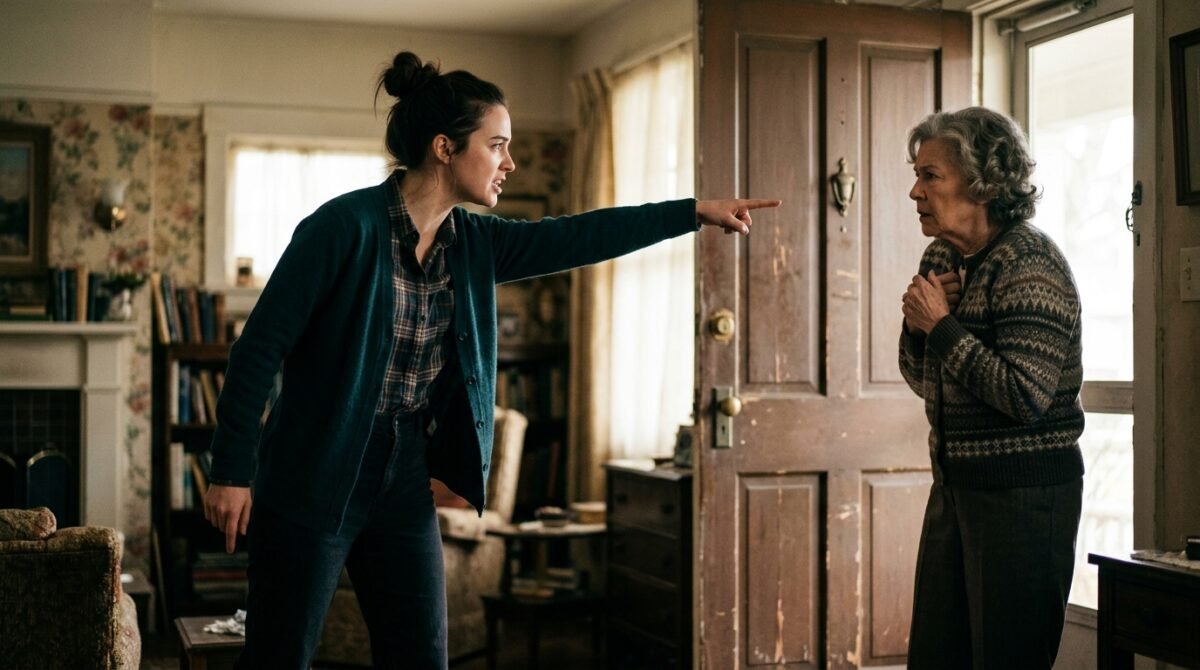
I could feel the heat rising in my neck. I stepped forward, putting myself between Linda and the foyer. I knew that if I didn’t shut this down now, it would never end. I looked at Mr. Henderson, who was awkwardly hovering near the fireplace, and then back at my mother-in-law, whose eyes were darting around the room, taking in every piece of furniture as if she were pricing it for a liquidation sale.
“Linda,” I started, my voice shaking with a mix of fury and disbelief. “This is our home. We worked hard for this. If you cannot respect that, you need to leave. Right now. You are making our guests uncomfortable, and you are being incredibly disrespectful to us.”
The room was so quiet you could hear the ice cubes clinking in the drinks in the kitchen. A few of our friends began to slowly back toward the exit, sensing that the social gathering was turning into an intervention of the most toxic variety. Linda, however, seemed to thrive on the tension, her smile never faltering as she held her ground.
“I am just trying to protect my son from your reckless spending, dear. A house like this requires a certain level of upkeep that I know for a fact you haven’t budgeted for. I’m doing this because I love him.”
— Linda, during the peak of the confrontation
“You don’t get to decide what we can afford,” I countered. “You don’t see our bank accounts. You don’t see our savings. You see what you want to see so you can control us. Well, not today.”
I gestured toward the front door. It wasn’t a request; it was a demand. Mark, finally finding his voice, stepped up beside me. “Mom, if you don’t walk out that door with your appraiser friend right now, you are not coming back for a long time. I mean it.”
The Aftermath: When Silence Fills the House

The departure was swift and cold. Linda didn’t apologize; she simply huffed, tossed her bag over her shoulder, and marched out with Mr. Henderson trailing behind her, looking apologetic and bewildered. The door clicked shut, leaving us in a hollow, echoing silence. The house suddenly felt different—less like a home and more like a crime scene.
Our friends tried to make light of the situation, offering awkward platitudes about ‘in-laws being crazy,’ but the mood had been shattered beyond repair. We finished the party in a daze, going through the motions of being good hosts while our internal worlds were collapsing. Once the last guest left, the house felt far too large and far too quiet.
Mark sat on the edge of the sofa, head in his hands. He looked defeated. The house we had fought so hard to buy had been stained by his mother’s malice. He whispered that he was sorry, that he should have seen this coming, but I told him it wasn’t his fault. We couldn’t have anticipated that anyone would go to such lengths.
That night, we didn’t talk about the appraisal. We didn’t talk about the money. We sat on the porch, watching the neighborhood lights flicker on, trying to reclaim our sense of peace. But the seed of doubt had been planted. I wondered if Linda was right about one thing: would she ever stop trying to prove us wrong?
The next morning, the silence was broken not by a knock at the door, but by a barrage of notifications on Mark’s phone. Linda had been busy. She hadn’t just humiliated us in person; she had taken the narrative to the family group chat, painting herself as the victim of our ‘unreasonable’ and ‘abusive’ behavior.
The Digital Campaign: Leaked Family Texts

Mark opened the family group chat, his thumbs hovering over the screen. It was a feed of toxicity, with Linda claiming that she only brought the appraiser because she was ‘worried about our mental health and financial stability.’ She had framed our rejection of her ‘help’ as evidence that we were spiraling out of control.
“Mark and his wife are clearly in over their heads. They wouldn’t even let a professional look at the house. If they have nothing to hide, why the panic? I just want to make sure they aren’t going to end up on the street in a year.”
— Linda in the Family Group Chat
Mark’s sister, Sarah, had jumped in to defend us, but Linda quickly shut her down, accusing her of being ‘part of the problem.’ It was a masterclass in manipulation. She was isolating us, making us look like the unstable ones while she positioned herself as the concerned, long-suffering mother.
“She’s trying to control the narrative,” I said, reading over his shoulder. “If she can make everyone else believe we’re failing, she wins.” I realized then that this wasn’t just about the house. It was about power. She couldn’t handle the fact that we were building a life that didn’t require her approval or her financial ‘expertise.’
We decided not to respond. Responding would only give her the audience she craved. We blocked her on social media for the time being, a small but necessary boundary. The digital silence was our first step toward healing, even as the sting of her words lingered in our minds like a bad taste.
The irony was that we *had* done our due diligence. We had hired our own inspectors, researched the market, and negotiated a price that was well within our means. We weren’t failing; we were thriving. And that was exactly what Linda couldn’t stand.
The Reddit Verdict: Thousands Weigh In

I finally broke down and posted our story to a popular subreddit dedicated to relationship drama. I needed to know if I was crazy. I needed an outside perspective. I laid out the timeline, the appraisal incident, and the subsequent fallout. Within hours, the post had blown up, garnering thousands of comments from people who had experienced similar ‘MIL-from-hell’ scenarios.
“This is not just about a house. This is a massive boundary violation and a display of financial abuse. She wasn’t there to ‘help’—she was there to assert dominance and humiliate you in front of your friends. Go no-contact immediately.”
— u/SupportiveStranger (Top Comment, 32.4k upvotes)
The outpouring of support was overwhelming. People shared stories of in-laws who tried to sabotage weddings, jobs, and even pregnancies. It made me realize that Linda’s behavior wasn’t just a quirk; it was a pattern of control that many people recognize all too well. The ‘NTA’ (Not The Asshole) verdicts rolled in by the hundreds.
There were some, however, who played devil’s advocate, suggesting that maybe she was just misguided. But the consensus was clear: hiring a professional appraiser to bring to a housewarming party is a calculated act of aggression. It wasn’t a mistake. It was a choice.
Reading the comments helped me realize that we had nothing to apologize for. We were the victims of an unprovoked attack. The validation from strangers gave us the strength to move forward, knowing that our reaction—kicking her out—was the only healthy move we could have made.
It also gave us perspective. We started to view Linda’s actions not as a reflection of our inadequacy, but as a symptom of her own deep-seated need for control. It didn’t make the pain go away, but it made it feel more manageable, less like a personal failure on our part.
The Financial Audit: A Reality Check

A few days later, I decided to do something I hadn’t planned. I pulled our own financial records and sat down with Mark. If Linda wanted to talk numbers, I wanted to show her exactly how wrong she was. We didn’t do it for her—she would never see them—but we did it for ourselves. We needed to be certain.
We looked at our mortgage interest rate, our down payment ratio, and our monthly expenses compared to our income. We had an emergency fund that could cover six months of mortgage payments. We were in a stronger financial position than most of our peers. It felt good to look at the numbers and realize that, despite the emotional turmoil, we were actually in a great place.
“We’re fine, Mark,” I said, pointing to the spreadsheet. “Look at this. We’re not just fine; we’re doing well. She has no power here. Her math doesn’t change our reality.” It was a powerful moment of reclaiming our narrative. We weren’t the ‘reckless’ couple she portrayed; we were adults making smart, calculated choices.
This exercise became a form of therapy. Every time the doubt crept in, we reminded ourselves of the numbers. It was our shield against her criticism. We learned that the best way to handle someone who attacks your competence is to be so competent that their words simply don’t stick.
We also decided to lock down our financial information. No more casual mentions of raises, bonuses, or savings goals in front of the family. We realized that information was a weapon in Linda’s hands, and we were done supplying her with ammunition.
The Sunday Dinner Silence

The next scheduled family dinner was a massive source of anxiety. We debated skipping it entirely, but we decided that avoiding it would look like we were hiding. We went, but we went with boundaries. We had a plan: if she mentioned the house, we would leave. No arguments, no explanations. Just walking out.
The table was tense. Linda acted as if nothing had happened, chatting about the weather and her garden. It was surreal. The person who had tried to sabotage our life a week ago was now asking about our favorite recipes. We played along, but we kept the conversation strictly superficial.
When she finally brought up the house, the table went silent. “So, have you two thought about listing the house yet? I know a great realtor who can help you recoup your losses.” She said it with a smile, as if she were offering a helpful tip.
“Linda, we are not selling. And if you mention the house again, we are leaving. This is your only warning.”
— Mark, his voice firm and unwavering
She looked shocked that he had spoken up so directly. She didn’t press it again, but the rest of the dinner was agonizingly awkward. We stayed for the meal, and then we left. It was a victory, however small. We had established that the house was off-limits, and she had been forced to back down in front of the rest of the family.
It wasn’t a total resolution, but it was a start. We realized that we didn’t have to win the war in one day. We just had to hold the line. Each time we successfully navigated a boundary, it got a little easier. The fear of her disapproval began to fade, replaced by a sense of calm resolve.
The Professional Repercussions

We later learned that Mr. Henderson, the appraiser, had been quite unsettled by the whole experience. We decided to reach out to his firm, not to complain about his work, but to clarify the situation. We wanted them to know that he had been brought into our home under false pretenses.
The firm was horrified. They apologized profusely and told us that they would be reviewing their policies regarding private ‘visits.’ It felt like a small act of justice. We didn’t want to get the man fired—he was just doing his job—but we wanted to ensure that Linda couldn’t use his services to harass others in the future.
It also served as a reminder that the world doesn’t operate by Linda’s rules. Real professionals have ethics, and she had violated them. Seeing the company take our side was validating. It confirmed that her behavior was considered abnormal and unacceptable by any reasonable standard.
We even considered sending her a copy of the firm’s policy, but we decided against it. She wouldn’t listen, and she would only view it as another attack. We were done trying to educate her. We were moving on, and she could either move on with us or get left behind.
This was the moment we truly let go of the need for her to understand. We realized that she wasn’t looking for understanding; she was looking for a fight. By refusing to engage in that fight, we were already winning.
Building Our Own Traditions

With the housewarming drama behind us, we started to focus on what really mattered: making this house a home. We began hosting small, intimate dinners where we knew everyone was genuinely happy for us. We started new traditions, like Sunday morning coffee on the porch and gardening in the afternoons.
We invited our friends back, the ones who had witnessed the incident, and we laughed about it. We turned the trauma into a story, something we could look back on and realize how far we’d come. The house no longer felt like a place Linda had invaded; it felt like a place we had defended.
We also made sure to keep our personal lives private. We didn’t share updates on home improvements or financial decisions. We kept that part of our lives sacred, protected from outside interference. It was liberating to realize that our happiness didn’t need to be broadcast to earn approval.
The house became our fortress. Every room we painted and every piece of furniture we chose felt like a declaration of independence. We were building a life that was authentic to us, and that was something no appraiser—or mother-in-law—could ever put a price on.
Slowly, the bitterness began to fade. We weren’t thinking about Linda every day anymore. We were thinking about our future, our plans, and the life we were building together. We had come out the other side stronger, both as a couple and as individuals.
Reflections on Boundary Setting

Looking back at the whole ordeal, the most important lesson we learned was the power of immediate, firm boundaries. We had spent years trying to be ‘polite’ to Linda, thinking that if we were kind enough, she would eventually treat us with respect. We were wrong. Kindness is often mistaken for weakness by people who thrive on control.
We had to learn how to be ‘the bad guy’ in her story to be the good guys in our own. It was a painful realization, but a necessary one. We learned that you cannot negotiate with someone who sees you as a subject to be managed rather than an adult to be respected.
We also learned that we are a team. When one of us was weak, the other was strong. We checked in with each other constantly, making sure we were on the same page. That unity was our greatest asset. As long as we were together, Linda could never break us.
We’re still in contact with her, but it’s limited. We see her at holidays, but we have strict rules about what can be discussed. If she crosses a line, we leave. It’s a simple, effective system that has restored a sense of peace to our lives. We don’t owe her access to our home, our finances, or our peace of mind.
The house is still there, and it’s still ours. It’s a beautiful, imperfect home that we love. And the best part? It’s completely and utterly ours, free from the judgment of anyone who doesn’t have our best interests at heart.
Conclusion
Our journey from that disastrous housewarming to where we are now wasn’t easy, but it was essential. We learned that the most important house you build isn’t made of wood and brick; it’s the internal foundation of self-respect and the external walls you build around your life to keep the toxicity out. Linda may still try to find cracks in our armor, but she won’t find them here. We are secure in who we are and what we have built.
Boundaries aren’t about being mean or exclusionary; they are about preserving the sanctity of your life. When you allow someone to constantly undermine your accomplishments, you aren’t being polite; you are being complicit in your own unhappiness. It took us a long time to realize that, but once we did, everything changed.
To anyone out there struggling with an invasive, controlling in-law: you are not alone. Your home, your finances, and your happiness are not up for negotiation. Stand your ground, trust your instincts, and don’t be afraid to walk away from anyone who refuses to respect the life you’ve worked so hard to create.
What about you? Have you ever had a boundary-breaking moment with a family member that changed how you view them forever? Would you have stayed, or would you have walked them out the door immediately? Let’s talk about it in the comments below.
What's your verdict on this dilemma?
Vote below to contribute to the official community consensus.

Have a Dilemma Keeping You Up at Night?
Share your real-life feud, wedding chaos, or relationship crossroads anonymously with our editorial team.
What do you think ?
0 Comments🛡️ Comments are moderated to protect community integrity. Your comment will appear once approved by the editorial team.