

Inheritance is rarely just about the items left behind; it is about the tether we hold to the people we have lost. When my grandmother passed, she left me her ‘Sunbeam’ quilt—a masterpiece of embroidery and patience that she had worked on for three years. It was the only physical object that made me feel close to her in the quiet moments of my grief. It was never about the monetary value; it was the stitches that held the ghost of her affection.
My sister-in-law, Jessica, had always been the black sheep of our family, prone to fits of performative luxury and a chronic lack of respect for boundaries. She viewed everything around her as either an asset to be liquidated or a status symbol to be flaunted. I never imagined, however, that her obsession with ‘the aesthetic’ would drive her to rifle through my private storage unit while I was away for work.
The discovery was accidental, yet devastating. I walked past a suburban yard sale on my way home, only to see the distinct, gold-threaded border of my grandmother’s quilt hanging from a clothesline like a common rag. As I approached, I saw Jessica sitting in a lawn chair, scrolling through her phone, wearing a smug expression as she chatted with a buyer. I didn’t scream. I didn’t cry. I simply took a photograph of the transaction and began the process of dismantling her life the same way she had dismantled mine.
This is the story of how a twenty-dollar yard sale transaction transformed into a legal battle that tore my family apart. It is a story about the intersection of material greed and sentimental value, and why, sometimes, ‘family’ is not a valid excuse for the destruction of your most precious memories.
The Morning of the Unthinkable Sale
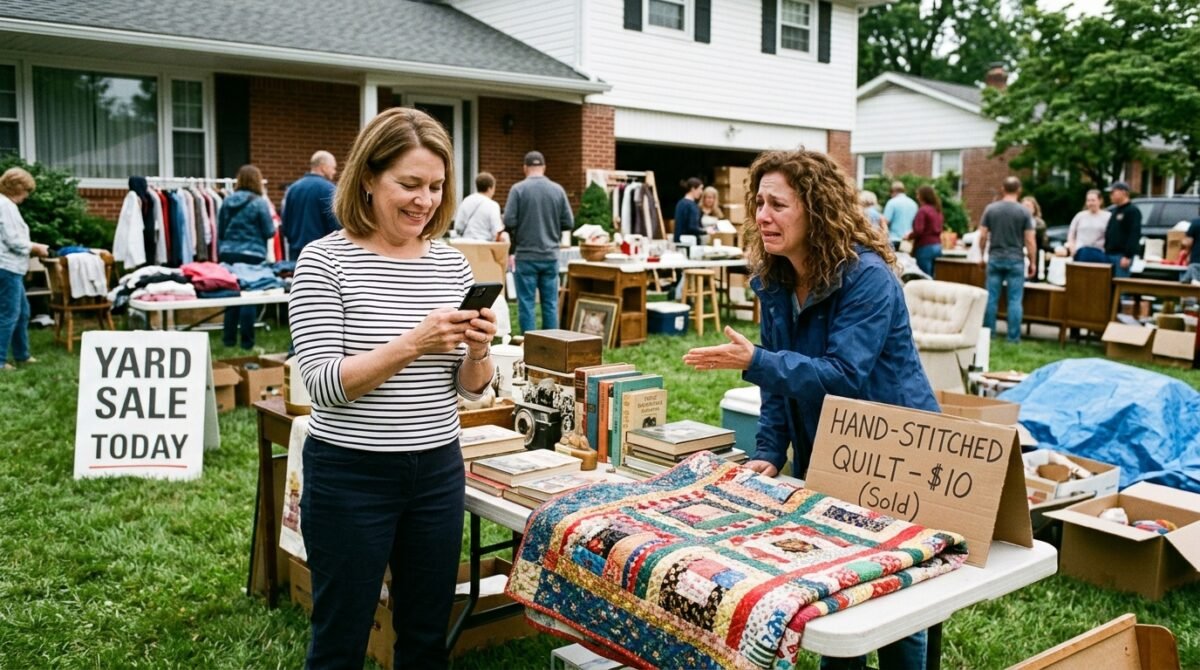
It was a Saturday morning, the kind characterized by the smell of cut grass and the distant hum of suburban lawn mowers. I was returning from a two-week business trip, exhausted and looking forward to nothing more than a nap. I decided to take a shortcut through a neighborhood street, unaware that this choice would lead me to the most gut-wrenching moment of my adult life. My heart stopped when I saw the familiar patchwork patterns fluttering in the wind.
I pulled my car over, my hands shaking so violently I nearly dropped my keys. As I stepped onto the pavement, the reality hit me. There, spread across a folding table, were pieces of my life. Old photos, a vintage clock, and finally, there it was: the quilt. It was listed with a handwritten sign that read ‘Vintage Blanket – $15’. I felt a cold surge of nausea replace the heat of my anger.
Jessica was perched nearby, looking like she hadn’t a care in the world. She was busy showing a stranger a pair of red-bottomed designer heels she had just ordered on her phone, boasting about the ‘steal’ she found online. I walked up to her, my voice barely a whisper, though it felt like a scream in the quiet cul-de-sac.
“Jessica, why is my grandmother’s quilt sitting on a folding table with a fifteen-dollar price tag on it?”
She didn’t even look up at first, her eyes fixed on the screen of her smartphone. When she finally turned to me, her face held that familiar look of practiced nonchalance, a mask she wore whenever she knew she had done something wrong but refused to take accountability.
“Oh, look who’s back early. You weren’t using it, and I needed some quick cash for these shoes. It was just gathering dust in your storage unit, wasn’t it? Don’t be so dramatic, it’s just fabric.”
The Digital Breadcrumbs of Greed

I didn’t argue with her there. I didn’t cause a scene, though every fiber of my being wanted to grab her by the collar and shake the arrogance out of her. I calmly paid the stranger who had just purchased the quilt—a kind woman who was confused by my sudden appearance—and took my property back. I drove home in a silence so profound it felt like a physical weight in the car.
Once I reached home, the real investigation began. I knew Jessica had used my storage unit key, but I needed proof of her intent. I logged into our shared family cloud account, a relic of a time when we were all ‘close.’ I found what I was looking for in the trash folder: a series of deleted messages between Jessica and her sister, mocking me for being ‘sentimental’ about ‘old trash.’
“She’ll never know. She’s been in Chicago for weeks. I’ll clear out the unit, sell the junk, and get those heels. She treats that quilt like a religious relic anyway—it’s annoying.”
— Leaked Message from Jessica’s Phone
The realization that this was premeditated changed everything. This wasn’t a mistake; it was a targeted effort to disrespect my boundaries and profit from my loss. I spent the next four hours documenting everything. I took screenshots, I pulled the lease agreement for my unit showing unauthorized access, and I drafted a list of the items she had taken.
My husband, who was still in the dark, walked in as I was printing out the final stack of evidence. He saw the look on my face—a look he had never seen before—and immediately knew that something irreparable had shifted in our world. I handed him the printouts without saying a word, watching the color drain from his face as he realized exactly what his sister had done.
The Sunday Dinner Confrontation
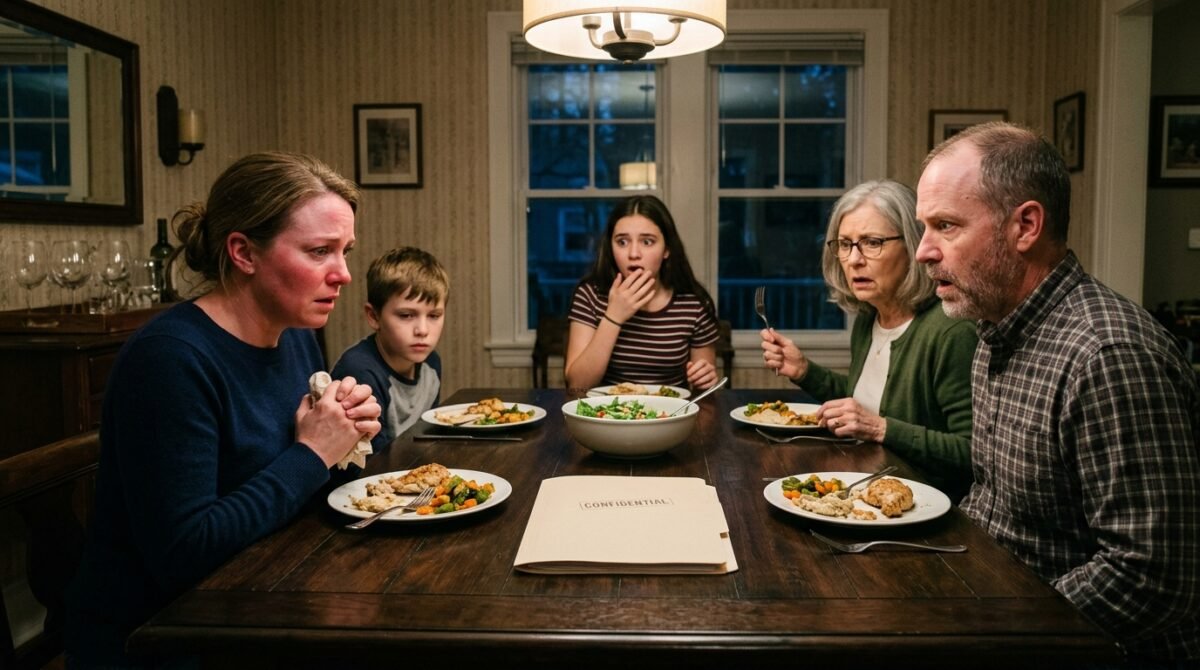
We didn’t wait long to confront her. The following Sunday, we showed up at my in-laws’ house for our weekly dinner. Jessica was there, looking perfectly polished, completely unaware that the ‘victim’ of her little yard sale heist had moved from grief to litigation. The table was set with the usual polite chatter, but I was vibrating with a cold, focused fury.
I waited until the main course was served before I spoke. I set a thick manila envelope on the table. The sound of it hitting the wood silenced the entire room. Jessica looked at the envelope, then at me, her smile faltering for the first time. She knew.
“Jessica, I hope those heels were worth it. Because you’re going to be paying for them for a long time. I have the logs of you breaking into my unit, the texts where you bragged about the theft, and the police report I filed yesterday.”
The silence that followed was absolute. My mother-in-law dropped her fork, the clatter echoing like a gunshot. Jessica turned pale, her bravado evaporating as she realized the consequences were no longer theoretical. She tried to stammer out a defense, claiming it was ‘all a big misunderstanding,’ but the evidence was too clear, too cold, and too damning.
The rest of the family sat in paralyzed horror as I laid out the timeline. My husband stood by me, his voice steady as he told his family that there would be no ‘sweeping this under the rug’ this time. He was done with her entitlement, and he was done with the family enabling her behavior under the guise of keeping the peace.
The Legal Ultimatum

The following week was a flurry of activity. I wasn’t just doing this to be vindictive; I was doing this to establish a boundary that she could never cross again. I consulted with a lawyer who specialized in property disputes. When he saw the evidence—the text messages, the photos of the stolen items, and the record of the storage unit breach—he told me we had a very strong case for conversion, trespassing, and emotional distress.
We sent a formal cease and desist, followed immediately by a civil suit. Jessica was served the papers at her workplace. She called my husband six times in one hour, leaving frantic, tearful voicemails about how this was ‘ruining her life’ and how she was ‘just trying to have a nice summer.’ She had no concept of the reality that she had committed a crime, not just a faux pas.
“You’re really going to take your own sister to court? Over a blanket? You’re acting like a psychopath. Just drop the suit and I’ll pay you back the fifteen dollars!”
— Voicemail from Jessica to my husband
The absurdity of her offer—to pay back the fifteen dollars—was almost comical. She still didn’t understand. To her, the item had a price. To me, it had a legacy. The legal process wasn’t about the money; it was about the principle that actions have consequences. I was prepared to spend every cent I had to ensure she understood the gravity of her betrayal.
The family began to fracture. Some members insisted that I was being ‘too harsh’ and that ‘blood is thicker than water.’ Others, however, were horrified by her actions and supported my decision to pursue legal action. The division was sharp, and it became clear who actually valued respect in our family and who simply enjoyed watching the drama unfold from a distance.
The Courtroom Realization

When we finally stood in front of the judge, the atmosphere was thick with tension. Jessica tried to play the victim, crying about her financial struggles and how she was just ‘cleaning up.’ But the judge was having none of it. Once the evidence of the text messages was presented, her defense fell apart. The judge pointed out that the value of the heirloom wasn’t just the fabric; it was the sentimental loss and the malicious intent behind the theft.
Jessica’s face turned from smug to defeated as the judge read the ruling. I wasn’t just awarded the value of the items—which were significant given their age and craftsmanship—but I was also awarded damages for the emotional distress and the violation of my property rights. The total amount was substantial, a figure that would definitely prevent her from buying any designer heels for the foreseeable future.
“This court does not look kindly on the violation of private property, especially when that property is clearly identified as a family heirloom. You acted with malice, and you will compensate the plaintiff for her loss.”
— Judge’s ruling in the final hearing
Walking out of the courtroom, I felt a strange sense of peace. The heavy, dark weight that had been sitting on my chest since I found the quilt at the yard sale was finally lifting. I didn’t hate Jessica; I simply recognized her for exactly what she was—someone who could never be trusted. The legal victory was the final period on a sentence I had been writing for months.
My husband held my hand as we walked to the car. He looked relieved, not just for the outcome, but for the fact that we had finally stood up for ourselves. The family drama didn’t end that day, but the power dynamic had shifted forever. Jessica was no longer the queen of the family; she was a cautionary tale.
The Internet Weighs In: Reddit’s Verdict

I posted my story on a popular forum just to see if I was truly the monster my sister-in-law claimed I was. The response was overwhelming. Within hours, the post had reached the top of the ‘Legal Advice’ and ‘Relationship Drama’ threads. Thousands of people weighed in, and for the most part, the consensus was clear: I was not the villain.
“This is the most satisfying ‘f*** around and find out’ story I’ve read all year. She stole a family heirloom to buy shoes. She deserves every single cent of that judgment. Don’t you dare drop that suit.”
— u/JusticeForHeirlooms (Top Comment, 32.4k upvotes)
Another commenter provided a more nuanced perspective on the family dynamic, which resonated with me deeply. It validated the feeling that I hadn’t destroyed the family; I had merely pointed out that it was already broken.
“People who call you the AH are just people who want to be able to do whatever they want to you without consequence. If she truly cared about family, she wouldn’t have sold your inheritance for personal luxury items. Keep the boundaries hard.”
— u/RationalObserver (15.2k upvotes)
Reading these comments felt like a collective hug from strangers. It confirmed that there is a standard of decency in this world, and when someone violates it, it is not only acceptable but necessary to hold them accountable. The support gave me the courage to continue enforcing the no-contact rule I had established with Jessica.
There were, of course, a few dissenters who argued that ‘money isn’t worth the family bond,’ but they were quickly drowned out by the chorus of people pointing out that Jessica was the one who severed the bond when she decided my grandmother’s legacy was worth less than a pair of designer heels.
The Aftermath: Rebuilding Boundaries

Life after the lawsuit hasn’t been without its challenges. The holidays are quieter, and family gatherings are fraught with unspoken tension. But it’s a better kind of silence—a respectful one. My mother-in-law eventually came around, realizing that my actions were the only way to stop Jessica’s downward spiral of entitlement. She actually apologized to me, acknowledging that she had spent years making excuses for her daughter’s behavior.
I have fully restored the quilt. I had a professional textile conservator fix the spots that were damaged by the sunlight and the improper storage during the ‘yard sale’ episode. It sits on my bed now, a symbol of resilience. It survived the greed of a family member, and it survived the indignity of being sold for pennies. It is stronger for it, and so am I.
My relationship with my husband has never been stronger. We learned that we are a team, and that our boundaries are our own to define. We don’t owe anyone access to our lives, our belongings, or our emotions if they don’t treat us with the respect we deserve. We learned the hard way that ‘family’ is not a blank check for abuse.
As for Jessica, I don’t know what she’s doing now. I hear she had to sell her car to pay off the judgment, and that she’s living in a smaller apartment. It’s not something I take pleasure in, but it is a consequence of her choices. She had the opportunity to apologize, to return the item, to show remorse. She chose the heels. She chose the money. She chose the ego.
Lessons in Materialism and Respect

The biggest lesson I learned from this entire ordeal is that material things carry the weight we give them, but the respect we show for someone else’s ‘weight’ defines our character. I have always been a person who cherishes items with history, and I realize now that I was surrounded by people who viewed objects only as tools for advancement or validation.
I have stopped trying to explain myself to people who benefit from my silence. If someone thinks I am ‘cold’ for suing my sister-in-law, that is a reflection of their own moral compass, not mine. I have become much more selective about the people I allow into my inner circle, and much more protective of my personal space and belongings.
I have also learned the importance of documentation. I never thought I would need to keep a ‘paper trail’ for my own family, but the world is not always as kind as we want it to be. Keeping records of my assets and my boundaries has become a form of self-care. It’s not about being paranoid; it’s about being prepared to protect what matters most.
Finally, I have learned that loss is not always permanent, but betrayal leaves a scar. The quilt is back, and it is beautiful, but the memory of the betrayal is still there. I’ve learned to live with the scar, to treat it as a reminder of my own strength. I stood up for myself, and I would do it again in a heartbeat.
The Silence of the Family Table

The family gatherings are perhaps the most jarring part of this new reality. When we do see my in-laws, there is an elephant in the room that no one dares to name. Jessica is never invited, and the subject of her current status is strictly off-limits. It creates an atmosphere of artificiality, but it’s a necessary trade-off for the peace we now enjoy.
My husband often reflects on how different things were before the quilt incident. We used to spend hours laughing, sharing stories, and ignoring the subtle jabs Jessica would make. We didn’t realize how much we were suppressing to keep the peace. Now, we are honest about our feelings, and we have found that the people who truly love us respect those boundaries, even if they find them ‘unconventional.’
There is a specific kind of freedom in no longer trying to manage other people’s perceptions of you. For years, I wanted to be seen as the ‘understanding’ daughter-in-law, the one who would overlook the petty slights and the passive-aggressive comments. The quilt sale shattered that persona, and I am grateful for it. Being the ‘difficult’ one is so much easier than being a doormat.
I often wonder if Jessica thinks about that day. Does she regret it? Does she look at those heels—if she even still has them—and feel the weight of what she gave up for them? Or is she still searching for the next thing to sell? I suspect the latter, but it’s no longer my problem. I have my quilt, I have my peace, and I have my integrity.
Moving Forward: The Final Chapter

Today, I am in a place of radical acceptance. I don’t harbor anger toward my former sister-in-law anymore, but I am also under no illusions about who she is. I’ve realized that forgiving someone doesn’t mean inviting them back into your life to hurt you again. Forgiveness is for me; boundaries are for her.
I have started a new tradition for my family. Every year on my grandmother’s birthday, I take out the quilt and we tell stories about her—not just about the items she left behind, but about the lessons she taught us. We talk about kindness, about patience, and about the importance of protecting the things that hold our memories. It is a way of reclaiming the legacy that Jessica tried to sell for a pair of shoes.
I am writing this story not just to vent, but to encourage others who are dealing with similar betrayals. If you are struggling with a family member who disrespects your boundaries and treats your possessions with contempt, know that you are not wrong for drawing a line. You are not wrong for expecting better. You are not wrong for protecting your peace, even if it costs you a relationship.
Thank you to everyone who supported me through this journey. Your words of encouragement were the light in the dark when I felt like I was losing everything. I am grateful for the outcome, and I am even more grateful for the person I have become because of it. I am no longer afraid to stand up for what is mine, and that, in the end, is the greatest inheritance of all.
Conclusion
The story of the ‘Sunbeam’ quilt is ultimately a story about the boundaries we draw and the value we place on the things that make us who we are. When my sister-in-law sold my grandmother’s memory for a fleeting fashion statement, she didn’t just sell a piece of fabric; she sold the trust of our family. The legal battle that followed was the crucible in which I learned that I am capable of standing my ground, even when it feels like the world is collapsing around me.
We all have our own ‘heirlooms’—the things that hold our history, our grief, and our joy. Protecting them is not an act of selfishness; it is an act of preservation. By holding Jessica accountable, I wasn’t just recovering a quilt; I was reclaiming my own agency. It is a lesson I will carry for the rest of my life: never let someone else decide the value of what you hold dear.
What about you? Have you ever had a family member disrespect a boundary so egregiously that you were forced to cut ties or take legal action? How did you navigate the fallout with your extended family? Let’s talk about it in the comments below. Your stories might be the exact encouragement someone else needs to stand up for their own peace.
What's your verdict on this dilemma?
Vote below to contribute to the official community consensus.

Have a Dilemma Keeping You Up at Night?
Share your real-life feud, wedding chaos, or relationship crossroads anonymously with our editorial team.
What do you think ?
0 Comments🛡️ Comments are moderated to protect community integrity. Your comment will appear once approved by the editorial team.