
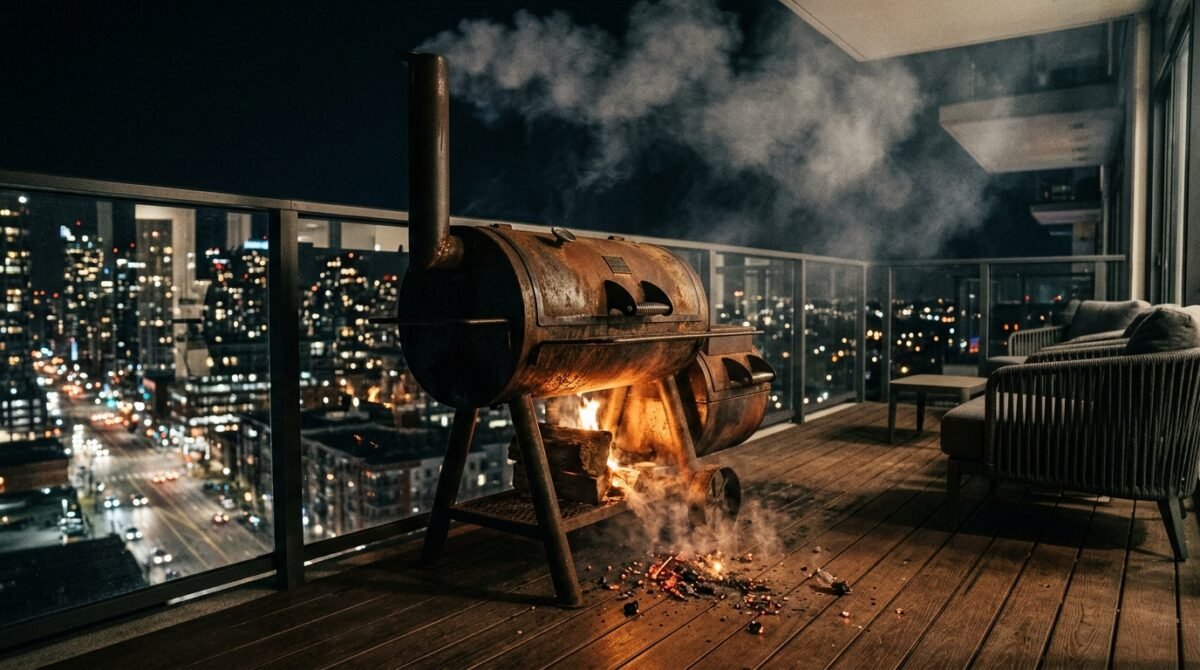
Living in a high-density apartment complex requires a certain level of social contract. You keep your music down, you don’t dump grease into the sink, and most importantly, you do not turn a third-floor, cedar-planked balcony into a commercial-grade barbecue pit. My former roommate, Mark, didn’t just ignore these unspoken rules; he seemed to believe they were merely suggestions designed for lesser men.
It started as a hobby. Mark had always been obsessed with slow-cooked brisket, but when he moved in with his ‘new purchase’—a massive, iron-cast industrial smoker that weighed nearly 300 pounds—I assumed it was for his backyard patio back home. Instead, he hauled it up two flights of stairs, dragging it across our pristine balcony decking, leaving deep, splintering gouges that would eventually cost us our entire security deposit.
The moral dilemma began the first time he fired it up. The smell of hickory smoke was initially pleasant, until it wasn’t. By the third weekend, my clothes smelled like a bonfire, our curtains were yellowing, and the downstairs neighbor, Mrs. Gable, was beating on our door with a fire extinguisher in her hand. This wasn’t just a culinary disagreement; it was a fundamental breach of safety and common sense.
When I finally told him it had to go, the entitlement I encountered was staggering. He looked at me with genuine confusion, as if I were the unreasonable one for wanting to sleep without breathing in aerosolized meat fat. The situation escalated from passive-aggressive notes to a full-blown legal impasse that would ultimately force me to file a lawsuit to recover the damages to my credit, my lease, and my sanity.
This is the story of how a brisket hobby became an expensive, litigious nightmare, and how one apartment complex’s fire code saved me from a catastrophic loss. Here is how it all unfolded, from the first spark to the final court summons.
The Arrival of the Iron Beast
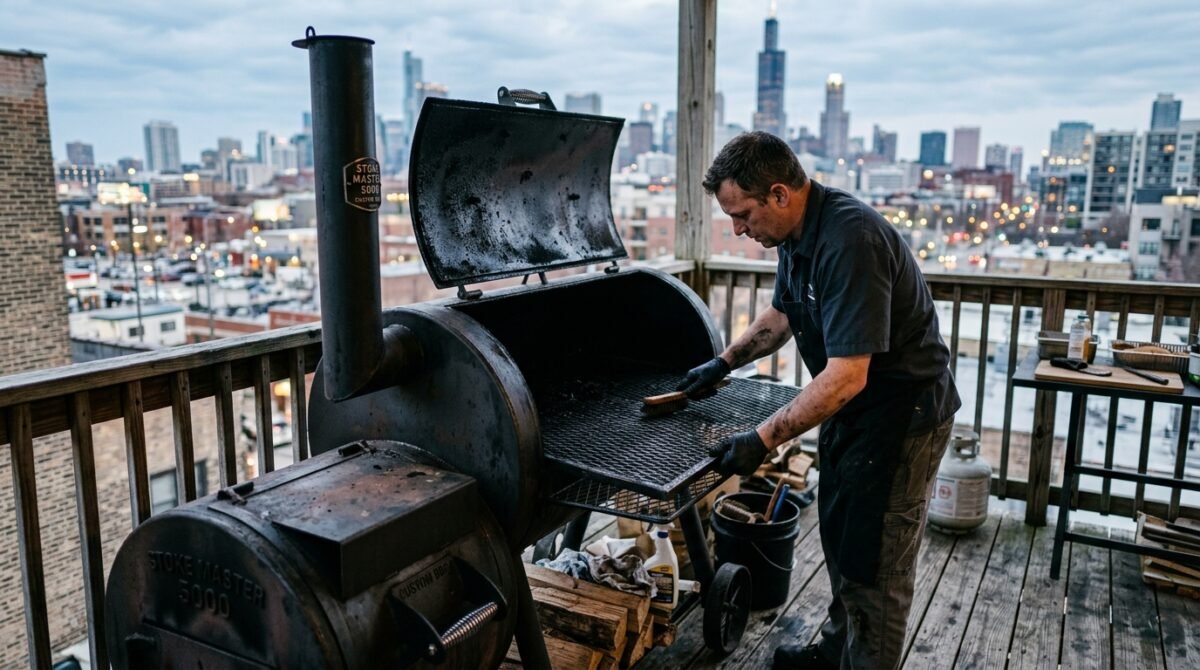
I still remember the sound of that metal monstrosity hitting the floorboards. It was a dull, heavy thud that reverberated through the entire living room. Mark had spent weeks talking about ‘authentic low-and-slow’ smoking, but I envisioned a small, portable unit. What he brought home was an industrial behemoth, rusted, soot-stained, and smelling of years of accumulated grease.
“Are you kidding me?” I asked, standing in the doorway with my hands on my hips. “We are on the third floor, Mark. That thing is going to fall through the deck or ignite the building. Have you even read the lease? There’s a specific clause about open-flame cooking equipment.”
Mark just laughed, wiping his brow with a grease-stained rag. “It’s a professional unit, man. It’s got a sealed firebox. It’s safer than a charcoal grill. You’re just being a buzzkill because you don’t know good barbecue. Once you taste my Texas-style brisket, you’ll be thanking me for the investment.”
He spent the next three hours maneuvering it into place, dragging it across the cedar planks. Every screech of metal against wood was like a dagger to my nerves. I knew then that we weren’t getting our deposit back. I didn’t know yet that we were courting a lawsuit.
The smell started almost immediately after he lit the first round of charcoal. It wasn’t just a hint of woodsmoke; it was a thick, cloying blanket of exhaust that clung to our patio furniture. Within forty-five minutes, the entire living room was filled with a faint, hazy blue smoke that made my eyes water.
“You’re really going to smoke meat in a building that’s eighty percent wood and pine? If you burn this place down, I’m not just leaving, I’m testifying against you.”
— Me, during our first confrontation
He didn’t listen. He just adjusted the dampers and told me to get a hobby of my own. That night, I started documenting everything—the gouges in the floor, the soot on the windows, and the temperature of the smoker’s exterior casing. It was the start of my paper trail.
The Friday Night Smoke Cloud
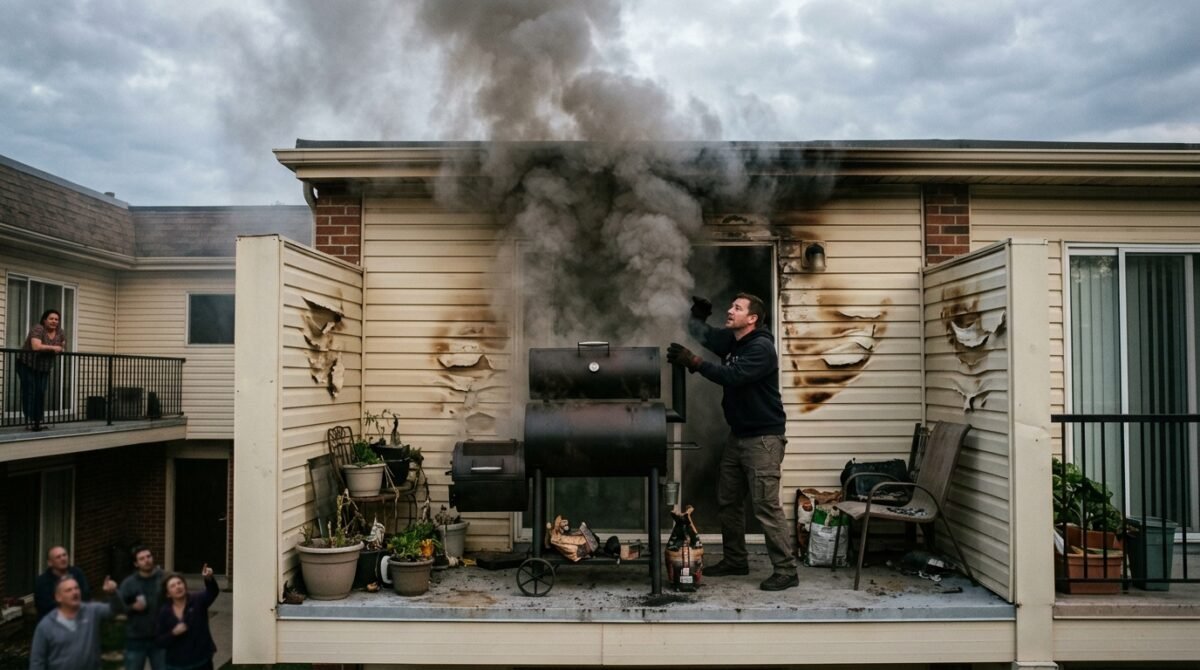
The escalation happened on a sweltering Friday in July. Mark decided he wanted to host a ‘neighborhood pop-up’ on our balcony. He invited five of his friends over, none of whom lived in the complex. They crowded onto the balcony, beer in hand, while the smoker poured thick, dark smoke directly into the open window of the apartment next door.
The air quality index in our living room was likely worse than a Beijing subway station. My curtains were starting to look like they’d been hanging in a chimney for a decade. I walked out to the balcony, feeling the heat radiating off the metal unit. It was so close to the railing that the vinyl siding of the building was actually starting to bubble and warp.
“Mark, look at the wall,” I said, pointing to the melted siding. “The heat is literally deforming the building. We are going to be evicted. We need to shut this thing down right now. Mrs. Gable from downstairs has called the management office twice already.”
Mark’s friends looked at me like I was a party crasher. One of them, a guy named Dave, chuckled. “Relax, dude. It’s just a little bit of heat. It’s a smoker, that’s what they do. You should try the brisket, it’s honestly life-changing.”
“I don’t care if it’s the best meat on the planet. The siding is melting, the floor is rotting from the grease, and the building manager is on his way. Shut it off.”
— My demand to Mark
I didn’t wait for him to comply. I went inside and called the complex manager, who was already on his way. By the time he arrived, the smoke was so thick you could barely see the parking lot. The look on the manager’s face was one of pure, unadulterated shock. He didn’t just ask us to move the smoker; he handed us a formal notice of lease violation, citing fire hazards and property damage.
The Eviction Notice and the $4,000 Bill
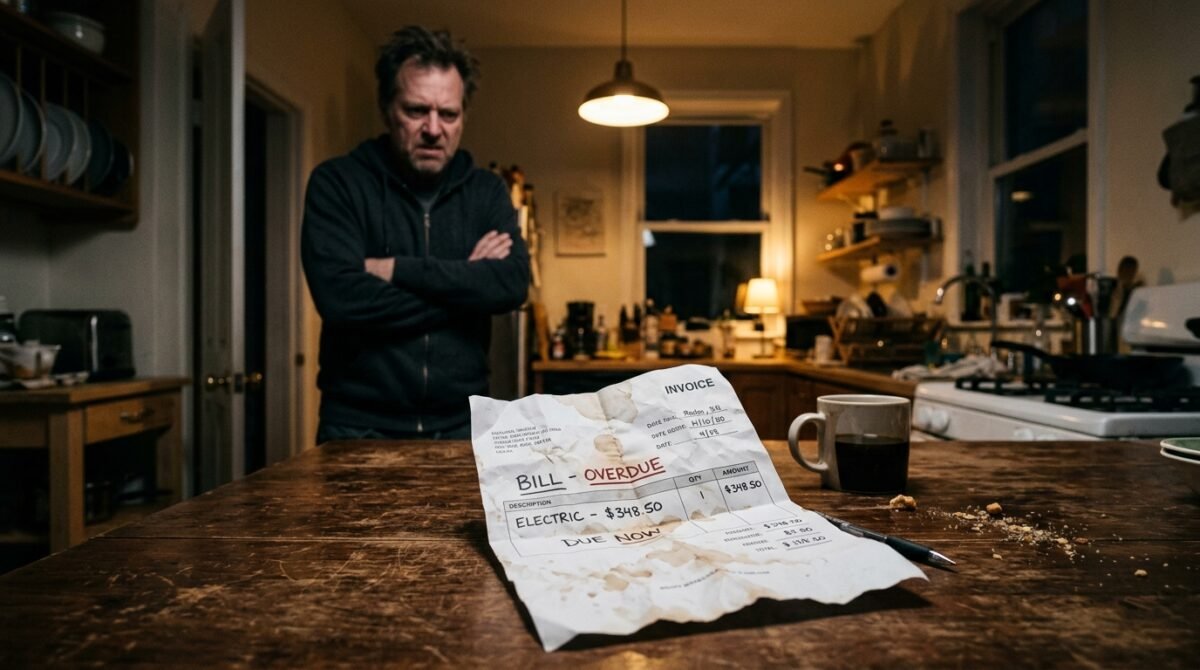
When the letter arrived on Monday, it was addressed to both of us. The total cost for damages—including the replacement of the warped siding, refinishing the balcony floor, and professional cleaning of the HVAC ducts because the smoke had been sucked into the building’s circulation—was $4,200. My portion, according to the lease, was half.
I sat Mark down at the kitchen table. I had the itemized bill laid out, along with a printout of our lease agreement, specifically highlighting the section on ‘Prohibited Fire Hazards.’ He stared at the total amount with a look of absolute disbelief, as if the apartment complex were running some kind of scam.
“Four thousand dollars? This is insane,” he muttered, picking up the paper and crumpling the edge. “They’re trying to rip us off. This is normal wear and tear. A little smoke damage isn’t worth this much. I’m not paying a cent of this. They can take it out of the security deposit.”
I took a deep breath, trying to keep my voice steady. “The security deposit was only two thousand, Mark. And it’s already gone because of the gouges you left in the wood. This is a bill for damages beyond the deposit. And since your name is on the lease and you’re the one who insisted on this, you are the one responsible.”
“I’m not paying for your hobby, Mark. If you want to smoke meat, buy a house with a yard. You destroyed our standing with the landlord, and you destroyed the balcony. Pay your half or I’m going to small claims.”
— My ultimatum to my roommate
He laughed in my face. He truly believed that because we were friends, I would just eat the cost. He didn’t realize that in my world, loyalty doesn’t include subsidizing someone else’s property destruction. I walked out of the room, leaving the bill on the table, and started calling a local attorney to see what my options were for a split-liability lease.
The Group Chat Betrayal
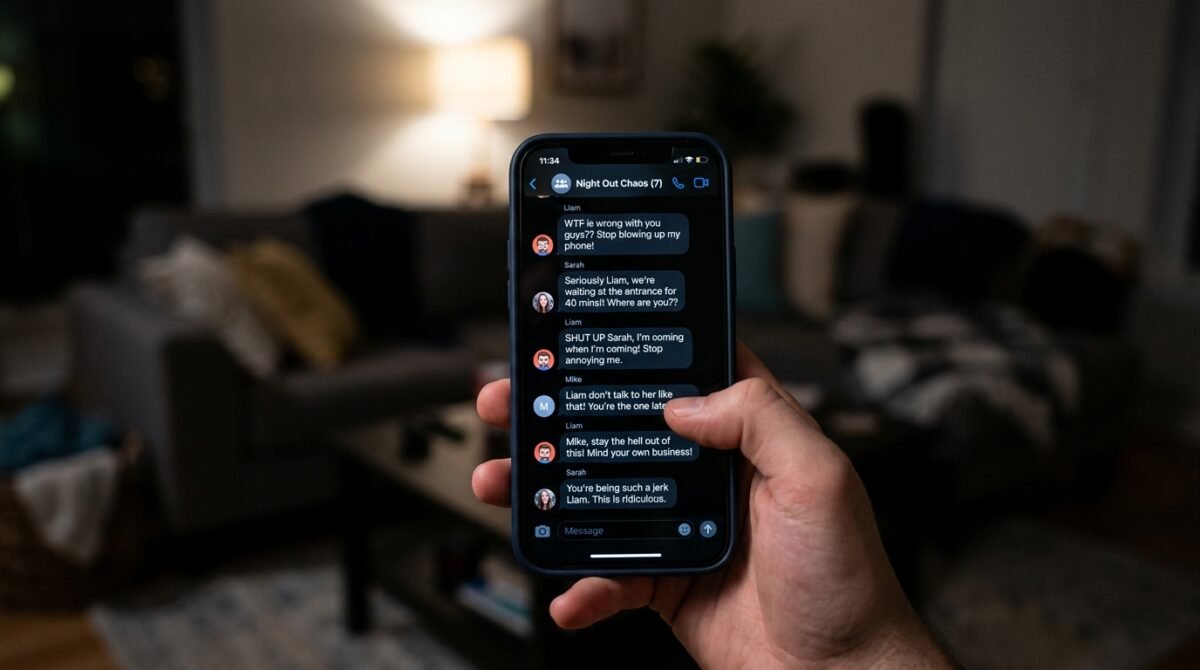
Things took a turn for the worst when Mark decided to take his grievance to our mutual friend group. He created a group chat titled ‘The Anti-Brisket Tyrant’ and invited everyone we knew. He painted himself as a victim of a ‘petty, uptight roommate who hates joy.’ He conveniently left out the melted siding and the $4,000 bill.
I only found out because Sarah, one of our mutual friends, sent me a screenshot. She was horrified by how he was spinning the story, making it sound like I had physically blocked him from cooking for a family party. The texts were filled with vitriol, calling me names and suggesting that I was ‘controlling’ and ‘suffocating.’
“He honestly thinks he can just destroy a building and I’ll pay for it because he’s ‘fun.’ The guy is a child. He’s going to get us evicted and think it’s my fault.”
— My reply to Sarah
I didn’t engage in the chat. I simply took screenshots of everything—every lie, every admission of guilt about the smoke, and every time he belittled the damage. These would be crucial evidence. The betrayal hurt, but it also made the decision to sue him infinitely easier. If he wanted to play dirty, I was ready to play by the rules of the court.
The group chat went on for three days. By the end of it, Mark had convinced himself that he was the hero of the story. He even posted photos of his ‘best’ brisket on Instagram, tagging our location, which was a brilliant move for my case. It proved he was intentionally using the unit for commercial-style volume in a residential setting.
I started preparing my evidence binder. I had the emails from the landlord, the photos of the damage, the estimate for repairs, and now, a digital trail of his own admission. I wasn’t just going to sue for the money; I was going to make sure he understood exactly what his ‘hobby’ had cost us.
The Legal Summons
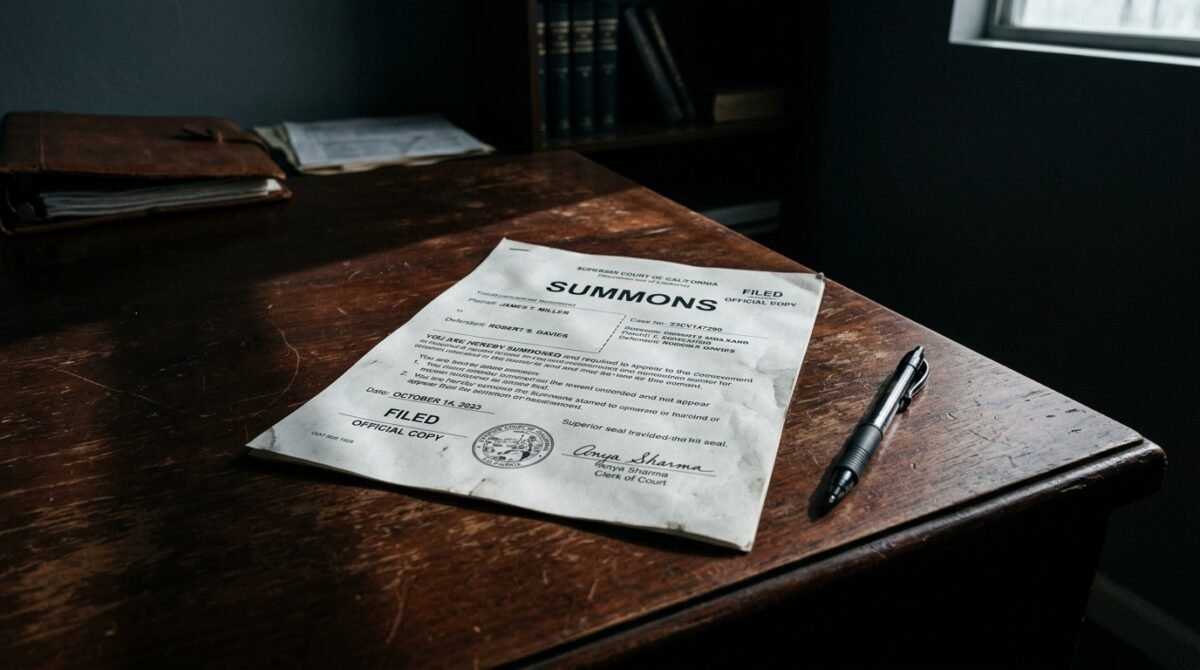
Serving someone with a lawsuit isn’t as dramatic as it is in the movies. I hired a process server who met Mark at his workplace. I watched from a distance as the man in the suit handed him the envelope. I saw the exact moment Mark realized what it was—his shoulders slumped, and he looked around, suddenly very small.
He called me within ten minutes. I let it go to voicemail. He left a string of messages, ranging from ‘Are you really doing this?’ to ‘You’re going to regret this, I have a lawyer,’ to finally, ‘Please, let’s talk.’ I didn’t return any of them. The time for talking had ended when he decided to lie to our friends and ignore the repair bills.
I spent the next two weeks meeting with a legal aid clinic to ensure my filing was airtight. I had the lease, the proof of damage, the correspondence with the landlord, and the receipts from the professional cleaning company I had already hired to mitigate the smoke damage to the rest of the unit. I was prepared to represent myself in small claims, but I wanted to be perfect.
“I just wanted to make some food for my friends. Why are you trying to ruin my life over a stupid grill?”
— Mark’s final voicemail before the court date
The irony of his question wasn’t lost on me. He thought the grill was the issue. He didn’t understand that the issue was his inability to respect boundaries or accept responsibility for his actions. It was never about the brisket; it was about the lack of maturity.
As the court date approached, the tension in the apartment was unbearable. We lived in silence, avoiding each other in the kitchen. I spent my evenings finalizing my timeline of events, making sure every date, cost, and incident was documented with precision. I was ready for this to end.
The Courtroom Confrontation
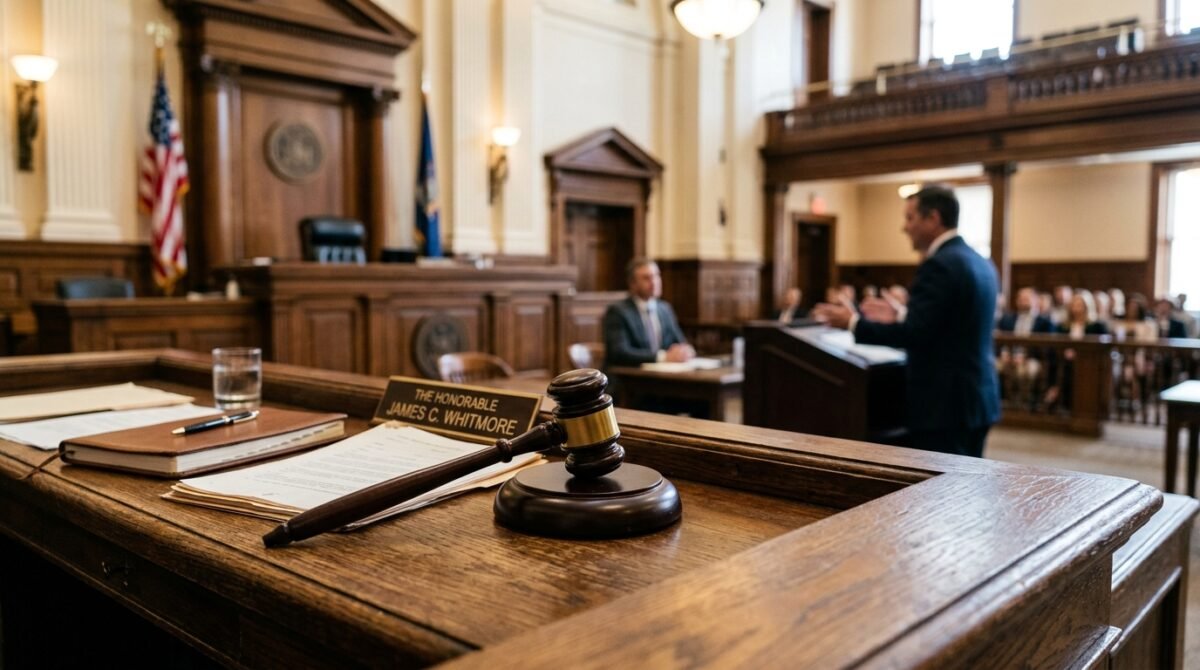
The courthouse was a sterile, intimidating place. Mark showed up wearing a suit that looked like he’d bought it specifically for the occasion, trying to look like the ‘responsible adult’ he clearly wasn’t. I kept my outfit professional but simple. When the judge called our case, I felt a strange sense of calm.
Mark’s defense was that he was ‘just using the balcony for its intended purpose,’ and that the damage was due to ‘poor building construction.’ The judge didn’t even blink. He looked at the photos of the melted siding and the gouges in the wood, then looked back at Mark.
“Mr. Miller, this is a third-story residential apartment, not a commercial BBQ kitchen. Did you or did you not sign a lease that prohibited open-flame cooking equipment?” the judge asked. Mark stumbled over his words, trying to explain the nuance of a ‘sealed firebox.’
“The lease was clear. The damage was caused by your equipment. You are liable for the repairs. I find in favor of the plaintiff for the full amount of the damages, including legal fees.”
— The judge’s ruling
I felt a rush of relief. It wasn’t about the money, really. It was about the validation. For months, I had been made to feel like the crazy one, the uptight roommate, the person who didn’t ‘get it.’ But the judge saw it. The system saw it. I had been right all along.
Mark looked devastated, not because he was broke, but because his narrative had been dismantled in front of the world. He tried to argue about the amount, but the judge cut him off. The case was closed. I had my judgment, and now the process of collecting began.
Reddit Weighs In

I decided to post my story on the ‘Am I The A**hole’ subreddit, just to see if the internet thought I’d gone too far. I laid out the timeline, the smoker, the melted siding, and the eventual lawsuit. The reaction was almost entirely unanimous.
“NTA. Your roommate sounds like a classic narcissist who thinks his hobbies are everyone’s responsibility. He endangered your housing and your security deposit. You were right to sue him. If he wants to live like he’s in the sticks, he should move to the sticks.”
— u/BarbecueTruth (Top Comment, 32.1k upvotes)
The comments were a mix of validation and horror stories. People shared their own experiences with nightmare roommates—the ones who leave dishes for weeks, the ones who bring home stray animals, and the ones who, like Mark, think their personal comfort overrides fire codes. It was strangely therapeutic to see that I wasn’t alone in this kind of struggle.
Some users, however, pointed out the legal risks. One user in particular, a landlord, mentioned that I was lucky the building management hadn’t just evicted us both immediately. ‘In many states, the landlord could have evicted both of you for lease violations. You saved your own record by taking action against him,’ they noted.
Reading the feedback helped me process the last few months. It confirmed that while the situation was extreme, my reaction was measured and justified. I realized that my desire to avoid conflict had actually been the thing that allowed the situation to spiral in the first place. I learned to draw lines sooner.
The thread became one of the most popular that week, with thousands of people debating the ethics of apartment living and the limits of friendship. It was a strange kind of fame, but it helped me realize that the drama I had lived through was a universal experience for many.
The Aftermath: Moving Out
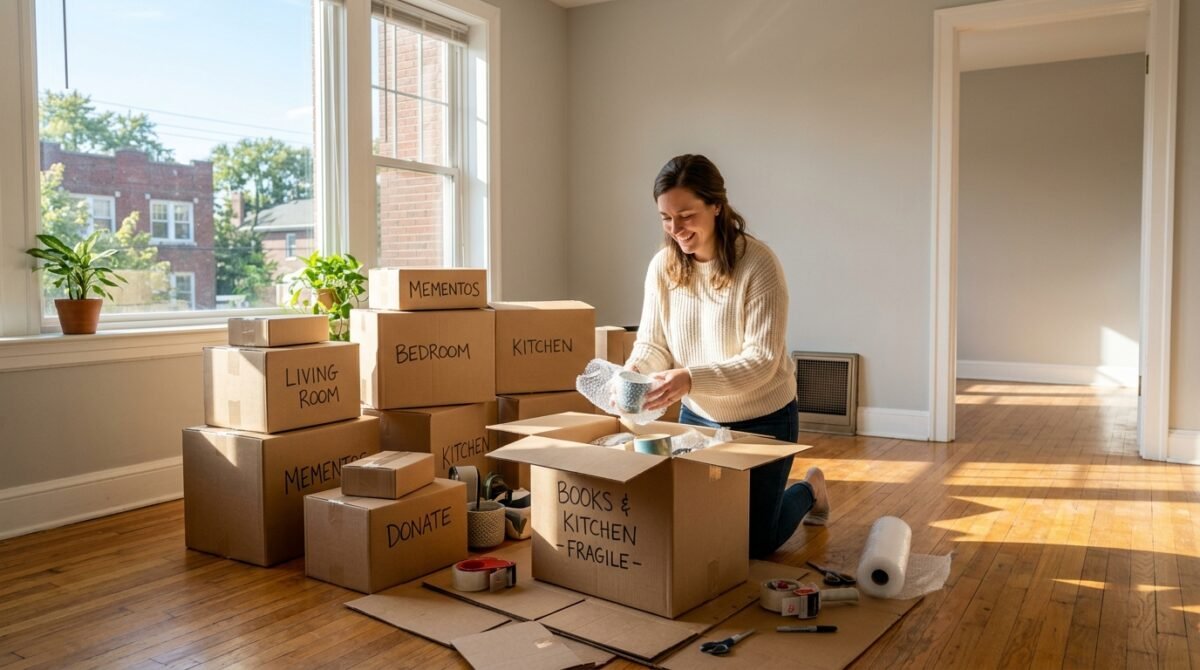
Moving out of the apartment was a bittersweet affair. I had loved that place, but it was now tainted by the memory of the smoke and the stress. I spent a week cleaning, trying to get the scent of hickory out of the baseboards. It was a reminder of why I had to leave.
Mark moved out two days before me. He didn’t say goodbye. He just loaded his truck, including that cursed smoker, and left. He still owed me the money from the judgment, which I eventually had to take to a collections agency to start garnishing his wages. It was a messy, long process, but it felt like the final step in closing that chapter.
I moved into a small, quiet place in the suburbs. There’s no balcony, and the lease is incredibly strict about grills. I’ve never been happier to follow rules in my life. The silence and the clean air are a luxury I no longer take for granted.
“Sometimes you have to burn a bridge to keep your own house from catching fire. You did the right thing.”
— My mother, after I told her about the move
I still talk to some of our mutual friends, but the group dynamic has changed. A few of them realized that Mark wasn’t the victim he claimed to be, and they’ve distanced themselves. It’s been a lesson in character. You learn who your real friends are when things get difficult.
I’m finally at peace. The smoker is gone, the legal battle is resolved, and I’ve regained my sense of security. I learned a lot about boundaries, about the importance of reading the fine print, and about standing up for myself, even when it’s uncomfortable.
Reflecting on the Smoke Damage

It’s been six months since the move. When I look back at the photos I took of the balcony, I still get a knot in my stomach. The damage was so extensive, and the potential for a fire was so high. I think about what might have happened if I hadn’t been there, or if I hadn’t pushed back when I did.
Living with someone else is a high-stakes gamble. You are essentially tying your credit, your reputation, and your physical safety to another person’s judgment. Mark was a good guy in many ways, but his lack of awareness was a fundamental flaw that made us incompatible as roommates.
I’ve developed a new system for vetting people. I ask questions about their habits, their previous roommate experiences, and how they handle conflict. It might seem a bit intense, but after what I’ve been through, I think a little bit of vetting is perfectly reasonable.
“The cost of a lesson is often the price of the damage caused. I paid for my lesson in stress and legal fees, but I gained a lifetime of boundary-setting skills.”
— My reflection on the experience
The money from the judgment is slowly coming in. Every time I get a small deposit in my account, it serves as a reminder that I didn’t let someone else walk all over me. It’s not just about the cash; it’s about the principle.
I hope Mark learned something, too. I hope he realizes that a hobby isn’t worth the cost of your integrity or the safety of your neighbors. But even if he hasn’t, I know that I have. And that’s what matters at the end of the day.
A Final Word for the Roommate-Bound

To anyone currently living in a nightmare roommate situation, my advice is simple: document everything. Do not rely on verbal agreements. When things go wrong, you need a paper trail. Emails, texts, photos, and receipts are your best friends in a dispute.
Don’t be afraid to involve your landlord if things become dangerous. Your lease is a legal contract, and you are not obligated to shoulder the consequences of someone else’s recklessness. If they refuse to take responsibility, don’t hesitate to pursue legal avenues.
It’s better to be the ‘uptight’ one who moves out and stays safe than the ‘chill’ one who ends up in court or, worse, dealing with the aftermath of a fire. Your home should be your sanctuary, and you have every right to protect it.
“Never let your desire to be ‘nice’ outweigh your need to be safe. Boundaries are not mean; they are necessary for survival in shared spaces.”
— My closing thought
Living with others is a test of character for everyone involved. If you find yourself in a situation where your boundaries are constantly being pushed, don’t wait for things to explode. Address it, set your limits, and if they aren’t respected, prepare to leave. You owe it to yourself to live in a space where you feel comfortable and secure.
Thank you for listening to my story. It wasn’t an easy year, but it was an important one. I’m moving forward, and I’m taking these lessons with me into whatever the future holds.
Conclusion
My experience with the industrial smoker incident has fundamentally changed how I view relationships and personal responsibilities. It wasn’t just about a piece of equipment; it was about the collision of two completely different approaches to life. One approach prioritized immediate gratification and ‘fun’ at any cost, while the other valued safety, integrity, and the shared rules that keep a community functioning. While the financial burden was heavy, the clarity I gained was worth the price.
I now understand that setting boundaries isn’t an act of aggression; it’s an act of self-preservation. When we allow others to disregard our comfort and safety, we aren’t being kind—we are being complicit in our own unhappiness. The lawsuit was the final, difficult step in reclaiming that power, and I feel a profound sense of relief that it is now behind me.
What about you? Have you ever had a roommate whose hobbies or habits pushed you to the brink? Have you ever had to draw a hard line that ended a friendship or a living arrangement? Let’s talk about it in the comments. Would you have taken the legal route, or would you have walked away and absorbed the cost to avoid the conflict? Your perspectives help make these stories a shared lesson for us all.
What's your verdict on this dilemma?
Vote below to contribute to the official community consensus.

Have a Dilemma Keeping You Up at Night?
Share your real-life feud, wedding chaos, or relationship crossroads anonymously with our editorial team.
What do you think ?
0 Comments🛡️ Comments are moderated to protect community integrity. Your comment will appear once approved by the editorial team.