
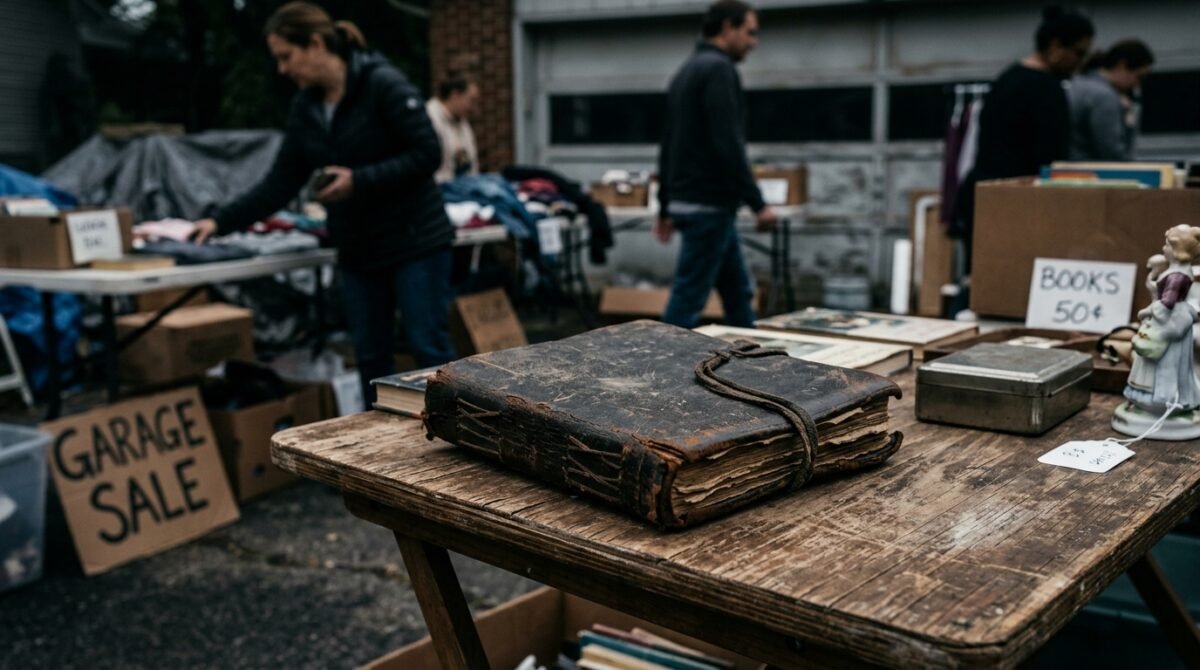
Grief is a strange, shapeless entity. For years, I kept my mother’s journals tucked away in a velvet-lined trunk, a fragile bridge to the woman I lost when I was only twelve. They weren’t just paper and ink; they were her voice, her fears, and her deepest secrets captured in cursive that I traced with my fingertips whenever the silence of my father’s house became too loud. My stepmother, Claire, always treated these items as clutter—mere obstacles in her quest to turn our home into a sterile, modern showroom.
The trouble began when my father, blinded by his own performative move toward a ‘fresh start,’ allowed Claire to ‘declutter’ the attic. I was away at university, trusting them to respect the boundaries of my personal property. I had explicitly labeled the trunk: Do Not Touch – Personal Property. But to Claire, a label was merely a suggestion, and my mother’s existence was a nuisance she was desperate to scrub from the floorboards.
It wasn’t until I arrived home for a long weekend that the floor fell out from under me. The attic was empty. The trunk was gone. When I confronted my father, his eyes darted toward the kitchen, where Claire was busy arranging artisan appetizers for a bridge club meeting. She didn’t even look up from her tray when she told me she had ‘cleared out the junk’ at the neighborhood-wide garage sale that morning.
Fifty cents. That was the price she had set for the soul of my mother. Fifty cents for the only record of the woman who taught me how to read, how to laugh, and how to survive the loss of a parent. As the realization hit me that my entire history had been sold to strangers for the price of a gumball, something cold and sharp crystallized in my chest. I didn’t scream. I didn’t cry. I pulled out my phone and started making calls, not to my family, but to the one person who could turn this from a family tragedy into a legal nightmare.
The Morning of the Great Liquidation
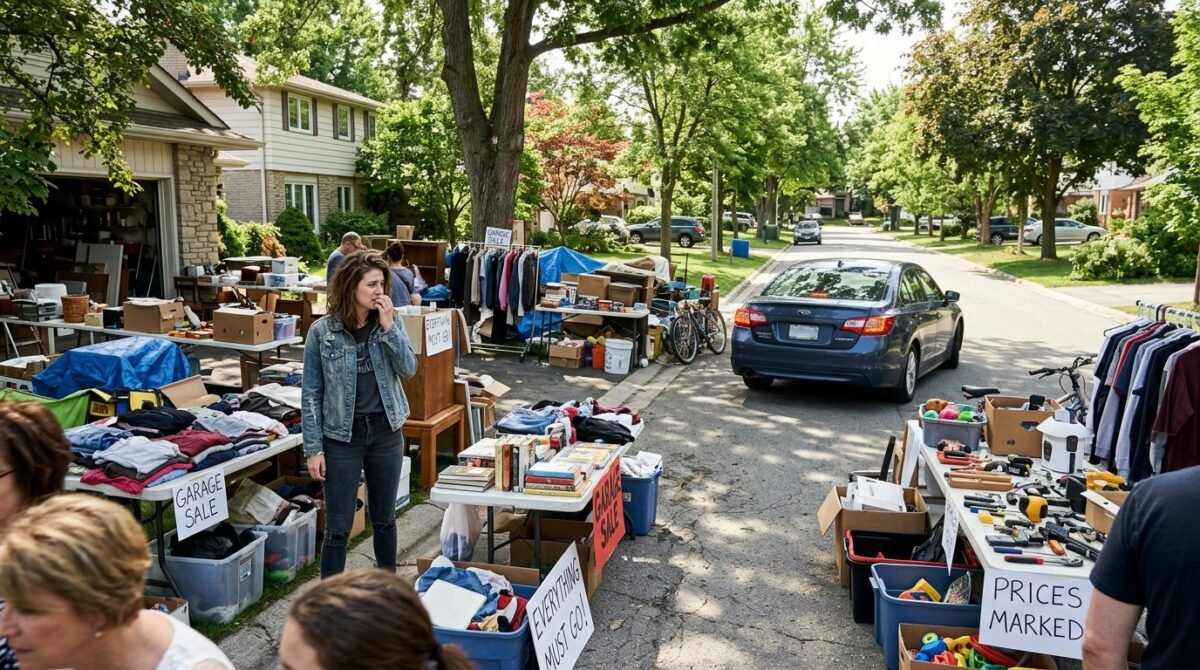
The driveway was cluttered with folding tables, mismatched lamps, and boxes of faded kitchenware. It was a typical suburban Saturday, the air smelling of cut grass and the desperate optimism of people trying to sell their trash to their neighbors. I walked up the driveway, my stomach churning as I recognized a familiar porcelain tea set—the one my mother had saved for my future wedding—sitting next to a stack of paperback novels.
I saw Claire standing near the makeshift checkout station, holding a stack of ones and fives, her face radiating the smug satisfaction of a woman who had successfully pruned her garden. She looked up and saw me, her smile faltering for only a fraction of a second before hardening into that familiar, condescending mask of ‘maturity.’ She thought I was there to help. She had no idea I was there to witness the arson of my own heritage.
“Oh, you’re up early. I’ve already moved a lot of the old stuff, honey. You should be happy; the house finally feels like it can breathe without all those dusty relics taking up space.”
— Claire, my stepmother
I scanned the tables frantically, ignoring her prattle about ‘minimalism.’ My eyes darted from discarded toys to rusted tools, looking for the telltale dark leather of the trunk. It wasn’t there. I grabbed a neighbor, a woman named Mrs. Gable who had lived next door since the nineties, and my voice shook as I pointed toward the driveway.
“Mrs. Gable, did you see a trunk? A wooden one with a brass latch? It held my mother’s journals.” She looked at me, her face pale, and gestured toward a young man walking away with a box of miscellaneous items. “Honey, she sold a whole lot of stuff to that fellow in the blue truck. Said it was all ‘estate clearance’ junk. She sold those books for fifty cents a pop, claimed they were just ‘old diaries’ she didn’t want to store anymore.”
The adrenaline that surged through my veins was toxic. I didn’t approach Claire. I walked back to my car, my hands gripping the steering wheel so hard my knuckles turned ivory white. I didn’t need to argue with her. She had committed a crime against my property, and while the law is often blind to sentimental value, it is very clear about the theft of private, labeled belongings.
The Phone Call That Toppled the House
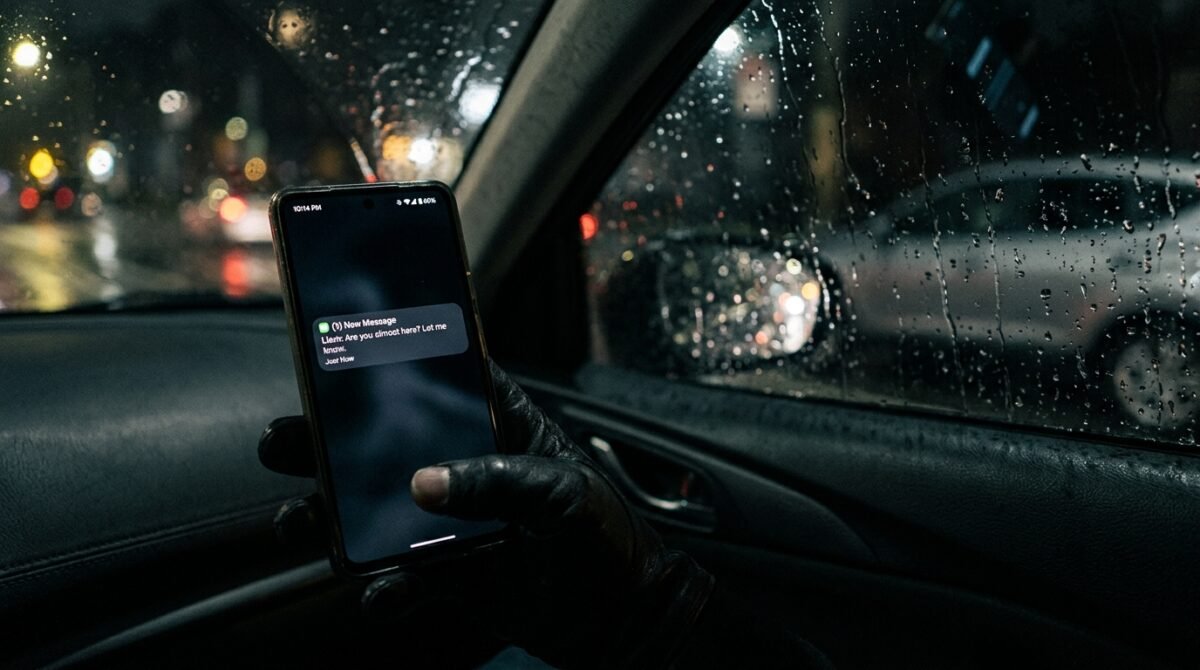
I drove three blocks before I pulled over, my phone in my lap. I knew the local ordinance codes—my mother had taught me that knowledge was the only armor worth wearing. Theft, even when disguised as a garage sale, requires the consent of the owner. Claire had never owned those books. She had merely been the curator of a house she didn’t fully belong to.
I called the local State Marshal’s office, not the police. I needed someone who dealt with civil disputes and property recovery, someone who would understand the weight of ‘malicious destruction of property’ and ‘unauthorized sale of goods.’ The voice on the other end was weary, but when I explained that the items were irreplaceable personal effects worth significant sentimental value, the officer’s tone shifted.
“If these items were clearly marked as personal property and you have documentation of ownership or your father’s initial agreement that they were your inheritance, you have a solid case for civil conversion, miss. You call them back and tell them the State Marshal is being alerted to a potential theft of private records.”
— Officer H. Miller, State Marshal’s Office
I sat there for a long time, listening to the hum of the engine. I realized then that I wasn’t just trying to recover the journals; I was trying to shatter the illusion that Claire had power over me. She had spent years dismantling my mother’s legacy, piece by piece, and I had let her. Today, that was ending.
I picked up my phone and opened the family group chat. It had been silent for months, the tension between my father and me a thick, invisible wall. I typed out a message that I knew would turn their perfect little brunch afternoon into a complete disaster. I didn’t care anymore. The war wasn’t coming; it was already here.
The Group Chat Explosion

The message hit the group chat like a grenade. I didn’t sugarcoat it. I didn’t plead. I stated facts, and I let the threat of legal consequences hang in the air like smoke. My father’s response was immediate and frantic, clearly typed while Claire was hovering over his shoulder. The panic was palpable, even through the tiny digital screen.
“I don’t know what you’re talking about, but you better delete that ridiculous threat right now. It was a garage sale, not a crime scene. Don’t humiliate us in front of the neighbors.”
— Dad, in the Family Group Chat
I replied with a screenshot of the law regarding civil conversion and a mention of the State Marshal’s inquiry. I also tagged Claire, knowing full well she would be reading over his shoulder. The response from my father was silence, but Claire couldn’t help herself. She started typing, and I could see the ‘…’ bubble bobbing for nearly five minutes before she finally sent a wall of text.
She tried to claim that the house was ‘joint property’ and that she had the right to dispose of ‘stored trash’ that hadn’t been touched in years. She called me ‘dramatic’ and ‘stuck in the past.’ She even had the audacity to suggest that my mother would have wanted her to ‘move on’ and ‘clear the space.’ It was the classic manipulator’s playbook: turn the victim into the villain, and claim benevolence for their cruelty.
The neighbors had started to gather, sensing the tension. I saw Mrs. Gable looking toward the house, her face curious. I didn’t mind. If they wanted a show, I was going to give them a lesson in accountability. I walked back to the house, my pace deliberate, my heart beating a steady, rhythmic cadence of impending justice.
The Confrontation in the Kitchen
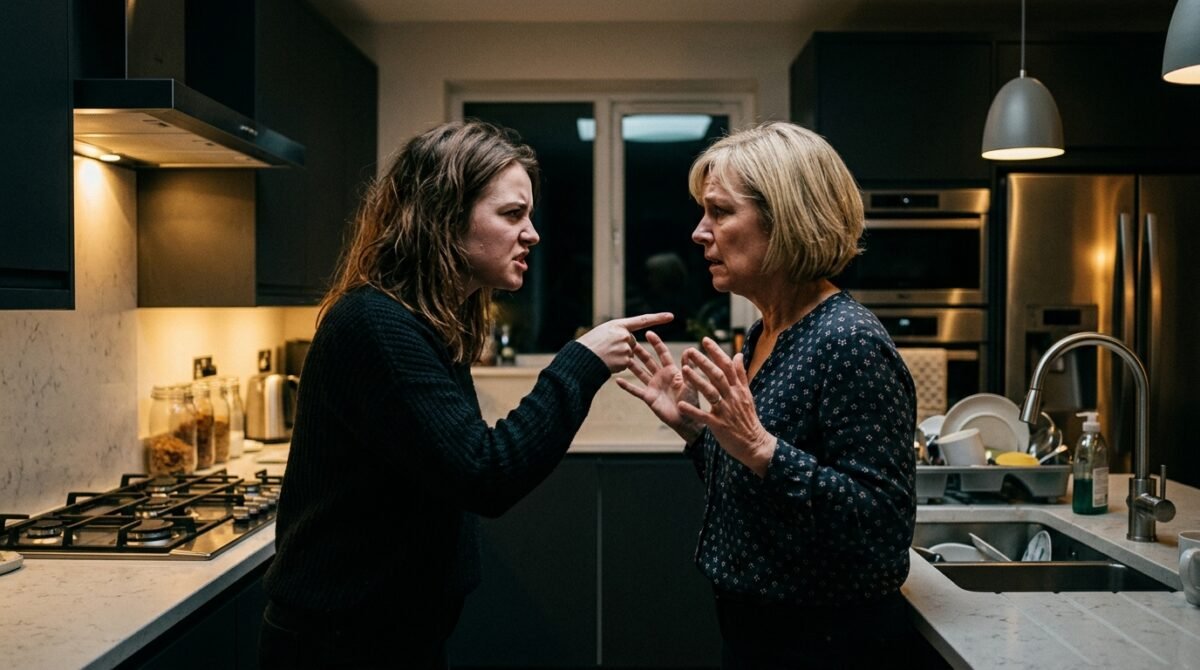
When I walked into the kitchen, the air was suffocating. My father looked like he had aged ten years in the last hour. He was sitting at the kitchen island, his hands trembling as he gripped a cold cup of coffee. Claire was standing by the sink, still wearing her ‘hostess’ apron, looking like a cornered animal trying to play the part of the refined lady.
“You called the Marshal?” she asked, her voice tight, a jagged edge of fear piercing through the faux-politeness. I didn’t answer her directly. I looked at my father. I looked at the man who had let this happen, who had stood by while his wife sold the only part of my mother that remained in this house. The betrayal wasn’t just the journals; it was the silence.
“I didn’t call the Marshal to talk, Claire. I called them to file a report for the theft of my private property. I hope you got your fifty cents, because it’s going to cost you a lot more to explain this to a judge when I sue for the replacement value of historical family heirlooms.”
— Me, facing down my stepmother
Claire let out a sharp, hysterical laugh. “Replacement value? They’re just paper! They’re just ramblings of a dead woman who didn’t know how to let go of her own neuroses! You’re acting like I committed a felony over some moldy scrapbooks.” My father winced at her words, but he didn’t stop her. He just looked down, his eyes hollow.
I stepped closer, invading the space she had tried to control. “Those ‘ramblings’ were my mother. They were the only thing I had left that wasn’t filtered through your jealousy. And now, you’re going to help me find them. You’re going to call every person who bought a box, and if you don’t recover them, you’re going to pay every penny of the emotional damages I’m entitled to under the law.”
The Neighborhood Scavenger Hunt

The rest of the day was a blur of humiliation for Claire. I forced her to walk door-to-door with me. I made her admit to our neighbors exactly what she had done. It was the ultimate leverage. She had spent years cultivating a reputation as the perfect, organized neighborhood mom, and I was going to dismantle it, one apology at a time.
We went to the house of the young man in the blue truck, a college student named Leo. He was shocked to see us. He had bought a box for five dollars, thinking it was just old junk. When I explained what was inside, his face fell. He reached into his closet and pulled out the trunk. It was scratched, the brass latch bent, but the journals were still inside. He hadn’t even opened them yet.
“I’m so sorry. I honestly just thought it was a cool vintage trunk for my apartment. I had no idea. Take it, please. I don’t want any part of this.”
— Leo, the neighbor who bought the trunk
I took the trunk, holding it like a life raft. I didn’t look at Claire. I looked at the contents, checking to ensure every volume was accounted for. She was standing behind me, looking at the ground, her face a mask of bitter resentment. She had been humiliated, forced to grovel before her neighbors, and stripped of her moral high ground in a single, brutal afternoon.
We walked back to the house in silence. The power dynamic had shifted irrevocably. She knew she couldn’t control me, and she knew she couldn’t silence me. My father, meanwhile, remained a specter in the background, a man who had chosen the path of least resistance and found himself at the bottom of a canyon.
The Aftermath and the Divide
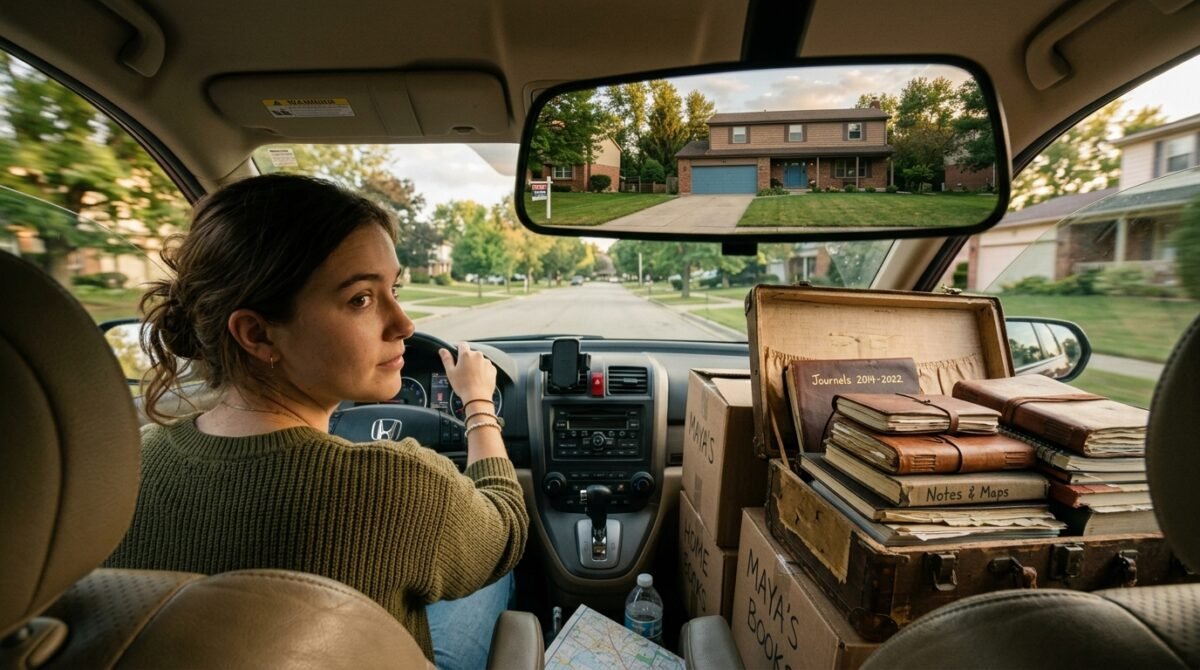
That night, I packed my things. I didn’t stay to talk. I didn’t stay to reconcile. I knew that my relationship with my father was damaged beyond repair. He had allowed this, and he had proven that my mother’s memory was less important to him than a conflict-free afternoon with his new wife. The betrayal was absolute, and the distance between us was now a chasm I had no intention of crossing.
I sat in my room, the journals spread out on the bed. I started reading, not because I was looking for answers, but because I needed to reconnect with the voice that had been so nearly silenced. My mother’s handwriting was steady, her thoughts clear and sharp. She wrote about her fears, her hopes for me, and her own struggles with my father. It was like reading a map of my own soul.
“I leave these pages for my daughter, so she knows that even when the world feels small and the people around her demand she be someone else, she is the author of her own story. Never let them edit you.”
— An excerpt from my mother’s journal
I realized then that the journals were never just about the past. They were about the future I was building for myself. I had been living in a house that didn’t love me, trying to please people who didn’t care about my history. That was over. I was leaving, and I was taking my mother’s voice with me.
As I walked out the front door, I didn’t look back. My father called out to me once, a weak, pathetic sound, but I didn’t turn around. I put the trunk in my car, started the engine, and drove away from the life I had been forced to outgrow.
Reddit Weighs In: The Verdict of the Masses

I posted the story on r/AmItheAsshole and r/LegalAdvice, expecting some blowback. I was surprised to find that the internet was overwhelmingly on my side. The thread blew up, with thousands of people sharing their own stories of step-parents who erased their legacies and the painful process of reclaiming what was rightfully theirs.
“This isn’t just about a garage sale. This is about the systematic erasure of your identity. You did the right thing by bringing the Marshal into it. Sometimes the only way to get through to people who lack empathy is to show them the legal consequences of their actions. NTA (Not The Asshole) a million times over.”
— u/JusticeForDaughter (Top Comment, 32.4k upvotes)
Another user noted the legal implications of what I had done, providing me with more ammunition for the future. The support was a tide that lifted me up, proving that my reaction wasn’t ‘over-the-top’ as Claire had claimed. It was a measured, necessary response to a profound violation of trust.
“Your father is the real villain here. He’s the one who promised to protect those memories. Claire is a secondary issue; your father is the primary failure. Cut them both off and don’t look back. You owe them nothing.”
— u/RealityCheck99 (Top Comment, 18.2k upvotes)
The community support helped me realize that the guilt I was feeling—the lingering sense that I had somehow destroyed my family—was a lie. I hadn’t destroyed the family; I had merely revealed it for what it was. The family had been broken long before I arrived at that garage sale.
The Legal Reality of Inheritance
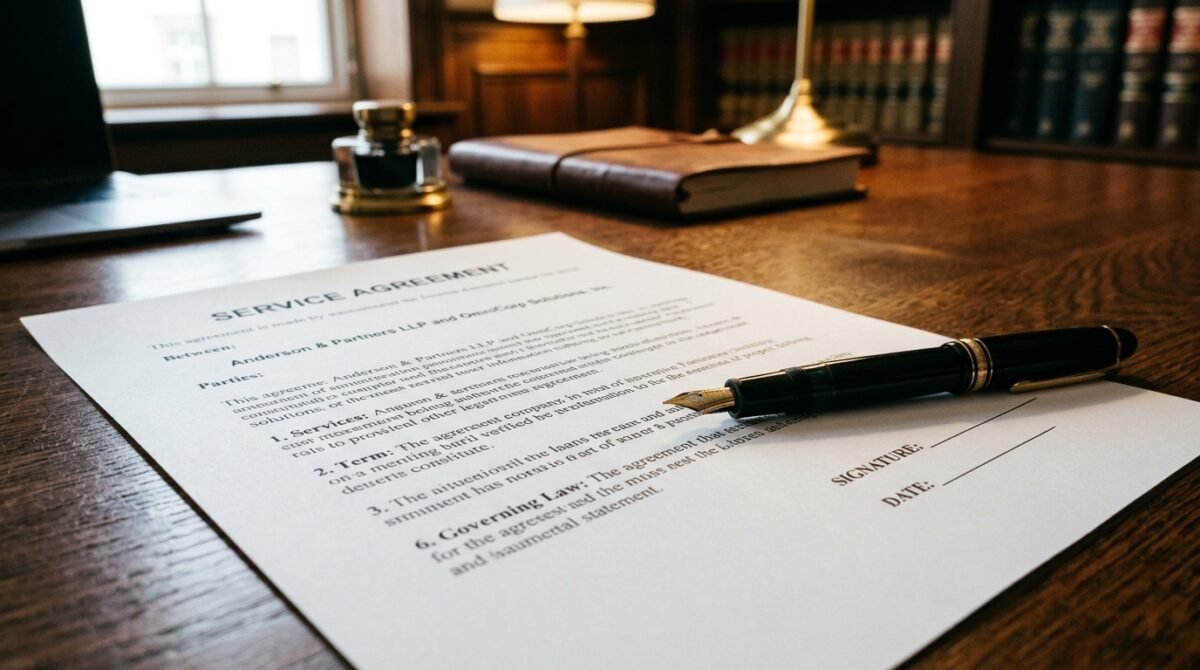
Weeks later, I consulted with an attorney to discuss the long-term implications of my father’s actions. While the journals were recovered, the emotional and psychological toll remained. We discussed the legal definition of ‘personal heirlooms’ and the potential for a civil suit against Claire for the intentional infliction of emotional distress. It wasn’t about the money; it was about the precedent.
The lawyer explained that because the items were clearly marked and the stepmother was aware of their significance, there was a strong case for damages. Even if the journals were worth nothing on the open market, their sentimental value was tied to my heritage. The law, as it turned out, was more protective of my history than my father had ever been.
“You have a claim here. It’s not just about the items; it’s about the violation of your boundaries and the intentional destruction of your property. We can proceed with a demand for damages and a formal request for an apology, or we can simply cut ties and ensure they never have access to your personal items again.”
— My Attorney
I chose the latter. I didn’t want their money. I wanted them out of my life. I sent a formal notice through my lawyer, explicitly stating that if any more of my property was touched, handled, or ‘liquidated,’ I would pursue the full extent of the law. The message was clear, and for the first time in years, the threat of their interference vanished.
Breaking the Generational Cycle

I spent the next year in therapy, unraveling the threads of my childhood and learning how to build a life on my own terms. I stopped trying to please my father. I stopped trying to explain myself to Claire. I focused on the journals, reading them until I knew every nuance of my mother’s thoughts. I was becoming the person she wanted me to be, regardless of the house I grew up in.
I started a new tradition, one that honored my mother’s memory without the suffocating weight of my father’s expectations. I donated a portion of my savings to a foundation for preserving personal histories, a way to ensure that other people’s memories wouldn’t end up on a folding table at a garage sale. It was my way of taking back the power that had been stolen from me.
“The hardest part of growing up is realizing that your parents are just people, and sometimes, they are the people who hurt you the most. Healing isn’t about forgiving them; it’s about outgrowing the hurt they caused.”
— My therapist
I am no longer the girl who looks for approval in my father’s eyes. I am the woman who protects her own history, who sets her own boundaries, and who knows that her voice is the only one that truly matters. The ordeal was a crucible, but I came out of it forged in fire, unyielding and finally free.
The Final Silence

I haven’t spoken to my father or Claire in over a year. There have been no birthday cards, no holiday invites, and no attempts at ‘reconciliation.’ It is a silence that I have cultivated, a space where I can finally breathe. My father occasionally sends emails, long, rambling apologies that never once mention the journals or the betrayal. They are ghost letters from a ghost of a man.
I don’t delete them. I archive them, keeping them as a reminder of why I left. They are evidence of a past that no longer controls me. I have built a life that is mine—a life where no one is allowed to touch my things, no one is allowed to tell me what is ‘junk,’ and no one is allowed to put a price tag on my memories.
“I miss you. Can’t we just move past this? It was just a mistake. Claire didn’t know what she was doing. Please, just come to dinner.”
— A recent email from my father
I read the words, and I feel nothing but a mild, distant pity. He still thinks the problem is the journals. He still thinks the problem is the garage sale. He doesn’t understand that the problem was him, and the way he abandoned his duty as a father for the comfort of a new life. And frankly, it’s not my job to teach him anymore.
Conclusion
Looking back, the fifty-cent price tag on my mother’s life was the cheapest price I ever paid for my own freedom. That garage sale was a disaster, a violation, and a heartbreak, but it was also the catalyst that forced me to wake up. I had been living in a state of suspended animation, waiting for permission to be myself, and that day, I took it by force.
If you find yourself in a similar situation—if you see your history being sold for parts, or your boundaries being treated like suggestions—do not wait for permission to act. You are the sole curator of your life, and your memories are not for sale. Protect what is yours, cut the ties that bind you to people who don’t respect your existence, and never apologize for choosing your own peace over the status quo.
What about you? Have you ever had to draw a hard line in the sand with family members who didn’t respect your boundaries, or did you ever have to fight for your inheritance or personal property? Share your experiences in the comments below. Let’s talk about the cost of standing up for ourselves.
What's your verdict on this dilemma?
Vote below to contribute to the official community consensus.

Have a Dilemma Keeping You Up at Night?
Share your real-life feud, wedding chaos, or relationship crossroads anonymously with our editorial team.
What do you think ?
0 Comments🛡️ Comments are moderated to protect community integrity. Your comment will appear once approved by the editorial team.